Aged Garlic Extract: Six Small Trials Slowed a Number on a Heart Scan. None Showed an Artery Unclogging.

“In randomized controlled trials, aged garlic extract was found to help reduce soft plaque rather than simply stabilize it.” That sentence is from the description of “Eat This Every Day to Unclog Your Arteries”, a 74-second video posted on 22 June 2026 by a chiropractor’s health-video channel whose descriptions advertise the creator’s own supplement line. It had 2,144,704 views when we read it on 10 October 2026 [1]. The same description calls the extract “one of the best foods to help clear out your arteries” [1].
Plenty of people are asking about it. In the United States, “aged garlic extract” is searched about 18,100 times a month (from a paid keyword database, pulled 10 October 2026), “aged garlic extract benefits” about 3,600 times a month (from a paid keyword database, pulled 10 October 2026), and “garlic for high blood pressure” about 2,400 times a month (from a paid keyword database, pulled 10 October 2026) [2]. Of the 18 ordinary results Google showed for the first of those, 16 were shops, by our count [2].
So we read the trials behind the sentence. Here is the short version; the rest of the page is the working.
The trials exist, and on a heart scan they lean the extract’s way. Six small ones, each lasting a year, found calcium building up more slowly in the heart’s arteries, or one kind of soft plaque shrinking, in people taking the extract compared with people taking a dummy [3].
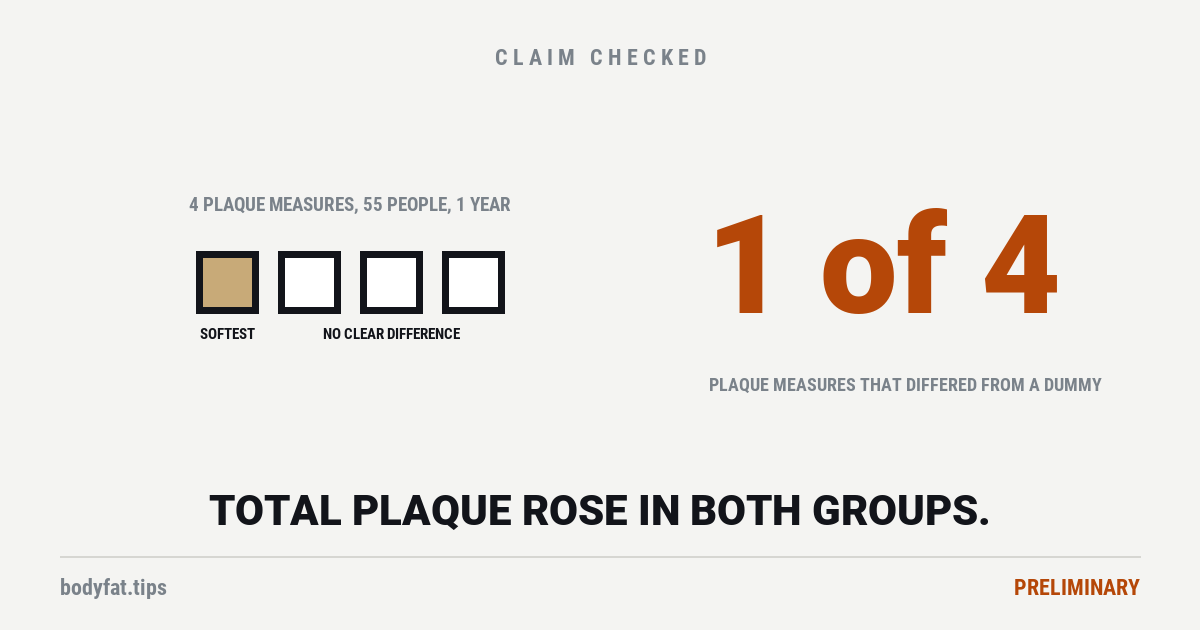
None of them showed an artery unclogging. In the two trials that measured all the plaque, the total rose in both groups, by less on the extract, a gap neither trial could tell from chance [4] [5]. In the calcium trials, calcium kept building in both groups; it built more slowly on the extract [6] [7] [8].
Most of the research comes from one lab and one company. Five of the six trials were run by one Los Angeles group, and at least five had money, capsules or a scientist from the extract’s maker [6] [7] [4] [5] [8]; we could not read the funding statement of the sixth [9].
The one long trial that counted heart deaths found no fewer. It gave a lower dose for seven years to prevent stomach cancer, and over 22 years about as many people died of heart and blood-vessel disease on garlic capsules as on dummy ones [10].
And it is not something you eat. Aged garlic extract is a supplement made by soaking garlic for up to 20 months; the advice to “eat this every day” points at a capsule [4] [11].
What is aged garlic extract?
It is garlic that has been sliced and soaked in a mix of water and alcohol for up to 20 months, then filtered and concentrated [4] [12]. It is sold as capsules and as a liquid. The plaque trials used capsules or the liquid, at doses from 250 mg to 2,400 mg of extract a day [3].
The soaking changes the garlic. Crush a raw clove and it releases allicin, the sharp compound behind the smell; in the aging process, allicin and garlic’s other volatile sulfur compounds are converted into more stable ones, among them S-allyl cysteine, the compound the products are standardised on [11]. A trial paper funded by the maker, with one of its employees as an author, describes the process as designed to eliminate “odor, toxicity, and hemorrhage-causing, oil-soluble, sulfur compounds” [12]. That answers a question people search for, whether the extract has allicin: the process is designed to turn the allicin into something else.
It also means that what is true of the extract is not automatically true of garlic, and the other way round. Keep that in mind when we get to “eat this every day”.
Does aged garlic extract reduce plaque? What the six trials found
First, the words. The coronary arteries are the ones that feed the heart muscle. Plaque is the fatty, scar-like build-up inside their walls that narrows them and can rupture. Two kinds of scan were used to watch it. A calcium score comes from a plain CT scan and counts the calcium in those arteries, which marks older, hardened plaque; the higher the score, the more of it there is [13]. CT angiography adds a dye so the scan can show the plaque itself, soft and hard, and sort it by how dense it looks [4].
Six trials have given people the extract or a dummy for a year and scanned them before and after. A 2023 review of every treatment tested in randomised trials against calcification of the heart and arteries in people without kidney disease, by kidney specialists in Melbourne with no funding, gathered all six [3].
| Trial | What people took | What the scan showed after a year |
|---|---|---|
| Los Angeles, 2004: 19 people at high risk, all on statins [6] | Liquid extract, 4 mL (1,200 mg) a day | Calcium score up 7.5% on the extract, 22.2% on dummy [6] |
| Los Angeles, 2009: 65 people at middling heart risk [9] | One capsule a day: 250 mg of extract plus B vitamins, folic acid and L-arginine | Calcium score up 6.8%, against 26.5% on dummy [3] |
| Los Angeles, 2012: 65 firefighters, 50 analysed [7] | One capsule a day: 1,200 mg of extract plus 120 mg of coenzyme Q10 | Calcium score up 32 points, against 58 on dummy [7] |
| Los Angeles, 2016: 55 people with metabolic syndrome [4] | 2,400 mg of extract a day | Softest plaque down 1.5 points, against up 0.2 on dummy; total plaque, all soft plaque and calcium did not differ [4] |
| Los Angeles, 2020: 66 people with type 2 diabetes [5] | 2,400 mg of extract a day | Softest plaque down slightly, against up on dummy, by an analysis chosen after the first ones were not significant; total plaque did not differ [5] |
| Southern Sweden, 2020: 93 analysed of 104 at raised heart risk [8] | 2,400 mg of extract a day | Calcium score up about 20% a year, against 28% on dummy [8] |
Read the right-hand column again and notice the verbs. In the calcium trials nothing went down. The calcium score climbed in both groups; it climbed more slowly on the extract [6] [7] [8]. In the Swedish trial, every patient’s score went up over the year, on the extract and on the dummy alike [8]. Only in the two CT angiography trials did anything shrink, and that is where the “soft plaque” sentence comes from.
“Reduce soft plaque rather than simply stabilize it”: the two trials behind the words
CT angiography sorts plaque by how dark it looks on the scan. The darkest, least dense kind is called low-attenuation plaque: fatty, soft, and the kind that has been linked to heart attacks in scan studies, which is why it matters [5]. It is one part of a larger category, noncalcified plaque, which is all the plaque without calcium in it [4]. When the video says “soft plaque”, the trials that measured it measured the darkest kind.
The first trial enrolled its patients in Los Angeles in 2012 and analysed 55 people with metabolic syndrome, a cluster of risk factors such as a large waist, raised blood pressure and raised blood sugar [4]. Half took 2,400 mg of the extract a day and half took a dummy, for about a year. The trial measured each kind of plaque as a share of the artery’s whole volume. On the extract, the share taken up by the softest plaque fell by 1.5 percentage points; on the dummy, it rose by 0.2 [4]. That gap was well on the “probably not chance” side of the line researchers use (p = 0.0049) [4].
Give the trial its due here: it was registered in a public database before it started. But not with this measure. In every version of its record up to September 2014, the main measure was “improvement of vascular function” on CT angiography; plaque on CT angiography was one of four secondary measures, and the softest plaque was not mentioned [14]. The main measure became plaque on CT angiography, defined as the softest plaque, in the version filed with the results in 2015, after the trial had finished [14]. The paper itself describes its aim as finding out whether the extract “reduces coronary plaque volume” [4]. So the softest-plaque result is one of several measures the trial reported, not the question it registered.
Now the other three numbers in the same trial. Total plaque: up 0.3 points on the extract, 1.6 on the dummy, a difference the trial could not tell from chance (p = 0.13). All noncalcified plaque, which is the broader meaning of “soft plaque”: up 0.2 against 1.4 (p = 0.14). Calcium: up 0.2 in both groups (p = 0.99) [4]. So one measure in four separated from the dummy. And the paper reports that at the start the extract group had more of the softest plaque, while the dummy group had more plaque overall and more calcium [4].
Then the press office got hold of it. The research institute’s release in January 2016 said the extract “can reverse the buildup of deadly plaque in arteries”, and that the people who took it “slowed total plaque accumulation by 80%” [15]. Where does 80% come from? Take the two total-plaque figures above, a rise of 0.3 on the extract and 1.6 on the dummy: 0.3 is about a fifth of 1.6, so the extract group’s rise was about 80% smaller, by our arithmetic. It is a ratio of two numbers the trial itself could not tell apart [4] [15].
The second trial enrolled 80 people with type 2 diabetes in 2016 and 2017, of whom 66 finished: 37 on 2,400 mg of the extract a day and 29 on dummy pills [5]. The softest plaque, measured against the length of artery scanned, fell slightly on the extract and rose on the dummy: a median, the middle value, of −0.2 against +2.5. The paper also puts it as a 29% fall against a 57% rise [5]. Total plaque, and the two denser kinds of noncalcified plaque, did not differ between the groups [5].
How the trial reached that result is in its own methods section. It first compared the groups with standard statistical models, including one adjusted for other differences between patients. Then: “As none of these modeling techniques were significant, we thus chose to focus on the simple progression of LAP in the placebo group and regression in the active group” [5]. The test it chose instead came in at p = 0.0415, just on the “probably not chance” side of the line [5]. A result found by a test picked after the first tests came up empty is a lead, not a finding. The trial was registered in April 2019, about eleven months after it finished [16]. By then its result was already public. In March 2019 the team presented the trial at a cardiology meeting, in an abstract that counts 69 patients, splits them 36 on the extract and 32 on dummy pills (68, by our arithmetic), and reports the softest plaque changing by −4.66 against +13.39 (p = 0.045) [38]. So the registry record that names the softest plaque as the main measure was filed after the result had been presented. The 2020 paper reports other figures and does not mention the abstract [5].
One more thing about both trials: the number of people enrolled in the paper differs from the trial’s own registry record. The 2016 paper says 72 were enrolled; its registry says 65 started [4] [14]. The 2020 paper says 80; its registry says 88 [5] [16]. Neither paper explains the difference.
Those are the two trials. The video’s description names no study, and we found no other trial of the extract that measured soft plaque directly [17].
Who paid for the plaque trials?
Here is what each paper says, or what we could find.
The 2004 pilot lists among its authors a scientist who, in papers from 2001 and 2006, gives the extract maker’s research and development department as his employer [6] [18] [12]. The lab’s lead cardiologist, writing up the same trial in 2006, disclosed research grants from the maker and an honorarium for co-chairing a garlic symposium the maker helped support [13]. The 2009 trial’s own funding statement we could not read [9]. The 2012 firefighter trial was “supported by a grant from” the maker to its senior author, the same lead cardiologist [7]. The 2016 soft-plaque trial was funded by the maker, which supplied the extract, and appeared in a journal supplement from a 2014 garlic symposium that supplement companies, the maker among them, supported [4]. The 2020 diabetes trial says plainly, “This study was funded by” the maker [5]. The Swedish trial was paid for by two Swedish hospital research foundations and by a research grant from the maker to its senior author, and the maker supplied the capsules and the dummies free [8].
Industry money does not make a result wrong. It is why the independent reading matters, and there is one. The 2023 review in Melbourne, which had no funding, judged the six trials at moderate risk of bias, giving as its reasons people dropping out, industry involvement and incomplete reporting, and noted that they were small and short [3]. It still called the extract the most promising of the treatments it looked at [3]. Both of those things are true at once.
And the summary that most searchers see first? Google’s AI answer for “aged garlic extract” says research shows it “can help reduce low-attenuation plaque”, and two of the sources it cites for that are the maker-funded diabetes trial and a 2025 review written by three of the maker’s own scientists [2] [5] [19]. That review declares “no competing interests” [19].
The one long trial that counted heart deaths
Calcium scores and plaque shares are surrogates: measurements that stand in for the thing you actually care about, which is heart attacks and deaths. A surrogate can move without the real thing moving. The 2023 review makes the point with a drug: statins, which reduce heart attacks and other cardiovascular events, do not reduce calcification in the heart’s arteries and can increase it [3]. So a slower-rising calcium score is not the same thing as a safer heart.
We found one randomised trial of a supplement containing the aged extract that counted deaths from heart disease, and it was not designed to [10] [17]. In 1995, in a rural county in China’s Shandong province with very high rates of stomach cancer, 3,365 adults were assigned by chance to garlic capsules or dummy capsules, among other treatments [10]. The garlic arm took two capsules twice a day, each holding 200 mg of the aged extract and 1 mg of steam-distilled garlic oil, for 7.3 years; that is 800 mg of extract a day, by our arithmetic [10]. Then the researchers kept counting, for 22 years.
Deaths from heart and blood-vessel disease: 157 of the 1,666 people given garlic, and 152 of the 1,678 given dummy capsules [10]. The range the true answer probably sits in runs from about 17% fewer such deaths on garlic to about 30% more, which takes in no difference at all [10]. The trial was paid for by the US National Cancer Institute and Chinese research programmes; the extract’s maker supplied the capsules [10].
It is not a clean test of the claim. The dose was a third of the plaque trials’ 2,400 mg, garlic oil was added, the people came from a region chosen for its stomach-cancer risk rather than for their hearts, and heart deaths were a secondary count, not the trial’s main question [10]. Its stomach-cancer results are a different question, not rated here. But it is the only count of heart deaths in a randomised trial of the extract that we found, and it showed no difference [10] [17].
If the scans keep improving, why has nobody shown fewer heart attacks?
This section is the desk’s own reasoning, and it is labelled as such. Six trials lean the extract’s way on a scan; the one long trial that counted heart deaths saw none fewer. Here are three answers to the gap between those two facts, each rated.
Answer one: nobody has run the trial that would show it. The plaque trials enrolled 23 to 104 people for a year each [3]. The only trial we found that counted heart deaths enrolled 3,365 people and followed them for 22 years [10]. The maker’s own scientists wrote in 2025 that the extract had been evaluated for up to a year and that large, long trials with clinical outcomes are needed [19]. This one is measured: the sizes and lengths are what the trials report.
Answer two: a number on a scan can move without much changing in the artery. It may have happened three ways here. In the Swedish trial, the extract group started with a calcium score of 207 on average, against 121 for the dummy group [8]. A rise of 40 points is about 19% of 207 and 33% of 121, by our arithmetic, so a group that starts higher can look slower in percentage terms for the same growth. The authors acknowledge that the measure depends heavily on the starting score, and the list of things their analysis adjusted for does not include it [8]. But this one may cut the other way. The paper’s limitations section says it defined calcium progression as the absolute change, the rise in points; the percentage arithmetic above does not apply to that measure, and on it a group that starts higher could look worse, not better. The paper reports its yearly rises as percentages and does not say which measure its main test, the one that favoured the extract, used [8]. In the 2016 trial, the extract group started with more of the very plaque that then fell, and a group that starts high has further to fall [4]. And in each CT trial only the softest-plaque measure separated from the dummy, out of four in one and five in the other, and in the second only by a test chosen after the first ones were not significant; in the first, the softest plaque became the registered main measure only when the results were filed, after the trial had finished [4] [5] [14]. Each of these is measured, in the papers’ and registry records’ own words. That they explain the results is a surmise.
Answer three: the extract may do a little, and the trials may be catching it. Garlic supplements lower blood pressure by a few points and LDL cholesterol by a few mg/dL in pooled trials, both covered below [20] [21]. If those small drops are real, they point the same way the scans do. Six small trials leaned that way too, and an unfunded review called the extract the most promising of the treatments it assessed [3]. This is a possibility the evidence leaves open, not something it shows.
Put the three together and here is what we think is true, stated plainly so you can disagree with it: aged garlic extract has changed pictures of arteries in small trials its maker paid for, and has never been shown to change what happens to the people in them.
What we could not find, and would like to. A trial run without the maker’s money, registered before it starts, of a few hundred people taking 2,400 mg a day or dummy capsules for two years or more, scanning total plaque by CT angiography and counting heart attacks along the way. We found no such trial, published or registered on ClinicalTrials.gov [17]. If you know of one, the corrections line on this site is open.
Does aged garlic extract lower blood pressure?
A little, and this is the best-supported thing on the page. Two terms first: systolic pressure is the top number, the pressure while the heart is pushing, and it is measured in mmHg, millimetres of mercury, the scale blood pressure has always used.
A 2020 review of 12 trials in 553 people with high blood pressure found that garlic supplements lowered the top number by 8.3 mmHg on average [11]. Its author ran four of those trials, all of the aged extract; the other eight used garlic powder [11]. Other teams’ poolings mostly found less. A 2025 review of 10 trials in people with high blood pressure, paid for by Chinese science grants, found 4.2 mmHg and concluded the overall impact “may be limited” [20]. A 2026 pooling of 108 trials of garlic in every form found 3.7 [21]. A 2025 pooling of 19 trials of aged garlic preparations found 2.5 off the top number and no clear change in the bottom one [22]. And the Cochrane review, an independent pooling of trials in people with high blood pressure, found only two trials and 87 people in 2012, with drops of about 10 to 12 points whose ranges were too wide to pin down, and no trial that counted heart attacks or deaths [23].
Who paid? Of the four aged-extract trials in the 2020 review, two say the maker funded them and supplied the capsules [24] [25], one was paid for by a hospital research grant with capsules from a company that sells the extract in Australia [26], and the fourth we read only as its summary [27]. The review itself was presented at a 2019 garlic symposium the maker supported, and the maker paid its author’s travel [11].
Two more things a reader searching this will run into. A 2024 pooling of aged-extract trials in people with high blood pressure was retracted by its journal in 2026; we have not used its figures [28]. And a university trial that measured blood pressure around the clock for 24 hours rather than at a clinic visit, with the maker listed as a collaborator, finished in July 2018; its registry record shows no results, and we found no publication of it [29] [17].
How does that sit next to the site’s blood-pressure verdict? That page did not weigh garlic, and these figures do not change it: they come from different poolings of different people and are not rows in its table. The site’s beetroot juice verdict is the nearest comparison, a supplement with a few points off resting pressure in short trials. Rated alone: that garlic supplements, the aged extract among them, lower the top number by a few points, mostly in people whose pressure is high, is Supported. That they replace a prescription is not something any trial here tested.
Does aged garlic extract lower cholesterol?
Barely, if at all. LDL cholesterol is the kind carried in the particles that build plaque, the one people call bad cholesterol. The most direct test of garlic and LDL we read was a six-month Stanford trial in 192 adults with moderately high LDL, paid for by the US National Institutes of Health [30]. It gave raw garlic, a garlic powder supplement, the aged extract or dummy pills, each at about a clove’s worth six days a week. LDL rose 0.2 mg/dL on the extract and fell 3.9 on the dummy; none of the garlic forms made a difference [30].
Poolings find a little. Across 19 trials of aged garlic, LDL came out 4.4 mg/dL lower, and total cholesterol did not clearly change [22]. Across 108 trials of garlic of every kind, LDL was 5.9 lower [21]. For scale, the site’s psyllium verdict reports about 13 mg/dL off LDL across 28 trials, and rates that Established. Rated alone: that aged garlic extract lowers cholesterol is Preliminary, a small pooled effect against an independent six-month trial that found none.
Is aged garlic extract good for inflammation?
Maybe; the signals are small and do not line up. C-reactive protein and interleukin-6 are substances in the blood that rise with inflammation. The firefighters taking the extract with coenzyme Q10 saw their C-reactive protein fall slightly while it rose on the dummy [7]; in the 2004 pilot it did not differ between the groups [6]. The Swedish trial reported more people on the extract in the lower half for interleukin-6, and no difference in C-reactive protein [8]. A second Swedish trial made inflammation its main question: 31 women at raised risk on a standard risk score, but with calcium scores of 5 or less, were assigned by chance to 2,400 mg of the extract a day or dummy capsules for a year. Interleukin-6 fell more on the extract by the paper’s comparison of yearly percentage changes, though the two groups’ levels at the end of the year were not clearly apart; C-reactive protein did not differ (p = 0.69) [39]. But the 2026 pooling of 108 garlic trials found C-reactive protein lower and interleukin-6 unchanged [21]. Rated alone: Preliminary.
Is aged garlic extract the same as eating garlic every day?
No, and the video’s own title runs the two together. “Eat this every day” sits over a description of a supplement [1]. Every plaque trial gave people capsules or a measured liquid, not garlic [3]. The extract is made to be chemically different from the raw clove [11].
The mix-up is already travelling. A fitness website ran a piece on 28 September 2026 headlined “Doctor Crushes Garlic, Waits 5 Minutes, Then Uses It to Stabilize Heart Plaque (CT Scans Proved It Works in 55 People)”, relaying another health video’s advice to crush one or two raw cloves daily so the allicin forms [31]. The 55 people were the 2016 trial, and they took 2,400 mg a day of an extract made to convert allicin into something else [31] [4] [11]. To its credit, the piece says the trial used “a specific supplement formulation, not fresh garlic cloves” [31].
So what does eating garlic do to arteries? We found no trial that gave people garlic as food and scanned their arteries [17]. The nearest evidence is a 2021 survey of 4,329 adults in Tianjin, China: people who ate raw garlic once to three times a week were less likely than those eating it less than weekly to have thickened walls in the neck arteries, and people who ate it four or more times a week were not [32]. A survey like that is a snapshot of who eats what, not a test of what garlic does. And in the Stanford trial, a raw clove’s worth six days a week for six months did not lower LDL [30].
Rated alone: that eating garlic every day clears your arteries is Unsupported, of the untested kind. Nobody has tested it on plaque, and what has been measured does not support it. An untested claim is not a disproven one; garlic is a fine thing to cook with.
Can garlic unclog your arteries?
Unclogging would mean less plaque, or a wider channel for the blood. The two trials that measured total plaque found it rising in both groups, by less on the extract, with no clear difference from a dummy [4] [5]. In every calcium trial the calcium kept building in both groups [3]. What the six measured was calcium and plaque volume; none of the papers or summaries we read reported whether anyone’s arteries became less narrowed [3] [17].
Other garlic products have been tried on other arteries. The largest we found is a Russian trial of a time-released garlic-powder pill, reported in a 2013 review by the team behind it, which writes that it has “developed and patented several anti-atherosclerotic drugs”: 257 men with early thickening of the neck-artery wall and no symptoms were assigned by chance to the pill or a dummy for two years, and 196 were analysed [40] [17]. On ultrasound, the wall of the main neck arteries thinned slightly on the pill and thickened slightly on the dummy, a gap well on the “probably not chance” side of the line (p = 0.002) [40]. The trial was entered in a public registry in November 2012; the record gives its dates as January 2004 to October 2005 and lists 300 men enrolled [40]. A German trial published in 1999 was smaller: 152 people took a garlic powder pill or a dummy for four years, and ultrasound of the arteries in the neck and upper leg found plaque grew less, or shrank slightly, on garlic [33]. We read only its summary; two of its authors published a letter the next year titled “statistics re-evaluated”, which we have not read [33]. Neither of those two trials was of the aged extract. For narrowed leg arteries, the Cochrane review found one trial of 78 people over 12 weeks: pain-free walking distance went from 528 to 679 ft (161 to 207 m) on garlic and from 564 to 666 ft (172 to 203 m) on dummy pills, a difference that could be chance [34].
Rated alone: that aged garlic extract unclogs your arteries is Unsupported, of the tested kind. Total plaque was measured in two trials, and it rose on the extract as well as on dummy capsules.
Is aged garlic extract safe with blood thinners?
Ask whoever prescribes the blood thinner before you add it. The US National Center for Complementary and Integrative Health says garlic supplements “may increase the risk of bleeding”, and that this matters most before surgery and for people taking anticoagulants or aspirin [35].
The extract’s maker and its research partners say it is gentler on bleeding than other garlic products [12] [11], and there is one trial on the point. In a trial published in 2006, 48 people on warfarin, a blood thinner, finished 12 weeks of 5 mL of the liquid extract twice a day or a dummy, and no one in either group had any bleeding [12]. The maker funded it and one of its employees was an author [12]. That is reassuring for 48 closely watched people over 12 weeks. It is not a safety record.
Notice who was not in the plaque trials: people taking anticoagulants were excluded from the firefighter trial, the diabetes trial and, by its registry record, the Swedish one, and people with bleeding disorders from those and the 2016 trial [7] [5] [8] [14]. So the trials that produced the headline tell you nothing about people on blood thinners. Garlic in large amounts is not risk-free either: one surgical case report describes heavy bleeding during spine surgery in a man who had taken the equivalent of 12 g of garlic a day in the days before [36]. The same health agency advises caution with garlic supplements in pregnancy and while breastfeeding [35].
Who these trials were done on
Mostly men in their fifties and sixties who already had plaque. The 2004 pilot had 14 men and 5 women, all at high risk and all on statins [13]. The 2009 trial was 79% men [9]; the firefighter trial’s registry lists men only [7]; the 2016 trial was 71% men and the Swedish one 65% [4] [8]. Every trial took people with calcium or plaque already in their heart’s arteries, or with heart disease [3] [7] [14] [16] [8]. The 2016 trial excluded people with diabetes [4]; the 2020 one took only people with type 2 diabetes [5]. Five trials were run from one research institute in the Los Angeles area and one from a university hospital in southern Sweden [9] [4] [8].
What changes the answer for you. Dose and form: three trials used 2,400 mg of capsules a day, one a liquid, and two mixed the extract with vitamins, L-arginine or coenzyme Q10, so their results belong to the mixture [3] [7]. What was measured: numbers on a scan, not heart attacks [3]. How long: one year [3]. Starting point: everyone already had calcium or plaque; if your calcium score is zero, no plaque trial here tested anyone like you; the one trial on this page that took people with scores of 5 or less, all of them women, measured inflammation, not plaque [3] [39]. Medicines: people on blood thinners were left out, and many in the trials were on statins and blood-pressure drugs [8] [13].
And the question the search results keep asking, which brand is best: this page does not rank brands or link to any. The plaque trials used the maker’s own product, and no trial we read compared one brand with another [4] [5] [8].
Where “eat this every day to unclog your arteries” came from
The research came first, from one lab. A pilot in 2004, finished by 19 of the 23 people who started, found calcium building more slowly on the extract [6], and the same group’s 2016 trial found the softest plaque shrinking in 55 people [4].
Then the framing. The institute’s January 2016 release turned that trial into a reversal of “deadly plaque” and an 80% slowing of total plaque, the second figure built from two numbers the paper could not tell apart [15] [4]. Its lead researcher was quoted saying the group’s trials had led them to conclude the extract could “reverse the early stages of heart disease” [15].
Then the spread. A news agency’s lifestyle wire ran it on 26 January 2016 as a story about “garlic eaters” who had “slowed the total accumulation of plaque by 80%”, on what it called “a 2.4 mg dose”; the trial’s dose was 2,400 mg [37] [4]. By 2026 the extract was “one of the best foods to help clear out your arteries” in a video seen more than two million times [1], the search engine’s AI answer was citing the maker’s own scientists [2] [19], and a fitness site was turning the extract trial into crushed cloves [31].
And the product. The first page of results for “aged garlic extract” is a shelf: 16 of its 18 ordinary results were shops and one was the best-known brand’s own site, by our count [2]. The video’s description advertises its creator’s own supplement line [1].
None of this is aimed at anyone with a bottle of garlic capsules in the cupboard. The trials are real and the people running them published their numbers, which is how we can check them. It is the step from “slowed a number on a scan in a year” to “unclog your arteries” that the evidence does not carry.
What this is rated, and what the rating covers
Preliminary — for the claim that aged garlic extract reduces soft plaque in your arteries.
It is rated Preliminary because the evidence is real but early and small. Six randomised trials, each a year long and none larger than 104 people, found calcium building more slowly or the softest plaque shrinking on the extract [3]. Five came from one lab, at least five had money, capsules or staff from the maker, and an unfunded review judged them at moderate risk of bias [3] [6] [7] [4] [5] [8]. Only two measured soft plaque, and in each, total plaque rose in both groups without a clear difference. One reached its result by a test chosen after its first analyses were not significant, and was registered after that result had been presented; the other’s registered main measure became the softest plaque only when its results were filed, after it had finished [4] [5] [14] [16] [38]. The one long randomised trial that counted heart deaths, at a lower dose, found no fewer [10]. It is not Unsupported, because the claim has been tested and the tests lean its way on the scans. It would move up with a larger trial run without the maker’s money that showed total plaque falling, or fewer heart attacks.
Rated alone, in words. That aged garlic extract “unclogs your arteries”: Unsupported, of the tested kind; total plaque was measured, and it rose on the extract as well as on a dummy [4] [5]. That you should “eat this every day”: Unsupported, of the untested kind for plaque; the extract is a supplement, and we found no trial that gave people garlic to eat and scanned their arteries [17]. That garlic supplements lower blood pressure by a few points, mostly in people whose pressure is high: Supported [20] [21], with a known limit: the US health agency whose fact sheet we cite above says only that “limited evidence suggests” garlic supplements may lower blood pressure “to a small extent” in people whose pressure is high [35]. That aged garlic extract lowers cholesterol: Preliminary [30] [22]. That it calms inflammation: Preliminary [21].
What is not rated here: immunity, colds, cancer and the stomach-cancer results of the Chinese trial, none of which this page weighed; the brand comparisons people search for; and the frame above, which is this desk’s reasoning from the evidence rather than a result the evidence delivered. It is marked as ours so that you can weigh it as ours. This is journalism, not medical advice: plaque, chest pain and blood thinners are matters for a clinician. The site’s fish oil verdict looks at another supplement sold for the heart. How we read a study, and what each tier means, is set out here.
- Akkermansia Benefits: The Supplement Trials for Weight and Blood Sugar Are Small and Mixed. The Cancer Link Is a Stool Finding, and More Was Not Better.
preliminary - Do Parasite Cleanses Work? One Seller Told Buyers 90% of Americans Have Parasites. In 129,732 Rounds of Lab Tests Doctors Ordered, 1.7% Found One That Causes Disease.
unsupported - Caffeine Before a Workout Works. Does a Coffee Habit Blunt It? Not Settled.
established