Magnesium Glycinate: The Trial Built to Test It Came Out Even With Oxide

Start with the concession, because it is real and it is the part most debunkings skip.
There is a genuine reason to buy magnesium glycinate instead of the cheap stuff. It is just not the reason printed on the bottle.
In the trial built to compare it with oxide, twelve patients who had lost part of the small bowel passed fewer stools in the day after one 100 mg dose of glycinate than after the same dose of oxide: 2.4 against 3.7, on average. [1] That matters, because the thing that actually limits how much magnesium anyone takes is not absorption. It is that magnesium at a decent dose sends you to the bathroom.
That is a real result, in people for whom magnesium’s laxative effect is the whole problem. It is also a narrow one: one small dose, twelve patients, stools counted for a day, and the weight of those stools did not differ significantly. The paper’s abstract says glycinate was “better tolerated by all patients”; its own conclusion says “by the group as a whole”. [1]
In healthy adults the stomach question points in no clear direction. A 2018 study that gave ten people one dose of each form reported no side effects with any of them. [4] In a 2024 study of forty people, each given one larger dose of each form, 40% said glycinate increased their bowel movements against 50% for oxide, but 40% reported fullness or heaviness in the stomach after glycinate against 25% after oxide, the most of the four forms tested, and one volunteer dropped out with side effects after taking glycinate. The paper reports no statistical test of those differences. [5]
Now the claim on the label.
The trial the whole category rests on
Magnesium glycinate is sold on absorption. Better absorbed, more bioavailable, the form your body actually recognises.
The claim is older than the trial built to test it. The 1994 paper opens by citing laboratory work that had already called the chelate “a highly available form of magnesium”, and the labelled chelate it tested was prepared by the company that makes it. [1] But that trial is where the claim was put to people, so it is worth knowing what was in it.
It was a double-blind randomised crossover trial, which is a good design. It used isotope-labelled magnesium, which is a genuinely rigorous way to measure absorption. And it enrolled twelve patients who had undergone ileal resection — people who have had part of their small intestine surgically removed. [1]
Here is the result for the group as a whole, and what four later studies found:
| Trial | Who | Winner |
| Glycinate vs oxide, 1994 | 12 patients with part of the bowel removed | neither — 23.5% vs 22.6% |
| Chelate vs citrate vs oxide, 2003 | 51 young healthy adults (46 finished), 60 days | citrate |
| Glycinate vs oxide, 2013 | people after weight-loss surgery, 6 weeks; numbers not given | glycinate, in pilot data |
| Glycinate, oxide, citrate and a rival product, 2018 | 10 healthy adults, one dose | not glycinate |
| Glycinate, oxide, citrate and a rival product, 2024 | 40 healthy adults, one dose | not glycinate |
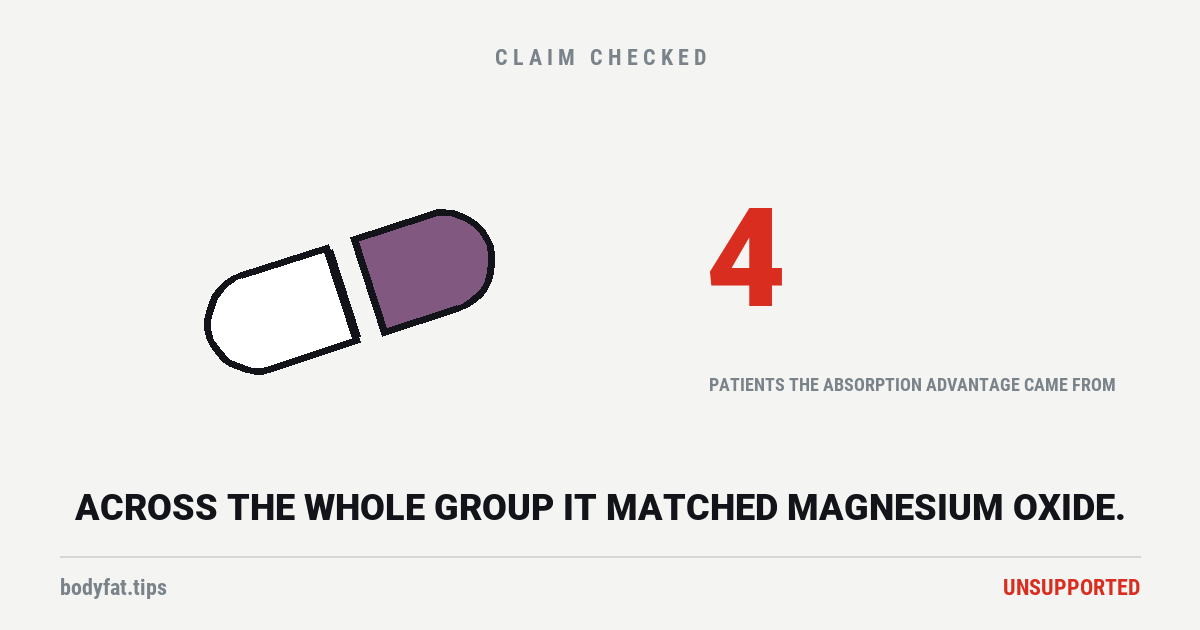
23.5% absorbed from glycinate. 22.6% from magnesium oxide. (The paper’s abstract gives 22.8%; its results section gives 22.6%.) The cheap one. No meaningful difference.
The advantage everyone cites comes from a subgroup: four patients whose absorption on oxide was worst. In those four, glycinate did considerably better. In the trial overall, it did not: the amount absorbed, and the amount still held five days later, were the same for both forms. Two blood measures did favour glycinate across all twelve. The labelled magnesium peaked in the blood about three hours sooner, and the area under the blood curve, a measure of how much of it showed up over the first day, was larger. The authors read that as a partly different route in, not more magnesium in; in their words, for most individuals the chelate’s bioavailability “is equivalent to that of MgO”. In the other eight patients, absorption tended to be lower with glycinate, though not significantly. [1]
The 1994 authors did propose one thing that travels beyond their patients: that part of the chelate is absorbed intact, “probably via a dipeptide transport pathway”, the gut’s route for taking up pairs of amino acids. [1] Their recommendation, though, stayed with the people they studied. Their conclusion is that glycinate may be a good alternative in patients with intestinal resection. That is the population they recruited and the claim they made. The leap to healthy people buying it for sleep came later, from somebody else. A 2025 trial has since tested bisglycinate for poor sleep: 155 adults aged 18 to 65 took 250 mg a day or a placebo for four weeks, and the glycinate group’s score on a seven-question insomnia scale fell 3.9 points against 2.3, a small difference that landed just on the right side of the line researchers use for “probably not chance”. It compared no other form of magnesium. [7]
What happened when healthy people were compared
Someone did compare the forms in healthy people. In 2003, 51 young healthy volunteers at a British university, most of them women, were randomised to an amino-acid chelate, citrate, oxide or one of two placebos for 60 days, double-blind; about a dozen took each form, and 46 finished. The paper never says which amino acid its chelate was bound to. [2]
Two findings, and the second one is awkward for the aisle.
First: the organic forms did beat oxide. Magnesium oxide produced no difference compared with placebo. So the form does matter — there is a real line here, and oxide is on the wrong side of it.
Second: among the forms that worked, the winner was citrate. It produced the highest blood magnesium both after a single dose and after two months, and the highest levels in saliva. Not the chelate. The cheaper, less fashionable one. The authors called that gap between citrate and the chelate preliminary, needing “an adequately-powered study comparing the two”. [2]
If bioavailability were really the argument, the shelf would be full of citrate.
Two later studies gave healthy adults glycinate and oxide directly, one dose of each, while testing a third product, and each came from that product’s maker. In 2018, in ten people, glycinate’s rise in blood and urine a day later was not significantly different from oxide’s, and its red-cell magnesium fell while oxide’s rose, the one gap between the two that the paper marks as significant. [4] In 2024, in forty people, blood magnesium rose an hour after oxide and did not rise significantly at any of the three points measured over six hours after glycinate; no difference between the two was significant. [5] One dose, a day or less, run for a rival product’s maker: neither settles it, and neither puts glycinate ahead.
And then the review
In 2021 researchers searched four databases, found 433 records on magnesium supplement bioavailability and kept 14. It is a descriptive review: it pools no numbers, its search ran in February 2020, and it discusses rat studies alongside human ones, with a section on the limits of carrying animal results over to people. [3]
They confirmed the pattern: inorganic forms are less bioavailable than organic ones, and absorption depends on the dose.
Then they wrote the sentence that should be printed on every magnesium tub:
“All magnesium dietary supplements can maintain physiological levels in healthy people without prior deficit, although this cannot be assured in older people or those with illnesses or previous subphysiological levels.” [3]
All of them work, in healthy people. The form argument is a real question for someone who is older, unwell, or actually deficient. For everyone else it is a pricing strategy.
Which is the same shape as everything else in this aisle
Notice the pattern, because you will see it again by tomorrow. A finding is generated in a clinical population with an actual problem — surgically resected bowels, here — and then sold to people who do not have that problem, with the population quietly removed from the sentence.
We found exactly this with psyllium, where blood sugar improved in proportion to how much control you had already lost and did nothing measurable in people whose levels were normal.
The one result in the table that puts glycinate ahead of oxide also comes from a clinical population. It is the 2013 row: pilot data from people after weight-loss surgery, in whom six weeks of 400 mg a day of glycinate raised blood magnesium and oxide, at a slightly lower dose, did not. It comes from a conference abstract by a US university laboratory, with no group sizes and no statistics. [6]
The verdict
Unsupported — for the claim that glycinate is the superior, best-absorbed form. The trial built to compare it with oxide came out even, in twelve people with surgically shortened bowels. Two single-dose studies in healthy adults, each from the maker of a rival product, did not show it ahead of oxide either, and a two-month trial in young healthy adults, of a chelate whose amino acid its authors never name, favoured citrate. And the systematic review says every form does the job in a healthy person anyway.
Two things that are true and worth keeping: magnesium oxide performed no better than placebo in the two-month trial, so that distinction is real. And in the patients of the 1994 trial, glycinate meant fewer trips to the bathroom than oxide, though that result comes from one dose in twelve people missing part of the bowel.
Do not buy it for the absorption. If the cheaper forms upset your stomach, it is a reasonable thing to try. And if you are older, unwell, or have been told your magnesium is low, the review is explicit that its reassurance does not extend to you — that is a conversation with a clinician.
The bigger question is whether to take magnesium at all, which is a different page: we found it lowers blood pressure by about two points, mostly in people whose blood pressure is high, and has no clear effect on the night leg cramps of older adults, and the sleep evidence is thinner than the marketing.
Related: melatonin dosage and sleep hygiene — the rest of the sleep aisle, checked.
If you want to know what earns each rating, we wrote down how we read a study, and everything we have checked is in one place.
Our magnesium verdict was corrected on 18 September 2026 after an independent editorial review, and this page repeated one of the claims it corrected. We summed that verdict up as finding that magnesium does nothing for leg cramps. The Cochrane review behind it found no benefit for the night cramps of older adults; in pregnancy its trials conflict, and it found no trial at all of cramps from exercise. The sentence now says so, and adds that the blood-pressure fall showed up mainly in people whose blood pressure was high. Nothing about glycinate itself changed, and the rating is unchanged: Unsupported.
This page was corrected on 7 October 2026 after an independent editorial review. It called the 1994 trial in twelve patients with resected bowels the only head-to-head trial of glycinate against oxide, and a 2003 trial the only comparison in healthy adults, in its title, search description, evidence panel, table, verdict and its account of how the claim spread. Neither was true. Two later single-dose studies in healthy adults, each from the maker of a third product, also gave people glycinate and oxide, and neither put glycinate ahead; pilot data in a 2013 conference abstract favoured glycinate after weight-loss surgery; and a comparison registered in 2017 has posted no results. The page now reports all of them. The 2003 trial randomised 51 volunteers, not 46; 46 finished. And the funding row said funding was not stated in the sources; all three state it, and two record that the maker of a product under test supplied it.
Also changed: the page told healthy readers that glycinate’s gentler stomach was a documented effect. What the 1994 trial measured was fewer stools in the day after one small dose, in twelve patients missing part of the bowel, and in healthy adults the evidence points in no clear direction. The page now also reports the two blood measures that favoured glycinate across that trial, says the claim is older than the trial, describes the 2021 review as descriptive rather than settling, adds a 2025 sleep trial of bisglycinate, and no longer quotes a monthly search figure we could not trace to a saved source. The oxide figure is now the 22.6% of the 1994 trial’s results section; we had quoted its abstract, which gives 22.8%. The rating is unchanged: Unsupported.