Glutathione Benefits: It Does Absorb. That Is the Part Everyone Got Wrong, and It Is Not the Part That Matters.

Here is the line you will have heard, and it is usually delivered with confidence: glutathione is a tripeptide, your gut takes peptides apart, so swallowing it is money on fire.
It is a good argument. It is also, as far as the best trial we can find goes, wrong.
Which is more interesting than the debunk would have been — because the absorption turns out to be the part that works, and the part everyone argues about is not the part that matters.
The trial: six months, 54 people, and the stores went up
In 2015 researchers at Penn State ran a randomised, double-blind, placebo-controlled trial — the proper kind — giving 54 non-smoking adults either 250 mg or 1,000 mg of oral glutathione a day, or a placebo, for six months. They then measured glutathione in blood, red cells, plasma, lymphocytes and cells scraped from the inside of the cheek [1].
| Where it was measured | Change at 6 months |
| Red blood cells, plasma, lymphocytes | +30 to 35% |
| Cheek cells | +260% |
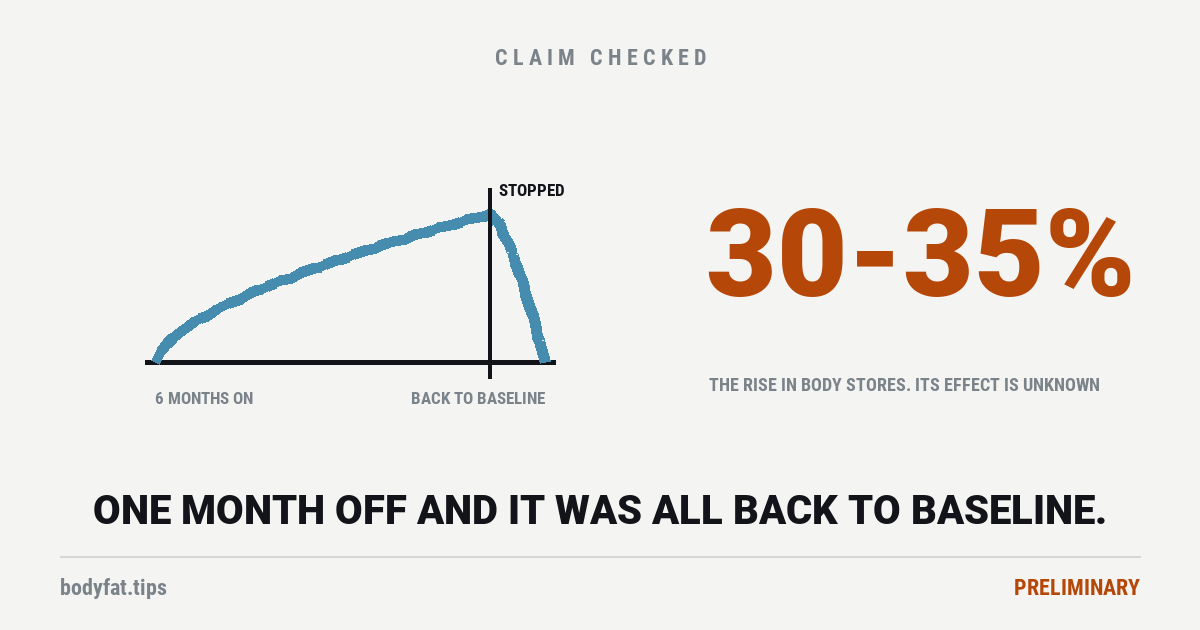
| After one month off it | back to baseline |
| Natural killer cell activity (a subset, at 3 months) | more than doubled |
At the higher dose, glutathione in red cells, plasma and lymphocytes rose by 30 to 35%. In cheek cells it rose 260%. At the lower dose the rises were smaller — 17% in blood, 29% in red cells — and the pattern was dose- and time-dependent, which is what you want to see if an effect is real rather than noise [1].
So the gut objection does not survive contact with the measurement. Whatever is happening — and the paper does not settle the mechanism — taking it daily raises what is in you.
Then they stopped, and it all went away
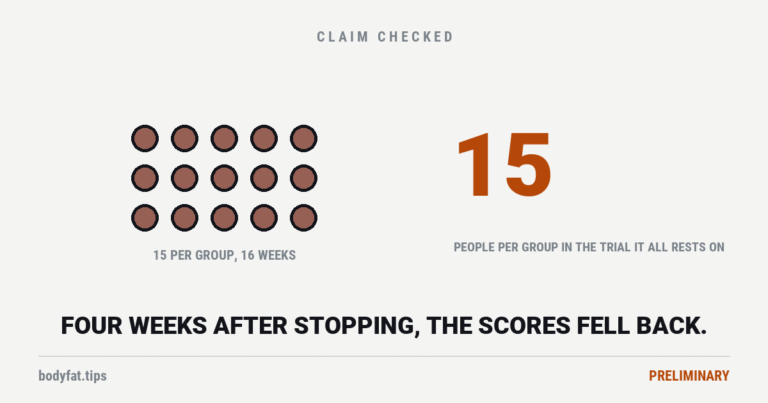
One month off the supplement and levels returned to baseline [1].
That is not a criticism, it is a specification. This is a standing order, not a course of treatment, and the same is true of most things that raise a level in you. It also means anyone selling a “reset” or a loading protocol is selling you a shape the biology does not have.
So what did the higher levels actually do?
This is where the page turns, and where honesty costs the story its ending.
The trial was designed to answer whether stores go up. Stores are not health. They are a surrogate — a thing you measure because it is easier to measure than the thing you care about, on the assumption that the two travel together. Sometimes they do not.
The trial did look at some immune markers, in a subset of participants. Natural killer cell activity — one arm of the immune system — more than doubled in the high-dose group at three months [1]. That is genuinely interesting and it is one outcome, in part of one small trial, at one timepoint.
What there is not, anywhere we could find, is a trial showing that taking oral glutathione makes a person healthier in a way they would notice. Not one that failed. One that has not been run.
The trial has a published argument attached to it
Worth knowing if you go reading. The 2015 trial drew a published Commentary in the same journal, and the authors published a Reply [4] [5].
We are not going to tell you what either said. Both are letters, neither carries an abstract, and we could not read them. Telling you a dispute exists and where to find it is honest; summarising an argument we have not read would not be.
One thing is on the record and worth stating flatly: the Commentary’s author gives an affiliation with a company that sells a glutathione supplement [4]. That is not an accusation of anything. It is the same disclosure we would print about any source, and who is arguing is part of reading an argument.
The sublingual study, and who wrote it
You will meet the claim that ordinary oral glutathione is inferior and you want a sublingual or liposomal version. There is a study.
Twenty people with metabolic syndrome, a three-week randomised crossover comparing a sublingual glutathione against ordinary oral glutathione and against N-acetylcysteine. The sublingual form came out ahead on blood levels [2].
Two of that paper’s four authors give their affiliation as the laboratory that makes the sublingual product [2]. Twenty people, three weeks, and the manufacturer testing its own formulation against the competition. That does not make the result false. It makes it a starting point, and it is the whole evidence base for the upgrade you are being asked to pay for.
The injections, which is where the real risk is
The biggest commercial use of glutathione is not a capsule. It is skin lightening, and increasingly it is intravenous.
A 2025 review looked at all three routes. Oral produced significant but variable reductions in melanin with limited side effects. Topical produced reasonable reductions with variable durability [3].
Intravenous is the one to stop at. The review describes it as fast-acting and attaches to it “serious safety concerns like anaphylaxis and hepatotoxicity” — a whole-body allergic reaction that can kill, and liver damage — made worse by the absence of any standardised dosing protocol [3].
Their own closing advice is that consumers and clinicians should exercise caution, particularly with intravenous use [3]. We would put it harder. There is no established benefit that justifies an unstandardised infusion carrying an anaphylaxis risk, and the people selling those drips are not the people who will manage the reaction.
Why this is Preliminary
Not Unsupported — because the central factual claim everyone argues about turned out to be true. It absorbs. A six-month randomised trial with a dose-response says so, and pretending otherwise to reach a tidier verdict would be the failure this site exists to correct.
Not Supported — because raising a number in your blood is not a benefit until somebody shows it does something. One trial, 54 people, a surrogate outcome, one immune marker in a subset, a published dispute, and a formulation literature written partly by the people selling the formulation.
Preliminary is the rating for exactly this: real evidence, too little of it, and the interesting question still open. The site’s own definition adds not actionable alone, and that is the right reading here.
What we would actually do
Do not get it injected. That is the whole of the safety advice on this page and it is the only part that is urgent. Anaphylaxis and liver injury, no standard dose, for a cosmetic effect that oral and topical routes also produce [3].
If you take it, know what you have bought. You are buying a higher glutathione level, which is well evidenced, and a hope about what that level does, which is not. Those are different purchases at the same price.
Do not pay extra for the delivery system yet. The case for sublingual and liposomal forms rests on twenty people over three weeks, co-authored by the manufacturer [2]. Ordinary oral glutathione is the form with the six-month randomised trial behind it.
And expect it to stop when you stop. A month off and you are back where you started [1].
This is journalism about research, not medical advice. Intravenous anything is a conversation with a doctor, not a wellness purchase. How we read a study · NAD+ supplements · Collagen · Greens powders
- Fadogia Agrestis: The Testosterone Study Was Rats. The Same Lab Then Found Liver and Kidney Damage.
preliminary - Do Multivitamins Work? 84 Trials and 739,803 People Later, the Official Verdict Is “Cannot Be Determined”
preliminary - Whey vs Plant Protein: Strength Came Out the Same. The Lean-Mass Edge Was Under a Pound, in People Under 50.
preliminary