Melatonin Dosage: What Regulators Say, and What 25 US Gummies Held

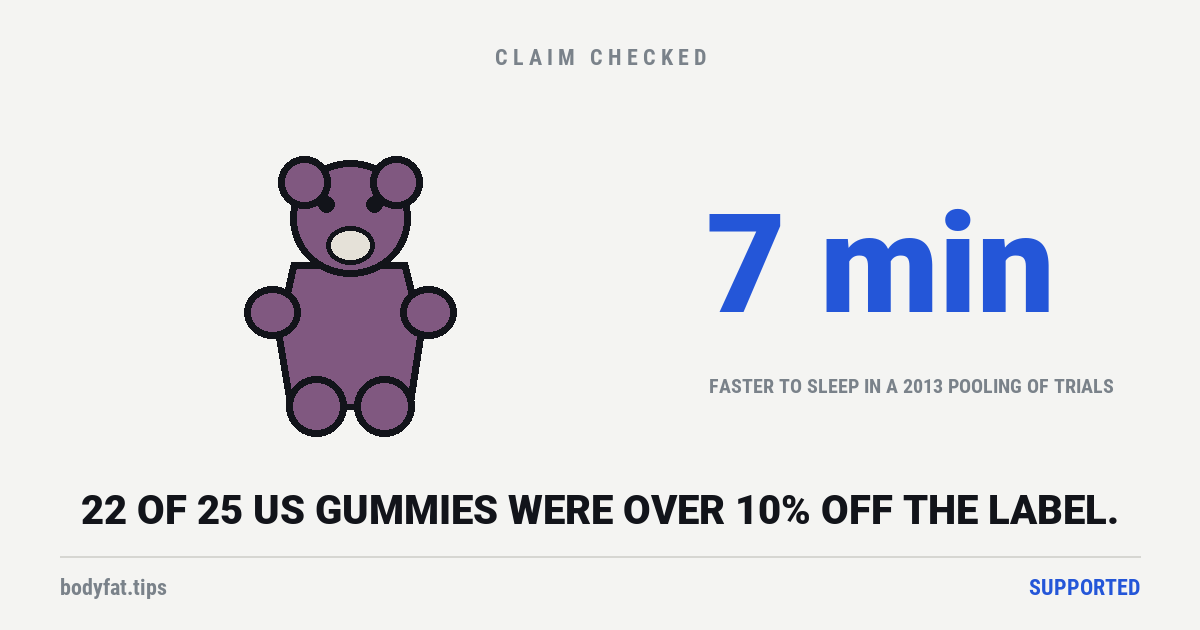
Melatonin works, a little. In pooled trials it shortens the time it takes to fall asleep by a few minutes. How many depends on who was counted. A 2013 review of 19 trials, 1,683 adults and children with three different sleep disorders, put it at about seven minutes. [4] A 2022 review that split the trials by age put it at about two minutes in adults with long-running insomnia, too small to tell apart from zero, and at about 22 minutes in children and teenagers, from three small trials. [5]
The doctors’ groups do not agree about it. A 2017 review article in the family doctors’ journal called controlled-release melatonin a first-choice drug for older adults, and behavioural treatment the mainstay. [7] The same year the sleep specialists’ academy suggested that doctors not use melatonin for insomnia in adults. [6] The physicians’ college had found the evidence on it insufficient a year earlier. [8] Europe’s 2023 guideline allows one form, the slow-release tablet, for people 55 and over, for up to three months. [9]
All four put behavioural treatment for insomnia, in its structured form known as CBT-I, ahead of any pill. Our sleep hygiene verdict covers it.
So what dose? What each named body says
This is reporting, not advice, and we are not going to tell you what to take. But a page with “dosage” in its title owes you what the bodies that have ruled on melatonin actually say: for whom, how much, and when they said it.
| Who says it | For whom | What it says |
| European Medicines Agency: a licence of 2007, label text of July 2025 [11] | Adults 55 and over with insomnia marked by poor sleep quality, short term, on prescription | 2 mg slow-release tablet once a day, 1 to 2 hours before bedtime, after food, for up to 13 weeks |
| EU food law: a 2012 regulation resting on two opinions of the European Food Safety Authority [13] [14] [15] | The general population, as a claim permitted on foods and supplements | 1 mg close to bedtime, to fall asleep sooner; at least 0.5 mg close to bedtime on the first day of travel and for a few days after arrival, for jet lag |
| Health Canada: a licensing monograph dated December 2025 [16] | Adults 18 and over, as needed, for occasional sleeplessness | 0.1 to 10 mg a day, 30 to 60 minutes before bedtime; 0.5 to 10 mg for jet lag. Slow-release forms are outside it |
| US sleep specialists’ academy: a guideline of 2017 [6] | Adults with chronic insomnia | Suggests doctors not use it. A weak recommendation, resting on three trials of 2 mg in people over 55, with the evidence rated very low |
| FDA [1] [17] | Anyone buying it in the US | No approved dose. Melatonin is not an approved drug there. Beyond the maker’s duty to meet the safety and labelling rules, the FDA says, no law or regulation limits how much of an ingredient a supplement serving may hold |
| US supplement trade association: a voluntary guideline of March 2024 [28] | Its member companies | Label directions should give no more than 10 mg a day |
| A 2024 analysis lining up 26 trials by dose, read as its abstract [25] | People with insomnia and healthy volunteers | The effect grew with dose up to about 4 mg a day. That is a comparison between trials, not a trial of 4 mg |
Read down the last column and the spread is a hundredfold: a tenth of a milligram to ten. In that table the dose licensed as a prescription medicine is 2 mg, for one slow-release tablet and for people 55 and over. The trade guideline’s ceiling of 10 mg cites a 2004 safety monograph and Canada’s permitted range. Neither is a trial of what dose works. [28] And the trials behind the seven minutes used 0.1 to 5 mg. [4]
The same European regulator licenses a children’s slow-release product, on prescription, for insomnia in children with autism and certain other conditions, when changing sleep habits has failed. [11] That is a prescription for a diagnosed condition, not a shelf product.
The licensed products’ labels carry cautions worth knowing. The European tablet’s label says it is not recommended in pregnancy, while breastfeeding, or for people with liver impairment or autoimmune disease; that it should not be combined with the antidepressant fluvoxamine, which raised melatonin exposure 17-fold; that it adds to the effect of sleeping pills; and that it has a moderate effect on the ability to drive. [11] Canada’s wording is to avoid driving for five hours, not to use it when pregnant or breastfeeding, to ask first if you take medicines for seizures, blood pressure, immune suppression or blood thinning, and to see someone if sleeplessness lasts more than four weeks. [16] The clinical reference adds reports of falls and fractures in older people. [1] And the sleep specialists’ 2015 guideline on body-clock disorders, which suggests timed melatonin for delayed sleep phase, suggests doctors avoid it for the irregular sleep of older people with dementia. [29]
And keep it where children cannot reach it. US poison centres logged 260,435 reports of melatonin swallowed by people aged 19 and under between 2012 and 2021, the yearly number rising 530%. [19] Most of them had no symptoms; 4,097 were admitted to hospital and two, both under two years old, died. [19] A second CDC report estimated about 11,000 emergency-room visits by children aged five and under from 2019 to 2022, nearly half of them involving gummies. [20] The sleep specialists’ academy’s advice is to handle melatonin like any other medicine. [21]
Now the part that should change what you buy
In the United States melatonin is not approved by the FDA for any indication. [1] It is sold as a dietary supplement. The FDA says it has no authority to approve supplements before they are marketed and does not test them before they are sold; it enforces the law once they are on the shelf. [17] And the labelling rule is a floor. An added ingredient has to be there at 100% of the labelled amount or more, and the regulation accepts “reasonable excesses” above it. [17] The supplement trade’s own guideline has a name for the extra that makers put in to stay above the floor: “intentional overage”. [28]
Two prescription drugs act on the same receptors as melatonin. Ramelteon is FDA-approved for insomnia marked by trouble falling asleep. Tasimelteon is approved for a body-clock disorder and for the sleep disturbance of a rare genetic syndrome, and not for insomnia: the FDA refused an application to add insomnia to its label, in a decision announced in March 2025. [12] In other countries melatonin itself is a medicine. Europe’s regulator has licensed a 2 mg slow-release tablet, on prescription, since 2007, and Canada licenses melatonin products before they are sold. [11] [16]
So what is actually in the bottles? Laboratories have gone and measured.
| What was measured | Result |
| 30 Canadian products, 2017: melatonin found, as a share of the label (the paper gives this as 83% under to 478% over) | 17% to 578% |
| …lots more than 10% from the label (our count) | 33 of 50 |
| …lots within 25% of the label (our count) | 40 of 50 |
| …products containing serotonin | 8 of 30, all herbal or 5-HTP blends |
| 25 US gummies, 2023: melatonin found, as a share of the label (one more held none) | 74% to 347% |
| …more than 10% from the label, or holding no melatonin | 22 of 25 |
| …products containing serotonin | 0 of 25 |
| 110 US children’s products, 2025: melatonin found, as a share of the label | 0% to 667% |
One Canadian city, 2017: minus 83% to plus 478%
Thirty products from 16 brands, bought in grocery stores and pharmacies in one city in Ontario, for a paper its authors sent to the journal in September 2016. Melatonin content ranged from 83% below the labelled amount to 478% above it. [2] Each end of that range is a single lot of a single product. The high one was a chewable tablet labelled 1.5 mg that held 8.67 mg; a second lot of the same product held 1.31 mg. The low one was a herbal capsule labelled 3 mg that held 0.53 mg; its second lot held 3.63 mg. [2]
Most of the misses were far smaller. The paper’s summary says more than 71% missed their own label by more than ten per cent. [2] Adding up its table ourselves: of the 50 lots measured, the middle one was about 13% off, 40 were within 25% of the label, six were off by more than half and two held more than four times their label. That arithmetic is ours, not the paper’s. Between two lots of one product the difference reached 465%: the chewable above. [2] Same brand, same label, different lot, different dose.
Brand did not predict which bottles were right: the variability “did not appear to be correlated with manufacturer or product type”. [2] The authors did see one pattern. The least variable products, they wrote, were those with the simplest mix of ingredients, generally plain tablets and under-the-tongue tablets. [2] And the clinical reference this page started from, straight after its warning about variable tablets, points readers to an independent verification mark run by a non-profit standards body. [1] The sleep specialists’ academy gives parents the same advice, and adds that the scheme is voluntary and that four melatonin products carried the mark when it wrote, in 2022. [21]
Then someone tested American gummies
In September 2022 a research team looked up melatonin gummies in a federal database of supplement labels, bought the ones it could find on sale online and measured one sample of each of 25. [3] One held no melatonin at all. The other 24 held between 74% and 347% of what the label said, and 22 of the 25 were more than 10% off. [3] Most erred upward: by our count from the letter’s table, 21 of the 24 held more than the label, and the middle product held about a quarter more. That is what a floor with an allowed excess would produce. The authors call it a small sample of gummies, one bottle each, and say it may not describe tablets or capsules. [3]
A larger survey by FDA scientists, published in 2025, measured 110 melatonin products sold for children and found between 0% and 667% of the labelled amount. [18] We have read only its abstract.
Not every shelf looks like that. A 2026 study of ten brands sold in pharmacies in Lithuania, where the doses are 1 mg or less, found every lot between 7% under and 26% over its label. [26] And a 2025 meeting abstract by two authors at a drug company reported four of ten US melatonin supplements more than 10% from their label, and six within it. [27]
Serotonin: eight Canadian blends, none of 25 American gummies
Eight of the thirty Canadian products contained serotonin, at about one to 74 micrograms. [2] All eight were blends: seven with added herbal extracts such as passionflower, valerian or chamomile, and one a chewable with added 5-HTP, a compound the body makes serotonin from. Not one of the 21 melatonin-only products is in the paper’s serotonin table. That cross-reading of its two tables is ours. [2] The authors themselves say the herbal cases could be serotonin that occurs naturally in the plants. [2]
The paper’s own summary: melatonin content missed the label in more than 71% of supplements “and an additional 26% were found to contain serotonin”. [2] The American gummy study looked for serotonin in all 25 of its products and did not detect it in any. [3] On what we have read, then, the finding belongs to herbal and 5-HTP blends in one Canadian sample. The FDA scientists’ survey looked for serotonin too, and its abstract does not say what it found. [18]
Do 74 micrograms matter? The paper measured what was in the bottles, not what it does to the person who swallows it. Its authors raise a worry about people taking antidepressants; that is their concern, not a measured effect. [2] For a sense of scale, a 1985 analysis of foods found about 15 micrograms of serotonin in each gram of banana. [22] By our arithmetic that is about 1,500 micrograms in 3.5 oz (100 g) of fruit, some twenty times the most found in any of these products. Scale is all that is. It is not a safety test of either.
What the seven minutes were made of
The clinical reference this page started from offers a reason for melatonin’s uneven trial results, and gives no source for it.
On why melatonin’s trial results are so inconsistent: “Variable tablet content can make accurate dosing challenging and might contribute to the wide range of efficacy reported in various trials.” [1]
It is a fair guess. The review behind the seven minutes leaves it little room. Of its 1,683 people, 1,310 were in four trials of one product: a 2 mg slow-release tablet that is a licensed medicine in Europe. [4] [11] Three of the four enrolled only people 55 and over. [6] The largest of the four, with 746 people, was paid for by the company that makes the tablet; two of its authors were that company’s employees and a third its founder. [10] The other three are the trials the sleep specialists’ guideline rests on, and it marked them down for industry sponsorship. [6] Whatever else those trials were, they were not bottles nobody had measured. The review lists every trial’s dose: 0.1 to 5 mg, plus one children’s trial dosed by bodyweight. [4] And the trial that carries the most weight in its chart for time to fall asleep, about a third of the total, is a 22-person study of delayed sleep phase, a body-clock disorder, that the review entered at one minute. [4]
Nor is seven minutes one firm number. The review reports heterogeneity of 56%: the share of the spread between the trials’ results that is more than chance would produce. [4] Its headline comes from a fixed-effect model, which treats every trial as measuring one true effect. Its own random-effects model, which does not, gives ten minutes. [4] The extra sleep is shakier. The eight minutes is the fixed-effect figure; in the random-effects model the range the true average probably sits in runs from four minutes less sleep to 21 minutes more, which includes no gain at all, and on objective measures the gain was a third of a minute. [4] People did rate their sleep as better, by 0.22 on a scale where 0.2 is what researchers call small. [4]
Later reviews have not settled on seven either. The 2022 review, the one that found two minutes in adults, entered the largest trial, which supplies more than half of its adults, at under two minutes, using figures it got from the trial’s authors; the 2013 review had entered the same trial at 11. [4] [5] That trial’s own report has the tablet beating placebo in its older patients, 19.1 minutes against 1.7, and not in the group it was set up to test, people of any age with low melatonin. [10] A 2023 review of the slow-release tablet found five to six minutes. [23] And a comparison of insomnia drugs that pooled 154 trials in 2022, with people’s own rating of their sleep as its yardstick, concluded that melatonin “did not show overall material benefits”. [24]
The verdict
Supported, and narrowly: on average, in trials, melatonin helps people fall asleep a few minutes sooner. The effect shows most clearly in people 55 and over on the licensed slow-release tablet and in children with trouble falling asleep, and least clearly in adults as a whole, where the review that split the trials by age could not tell it from zero. [5] [10] [23] The clinical reference calls it relatively safe, with a low risk of adverse effects, and the cautions above are real ones. [1] A small effect that shows up across trials still puts it ahead of most of the shelf this site has checked.
What is not supported is the number on the front of the bottle. In the two North American papers we read in full, most products were more than 10% from their label: 33 of 50 Canadian lots by our count, 22 of 25 US gummies. [2] [3] The typical miss was modest, about an eighth either way in Canada and about a quarter over in the US gummies, and three bottles across the two tests held more than three times their label. In Lithuania, where the doses are smaller, 12 of 20 lots were within 10% by our count. [26]
So we are not going to tell you how many milligrams to take. The table above is what the bodies that have ruled on it say, and they do not agree. What this page can add is about the label: on a US shelf the milligrams printed on it are a floor, not a measurement, and in the US gummy test the bottle usually held more.
If you take melatonin and sleep better, that fits the trials. It does not prove the tablet did it: a pooled result is an average across the people in the trials, never a range for one person, and in one of the pooled trials the people on placebo fell asleep 12.9 minutes sooner too, against 24.3 on the tablet. [11] And if it seemed to stop working when you opened a new bottle, a different amount in that bottle is one possible reason, and only a possible one.
Journalism, not medical advice. Sleep that will not come for weeks is worth a doctor rather than a supplement aisle — and melatonin for children in particular is a question for a clinician, not a website.
Related: sleep hygiene · methylene blue · how much vitamin D should I take · high cortisol symptoms · every claim we’ve checked
This page was corrected on 30 September 2026 after an independent editorial review, and much of it was rewritten. Two statements were wrong. We said a family physicians’ academy recognises melatonin as first-line drug therapy for insomnia; that came from a clinical reference that gives no source for it, and the traceable document is a 2017 review article in the academy’s journal about controlled-release melatonin in older adults, published the year the sleep specialists’ academy suggested against melatonin for insomnia. And we said tasimelteon is FDA-approved for insomnia; it is approved for two other conditions, and the FDA refused an application to add insomnia in a decision announced in March 2025. We also wrote that the trials behind the seven minutes may have been testing bottles nobody had measured, at an unknown mixture of doses. We had not opened the review. Most of its people were in four trials of a licensed 2 mg slow-release tablet, the largest paid for by its maker, and it lists every trial’s dose.
What else changed. The seven minutes is now reported as a 2013 figure for adults and children together, beside a 2022 review that found about two minutes in adults and could not tell that from zero; the eight minutes of extra sleep now comes with the range that includes no gain. The range of 83% under to 478% over is scoped to 30 products bought in one Canadian city, each extreme a single lot. The count of products with serotonin is 8 of 30, not 8 of 31, all of them herbal or 5-HTP blends, and the US gummy study we had listed as unread is now read and reported, including that it detected no serotonin. The page now reports the doses that named regulators state, the cautions on the licensed product’s label and the CDC’s figures on children, and it names two tests in which most bottles were close to their label. The sentence telling readers to be suspicious of anyone who states a dose is gone: regulators state them. The funding row said funding was not stated in the sources read; it was stated, in papers we had read only as abstracts. The title and the search description changed with the text. The rating is unchanged.
Corrected on 7 October 2026. The provenance chain gave a search figure, 22,200 searches a month for a dosage question, without saying where it came from or when. It comes from a count of US searches for “melatonin dosage” in a paid keyword database, pulled on 16 August 2026, and the chain now says so. The rating is unchanged.