Ashwagandha Benefits: The Cortisol Drops. Feeling Better Is a Separate Question.

If you are stressed, your cortisol will probably go down.
Whether you feel any better is a separate question. Of the two reviews that measured both, one found people’s own stress ratings fell too; the other could not show that they did.
The question that should frame everything else
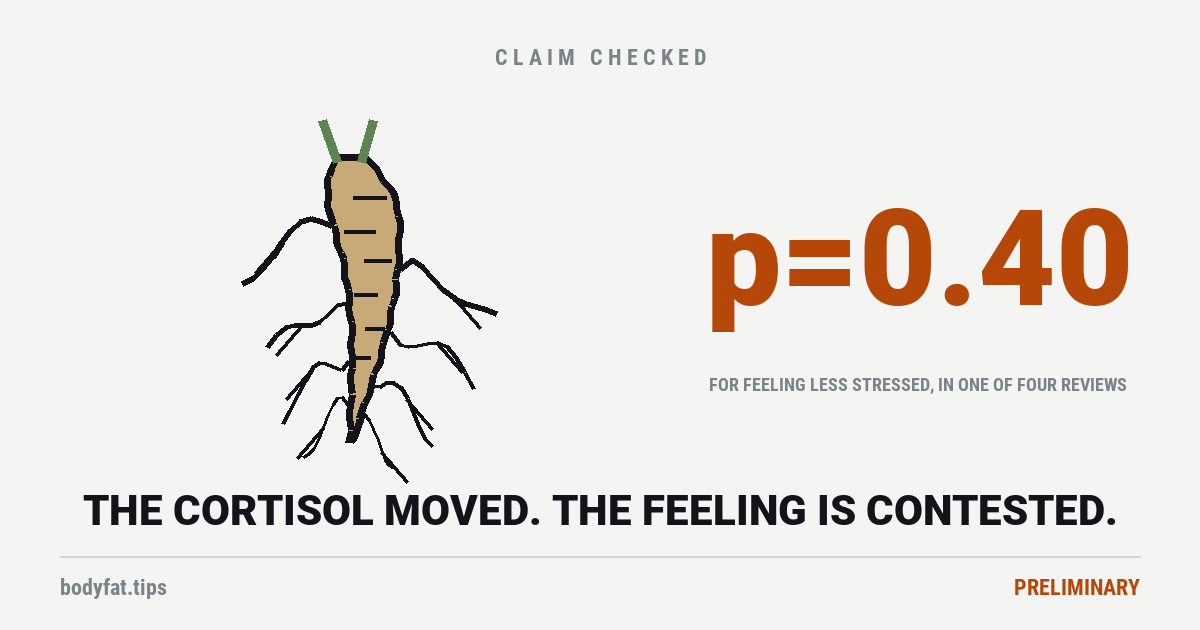
In 2025 a systematic review pooled two things side by side from ashwagandha trials: cortisol — the stress hormone you can measure in blood — and Perceived Stress Scale scores, which is the questionnaire where people say how stressed they actually feel. [1]
Cortisol dropped, clearly and significantly. Perceived stress did not reach significance — p = 0.40, which means the result is compatible with nothing happening. But the range of plausible answers ran from a large drop in stress to a modest rise, so the review could not rule out a real benefit either.
This is the oldest trap in health research and it has a name: a surrogate endpoint. Cortisol is a stand-in for stress. It is easy to measure, it moves, and it makes a great bullet point. The thing you actually care about — how you feel on a Tuesday afternoon — is harder to shift and harder to measure, and in this analysis it could not be shown to shift.
So does that settle it? No. A 2024 review pooled the same two measures, from nine trials in 558 people, and found that both fell: the questionnaire scores as well as cortisol. [13] A 2025 review of three trials in people with diagnosed mental disorders found perceived stress fell too, and rated its own evidence low certainty. [14] So the felt outcome is not a clean no. It is a weakly supported yes with one review dissenting, and here is where it gets genuinely complicated rather than conveniently simple.
The spectacular number, and why it should worry you
The headline result for ashwagandha and anxiety comes from a 2022 meta-analysis of 12 trials in 1,002 people. It found a standardised mean difference of −1.55 for anxiety and −1.75 for stress. [2]
A standardised mean difference puts different studies on one scale: 0.2 is a small effect, 0.5 moderate, 0.8 large. So 1.55 is not just large. It is enormous. Prescription drugs for generalised anxiety averaged 0.39 against placebo, on the same kind of scale, in one analysis of 21 trials. [15]
Which is exactly why you should look at the next number. The heterogeneity was 93.8%.
Heterogeneity is how much the trials’ results differ from one another. The 93.8% figure, called I², is the share of that spread that is more than chance would produce, so at 93.8% nearly all of it is real: the trials found effects of very different sizes. An average computed across studies that found wildly different things is still an average, but it is not the reliable summary it looks like — it is a number sitting in the middle of a very wide argument.
The authors were straightforward about this. Their own assessment: “we identified that the certainty of the evidence was low for both outcomes,” and “further high-quality studies are needed to firmly establish the clinical efficacy of the plant.” [2]
That caveat is in the paper. Look for it the next time you see the −1.55 quoted.
Where the evidence is actually decent: sleep
This is the claim with the cleanest support, and it is not the one on the front of the bottle.
A 2021 meta-analysis of five randomised trials in 400 people found a significant effect on sleep — a standardised mean difference of −0.59, which is moderate on the scale above rather than spectacular; the review’s authors call it “small but significant”, and rate the certainty of that evidence moderate, the second of four grades. [3] It was larger in three specific circumstances: in people actually diagnosed with insomnia, at doses of 600 mg a day or more, and over treatment lasting at least eight weeks.
Ashwagandha also improved how alert people felt on waking. It did not significantly improve quality of life.
Worth knowing about that review, because it is unusually candid: it declares itself unfunded, it notes that all five trials were conducted in India, and it records that one of them was partly sponsored by the manufacturer. [3]
Ashwagandha for men and for women — the hormone numbers
A 2026 meta-analysis pooled 23 randomised trials covering 1,706 people and measured what actually happens to circulating hormones. [4] It is the most useful single answer to the men-versus-women question, because it reports both. Not every trial measured every hormone, and the counts below say how many did.
Cortisol fell on average across the 12 trials that measured it. The headline figure, −1.18 on the standardised scale, comes from the nine run in people with raised stress. That is large, but the authors found signs of publication bias — small trials with disappointing results tend not to get published — and the result shifted when single trials were left out. [4] Serotonin rose. Testosterone was measured in eight of the trials. Pooled from the six that included men, it rose in men by 57.43 ng/dL. In women it rose by 5.09 — a change the analysis could not tell apart from zero, and the difference between the sexes was itself statistically significant. Estradiol did not move in either group.
What is 57 ng/dL? It is a real, measurable change, and it is not testosterone replacement therapy. We are deliberately not converting it into a percentage, because that needs a baseline the meta-analysis does not report, and a made-up denominator is exactly the trick this site exists to catch other people doing.
A broader 2021 review of 13 herbs across 32 studies puts it in context: ashwagandha and fenugreek were the two with positive testosterone findings in men, but across the whole field only 9 of 32 studies showed a statistically significant increase at all. [5]
The thyroid question, on five small trials
This matters if you take thyroid medication, and the honest answer has two halves.
Only five of those 23 trials measured TSH, the pituitary hormone that tells the thyroid how hard to work; four measured T3 and three T4, the thyroid’s own hormones. They were a mixed group: healthy volunteers, stressed adults, people with bipolar disorder, and the subclinical-hypothyroid trial described next. Pooled, TSH and T3 did not move, and T4 rose modestly. [4]
But a 2018 trial ran specifically in 50 people with subclinical hypothyroidism — a mildly underactive thyroid without obvious symptoms — and found significant changes in all three: TSH, T3 and T4. [6] Its authors call it a pilot study, and it is one of the five in that pool.
What that leaves is thin. The pooled result already includes the one trial that moved all three hormones, so it cannot show that a healthy thyroid is left alone, and the idea that a borderline thyroid responds rests on that single pilot of 50 people. If you are on levothyroxine or being monitored for thyroid function, that is a conversation with the person managing it — not because ashwagandha is dangerous to your thyroid, but because it may be active on it, and your dose was calculated without it.
Side effects: the liver, reported properly
This is the part of the ashwagandha story that gets either ignored or turned into a scare. Neither is useful, so here is what is actually documented.
| Who | What happened |
| No liver disease reported Iceland + US DILIN, 5 cases |
Jaundice in all five, itching in two. No liver failure. Recovered in the four followed up. |
| No liver disease reported US case report, 2023 |
Acute liver failure; needed a transplant. She was also taking a progesterone supplement. |
| Existing chronic liver disease India, within an 8-case series |
Three developed acute-on-chronic liver failure. All three died. |
In 2020, a case series from Iceland and the US Drug-Induced Liver Injury Network described five people who developed liver injury after taking ashwagandha supplements. [7] All five became jaundiced. The paper puts onset at 2 to 12 weeks after starting, though its own case table records symptoms beginning anywhere from day 5 to day 116. The injury was cholestatic or mixed — cholestatic is the bile-flow type, and mixed means the liver cells themselves were hit as well — and bilirubin, the yellow pigment behind jaundice, stayed high for 5 to 20 weeks; two of the five had itching. Nobody developed liver failure. Liver tests recovered in the four who were followed up, most within one to five months (one took nine to clear fully); the fifth was lost to follow-up.
One detail in that paper closes off the usual escape hatch. Chemical analysis confirmed ashwagandha was in the supplements, and “no other toxic compounds were identified.” [7] This was not a contamination story. The expert committee rated the herb the cause as definite in one case, highly likely in two, probable in one and possible in one, and in one case a second herb, rhodiola, may also have played a part.
Then a 2023 series from multiple centres in India reports the other end of the range. Among eight patients injured by single-ingredient ashwagandha, five had underlying chronic liver disease. Three of those arrived in acute-on-chronic liver failure. All three died. [8] In the patients without existing liver disease, the injury was prolonged but self-limiting — the same picture as Iceland. Across the eight, symptoms began anywhere from day 14 to day 540 after starting.
So the risk is not one thing. The worst outcomes cluster in livers that were already damaged, but a healthy liver is not a guarantee. A 2023 US case report describes a 41-year-old woman, with no liver disease reported, whose liver failed after two months of ashwagandha taken alongside a progesterone supplement; she needed a transplant, and the case’s causality score rated ashwagandha a possible cause. Counting her and the three deaths in India, 4 of the 25 published cases ended in death or a transplant. [9]
Now the denominator, because scale matters
A 2026 scoping review searched the literature through December 2025 and found 13 publications describing 25 patients. That counts cases written up in English-language, peer-reviewed journals; the review left out the first report, which was in Japanese, and says others may have been missed. [9]
How many people are taking it? A 2024 analysis of national US survey data from 2017 to early 2020 estimated that about 1.25 million American adults had taken ashwagandha in the previous 30 days. That rests on 28 users in the survey sample, so the range the true figure probably sits in runs from about 760,000 to 2.1 million. The paper’s headline number, 15.6 million, is for any of six liver-linked botanicals, and turmeric alone accounts for about 11.4 million of it. [10] The authors point out that the six-botanical total is comparable to the 14 million people prescribed simvastatin, a cholesterol drug that can also, rarely, injure the liver. [17]
So can you divide one number by the other and call it your risk? No. The published cases are only the ones somebody wrote up, and the review itself says case reports “cannot quantify attributable risk”. [9] What can be said is that published cases are few against a million-plus users, and Australia’s regulator, which holds its own reports of side effects, calls the risk very rare. [16] That does not mean zero, it does not mean the cases are not real, and it does not help you at all if you have cirrhosis.
What the simvastatin comparison should make you notice is the asymmetry. Simvastatin comes with a prescriber, and with a label telling that prescriber to consider a liver test before starting and to stop the drug if serious liver injury appears. [17] Nearly all of the ashwagandha users in the survey, 96% of a small sample, said no health care provider had recommended it. [10]
What the authorities have said
Here is what authorities in five countries have said, each for its own reasons. Denmark’s food authority says ashwagandha is illegal to sell as a food there, because a risk assessment by the Technical University of Denmark found negative effects on sex hormones and reproduction in both men and women, and that the plant can affect metabolism, the immune system and the central nervous system. [18] The ban dates from 2023, [4] and the reasons Denmark gives do not include the liver. France’s food-safety agency, ANSES, said in April 2024 that the data were too poor to set a safe intake, and advised people with liver, thyroid or heart conditions or hyperandrogenism (excess male hormones), pregnant women, and anyone taking sedatives not to use ashwagandha supplements, and breastfeeding women and under-18s not to either, as a precaution. [19] In the Netherlands, the national public-health institute, RIVM, advised consumers in March 2024 not to use ashwagandha preparations, as a precaution and especially in pregnancy, citing reports of harm to the liver and to thyroid-hormone and cortisol levels, [20] and the Dutch pharmacovigilance centre, Lareb, which collects reports of side effects, warned about liver toxicity in September 2023 and again in July 2025, after eight more reports. [21]
Australia’s Therapeutic Goods Administration issued a safety advisory in 2024 and followed it up on 7 July 2026. Liver injury, it says, is very rare but can be severe: 11 possible cases have been reported to it, none fatal and none needing a transplant; it knows of at least four published cases of liver failure abroad, one of which needed a transplant; and people who have or have had liver problems should avoid the herb. Its summary of the Dutch reports puts onset anywhere from 6 weeks to 22 months after starting. [16] And in India, the food regulator told manufacturers on 16 April 2026 that only the root and its extracts are permitted in supplements, not the leaf, the day after the traditional-medicine ministry barred the leaf from its own products, citing possible safety concerns from the leaf’s higher levels of reactive withanolides, the plant’s active compounds. The ministry recommends the root. [22]
Dose, timing, and what the trials actually did
Dose. The two stress trials cited here gave 300 mg twice a day, 600 mg in all [11], or 125 or 300 mg twice a day, 250 or 600 mg in all [12]. The sleep trials used 120, 250 or 600 mg a day, and the effect was stronger at 600 mg a day or more. [3] So 600 mg a day, as two doses of 300 mg, is the most-tested amount; none of these trials used 300 mg a day. Across the 23 trials in the hormone review, daily doses ran from 60 to 6,000 mg, and the extracts’ strength varied just as widely, from 0.2% to 35% withanolides. [4]
Timing. The two stress trials cited here dosed twice a day, after food, without naming a time of day. [11][12] None of these studies tested whether a particular hour matters, so anyone telling you there is a magic window is going beyond the evidence.
How long. Eight weeks or more, in the trials where the sleep effect was largest. [3] Nothing here is a same-week proposition.
One caveat that runs under all of it: the two stress trials cited here both used the same branded extract, KSM-66, described as “provided by” and “manufactured and gifted by” its manufacturer. [11][12] The 2012 paper declares no funding and no conflict of interest, and that declaration deserves to be reported alongside the supply arrangement rather than instead of it. The two are typical. Every one of the nine trials behind the hormone review’s headline cortisol figure was paid for by a company, used product a company supplied, or had company staff among its authors, and so did at least four of the five sleep trials; the funding row at the top names them. And a branded extract means the dose you buy may not be the material that was tested, and withanolide content — the active fraction — varies between products.
The verdict
Ashwagandha is not nothing, which makes it more interesting than most of what we check. On average, it lowers a stress hormone. It has a moderate, replicated effect on sleep. It nudges testosterone in men and not in women. It is measurably active on the endocrine system.
What it has not clearly done is make people report feeling less stressed — the one outcome the whole category is sold on. Of the two analyses that measured cortisol and perceived stress side by side, one found both fell and the other found the first and could not show the second. The analysis with the spectacular anxiety numbers carries 93.8% heterogeneity and a low-certainty rating from its own authors, and the 2025 review in people with mental disorders rates its stress evidence low too. And the evidence base is narrow: for sleep, five trials, all from one country, largely one supplier’s extract, and across the board, trials mostly paid for, supplied or staffed by companies that sell extracts.
We have it at Preliminary. Something real is happening in the bloodwork. Whether it reaches the part of you that wanted the bottle is not yet established.
If you try it: the most-tested amount is 600 mg a day, as two doses, for at least eight weeks; sleep is the claim with the best support; and you should talk to a doctor first if you have any liver condition, take thyroid medication or sedatives, or are pregnant. If you develop jaundice (yellowing skin or eyes), dark urine, or persistent itching, stop and get liver tests; Australia’s regulator adds nausea, vomiting, unusual tiredness, weakness, stomach pain and loss of appetite to that list. [16] Jaundice is the usual pattern in the published cases. Most cases began within weeks to a few months of starting, but reports run from days to 22 months, so a long run without trouble is not a clean bill of health. [7][8][9][16]
What would move this to Supported: trials outside India, using extracts from more than one supplier and paid for by someone other than the companies that sell them, powered for perceived stress rather than cortisol, and reporting whether people felt better rather than whether their bloodwork did.
Related: berberine benefits · apple cider vinegar benefits · does lack of sleep cause weight gain · is creatine safe
An independent editorial review on 18 September 2026 found that this page understated the liver risk and turned an unproven result about stress into a negative one. We said liver injury in the published cases showed up between two and twelve weeks after starting, and our table suggested that a previously healthy liver did not fail. The page’s own sources record symptoms starting anywhere from day 5 to day 540, Australia’s regulator reports Dutch cases with onset as late as 22 months, and a 2023 US case of acute liver failure, in a woman with no liver disease reported who was also taking a progesterone supplement, ended in a transplant. We also said perceived stress did not fall. The 2025 review we relied on could not show that it did, but its range still allowed a large benefit; a 2024 review of nine trials found it fell, as did a 2025 review of trials in people with mental disorders. The page, its graphic and its search description now say so.
Also corrected. We set 25 published cases against 15.6 million users. That figure covers six botanicals, mostly turmeric; the same survey puts ashwagandha users at about 1.25 million; and a count of published cases cannot give a risk. Simvastatin’s label sets no liver-monitoring schedule. The hormone review’s cortisol result comes from 12 of its 23 trials, with signs of publication bias, and its thyroid results from three to five trials that include the pilot trial we contrasted them with. No trial cited here used 300 mg a day, and none tested an evening dose. We misdescribed what the 93.8% heterogeneity figure measures and had left out the liver case series’ own qualifiers; both are fixed. The funding row now names the companies that paid for, supplied or employed authors of the trials, the provenance chain names a real place the claim appears, and a new section reports what authorities in Denmark, France, the Netherlands, Australia and India have said. And we had put the men’s testosterone rise on all eight trials that measured testosterone; it pools the six that included men, and the page now says so. The rating is unchanged: Preliminary.