Collagen Benefits: It Does Work on Skin. 95% of the Evidence Is in Women.

It works. Two separate meta-analyses, different teams and different databases, pooled 45 randomised trials between them and both found real improvements in skin hydration and elasticity against placebo. [1][2]
That is more evidence than most things on the shelf next to it have, and we are not going to pretend otherwise because the category is expensive.
The interesting part is underneath the result.
| Problem | Trials affected |
| Missing outcome data | 13 of 26 |
| People not doing what they were assigned | 7 |
| Selective reporting of results | 2 |
| Problems with the randomisation itself | 1 |
Half the trials lost track of people
The larger review ran the Cochrane risk-of-bias tool over its 26 trials. It found problems with missing outcome data in thirteen of them. [1]
Missing outcome data means participants dropped out or their results never made it into the analysis. It matters more than it sounds, because the people who quit a skin-supplement trial are not a random sample — the ones seeing nothing have less reason to keep turning up. Lose them and the average quietly improves.
Seven trials had people not doing what they were assigned. Two selectively reported their results. One had a problem with the randomisation itself. [1]
None of that makes the finding wrong. It does mean the finding is resting on softer ground than a pooled p-value below 0.00001 makes it look.
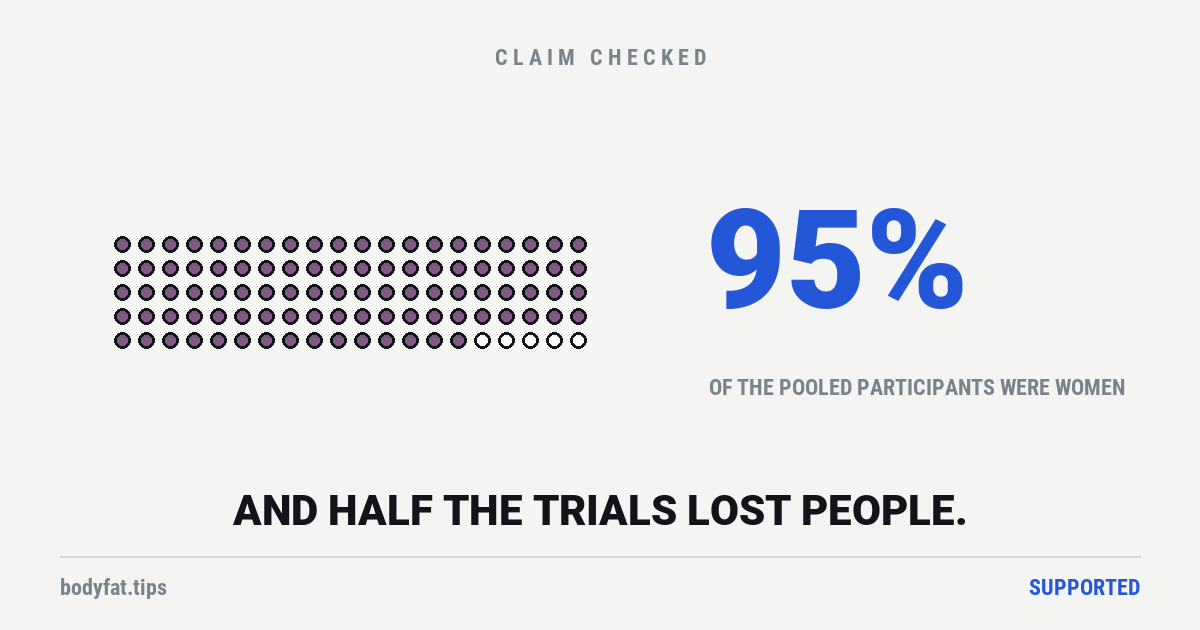
Ninety-five percent of the participants were women
The other review pooled 1,125 people aged between 20 and 70, and states it plainly: 95% of them were women. [2]
So if you are a man buying collagen for your skin, the honest position is that you are extrapolating from a body of evidence that barely included you. It might work identically. Nobody has really checked.
This is the sort of thing that gets lost between a paper and a product page, and it is not a small detail — it is nineteen out of twenty participants.
The journal published an objection to its own meta-analysis
A year after the second review came out, the same journal ran a comment on it, titled “Concerning the heterogeneity of the studies included in meta-analyses”. [3]
Heterogeneity means the pooled studies were not really measuring the same thing in the same way — different products, doses, durations and measurement methods averaged into a single number. The first review concedes the same point in its own limitations, noting the studies “used different durations and forms of collagen supplementation, making it difficult to compare the results” and that sample sizes were “relatively small”. [1]
We are flagging the objection rather than adjudicating it. Two meta-analyses found an effect; a published comment questions whether the things pooled belonged together. Both are on the record.
Does it even reach your skin?
This is the objection people raise first, and it turns out to be the weakest one.
The intuition is that collagen gets digested like any other protein, so swallowing it can no more build skin than eating a brick builds a wall. But researchers tracked a specific collagen fragment — a three-amino-acid chain called Gly-Pro-Hyp — and found it does appear in the blood after eating collagen, and does get carried to skin. One study using a radioactive tracer found the signal still present in skin when it had cleared almost everywhere else. [1]
So the mechanism is not the problem here. The trial quality is.
What this page will not tell you
Which one to buy. Thirty-three thousand people a month search for the best collagen supplement, and advertisers pay $3.69 a click for them. That is a good reason for someone to write that page. It is not a reason for us to.
Whether marine beats bovine. The larger review looked and found no significant difference by source for elasticity. [1] The comparison is not settled, and marine collagen is one of the cheapest search terms in this whole category to rank for — which tells you how much unopposed marketing sits on it.
A dose. Sources, forms and durations varied across the trials, which is exactly the heterogeneity the objection is about. Ninety days appears to be the point at which effects were observed. [2]
The verdict
Collagen improves skin hydration and elasticity. That is Supported — 45 randomised trials across two independent meta-analyses, a plausible mechanism, and effects that hold up against placebo.
The limits are real and they are specific: half the trials in the larger review had missing outcome data, the participants were 95% women, the studies were small and inconsistent enough that the journal published an objection, and the reviewers themselves say larger trials are needed. [1]
Which is an unusual place to land. Most of what this site checks either works or does not. This works — and the evidence that says so is weaker than the confidence with which it gets sold.
Related: creatine benefits · magnesium benefits · fish oil benefits · ashwagandha benefits · best supplements for muscle growth