Natto Benefits: Linked to Fewer Heart and Stroke Deaths. No Trial We Found Has Tested It

“Natto benefits” is searched about 22,200 times a month in the United States, the database’s figure for the past year; the latest months read higher, 33,100 in July and in August and 27,100 in September (from a paid keyword database, pulled 23 October 2026) [1]. Natto is whole soybeans fermented by a bacterium, Bacillus subtilis var. natto, until they are sticky and stringy, and in Japan it is eaten over rice. Online it is called a superfood, and people search for what it does for the heart, the bones, the skin and their weight; its enzyme is sold separately as a pill [1].
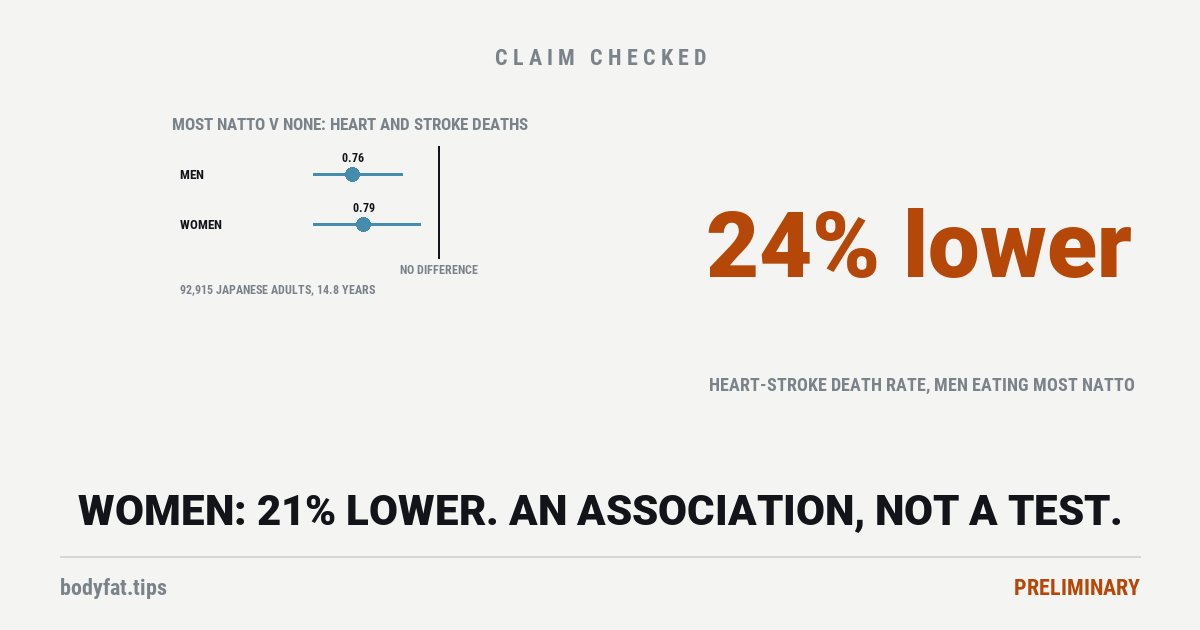
Here is the short answer. In large Japanese studies, people who ate the most natto died of heart disease and stroke at a lower rate, about a fifth to a quarter lower. That is an association, not a test. Nobody can tell from those studies whether the beans did it or the people who like beans did [2]. The enzyme sold from natto as a supplement, nattokinase, is a different question, with its own trials, and they are thinner than the marketing.
Before anything else: if you take warfarin, do not start eating natto without your prescriber. Natto is packed with vitamin K2, vitamin K counteracts warfarin, and warfarin’s label says more vitamin K in the diet can blunt the drug [3] [4]. If you take any blood thinner, or a drug that stops platelets clumping such as aspirin, or have surgery coming up, ask before taking nattokinase: in trials it lengthened clotting-time tests [5], and case reports describe a brain bleed in a woman also taking aspirin and a clotted heart valve in a man who swapped his warfarin for it [6] [7]. The surgery point is our inference from those tests. More generally, anyone on prescribed medicines, pregnant or breastfeeding, or managing a chronic illness should ask a clinician or pharmacist before starting a supplement. No food or supplement replaces treatment. This is journalism, not medical advice.
What is natto, and what is in it?
Two things in natto drive almost every claim made for it. The first is vitamin K2, in a form called MK-7 (menaquinone-7), which the bacterium makes as it ferments the beans. Three ounces of natto carries about 850 micrograms of it, about seven times the daily value, which puts natto at the top of the US government’s table of vitamin K in foods, ahead of boiled collard greens at 530 micrograms a half cup [8]. A typical pack sold in Japan, about 1.4 ounces (40 grams), carries about 380 micrograms [9].
The second is an enzyme. In 1987 a physiology lab in Japan reported that natto broke down fibrin, the mesh that holds a blood clot together, and named the enzyme nattokinase [10]. Those two discoveries, a clotting vitamin and a clot-dissolving enzyme in the same sticky bean, are most of the story, and they pull in opposite directions. Hold on to that; it matters for the warfarin section.
Is natto good for your heart?
The best evidence comes from cohort studies: researchers ask a large group of people what they eat, then follow them for years and count who gets ill or dies. They show an association, which means two things travel together. They cannot show that one causes the other, because people who eat a food often differ in a dozen other ways from people who do not.
The largest study of natto and death we found followed 92,915 Japanese adults aged 45 to 74 for 14.8 years [2]. The fifth who ate the most natto, more than about 0.9 ounces (26.2 grams) a day, were compared with people who ate none. Their death rate from heart disease and stroke was 0.76 times as high in men and 0.79 times as high in women, which is a hazard ratio: the rate in one group divided by the rate in the other, so 0.76 means about a quarter lower [2]. The confidence interval, the range the true figure probably sits in, ran from 0.65 to 0.90 in men and 0.65 to 0.95 in women; neither reaches 1.00, which would mean no difference [2].
| Study | Who, and for how long | What they found |
|---|---|---|
| Japan Public Health Center study, deaths, 2020 [2] | 92,915 adults aged 45 to 74; 14.8 years | Heart and stroke deaths: 0.76 in men, 0.79 in women, for the fifth eating the most natto against those eating none. Deaths from any cause: 0.84 in women; in men 0.94, not significant |
| Takayama study, 2017 [11] | 29,079 adults aged 35 and over; 16 years | Heart and stroke deaths: 0.75 for the quarter eating the most natto against the quarter eating least; stroke deaths 0.68 |
| Japan Public Health Center study, new cases, 2021 [12] | 79,648 adults aged 45 to 74, free of heart disease and stroke at the start; followed to 2009–2012 | Natto linked to fewer new cases of heart disease and stroke in women; no significant link in men |
| Older men, 2025 [13] | 1,548 men aged 65 and over; 12 years on average | Deaths from any cause: 0.60 for several packs a week against none; 0.79 for a pack a day or more, not significant |
Read the table for what it does not say, too. In the largest study, death from any cause was lower in the women who ate the most natto, 0.84, but not significantly lower in the men, 0.94 [2]. The same research group, counting new heart disease and strokes rather than deaths in 79,648 of its people, found the link in women and nothing significant in men [12]. In older men, the group eating several packs a week did better than the group eating a pack a day or more, which is not the pattern you expect if more natto simply means more protection [13]. And a 2025 review of fermented foods and death found two natto studies in its search, both Japanese, and concluded that the evidence on fermented foods and death is not yet enough to support an official health claim in Europe [14].
So: eating natto is linked with fewer heart and stroke deaths in Japan, consistently enough to take seriously, and no trial we found has tested whether eating it prevents them. That is what this page rates, at the end.
Does nattokinase lower blood pressure?
Here the evidence changes kind. Nattokinase is tested as a capsule, against a dummy capsule, which is a randomised controlled trial: people are assigned to the real thing or the dummy by chance, so that, on average, the two groups differ only in the capsule. Capsules are labelled in FU, fibrinolytic units, a lab measure of how much clot mesh a dose breaks down in a test tube; 2,000 FU, about 100 milligrams, is the dose in five of the eleven studies below [15].
| Study | Who, what dose, how long | What happened |
|---|---|---|
| Korea, 2008 [16] | 86 adults with high-normal or mildly high blood pressure; 2,000 FU a day or a dummy capsule; 8 weeks | Upper number 5.6 mmHg lower than on the dummy (range 0.6 to 10.5); lower number 2.8 lower (0.3 to 5.3) |
| North America, 2016 [15] | 79 adults with high blood pressure, 74 analysed; 2,000 FU each morning or a dummy; 8 weeks | Fall in the upper number not significantly different from the dummy; lower number 84 against 87 mmHg at 8 weeks |
| Korea, 2019 [5] | 100 adults with high cholesterol, 50 a group; 6,000 FU a day, as a 2023 pooling records it; 8 weeks | A platelet test (closure time) and one clotting-time test lengthened more than on the dummy |
| China, 2024 [17] | 178 adults with stable coronary artery disease, of 189 randomised; 3,615 FU a day, a dummy, red yeast rice, or nattokinase and red yeast rice together; 90 days | Nattokinase alone: neither blood-pressure number significantly different from the dummy (upper number down 6.3 mmHg against 3.8). The combination with red yeast rice lowered the lower number 7.4 mmHg, more than every other group |
| United States, 2021 [18] | 265 healthy adults at low heart risk, median age 65; 2,000 FU a day or a dummy; median 3 years | Neck-artery wall thickened 0.013 mm a year against 0.011, not significantly different; no significant effect on blood pressure or any blood test |
| Japan, 2015 [19] | 12 healthy young men; one 2,000 FU dose or a dummy, each man taking both in turn | Products of clot breakdown in the blood rose 4 to 8 hours later; one clotting-time test lengthened |
| Taiwan, 2009 [20] | 45 adults, healthy, with heart risk factors, or on dialysis; 4,000 FU a day; 2 months; no comparison group | Fibrinogen, a clotting protein, 7 to 10% lower; two other clotting factors 7 to 19% lower |
| China, 2017 [21] | 82 adults with neck-artery plaque and high cholesterol; 6,000 FU a day or a statin; 26 weeks; no dummy | Plaque area 36.6% smaller on nattokinase, 11.5% on the statin; the statin lowered cholesterol more |
| China, 2022 [22] | 1,062 adults with high cholesterol, from records; mostly 10,800 FU a day; a year; not randomised, no dummy | Plaque and cholesterol results reported as better at 10,800 FU than at 3,600 |
| China, 2026 [23] | 120 adults with narrowed head or neck arteries and no symptoms; 8,000 FU a day or a dummy; 6 months | Overall thinking score not significantly different; one sub-score better in an exploratory analysis |
| United States, 2020 [24] | 17 women with obesity and diabetes; 2,000 FU a day or a dummy; 3 months (a conference abstract) | The abstract reports “no difference in weight loss” between the groups |
Two small trials found blood pressure lower on nattokinase. In Korea, 86 adults with high-normal or mildly high blood pressure took 2,000 FU or a dummy for eight weeks; the upper number, the systolic pressure when the heart beats, fell 5.6 mmHg more than on the dummy, with a range of 0.6 to 10.5, and the lower, diastolic number 2.8 more [16]. The company that makes the nattokinase supported the trial and supplied the capsules, and two of its staff were authors [16]. In North America, 79 adults with high blood pressure did the same for eight weeks; the upper number’s fall was not significantly different from the dummy’s, and the lower number ended at 84 against 87 mmHg [15]. That trial was sponsored by the nattokinase’s US distributor [15].
The longest placebo-controlled trial we found pulls the other way. In the United States, 265 healthy adults at low heart risk, median age 65, took 2,000 FU or a dummy for a median of three years, and the authors report “no significant effect of nattokinase supplementation on blood pressure” [18].
A 90-day trial in heart patients, published in 2024, did not find a significant fall on nattokinase alone either. In China, 189 adults with stable coronary artery disease, narrowing of the arteries that feed the heart, more than half of them on statins, were randomly assigned to capsules identical in look, feel and smell: nattokinase alone at 3,615 FU a day, a dummy of maltodextrin, a starch-based powder, red yeast rice, or nattokinase and red yeast rice combined; 178 were analysed [17]. On nattokinase alone the upper number fell 6.3 mmHg against 3.8 on the dummy, and the lower number rose 1.0 against a fall of 0.2; neither change was significantly different from the dummy’s [17]. The combination lowered the lower number by 7.4 mmHg, significantly more than any other group, but it is a different product: red yeast rice is rice fermented with a yeast and sold for cholesterol, whose monacolins block an enzyme the body uses to make cholesterol, and the result belongs to the combination, not to nattokinase, on which the lower number did not fall [17]. A supplement company supplied the capsules, a research foundation bearing the company’s name paid for the trial, and five of the twelve authors worked for the company [17].
A 2023 pooling, a meta-analysis that combines trials into one estimate, put the effect at 3.45 mmHg on the upper number and 2.32 on the lower, with very tight ranges [25]. Before printing a pooled figure we look at what went into it. The upper-number estimate pools two trials, the Korean pair; the lower-number estimate pools three; and the three-year trial, the biggest and longest, is not in either, although the same pooling used it for cholesterol [25].
And the tightness is an artefact, by our reading. A pooling needs each trial’s standard deviation, how spread out people’s readings are. The pooling’s chart lists figures of 1.1 to 2.2 mmHg, and those are the standard errors the trials printed, a much smaller number that measures how sure the average is, not how spread out people are: the Korean paper says its results are means with standard errors, and the North American paper’s chart says the same [25] [16] [15]. The third trial’s figures are the same size, and we could not read that paper [5]. Turning each standard error back into a standard deviation, by multiplying it by the square root of the group’s size, and pooling again, gives 3.5 mmHg lower on the upper number with a range of 7.1 lower to 0.2 higher, and 2.3 lower on the lower number, from 4.8 lower to 0.1 higher. That is our arithmetic, from the pooling’s own chart. Both ranges now include no difference at all.
None of this says nattokinase cannot lower blood pressure. The Korean trial’s own analysis, of each person’s change, found a significant fall [16]. It says the evidence is two small eight-week trials tied to the enzyme’s makers, a third we could not read, a 90-day trial run with a supplement company in which nattokinase alone was not significantly different from the dummy, and one three-year trial that found nothing significant. For scale, our verdict on lowering blood pressure naturally puts a figure on what each proven change is worth.
Does nattokinase dissolve blood clots or clear artery plaque?
In a test tube, yes; that is how it was found [10]. In people the evidence is about blood tests, not clots. The discoverers reported in 1990 that nattokinase or natto taken by mouth produced “a mild and frequent enhancement” of clot-dissolving activity in the blood, and that it dissolved clots in dogs [26]. In 12 healthy young men, one 2,000 FU dose raised D-dimer, a fragment left when a clot breaks down, six and eight hours later, compared with a dummy [19]. In 45 Taiwanese adults with no comparison group, two months of 4,000 FU a day lowered fibrinogen, a clotting protein, by 7 to 10% [20]. An Italian hospital gave 2,000 FU a day for a month to patients with leg-vein clots after a month of an injected blood thinner, with no comparison group, and reported their symptoms improving and no drug reactions; the clots had been treated with the drug first [27].
The three-year US trial is the test that matters most here, because it measured the arteries. It used ultrasound to track the thickness of the wall of the main neck artery, the intima-media thickness, a standard early sign of artery disease. The wall thickened 0.013 mm (about half a thousandth of an inch) a year on nattokinase and 0.011 mm on the dummy, not significantly different, and the stiffness of the artery did not differ significantly either [18]. The authors report no significant effect on “any laboratory determination”, including the clotting and clot-dissolving factors they measured [18].
The studies reporting plaque shrinking used three to five and a half times that dose, in people with high cholesterol, many of them with plaque, and neither compared nattokinase with a dummy. A Chinese trial of 82 patients drew lots between 6,000 FU a day and a statin for 26 weeks and reported plaque area 36.6% smaller on nattokinase against 11.5% on the statin, while the statin lowered cholesterol more [21]. A study of the records of 1,062 Chinese adults, most on 10,800 FU a day, reported better results than at 3,600 FU; it was not randomised, and five of its authors worked for a nattokinase maker [22]. Neither can separate the pill from everything else that happened to those patients. Our verdict on whether plaque in arteries can be reversed sets out what has and has not shrunk it in trials, including two 2026 trials of vitamin K2.
Is natto good for your bones? The vitamin K2 question
Vitamin K helps a bone protein called osteocalcin grip calcium, and natto raises the K2 in your blood: a 2025 pooling of Japanese studies found blood MK-7 consistently higher in regular natto eaters [28]. Whether that turns into stronger bones is a separate question, and the evidence is mostly cohort studies again.
In 1,417 Japanese women past menopause, followed for a median of 15.2 years, 172 broke a bone in a way typical of osteoporosis [29]. After adjusting for age, bone density, body-mass index, past fractures, smoking, drinking, calcium intake and other soy foods, women eating seven or more packs a week had a hazard ratio of 0.56, with a range of 0.32 to 0.99, against women eating less than one; for one to six packs a week it was 0.79, from 0.56 to 1.10, which includes no difference [29]. The study’s starting survey was paid for by two Japanese dairy-industry bodies; the journal later corrected two participant counts in the study’s flow chart, saying that the number of women analysed and the conclusions were unaffected [29].
In 944 women from the same national study, bone density at the femoral neck, the top of the thigh bone, fell more slowly over three years in the women past menopause who ate more natto [30]. In 1,662 men aged 65 and over, measured once, natto eaters had denser hips, and the link faded once a blood marker of vitamin K was taken into account, which the authors read as vitamin K doing the work [9]. The 2025 pooling rated the certainty for bone density very low; its pooled figure dropped by about half when one outlying study was left out [28].
The one randomised trial of eating natto and bone we found put 73 women before menopause on natto never, once a month, once a week or three times a week for a year; bone stiffness, measured by ultrasound, did not differ significantly between the groups, though some blood markers of bone building favoured the three-times-a-week group [31].
What about vitamin K2 supplements instead of the beans? Five trials of MK-7 in women past menopause point both ways. A three-year trial of 244 women on 180 micrograms a day found less loss of bone density at the spine and femoral neck, though not at the whole hip; it was funded by the company selling the supplement [32]. A one-year trial of 334 women on 360 micrograms a day, in capsules made from natto, found no significant difference in bone loss [33], and a three-year trial of 142 women on 375 micrograms found no significant difference either [34]. Two more lean the other way: in a one-year Chinese trial of 311 women past menopause and men, aged 50 to 75, 90 micrograms a day slowed bone loss at the femoral neck in the women, not the men [35], and in a one-year Greek trial, dairy foods enriched with MK-7, calcium and vitamin D raised spine density more than in women given no enriched dairy, though its summary does not say whether they beat dairy enriched with calcium and vitamin D alone [36]. Our verdict on vitamin D3 and K2 sets these trials out in detail. If your concern is bone, exercise has a stronger case, and calcium supplements and vitamin D have their own verdicts.
Natto benefits for women, and for men
The sexes did not get the same results, and the split is worth knowing. For women, the largest study linked natto with lower death from any cause and from heart disease and stroke [2], the new-cases study found its link in women only [12], the fracture study was of women only [29], and a 2026 study of 5,278 Japanese adults found the women eating the most natto developed atrial fibrillation, an irregular heartbeat, at less than half the rate, 0.44, with no significant link in men, 0.97 [37].
For men, the largest study linked natto with fewer heart and stroke deaths but not significantly fewer deaths overall [2]; the bone-density study was of men [9]; and in the North American trial the fall in the lower blood-pressure number was larger in men [15]. These are the same kinds of evidence as above, split by sex, and the splits are associations too.
Natto benefits for skin
A trade-press headline from 2023 says “Japanese natto boosts skin elasticity while targeting fine lines and sagging, researchers confirm” [38]. The study behind it gave 15 women aged 40 to 65 a tablet of proteins made by natto bacteria for six weeks, with no comparison group, and found skin readings better than before [39]. The tablet is not natto: the bacteria are removed and the vitamin K reduced to negligible levels, and the company that makes it paid for the study and employed two of the three authors [39].
Plain natto has been tried on skin, by researchers at a Japanese natto maker. The study’s first author, at the company’s research institute, described it in 2006: 21 women aged 40 to 55 who did not usually eat natto, some of them given 50 grams (1.8 ounces) a day for nine weeks of natto made with the company’s own strain of the bacterium, with no collagen added, and the rest none [40]. From the second week the natto eaters reported significantly more improvement than the other women in their skin’s moisture, smoothness and overall condition, and their measured skin moisture and elasticity rose against where they had started, while the other group’s did not change significantly [40]. The article does not say how many women were in each group or how they were placed in it, and it reports no direct comparison between the groups on the measurements; with no dummy food, the women knew whether they were eating natto [40]. The full paper, published in a Japanese journal in 2007, we could not read [40]. The same researchers also gave 11 women aged 40 to 54 natto with collagen added to the beans and the sauce for nine weeks, against 11 who ate nothing extra. Its summary says the groups were formed so that their ages and questionnaire scores were balanced, and does not say whether chance played a part; the improvements were again measured against where the natto group started, and the collagen makes it impossible to credit the beans [41].
Natto and your gut
Natto is sold as a probiotic food, because its bacteria are alive when you eat it. In 2022, a study run with a company that sells capsules of freeze-dried natto powder randomly assigned Japanese townspeople to the capsules or to nothing for 62 days [42]. Of the 116 analysed, those on the capsules ended with a larger share of two groups of gut bacteria, Bifidobacterium in both sexes and Blautia in men, and no significant change in their bowel habits in either sex [42]. A shift in bacteria is not the same thing as better health, and the study did not measure health. Everyone knew which group they were in, there was no dummy capsule, and the company’s president was an author [42]. Whether probiotic capsules cause diarrhea has its own verdict.
Natto benefits for weight loss
No trial we found gave people natto as food to see whether they lost weight [43]. Two trials on this page did give people natto as food and weighed them along the way, and neither reported a significant change. In the year-long bone trial above, the authors report that the 73 women’s body-mass index, weight scaled for height, did not change significantly over the year; they ate 1.1 ounces (30 grams) of natto at lunch never, once a month, once a week or three times a week, and their average body-mass index at the start, 21.6, was in the normal range [31]. In the two-week breakfast trial below, the 11 overweight adults’ weight “remained stable” on the natto breakfast and on the comparison breakfast alike: an average of 168.7 pounds (76.5 kg) before the natto fortnight and 167.8 pounds (76.1 kg) after it, against 168.2 and 167.6 pounds (76.3 and 76.0 kg) before and after the comparison fortnight, with no significant differences [44]. Neither trial was built to test weight loss: the first was of women of normal weight on average, eating natto at most three times a week, and the second lasted a fortnight. The rest of the evidence in people is further from natto eaten as food, and it points both ways. In the gut study, the men on natto-powder capsules gained weight over the 62 days, significantly against where they started, while the men without capsules did not, and the women’s weight did not change significantly in either group [42]. In a conference abstract of 17 US women with obesity and diabetes, three months of nattokinase or a dummy gave “no difference in weight loss”; in the same abstract, of 42 women with lipedema, a fat disorder of the hips and thighs, 57% of the 21 taking nattokinase lost weight over 4 to 20 months against 33% of the 21 not taking it, in a clinic comparison the abstract does not describe as randomised, with no test of the difference reported [24]. A Korean fermented soybean food, chungkookjang, has been tested for body fat against a dummy in two trials we found: in 120 overweight adults aged 19 to 29, the women’s body-fat percentage and waist improved more than on the dummy [45], and in 60 overweight adults the fat packed around the organs, measured by CT scan, was not significantly different from the dummy group’s after 12 weeks [46]. A 2025 pooling of 15 trials of fermented soy foods found body-mass index 0.14 points lower than in the comparison groups, about 0.9 pound (0.4 kg) for someone 5 feet 7 inches tall by our arithmetic, and waists 0.6 inch (1.5 cm) smaller; its reference list names trials of Korean soybean pastes, chungkookjang, Indonesian tempeh and Japanese miso soup, and the one study in it we could identify as feeding people natto, ten men for two months, was about blood levels of polyamines, compounds involved in cell growth, and its summary says nothing about weight [47]. In animals, natto itself has been tested, and there it points the weight-loss way: mice on a high-fat diet with natto added stored less fat around the organs, more so than with plain cooked soybeans [48], and natto powder given to obese rats on a high-fat diet “significantly reduced the body weight” [49]. Rodents on a lab diet are not people eating natto over rice.
Natto may help with blood sugar after a meal. In a two-week trial of 11 overweight adults with raised blood sugar, a breakfast of rice with natto, yam and okra improved a measure of insulin sensitivity against where they started, which the comparison breakfast did not [44]. In a crossover test of 36 adults, each eating both meals, natto made to carry more of its sticky substance blunted the rise in blood sugar over the first half hour after white rice more than ordinary natto did [50]. Those are meal-by-meal effects on blood sugar, not on weight.
Natto benefits and side effects: warfarin, bleeding, allergy
Warfarin. Warfarin works by blocking vitamin K, and its label warns that more vitamin K in the diet can weaken it, tells patients to keep their vitamin K intake steady and to avoid drastic changes in diet [3]. Natto is the extreme case. In patients on warfarin after heart-valve surgery, natto pushed a clotting test the wrong way, and the surgeon who reported it called natto strongly antagonistic to the drug [4]. The vitamin K2 in natto lingers in the blood far longer than vitamin K1, and a 2007 study warned that supplements with 50 micrograms a day of MK-7 or more may interfere with these drugs [51]; one pack of natto has about 380 [9]. Researchers working with a natto maker write that natto “must be avoided by warfarin-dependent patients”, and developed a low-K2 natto for them, tested in 10 patients for a week [52]. Even the trade association of nattokinase makers says doctors tell warfarin patients not to eat natto [53].
Nattokinase and bleeding. The same association says nattokinase “can be safely taken” by people on warfarin, citing a 2008 Japanese study we did not read [53]. Weigh that against what is on record. A woman taking aspirin to prevent another stroke had a bleed in the back of the brain after seven days of 400 milligrams of nattokinase a day [6]. A 53-year-old man with a mechanical heart valve stopped warfarin and took 100 milligrams of nattokinase a day instead; a year later a clot had jammed the valve and it had to be replaced again [7]. Those are single cases, which show what can happen, not how often. Do not swap a prescribed blood thinner for nattokinase.
Allergy. Soybeans are one of the nine major food allergens under US law [54]. Natto adds two of its own. The sticky threads contain a substance called poly-gamma-glutamic acid, which can cause anaphylaxis, a severe allergic reaction, hours after eating; in one Japanese clinic, 12 of 13 patients allergic to natto, 92.3%, did a water sport, mostly surfing, which the authors link to jellyfish stings, which contain the same substance [55]. And nattokinase itself is an allergen: three of eight natto-allergic patients reacted to it in skin tests [56].
Infection, rarely. A Japanese hospital’s records from 2016 to 2023 found that 69 of the 70 Bacillus subtilis grown from blood samples were the natto strain; 25 were judged true bloodstream infections, in patients with a median age of 79, and 4 of them died within 30 days [57]. The study did not set out to show that eating natto caused them, and the authors’ point is that doctors should not dismiss the natto strain as harmless [57].
What is the best time to take natto?
The trade association of nattokinase makers says the enzyme works best “after dinner and before bedtime”, because clots tend to form late at night or early in the morning [53]. No trial we found compared taking natto or nattokinase at different times of day [43]. The North American blood-pressure trial, one of the two that found a fall, had people take the capsule in the morning [15]. If you take warfarin, timing is not the issue; the amount of vitamin K is, every day [3].
How to eat fermented soybeans
In Japan natto is typically topped with soy sauce, mustard or chives and served with rice [1], and stirred well first, which makes it stickier [57]. Heat changes it. Boiling natto cut its live bacteria and its vitamin K2, and boiled natto raised blood vitamin K2 far less than raw natto in a Japanese study of volunteers [58]. Its authors suggest warfarin patients might eat it boiled; that is a question for the prescriber, not for this page.
Who these studies were done on
Almost all of the natto-as-food evidence is from Japan, from Japanese adults eating natto as part of a Japanese diet [2] [11] [29]. The bone studies were mostly of women past menopause, plus one of older men [29] [30] [9]. The two eight-week nattokinase blood-pressure trials were of Korean and North American adults with high-normal or high blood pressure [16] [15], and the 90-day trial of Chinese adults with stable coronary artery disease [17]; the three-year trial was of healthy Americans at low heart risk, median age 65 [18].
So read yourself against them. If you are an American adding a pack of natto to a Western diet, the cohorts describe people who differ from you in what else they eat and how they live. If you have heart disease or high blood pressure and are thinking of nattokinase instead of a prescribed drug, no trial on this page tested that swap, and one case report shows how it can go [7].
If the people who eat natto die less often of heart disease, why didn’t the pill made from it slow artery disease?
This section is the desk’s own reasoning, and it is labelled as such. The cohorts link natto with fewer heart deaths. The longest trial of the enzyme sold from natto found no significant slowing of artery thickening. Here are three ways those fit together, each rated.
Answer one: the eaters, not the beans. In the largest study, men who ate the most natto had a death rate from any cause 0.82 times that of men who ate none, when only age and area were taken into account; once smoking, drinking, exercise, the rest of the diet and other factors were added, it was 0.94 and no longer significant [2]. Most of the gap went away once those other things were counted. That shrinking is measured. That what is left is partly the people too, through things no questionnaire captured, is a surmise.
Answer two: a food is not an enzyme. In both large cohorts natto stood out from other soy foods: in one, soy protein and isoflavones from other soy foods were not linked with heart deaths while natto was [11]; in the other, people in the top fifth for tofu did not have significantly lower death rates from any cause in either sex [2]. Something particular to natto, or to people who eat it, is at work. The nattokinase tested in the North American trial, and the kind the makers’ association recommends, has the vitamin K2 removed [15] [53]. That natto’s K2, or its fibre, or anything else in the whole food rather than the enzyme is the reason is a surmise.
Answer three: the wrong yardstick. The cohorts counted deaths among tens of thousands of people over about 15 years [2] [11]. The trial measured a wall thickening by about a hundredth of a millimetre a year in 265 people at low risk, over three years [18]. The numbers are measured. That the trial was too small or too short to see a benefit is a surmise, and the trial’s own figures do not lean its way: the wall thickened slightly faster on nattokinase, though not significantly [18].
Put the three together and here is what we think is true, stated plainly so you can disagree with it: natto’s evidence describes the people who eat it; nattokinase’s evidence describes a pill, and the pill has to win its own trials, where so far it has a few points of blood pressure in small trials tied to its makers, and no significant fall in two others and no significant slowing of artery thickening in the longest one.
What we could not find, and would like to: a trial that had people eat natto, or not, for years, and counted heart attacks, strokes, broken bones or deaths [43]. The nearest is the year-long trial of 73 women eating natto at four frequencies, which measured bone stiffness [31]. If you know of the longer one, the corrections line on this site is open.
Where “natto is a superfood” came from
The research behind it is real and old. In 1987 a Japanese physiology lab found and named nattokinase [10]. In 2001 a study found far more vitamin K2 in the blood of women in Tokyo, where natto is eaten often, than in Hiroshima, where it is not, or in Britain, and found hip fractures less common in the Japanese prefectures that eat more natto [59]. That comparison of regions, not of people, is where the bone story begins.
Much of the framing comes from the people who sell products made from natto. A trade association of makers and distributors of natto-derived supplements, founded in 2003, describes nattokinase as dissolving clots, lowering blood pressure and best taken at night, and sets out to promote natto’s ingredients “in forms other than natto food” [53]. We could not trace who first called natto a superfood.
It spreads through health publishing. For “natto benefits”, Google’s AI answer says natto “Contains nattokinase, an enzyme that helps break down blood clots, lower blood pressure, and reduce artery plaque” under heart health, and a US health publisher it cites lists “preventing plaque build-up in arteries” among nattokinase’s benefits [1]. The one long trial that measured artery walls found no significant difference [18]. The skin headline above is the same pattern, from a fifteen-woman study of a tablet that is not natto [38] [39].
And it sells: as nattokinase capsules standardised to 2,000 FU and stripped of vitamin K2 [15], as vitamin K2 capsules [33], as freeze-dried natto powder [42], and as a skin tablet [39].
None of this is aimed at anyone who eats natto, likes it, or is curious about it. It is a food with a long record in Japan and some of the best association data of any food on this site. It is the supplement sellers who turned a lab finding about a bean into a clot-busting pill, and who tell warfarin patients the pill “can be safely taken”.
What this is rated, and what the rating covers
Preliminary — for the claim that eating natto protects your heart.
It is rated Preliminary because the evidence in its favour is associations: two large Japanese cohorts linked natto with fewer heart and stroke deaths in both sexes [2] [11], and a third with fewer new cases in women only [12]. Associations can be strong and still be the people rather than the food, and adjustment shrank the largest study’s link with deaths from any cause in men to nothing significant [2]. No trial we found has had people eat natto and counted heart attacks, strokes or deaths [43].
Each part, rated alone, in words. That eating natto protects your bones: Preliminary, on one fracture study of 1,417 women whose range just stays below no difference, a slower-bone-loss study and a single-look study in men, with the one randomised trial of natto finding no significant difference in bone stiffness [29] [30] [9] [31]. That nattokinase lowers blood pressure: Preliminary, on two small eight-week trials tied to its makers, with the three-year trial finding no significant effect, nattokinase alone not significantly different from the dummy over 90 days in heart patients, and the pooling’s tight ranges an artefact by our reading [16] [15] [18] [17] [25]. That nattokinase dissolves clots in people: Preliminary, on blood-test changes after a single dose and in a study with no comparison group; no controlled trial we found measured a clot in a person getting smaller [19] [20] [43].
That nattokinase slows artery disease: Unsupported, of the tested kind, at the 2,000 FU a day the three-year trial tested, in adults at low risk; that placebo-controlled trial found no significant slowing [18]. The reports of shrinking plaque at three to five and a half times that dose, in people with high cholesterol, compared it with a statin, or with a lower dose in records, not with a dummy [21] [22]. That natto helps your gut: Preliminary, on one open-label study run with a capsule seller, in which gut bacteria shifted and bowel habits did not change significantly [42]. That natto improves your skin: Preliminary, on a natto maker’s own study of plain natto in 21 women, whose measured changes were against the eaters’ own starting point, the same researchers’ study of natto with added collagen, and a single-arm study of a tablet that is not natto [40] [41] [39]. That natto helps you lose weight: Preliminary, on animal studies: the only tests of natto itself we found that point its way were in rodents, where natto cut fat in mice and weight in obese rats [48] [49]. In people, no trial we found tested natto for weight loss [43]; in the two natto-food trials on this page that weighed people along the way, weight did not change significantly [31] [44]; the men on natto-powder capsules gained [42]; and in a small randomised test of the enzyme pill, the abstract reports “no difference in weight loss” [24]. A different Korean fermented soybean food lowered body fat in women in one trial and not significantly in another, and fermented soy foods pooled together lowered body-mass index by a fraction of a point, but neither is natto [45] [46] [47].
What is not rated here: Japanese longevity as a whole, cancer, dementia, and the frame in the section above, which is this desk’s reasoning from the evidence rather than a result the evidence delivered. It is marked as ours so that you can weigh it as ours. Foods with a stronger case for your cholesterol are in our cholesterol verdict.
This is journalism, not medical advice. If you take warfarin or another blood thinner, talk to your prescriber before changing what you eat or adding nattokinase. How we read a study, and what each tier means, is set out here.
- Hydrogen Water Benefits: Small, Mixed Shifts in Blood Markers, and No Significant Win in the Three Biggest Trials
preliminary - Does Seed Cycling Work? A Few Small Studies, Mostly in PCOS, Lean Its Way. None We Found Tested the Timing.
preliminary - Spearmint Tea Benefits: Free Testosterone Dipped in Two Small Studies of Women. We Found No Acne Study of the Tea
preliminary