Biotin for Hair Growth: It Regrows Hair Lost to a Deficiency. Without One, the Two Small Tests of Biotin Alone We Found Showed No Significant Gain.

“Biotin for hair growth” is typed into Google about 14,800 times a month in the United States, by the database’s figure for the past year; the latest month, September 2026, was 8,100, and December 2025 and January 2026 each ran at 22,200 (from a paid keyword database, pulled 23 October 2026) [1]. The pitch behind it is simple. Biotin is a B vitamin, too little of it makes hair fall out, so more of it should make hair grow. It is sold in supplements of 5,000 to 10,000 micrograms [2] [3], a microgram being a millionth of a gram. An adult needs about 30 [4].
If your hair is falling out because you are short of biotin, biotin brings it back. Biotin deficiency is rare. In people who are not short of it, the two small tests of biotin on its own that we found showed no significant gain, significant being the word researchers use for a difference chance would rarely produce.
The first sentence is real, and it is where the whole idea comes from. Children whose hair fell out because they could not get or use biotin grew it back on biotin [5] [6]. The jump from “fixes a shortage” to “grows more hair on anyone” is the part that was tested, briefly, without finding a significant gain [2] [7].
Two things before anything else. If you take biotin, tell your clinician before any blood test. High doses can make some lab results wrong, including a test used to diagnose heart attacks, and the US Food and Drug Administration has a report of a patient who took high levels of biotin and died after a falsely low result on that test [8]. And hair loss that came on quickly, or in patches, needs its cause found before anything is bought: the American Academy of Dermatology says effective treatment begins with finding the cause, and that biotin should be taken only when a blood test shows a deficiency [9].
This is journalism, not medical advice.
Does biotin work for hair? The tests of biotin on its own
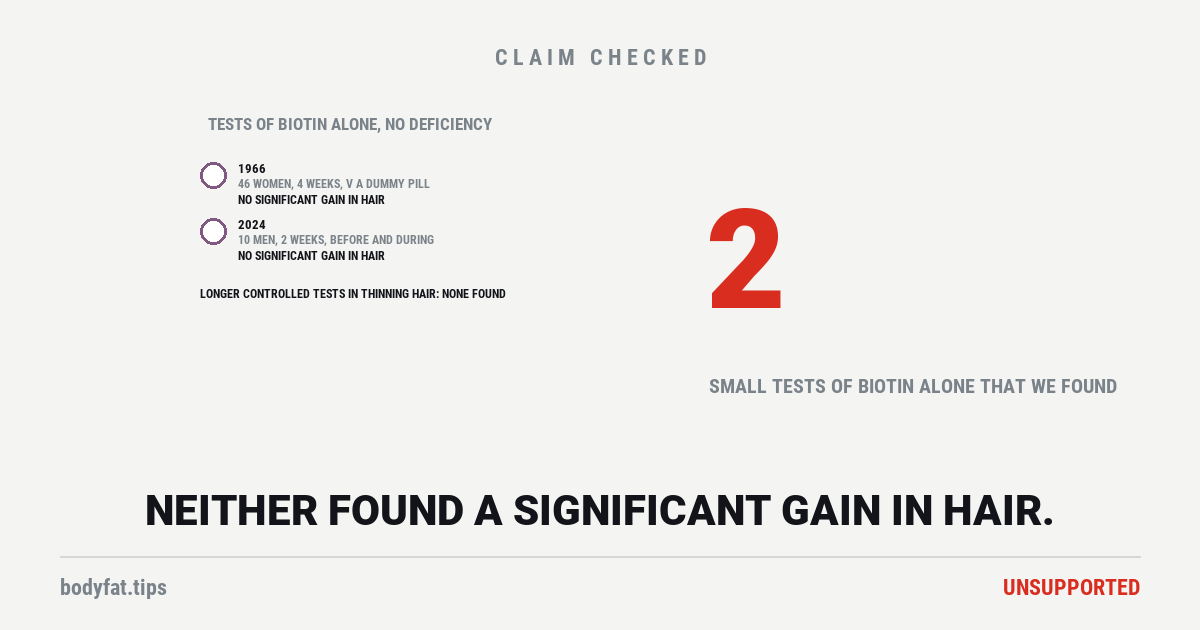
Here is every study we found that gave people biotin by itself, measured their hair and had something to compare it with [10]. It is a short list, and the newest systematic review of biotin for hair loss, which searched PubMed to the end of 2025, lists the same 1966 and 2024 trials of biotin on its own and calls that evidence “limited and largely negative” [11].
| Study | Who, how much, how long | What happened to the hair |
|---|---|---|
| Poland, 1966 [12] [2] | 46 women with diffuse hair loss: 10 mg of biotin a day (28 women) or a dummy pill (18); 4 weeks | Both groups improved; no significant difference between them in hair growth (as a 2024 review reports it; we could not read the paper) |
| Brazil, 2024 [7] | 10 healthy men; 5 mg of biotin a day for 14 days, minoxidil lotion for 14 and both for 14, in random order; no dummy pill; everyone knew what they took | On biotin alone, growth went from 2.50 mm a week to 2.47, and hair covered the shaved patch at 2.22% of its area a day before and 2.68% during; neither change was significant. Only biotin with minoxidil changed significantly |
| Turkey, 2021 [13] | 60 people taking the acne drug isotretinoin; 30 of them also took 10 mg of biotin a day; 4 months; not blinded | More hairs in the growing phase than at the start in the biotin group; full-thickness hair density fell in both groups (summary read) |
| Turkey, 2021 [14] | Women losing hair after weight-loss surgery who took 1 mg a day: 22 who were short of biotin, 29 who were not; no untreated comparison group | 23% and 38% said their hair loss had slowed markedly; the gap was not significant (summary read) |
The one with a dummy pill is sixty years old. In 1966 doctors in Poland gave 46 women with diffuse hair loss, thinning all over rather than in patches, either 10 milligrams of biotin a day, which is 10,000 micrograms, or a placebo, a dummy pill that looks the same, for four weeks [12]. Both groups improved, and there was no significant difference between them in hair growth [2]. We could not find the paper itself; that account comes from a 2024 review that included it [2]. Four weeks is a short look at hair.
The newest is tiny and precise. In 2024 a Brazilian university team took 10 healthy men, shaved a small square at the back of each head and photographed it 38 hours apart to measure how fast the hair grew [7]. Each man then took 5 mg of biotin a day for 14 days, used 5% minoxidil lotion for 14 days, and did both for 14 days, in random order with two weeks off between, a design called a crossover, in which each person is compared with himself. Everyone knew what they were taking [7]. On biotin alone, hair grew 2.50 mm a week before and 2.47 mm a week during, about a tenth of an inch either way, and the difference was not significant [7]. The trial also measured hair a second way: how fast it covered the shaved square, as a share of the square’s area each day. On that measure biotin’s figure went up, from 2.22% of the square a day before to 2.68% during, and that change was not significant either [7]. Ten men for two weeks is too small and too short a test for either result to say much in either direction. Minoxidil alone did not change either measure significantly; the two together did, from 2.36 to 2.64 mm a week on length, and on coverage too [7]. The authors call for longer studies of each on its own, and nobody paid for this one: they declare no funding and no conflicts [7].
The other two are special cases. In people taking isotretinoin, a strong acne drug that has been linked to lower activity of the enzyme that recycles biotin [2], adding 10 mg of biotin a day for four months left more hairs in the growing phase than at the start, while the density of full-thickness hairs fell in both groups, and nobody was blinded [13] [2]. After weight-loss surgery, among women who took 1 mg a day, 23% of those who had been short of biotin and 38% of those who had not said their shedding had slowed markedly, a gap the authors found not significant [14]. Neither tells you much about a healthy head of hair.
What about the hair supplements that contain biotin?
Many hair supplements put biotin in with a list of other things [15], and several have been tested against a dummy pill or another product. Here are the ones we read.
| Product and trial | What was in it, in whom, how long | What happened | Who paid |
|---|---|---|---|
| Marine protein tablet, 2015 [16] | Shark and mollusc powder, horsetail, acerola, biotin and zinc, or a dummy tablet; 60 women whose hair felt thin to them; 90 days | Full-thickness hairs in a marked square rose from 178 to 236, against 178 to 181 on the dummy | The tablet’s maker |
| Capsule with saw palmetto, 2025 [17] | L-cystine, saw palmetto, pumpkin seed oil, an African plum bark extract, zinc, B vitamins including biotin and horsetail, or a dummy; 80 people with pattern hair loss or long-running shedding; 6 months | 12.3 more hairs per square centimetre than at the start (about 79 per square inch, by our arithmetic), against 1.5 on the dummy | The capsule’s maker; six authors its employees |
| Biotin-and-silicon capsule, 2021 [18] | 10 mg or 3 mg of biotin, each with 10 mg of silicon plus arginine, inositol and magnesium, or a dummy; 90 women with thinning hair; 12 weeks | The share of fine, wispy hairs fell more on the 10 mg dose than on the dummy, 13.2 points against 5.7; the 3 mg dose did not differ significantly from the dummy | The ingredient’s sponsor; the authors worked for the research firm overseeing the study |
| Plant extract sold as a biotin source, 2025 [19] | A leaf extract said to supply 1.25 mg of biotin, with or without a bamboo silica extract, or a dummy; 105 adults; 90 days | Gains reported mostly against each group’s own start; against the dummy, as percentages of the dummy group’s change, up to 10,512% for hair density | An author employed by the extract’s maker |
| Liposomal plant extract, 2026 [20] | A leaf extract described as rich in biotin and polyphenols, or a dummy; 35 adults with hair loss analysed; 6 months | Improvement reported on every hair measure | The ingredient company; two authors hold pending patents on it |
| Injections, 2022 [21] | Biotin with dexpanthenol, two brands compared; 50 people with diffuse hair loss; 6 weekly injections; no dummy | Both groups improved from where they started | Not read (summary only) |
| Women’s hair supplement, 2018 [22] | Zinc, biotin, iron, vitamins and amino acids, against a second supplement; 120 women shedding for six months or more; 180 days; no dummy | Both improved; a scalp-imaging measure improved significantly only on the biotin product | Two authors worked for the biotin product’s maker |
Two of them deserve a closer look. The capsule in the 2025 trial also carries saw palmetto and pumpkin seed oil, which its own authors credit with blocking 5-alpha-reductase, the enzyme behind pattern hair loss [17]. Whatever that capsule did, there is no way to hand the credit to its biotin.
The 2021 silicon trial is the closest any of them comes to isolating biotin. Its two doses carried the same silicon and differed in biotin, 10 mg against 3 mg, along with the magnesium it comes bound to, and only the higher dose beat the dummy on hair [18]. That is a hint. But the methods promise a test of the two doses against each other, and we found no hair result for it in the paper; the trial was small, described by its authors as exploratory, and paid for by the ingredient’s sponsor [18].
Products that put biotin together with collagen are covered in our collagen and hair verdict, which runs into the same wall from the other side.
Why biotin and hair go together: what a shortage does
The link is real, and it runs through deficiency. In 1985 doctors described three children fed entirely by drip, none of whom had been given biotin, who lost all their hair along with muscle tone and developmental progress [5]. On 100 micrograms of biotin a day, a hundredth of a 10,000-microgram pill, the rash, the hair loss and the neurological signs “responded dramatically” [5]. All three were given that dose, and one of them also started on larger doses, 1 mg a day for a week and then 10 mg a day for seven weeks; the authors report that abnormal acids in the urine, a sign of the shortage, persisted in one of the two who did not get the larger doses [5].
A 2017 review collected 18 reported cases in which biotin helped hair or nails, and every patient had an underlying problem: ten had an inherited fault in the enzymes that handle biotin, and three had a rare hair-shaft disorder called uncombable hair syndrome [6]. Its authors found “no evidence to suggest benefit from biotin supplementation outside of known deficiencies” [6]. The 2024 review lists the same kinds of patient and adds that, as of its search in mid-2023, there had been no studies showing biotin helps hair growth in healthy people [2].
The European Union’s food-safety agency has looked at the same link. In 2009 its nutrition panel concluded that cause and effect is established between biotin in the diet and keeping hair normal, and proposed the wording “Biotin contributes to the maintenance of normal hair” for a label claim [23]. In the same opinion it said the evidence did not show that people in the European Union generally get too little biotin to keep their hair normal [23]. That is a statement about not running short, not about growing more. The one study it was sent on high doses of biotin for hair loss, a 1992 paper in a German dermatology journal, used no objective way of judging hair loss or hair quality, the panel noted [23]. We could not read that paper. A Zurich dermatologist and hair specialist, interviewed in 2004, who in 2016 published the hair-clinic study of blood biotin described further down this page, called it a purely observational clinical study rather than a controlled one [24] [10]. The article that carries the interview describes an observational study of biotin for hair that, from its reference list and the interview, appears to be that paper: 93 people, 65 women and 28 men, most with pattern hair loss, took 2.5 mg of biotin a day for five to ten months, and hair loss fell markedly in 64% of them [24]. The article says hair counts were used to check the results, which is not how the EU panel described the paper [24] [23].
What are the symptoms of biotin deficiency?
According to the US National Institutes of Health’s fact sheet, they come on gradually and can include thinning hair that progresses to losing all the hair on the body; a scaly red rash around the eyes, nose and mouth; conjunctivitis, which is pink eye; brittle nails; and, in adults, depression, lethargy, hallucinations and pins and needles in the hands and feet [4]. Hair loss has many causes, which is why the dermatologists’ advice is to find the cause first [9].
Who actually runs short of biotin?
Not many people. The NIH calls deficiency rare, and in other western countries people eat about 35 to 70 micrograms a day from food, against the 30 an adult needs; there is no national estimate for the United States [4]. The groups that can run short:
Babies born with biotinidase deficiency, an inherited lack of the enzyme that frees biotin from food. A worldwide survey of 8.5 million screened newborns found it in about 1 in 60,000 [25]. US newborns are screened for it, and biotin taken for life prevents its symptoms [4].
Pregnant women. At least a third develop marginal deficiency, a mild shortfall picked up by lab markers, and what it means clinically is still being studied [4].
People on long-term seizure medicines, which have been linked with lower blood biotin, heavy drinkers, among whom low blood biotin turns up in 15% of people with chronic alcoholism, and people who eat a lot of raw egg white, whose protein avidin locks up biotin so it cannot be absorbed; cooking switches avidin off [4] [2]. Long-term drip feeding without biotin is the other route, as in the 1985 children [5].
Hair clinics tell a less settled story, and their studies disagree. A Swiss hair clinic that measured blood biotin in women complaining of hair loss counted 38% of them as deficient, and nearly nine in ten of those had no history of the recognised risk factors for a shortage, such as bowel disease or drugs that interfere with biotin; the study was supported by a drug company [26]. The comparisons we found, of people losing hair against people who were not, point both ways. Two found no significant difference: a team at an Egyptian university, which found blood biotin normal on average in 60 people with shedding and in 20 without [27], and a Turkish study of 90 people with shedding and 90 without, counted in a 2026 review, which measured urine biotin as well [11]. Two others, both from that same Egyptian university, found biotin lower in the people losing hair: a 2021 study set 130 people with shedding against 120 without and found their average blood biotin significantly lower [28], and a 2019 study found blood biotin in the range its authors call suboptimal in 60 men with pattern hair loss and normal in 60 matched men without, a significant difference, though not tied to how far the hair loss had gone [29]. Blood biotin can vary by up to 100% from one day to the next and is a poor guide to a mild shortage, which is why a urine test is considered more reliable [26] [27] [2]. The 2021 study then gave its 130 people with shedding biotin for three months, with no untreated group, and reports the improvement mostly in those whose levels were low [28]. That is the sense of the dermatologists’ advice: find out first, and take biotin if a test shows a shortage [9].
Is 2 eggs a day enough biotin?
Close, and with the rest of a normal day’s food, yes. A cooked whole egg weighing 47 g (1.7 oz) held 10.0 micrograms of biotin when a university lab measured it [30]. Two eggs is about 20 micrograms, two-thirds of the 30 an adult needs, by our arithmetic [30] [4]. Treat the egg figure as rough: the lab analysed one sample of each food, and earlier published values for whole eggs ran from 165 to 538 nanograms per gram, against the lab’s 214 [30].
Cook them. Raw egg white carries avidin, which binds biotin; cooking stops it [4].
Biotin foods: where the rest comes from
Organ meats, eggs, fish, meat, seeds, nuts and some vegetables, such as sweet potatoes, carry the most [4]. The richest common food in the lab’s measurements was beef liver: 30.8 micrograms in a 2.6 oz (74 g) serving [30]. A multivitamin typically adds a few tens of micrograms [2]. The FDA says the recommended 30 micrograms does not typically cause trouble with lab tests, though it lists multivitamins among the products whose biotin may, which is the next section [31].
Biotin side effects: the lab-test problem
Biotin itself has no known toxic dose. No upper limit has been set, because there is no evidence in people that biotin is toxic at high intakes, and several studies of 10 to 50 mg a day found no adverse effects [4]. The trouble is what it does to blood tests.
Many lab tests use biotin as a molecular hook to catch the thing they measure. Biotin floating in the blood sample can jam the hook, giving a result that is falsely high or falsely low, depending on the test [8]. On 28 November 2017 the FDA warned that it had seen more reports of harm, including a patient taking high levels of biotin who died after a troponin test, the blood test used to diagnose heart attacks, came back falsely low [8]. It noted that supplements sold for hair, skin and nails can carry up to 650 times the recommended daily intake [8].
On 5 November 2019 it updated the warning. Reports of falsely low troponin results were still arriving; some test makers had fixed the problem and others had not; and it knew of “many supplements containing 20mg of biotin, and some containing up to 100mg per pill” [31]. Its list of troponin tests that had not addressed the risk, current as of 21 June 2022, names 17 cleared devices, by our count [32].
How much does it take? In a 2017 study, six healthy adults took 10 mg a day, a dose common in over-the-counter supplements, for a week. Nine of 23 biotin-based tests run on their blood were thrown off, some reading falsely high and some falsely low; none of the 14 tests that did not use biotin were [33]. Thyroid hormones were among the things measured [33], and the NIH notes that a single 10 mg dose has thrown off thyroid tests taken within 24 hours, and that biotin has produced results falsely suggesting an overactive thyroid [4].
The FDA’s advice to consumers is to talk to your doctor if you take biotin, and its advice to doctors is to tell the lab [31]. It also says there is not enough information to know whether stopping biotin for any number of hours before a test prevents a wrong result [31], so it gives no safe number of days to stop ahead.
Biotin dosage for hair growth, and what 10,000 mcg does
None of the studies on this page found a dose of biotin on its own that grew hair in people who were not short of it. An adult needs about 30 micrograms a day [4]. A 10,000-microgram pill is 333 times that, and a 5,000-microgram pill 167 times, by our arithmetic. The drip-fed children regrew their hair on as little as 100 micrograms a day, though one of the three was also given 1 to 10 mg a day for the first eight weeks [5]. People born with a faulty biotin enzyme, whose problem is the enzyme rather than the diet, are another matter: a 2017 review says larger doses are recommended for them, 10,000 to 30,000 micrograms a day [6]. The doses tested on their own in people without a deficiency ran from 1 to 10 milligrams [7] [2] [14], and 10 mg is the dose that disturbed lab tests within a week [33]. On the evidence here, what a 10,000-microgram dose has been shown to do in people who are not short of biotin is disturb some blood tests.
Can I see results from taking biotin after only one week?
Not in your hair, whatever you take. Scalp hair grows slowly: in the Brazilian men it grew about 2.35 mm a week before any treatment, under a tenth of an inch [7]. And after 14 days on 5 mg of biotin, the speed itself had not changed significantly on either of the trial’s two measures [7]. Among the pages Google shows for “biotin for hair growth” is a telehealth company’s article promising to explain biotin results after one week [1].
Does biotin help hair growth? What the forums and reviews say
Plenty of people say yes. When researchers read the reviews of the 16 top-rated biotin products on a large online retailer in 2019, an average of 27.2% of reviews said biotin had helped their hair [34]. Discussion threads asking how biotin worked out turn up near the top of Google’s results for “biotin for hair growth” [1]. A 2021 study gave biotin to 130 people with shedding and reported most of them better after three months, with no untreated group to compare [28].
Here is why none of that can settle it. Shedding often stops by itself. In the 1966 trial, the women on the dummy pill improved too [2]. After weight-loss surgery, hair loss lasted about five and a half months on average and was permanent in none of the 112 women who had it [14]. Someone who starts biotin at the worst of a shedding spell will usually see it end, and so would someone who started nothing; that is our reading of those two results, not a measurement of anyone’s review.
Best biotin for hair growth, for women and for men
No published trial we found set one brand of biotin pill sold for hair against another brand [10], so there is no best one to name. Two trials on this page, each paid for or co-written by the company behind its ingredient, did set two versions of the same capsule against each other and a dummy pill: 10 mg against 3 mg of biotin, with no hair result we found for that comparison [18], and a leaf extract sold as a biotin source, with and without silica, whose authors say the version with silica did better [19]. Neither compares brands. The nearest to that are a trial of two brands of biotin-and-dexpanthenol injections, in which one brand did better on one measure, the ratio of full-thickness to fine hairs [21], and a 2018 trial of a biotin supplement against a different supplement with no biotin in it [22]; neither says which biotin pill to buy. Three registered trials we found come closer and had posted no results by 23 October 2026: the Cairo trial of a millet-extract capsule containing 200 micrograms of biotin against 5 mg of biotin, finished in March 2026; a seller’s trial of its own complex at 5,000 against 10,000 micrograms, still under way; and a Slovenian trial of two liquid hair supplements, one with 150 and one with 500 micrograms of biotin among other ingredients, against a dummy, finished in October 2024, of which we found no published report [3] [10]. For women, the only dummy-pill trial of biotin alone we found was in women, and it found no significant difference [2]. For men, the only test of biotin alone in healthy men we found was ten men for two weeks [7]. Whatever the label says, the dose matters most for your next blood test [31].
Is biotin good for weight loss?
We found no trial in people that tested it [10]. The one registered trial we found that gave biotin alone with body weight among its outcomes, a Paris study before weight-loss surgery, stopped after enrolling five people when its funding ended [3]. The case in its favour comes from rodents. Its main source is a 2022 study whose human part measured biotin levels in people with severe obesity rather than giving them supplements [35]. In mice already made obese on a high-fat diet, eight more weeks of biotin with a prebiotic fibre limited both weight gain and fat gain, while biotin on its own did not limit fat gain significantly [35]. In a second experiment, mice were given biotin alone from the start of a high-fat diet, in their food or from a pump under the skin, and compared with mice fitted with the same kind of pump holding only the liquid the biotin was dissolved in, water with a little of a solvent called DMSO. What was measured was the share of each mouse’s weight that was fat, not its weight. By the significance marks on the paper’s supplementary chart, the mice on the biotin pump had a significantly smaller share of fat than the control mice at the last three measurements of the experiment, which ran about two months, while the mice given biotin in their food differed significantly only at two measurements before that, and not at the end; the authors call the results for body make-up “similar” [35].
Other rodent studies at very high doses point the same way. Young rats fed a diet with 0.2% added biotin for three weeks ended lighter than rats on the control diet, 10.1 oz (285 g) against 10.9 oz (308 g), with a smaller fat pad for their size, of the kind researchers weigh as a gauge of body fat, and their food intake was not significantly different [36]. Young mice fed 97.7 mg of biotin per kilogram of food for eight weeks, the dose the 2022 study put in its mice’s food, carried significantly lighter fat tissue than mice on the control diet [37]. And one rat study reads the same kind of result as harm. In newly weaned rats, diets with 0.08% biotin or more cut how much they ate and how much weight they gained, and its authors took the lowest of those doses as the lowest at which they saw an adverse effect; at 0.8% and 1%, some of the rats died [38]. None of these is a study of weight loss, and none is a study of people.
Does biotin help nails?
The evidence is a little better than for hair, and still thin. Three small studies of 2.5 mg a day for brittle nails, none with a dummy pill, reported improvement: nails 25% thicker in eight patients in one, though not significantly thicker in 14 others, firmer nails in 41 of 45 in another, and improvement in 22 of 35 in a third [4]. There is one dummy-pill trial we know of, and we could not read it: a 2004 Swiss nutrition-journal article describes a 1996 German trial in which 54 people with poor-quality nails took 2.5 mg of biotin a day or a dummy pill for six months, and reports a significant difference in nail quality on biotin, in people none of whom was found short of biotin [24]. We found no copy of it and no record of it in PubMed [10]. Pages that turn up in an ordinary web search describe another, a 2017 dummy-pill trial of biotin for nails in a US dermatology journal, with 35 people on one page and 40 on another; we could not find it in that journal’s records, in PubMed or on the journal’s own site, where its one 2017 paper on biotin is a review of the evidence and of biotin’s popularity, not a trial [10]. In 2021 the Brazilian team behind the hair study gave 38 healthy adults 2.5 mg of biotin, minoxidil, both or nothing for 28 days, without blinding: nail growth sped up 13% on biotin and 19% on minoxidil, and every treated group grew nails faster than the untreated one [39]. In 50 people with brittle nails using a nail lacquer, adding 10 mg of biotin a day for four months took the share who improved by half or more from 53% to 80%; the p-value of .05 sits right on the line researchers use for “probably not chance”, the biotin group started with worse nails, and one author works for a dermatology products company [40].
What does work for common hair loss?
For pattern hair loss, the commonest kind [15], two treatments have large placebo-controlled trials behind them. Minoxidil lotion: in 393 men over 48 weeks, the 5% strength beat both the 2% and a dummy [41], and in women, trials pooled by a Cochrane review found 157 of 593 on minoxidil reporting moderate to marked regrowth, against 77 of 555 on a dummy [42]. Finasteride tablets, for men: in two year-long trials of 1,553 men, those on finasteride had 107 more hairs than those on a dummy in a 1-inch circle (5.1 cm²) of the crown [43]. Both are drugs, with side effects and prescribers; our finasteride verdict covers what that drug does to hormones, our creatine and hair-loss verdict explains the hormone behind pattern loss, and our castor oil verdict sets the drug trials beside an oil’s.
Shedding after an illness, a birth or a crash diet is a different thing, and the dermatologists’ society says that sometimes hair regrows on its own, making treatment unnecessary [9].
Who these studies were done on
The only dummy-pill trial of biotin alone we found: women with diffuse hair loss, in Poland, in the 1960s [2]. The only test in healthy people we found: ten Brazilian men with a median age of about 30 [7]. The rest: people on an acne drug [13] and women after weight-loss surgery [14]. We found no controlled test of biotin alone lasting months in the people most likely to buy it, adults with thinning hair and normal biotin levels [10]. Three uncontrolled ones on this page gave biotin for months: for about two and a half to three months, to women after weight-loss surgery whose biotin was normal and to people with shedding whose levels varied [14] [28], and for five to ten months to 93 people, most with pattern hair loss, in the 1992 German study we know only through a 2004 article [24]. With nobody left untreated for comparison, none of them can separate what biotin did from what would have happened anyway. If you are an adult with thinning hair and normal biotin levels, the evidence about you is close to empty in both directions, and the lab-test warning applies to you in full [31].
If too little biotin makes hair fall out, why doesn’t more make it grow?
This section is the desk’s own reasoning, and it is labelled as such. A shortage of biotin costs hair, and the small tests found no significant gain from extra. Here are three ways those fit together, each rated.
Answer one: a missing part is not a fuel pedal. Biotin works as a helper built into five enzymes [2]. Children who lost their hair to a shortage in their drip feed regrew it on as little as 100 micrograms a day [5], about three times what an adult needs [4]. (People born with faulty biotin enzymes are given far more [6], but their problem is the enzyme, not the supply.) If the follicle’s problem is a missing part, then once every enzyme has its part, extra has nothing left to fix. That biotin is an enzyme part and that hair lost to a shortage in the feed reverses on a small dose is measured; that the follicle gains nothing beyond that point is a surmise, and the two small tests are consistent with it.
Answer two: the products that look good carry other things. The trials with the best-looking results tested mixtures, one with saw palmetto and pumpkin seed oil that its own authors say act on the enzyme behind pattern loss [17], and they were paid for by, or written with, the companies behind them [16] [17] [18]. The ingredient lists and the funders are measured; that the other ingredients, not the biotin, carry those results is a surmise that only a trial with a biotin-only arm could test.
Answer three: shedding ends on its own. In the 1966 trial both groups improved [2], and after surgery the hair loss lasted about five and a half months on average and was permanent in none of the women who had it, whether or not they took biotin [14]. Those are measured. That this explains most of the testimonials is our inference.
Put the three together and here is what we think is true, stated plainly so you can disagree with it: biotin is a part your hair needs, not a fertiliser; if you are short of it, it fixes the shortage, and if you are not, the two small tests found no significant gain, while a big dose can make a blood test lie.
What we could not find, and would like to: a trial of biotin alone against a dummy pill, for six months or more, in adults with thinning hair whose biotin levels were measured and normal, counting hairs, paid for by someone with nothing to sell [10]. The registered Cairo trial, which used 5 mg of biotin as a comparison treatment, may say something when it reports [3]. If you know of the trial we describe, the corrections line on this site is open.
Where “biotin grows hair” came from
We could not trace who first said that biotin makes hair grow in people who are not short of it [10]. The pieces are old. Biotin was also named vitamin H, which the 2024 review traces to the German words for hair and skin, Haar und Haut [2]. By 1946 a Paris medical journal ran a note whose indexed title offers a “preventive, curative and specific” treatment of hair loss and baldness with vitamin H; we could read only its title [44]. The medical evidence that followed was about deficiency: children with inherited enzyme faults and patients fed by drip, whose hair came back on biotin [5] [6].
Then the leap. As the 2024 review puts it, from the fact that deficient patients lose hair “the media extrapolated that excess supplementation of this vitamin would be useful” for hair growth [2]. By 2019 the 16 top-rated biotin products on a large online retailer averaged 4.38 stars out of 5, and not one of them mentioned the FDA’s warning about lab tests [34].
And what it became: tablets of 5,000 to 10,000 micrograms [2] [3], hair, skin and nail supplements that the FDA says can carry 650 times the daily intake [8], and, on 23 October 2026, a supplement brand’s name paired with “hair growth” rising fast among Google searches related to biotin [1].
None of this is aimed at anyone who has bought biotin hoping their hair would come back. Watching hair thin is upsetting, and “too little causes hair loss” is true, which is what makes the leap easy to sell. It is the labels that leave out the second half.
What this is rated, and what the rating covers
Unsupported, of the tested kind — for the claim that biotin supplements make hair grow in people who are not deficient.
It was tested, briefly, and neither test found a significant gain. A dummy-pill trial of 46 women for four weeks found no significant difference [2], and in ten healthy men, 14 days of 5 mg changed neither of the trial’s two measures of hair growth significantly, one slightly down and one up [7]. The trials that favour hair supplements test mixtures and cannot say what their biotin did [16] [17] [18] [19] [20]. A long controlled trial of biotin alone in people with thinning hair and normal biotin levels could change this rating; we found none [10].
The narrower claims, each rated alone, in words. That biotin restores hair lost to a biotin deficiency: Supported. It rests on case reports and case series, of inherited enzyme faults and of patients fed by drip, which agree in direction and have a known mechanism behind them, rather than on trials [5] [6] [2].
That biotin strengthens nails: Preliminary. Small studies point the same way; none of those we read had a dummy pill [4] [39] [40], and the one dummy-pill trial we know of, from 1996, we could read only as a later article describes it [24].
That biotin improves the skin of adults who are not deficient: Unsupported, of the untested kind. Apart from the isotretinoin study, in which skin hydration fell significantly in the group without biotin and not significantly in the group with it, in people whose acne drug has been linked to lower activity of a biotin enzyme [13] [2], the skin trials of adults we found test products in which biotin is one ingredient [18] [19] [10]; in babies with cradle cap, a Cochrane review found two dummy-pill trials of biotin, of very low quality, and the one that reported a test found no significant difference [45].
That biotin helps with weight loss: Preliminary, and in animals only. In rodents, very high doses of biotin alone have slowed weight gain or kept body fat lower in some experiments, which is evidence in its favour from animals alone, and this site rates that Preliminary [35] [36] [37]. Against it: in mice already obese, biotin alone did not significantly limit fat gain [35]; none of the rodent studies on this page measured weight loss; and one rat study counts slower weight gain on biotin, which came with eating less, as harm [38]. We found no human trial [10], and the one registered stopped after five people [3]. It says nothing yet about a person trying to lose weight.
What is not rated here: biotin with minoxidil, whose one 14-day result in ten men is too small to rate [7]; the hair products in the second table, each of which would need its own page; biotin for rare hair-shaft disorders of children, such as uncombable hair syndrome, where case reports describe better hair even when biotin levels were normal [2]; and the frame in the section above, which is this desk’s reasoning from the evidence rather than a result the evidence delivered. It is marked as ours so that you can weigh it as ours.
This is journalism, not medical advice. If you take biotin, tell whoever orders your blood tests. If you are losing hair, a clinician who can find the cause is the place to start [9]. How we read a study, and what each tier means, is set out here.