Time Under Tension: 14 Tempo Studies. Slower Reps Built No More Muscle

Every gym has somebody lowering the bar like it owes them money. Four seconds down, a pause, drive up. Time under tension. The idea is that the muscle does not know how much weight is on the bar, only how long it is working — so stretch the seconds and you stretch the growth.
It is a tidy theory. And it has now been tested about as directly as a training theory can be.
Fourteen studies that changed one thing
The trouble with most tempo research is that when you slow a rep down you usually change something else too — the load, the number of reps, whether you hit failure. So a 2025 meta-analysis went looking only for trials that matched the other training variables and changed the speed of one phase of the rep, the lowering or the lifting [1]. It found fourteen: nine slowed the lowering, four the lifting, and one tested both.
| Slower group | the slowed phase took 1.7 to 4.5 seconds, averaging about 3.5 s |
| Faster group | the same phase took 0.3 to 2 seconds, averaging about 1 s |
| Everything else | matched within each trial; some took every set to failure and some did not, and volume meant the same sets or the same total weight lifted, not the same seconds under load [1] |
| Growth, slower | effect size 0.34 (range 0.22 to 0.47) |
| Growth, faster | effect size 0.43 (range 0.29 to 0.58) |
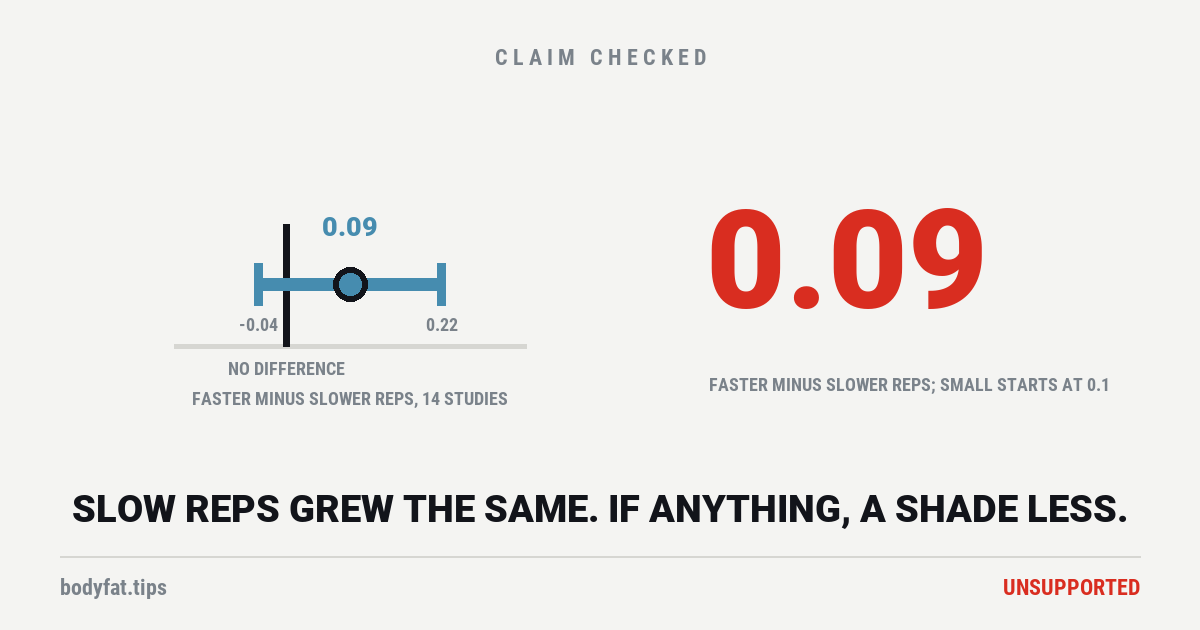
| Difference | 0.09, leaning faster — range −0.04 to 0.22 |
| Chance the gap is at least small | 45% (small = 0.1 on this group’s scale). Medium: 0.1%. Large: under 0.1% |
In the slower groups the changed phase averaged about three and a half seconds; in the faster groups, about one. The review’s abstract calls these repetition times, but it excluded trials that changed both phases, so we read them as the length of the one phase that changed, not of the whole rep [1]. Time under tension per set was not one of the things matched: with the same reps, a slower phase means more seconds under load. Both grew — that part is not in question. The question is whether the slow groups grew more.
They did not. Pooled across all fourteen, the difference between them was 0.09 [1]. An effect size puts different measures of muscle on one scale, and for a gap between two training programmes this research group counts 0.1 as small and 0.3 as medium [10]. So 0.09 sits just under small — and the range the true answer probably sits in runs from −0.04 to 0.22, which includes zero. “No difference at all” is still on the table.
And the direction? It leaned toward the faster group. Trivially, but toward it [1].
The authors put a number on how likely it is that the gap is at least small: 45%. For a medium gap, one in a thousand [1]. Read the 45% with its direction. Worked out from their own range, nearly all of it sits on the side of the faster reps; the chance that slower reps come out ahead by even a small margin is about two in a thousand. Which line counts as small? The paper’s methods section is paywalled, but this group states 0.1 in its other reviews [10], and the 45% fits it. Measured against 0.2, the textbook line, the chance of a small gap either way would be about one in twenty. The two in a thousand, the one in twenty and the fit are our arithmetic, not the paper’s.
Does time under tension actually work, then?
Here is the precise answer, because the sloppy one gets people hurt.
Time under tension works in the sense that a muscle under load for a reasonable stretch of time grows. It does not work in the sense it is sold — that more seconds per rep buys more growth per set. Across the range these trials covered, a lowering or lifting phase from a third of a second to four and a half seconds [1], and whole reps from half a second to eight seconds in an earlier review [2], the seconds were not the variable that mattered.
A 2015 review of eight earlier studies, all of which took every set to failure, reached the same place with a wider net: growth was similar anywhere from half a second to eight seconds per rep [2]. That is a sixteen-fold range of tempos producing about the same muscle.
A second 2025 meta-analysis, by a separate team, was pre-registered and limited to trials that slowed the lowering and matched everything else, including the length of the lifting phase, the load and the volume. It pooled nine trials and 166 people, 46% of them already trained [7]. Six of the trials measured muscle size, and for those the difference was 0.05, leaning this time toward the slower lowering, with a range of plausible answers (at the 90% level its authors use) from −0.22 to 0.33. Zero sits inside it, and the authors call the estimate uncertain [7]. Those six trials are all cited by the first review too, so read the two as separate analyses of overlapping trials, not two independent bodies of evidence.
So if slow does not beat fast, should you go fast? No — and this is the line to read twice. Faster did not meaningfully beat slower either. A trivial lean is not a recommendation. Tempo is simply a free variable: pick the speed at which you can actually control the weight, and stop spending attention on it. Who does that apply to? Mostly to people new to lifting, who supplied most of the evidence [9]. In the second 2025 review, two of the six trials that measured muscle size were in people who already lifted [7]. For experienced lifters and for older adults the tempo trials are few and small, so take this as the best current reading for them rather than a settled one.
Is TUT better than heavy lifting? Not better. Sometimes as good
This is the second thing people search, and it has been run head-on more than once. Here are three trials that put slow sets with a light weight against normal-speed sets with a heavy one, and measured the muscle itself.
In the first, thirty-four untrained women were divided into four groups for six weeks, one of which did not train [3]. One did super-slow reps — ten seconds up, four down — which forced them to use a light load, around 40 to 60% of their maximum. One trained at normal speed with the same light load. And one trained at normal speed with a heavy load, 80 to 85% of maximum.
Two results, and both matter. Against the same light weight, the super-slow group did better — muscle fibres grew where the light-and-normal group’s did not [3]. In this trial, slowing down rescued a light load that did little at normal speed.
But the heavy group beat everybody here. Every fibre type grew, and its fibre response was the largest on every fibre measure the researchers took [3].
That was a ten-second lift, slow enough to force a light weight. Two trials of a milder slow rep came out differently. In 2006, 24 young men new to lifting did knee extensions for 12 weeks: slow and light (about half their maximum; three seconds down and three up, a one-second pause, no rest between reps), heavy at normal speed (about 80%), or light at normal speed [5]. The slow-light and heavy groups both worked to exhaustion at about eight reps, and their thigh muscle grew by much the same amount on MRI, 5.4% and 4.3%. The light normal-speed group did the same eight reps without going to exhaustion, and did not grow [5]. In 2008, 36 young men were split three ways for 13 weeks, one group a control that did not train: whole-body training that was slow and light grew muscle thickness by 6.8%, heavy by 9.1%, which the authors called comparable [6].
Read those together and the lesson is not that slow is magic, or that heavy is the one road to size. Super-slow forced a weight light enough to lose to heavy lifting over six weeks; a moderately slow set taken to exhaustion did about as well as a heavy one over twelve and thirteen. Even the authors of the 2008 trial said the slowness was not the point: they advised moving as fast as you can while keeping the muscle under continuous tension [6]. Light loads work when the set is hard. In a 2012 trial, legs trained at 30% of their maximum for three sets to failure grew 6.8% on MRI, and legs trained at 80% grew 7.2% [8]. A 2026 position stand from a sports-medicine professional body, drawing on 137 reviews, found that muscle growth was not affected by load anywhere from 30% to 100% of maximum, while heavier loads did build more strength [9]. This site’s verdict on bodyweight training says the same: load does not decide muscle growth. So lift heavier if you want strength. For size, how hard the set is matters more than the weight on the bar.
What about the 3-3-3 rule?
If you have arrived here from a video: three seconds down, three seconds paused, three seconds up. Nine seconds a rep. (The same name is also used for a weekly plan of three strength, three cardio and three recovery days, and for a nine-rep set; this section is about the tempo.)
Nobody has tested that prescription specifically, and this page will not pretend otherwise. What can be said is where it sits. Its three-second lowering sits inside the range the 2025 analysis tested, close to its slow-group average [1]. Nine seconds for the whole rep is a second past the slow end of the 2015 review’s half-a-second-to-eight-seconds range [2]. The protocol in the two slow-light trials above comes close to it, three seconds down and three up with no rest between reps and a one-second pause in the 2006 version, and it grew muscle about as well as heavy lifting [5] [6]. Past ten seconds, the 2015 review found training looked inferior for growth — while noting there were too few controlled studies to say so firmly [2].
So the 3-3-3 rule is not dangerous, and it will make a light weight feel brutal. It sits at the slow end of a range where the speed was not what mattered, a second short of the ten-second mark past which the 2015 review saw a signal, too thin to be sure of, that growth suffers [2].
Where the idea came from, and why it sounded so right
The branded slow rep has a birth certificate. In 1982, an osteoporosis study at a US university medical school, sponsored by an exercise-machine maker, needed a way to train older women safely on machines, and the study’s exercise supervisors wrote a protocol of very slow reps for it. It was later trademarked and given a certification programme of its own; the version trials later used took about ten seconds to lift each rep [3]. A safety protocol for a bone study became a growth method.
Then, in 2012, it got a mechanism. Eight men did knee extensions at 30% of their maximum — a light load — one leg at six seconds up and six down until it could not do another rep, the other at one second up and one down for the same number of reps, stopping short of failure [4]. A day later, the slow leg was building muscle protein faster. Myofibrillar protein synthesis — the rate at which the muscle assembles its contractile machinery — was significantly higher in the slow condition at 24 to 30 hours [4]. The authors tied that to effort as much as to seconds: a longer time under tension mattered, they wrote, only when fatigue brought the whole muscle into play [4].
That is a real finding and this site is not going to sneer at it. It is also a measurement of one day’s building rate in eight people, not a measurement of muscle. Building rate and muscle are different things, and this site has already spent a page on the difference: an acute rise in protein synthesis does not reliably predict what you keep. The fourteen-study analysis is what happened when somebody checked whether the slow legs ended up bigger [1]. They did not.
Between those two papers the idea acquired its notation. Around 2000, strength coaches popularised the four-digit tempo code — 4-0-1-0, four seconds down, no pause, one up — and it has been printed in programmes ever since, which is how a rep speed came to feel like a prescription rather than a preference.
And where it lives now: when we put this question to a major search engine on 12 September 2026, its AI-written answer said that slowing down “can stimulate more muscle growth”, with the 2012 eight-man study as its first source. That answer and the panel of questions beneath it cited an apparel brand on three regional domains, a meal-replacement company, workout apps and a personal-trainer certification body, among others, alongside a medical school’s consumer-health site and a health-information site. The physiology has two 2025 meta-analyses. The overview has an apparel brand.
None of that is a knock on anyone who lifts slow. The theory is genuinely intuitive, it was handed to you with a number attached, and slow reps feel like they are doing more. Feel is not the instrument, which is a recurring theme around here.
What actually moves the number
If tempo is a free variable, what is not?
Effort. How close each set ends to the point where you cannot do another rep. A light weight taken to failure grew muscle about as well as a heavy one [8]; the same light weight stopped short of exhaustion did not [5]. Going all the way to failure on every set did not add growth in the reviews the 2026 position stand drew on [9], so the set needs to be hard, not maximal. Load is where strength comes from: heavier loads built more of it [9].
Total hard work over time. Sets, reps, weeks. More weekly sets built more muscle, with ten or more sets a week for a muscle group doing better than fewer [9]. How long it actually takes is its own page, and the answer is longer than a tempo tweak will fix.
Protein — enough of it, though how much is less settled than the famous number suggests.
Control. This is the one legitimate use of tempo. If slowing the lowering phase is what lets you keep a heavy weight where it belongs, slow it down. That is a coaching decision about safety and skill, not a claim about growth, and it is a perfectly good one.
What this is rated, and what the rating covers
Unsupported. The claim is that slower repetitions build more muscle than faster ones.
It is rated Unsupported because a 2025 meta-analysis of trials that changed the tempo and matched the other training variables found a pooled difference of 0.09 with a range including zero, leaning the wrong way for the claim [1]; because an earlier review found similar growth across a sixteen-fold range of tempos [2]; and because a second 2025 meta-analysis, by a separate team and limited to slowing the lowering, found the difference in growth too uncertain to call either way [7]. The trials that set slow, light training against heavy training are not part of the rating, because they change the weight along with the speed.
What is not rated here: reps slower than ten seconds, where there is a signal they are worse but not enough controlled studies to be sure [2]; tempo for strength or power, which are different outcomes with their own literature; and tempo as a control or safety tool, which is a coaching call rather than a growth claim. The 2025 authors also note “potential differences emerging under specific conditions” in their subgroups, with varying certainty [1] — a door left ajar, and this page reports it as ajar rather than open or shut.
Related: what lifting actually does to your fat. How we read a study, and what each tier means, is set out here.
This page was corrected on 10 October 2026 after an independent editorial review, and the corrections change its advice. It answered “is time under tension better than heavy lifting?” from one six-week trial, called it the head-to-head trial, and concluded that if you can lift heavier at a normal speed, that is where the growth is. Two other randomised trials of slow, light training against heavy training found the muscle grew about as much; a trial of light against heavy loads found the same once the sets went to failure; a 2026 position stand found muscle growth unaffected by load; and this site’s verdict on bodyweight training says load does not decide growth. The page now reports three slow-against-heavy trials, says heavier loads build strength rather than size, and says the set has to be hard. The six-week trial also had four groups, not three; one did not train. And the protein line now agrees with this site’s protein verdict: more than the minimum helps, and how much more is not settled.
It also misdescribed its main source. The 2025 meta-analysis did not restrict itself to sets taken close to failure (the 2015 review did); its seconds are the length of the one phase each trial slowed, mostly the lowering, not of a whole rep; and it could not have held both the reps and failure the same, so it tested tempo, not time under tension per set, and the headline now says so. Its 45% chance of an at-least-small difference fits 0.1, the line this research group uses, not the 0.2 the page gave, and nearly all of that 45% favours the faster reps. The page had said there was just one meta-analysis of tempo alone; a second, by a separate team, is now cited, and the two earlier reviews the page called independent share an author. The account of how the idea spread credited two large outlets with a nine-second 3-3-3 rep; their 3-3-3 articles describe a weekly workout plan, and the account now says where the tempo version appears. Also changed: in the 2012 protein-synthesis study only the slow leg went to failure, and the page now says so; the 3-3-3 section compares like with like; the page says who was studied; and the funding panel reports each source’s own statements. The rating is unchanged.