How Many Steps a Day? About 7,000 — and It Buys More Than Your Heart.

The 10,000 came from a walking campaign, not from a pedometer and not from a study. Japanese doctors and journalists were promoting a walk-ten-thousand-steps-a-day movement in 1963; the founder of a Tokyo instrument company was asked to build something to count it with; and the counter went on sale in 1965, the year after the Tokyo Olympics, as the Manpo-meter. Manpo-kei — “ten-thousand-step meter” — was not registered as a trademark until 1984, nineteen years later [6]. The editorial we cited here calls that first counter the “Manpo-Kei” [5]; the company says the device it sold in 1965 was the Manpo-meter and, in its own words, was not the Manpo-kei, so we have gone with the manufacturer. Two of the health papers cited below tell the older version, that the number likely came from the pedometer’s trade name [3] or from a Japanese “marketing campaign” [2]; a 2004 review’s “Japanese walking clubs and a business slogan” [4] fits either account. We tell the story in full on our walking and weight verdict, so here we will leave it at that and answer the other question instead.
Which is: how many steps actually buy you something, and what do they buy?
There is now a real answer, and it arrived in 2025.
| Outcome | Change | Confidence |
| Dying of anything | −47% | moderate · 14 studies |
| Dementia | −38% | moderate · 2 studies |
| Depressive symptoms | −22% | moderate · 3 studies |
| Heart disease and stroke | −25% | moderate · 6 studies |
| Type 2 diabetes | −14% | moderate · 4 studies |
| Falls | −28% | VERY LOW · 4 studies |
| Getting cancer | no change | low · 2 studies |
About 7,000
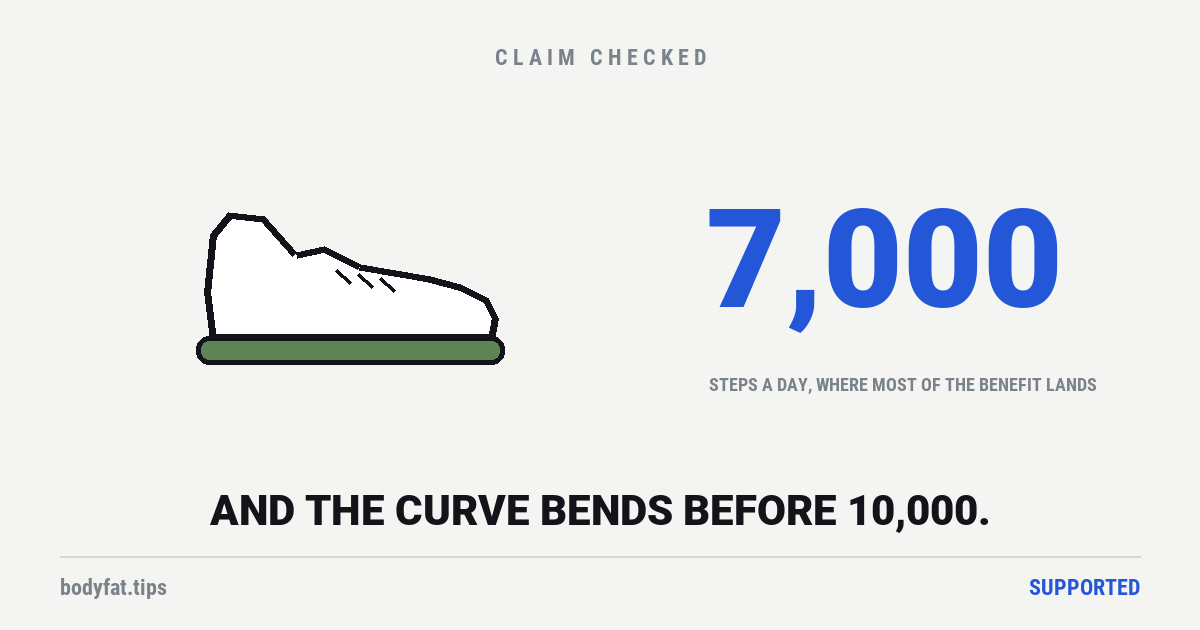
A dose-response meta-analysis published in The Lancet Public Health pooled 31 studies from 24 separate groups of people, and looked at nine different health outcomes rather than just death. [1]
Compared with a fairly sedentary 2,000 steps a day, 7,000 steps was associated with 47% lower risk of dying from any cause — and the studies agreed with each other reasonably well while saying it.
The shape matters more than the single number. For death, heart disease and stroke, dementia and falls, the curve is not a straight line. It falls steeply and then bends. For death, the bend sits at about 5,400 steps; for heart disease and stroke, nearer 7,800; for dementia and falls, nearer 8,800, though those two curves rest on just two and four studies. [1] The paper’s own summary puts all four bends at “around 5000–7000”; the figures here come from its results section. Past the bend, you keep gaining, but you gain far less per step than you did climbing out of the bottom.
The authors’ own conclusion is worth quoting because it is unusually un-preachy: 10,000 “can still be a viable target for those who are more active”, but 7,000 “might be a more realistic and achievable target for some.” [1]
The part nobody puts on the box
Steps get sold as a weight and heart thing. Look at what else moved.
Dementia risk was 38% lower. Depressive symptoms, 22% lower. Type 2 diabetes, 14% lower. [1] The dementia estimate came from only two studies — and their answers were close enough that the statistics could not tell them apart, which is not nothing, though two studies make a weak test of agreement.
And one that did not move: getting cancer. The estimate was a 6% reduction with a range running from 13% lower to 1% higher, which means no effect is still comfortably on the table. [1] Deaths from cancer were 37% lower, in three studies — and two of those three are the same cohorts that showed no clear drop in diagnoses. [1] Fewer cancer deaths without fewer cancers is a different claim, and this page cannot tell you which way it runs: people who walk more may survive cancer better, or people already ill may walk less, which is the reverse-causation problem below.
We are reporting that null in the same breath as the wins because leaving it out would make the list look tidier than the evidence is.
Does your age change the number?
Here is the finding that partly rescues the 10,000.
An earlier meta-analysis pooled 15 cohorts — 47,471 adults, 3,013 deaths, a median of just over seven years of follow-up. [2] When they split by age, the curve bent in different places:
• 60 and over: risk kept falling until about 6,000 to 8,000 steps a day.
• Under 60: it kept falling until about 8,000 to 10,000.
So for a younger adult, 10,000 lands roughly where that analysis says the benefit stops accruing quickly. The number is approximately right for them — by coincidence, not by derivation. A slogan got lucky.
The 2025 review split its studies by the participants’ average age as well, at 65, and for death it got close to the opposite picture. [1] In the younger groups, the curve for death bent at about 5,400 steps a day, well below 10,000. In the older groups it did not bend at all: it kept falling in a straight line across the range the studies covered. For heart disease and stroke, though, its older groups bent earlier than its younger ones, the same direction as the 2022 pool. Whether younger and older adults should get different targets, the authors write, “remains uncertain”. [1]
So for a 72-year-old, it depends which analysis you ask. The 15-cohort pool puts 10,000 well past the bend. The 2025 review found no bend in older groups’ risk of death, so there the extra steps kept going with lower risk.
National guidance has not settled it either. Australia’s 24-hour movement guidelines, published on 13 March 2026 and built on the 2025 review, give adults aged 18 to 64 and adults 65 and over the same line: “For those who are able and track daily steps, aim for 7,000 or more steps per day.” [7] Japan’s health ministry, in a guide dated January 2024, gives older adults a lower figure — “approx. 6,000 steps or more daily”, against about 8,000 for other adults — as the step equivalent of 40 and 60 minutes a day of walking or anything harder, and declines to fix the age at which “older” begins. [8] A guideline is a judgement about what to tell people, not a new result, and on age these two judgements differ.
Does walking faster help?
Less than you would think, once you account for the fact that faster walkers also walk more.
In the study of 16,741 older women, higher stepping intensity looked strongly protective — until the researchers adjusted for total steps per day, at which point almost all of it evaporated. [3] The 15-cohort analysis found a bit more survived that adjustment, but not for every measure of pace. [2]
The honest summary: total steps is doing most of the work. If you have to choose between more steps and faster steps, the evidence points at more.
What would change our mind
All of this is observational. Nobody has randomly assigned people a step count and followed them for a decade, and realistically nobody will.
That leaves two objections open, and they are not small ones.
Reverse causation. Being ill makes you walk less, often long before it kills you. Some of the gap between the 2,000-step group and the 7,000-step group is people who were already sick, and no statistical adjustment fully removes that.
Residual confounding. People who walk more differ in other ways — income, smoking, whether they have a safe pavement. The 2025 authors list it as a limitation themselves, along with the small number of studies behind most of the individual outcomes. [1]
That is why this is rated Supported and not Established. The evidence is consistent, graded moderate by its own authors, and points the same way across three analyses — though not three independent ones, since they share much of their data: women from the same older-women study appear in all three. It is still not a trial.
The verdict
More daily steps track with living longer, and with less dementia, less depression and less diabetes. That is Supported. Most of the gain has landed by around 7,000 a day, and the steepest part of the curve is well below that — the biggest single win is getting off 2,000.
The 10,000 came out of a 1963 walking campaign, and became a trademark nineteen years after the counter shipped. In the 15-cohort analysis it is also, for the under-60s, not far off, though the 2025 review put the bend for its younger groups nearer 5,400. The first is history; the second, where it holds, is an accident.
If you are currently taking 3,000 steps a day, the useful number is not 10,000 or 7,000. It is 4,000.
Related: does walking help you lose weight · does lifting weights burn fat · does metabolism slow with age · does lack of sleep cause weight gain · magnesium benefits
The one line this page spent on where the 10,000 came from ran the wrong way round, and an independent editorial review of our walking verdict on 18 September 2026 caught it. We had written that the number came from a pedometer: a Japanese company launching the first commercial step counter around the Tokyo 1964 Olympics and calling it the “Manpo-Kei”. The manufacturer’s own history, now source [6], says the figure came first. Doctors and journalists were promoting a ten-thousand-steps-a-day movement in 1963; the founder was asked to build something to count it with; the device that shipped in 1965 was called the Manpo-meter and, in the company’s own words, was not the Manpo-kei; and “Manpo-kei” was not registered as a trademark until 1984. The 2023 editorial we cited does call that first counter the “Manpo-Kei”, so the name is where our source and the company disagree — but nothing in the editorial says the number came from the product, and that inference was ours. The 2004 review this page’s provenance chain rests on sides with the company: it traces the figure to “Japanese walking clubs and a business slogan”. The opening paragraph, the provenance chain’s framing step and the closing line have been rewritten.
None of the step-count evidence changes. The 7,000-a-day figure, the 15-cohort pool of 47,471 adults, the age split and the advice to a 3,000-steps-a-day reader are all untouched, and the rating stays Supported. What changed is the history of the number, and it makes the same point more sharply: 10,000 was a campaign’s round figure before it was anything else.
An independent editorial review of this page on 18 September 2026 found that it counted some of the same evidence more than once, and that its funding row left out a declared industry tie. The evidence panel called the three analyses behind this page independent. They are not. The 16,741 older women in the 2019 study are one of the 15 cohorts in the 2022 pool, and all seven of that pool’s published cohorts, those women included through a later follow-up, are among the 14 studies behind the 2025 review’s estimate for deaths. The funding row named the 2025 and 2022 funders and stopped there. The 2019 study was paid for by six NIH grants, and one of its co-authors declared personal and travel fees from ActiGraph, whose hip-worn monitors the study used, and a seat on the company’s scientific advisory board — stated as outside the work, with the paper recording that ActiGraph had no involvement. Our walking verdict already disclosed this for the same paper. The row now does too, and adds the Australian Government contract behind the 2025 review and the part the US CDC’s staff played in the 2022 one.
Four readings of the 2025 review were also wrong. Cancer deaths and cancer diagnoses were measured largely in the same people, not in “a different group of people”. Its results put the bend at about 5,400 steps for death but nearer 7,800 for heart disease and stroke and 8,800 for dementia and falls; we had repeated its summary’s 5,000 to 7,000. Its studies are cohorts, not trials. And its age split for deaths points the other way from the 2022 pool’s: in older groups the curve never flattened, and the authors call separate targets by age uncertain. The age section now says so, beside Australia’s March 2026 guidelines and Japan’s January 2024 guide, which disagree on age. Smaller changes: the opening notes that two of our own sources tell the product-name history; our first note today said the 2004 review “sides with the company”, when its “business slogan” fits either account; source [4] was a 2011 paper by the same lead author under a near-identical title, never cited here, and the 2004 review our provenance chain quotes now takes its place; the figure’s spread is dated to the twenty years before 2023; the 15-cohort pool’s seven years is its median follow-up, not each cohort’s; the two dementia studies are said to agree only as far as two studies can show; the table’s heart row now reads heart disease and stroke, the review’s cardiovascular outcome, and the table compares risks rather than saying what “changed”; and the cost line notes that the studies used research monitors. The rating stays Supported: it rests on the 2025 review’s moderate certainty, which none of this changes.