Does Soreness Mean Muscle Growth? It Loosely Tracks Damage. Not Growth.

You finish a session, and two days later the stairs are a problem. Somewhere in the back of your head a little scoreboard ticks over: that one worked.
Almost everybody who trains uses soreness as a gauge. It is free, it needs no equipment, and it arrives right on schedule. It is also the single most available piece of feedback your body gives you about a workout, which is exactly why it got the job.
So here is the question worth asking about it: has anyone ever checked whether the gauge is connected to anything?
They have. Repeatedly. It is connected to the damage, loosely. To the growth, it is not.
Five times the work, and the soreness only partly followed
Start with the cleanest test of the gauge itself. A 2002 study took 110 male students and split them three ways [1]. One group did 12 all-out eccentric curls. One did 24. One did 60.
Eccentric means the lowering half of the rep — the part where the muscle is being pulled long while it is trying to hold on. It is far and away the best way to make yourself sore, which is why so many soreness studies use it.
Then they measured what actually happened to the arm: how much force it could still produce, how far it would straighten, how far it would bend, how much it had swollen, and how much creatine kinase — a muscle protein that leaks into the blood when fibres are torn — had shown up in the bloodstream.
| People | 110 male students |
| What they did | 12, 24 or 60 all-out eccentric curls — the lowering half, which is the part that wrecks you |
| Measured | peak force, elbow angle at rest and bent, arm circumference, creatine kinase in the blood |
| Objective damage | clearly worse in the 24 and 60 groups, and slower to recover |
| Soreness when pressed or bent | no significant difference between 12 and 24, or 12 and 60 |
| Soreness when stretched | significantly lower after 12 than after 24 or 60 |
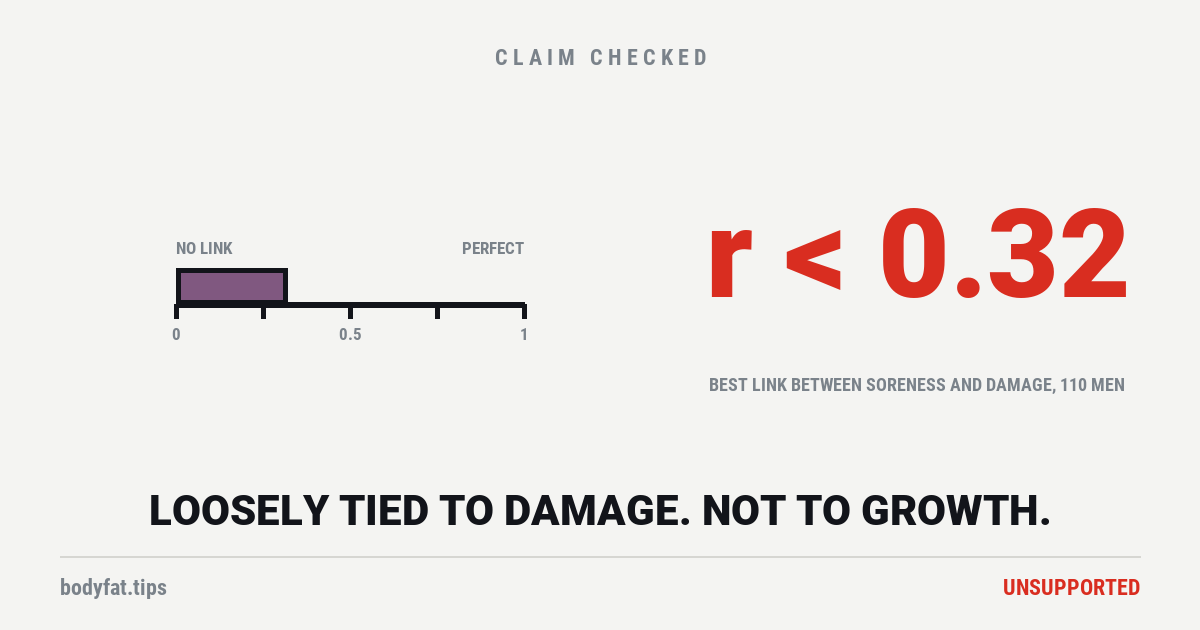
| Soreness vs damage markers | no significant correlation for pressing pain; weak but statistically significant ones for bending and stretching pain |
| Best correlation found | r below 0.32 — on a scale where 0 is no link and 1 a perfect one: weak, but statistically real |
The objective damage behaved exactly as you would expect. Sixty reps did more harm than twelve, and took longer to come back from.
The soreness only partly followed. Pressing on the muscle, or bending the arm, produced pain with no significant difference between a man who had done twelve reps and a man who had done sixty. Stretching the arm did separate them: the twelve-rep men hurt significantly less [1]. And soreness on palpation — pressing — correlated with none of the damage measures. Not one.
The best links they found, for bending and stretching pain, were below 0.32, and statistically significant: real, but weak. A correlation like this runs from 0, where knowing one thing tells you nothing about the other, to 1, where the two move together perfectly (or to −1, if one falls as the other rises). Below 0.32 is near the nothing end: square it (0.32 times 0.32 is about 0.1) and soreness accounted for at most about a tenth of the differences in damage between these men. That is our arithmetic, not the paper’s.
Their own conclusion, in the title of the paper: delayed-onset muscle soreness does not reflect the magnitude of the damage [1].
That is not the last word, and the next one cuts the other way. In 2016 a team that included the 2002 study’s lead author sorted 286 young men by how much strength they lost after one unaccustomed bout of all-out lowering curls [9]. Soreness, like every other damage marker they measured, came out smallest in the group that lost the least and largest in the group that lost the most, and they concluded that the usual markers are valid [9].
So, on average, more damage does mean more soreness. What the 2002 numbers add is how little one man’s soreness told you about his own damage. And neither study measured growth at all.
Fine — but does the damage build the muscle?
This is the fallback argument, and it deserves a straight answer, because for years it was a live hypothesis with real people behind it: tear the fibres, the body repairs them stronger, that is how you grow. A 2012 review laid out the case for and against it, found that no cause-and-effect link had been established, and still leaned towards a moderate amount of damage as best for growth [7].
Then somebody went and looked inside.
A 2016 study put ten young men, who had lifted before but not for at least six months, through ten weeks of resistance training and took muscle biopsies — actual samples, cut out of the thigh — at week one, week three and week ten [2]. At each point the researchers measured two things: how torn up the muscle was under a light microscope (checked against an electron microscope in a pilot), and how fast it was building new contractile protein.
| Week 1 | Week 3 | Week 10 | |
|---|---|---|---|
| Muscle damage under the microscope | highest | lower | minimal |
| Protein synthesis after the session | highest | lower | lower |
| Did it predict growth? | no | yes | yes |
| Fibres actually bigger? | no | no | yes |
| Soreness two days after the session, 0 to 100 | 61 | 8 | 8 |
| Did the soreness predict growth? | no | no | no |
Read the third row twice, because it is the whole argument.
At week one, damage was at its peak and protein synthesis was at its peak — and neither one predicted how much muscle those men ended up with. At weeks three and ten, when the damage had faded, protein synthesis and eventual growth moved together almost in lockstep [2].
The building response in week one was not building. It was repairing. It looks identical from the outside and it produces nothing you keep.
And the soreness the men rated after each of those sessions? It did not predict their growth at any stage [2]. They were sorest in week one, the week whose burst of protein synthesis did not predict how much muscle they ended up with.
The same group summarised the whole line of work in a review published at the end of 2017, and the sentence is about as blunt as physiology gets: muscle damage “is not the process that mediates or potentiates” the muscle growth you get from resistance training [3]. That is the group’s verdict on its own work. An independent 2019 review of what sets muscle growth off put it more cautiously: damage is probably not essential, and whether it adds anything is still unclear [12].
A direct test of the idea is a 2011 trial in fourteen untrained students [10]. Seven were eased into hard eccentric cycling over three weeks, and their creatine kinase never rose above the normal range; the other seven started with a damaging first session, and had creatine kinase more than five times higher and more soreness at the start. After eight weeks of matched work, their thigh muscles had grown by similar amounts, 6.5% and 7.5%, a gap that could easily be chance, and their strength by 25% and 26% [10].
The cruellest part: in the early weeks you really do look bigger
Here is why this myth is so hard to shake. It has evidence. You feel it.
The same group reported the ultrasound side of the same experiment [4]: the same ten men, the same ten weeks, the thigh scanned at weeks one, three and ten. Cross-sectional area — the area of a slice across the muscle — was up about 2.7% by week three. Progress, surely.
Except the echo intensity was up 17.2%. Echo intensity is how bright the muscle looks on the scan, and it goes up when the tissue is waterlogged. Normalise the size gain against it and week three is the only timepoint where the muscle is disproportionately full of fluid [4].
And the strength? On a fixed test of the most force the thigh could produce, it showed no significant gain until week ten. The weights they were handling in training, though, load times reps times sets, had already gone up by week three [4].
So in the first few weeks of training you are sore, the tape says you are bigger, and the weights are going up. All three are poor readouts of new muscle, this early. In a programme that damages the muscle, part of the early size gain, possibly a large part, can be swelling [4]. The soreness tracks the damage only loosely [1] [9]. And the climbing weights are progress, not proof of growth: in these men they rose by week three, and the fibres had measurably grown only by week ten [2] [4].
The same group’s 2017 review puts numbers on the phases: for roughly the first four sessions the size change is mostly swelling; a modest amount of real growth arrives around ten sessions; and genuine hypertrophy — actual new muscle — is what you are looking at after about eighteen [3].
Not everyone reads the early weeks that way. In a 2017 trial built to avoid the damage, thirteen untrained men did curls and presses with the lowering half taken out, and their lean mass and muscle thickness rose within seven sessions, by about a quarter of a pound of lean mass (109 g) at the seventh test, while their soreness, the swelling signal on the scan and their relaxed arm size did not change [11]. Small, and real. So early tape readings are noisy, not worthless.
Then what is soreness measuring?
Novelty. That is the short answer, and it is a useful one.
A 2026 trial makes it very hard to argue with [5]. Twenty-three people did a punishing bout of eccentric work, waited three weeks, and did it again. The second bout was matched for total work — about 1,300 joules both times, and the difference between them was nowhere near statistical significance.
Identical work. And the second time, both the strength loss and the soreness recovered faster [5].
Nothing about the workout got easier. Something about the person got better at absorbing it — the researchers found steadier firing the second time in the motor units, the nerve-and-fibre bundles that actually pull, but say they cannot tell whether that protected the muscle or simply reflected less damage [5]. A 2026 review of twelve studies by the same group calls that question unresolved [13].
Which gives you the thing that finally kills the gauge as a training tool. Soreness is highest when you are worst at an exercise, and it fades as you get good at it — in the ten-man study it had all but gone by week three, before the fibres had measurably grown [2]. The signal is loudest before the thing it is supposed to be reporting can even be measured.
If you have ever come back after a layoff, been destroyed by week one, and concluded that week one was your best week — that is the illusion, in one paragraph.
And there is a decent chance the pain is not even in the muscle
This last one is a hypothesis rather than a settled finding, and we are labelling it that way rather than letting it carry weight it has not earned.
The authors of a 2021 review make the case that delayed soreness may originate not in the muscle fibres but in the fascia — the sheet of connective tissue wrapped around and through the muscle [6]. Their argument is that fascia is far more richly supplied with pain nerve endings than muscle is, and that it hurts a great deal more when you provoke it.
The experiment that makes the point, in 13 young adults: concentrated salt water, which irritates tissue, injected into the fascia or the muscle of each leg, a day after one leg had been made sore. In the leg that had not exercised, the fascia hurt about 42% more than the muscle. In the sore leg, the muscle hurt exactly as much as it had in the other leg. It was the fascia that had become 39% more sensitive [6].
Read that plainly, and narrowly. In that one small study, the extra sensitivity in the sore leg was in the wrapping, not the muscle. It measured pain from an injection, not tenderness to the touch, and in another study the review describes, the fascia’s extra sensitivity did not line up with pain on pressing [6].
The authors go as far as proposing the phenomenon be renamed — delayed onset soft tissue stiffness rather than muscle soreness [6]. Whether that survives is an open question. But if the pain is substantially a connective-tissue signal, then asking it about muscle growth is asking the wrong tissue.
Where the belief came from, and it is older than the gym
The story starts with a physiology paper from 1902 [8]. Its author had people pull a finger against a strong spring, contraction after contraction, and logged what hurt and when. He had already noted, the year before, that a muscle out of training, worked that way, often ends up with a soreness that “cannot be regarded as a phenomenon of pure fatigue” [8].
Sit with that for a second, because the rest of the 1902 answer matters more. The delayed soreness was not fatigue. It struck muscles out of training, it rose with how sudden and how forceful the contractions were, and the author blamed ruptures inside the muscle, in the fibres themselves or in the connective tissue that passes their pull to the tendon [8]. That is the damage explanation, and it did make it out of the journal: a 2021 review credits this paper with first proposing it [6]. It is also the first link in the myth. If soreness means tearing, and tearing is what makes muscle grow back bigger, then soreness would mean growth. The evidence above weakens the first link and breaks the second.
The other explanation, one of the oldest according to the same review, was lactic acid [6]. Soreness got explained as acid pooling in the muscle after hard work, which recast the pain as the exhaust fumes of effort — a receipt. That explanation has been largely rejected, and the killer detail is this: concentric exercise, the lifting half, produces considerably more lactate than eccentric work at matched power output, and it almost never makes you sore [6].
From there it needed a slogan, and weightlifting already had one. “No pain, no gain” was a lifting saying by 1977: a book that year took it for granted that anyone who had lifted weights understood it [16]. In 1982 a film star’s home-workout video, built around “feel the burn”, carried the idea into living rooms [17], and a whole generation learned to read discomfort as the unit of account.
And where does it end up? When we asked the biggest search engine the exact question at the top of this page, on 10 September 2026, its AI summary answered partly by citing a supplement company and a mobility app, alongside two hospital systems’ patient pages. Which is the tell. A question about physiology gets answered, at the top of the internet, partly by people who sell you the thing that makes the soreness go away.
None of which is your fault. It is the most intuitive feedback signal in fitness, it has been explained to you half-right for a century, and it got printed on the wall of every gym you have ever walked into.
So how do you actually tell if you are growing?
The honest answer is that you use the boring instrument, and you use it over a longer window than you want to.
Is the work going up? Load times reps times sets. If you are doing more of it this month than last month with the same form, you are training in a way that grows muscle, whether or not it hurt afterwards. It is the readout that updates weekly, but it tells you that you are progressing, not that you have grown: in the ten-man study it rose by week three, well before the fibres measurably grew [2] [4].
Is the tape moving over eight to twelve weeks? Not eight days. In a programme that damages the muscle, part of the size change at three weeks can be swelling [4], and training that does little damage adds only small amounts that early [11], so early readings are noisy. Give it a training block.
Are you expecting a sane amount? This is where most people go wrong before they ever get to soreness — and it is worth reading what happened when 585 people ran the identical programme for twelve weeks. The spread in what they got is the single most clarifying thing in this whole area.
And the unglamorous inputs still decide it: enough total hard work, enough recovery, and enough protein — though how much is less settled than the famous number suggests.
What this does not mean
It does not mean train easy. This is the misreading to avoid, so let us be blunt: the training still has to be hard. The gauge is broken, not the engine. Progressive overload built every result in the ten-man study [2]. Those men trained for ten weeks and their fibres got bigger. Nothing here is an argument for doing less.
It does not mean soreness is a bad sign either. It is not damage you need to fear, and it is not damage you need to chase. It is mostly information about how new the movement was to you.
One exception, because that is a reassurance and this is a health page. Soreness that is severe, with marked swelling, real weakness, or urine that is dark, red or cola-coloured, can be exertional rhabdomyolysis: muscle breaking down fast enough to harm the kidneys [14] [15]. It is uncommon, and it typically follows hard, repeated work far beyond what you are used to, especially work heavy on the lowering half [15]. Dark urine after exercise needs a doctor, promptly [14] [15].
It does not mean you should go out of your way to prevent it. Some of the things sold for that are actively counterproductive — routine post-lifting cold water eases soreness and can blunt the growth, by an amount the pooled trials find small and not yet certain, and that is where chasing the soreness number may genuinely cost you. Others do less than advertised: compression boots, tart cherry juice. Massage is different: it does ease the ache, which our massage verdict rates Supported, though whether it makes you stronger afterwards is unproven, because the reviews disagree.
And it does not mean the absence of soreness is a warning. If you have been training the same movements for months and they stopped hurting, that is the repeated bout effect doing precisely what it is supposed to [5]. You did not get lazy. You got adapted.
What this is rated, and what the rating covers
Unsupported. The claim is that soreness indicates muscle growth. Tested head-on, it did not, and the two links it leans on are weak or broken.
It is rated Unsupported because the trials on this page that set soreness beside measured growth found no sign that it predicts growth: in ten men, soreness did not predict growth at any stage of ten weeks [2]; in fourteen untrained students, the group spared the early soreness grew as much as the group that had it [10]; and in thirteen untrained men, muscle grew while soreness did not change [11]. Behind those sit the two links the belief needs. Soreness tracks damage only loosely, weakly from one man to the next in one study and on group averages in another [1] [9]. And damage is not what drives the growth, by the account of the group that measured both inside the muscle, and probably not essential to it, by an independent review’s [2] [3] [12]. One result we found points the other way, and it is about damage rather than soreness: in a 2009 conference summary from a US study of 51 untrained men, the rise in creatine kinase, a blood marker of muscle damage, after the first two workouts predicted how much the arm had grown 12 weeks later; in 51 women it did not [18]. Soreness had also all but gone by week three of training, before the fibres measurably grew [2], and part of the early size change that seems to confirm it can be swelling [4].
What is not rated here: whether hard training builds muscle, which it plainly does; whether eccentric work is a good tool, which it is; and whether the fascia hypothesis is correct, which is genuinely unsettled and is flagged as such above [6]. Who it applies to: young adults, nearly all of them men; in every study here whose participants we could read about, they were untrained, recreationally active, or back after at least six months off [2] [10] [11] [13]. How far it carries to experienced lifters is open, and the 2012 review this page cites raised the possibility that damage matters more in highly trained people [7].
How we read a study, and what each confidence tier means, is set out here. Related: whether cardio burns the muscle you just built.
Corrected on 7 October 2026, after our ice bath verdict was corrected the same day. We said routine cold water after lifting blunts muscle growth, and called it the one place where chasing soreness genuinely costs you. The pooled trials find the growth cost small and not yet certain, so the sentence now says it can blunt growth; and we had not checked whether it is the only such place, so that phrase is gone.
Corrected again on 9 October 2026, after an independent editorial review of this page. Our headline said 110 men who did 12, 24 or 60 all-out reps “hurt about the same”. In that 2002 study, pressing and bending pain did not differ significantly, but stretching pain was significantly lower after 12 reps, and two of the three soreness ratings tracked the damage weakly but significantly; a 2016 analysis of 286 men found soreness largest, on average, in the men who lost the most strength. The title, description, headings, table and the figure’s label now say soreness tracks damage loosely. Our history section had the 1902 study backwards: it tied delayed soreness to sudden, forceful contractions in muscles out of training and blamed ruptures in the muscle, which is where the damage explanation began. Source [5] listed three people who are not its authors; the evidence panel counted one ten-man study as two trials and called a review by the same group independent; and the rating leaned on a trial that measured no growth.
Also changed: the page now reports the three trials here that set soreness beside measured growth, in which it did not predict growth; says the weights those ten men lifted went up in the early weeks, that part of the early size gain, not all of it, can be swelling, and that small real gains have been seen without soreness; says what the motor-unit trial could not show; adds a warning about rhabdomyolysis; says who the trials studied; brings the massage and protein lines into line with our own verdicts on them; rewrites the funding row from the papers’ own statements, including a food maker thanked by the ten-man study and a patent held by two authors of the 2011 trial; corrects the slogan’s history (weightlifters were saying “no pain, no gain” by 1977, before the 1982 workout video that popularised it); and fixes smaller errors (a review dated six years late, a light microscope called an electron one, a correlation scale given as 0 to 1, and a search observation now dated 10 September 2026). A later search found one result pointing the other way, about damage rather than soreness, and the page now reports it. The rating is unchanged: Unsupported, now resting on those direct tests.