Moringa Benefits: A Nutritious Leaf With Small, Mixed Blood Sugar Trials

“Moringa benefits” is searched about 90,500 times a month in the United States by the database’s figure for the past year, and 74,000 times in September 2026 (from a paid keyword database, pulled 23 October 2026) [1]. The leaf of the drumstick tree, Moringa oleifera, is sold as a powder, in capsules and as tea: as a superfood, and for blood sugar, cholesterol, weight and belly fat, energy, hair and skin, and breast milk [1].
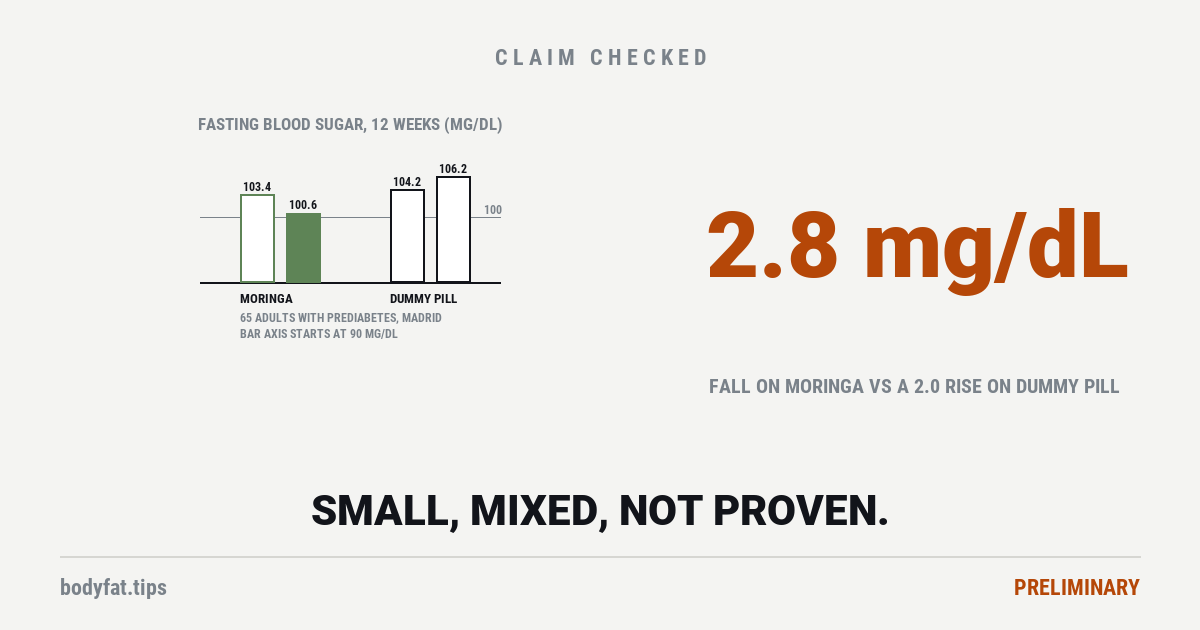
The leaf is genuinely nutritious. The blood sugar claim rests on small trials that disagree. In a 12-week double-blind trial of 65 adults with prediabetes, fasting blood sugar fell 2.8 mg/dL on moringa and rose 2.0 on a dummy pill, and when a 2025 review pooled the randomised trials, the difference was not significant. [2] [3] Weight did not move in the trials that measured it. The breast milk evidence is small and mixed. The real cautions are pregnancy, medicines and contaminated powder.
This is journalism, not medical advice. If you are pregnant, do not take moringa root or bark preparations, and ask your midwife or doctor before taking leaf products: the bark has a record of use to end pregnancies, and a leaf extract ended every pregnancy in a small rat study [4] [5]. If you take medicine for diabetes or blood pressure, ask before adding moringa: some trials found it lowered both, which would add to the drug’s effect [6]. If you take a blood thinner, are breastfeeding, take other prescribed medicines or manage a chronic illness, ask a pharmacist or clinician before starting it; a US government reference on medicines in breastfeeding advises caution in anyone at high risk of blood clots [7]. No food or supplement replaces treatment.
Does moringa lower blood sugar?
Start with the trial built to answer the question cleanly. In Madrid, 73 adults aged 40 to 70 with prediabetes, blood sugar above normal but below the diabetes line, were assigned by chance to six capsules a day of dried moringa leaf, 2.4 g in all, or six identical capsules of cellulose, for 12 weeks [2]. A teaspoon of the powder is about 2.4 g, by a US trial’s measure [8]. Neither they nor the researchers knew who had which. Sixty-five finished: 31 on moringa, 34 on the dummy pill [2].
Fasting blood sugar on moringa went from 103.4 to 100.6 mg/dL (5.74 to 5.58 mmol/L). On the dummy pill it went from 104.2 to 106.2 mg/dL (5.78 to 5.89 mmol/L) [2]. HbA1c, a blood test that reflects average blood sugar over the past two to three months, went from 5.88% to 5.79% on moringa and from 5.83% to 5.87% on the dummy pill [2]. Both differences crossed the line researchers use for “probably not chance”, the blood sugar one barely: p = 0.049, where the line is 0.05 [2]. For scale, the fasting range that counts as prediabetes runs from 100 to 125 mg/dL, and the share of people whose blood sugar was back in the normal range at the end was much the same in both groups, about one in five [2].
That is a real result, and a small one. A second trial points the same way. At a clinic in Bekasi, Indonesia, 88 adults with prediabetes took the same daily 2.4 g in capsules, or placebo capsules, for 50 days [9]. By day 38 fasting blood sugar averaged 117.4 mg/dL (6.52 mmol/L) on moringa and 119.5 (6.63) on placebo, from 118.6 and 117.8 at the start, a difference the paper reports as significant, p = 0.001 [9]. The paper does not say whether anyone was blinded, and it carries no funding statement [9]. Its spreads are unusually narrow for fasting blood sugar: the standard deviation, a measure of how far people’s readings sit from the average, was 1.8 and 2.5 mg/dL on day 38, narrower than at the start (4.3 and 3.6) and far narrower than the Madrid trial’s 8.7 and 18.0 [9] [2]. With that little spread, a gap of 2.1 mg/dL comes out highly significant. A registry record from the same university, at a Bekasi clinic, matches the paper on the ages enrolled (25 to 55), no diabetes drugs or insulin in the previous three months, the daily 2.4 g, glucose checks every three days, and a start in April 2024, the month in the paper’s ethics approval number [10] [9]. It describes a double-blind trial of 114 adults for 90 days, completed in August 2024 and posted on ClinicalTrials.gov in September 2026, two years after it ended, with no results [10]. It is very probably the same trial; if so, the paper reports 88 of its 114 people on day 38 of 90 [10] [9].
And one that found no significant difference. In Bangkok, 32 adults with type 2 diabetes diagnosed within five years and never treated with diabetes drugs, took 8 g of moringa leaf a day, more than three times the Madrid dose, or a dummy pill for four weeks [11]. “There was no significant difference of FPG and HbA1C between MO leaf and placebo group,” the authors wrote, FPG being fasting blood sugar [11]. Four weeks is short for HbA1c, as they say; their weekly readings before and after meals did not differ either [11]. Four of the 16 on moringa had diarrhoea that passed within days [11].
| Where, when | Who, what dose, how long | Fasting blood sugar |
|---|---|---|
| Madrid, Spain, 2021 [2] | 73 adults with prediabetes assigned by chance (65 finished: 31 moringa, 34 dummy pill); 2.4 g of leaf powder a day in capsules or cellulose capsules; 12 weeks; double-blind | 103.4 to 100.6 mg/dL on moringa, 104.2 to 106.2 on the dummy pill; HbA1c 5.88% to 5.79% against 5.83% to 5.87% |
| Bekasi, Indonesia, 2024 [9] | 88 adults with prediabetes (45 moringa, 43 placebo capsules); 2.4 g a day; 50 days | On day 38, 117.4 mg/dL on moringa against 119.5 on placebo, from 118.6 and 117.8 |
| Bangkok, Thailand, 2017 [11] | 32 adults with type 2 diabetes of under five years, never treated with diabetes drugs (16 and 16); 8 g a day; 4 weeks | No significant difference from the dummy pill, in fasting sugar or HbA1c |
| Kunming, China, 2026 [12] | 63 adults with obesity (34 extract, 29 placebo); 4 g of leaf extract a day in a drink; 90 days; blood tests analysed for 17 a group | Fasting sugar not significantly different; HbA1c fell 0.31 points against 0.1 |
| Pakistan, 2025 [13] | 40 overweight adults with high cholesterol (20 and 20); 1 g of leaf powder a day or corn-starch capsules; 12 weeks; blinding not stated | 98.80 to 92.65 mg/dL on moringa, 102.85 to 101.70 on corn starch |
| Sahrawi refugee camps, Algeria, 2025 [14] | 52 women with type 2 diabetes, all on diabetes drugs, randomised; 45 analysed (30 moringa, 15 nothing extra); 10 g of leaf powder a day; 3 months; unblinded | 205 to 186 mg/dL on moringa, 204 to 188 without it; not significantly different, nor was HbA1c |
| South Sulawesi, Indonesia, 2025 [15] | 240 adults with type 2 diabetes (120 and 120); 1 g of leaf extract a day plus usual care, or usual care alone; no dummy pill, no blinding; 30 days | 187.3 to 132.6 mg/dL on moringa, 184.9 to 179.2 without it, on a handheld meter |
In one pooling, the randomised trials do not separate. A 2025 meta-analysis, a method that combines trials to get one estimate, took only randomised trials of at least two weeks against a placebo or a comparison group [3]. For fasting blood sugar it pooled seven comparisons from five trials and found a difference of −0.12 [3]. That number is an effect size, which puts different trials on one scale: 0.2 is small, 0.5 moderate, 0.8 large. Its confidence interval, the range the true average probably sits in, ran from −0.38 to 0.14, so “no difference at all” is still on the table [3]. HbA1c, in three trials, did not fall significantly either, and the reviewers graded the certainty of every result very low, meaning the true effect could be substantially different [3]. It did not include the Bekasi trial, published in an Indonesian journal at the end of 2024 [3] [9]. Its count of 227 people for fasting sugar enters one trial’s comparison group of 10 once for each of the three doses that trial tested, so they are 207 people [3]. Thirty of them are in a 45-day trial in Lahore, Pakistan, of adults with high cholesterol, all taking a statin, given moringa or placebo capsules; its paper reports body mass index and blood fats and no blood sugar at all, and the pooling’s fasting-sugar row for it carries the same effect size and range as its row for LDL cholesterol, −0.05, from −0.77 to 0.66 [16] [3]. Without that row the pooled result is still not significant, by our arithmetic [3].
A 2026 pooling went wider and found more [6]. It took 20 studies of people with diabetes, prediabetes or high cholesterol, ten of them randomised and ten not, and found fasting blood sugar lower by an effect size of 0.70 and HbA1c lower by 0.62 percentage points [6]. The studies’ results were far from uniform: its I-squared, the share of the spread between the studies’ results that is more than chance would produce, was 89.8% [6]. The authors call their findings “preliminary and hypothesis-generating” [6].
Open its list of studies and two things stand out. The largest in it, 240 adults with type 2 diabetes at three community health centres in South Sulawesi, Indonesia, compared moringa capsules plus usual care with usual care alone: no dummy pill, no blinding, blood sugar on a handheld meter, and no record of the medicines people were taking [15]. Fasting blood sugar fell from 187.3 to 132.6 mg/dL (10.4 to 7.4 mmol/L) in 30 days on moringa, against 184.9 to 179.2 (10.3 to 9.9) without it [15]. A fall of 54.7 mg/dL in a month on 1 g a day is about 20 times what the Madrid trial saw on 2.4 g, by our arithmetic [15] [2]. And the pooling’s table of studies describes the Bangkok trial as 500 mg a day for six weeks, with significant falls in fasting sugar, HbA1c and blood pressure [6]. The trial’s own paper says 8 g a day for four weeks and no significant difference [11]. The numbers the pooling actually fed into its estimate for that trial match the paper, a fall of 2 mg/dL on moringa against 6 on placebo, so the error is in the table’s description, not in the pooled figure [6] [11]. The same table calls a trial of Sahrawi women, described below, a significant fall in fasting sugar and HbA1c, and the lower-dose arm of a Pakistani trial a significant fall in both and in blood pressure, while the pooling’s own chart shows neither as a significant fall in blood sugar [6] [14]. A table that misdescribes its trials is a reason to read the trials, not the table.
More randomised trials sit beside these, on both sides. A 2026 trial in Kunming, China, published after both poolings, found HbA1c fell 0.31 points on a moringa leaf extract drink against 0.1 on placebo in 63 adults with obesity, with fasting sugar not significantly different; the blood tests were analysed for 17 people a group [12]. An unblinded three-month trial of Sahrawi women with type 2 diabetes in Algeria’s refugee camps, all on diabetes drugs, gave 10 g of leaf powder a day or nothing extra; 52 were randomised and 45 analysed, 30 and 15 [14]. It found no significant difference from the women not given moringa, in fasting sugar or HbA1c; HbA1c fell 0.59 points within the moringa group, which is the result its authors lead with [14].
The 2026 pooling holds more randomised trials still [6]. In Pakistan, 40 overweight adults with high cholesterol took 1 g of leaf powder a day or corn-starch capsules for 12 weeks; fasting sugar fell 6.15 mg/dL against 1.15, a significant difference, though the moringa group also ate fewer calories over those weeks [13]. In Iran, 73 adults with metabolic syndrome were randomised to 2 g of a leaf extract a day or a placebo for eight weeks; in the pooling’s chart HbA1c fell 0.86 points against a rise of 0.03, in the 68 analysed [17] [6]. In another Pakistani trial, 50 adults with type 2 diabetes on metformin added a 1 g moringa capsule a day for three months, or did not. The paper’s figure says the comparison group took a placebo and that the trial was triple-blind, which usually means patients, staff and analysts were all kept from knowing who had which; its registry record lists metformin alone as the comparison and says only the patients were kept from knowing [18]. In the pooling’s chart HbA1c fell 0.97 points against a rise of 0.04, in groups whose fasting sugar started far apart, about 180 against 330 mg/dL as read off the trial’s own chart [18] [6]. On the other side, the two-dose Pakistani trial whose table row is wrong comes out on the placebo side of the pooling’s chart for fasting sugar at both doses, and in a two-week Nigerian trial of 20 to 60 g of leaves a day, fasting sugar was not significantly different from a diet-only group [6].
Split by design, the 2026 pooling’s own numbers sort most of this out, with one catch [6]. For fasting sugar, the arms it classes as randomised, the South Sulawesi trial among them, and, by our rebuild of its chart, very probably the Benin study described next, came out lower by an effect size of 0.34, with a range from 1.05 lower to 0.38 higher, so the difference was not significant; the non-randomised arms came out 0.99 lower [6]. For HbA1c, the arms it classes as randomised fell about half a percentage point, 0.53, with a range from 0.12 to 0.93 [6]. The catch is a 2016 study from Benin. The pooling’s own quality assessment lists it as not randomised, and at serious risk of bias for that reason, meaning its design could skew its result. Its paper gave moringa leaf powder with meals to 20 men with type 2 diabetes and used 20 people with prediabetes, whose fasting sugar started lower, 114 against 131 mg/dL, as the comparison [6] [19]. Rebuilt from the pooling’s own chart, that 0.53 comes out exactly only with the Benin study counted as randomised, where it carries about a fifth of the weight. Take it out and the seven randomised comparisons, from six trials, give a fall of 0.43 points, with a range from 0.89 lower to 0.04 higher: not significant. Both steps are our arithmetic from the pooling’s chart, not results the pooling reported [6].
So, in the randomised trials: fasting sugar came out a few mg/dL lower than placebo in the Madrid, Bekasi and Pakistani cholesterol trials, and was not significantly different in the Bangkok, Sahrawi, Kunming and Nigerian trials or, in the pooling’s chart, the two-dose Pakistani diabetes trial. The 2025 pooling found no significant difference; the 2026 pooling’s randomised arms did not separate on fasting sugar, and on HbA1c separated only with the non-randomised Benin study counted among them. The big effects come from the studies with the fewest controls.
What happens if you take moringa every day?
In the trials, people took it every day for two weeks to six months [3]. What they reported: diarrhoea in 4 of 16 on 8 g a day in Bangkok [11]; in a Thai breast milk trial of 900 mg a day for three days, nausea in 2 of 44 mothers, low blood pressure in one and low blood sugar in one newborn, against none of these on the dummy pill, by its table, though its text says no side effects were detected; none of these differences was significant [20]. In a one-week US trial of 52 healthy adults, those told to take three teaspoons a day, about 7.2 g, reported more gut symptoms than those taking one; the authors call them mild and short-lived [8]. In the eight-week Iranian trial, two of the 37 given the leaf extract were excluded for an allergy, and none of the 36 on placebo, by its participant chart, which does not say what they reacted to [17]. In Madrid, the changes in liver and kidney blood tests over 12 weeks were not significantly different between the groups [2]. In Kano, Nigeria, 177 adults with HIV took 15 g a day for six months; that trial reported their weight, and we found no side-effect count in it [21].
Two risks are ones trials of that size would not catch. The first is the powder itself. The FDA’s list of foodborne outbreak investigations, which runs back to 2020, has four for moringa powder, all posted between October 2025 and May 2026 [22]. Salmonella from moringa leaf powders and capsules, and from greens powders made with the leaf, three of the four traced to leaf from India, made 186 people ill and put 53 in hospital, by our addition of the four; no one died [22]. In the largest, 63 of the 84 sick people interviewed had eaten a greens supplement powder containing the leaf, and no other moringa product [22]. One strain was extensively drug-resistant, in capsules sold through online marketplaces and social-media shops [22]. The FDA notes the powder keeps for a long time, so a recalled jar can still be in a kitchen [22].
The second is a rare reaction. The US government’s liver-injury reference rates moringa a possible rare cause of liver injury, on one case: a 60-year-old woman in Brazil whose liver inflammation, without jaundice, returned when she restarted a moringa capsule product on its own [23]. A 2026 review tabled eight published case reports from 2015 to 2025 (its abstract says nine), six of them describing harms, among them a severe allergic reaction to fresh leaves, a serious skin reaction after eating cooked leaves, and recurring rashes [24]. A 63-year-old woman developed blood clots in both lungs after five months of a leaf extract; her doctors thought moringa the likely trigger [25]. A single case cannot show that the plant caused what followed it, and that is all these are.
Can moringa reduce belly fat?
“Moringa for weight loss” is searched about 720 times a month by the database’s figure for the past year, and 480 times in September 2026 (from a paid keyword database, pulled 23 October 2026) [1]. The trials say no, as far as they go. A 2026 pooling of four placebo-controlled trials found body weight came out 0.13 lb (0.06 kg) lower on moringa than on a control, with a confidence interval from 3.5 lb lower to 3.3 lb higher (−1.60 to 1.48 kg), and an I-squared of 0%: the trials differed no more than luck allows [26]. The 2025 pooling found no significant change in weight, body mass index or waist size, the last being the nearest measure to belly fat these trials took: four trials, an effect size of −0.18, with a range from −1.53 to 1.17 [3].
The largest trial in both weight poolings is from Kano: 200 adults with HIV on treatment, 15 g of leaf powder or a coloured cornstarch powder with meals every day for six months. Of the 177 who finished, the two groups’ weight and body mass index did not differ significantly [21].
Three results point the other way, and each comes with a catch. In the 12-week Pakistani trial above, weight fell significantly more on moringa than on corn-starch capsules, in a moringa group that also reported eating fewer calories [13]. In Bengaluru, India, 140 overweight adults lost 11.8 lb (5.36 kg) in 16 weeks on 900 mg a day of a blend against 1.9 lb (0.87 kg) on placebo, both groups dieting and walking [27]. The blend is moringa leaf, curry leaf and turmeric, and its funders, by the indexes, were the company that makes it and a company that sells it; we read only its abstract [27]. In the Kunming trial, body mass index fell 2.16 points on moringa against 1.5 on placebo at two months, with 19 and 14 people measured of the 63 who started [12].
One health publisher in Google’s results answers this question by saying no studies have examined it in humans [1]. The 2025 pooling alone holds four trials that measured waist size [3]. The pooled change was not significant, which is a finding, not an absence.
Does moringa lower cholesterol?
Not measurably, in the trials pooled so far. Five trials and 305 people (the pooling counts 325, entering one trial’s comparison group once for each of its three doses): LDL, the cholesterol linked to clogged arteries, changed by an effect size of −0.30, with a confidence interval from −1.10 to 0.51, an I-squared of 91% and very low certainty; total cholesterol and triglycerides were not significantly different either [3]. In Madrid, where the trial was double-blind, cholesterol and blood pressure were not significantly different between the groups [28]. The largest trial in the cholesterol pooling is the Bengaluru blend, which did lower LDL, and which is not moringa alone [3] [27]. Of the trials of moringa alone in it, one found LDL lower: the 12-week Pakistani trial above, 18.1 mg/dL down against 1.2 up on corn-starch capsules, in 40 people [3] [13]. The other three, the double-blind Madrid trial, the two-week Nigerian trial and the Lahore statin trial described above, found no significant difference in the pooling’s chart, and pooled, the change was not significant [3]. Foods that do lower LDL, and by how much, have their own verdict.
Moringa and breastfeeding: does it raise milk supply?
In the Philippines, where it is called malunggay, and in parts of Africa and India, moringa dishes are given to new mothers to make more milk [29]. A substance taken for that is called a galactagogue.
A double-blind trial found a gap it could not tell from chance. In Bangkok, 88 mothers, nearly all after a caesarean, took 450 mg of leaf twice a day or an empty capsule [20]. On day three, measured by weighing the babies, the median mother on moringa, the one in the middle, fed 2.5 fl oz (73.5 mL) of milk, against 1.7 fl oz (50 mL) on placebo: 47% more, and not significant, p = 0.19 [20]. At six months 52% were still breastfeeding exclusively, against 45%, also not significant [20].
Smaller trials found more. In a 2000 Philippine trial of 68 mothers of premature babies, 500 mg a day raised the milk expressed on the second and third days of taking it by 2.2 and 6.7 fl oz (66.2 and 199.5 mL) over placebo, by a 2026 review’s arithmetic; we read the trial only through that review [30]. In Kenya, 50 mothers at two locations, those at one eating 20 g of moringa a day in porridge and those at the other plain porridge, expressed 32 fl oz (947 mL) a day against 21 fl oz (618 mL) after three months; the babies’ growth was not significantly different [31]. With one location per group, the authors note, the treatment cannot be separated from the place, and one author is a co-inventor on a patent application for moringa-family extracts [31].
The poolings disagree with each other. Cochrane’s 2020 review, of mothers of healthy full-term babies, could pool two moringa trials, 135 mothers: 4.5 fl oz (132.59 mL) more milk, with a range from 3.0 fl oz less to 11.9 more (−88.10 to 353.28 mL), at very low certainty [29]. It also recorded that one moringa trial reported no adverse effects in its text while listing an infant death in the moringa group in a table, with too little information to judge whether the two were related [29]. A 2026 pooling of 14 studies and 865 mothers found a large benefit, an effect size of 1.01, and called it moderate-quality evidence [32]. That figure combines milk volume with prolactin, the hormone that drives milk production, milk fat and satisfaction scores, as its authors acknowledge, and its six randomised trials gave 0.85, the four it rated high quality 0.83; its abstract labels the 0.85 as the high-quality figure [32]. Ten of its 14 studies are from Indonesia, eight were not randomised, and the largest, 160 mothers, gave moringa together with royal jelly [32]. Its row for the Bangkok trial reads 184 mL a day on placebo against 271 on moringa; the trial’s own report has 50 against 73.5 on day three [32] [20]. A 2025 review printed the same trial as a 30% increase [33]. That 30% is the gain the trial’s authors hoped to detect when they worked out how many mothers to enrol, not a result [20].
The professional guidance splits. The Academy of Breastfeeding Medicine’s protocol says “ABM cannot recommend any specific galactogogue at this time” and lists moringa only among herbs commonly mentioned [34]. The US government’s breastfeeding-medicines reference reads the 2026 pooling as showing that moringa raises prolactin and milk volume and quality, and says studies have found no serious short-term harm to nursing mothers or their babies [7]. It also notes that the long-term benefit to breastfed babies has not been well studied, and says such remedies “should never replace evaluation and counseling on modifiable factors that affect milk production” [7]. We weigh that pooling less than the reference does, for the reasons above: most of its studies were not randomised, its 1.01 is not a measure of milk alone, and its row for the Bangkok trial does not match the trial [32]. If milk supply is the worry, the first call is to a lactation consultant, midwife or doctor.
Moringa powder: is it more nutritious than oranges, milk and carrots?
Gram for gram, the fresh leaf is a rich vegetable. Per 3.5 oz (100 g) the USDA lists 9.4 g of protein, 185 mg of calcium, 4 mg of iron and 378 micrograms of vitamin A [35]. That is more calcium than the same weight of whole milk [35]. An Indian online pharmacy in Google’s results says the leaves surpass “carrots, oranges, and even milk” [1]. Vitamin C is where it wobbles: the USDA lists 51.7 mg per 100 g of fresh leaf against 53.2 mg in the same weight of orange, while an Indian laboratory measured 271 mg in its fresh leaves, and 510 to 1,326 mg per 100 g after drying them by different methods [35] [36]. Leaves, harvests and laboratories differ by that much.
| Food and amount | Vitamin C | Calcium | Source |
|---|---|---|---|
| Fresh moringa leaves, 3.5 oz (100 g) | 51.7 mg | 185 mg | USDA [35] |
| Orange, 3.5 oz (100 g) | 53.2 mg | 40 mg | USDA [35] |
| Whole milk, 3.5 oz (100 g) | 0 mg | 113 mg | USDA [35] |
| Fresh moringa leaves, 1 cup chopped (21 g) | about 11 mg | about 39 mg | USDA, our arithmetic [35] |
| One orange (131 g) | about 70 mg | about 52 mg | USDA, our arithmetic [35] |
| Whole milk, 1 cup (244 g) | 0 mg | about 276 mg | USDA, our arithmetic [35] |
| Moringa leaf powder, 2.4 g (the Madrid trial’s daily six capsules) | not measured | 116.5 mg | The trial’s own laboratory analysis, our arithmetic [2] |
Per serving is where the comparisons fall apart. A cup of chopped fresh leaves weighs 0.7 oz (21 g) and holds about 11 mg of vitamin C and 39 mg of calcium; an orange holds about 70 mg of vitamin C, and a cup of milk about 276 mg of calcium [35]. The Madrid trial’s daily six capsules, 2.4 g of powder, carried 116.5 mg of calcium, 9% of the Daily Value, 0.5 mg of iron, 3%, and 0.7 g of protein, by the trial’s own laboratory analysis and our arithmetic [2] [37]. Even at the Indian laboratory’s highest dried figure, 2.4 g of powder holds about 32 mg of vitamin C, a third of the 90 mg Daily Value; at its lowest, about 12 mg, by our arithmetic [36] [37]. A capsule is a pinch of a vegetable. Another powder sold on nutrient density, greens powder, has its own verdict; two of the four outbreaks above ran through greens powders made with moringa leaf [22].
What to avoid while taking moringa?
Root and bark in pregnancy. A 1978 Indian forensic paper described moringa bark as a “poison used for abortion”: by its abstract, the powdered bark causes violent contractions of the womb, with fatal results, and was used in Bengal [4]. In 1988 a drug research institute in Lucknow, India, reported observing that about 80% of women in one village used moringa leaves to end early pregnancies, and that a leaf extract given to seven pregnant rats ended every pregnancy [5]. A root extract acted like estrogen on the womb in rats [38]. These are animal studies of extracts, not of a leaf powder eaten by women. They are still enough to keep root and bark out of pregnancy, and to make the leaf a question for the midwife or doctor.
Diabetes and blood pressure medicines. If the trials that found falls in blood sugar and blood pressure are right, moringa would add to drugs that lower them [6] [26]. The Bangkok trial saw no dangerously low blood sugar, but its patients took no diabetes drugs [11]. Ask the prescriber first.
Blood thinners and clots. The US breastfeeding-medicines reference advises caution in anyone at high risk of blood clots, on the strength of the single case report above [7] [25].
Allergy. Allergic reactions turn up in both the case reports and the trials above: a severe reaction to fresh leaves in one case report, and two people excluded from the Iranian trial for an allergy [24] [17].
Recalled powder. Check any moringa jar or bottle against the FDA’s recall lists [22].
Moringa benefits for women and for men
Who the studies were done on matters more than whose name is on the jar. The blood sugar trials enrolled adults aged roughly 25 to 70, most with prediabetes or type 2 diabetes, in Spain, Indonesia, Thailand, China, Pakistan, Iran, Nigeria and Algeria’s refugee camps [2] [9] [11] [12] [13] [14] [6]. The weight and body-size trials ran in Nigeria, the Democratic Republic of the Congo, Pakistan, the Philippines, Thailand, Spain, India and China, two of them in people with HIV [26] [3] [12]. The breast milk trials were in mothers in Thailand, the Philippines, Indonesia and Kenya [20] [30] [32] [31]. None of the trials of blood sugar, weight or breast milk on this page ran in the United States; the one US trial here, in California, tested whether healthy adults would take the powder for a week, how much they liked it and what symptoms it caused [8].
For women, the moringa-specific evidence is the breast milk question above, and the pregnancy caution. For men, the nearest thing is a 2024 pilot trial from a Tianjin research institute in 44 young men: 30 days of a leaf water extract improved push-ups and time on a treadmill against placebo [39]. One small trial, read as its abstract. For blood sugar, weight and cholesterol, the trials we could check enrolled men and women together, except the Sahrawi trial of women [14]; the Benin study above gave moringa only to men [19].
Which is better, ashwagandha or moringa?
They are sold for different jobs, and we found no trial that set one against the other [40]. Ashwagandha is sold for stress and sleep; this desk’s ashwagandha verdict found its cortisol fall real and the “feel less stressed” result contested. Moringa is sold as food and for blood sugar, and is rated on this page. If the comparison you need is moringa or turmeric, the turmeric verdict answers it; if it is another plant sold for blood sugar, berberine has its own, and so does hibiscus tea for blood pressure.
If moringa cut blood sugar 69% in rats, why does it move a few mg/dL in people?
This section is the desk’s own reasoning, and it is labelled as such. The modern claim leans on animals: in a 2009 study, a moringa leaf extract cut fasting blood sugar 69.2% in severely diabetic rats over 21 days, and by 2021 a pooling of 44 rodent studies found a very large pooled fall [41] [42]. In people given a dummy pill for comparison, the difference is a few mg/dL [2] [9]. Three answers, each rated.
Answer one: the rats were a different patient. Those rats were made diabetic with a drug that destroys the insulin-making cells, and the 69.2% fall came in the most severely affected; the people in the careful trials had prediabetes, starting near 104 to 119 mg/dL [41] [2] [9]. Blood sugar that starts near normal has little room to fall. The starting points are measured; that they explain the gap is our inference.
Answer two: the bigger human effects come from the studies with the fewest controls. The pooling restricted to randomised trials found a fall with an effect size of 0.12; the one that admitted unblinded and non-randomised studies found 0.70, and its largest study had no dummy pill [3] [6] [15]. The gap between the two poolings is measured. For fasting sugar, so is the split inside the wider pooling: its non-randomised arms gave 0.99 and its randomised arms 0.34, and its authors write that the non-randomised studies overestimated the effect; their own test of that difference came out at p = 0.073, just the wrong side of the line [6]. For HbA1c the pooling’s split, as printed, seems to say the opposite: its randomised group still showed a fall of about half a point. But that group counts the non-randomised Benin study, and without it, by our arithmetic from the pooling’s chart, the randomised trials do not separate on HbA1c either [6] [19]. That step is our arithmetic, not a measurement.
Answer three: the dose is a garnish. Fresh leaves are about 79% water by the USDA’s figures, so the Madrid trial’s 2.4 g of powder is the dry matter of roughly 11 g of fresh leaf, about half a cup chopped [35] [2]. That is arithmetic, not a measurement, and it ignores the moisture left in a powder; it is the right size, not the right decimal.
Put the three together and here is what we think, stated plainly so you can disagree with it: moringa is a nutritious vegetable that was sold as a diabetes medicine on the strength of rat studies, and at the doses in a capsule it behaves like a vegetable.
What we could not find, and would like to: a placebo-controlled trial of a few hundred adults with prediabetes, run for a year, at a dose people buy, measuring HbA1c and how many go on to diabetes. None of the randomised blood sugar trials on this page ran longer than three months, and the 114-person registered trial in Bekasi has posted no results [10]. If you know of the longer trial, the corrections line on this site is open.
Where “proven to treat diabetes” came from
The nutrition story came first, from aid work. In 1999 a relief agency’s West Africa office in Dakar published The Miracle Tree on its moringa project in Senegal, and in April 2000 a church news service quoted its head on the leaf’s vitamin A, “four times the amount found in carrots” [43]. In June 2000 the agency gave seedlings of the “miracle tree” to a former UN ambassador to promote its work [43]. The name stuck: a US hospital system’s health blog uses it in January 2026 [1]. We have not read the 1999 book, so we cannot say whether the comparisons with oranges and milk that circulate now began there.
The diabetes story came from the rats. The 2009 study that cut blood sugar 69.2% in diabetic rats concluded that it “validates scientifically the widely claimed use” of the plant to treat diabetes [41]. Today Google’s AI answer says “early studies suggest leaf extracts may help lower post-meal blood sugar”, and a moringa brand’s “Top 10 Benefits” page, published in 2018, says moringa “is proven to decrease blood glucose levels” [1]. From the rat paper’s “validates scientifically” to a brand’s “proven” is nine years; we could not trace the steps between.
None of this is aimed at anyone who eats moringa or buys the powder. It is a real vegetable with a real nutrient profile, and some placebo-controlled trials found a small blood sugar effect, while others found no significant difference. The word that does not belong is “proven”.
What this is rated, and what the rating covers
Preliminary — for the claim that moringa lowers blood sugar.
It is rated Preliminary because the evidence in its favour is small, short and conflicting. In randomised trials, fasting blood sugar came out a few mg/dL lower than placebo in two prediabetes trials and one in overweight adults with high cholesterol, and was not significantly different in trials in diabetes lasting two weeks to three months or in a 90-day trial in obesity [2] [9] [13] [11] [14] [12] [6]. The 2025 pooling of randomised trials found no significant difference at very low certainty [3]. In the 2026 pooling the randomised arms did not separate on fasting sugar; on HbA1c they separated only with a non-randomised study from Benin counted among them, and by our arithmetic not without it, though in the pooling’s chart the eight-week Iranian trial found a clear fall on its own [6] [19] [17]. The Bekasi result, very probably an early report of a larger trial, with unusually narrow spreads, carries less weight than its p-value suggests [9] [10].
In words, the narrower claims: blood pressure, Preliminary: the two 2026 poolings found falls of about 6 to 7.5 mmHg, while the 2025 pooling, limited to randomised trials, found only the lower number fell, in a result it called not robust [26] [6] [3]. Cholesterol: Unsupported, of the tested kind; it was tested in five trials and did not hold up: the one trial of moringa alone that found LDL lower was 40 people whose moringa group also ate fewer calories, three others found no significant difference, and the pooled change was not significant [3] [13]. Weight and belly fat: Unsupported, of the tested kind, on two poolings and a six-month trial [26] [3] [21]. Breast milk: Preliminary, on small and mostly non-randomised studies against a double-blind trial that was not significant [32] [20]. Energy: Preliminary, on one 30-day trial of 44 young men [39]. Hair: Preliminary; a 2026 review found five studies, four in animals and one case series [44]. Skin is not rated: the human skin studies in a PubMed search we ran tested creams on the skin, not moringa eaten [40]. A nutritious leaf, gram for gram: Established, by food composition data [35] [36]. More vitamin C than oranges, per serving: Unsupported, of the tested kind; the food data test it, and per serving it does not hold [35].
What is not rated here: moringa seed oil, the seeds for water purification, testosterone and sexual claims for men, and the frame in the section above, which is this desk’s reasoning from the evidence rather than a result the evidence delivered. It is marked as ours so that you can weigh it as ours. This is journalism, not medical advice. How we read a study, and what each tier means, is set out here.
- Biotin for Hair Growth: It Regrows Hair Lost to a Deficiency. Without One, the Two Small Tests of Biotin Alone We Found Showed No Significant Gain.
unsupported - DHEA Benefits: Two Years Restored the Hormone, Not Strength or Quality of Life
unsupported - Vitamin D3 and K2: Artery Calcium Still Rose, a Fifth Slower in the Largest Trial
preliminary