DHEA Benefits: Two Years Restored the Hormone, Not Strength or Quality of Life

“DHEA benefits” is searched about 8,100 times a month in the United States, and “DHEA for women” about 6,600, by the database’s figure for the past year (from a paid keyword database, pulled 23 October 2026) [1]. The questions beside it are practical: is it okay to take every day, does it reduce belly fat, why take it at night, what are the side effects [1].
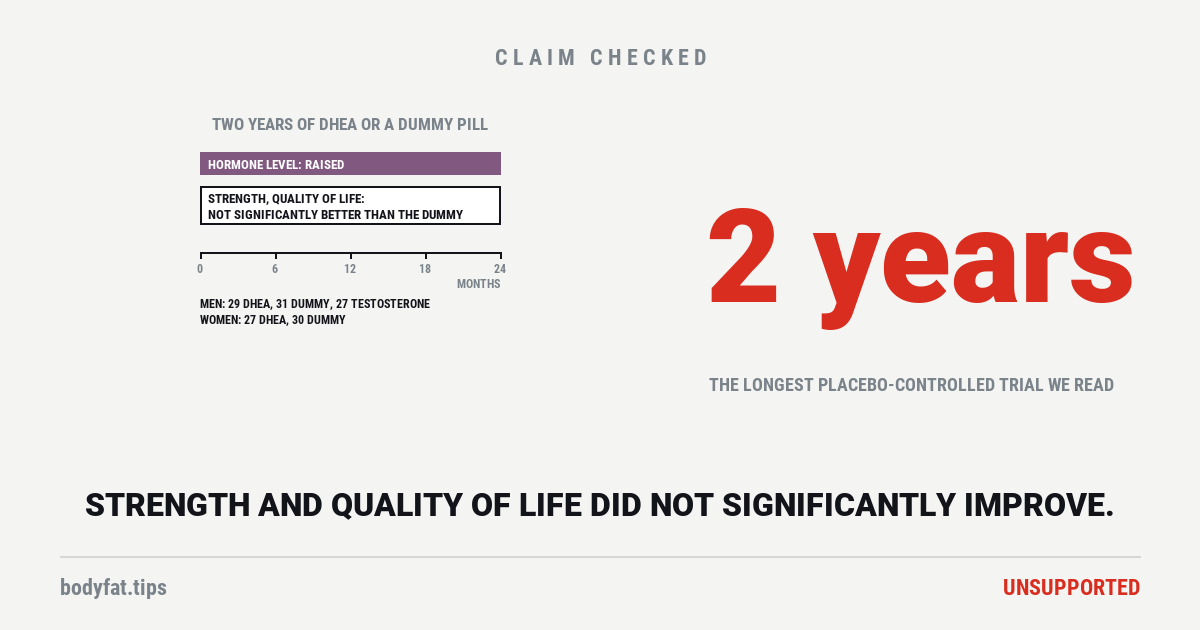
DHEA pills reliably do one thing: they raise hormone levels in the blood. In placebo-controlled trials of older adults lasting up to two years, the things it is sold to bring back, a leaner body, more drive, more energy, improved little or not significantly. The longest placebo-controlled trial we read gave 144 people aged 60 and over DHEA, a dummy pill or, for some of the men, testosterone, for two years (56 of them took DHEA), and its authors concluded that their data “provide no evidence that either DHEA or low-dose testosterone is an effective antiaging hormone supplement” [2].
DHEA, short for dehydroepiandrosterone, is a hormone made mainly by the adrenal glands, which sit on top of the kidneys. Its level in the blood falls steadily through adult life [3] [2]. Your body turns some of it into testosterone and estrogens, and that is the whole reason anyone expected a pill to matter.
This is journalism, not medical advice. DHEA is a hormone, and in the trials below it raised testosterone and estrogen. A university health system’s guidance says it is not recommended for anyone with a hormone-sensitive cancer such as breast or prostate cancer, anyone pregnant or breastfeeding, anyone with high cholesterol or taking antidepressants, and warns that adding it to estrogen or testosterone can raise the risk of side effects [4]; a cancer centre’s page adds that it should not be used with tamoxifen, a breast cancer drug [5]. If any of that applies to you, or you take prescribed medicines, are trying to conceive or are under 18, talk to a clinician before starting it; the individual trials on this page were all in adults. And if you compete in a tested sport, DHEA and 7-keto DHEA are both on the World Anti-Doping Agency’s list of substances banned at all times [6].
What does a DHEA supplement do to your hormones?
This part works. In a 1994 trial whose authors called it the first demonstration of “novel effects” of DHEA replacement in older men and women, 50 mg taken nightly brought DHEA and DHEA-S, the sulfated form most of it circulates in, back to young-adult levels within two weeks; in the women it doubled testosterone and two related male-type hormones, and in the men only one of those rose, a little [7].
Later trials confirm the direction. A 2025 pooling, a meta-analysis that combines trials to get one estimate, of 21 studies in women past menopause, with 20 trial arms measuring testosterone and 17 estradiol, found testosterone about 24 ng/dL higher on DHEA than in the comparison groups, most of them given a dummy pill, and estradiol, the main estrogen, about 8 pg/mL higher [8]. A 2020 pooling of 42 publications in women and men put the testosterone rise at about 28 ng/dL, larger in women than in men, 31 against 21 [9]. One caution about the 2025 pooling: its biggest entry is itself a pooling of four trials, and its table also lists, as separate entries, reports from two of those four trials, one of them twice, so some women are counted more than once, by our reading of its table [8].
In older men the pill seems to turn into estrogen more than into testosterone. In the two-year trial, estradiol rose in both sexes on DHEA and total testosterone rose in the women [2]. Pooling four US trials and 585 older adults, testosterone rose significantly in the women; in the men, estradiol rose and testosterone did not: it fell slightly on both DHEA and the dummy pill, by amounts not significantly different [10].
What does a higher number on a blood test mean? That the pill was absorbed and converted. It is not, on its own, a benefit. A hormone level is the means; the trials in the rest of this page measured the ends people buy it for. How to read your own result is in our free and total testosterone verdict and our verdict on normal testosterone levels by age.
What about the DHEA dosage for testosterone? Across trials, doses above 50 mg a day went with bigger testosterone rises than 50 mg or less, about 58 against 19 ng/dL [9]. That compares different trials rather than doses in the same people, and a bigger rise in a number is not a bigger benefit. Testosterone boosters and testosterone replacement have their own verdicts.
Does DHEA reduce belly fat?
One trial says yes. In 2004 a Washington University team gave 56 people aged 65 to 78 either 50 mg of DHEA a day or a dummy pill for six months and measured visceral fat, the fat packed around the organs, by MRI. The DHEA group’s visceral fat area fell by about 2 square inches (13 cm²) on the scan; the dummy-pill group’s rose by about half a square inch (3 cm²) [11].
A bigger, longer trial did not find it. At the University of Colorado, 140 people aged 60 to 88 took 50 mg or a dummy pill for a year; in the 119 who took their pills, CT scans showed no significant difference in belly fat between the groups [12]. In fairness to the claim, its authors add that the trial was designed around bone and lean mass, so its negative findings on fat “should be interpreted cautiously”, and that they knew of one trial that had found the belly-fat effect, the 2004 one [12].
The two-year trial measured belly fat too. Analysed separately, neither the men nor the women on DHEA showed a significant effect on any body-composition measure; with both sexes combined, the DHEA groups had what its authors call a “slight but significant” rise in fat-free mass, of less than 1.1 lb (0.5 kg), and a fall in the proportion of body fat of less than 1.5%, in the paper’s figures [2].
Put the four US trials together, 290 men and 295 women followed for a year, and the men taking DHEA lost 0.9 lb (0.4 kg) of fat over the year, a change significantly different from the dummy-pill group’s; the women’s fat mass did not differ significantly [10]. A 2013 pooling of 25 trials in 1,353 older men found a small fall in fat mass, pooled from those of its trials that measured fat (its summary does not say how many): a standardised mean difference of −0.35, a scale that puts results measured in different ways on one footing, where 0.2 is small and 0.5 moderate. Its authors call it “a small but significant positive effect”; when they compared the trials in a regression, the link with fat “disappeared” once the rises in testosterone and estradiol were taken into account, and they read the effect as working through DHEA’s conversion into those hormones [13]. A 2020 pooling of trials in adults of both sexes and a wide range of ages also found fat mass lower on DHEA, by a figure its summary gives as 0.85% without saying of what [14]. It is less of a separate check than it sounds: by the weights printed on its chart, 71% of that estimate comes from one Washington University trial that is also one of the four US trials above, and one of its entries is a trial of 7-keto DHEA, a different compound, by our reading [14]. We could not read the 2013 pooling’s list of trials, so we do not know how many of the four US trials it also counts [13]. In women past menopause, a 2014 pooling of 23 trials found no significant change in weight or body-mass index [15].
So does DHEA reduce belly fat? In one six-month trial of 56 people, yes. In a year-long trial of 119, the difference was not significant. Across a year in 290 older men, the men on it lost under a pound of fat. What has shrunk belly fat in trial after trial has its own verdict.
DHEA for women: sex drive, menopause and bones
A 2015 Cochrane review gathered 28 trials and 1,273 women around and after menopause [16]. On quality of life it found no improvement: a standardised mean difference of 0.16, with a confidence interval, the range the true average probably sits in, of −0.03 to 0.34, which includes no difference at all [16].
On sexual function the review’s main estimate, after it left out one trial it judged at high risk of bias, favoured DHEA, 0.31, which its authors translate into about 2.3 points on an 84-point questionnaire and say “may not be clinically significant” [16]. That estimate leaned on a different product: 107 of its 261 women were in a trial of DHEA inserted into the vagina [16]. When the review split the trials by route, the ones of DHEA taken by mouth showed no significant improvement, 0.11 (from −0.13 to 0.35), a figure that still includes the trial left out of the main estimate, and the one vaginal trial did, 0.42, though the review found the two routes not significantly different from each other, with or without that trial [16].
A second pooling, done to inform the Endocrine Society’s guideline on androgens in women, looked only at DHEA that reaches the whole body: 23 trials and 1,188 women past menopause [15]. Libido and sexual function, pooled from five of those trials, came out at 0.35, with a confidence interval of −0.02 to 0.73, not significant; quality of life, mood, weight and bone density were not significantly improved either, and its authors rated their confidence in all of it low [15].
Hot flushes and night sweats? The Cochrane review could not pool its trials, which measured symptoms in different ways, and its authors write that there is “uncertainty whether DHEA decreases menopausal symptoms” [16]. Every trial of menopause symptoms in the review gave DHEA by mouth, and against a dummy pill the two it counted, of 17 and 66 women, both “showed no decrease in menopausal symptoms for DHEA” [16]. A third, which the review counted under quality of life instead, gave 93 women past menopause with low sexual desire 50 mg a day or a dummy pill, and over 26 weeks found no significant difference between the groups on a menopause-specific questionnaire, or on its measures of sexual function and well-being [17]; a 2014 review reports the same for that questionnaire [15]. The favourable results came from other comparisons. A 2006 pilot gave 28 women 50 mg a day for four weeks with no comparison group: in the 22 who could be assessed, the average hot-flush score, how often times how bad, fell 50% from where it started, and its authors called for a placebo-controlled trial [18]. A trial of 50 women whose menopause followed surgery, against no treatment and not blinded, found less tiredness, fewer night sweats and less loss of libido; hot flushes, by the review’s account, “did not differ” between its groups [16]. Against hormone therapy, a trial of 24 women favoured DHEA and another favoured the hormone therapy slightly [16]. A trial published since the review randomised 70 women past menopause to DHEA or another product for three months: both groups’ scores on a menopause-symptom scale fell, by comparable amounts, and with no dummy pill its authors call the findings “hypothesis-generating” [19]. Two more placebo-controlled trials of DHEA pills alone that set out to measure hot flushes have finished with no results posted: one of 50 women at a Quebec university hospital centre, which ended in 2007 [20], and one planned for 100 women, sponsored by a Polish drug company, which ended in November 2024 [21]; we found no paper from either [22].
What DHEA did do, more often than a dummy pill, was cause side effects of the male-hormone kind, mostly acne, in 15% of women against under 3% [16]; the review’s examples include unwanted hair growth [16].
Bones are the most consistent small positive in women. Across the four pooled US trials, spine density in the women on DHEA rose 1.0% over a year, significantly more than on the dummy pill, which the authors note is less than the 3 to 5% seen with a standard osteoporosis drug, alendronate [10]. In the same women, density held steady at the total hip and rose 0.5% at the trochanter, the bony point at the top of the thigh bone, and at both sites, as at the spine, the result was significantly better than on the dummy pill [10]. A 2019 pooling of placebo-controlled trials found hip density higher on DHEA in women, and not in men [23]. The 2014 pooling’s spine result pointed the same way but did not pass its own strict threshold, its hip result was not significant, and that review found no trial that had counted fractures [15]. These are not three separate checks: the 2014 review’s trials include all four US trials, and so does the 2019 pooling’s reference list, though we could not read which of its analyses used them [15] [23]. What else moves bone density is in our exercise for osteoporosis verdict.
Vaginal DHEA is a prescription drug, and a different thing
One form of DHEA is an approved medicine. In the US it is prescribed as a 6.5 mg vaginal insert, used once a day at bedtime, for moderate to severe dyspareunia, pain during sex, caused by the thinning and drying of vaginal tissue after menopause; it was first approved in 2016 [24]. In the larger of its two 12-week trials, which enrolled 558 women for whom painful sex was the most bothersome symptom, pain severity on the trial’s scale fell, among the 482 in the label’s analysis table, from about 2.5 to 1.1 on the insert and to 1.5 on a dummy insert, a difference of 0.35 points [24]. Its label warns that estrogen is one of the things prasterone, the drug name for DHEA, becomes, and that it has not been studied in women with a history of breast cancer [24].
Those trials tested the insert, for that one symptom. Google’s AI answer for “dhea benefits” lists the vaginal inserts among DHEA’s benefits [1]; for a capsule swallowed for anything else, that is evidence borrowed from a different product.
DHEA benefits for men: testosterone, sex and strength
For men the record is thinner still. The 2013 pooling of 25 trials and 1,353 older men, followed for 36 weeks on average, found no benefit over a dummy pill for sexual function, bone health, blood fats and sugar, or quality of life [13]. In the two-year trial, where the men took 75 mg a day, strength and aerobic fitness in the DHEA groups changed about as much as on the dummy pill, and quality-of-life scores did not change significantly [2]. A 2011 review of eight studies in 661 people aged 50 and over called the evidence on strength and physical function inconclusive: for each measure that improved in one study, a similar number of studies found no gain [25].
If what you want is more testosterone, the pooled rise in men was about 21 ng/dL [9], and in the four US trials testosterone was not among the men’s hormones that rose significantly [10]. Fadogia agrestis, a plant extract sold to raise testosterone, has its own verdict.
Energy, mood and quality of life
The first good news was about how people felt. In the 1994 trial, 30 people aged 40 to 70 took DHEA for three months and a dummy pill for three, in random order, and the authors reported “a remarkable increase in perceived physical and psychological well-being” in 67% of the men and 84% of the women; percent body fat was “unaltered” [7]. The larger trials that came after measured quality of life with standard questionnaires and did not find it improved: not in the Cochrane review’s eight trials [16], not in the 2014 pooling [15], not over two years [2].
Mood is more open. A 2020 review of 15 trials and 853 people with depression or depressive symptoms drew data from 14 of them and pooled 12, 742 people, after setting aside two that its authors say strongly influenced the disagreement between the trials, and found DHEA ahead of a dummy pill, a standardised mean difference of −0.28 (from −0.45 to −0.11); it rated the certainty of that result very low [26]. We could not read its list of trials, so we have not checked its biggest one [26]. A 320-person trial at a Berlin university hospital, testing DHEA added to antidepressants, began in June 2026 and is due to finish its main measurements in 2028 [27].
DHEA and IVF for women with a poor response
Fertility clinics have given DHEA to women whose ovaries respond poorly to IVF drugs. A 2024 Cochrane review pooled nine trials and 1,433 women for live births, counting an ongoing pregnancy where a trial did not report births, and concluded that DHEA “likely results in little to no difference”: an odds ratio, how the odds of a birth compare, where 1.00 means no difference, of 1.30, with a confidence interval of 0.95 to 1.76, and moderate certainty [28]. With the trials at high risk of bias left out, it was 1.08 [28].
Its biggest trial is the clearest. At nine centres in China, 821 women were randomised to DHEA or a dummy pill before IVF: 8.8% of the DHEA group and 9.0% of the dummy-pill group had a live birth [29]. That one trial holds 57% of the women in the review’s analysis of live births and ongoing pregnancies, by our arithmetic [28] [29]. One of the nine, an Egyptian trial of 140 women that had reported more pregnancies on DHEA than on no treatment, entered that analysis on ongoing pregnancies, since it did not report births [28]; it was retracted by its journal in 2026, after the review’s search [30].
When DHEA replaces a missing hormone: adrenal insufficiency
In adrenal insufficiency the adrenal glands fail, and the body makes too little cortisol; in the form that starts in the glands themselves, DHEA production fails almost entirely too [31]. That is a medical condition treated with prescribed cortisol replacement, not the “adrenal fatigue” sold online, as our cortisol detox verdict explains. Here DHEA has been tested as a replacement, and the results are small. A 2009 pooling of ten trials in women found a small improvement in quality of life, a standardised mean difference of 0.21, which its authors said DHEA may produce “in a small and perhaps trivial manner”, a small benefit on depression too, and no significant effect on anxiety or sexual well-being; they judged the evidence “insufficient to support the routine use of DHEA” in these women [32]. A year-long UK trial in 106 people improved one quality-of-life subscale and reversed ongoing bone loss at the hip, and found no significant benefit on fatigue or sexual function [31].
The Endocrine Society’s guideline suggests a six-month trial of DHEA for women with this condition who still have low libido, low mood or low energy despite otherwise good treatment, stopping it if there is no sustained benefit; it rates that suggestion weak and the evidence low [33]. Its own reading of the trials: some, but not all, studies have shown DHEA may improve quality of life and mood, and a pooling of placebo-controlled trials has not shown “any substantial clinical benefit” [33]. None of this is evidence for people whose adrenal glands work.
7-keto DHEA: the weight-loss version
“7 keto dhea” is searched about 1,900 times a month by the database’s figure for the past year, and 1,300 times in September (from a paid keyword database, pulled 23 October 2026) [1]. 7-keto DHEA is a compound the body makes from DHEA, sold as a weight-loss supplement [34]. A 2023 systematic review searched for every trial of it for weight and found four [34].
| Trial | What people took, for how long | Weight against the dummy pill |
|---|---|---|
| 2000, 30 adults, 28 of them women [35] | 7-keto alone, 100 mg twice a day, with a diet and supervised exercise; 8 weeks; 23 finished | Lost 6.3 lb (2.88 kg) against 2.1 lb (0.97 kg); body fat down 1.8% against 0.57% |
| 2002, 33 adults finished [36] | A commercial blend containing 7-keto, with a diet and exercise; 8 weeks | Lost 4.7 lb (2.15 kg) against 1.6 lb (0.72 kg) |
| 2005, 35 of 47 finished [37] | A commercial blend containing 7-keto, with a diet and exercise; 8 weeks | 5.0 lb (2.26 kg) against 5.2 lb (2.34 kg), not significantly different; resting metabolism rose more |
| 2007, 40 of 45 finished [38] | 7-keto alone, and a blend, each for one week, in turn, on a diet | Resting metabolism rose 1.4% on 7-keto and fell 3.9% on the dummy pill; weight not significantly different |
The trial that found weight loss on 7-keto alone had 30 people, 28 of them women, eating about 1,800 calories a day and exercising with a supervisor three times a week; 23 finished [35]. Its corresponding author worked for a private research company [35]. The one trial whose funding statement we could read was paid for by a supplement company that had licensed 7-keto from the company that owns the rights to it [37]. The first author of three of the four trials is the named inventor on 7-keto weight and metabolism patents assigned to that same rights holder, filed from 2003; one of them lists the 2002 trial among its references, and a related application claims the blend tested in 2007 [36] [37] [38]. The one-week metabolism study was announced in 2007 by that rights holder’s ingredient division, in a press release calling the ingredient “clinically proven to increase metabolism and promote healthy weight loss” [39]; in that study, weight on 7-keto was not significantly different from the dummy pill [34].
We found one more trial. A contract research company ran a one-week trial of 7-keto at two doses against a dummy pill in 138 overweight adults in 2015 and 2016, with a supplement-ingredient company as collaborator, and registered it in 2021, more than four years after it ended; it has posted no results, and we found no paper from it [40] [22]. The review’s own verdict on the four published trials: “no clear answer can be given” [34].
What are the side effects of taking DHEA?
In women, side effects of the male-hormone kind, mostly acne, with unwanted hair growth among the examples, were at least five times as common on DHEA as on a dummy pill in the Cochrane review, 15% against under 3% [16]. With men and women counted together, HDL cholesterol, the kind usually called good, fell: in the two-year trial [2] and in the year-long Colorado trial, where the fall in each sex alone just missed the line researchers use for “probably not chance” [12]. A 2020 pooling of trials from 23 published papers found HDL about 5 mg/dL lower on DHEA in studies of women, and no significant fall in studies of men [41]. The pooled analysis of four US trials could not combine their side-effect reports, but notes that more heart and circulation events occurred in the DHEA groups in two of them [10].
In men, the two-year trial found PSA, a prostate blood test, and prostate size not significantly altered, and its authors added that two years “may not be sufficient to detect subtle adverse effects” [2]. In women past menopause, long-term studies of the body’s own hormones found breast cancer risk rising with higher levels of every sex hormone measured, DHEA and DHEA-S among them [42]. That is an association with natural levels, not a trial of the supplement. The prescription insert’s label carries a breast cancer warning because estrogen is one of the things DHEA becomes [24].
A supplement maker’s page in Google’s results says no study has “convincingly shown an increased risk of hormone-dependent cancer in people supplementing with DHEA” [1]. That is accurate as far as it goes, because none of the trials we read was built, or ran long enough, to count cancers [22]. The two-year trial’s authors call the long-term safety of DHEA “uncertain” [2].
Is it okay to take DHEA every day?
The trials gave it every day: for a year in the four US trials [10], for two years in the longest we read [2]. The Cochrane review found no serious side effects reported in trials of up to a year in women, at doses mostly of 50 mg a day or less [16]. We found no placebo-controlled trial longer than two years [22]. Whether daily use suits you, given your history and your medicines, is a question for a clinician, not this page.
How much DHEA should a woman take daily?
We do not set doses. Here is what was tested. In the Cochrane review, 90% of the trials in women gave 50 mg a day or less [16]; the four US trials gave women 50 mg [10]; the prescription vaginal insert holds 6.5 mg [24]. For women with adrenal insufficiency, the guideline suggests checking DHEA-S in the morning blood test and aiming at the middle of the normal range [33]. None of those is a dose for you.
Why take DHEA at night?
The 1994 trial gave its 50 mg nightly [7], and the prescription vaginal insert is labelled for bedtime [24]. The adrenal guideline, by contrast, has the blood test taken in the morning before the day’s dose [33]. We found no trial that compared taking DHEA pills at night with taking them in the morning [22]. The pages in an ordinary web search that answer the question one way or the other gave us no trial to read.
Is DHEA banned in sport, and why can you buy it?
The World Anti-Doping Agency lists prasterone, the drug name for DHEA, and 7-keto DHEA among the anabolic agents banned at all times, in and out of competition [6]. In the US, federal law defines an anabolic steroid as a hormone related to testosterone “other than estrogens, progestins, corticosteroids, and dehydroepiandrosterone” [43], so DHEA is not a controlled substance there, and it is sold without a prescription as a dietary supplement [11] [3].
Who these trials were done on
Mostly older adults, some of them chosen for low DHEA levels: aged 55 and over in the four US trials [10], 60 and over in the two-year trial [2], women around and after menopause in the reviews of women [16] [15]. The IVF trials were in younger women having fertility treatment [28], the adrenal trials in people with a failed gland [32], and the 7-keto trials in overweight adults aged 20 to 70 [34]. If you are a man under 50 with normal hormone levels who has read that DHEA will lift your testosterone and energy, the trials on this page say little about you: the trials of DHEA for ageing enrolled men aged 40 and over, most of them 55 and over.
If DHEA puts the hormone back, why doesn’t it put back the years?
This section is the desk’s own reasoning, and it is labelled as such. The trials agree that DHEA restores the hormone and disagree, or come up short, on almost everything it was meant to restore. Here are three ways those fit together, each rated.
Answer one: the fall may be a sign of ageing, not a cause of it. The idea came from animal studies and from studies that watched people, where higher DHEA went with better health and longer life [2]. The trials then asked the causal question directly, by putting the hormone back, and the outcomes mostly stayed where the dummy pill left them [2] [16]. The trials are measured. Reading the decline as a marker rather than a cause is our inference from them.
Answer two: in men it shows up as estrogen, not testosterone. In older women DHEA raised testosterone; in older men it raised estradiol, and testosterone did not rise significantly [10]. In a 2013 pooling of trials in older men, the link between DHEA and a small fall in fat “disappeared” once those hormone rises were accounted for, and its authors read the effect as working through that conversion [13]. The conversion is measured. That it explains why men saw so little is a surmise with one pooling on its side.
Answer three: the good news came first, from the smallest trials. The striking well-being result came from 30 people [7]; the trials that followed, larger and longer, measured quality of life with standard questionnaires and did not find it improved [16] [2]. That pattern is measured. That the first trial overstated the effect, rather than catching something the later ones missed, is a surmise.
Put the three together and here is what we think is true, stated plainly so you can disagree with it: DHEA restores a number on a blood test, not the years that lowered it.
What we could not find, and would like to: a trial of DHEA by mouth in older adults lasting several years, big enough to count fractures, cancers and heart attacks rather than scans and blood tests [22]. The longest placebo-controlled trials we read ran two years [2], and the 2014 review found no trial that had counted fractures [15]. If you know of the longer trial, the corrections line on this site is open.
Where “DHEA reverses ageing” came from
Before any of the human results on this page, the product was on sale. A 1987 Chicago Tribune feature reported that DHEA preparations had been sold in shops and by mail order for weight loss, a better sex life and longer life until 1985, when the US Food and Drug Administration ordered makers and distributors to stop selling them because they had not been proved safe and effective [44]; a 2000 review gives the same year for the agency’s removal of DHEA from over-the-counter sale, and dates its wide availability since to a 1994 US law on dietary supplements [45]. The same feature, headlined “Is a fountain of youth bubbling in the lab?”, was about a university laboratory whose researcher said mice fed DHEA lost weight, had less cancer and lived longer; it added that the research had been done only on animals, and that the researcher was involved with a company formed to promote the development and marketing of DHEA [44]. The human results the claim leans on came after that. In 1988 a 28-day trial gave five men 1,600 mg of DHEA a day, 32 times the 50 mg most later trials on this page used, by our arithmetic, and five men a dummy pill; in the DHEA group the average share of body fat fell 31% while weight held steady, and the dummy-pill group’s body measurements stayed the same, by the authors’ account [46]. In 1994 came a University of California trial: 30 people, DHEA nightly, a “remarkable increase” in how well they said they felt [7]. By 1996 the idea filled a run of books, among them The Superhormone Promise: Nature’s Antidote to Aging; its 1997 edition has a chapter titled “DHEA: superstar of the superhormones” [47]. In 2000 the team behind a 280-person French trial wrote that DHEA’s “commercial availability … outside the regular pharmaceutical-medical network in the United States creates a real public health problem” [3], and in 2006 the two-year trial’s authors described “extensive promotion of DHEA as an antiaging agent by the lay media” [2].
Where it lives now: Google’s AI answer for “dhea benefits” cites a holistic clinic’s page that says DHEA “has been called the ‘super hormone’ and the ‘fountain of youth hormone’” [1]. We could not trace who first called it that [22]. A supplement maker’s protocol page in the same results promises “Restoring youthful DHEA levels” and lists increased longevity among the benefits, and adds that 7-keto DHEA “has been linked with improved metabolism” [1].
None of this is aimed at anyone who has tried DHEA, or is thinking about it. Wanting your energy, your body and your sex drive back is a reasonable thing to want, and the hormone does fall with age. It is the sellers who turned a falling blood level into a promise to reverse it.
What this is rated, and what the rating covers
Unsupported, of the tested kind — for the claim that DHEA supplements turn back ageing: less belly fat, more sex drive, more energy.
It was tested, and it did not hold up. In placebo-controlled trials of older adults lasting up to two years, DHEA restored the hormone while strength and quality of life did not significantly improve [2] [16] [15]; body composition moved by less than 1.1 lb (0.5 kg) of lean mass with both sexes combined, a change its authors call slight but significant, and not significantly in either sex alone [2]; belly fat did not fall significantly in the year-long trial [12]; and the fat older men did lose came to under a pound in a year [10].
Each narrower claim, rated alone, in words. That DHEA raises DHEA-S, estrogen and, mainly in women, testosterone in the blood: Established [8] [9] [10]. That it trims a little fat in older men: Supported, for a small effect: under a pound (0.4 kg) in a year in the four pooled US trials, and a small fall in a 2013 pooling of trials in older men, whose authors tie it to DHEA’s conversion into other hormones; a 2020 pooling agrees but leans mostly on one of those four trials, and we could not read the 2013 pooling’s list of trials to see how many of the four it shares. The limits are the size, under a pound a year, the length, two years at most, that overlap, and the two-year trial, whose men on DHEA, analysed alone, showed no significant change in body composition. We keep it Supported because both poolings that report men separately found a significant fall, one of them from the four trials’ own records by a strict test [10] [13] [14] [2]. That it reduces belly fat: Unsupported, of the tested kind, one six-month trial for it and a year-long trial against [11] [12].
For women: that DHEA by mouth improves sex drive and sexual function, Preliminary, a small effect in one review’s main estimate that leans on a vaginal trial, and not significant by mouth alone or in a second review [16] [15]; that DHEA by mouth eases hot flushes, night sweats and the other symptoms on menopause scales, Unsupported, of the tested kind: against a dummy pill, the two small trials the Cochrane review counted showed no decrease and a third, of 93 women, found no significant difference; the favourable results came from a four-week pilot with no comparison group, an unblinded trial against no treatment, which did not include hot flushes among its gains, one small trial against hormone therapy, and a 2026 trial against another product with no dummy pill; two more placebo-controlled trials of it alone finished with no results posted or paper found [16] [17] [18] [19] [20] [21]; that it raises bone density in older women, Supported, for a small gain in the scan’s reading: about 1% at the spine in a year in the four pooled US trials, where the total hip and the trochanter also fared better than on the dummy pill, and higher hip density in a 2019 pooling, while the 2014 pooling’s results fell short of its strict threshold; the three poolings overlap, and the trials ran a year or two, with no fracture data. We keep it Supported because the pooling of the four trials’ own records found all three sites better by a strict test, and the other two poolings point the same way at the spine or the hip [10] [23] [15]. For men: that it improves sexual function, Unsupported, of the tested kind [13]. For everyone: that it lifts energy and quality of life, Unsupported, of the tested kind [16] [2]; that it eases depressive symptoms, Preliminary, a small effect of very low certainty [26].
For particular groups: that it raises the chance of a live birth in IVF, Unsupported, of the tested kind, in a review that counted an ongoing pregnancy where a trial did not report births, and in its largest trial, which counted births [28] [29]. That it improves quality of life in women with adrenal insufficiency: Preliminary, a small effect its own reviewers called possibly trivial and judged insufficient to support routine use; the guideline finds that some studies, not all, showed a benefit, and rates the evidence low; and the year-long trial improved one subscale [32] [33] [31]. Mood, above, is rated the same way for the same reason: a small effect, on evidence of low or very low certainty. That 7-keto DHEA causes weight loss: Preliminary, one small eight-week trial of it alone, most of the research linked to the industry, three of the four trials led by the inventor on the rights holder’s patents, and no published trial since 2007 that we found [34] [22]. That the prescription vaginal insert eases pain during sex after menopause: Established, for that product and that use [24].
What is not rated here: skin, memory, immunity, longevity, and the frame in the section above, which is this desk’s reasoning from the evidence rather than a result the evidence delivered. It is marked as ours so that you can weigh it as ours.
This is journalism, not medical advice. Whether to start, stop or change DHEA, and what to do about a side effect, belongs with a clinician who knows your history. How we read a study, and what each tier means, is set out here.