Black Seed Oil Benefits: Slightly Lower LDL, and Blood Sugar in Diabetes

“Black seed oil benefits” is searched about 74,000 times a month in the United States, the database’s figure for the past year; it read 74,000 in September too, down from a peak of 110,000 in January 2026 (from a paid keyword database, pulled 23 October 2026) [1]. The oil is pressed from the small black seeds of Nigella sativa, a plant of the buttercup family that is also sold as black cumin, black caraway or kalonji [2]. The list of what it is said to do runs from cholesterol and blood sugar to asthma, joints, skin and hair, and it often comes with a centuries-old saying: that it heals every disease except death.
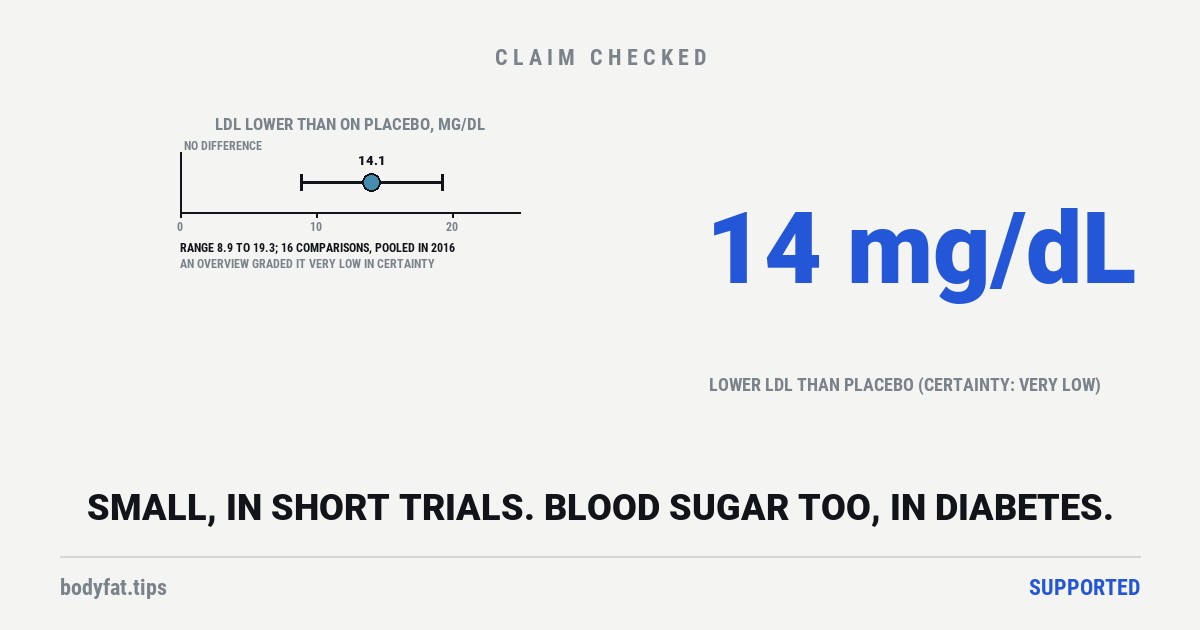
Here is the short answer. In trials, black seed did lower cholesterol and blood sugar, by small amounts, with the blood sugar falls mostly in people with diabetes. In trials against a placebo, a dummy capsule, LDL cholesterol came out about 14 mg/dL lower on average, across 16 comparisons [3]. An independent overview rated that figure very low in certainty; the one LDL result it rated moderate, from diabetes trials, was 11 mg/dL lower [2] [4]. In people with type 2 diabetes, HbA1c, the blood test that tracks average blood sugar over the past two to three months, fell about 0.4 to 0.7 points [4] [5]. That is real, and it is modest. The trials behind it were small and short, and the largest pooling of them we found, a meta-analysis that combines trials to get one estimate, contains errors we could see in its own charts. For weight loss, asthma, joints, skin and hair, the evidence is earlier and thinner.
This is journalism, not medical advice. If you take a blood thinner, a medicine for diabetes or blood pressure, or any regular prescription, if you are pregnant or breastfeeding, or if you are managing a long-term illness, ask your doctor or pharmacist before adding black seed oil; the reasons are further down. Nothing in these trials suggests it can stand in for a statin or a diabetes medicine.
| What it is sold for | The best summary we read | What it found | Rating here |
|---|---|---|---|
| LDL cholesterol | 16 comparisons in placebo-controlled trials, pooled in 2016 [3] | About 14 mg/dL lower than on a dummy capsule; a range of 9 to 19; graded very low in certainty, while 11 mg/dL in diabetes trials was graded moderate | Supported, with total cholesterol |
| Blood sugar | 17 trials pooled in 2019 [6]; 7 trials in type 2 diabetes [4]; 16 trials in type 2 diabetes, pooled in 2025 [7] | Fasting glucose about 10 mg/dL lower, and 21 in the 2025 diabetes pooling; HbA1c about 0.4 to 0.7 points lower in diabetes trials | Supported |
| Blood pressure | 11 trials, pooled in 2016 [8]; 17 trials, pooled in 2022 [9] | About 3 to 4.6 mmHg lower on the top number, in four poolings; two disagree on whether oil or powder does more | Supported, small |
| Weight | 11 to 13 trials, pooled twice in 2018 [10] [11] | About 4 lb (1.8 to 2.1 kg) more lost than on a dummy capsule; unsettled in people with obesity | Preliminary |
| Asthma | 4 trials, 187 people [12] | Symptom scores better; lung-function results mixed | Preliminary |
| Knee arthritis | 6 trials, 370 people [13] | Oil on the knee came out ahead in 3 trials, by the review’s count; by mouth, mixed | Preliminary |
| Skin | 14 studies across a range of conditions [14] | Four pooled; one study drove the result | Preliminary |
| Hair | One pilot of 20 women [15] | More hair on the lotion than the dummy, in a shedding condition that clears by itself | Preliminary |
What is black seed oil made from?
The seeds of Nigella sativa, cold-pressed into an oil or ground into a powder and packed into capsules. The trials used both, plus extracts, at doses from 200 to 4,600 mg a day, for anything from one week to 48 [16]. “Ethiopian” on a label names where the seeds were grown, and none of the trials on this page compared seeds by origin. The compound most often credited is thymoquinone, which Google’s AI answer names in its first line [1].
Two things it is not. It is not cumin, the kitchen spice, which is a different plant; a trial of cumin capsules has nonetheless ended up inside a 2026 pooling of black seed trials [17] [18]. And it is not one of the “seed oils” in the cooking-oil argument, which is about soybean, corn and sunflower oil; that argument has its own verdict.
Does black seed oil lower cholesterol?
Yes, a little. The cleanest summary is a 2016 pooling of 17 randomised trials that each compared black seed with a placebo [3]. On black seed, LDL cholesterol, the kind that builds up in artery walls, came out 14.1 mg/dL lower, with a confidence interval, the range the true average probably sits in, of 8.9 to 19.3 mg/dL. Total cholesterol came out 15.7 mg/dL lower and triglycerides, the main fat in the blood, 20.6 mg/dL lower. HDL, the kind called good, did not change significantly: 0.28 mg/dL, in a range from 2 lower to 2.5 higher [3]. The oil did more for total and LDL cholesterol than the powdered seed; HDL rose only on the powder [3]. The overview that graded these poolings rated this LDL figure very low in certainty and the total cholesterol figure low [2].
Open the pooling’s chart and the trials do not all agree. Of its 16 comparisons for LDL, 8 found a clear fall and 8 found a change too small to tell apart from chance, by our count [3]. But the average held: taking out any one trial left it between 12.9 and 15.5 mg/dL, every time clear of no difference [3]. Two of the trials in it were run in Karachi. In one, 250 men with metabolic syndrome were split four ways, black seed, turmeric, both or a placebo capsule, which the trial’s published summary calls only a placebo and a 2026 pooling’s table lists as ispaghula, psyllium husk; after eight weeks black seed had lowered their blood fats and fasting glucose against the placebo [19] [17]. In the other, of 123 adults randomised, 73 finished, and the authors reported changes in black seed’s favour that were not statistically significant [20].
A second team, independent of the first, found much the same in people with type 2 diabetes. A UK-led review of traditional Ayurvedic medicines for diabetes, paid for by British government and Wellcome money, pooled up to seven black seed trials, depending on the measure: LDL 11 mg/dL lower, from 6 to 17; total cholesterol 17 lower; triglycerides 12 lower [4]. An overview that graded the black seed meta-analyses using GRADE, the standard scale for how much confidence a result deserves, rated that LDL figure moderate, its only moderate grade for LDL. Of the 110 results it graded, it rated five moderate, 17 low, 88 very low and none high [2].
Where it did not show up. A review limited to powdered seed in people with high cholesterol, three trials, found total cholesterol 9.3 mg/dL lower but LDL not significantly different [21]. And in 30 healthy men in France given 1 g of powdered seed a day for four weeks, neither cholesterol nor blood sugar moved significantly more than on the dummy [22].
For scale: 14 mg/dL is about what single foods manage in pooled trials, 4 to 13 mg/dL for nuts, oats, barley or psyllium, as our verdict on foods that lower cholesterol sets out, and a little less than the 18 mg/dL in our berberine verdict. It is a nudge, not a statin.
Does black seed oil lower blood sugar?
A little, and mostly in people with diabetes. A 2019 pooling of 17 trials put fasting blood sugar 9.9 mg/dL lower than in the comparison groups, in a range of 6.4 to 13.4, sugar after meals 14.8 lower, and HbA1c 0.57 points lower, from 0.37 to 0.77 [6]. On HbA1c, 0.57 points is the difference between a reading of 8.0% and one of about 7.4%, by our arithmetic. The oil did more than the powder for fasting sugar [6]. The UK-led review found HbA1c 0.4 points lower in the diabetes trials it pooled, from 0.1 to 0.6 [4]; its fasting-sugar result fell short of statistical significance, 14.8 mg/dL lower in a range from 29.9 lower to 0.4 higher, and the overview graded that very low in certainty and the HbA1c result low [2]. The overview rated an older diabetes pooling’s fasting-sugar figure, 17.8 mg/dL lower, moderate in certainty [5] [2]. A 2025 pooling of 16 trials in type 2 diabetes put fasting sugar 21.4 mg/dL lower and HbA1c 0.44 points lower [7].
Who it moved for matters most here. A 2026 pooling broke its fasting-sugar result down by the people in the trials: 36.6 mg/dL lower in seven trials of people with type 2 diabetes, but 0.86 lower in three trials of people with overweight or obesity, a change too small to tell apart from chance [17]. In healthy people the few trials disagree: no significant difference in the men in France [22], while an Iranian trial of the oil in 70 healthy volunteers reported fasting sugar and HbA1c lower than on mineral oil, in a summary we read [23]. If your blood sugar is normal, the evidence that black seed lowers it is thin and mixed.
The longest study in the 2025 pooling ran a year, the top of its range of one to 48 weeks [16]. In it, 114 people in Saudi Arabia with type 2 diabetes, on their usual tablets, took 2 g of powdered seed a day or a capsule of activated charcoal [24]. HbA1c went from 8.6 to 8.2 on black seed and from 8.2 to 8.5 on charcoal; fasting sugar from 195 to 172 mg/dL against 180 to 180 [24]. Those are changes within each group. Set against each other, the two groups’ HbA1c differed significantly at six and nine months but not at the year’s end, and their fasting sugar at three and six months but not at nine or twelve [24]. The black seed group had also started higher on both, by gaps the authors did not count as significant [24], and readings that start high tend to drift back toward average on their own, which could account for part of that group’s fall, by our reasoning. The patients knew less than the doctors: the trial was blinded for the patients only [24].
How they were put into groups is where it gets awkward. The 2015 report’s summary says the patients were “assigned into 2 groups by convenience”, and its methods section says “by random allocation” [24]. The same team’s 2017 report on the same 114 people calls the study “nonrandomized”, says patients were “assigned to treatment or control at the discretion of the investigator”, and adds that “random allocation was not feasible”; its authors note the “possibility of allocation bias” [25]. A third report from the same team, of 60 patients on the same seed and charcoal for a year, over the same years and under the same registry number, is plainer. “For convenience”, it says, patients with lower HbA1c were put in the placebo group, so that fewer in that group would climb above an HbA1c of 9 during the year; it does not say whether its 60 are among the 114 [26]. The 114-patient study ran from May 2009 to January 2012 and was registered with India’s trial registry in 2013, after it had ended [24]. When the doctor picks who gets the seed, the two groups can differ in ways that have nothing to do with the seed. The poolings count the study as a randomised trial all the same [17] [4] [16].
The largest pooling says more, and its charts say why to be careful
The largest pooling we found, published in 2025, gathered 82 studies and 5,026 people [16]. It reports its results as standardised differences, the gap measured in units of how much people’s readings usually vary, on a scale where 0.2 is small, 0.5 moderate and 0.8 large. On that scale LDL came out 0.98 lower and fasting sugar 0.97 lower, both “large” [16]. Its LDL result carries an I-squared of 89%. I-squared is the share of the spread between the trials’ results that is more than chance would produce, where zero means they differed no more than luck allows; at 89%, nearly all of the spread between these trials is more than luck would produce [16].
We could not read its main text, which sits behind a bot check, but its 51 trial-by-trial charts are open, and before trusting a pooled number we read the rows. Three things stood out [16].
Two trials appear twice. Rows filed under two different years carry the same results, to two decimal places, on every chart we checked where both appear. One pair is a trial of 44 people with fatty liver, 22 on each side, entered under 2018 and again under 2019; the 2026 pooling’s own table describes the two entries identically [16] [27] [17]. The other is a trial of 40 people with Hashimoto’s thyroiditis, whose 2018 and 2020 reports describe the same design, though they give different registry numbers [28] [29]. Each counts twice toward the average, by our reading, and each points black seed’s way.
Some rows are implausible. One trial’s LDL row shows a standardised difference of 15.6, and another trial’s fasting-sugar row shows 11.2 [16]. On a scale where 0.8 is large, no supplement trial produces differences like these; they look like a misread table, not a result.
The UAE trial’s row does not match the trial. The pooling’s chart gives the 2024 trial from the United Arab Emirates an LDL difference of 2.40 in its favour [16]. That trial’s own table shows LDL in the black seed group going from 95.5 to 93.4 mg/dL, down 2.1, while the dummy group’s went up 6.4 [30]. Divided by how much LDL varied between people at the start, about 26 mg/dL, that is a standardised difference of about 0.33, by our arithmetic: roughly a seventh of what the chart prints. In the same trial, the black seed group’s HbA1c went from 5.50 to 5.49 [30].
The other new pooling, from 2026, has slips of its own. It gives its weight result as 1.59 kg in its summary and 2.16 kg in its own table, includes the cumin trial among its 31, lists the fatty-liver pair above as two trials, described identically, though its own rules exclude studies with overlapping participants, and grades its fasting-sugar result “High” in certainty while printing an I-squared of 99% beside it [17]. And the year-long Saudi study above sits in these poolings as randomised.
None of this turns the direction around. Every pooling we read found total or LDL cholesterol lower on black seed, and every one that measured blood sugar found it lower too; the 2016 pooling’s average survived taking out any one trial [3]. What the errors do is make the 2025 pooling’s “large” effects untrustworthy as sizes, and they fit the overview’s finding that 15 of the 20 meta-analyses it graded were critically low in quality [2].
Who were the trials done on?
Mostly adults with something to fix. The 2026 pooling admitted only trials in people with a metabolic disease, so all 31 of its entries enrolled people with a condition: type 2 diabetes, metabolic syndrome, fatty liver, high cholesterol, obesity, high blood pressure or polycystic ovary syndrome [17]. Of the 20 meta-analyses in the overview, 13 came from Iran [2]. The cholesterol and blood sugar trials named on this page ran in Iran, Pakistan, Saudi Arabia and the United Arab Emirates [31] [19] [24] [30]; the trials in healthy volunteers below add France, Bangladesh and India [22] [32] [33]. And they were short: 31 of the 36 rows in the 2025 pooling’s LDL chart are trials of 8 to 12 weeks, by our count [16].
Read yourself against them. If you have type 2 diabetes or high cholesterol, you look like the people in whom the numbers moved, and you are also the person most likely to be on medicines that black seed would be added to, which is why your doctor needs to know. If your numbers are normal, the trials in people like you are few, small and split. In France, 30 healthy men on powdered seed for four weeks saw nothing move significantly [22], and in Bangladesh 40 healthy older adults on capsules for nine weeks showed no significant change in blood fats, which that trial measured as a safety check [32]. In Iran, 70 healthy volunteers on the oil had lower cholesterol, LDL, fasting sugar and HbA1c than those on mineral oil after eight weeks, in two summaries we read of what looks like one trial [34] [23]. And in India, a 2022 trial of a high-thymoquinone oil in 70 healthy adults, four of whose six authors work for the company that makes it, reported cholesterol falling on the oil and staying within the normal range; the significance marks in its tables compare each group with its own start, and the oil group’s LDL had started higher [33]. The products differ too: the trials’ doses and forms varied widely [16], and a bottle on a shelf is not the capsule a trial tested.
Black seed oil benefits for women and for men
The cholesterol and sugar results came from trials of women and men alike: 140 Iranian women past menopause with metabolic syndrome in one, on 500 mg a day for eight weeks [31], and men in Karachi in another, 62 on black seed and 63 on a placebo capsule [19]. Both reported falls against their comparison capsules; the 2026 pooling’s table lists the Karachi trial’s as an ispaghula capsule, psyllium husk, and we could not read the trial’s methods to check [17]. The women’s trial carries a warning sign of its own: its published summary prints exactly the same numbers, 115.1 against 127.7 mg/dL, for LDL and for total cholesterol, two measurements that should not match [31]. One of the 2018 weight poolings was 64% men [11].
What about blood pressure?
About 3 to 4.6 points off the top number, in four poolings. A 2016 pooling of 11 trials and 860 people put systolic pressure 3.3 mmHg lower than in the comparison groups, from 1.4 to 5.1, and diastolic 2.8 lower [8]. The powdered seed did better than the oil in that pooling [8]. A 2022 pooling by another team, of 17 trials and 1,048 people, found 4.6 and 3.1 [9]; a 2023 update found 3.1 and 2.7 [35], and the 2026 pooling, which shares an author with the 2023 one, 3.3 and 2.8 [17]. Two more poolings we found give the change only as standardised differences, and both put it lower; one of them, from 2024, found the oil did more than the powder, the reverse of the 2016 result [36] [16]. Trial by trial it is thinner: a 2016 review that counted the trials rather than pooling them found black seed reduced blood pressure in 4 of 9, and a 2024 review of trials in metabolic syndrome found a significant fall in 1 of 5 [37] [38]. That is a little more than the 2 to 3 mmHg a magnesium capsule manages in our blood pressure verdict, about what beetroot juice does there on resting readings, and less than the diet and exercise changes ranked there. How sure is that? The overview’s search closed at the end of September 2022, so the only blood pressure results it graded were the 2016 and 2022 ones, and it rated them low to very low in certainty. It marked them down because the trials reported their methods too thinly to judge their risk of bias, and because much of the spread between the trials’ results was more than chance would produce [2]. The 2026 pooling graded its own figures high, while printing an I-squared of 98% beside the diastolic one [17].
Black seed oil for weight loss
About 4 pounds, in short trials, and unsettled in the people who most want it. Two 2018 poolings put weight 4.7 lb (2.11 kg) and 3.9 lb (1.76 kg) lower than on a dummy capsule, with I-squared values of 72% and 87% [10] [11]. A 2023 comparison of 18 supplements across 111 trials, all in adults with overweight or obesity, put black seed at 4.6 lb (2.09 kg) and rated that moderate in certainty [39]. Waist measurements conflict: one 2018 pooling found waists smaller, the other found no significant difference [10] [11].
Now look at the 2026 pooling. Its four trials of people with overweight or obesity showed 3.1 lb (1.42 kg) and the three in people with a BMI over 30 a difference of 0.1 lb (0.04 kg), both too small to tell apart from chance [17]. In the 2024 UAE trial, whose groups averaged a BMI of about 34 to 36, the black seed group gained 1.9 lb (0.86 kg) over 12 weeks, a change not significantly different from the others [30]. A 2025 pooling of 16 trials in type 2 diabetes found no significant change in weight [7]. So for people with obesity, the 2023 comparison found a fall its authors rated moderate in certainty, and the 2026 pooling’s subgroups were too small to confirm it or rule it out: the ranges of both include the 2023 figure.
Asthma, allergies and inflammation
A 2021 pooling of four small asthma trials, 187 people, found better scores on the Asthma Control Test, a five-question checklist of symptoms, while lung-function results were mixed [12]. The biggest of the four gave 80 adults in Jeddah 500 mg of oil or a dummy twice a day for four weeks, alongside their usual treatment; ten dropped out of each group, Asthma Control Test scores came out 21.1 against 19.6, and lung function did not improve significantly [40] [12]. In both adult trials we read, black seed was added to people’s usual asthma treatment [40] [41], and nothing here suggests putting that treatment down.
For inflammation, a 2023 pooling of 20 trials reported C-reactive protein, a blood marker of inflammation, lower on black seed by a standardised difference of 2.28 [42], nearly three times what that scale calls large, by our arithmetic. A difference that size, from a seed, is a reason to doubt the pooling’s arithmetic before believing the seed.
Joints
A 2024 review found six small trials in knee osteoarthritis, 370 people, five of them in Iran [13]. By the review’s count, oil rubbed on the knee came out ahead of its comparison in three trials; by mouth, the oil helped in one of two, and capsules of powdered seed did not beat a dummy in the one trial that tested them. The authors concluded that “conflicting findings from low-quality studies hinder the ability to make clinical recommendations for or against” [13]. For rheumatoid arthritis, a 2020 review found that the few trials in people did not show the improvements in inflammatory markers that the animal studies had [43].
Black seed oil for skin
A 2022 review gathered 14 studies across a run of skin conditions, from eczema and psoriasis to acne, warts and vitiligo, 12 of them using the oil and half of them in Iran [14]. It could pool only four, which favoured black seed, and its own sensitivity check found one study driving the result [14]. The same oil on the skin is also what causes the side effect doctors write up most often, below.
Black seed oil for hair
The only placebo-controlled hair trial we found is a 2013 pilot in Rome [44]. Twenty women with acute telogen effluvium, a burst of shedding after a stress such as illness or childbirth, used a lotion with 0.5% black seed essential oil or a dummy lotion for three months. By the trial’s own table, 9 of the 10 on the lotion had more hairs per square centimetre at three months, against 3 of the 10 on the dummy [15]. The paper itself calls the acute form “a self-limiting condition lasting for about 3-6 months” [15], and we found no between-group statistical test in it.
The other study we found was published in 2026 in a trade journal for cosmetics makers: 22 volunteers used a lotion with 5% of a standardised black seed oil for 28 days, with no comparison group; shedding fell 35% and density rose 7% [45]. One of its two authors works for the company that makes the oil ingredient it tested [45]. Twenty women and a study without a comparison group are not yet a hair treatment; castor oil, the other oil sold for hair, fared no better in its trials.
Does black seed oil boost immunity?
What has been tested is narrower than the claim. In 52 healthy volunteers aged 18 to 25 in Saudi Arabia, 1 g of powdered seed a day for four weeks raised some white-cell counts; 2 g did not [46]. In people already ill with Covid-19, a 2024 pooling of seven small trials reported fewer deaths, with a risk ratio, deaths on black seed divided by deaths without it, of 0.27, in a range from 0.10 to 0.72 [47]. Look inside it, though: only three of the seven gave black seed on its own, five were open-label, so everyone knew who was getting what, and the biggest, 419 people in Iraq, was one of those [47]. We do not rate Covid-19 treatment here.
Sellers did not wait for those trials. In May 2020 the US Federal Trade Commission warned a seller over a web page titled “Fight Coronavirus with Black Seed Oil: Boost Your Immunity” [48]. In September 2020 the Food and Drug Administration warned another, whose website had said of black seed oil that “we should all be taking it to protect against viruses” [49].
What happens when you take black seed oil every day?
In the trials, mostly nothing you would notice: small shifts on a blood test over weeks, and for some people an upset stomach. The overview found the side effects reported in the trials were mainly digestive, stomach pain, diarrhoea, nausea, and none of its meta-analyses reported a serious one [2]. In the year-long Saudi study the authors recorded no side effects [24]. Abu Dhabi’s health department calls black seed oil “possibly safe” at up to 5 mL or 5 g a day, and powdered seed at up to 2 g a day for up to 12 weeks [50]. Trials are too small and short to catch rare harms, and those show up instead as case reports.
What are the downsides of black seed oil?
The harm written up most is from oil on the skin. Near Paris, at a public hospital in Créteil, three women developed severe reactions after applying it, with blistering that spread beyond where they had used it and more than 15% of their skin detaching, resembling the most serious drug rashes [51]. Thymoquinone has been identified as one cause of the allergy [52]. If you try the oil on your skin, a rash is a reason to stop, and a spreading or blistering one is a reason to get care quickly.
By mouth, single case reports describe kidney injury, in a patient with diabetes in 2013 and, with muscle breakdown and liver injury, in another patient in 2024, both in Turkey [53] [54]; a dangerous drop in platelets after surgery in a woman taking black seed and evening primrose oils [55]; and serotonin syndrome, a reaction to too much of a brain chemical, after a medical procedure in a patient taking black seed oil [56]. A case report shows what can happen, not how often, and in most of these other drugs or illnesses were involved.
Pregnancy and breastfeeding: Abu Dhabi’s health department calls black seed “likely unsafe” by mouth in pregnancy in amounts above those found in food, and says to avoid it while breastfeeding [50].
What not to mix with black seed oil?
Blood thinners first. The evidence is a laboratory study, which predicted that black seed above about 1 g a day could interfere with how the body clears warfarin [57], and case reports. In one, a man on chemotherapy and two anti-clotting drugs, whose platelets were already low, developed a large bleed under the skin after his black seed dose went up to 2,000 mg a day; it cleared in ten days, and back on 1,000 mg it did not return [58]. We found no trial that measured bleeding or clotting in people taking black seed with a blood thinner, other than one that gave it as one of five herbs [44]. Some trials did give it to people on such drugs: one in Pakistan added it to treatment for metabolic syndrome that included clopidogrel, and a Covid-19 trial gave it with honey alongside standard care that included anticoagulants, by the tables of the two poolings that list them; neither pooling reports bleeding or clotting from them [17] [47]. The five-herb trial gave capsules of colchicum bulb, olive leaf, black cumin, lavender and ginger, or a placebo, to 150 people in hospital with severe or critical Covid-19, most of them on anticoagulants (77% and 71% of the two groups); at discharge their clotting times were not significantly different between the groups [59]. The hospital blog that Google’s AI answer cites says black seed oil “works as an anticoagulant” [1]; the evidence we read supports caution, not that certainty.
Diabetes and blood pressure medicines next. The year-long diabetes study gave black seed on top of tablets, and blood sugar fell within the black seed group, though by the year’s end it was not significantly lower than in the comparison group [24]; any extra drop is the reason to tell whoever manages your diabetes, not a reason to cut your dose yourself. The same goes for blood pressure tablets. Google’s AI answer also says to stop black seed two weeks before surgery, and the hospital blog ties that to the risk of low platelets after an operation [1], which is what the 2020 case report describes [55].
If black seed moves a few blood tests a little, why is it sold as a cure for nearly everything?
This section is the desk’s own reasoning, and it is labelled as such. The trials show small drops in cholesterol and blood sugar. The bottles, videos and “10 benefits” lists promise far more. Here are three reasons the two sit together, each rated.
Answer one: the list counts markers, not size. The 2025 pooling’s summary lists 35 measurements that improved, from body fat to liver enzymes to antioxidant enzymes [16]. Turn each into a benefit and you have the “10 benefits” list, and room to spare. The count is measured, from the pooling’s own summary; that it is what the lists are built from is our inference.
Answer two: the same small trials are pooled again and again. By 2022 an overview could already gather 20 meta-analyses of black seed trials [2], and the 2025 pooling counts at least two trials twice [16]. One researcher is an author on four of the poolings this page cites [16] [17] [35] [42]. The repetition is counted by us; that it makes the evidence look larger than it is to someone scrolling search results is a surmise.
Answer three: the reputation came first. “There is healing in black cumin for all diseases except death” is recorded in a collection of the Prophet Muhammad’s sayings compiled in the ninth century [60]. For many people it is a matter of faith, and this page does not argue with faith. A health claim on a sales page is a different thing, and in 2020 two US regulators wrote to sellers who had promised that black seed oil would help fight or prevent Covid-19, one of them resting its case on a study of infected cells in a dish [48] [49]. The letters are documents; that the old reputation, more than the trials, is what sells the bottle is our surmise.
Put the three together and here is what we think is true, stated plainly so you can disagree with it: black seed is a modest blood-test supplement sold as a cure-all; it nudges cholesterol, and blood sugar in people with diabetes, and the length of the list says how many small trials have been run, not how much it does.
What we could not find, and would like to: a large trial, independent of any seller, of a standardised black seed oil against a dummy capsule, running six months or more, outside the countries where most trials so far have been, with LDL cholesterol and HbA1c as its main measures, and counting heart attacks and strokes. We found no trial of black seed that counted heart attacks or strokes [44]. If you know of one, the corrections line on this site is open.
Where “a cure for everything but death” came from
The saying is old, and so is its English shape. The hadith collection records it as healing “for all diseases except death”, and the same chapter tells of black seed crushed with oil and dropped into the nose [60]. In English it borrowed an older proverb: “there is a remedy for everything but death” appears in a 1620 translation of Don Quixote [61]. A phrase historian’s record finds it attached to black seed in a 1994 US newspaper interview and a black cumin account’s post in 2011, and the bare phrase on an herb shop’s window sign in 2010 [61]. We could not trace who first printed it on a bottle.
The research arrived much later and says much less. The 82 studies in the 2025 pooling were published between 2008 and 2024 [16], and the 2016 pooling that first summed the cholesterol trials asked for trials on heart outcomes, not cures [3]. The spread is on video now. Google’s AI answer for this search cites a 29 April 2026 video titled “What Happens When You Take Black Seed Oil Daily”, seen 272,246 times by 23 October 2026, whose description says the oil may help lower LDL cholesterol and manage high blood pressure, and links to black seed oil and capsules on a shopping site [1]. Another, “The Black Seed Oil Benefits You Never Heard About”, from January 2024, had been seen 1,085,967 times [1]. Rising searches on the day we checked included two brand names and “ethiopian black seed oil side effects” [1].
None of this is aimed at anyone who takes black seed, or at the tradition it comes from. Wanting a gentler way to bring down a cholesterol or sugar reading is reasonable, and the trials say black seed does a little of that. It is the sellers who turned a little into everything.
What this is rated, and what the rating covers
Supported — for the claim that black seed oil lowers cholesterol and blood sugar, as the trials tested it: LDL cholesterol, taken as the oil or as powdered seed, and blood sugar in people with type 2 diabetes, each by a small amount, in short trials.
It is rated Supported because pooling after pooling, by different teams, found cholesterol and blood sugar lower on black seed: about 14 mg/dL for LDL across 16 placebo-controlled comparisons, an average that held when any one trial was taken out [3]; 11 mg/dL for LDL and 0.4 HbA1c points in a UK-led review of diabetes trials, the LDL figure graded moderate in certainty [4] [2]; fasting sugar about 10 mg/dL lower in 17 trials [6]; and 17.8 and 21.4 mg/dL lower in two poolings of diabetes trials, the first graded moderate [5] [7]. It is not Established because the overview graded 105 of its 110 black seed results low or very low in certainty, the 14 mg/dL among them [2], the trials are small and short, many come from one country, the poolings repeat one another and contain errors, at least one study counted as randomised was not, and its groups’ blood sugar was no longer significantly different at the year’s end [25] [24], and we found no trial that counted heart attacks or strokes [44].
Each narrower claim, rated alone, in words, is Preliminary, except one, and here is why for each. That it lowers cholesterol or blood sugar in people whose levels are normal: the few trials in healthy people are small and split [22] [32] [34] [33]. That it lowers blood pressure, by about 3 to 4.6 mmHg off the top number, is the exception, Supported in words for a small effect: all six poolings we found put it lower, and its limits are known, short trials, most too small to show a fall on their own, and the overview’s low to very low grades for the two poolings it could see [8] [9] [35] [17] [36] [16] [37] [2]. That it helps weight loss, by about 4 lb: the overview graded the 2018 poolings’ weight results low and very low, a 2025 pooling of diabetes trials found no significant change, and in people with obesity the 2026 pooling’s subgroups were too small to confirm the 2023 figure or rule it out [10] [11] [2] [7] [39] [17]. That it eases asthma, joint pain or skin conditions, grows hair, or boosts immunity or calms inflammation: each rests on small, short or conflicting trials in its favour [12] [13] [14] [15] [46].
“A cure for everything but death”, as a health claim on a bottle: Unsupported, of the untested kind. No trial could test “everything”. The trials that exist tested single conditions over weeks, measuring blood tests, symptom scores and recovery times, and several found no significant difference from a dummy, from capsules for knee pain to the healthy men in France [13] [22].
What is not rated here: Covid-19 treatment, cancer, fertility, liver disease, and the frame in the section above, which is this desk’s reasoning from the evidence rather than a result the evidence delivered. It is marked as ours so that you can weigh it as ours.
This is journalism, not medical advice. Whether black seed belongs alongside your medicines is a question for the doctor or pharmacist who knows them. How we read a study, and what each tier means, is set out here.
- Urolithin A Benefits: Both Ageing-Muscle Trials Missed Their Main Goal
preliminary - Cod Liver Oil Benefits: It Helped End Rickets. In a Winter Trial of 34,601 Adults, It Did Not Reduce Colds or Covid.
unsupported - B12 Shot Benefits: Real for Deficiency. Energy: Dummy Shots Kept Up. Weight: No Published Trial
unsupported