Fadogia Agrestis: The Testosterone Study Was Rats. So Was the Testicular Damage.

We found one study that measured what this plant does to testosterone.
It was done in male albino rats, it ran for five days, and the authors concluded that the extract “may be used to modify impaired sexual functions in animals” [1].
That qualifier is in the paper. So is a wider claim, in the same closing paragraph: that the results support the plant’s “acclaimed role” as an aphrodisiac in traditional medicine [1]. The qualifier is the first thing that falls off.
What the 2005 study actually did
Researchers at the University of Ilorin in Nigeria took an aqueous extract — the plant stem steeped in water — and gave it to male rats at three doses: 18, 50 and 100 milligrams per kilogram of bodyweight, once a day. They measured sexual behaviour and serum testosterone on days 1, 3 and 5 [1].
The rats mounted more often, took less time to start, and lasted longer before finishing. Serum testosterone rose across all three doses, in a pattern the authors described as suggestive of dose-dependence — more extract, more testosterone [1].
As a rat study, it is a perfectly reasonable rat study. The problem is everything that happened next.
The same three authors also ran the toxicity studies
Same laboratory. Same plant. In every paper of the series we could read, the same three doses — 18, 50 and 100 mg/kg — were given for three or four weeks instead of five days [5][6][7][8][2].
And the work started early. The 2009 paper’s own reference list cites the first author’s 2006 doctoral thesis, titled for both halves of the story (the plant’s “aphrodisiac potentials and toxicological evaluation”), and a 2006 paper by the same three authors on the rats’ livers [2]. Papers followed on the blood in early 2007, the testes and sperm in late 2007, blood fats and the kidneys in 2008 (the authors judged the blood-fat changes too small to put the rats at risk of atherosclerosis, the clogging of arteries), and the liver and kidneys together in 2009 [5][6][7][8][2].
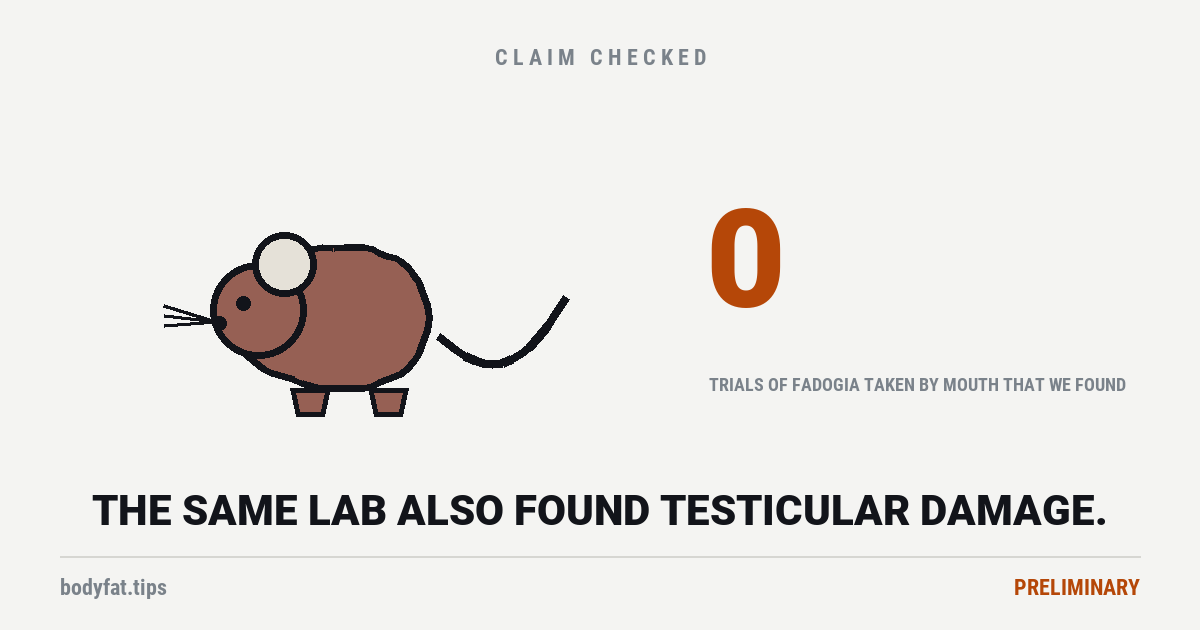
The testes are the part a testosterone buyer should read. After 28 days at 50 or 100 mg/kg, the rats’ sperm counts, motility (how well sperm swim) and shape were all down [6]. Under the microscope, the seminiferous tubules — the coiled tubes inside the testes where sperm are made — were damaged at every dose, from mild distortion at 18 mg/kg to complete destruction of the sperm-making cells at 100 [6].
Ten days after dosing stopped, the sperm measures at the two higher doses had still not recovered, and the authors called the damage to the testes at those doses irreversible [6]. Another paper from the team found the testes heavier for the rats’ size, and their chemistry altered, at all three doses, which the authors read as “indications of adverse effects on the male rat testicular function” [7]. At 18 mg/kg, the dose the researchers took from traditional use, sperm were unaffected and the authors called the toxicity mild and reversible, though one prostate enzyme was still raised ten days after dosing stopped [6].
The 2009 paper looked at the liver and kidneys together, after 28 days at the same three doses [2].
Nothing dramatic happened on the surface. No deaths, no visible distress, no swelling or shrinking of the organs [2]. If you were watching the cages, you would have seen nothing.
The blood said otherwise. Three enzymes — alkaline phosphatase, lactate dehydrogenase and gamma-glutamyl transferase — dropped inside the liver and kidney tissue and rose correspondingly in the serum [2].
That pattern has one ordinary explanation. Those enzymes belong inside cells. Finding less of them in the tissue and more of them in the blood is what it looks like when cells leak.
A fourth marker moved too. Malondialdehyde — a by-product of fats being oxidised, used as a rough gauge of membrane damage — rose in every treated group [2]. The authors’ own reading is disruption of the plasma membranes of the liver and kidney cells.
So: one paper found the testosterone. The same three people’s other papers found harm in the testes, the sperm, the liver and the kidneys, all in rats.
Both halves get quoted. Not always the right way round. We read the first page of an ordinary web search for the plant’s name on 7 October 2026. Three of its nine ordinary results were guides on supplement shops’ own sites, and all three cite the 2005 rat study. One of them also passes on the toxicity papers as safety warnings. One links the 2009 liver and kidney paper and tells readers it “found no toxicity or adverse effects to kidneys or liver”, the reverse of what it reported. The third lists the 2008 paper’s rise in testis weight among the plant’s study results, without the authors’ conclusion that the changes were adverse.
How much human evidence is there? We counted.
| Search | Records |
| Any record mentioning Fadogia | 20 |
| Fadogia agrestis and testosterone | 1 |
| … and that one is in | rats |
| Clinical trials or randomised trials | 0 |
PubMed holds twenty records that mention Fadogia at all. Exactly one of them connects Fadogia agrestis to testosterone, and it is the rat study above.
Searched for clinical trials or randomised controlled trials specifically, the count is zero.
That is worth stating precisely, because “no evidence” gets used loosely. This is not a trial that came out negative. It is not a trial too small to conclude from. Nobody has given it to people by mouth in a study built to find out what it does: PubMed, Europe PMC and ClinicalTrials.gov list none, searched on 7 October 2026 and again on 11 October, when a search of Europe PMC’s open full texts added nothing either.
The one study we found that put it on people sits in none of those indexes. It is a 2011 conference abstract from Benin: a skin gel made from six plants, fadogia one of them, rubbed on twice a day by patients with joint or muscle pain, 11 on one version of the gel and 7 on another, with 12 more on a diclofenac gel. It measured pain, not hormones, and it does not say whether the patients were randomised [11]. It tells you nothing about a capsule taken for testosterone.
If you search the plant’s name yourself, you may meet a health blog, on the first page of results when we searched, saying “Human studies found that men who took Fadogia Agrestis had increased testosterone levels.” It names no such study. The studies in its reference list are rat studies, and two of its links lead to unrelated papers.
Nobody knows what dose you would even take
Look again at how the rats were dosed: milligrams per kilogram of bodyweight. A heavier rat got proportionally more.
Now look at a capsule. It carries a flat number of milligrams, the same for everyone, and that number was not derived from a human study, because no study has given the plant to people by mouth.
There is a standard way of scaling animal doses to human ones. We are not going to run it for you, because the output would be an assumption printed next to real measured figures, and on this page that would be the same mistake we are describing. What can be said without inventing anything: the dose on the label is not a finding.
The extract in a capsule need not be the rats’ preparation either. One described to an EU food authority in 2025 is a 10:1 extract (ten parts of plant concentrated into one) of the root, stem and other above-ground parts, made with water, alcohol or carbon dioxide, for capsules at 200 to 1,000 mg a day [9]; the rats got the stem steeped in water [1]. That authority, the Czech agriculture ministry’s food safety department, determined in June 2025 that the extract is a novel food, because there is “insufficient evidence of significant consumption as a food in the EU before 15 May 1997” [9]. In the EU a novel food needs authorisation before it can be sold. The ruling is about history of use. It says nothing about whether the plant works or is safe.
And five of seventeen products had no detectable marker compounds
In 2019 a lab at the University of Mississippi built a method for measuring eleven chemical constituents of Fadogia agrestis, then pointed it at 17 dietary supplements that claimed to contain the plant [3].
Twelve of the seventeen contained detectable phenolic compounds — marker chemicals used to confirm the plant is actually in there — at 0.3 to 2.7 milligrams per day. In five of them, the phenolic compounds were not detected at all [3].
Be careful with what that does and does not prove. Not detecting those markers is not the same as proving the bottle is empty; a different extraction could in principle carry different compounds. But it does mean that for roughly one product in three, the analysis could not confirm the plant was present at a measurable level.
Which puts you in an unusual position. The active claim rests on a rat study, the dose on the label rests on no study in people, and the contents of about a third of the bottles could not be confirmed by the people who went looking.
The case reports we are not going to use against it
There is a published case of a 27-year-old man who developed acute liver injury after six months on a testosterone-booster supplement [4].
That report does not name Fadogia agrestis, and we are not going to imply that it does. It is here for what its authors actually wrote about, which is more useful anyway. They do name the product: a testosterone booster they describe as using ashwagandha, ginseng and tongkat ali, the plant fadogia is commonly stacked with [4].
The man arrived jaundiced and told the hospital he had taken paracetamol for a cold. He was treated for paracetamol poisoning. He improved, went home, and came back two weeks later worse. Only on repeat questioning did the supplement come up at all [4].
The paper is titled “Underreporting Supplements” for that reason. And it explains something about this whole category that is easy to misread: a thin record of case reports attached to a specific ingredient is not evidence that the ingredient is safe. It can also mean nobody wrote the ingredient down. Fadogia’s record is thin: the US Food and Drug Administration’s public database of adverse-event reports for foods and supplements holds no report naming it, against seven whose product names include tongkat (searched 7 October 2026; the data run to July 2026).
One published report we found does name fadogia, and we are not going to use that one against it either. In May 2025 doctors in New York described, in a conference abstract, a 51-year-old man with high blood pressure and raised blood fats who died after his heart, lungs and blood clotting failed [10]. His family said he had been injecting testosterone and taking a prescription drug that blocks the body’s production of estrogen, along with supplements including trimethylglycine and Fadogia agrestis [10]. The doctors blamed the combination. It is one man, described in a meeting abstract rather than a full paper, and nothing in it separates what fadogia did from what the injected testosterone and the other drug did.
So why is this rated Preliminary rather than Unsupported?
Because those two words mean different things here, and the difference matters.
Unsupported on this site means we looked and the evidence does not back the claim: either it was tested and did not hold up, or nobody has tested it and nothing that was tested supports it. That is not what happened here. Something has been tested, and it points the claim’s way: in rats, testosterone rose.
Preliminary means early, small, conflicting, or animal-only. This is animal-only, in the most literal sense available: one species, one laboratory, five days, and no trial of it taken by mouth in people.
Preliminary is not a green light. It is the rating for “nobody can tell yet”, and the definition carries a second half worth reading — not actionable alone. On this page it means the rat data is real, it is genuinely all there is, and the same lab’s rats, dosed for 28 days in later experiments, showed damaged testes and enzymes in the wrong compartment.
What we would actually do
Notice what you are being sold. The testosterone number comes from rats. The safety reassurance comes from nowhere — no study has measured the plant’s safety in people, the one published case we found that names it is tangled up with injected testosterone [10], and a category cannot be called well-tolerated on the strength of not having been tested.
If you are trying to father a child, read the sperm data. The sperm data on this plant come from rats, and they point the wrong way: at the two higher doses, counts and motility fell and were still down ten days after dosing stopped [6].
If you want the thing that does work, it is dull. We have checked what actually raises testosterone naturally, and the answer with the evidence behind it, for men carrying extra weight, is losing some of it — which, done by diet, needs nothing from a shop.
And the category has form. Our verdict on testosterone boosters as a class found that none of the top 16 testosterone supplements in a 2021 review had been tested as sold, and that the few finished products that have been tested rest on one small trial or a result that did not replicate. Fadogia is not an exception to that pattern. It is an unusually clean example of it.
If you are worried about your testosterone, measure it. That is a blood test somebody qualified orders, and we have written about whether you should.
This is journalism about research, not medical advice. If you are taking this and something feels wrong — particularly anything involving your skin or eyes turning yellow — that is a doctor, today, and tell them about the supplement. How we read a study · The other supplement whose evidence is mostly rodents
An independent editorial review of our testosterone-boosters verdict on 18 September 2026 found that it claimed more than its main source supports, and this page repeated the claim. We wrote that the boosters verdict had found not one branded product ever tested as sold. The 2021 review behind that looked at the top 16 testosterone supplements and found no published trial of any of them as sold; a few finished products have been tested elsewhere, on one small trial or with a result that did not replicate. While correcting that, we found this page had also summed up our verdict on raising testosterone naturally as sleep, lifting and correcting a deficiency. That verdict names a different lever: for men carrying extra weight, losing some of it. Both sentences now say what those verdicts say. Nothing about fadogia itself changed, and the rating is unchanged: Preliminary.
This page was corrected on 9 October 2026 after an independent editorial review found it had left out the most important findings on the plant’s safety. We wrote that the same three authors ran “the toxicity study” four years after the testosterone study, and that “the next paper” found the liver and kidney damage. Their toxicity work began in 2006 and came out as a series, and in 2007 and 2008 it reported lower sperm counts and damaged testes in rats at the two higher doses, damage the authors called irreversible. The page now reports those papers in order, and the title names the testicular damage. We also wrote that no human had been studied taking fadogia, and implied that no case report named it. We found no trial that has given it to people, but a 2025 conference abstract describes a man who died while taking it alongside injected testosterone and a prescription drug, and the page now reports that case and what it cannot tell us.
Also changed: we wrote that only the testosterone result ever gets quoted and that the toxicity finding travels with none of it. An ordinary web search shows the toxicity papers quoted, once as finding the reverse of what they found, and the page and its provenance chain now say what that search showed. A heading said a fifth of the products had no detectable marker compounds; it was five of seventeen. We said the rats with leaking liver and kidney cells were the rats from the testosterone study; they came from separate 28-day experiments. The evidence panel called the liver-injury case report’s product unidentified, when its authors name it, and the funding row now says what each source states. We added the EU’s 2025 novel-food determination for a fadogia extract. The opening line, and the lines about the one case report that names the plant, now say that these are what our searches found. The provenance chain’s search figure now says where it came from and when we pulled it. The paragraph explaining why this is not rated Unsupported now uses the wider definition of that rating the site adopted on 7 October 2026. The rating is unchanged: Preliminary.
Corrected on 11 October 2026. We wrote that there was no trial and that nobody had given fadogia agrestis to people in a study. We have since found one that did: a 2011 conference abstract from Benin, in which a skin gel made from six plants, fadogia among them, was tried on patients with joint or muscle pain. It is not in PubMed or Europe PMC, the indexes we named, but it came up in a wider search we had read on 9 October, and we missed it. It measured pain and tells you nothing about capsules taken for testosterone, so the rating is unchanged. The page now says no trial has given the plant to people by mouth, and describes the gel study.