Hydrogen Water Benefits: Small, Mixed Shifts in Blood Markers, and No Significant Win in the Three Biggest Trials

Fill a bottle with ordinary water, push hydrogen gas into it, and you have the most hyped drink of the decade. The sellers say it is an antioxidant that fights inflammation and ageing, lifts your energy, speeds recovery, lowers cholesterol and blood sugar, and helps your skin and your brain. And they point to Japan, where it has been sold for years [1].
Here is the short answer. The gas is real, and so is the research: we found 41 randomised trials outside sport that compared it with plain water or a dummy, one of them a preprint not yet peer reviewed, and more in athletes. In small trials, a few blood markers of inflammation and oxidation moved the right way, others did not differ significantly from plain water, and in two they moved the wrong way. Cholesterol fell a little in two of three poolings of the trials. And in the three biggest trials, of 700, 200 and 178 people, hydrogen water was not significantly better than a dummy on the thing each trial set out to measure. We rate the claim that hydrogen water reduces inflammation and oxidative stress Preliminary.
This is journalism, not medical advice. If you manage a chronic illness, such as diabetes, high cholesterol or Parkinson’s disease, do not swap a prescribed treatment for hydrogen water: the trials in those conditions added it on top of usual care, and the newest pooling of the cholesterol trials says it should not delay or replace proven treatment [2]. Ask your clinician before relying on it.
People want to know. “Hydrogen water benefits” is searched about 18,100 times a month in the US, the database’s figure for the past year; the latest month, September 2026, was 14,800, and October and December 2025 and January 2026 each ran at 27,100; “does hydrogen water work” is searched about 320 times a month (from a paid keyword database, pulled 23 October 2026) [1].
What is hydrogen water, and how much hydrogen is in it?
Hydrogen water is water with hydrogen gas dissolved in it: the two-atom molecule, H2, not the hydrogen already locked inside every water molecule. It has no taste, colour or smell, which matters later. Water can only hold a little of it. At room temperature and ordinary pressure, a litre holds at most about 1.6 mg, or 1.6 ppm (parts per million, the same thing as milligrams per litre) [3]. So a full 8-ounce glass (237 mL) of saturated water carries at most about 0.4 mg of hydrogen, by our arithmetic. Water under pressure, or fresh from a tablet, can hold more for a while, which is how some trials in the table below give figures of 7 ppm and more; the extra leaves once the water meets ordinary air, as the next paragraphs show.
And it does not stay put. Japan’s National Consumer Affairs Center tested ten packaged hydrogen waters and nine generators in 2016 [4]. In three of the five brands that printed a concentration at filling or shipping, the water held less than the label said. Two brands in plastic bottles that printed no figure held no detectable hydrogen at all. Opened and re-capped, the packaged waters kept 30 to 60% of their hydrogen after five hours and about 10% after a day; water from a generator, poured into a cup, kept 50 to 60% after an hour [4].
Tablets work differently. They hold magnesium metal and an acid; dropped in water, the magnesium reacts and gives off hydrogen. In one trial’s measurement, a tablet in 17 fl oz (500 mL) briefly pushed the water to about 10 mg/L, above what water can normally hold, and it fell back to 1.6 mg/L within 30 minutes [5]. The trials gave anything from about a third of a milligram a day to about 24 mg, by our arithmetic from their methods [6] [7].
One thing to keep separate. Hydrogen is also given as a gas to breathe, in hospitals. In a Japanese trial of 73 patients in a coma after a cardiac arrest, they breathed 2% hydrogen with their oxygen for 18 hours; the main result, a good brain outcome at 90 days, was 56% against 39% and not statistically significant [8]. That is a different dose, by a different route, in a different situation. Nothing on this page is about it.
Do the Japanese drink hydrogen water?
Some do, and enough to keep the regulators busy. The 2016 test picked its products from the popularity rankings of big online shops and from big stores and convenience stores; by then Japan’s consumer centres had logged 2,260 enquiries about drinking hydrogen water since 2011, rising each year [4]. The centre found sellers’ websites claiming that hydrogen “renders harmless the bad active oxygen said to cause various diseases” (our translation), and warned that such claims could breach three Japanese laws. It noted that no hydrogen water had been approved as a government-recognised health food, and that hydration was the effect the companies themselves most often named [4].
In March 2021 Japan’s Consumer Affairs Agency went further. It ordered four companies selling or renting hydrogen-water machines not to repeat, without a reasonable basis, claims that the water removed harmful active oxygen and so prevented ageing, cancer, skin spots and wrinkles, atopic eczema, inflammation and allergy, and diseases from diabetes to brain disease [9]. Three of the four sent in evidence. The agency did not accept any of it as a reasonable basis for the claims [9].
Does hydrogen water reduce inflammation and oxidative stress?
First, the words. Oxidative stress is the wear that reactive forms of oxygen, often called free radicals, do to the body’s fats, proteins and DNA. An antioxidant mops them up. Neither is easy to measure in a living person, so trials measure stand-ins in the blood: MDA, a breakdown product of damaged fats; d-ROMs, a measure of oxidised compounds; antioxidant capacity; and, for inflammation, signals the immune system sends, such as IL-6, TNF and CRP. A shift in one of these is not the same as feeling better or living longer. It is the evidence the claim rests on most directly, though.
The science behind it started in a lab. In 2007 a Japanese medical school reported that hydrogen “selectively reduced” the most damaging radical in cell dishes, and that rats breathing the gas suffered markedly less brain injury after a blocked artery was reopened [10]. That was gas, inhaled, in an acute injury. The drinking trials came after.
In healthy people the cleanest test is a Korean one: 41 adults drank 51 fl oz (1.5 L) a day of bottled hydrogen water or plain water for four weeks, without knowing which [11]. The oxidation and antioxidant markers did not differ significantly between the groups; antioxidant capacity rose in both. The hydrogen group had fewer dying white blood cells, and genes linked to inflammation were less active in them [11]. The authors’ headline was that hydrogen water “reduces inflammatory responses”. Their own main markers of oxidation did not show it. A second Korean trial ran twice as long. 65 hospital staff were assigned to drink 51 fl oz (1.5 L) a day for eight weeks from machines at work that either made electrolysed water carrying about 0.59 mg/L of hydrogen or only filtered it, without knowing which [12]. Its main outcome was a set of oxidation markers. Oxidised compounds (d-ROMs) ended lower on hydrogen water, but that group had also started lower, 301 units against 347; antioxidant capacity was ahead on hydrogen at four weeks and behind at eight; four other markers were not significantly different between the groups, and two antioxidant enzymes it named among its main outcomes, SOD and catalase, are not reported in the paper or its supplement [12].
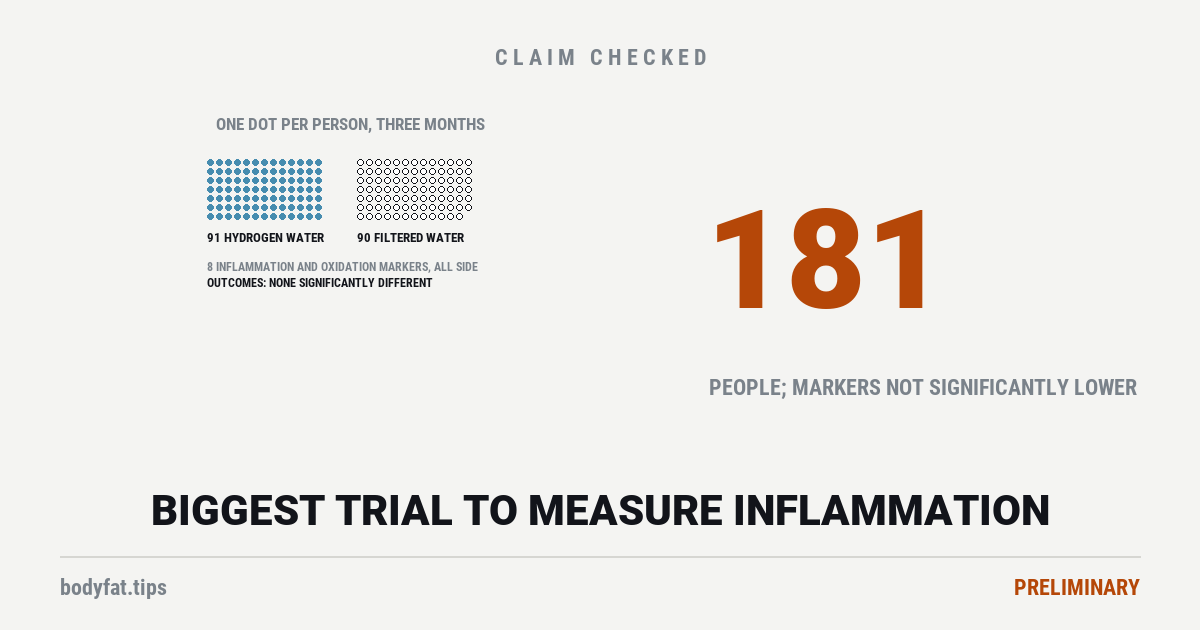
In people who were ill, the results point both ways. In 60 Indian adults with metabolic syndrome, three hydrogen tablets a day for 24 weeks beat dummy tablets on cholesterol, blood sugar and inflammation markers, though not on one oxidation marker [13]. The tablet maker donated the tablets and paid part of the costs. In 73 people with raised blood sugar analysed in a Chinese trial, IL-6 and TNF fell by much the same amount on hydrogen water and on plain water [14]. In the 181 analysed in the biggest metabolic trial, CRP and TNF did not differ significantly between hydrogen water and filtered water [15].
And in two trials an oxidation marker moved the wrong way. In 30 people with fatty liver disease, MDA rose on hydrogen tablets and fell on dummy tablets; the paper’s results section reports that difference as significant, and its summary calls it a non-significant tendency [16]. In 60 people with chronic mountain sickness in Tibet, oxidative stress was the main outcome: after eight weeks MDA had risen more on hydrogen water than on placebo water, by 2.11 units, with a confidence interval (the range the true average probably sits in) from 1.13 to 3.09 [17]. Antioxidant capacity rose more on hydrogen water too, by 2.86 units, from 0.09 to 5.64, and the authors read the result as both a pro-oxidant and an antioxidant effect; they concluded that it “did not reduce oxidative stress-induced damage”. A second Tibetan trial, of 50 people, found only a downward trend in the markers, not significant [18].
The only pooling of these markers in people alone that we found is in exercise. It combined six studies of 76 healthy adults who took hydrogen as water, a bath or a gas around hard exercise [19]. On d-ROMs the pooled difference was −0.01, a standardised difference: the gap measured in units of how much people varied, where 0.2 is what researchers call small and 0.8 large. Its confidence interval ran from −0.42 to 0.39, so it could not tell hydrogen from a dummy. Antioxidant capacity came out 0.29 higher, from 0.04 to 0.54: small, and just clear of no difference [19]. A 2022 pooling for gum disease reported large falls in inflammation markers on hydrogen water, but only 4 of its 17 studies were in people; the rest were in rats and mice, or in cells and bacteria in the lab, so it says little about people drinking the water [20].
Here is every trial outside sport we found that randomised people to hydrogen water or tablets against plain water or a dummy [21].
| Who, and for how long | What they drank, against what | Main or headline result | Who paid or supplied |
|---|---|---|---|
| 700 adults with Covid-19 (675 analysed), France and Serbia, 21 days [22] | A tablet in 8.5 fl oz (250 mL) of water twice a day; dummy tablets fizzed alike, with magnesium carbonate in place of magnesium metal | Worse by day 14: 46.1% on hydrogen, 43.5% on the dummy; not significant | Part-funded by the tablet maker, with public and charitable money |
| 200 adults with or near metabolic syndrome (181 analysed), Japan, 3 months [15] | Water from a home electrolysis machine; identical machines that only filtered | Waist size, the main outcome, and every secondary outcome: no significant difference | Funded by the machine maker; one author its employee |
| 178 people with Parkinson’s disease, Japan, 72 weeks [23] | 34 fl oz (1 L) a day of bottled hydrogen water; water saturated with nitrogen | Symptom score, the main outcome: no significant difference, by two later accounts (we could not read the trial’s own report) | Japanese public grant; water from two hydrogen-water companies |
| 144 people on chemotherapy for bowel cancer (136 analysed), China [24] | Water given hydrogen in the hospital’s lab, 0.27 to 0.4 ppm; placebo water; single-blind | Liver enzymes rose significantly on placebo, not significantly on hydrogen water | A city science and technology fund (Tai’an) |
| 114 people with high uric acid (100 analysed), China, 8 weeks [3] | Two or three 11 fl oz (330 mL) cans a day; the same cans of plain water; participants blinded | Higher dose: uric acid fell against its own start; lower dose not significantly different from plain water | Public grants; the cans supplied by a hydrogen-water company |
| 106 people with raised fasting blood sugar (73 analysed), China, 8 weeks [14] | 34 fl oz (1 L) a day of packaged hydrogen water; plain water from the same company | Fasting sugar fell in both groups, more on hydrogen; IL-6 and TNF fell by similar amounts in both | Public grants; both waters from a hydrogen-water company |
| 106 people with kidney stones in four groups, China, 12 weeks [25] | 68 fl oz (2 L) a day from a generator cup; plain water; not blinded | Hydrogen water alone: treatment “effective” in 32% against 28% on plain water | Public grants; the generators provided by a nanobubble company |
| 84 people with reflux disease, Italy, 3 months [26] | Electrolysed water from a home device plus their usual drug; tap water plus the drug; blinding not described | Symptoms and oxidation markers better | Italian ministry; the device lent by a named individual |
| 81 people with mild memory problems (73 analysed), Japan, 1 year [6] | About 10 fl oz (300 mL) a day from pouches; placebo water in identical pouches | Memory score, the main outcome: no significant difference; one gene-variant subgroup did better | Public grants; both waters given by a hydrogen-water company the senior author had advised from 2005 to 2008 |
| 72 women with premenstrual syndrome (65 analysed), Turkey, three cycles [27] | 51 to 68 fl oz (1.5 to 2 L) a day from a portable generator bottle; bottled water in a look-alike bottle | Symptom scores lower on hydrogen water | University grant; no competing interests declared |
| 68 healthy volunteers, Japan, 2 weeks [28] | 17 fl oz (500 mL) a day at over 7 ppm in a pressurised bottle; bottles filled with nitrogen | A finger test of blood-vessel function improved more on hydrogen | No funding; authors include doctors at a hydrogen clinic |
| 68 people with high cholesterol, China, 10 weeks [29] | 30 fl oz (0.9 L) a day; placebo water | HDL worked better in lab tests; more people saw cholesterol fall | Summary only; funding not read |
| 65 healthy hospital staff (53 analysed), Korea, 8 weeks [12] | 51 fl oz (1.5 L) a day of electrolysed water at about 0.59 mg/L; filtered water from the same machines | Oxidation markers, the main outcome: d-ROMs lower on hydrogen in a group that started lower; antioxidant capacity ahead at 4 weeks, behind at 8; four others not significantly different; two more it named as main outcomes not reported | A health foundation; the machines that made both waters installed by their maker, whose engineer also put up the labels that kept the groups blind; no conflicts declared |
| 60 adults with metabolic syndrome, India, 24 weeks [13] | Three tablets a day; dummy tablets alike in taste, fizz and look | Cholesterol, sugar and inflammation markers better than on the dummy; one oxidation marker not | Tablets donated, and the trial part-funded, by the tablet maker; lead author paid fees on hydrogen |
| 60 people with chronic mountain sickness (59 analysed), Tibet, 8 weeks [17] | 33 fl oz (990 mL) a day; placebo water | Oxidative stress, the main outcome: a damage marker and antioxidant capacity both rose more on hydrogen; side effects 50% against 37% | Summary only; no competing interests declared |
| 60 adults, Japan, 4 weeks [30] | Alkaline electrolysed water (0.2 mg/L of hydrogen) from modified home units; purified tap water from the same units | No clear effect; more said they slept soundly | Two authors employees of the appliance maker |
| 60 men at risk of artery disease (59 in its results), China, 10 weeks [31] | Three 8.3 fl oz (245 mL) bottles a day; identical bottles of pure water | Artery stiffness, MDA and SOD not significantly different at 10 weeks; total cholesterol ended lower on hydrogen than on plain water (P = 0.047), because it rose significantly on plain water and not significantly on hydrogen; one of four oxidised fats, measured only at the end, was lower on hydrogen | Public grants; the water bought from a hydrogen-water company. A preprint, not peer reviewed |
| 52 active men, Serbia, 14 days [32] | 68 fl oz (2 L) a day; tap water | Blood very slightly more alkaline | Summary only; funding not read |
| 50 people with type 2 diabetes, Japan, 3 months [33] | Water from an electrolysis machine; filtered water from look-alike machines | Insulin resistance, the main outcome: no significant difference | Funded by the machine maker; two authors its employees |
| 50 people with chronic high-altitude disease (43 analysed), Tibet, 60 days [18] | Hydrogen water; placebo water | Oxidative-stress and inflammation markers: a downward trend, not significant | Summary only; no competing interests declared |
| 49 people having radiotherapy for liver tumours, Korea, 6 weeks [34] | A magnesium stick in bottled water; an empty stick; blinding not described | Quality of life better; an oxidation marker lower | A Japanese foundation’s grant |
| 41 healthy adults (38 analysed), Korea, 4 weeks [11] | 51 fl oz (1.5 L) a day of bottled hydrogen water at 0.75 ppm; bottled plain water | Antioxidant and oxidation markers: no significant difference; fewer dying blood cells on hydrogen | Part-funded by the water-purifier company whose plain water was used |
| 40 active adults, Poland, 8 weeks [35] | Alkaline “redox” water from a generator; bottled water with the same label | IL-6 straight after a hard exercise test lower; the groups started unequal | Funded by the generator company |
| 40 people in hospital with unstable angina, China, 3 months [36] | 34 to 41 fl oz (1 to 1.2 L) a day from an electrolysis cup; pure water | Chest-pain symptoms and cholesterol fell more on hydrogen | Public grants; no conflicts declared |
| 40 adults aged 70 and over, Serbia, 6 months [37] | 17 fl oz (0.5 L) a day at 15 ppm; water with none | Telomere length better (P = 0.049) among dozens of outcomes; most others not significantly different | Summary only; funding not read |
| 36 adults with obesity (35 analysed), Serbia, 8 weeks [38] | 34 fl oz (1 L) a day carrying 15 mg of hydrogen; tap water | Cravings, the main outcome, lower (P = 0.05); total and LDL cholesterol lower | Part-funded and supplied by a hydrogen-product company; one author its employee |
| 36 people with type 2 diabetes or prediabetes, Japan, 8 weeks each way (crossover) [39] | 30 fl oz (900 mL) a day; placebo water | Modified LDL and a urine oxidation marker fell; other markers only trended | Summary only; funding not read |
| 34 healthy volunteers, Japan, one drink [40] | 17 fl oz (500 mL) at over 7 ppm; a nitrogen-filled bottle with a dummy insert | An artery-widening test better than on placebo | One author works for a maker of hydrogen generators; water from a hydrogen-water company |
| 32 people with long Covid, China, 14 days [41] | Water from an electrolysis device; placebo water in the same packaging; participants blinded | Fatigue score and walking test better; breathlessness not significantly different | No external funding |
| 30 people with fatty liver disease, Slovakia, 8 weeks [16] | Three tablets a day; dummy tablets that fizzed with carbon dioxide | Mostly no significant differences; an oxidation marker (MDA) rose on hydrogen and fell on the dummy | Part-funded by the tablet maker, which supplied both tablets |
| 30 people with painful bladder syndrome (28 finished), Japan, 8 weeks [42] | Hydrogen water or placebo water in pouches, two to one | Symptoms: not significantly different from placebo | A public-health research foundation; both waters obtained from a drug company |
| 27 adults over 50 starting weight training, Serbia, 6 weeks [7] | Two servings a day, 12 mg each; water with almost none | Muscle-damage markers and cholesterol lower | Summary only; one author works for a hydrogen-product company |
| 26 adults, Japan, 4 weeks each way (crossover) [43] | 20 fl oz (600 mL) a day from pouches; the same mineral water without hydrogen | A distress score and resting nerve activity lower | Funded by, and both waters from, a hydrogen-water company |
| 25 women with panic disorder, Spain, 3 months [44] | 51 fl oz (1.5 L) a day at 1.2 ppm from a home generator, plus therapy; look-alike machines giving ordinary water, plus therapy | Not significantly better than placebo | No grant; the company whose generator was used installed it, and its manager is an author |
| 24 healthy adults, Czech Republic, one session each way (crossover) [45] | 43 fl oz (1.26 L) in 15 minutes; hydrogen-free water | Eye pressure rose on both, not significantly different; more large individual rises on hydrogen | Summary only; funding not read |
| 22 people with muscle diseases, Japan, 8 weeks each way (crossover) [46] | 17 fl oz (500 mL) a day at about 0.5 ppm; placebo water | No objective clinical effect; one blood marker better in one disease | Japanese government grants; both waters bought from a hydrogen-water company |
| 21 people with keloid scars, China [47] | Hydrogen in their drinking water; hydrogen-free water | Pain, itch and scar scores lower after hydrogen water; the summary gives no comparison with the other group | Summary only; a hospital grant |
| 20 men, Japan, 2 weeks [48] | 17 fl oz (500 mL) a day of alkaline electrolysed water at 0.3 mg/L; purified tap water | Stools closer to “normal”; one gut bacterium more common | One author an employee of the appliance maker |
| 16 sleep-deprived adults, Serbia, one drink each way (crossover) [49] | Tablet water at 8 ppm; tap water | Faster on a pen-and-paper attention test | Public funds and the tablet maker, which supplied the tablets |
| 12 people with fatty liver disease, Serbia, 28 days each way (crossover) [50] | 34 fl oz (1 L) a day; placebo water | Liver fat lower | Summary only; funding not read |
| 10 overweight women, Serbia, 4 weeks each way (crossover) [51] | Hydrogen-making caplets; dummy caplets | Body fat and triglycerides lower | Summary only; its grants include one from a US company |
Read down the right-hand column. In 22 of these 41 trials a company that makes, sells or supplies hydrogen water, tablets or machines, or sells hydrogen treatment, paid for the work, employed an author, or was where the trial got what people drank or the machine that made it, by the papers’ own statements; we did not count water a paper says was bought. That does not make their numbers wrong. It is why we read the numbers rather than the conclusions. The good news for the trials is that hydrogen has no taste, so a fair dummy is easy to make: nitrogen water, degassed water, or a tablet that fizzes without making hydrogen [52] [16].
What did the biggest trials find?
The biggest is French and Serbian. In 2021 and 2022, 700 adults with mild or moderate Covid-19 were given hydrogen tablets or dummy tablets, to dissolve in water twice a day for 21 days [22]. The dummy fizzed the same way, with magnesium carbonate in place of the magnesium metal. By day 14, 46.1% of the hydrogen group and 43.5% of the dummy group had got worse; the trial’s test could not tell those apart [22]. The tablet maker was among the funders. The authors suggest their measure of getting worse, mostly fatigue and breathlessness, may have been too soft.
The second is the Japanese metabolic trial: 200 adults with or near metabolic syndrome were sent home with identical machines, half of which made hydrogen water by electrolysis and half of which only filtered [15]. After three months, waist size, the main outcome, and every secondary outcome showed no significant difference. The machine maker paid for it. The authors then split the groups by how active people were, and reported a smaller waist on hydrogen water only in the most active, a subgroup result: a slice of the trial picked after the main test had come back empty [15].
The third is the one the Parkinson’s story rests on. A 2013 pilot gave 34 fl oz (1 L) a day of hydrogen water or a dummy for 48 weeks and, in the 17 patients it reported on, found a significant difference in their symptom score [53]. So the same team ran a bigger one: 178 patients in 14 hospitals, 72 weeks, against water saturated with nitrogen [52]. It found no significant difference in the symptom score [54] [55]. We could not read that 2018 report itself, which sits behind a paywall; its result here is as the trial’s own lead author and a 2025 review describe it [23].
The fourth biggest went the other way. In 144 Chinese patients on chemotherapy for bowel cancer, liver enzymes rose significantly in the placebo group and not significantly in the group drinking hydrogen water made in the hospital lab [24]. It was single-blind, not double-blind. It has not been repeated in any trial we found.
Does hydrogen water lower cholesterol?
A little, in some trials, and it depends who pools them. A pooling, or meta-analysis, combines trials to get one estimate. Three have pooled the cholesterol trials, and they disagree.
| Pooling | What went in | Total cholesterol | LDL |
|---|---|---|---|
| 2026 [2] | 13 comparisons from 11 trials, 757 people as the pooling counts them, adults with overweight or obesity | 6.71 mg/dL lower, from 3.04 to 10.38 | 3.21 mg/dL lower, from 0.10 to 6.31 |
| 2024 [56] | 8 trials, 357 people with metabolic disorders | Not significantly different | Not significantly different |
| 2023 [57] | 7 trials in clinical populations | Lower, a small standardised difference | Lower, a small standardised difference |
The newest and biggest, from 2026, pooled 13 comparisons, from 11 trials, in what it counts as 757 adults with overweight or obesity [2]. Total cholesterol came out 6.71 mg/dL lower on hydrogen water, with a range from 3.04 to 10.38 lower; LDL, the “bad” cholesterol, 3.21 mg/dL lower, from 0.10 to 6.31; HDL, the “good” kind, 1.16 mg/dL lower too; triglycerides not significantly different [2]. The authors rate the evidence for total and LDL cholesterol as moderate in certainty, and call the falls far below what would matter for heart disease: they put the smallest change in LDL that matters at 10 to 15 mg/dL for lifestyle changes and 30 mg/dL for a statin [2].
Before we print a pooled figure we look for the biggest trial inside it. Here it is the Japanese metabolic trial, with nearly a fifth of the weight [2]. Its own table shows total cholesterol 7.18 mg/dL lower after three months on hydrogen water and 1.22 lower on filtered water, a difference that was not significant; and the hydrogen group had started about 15 mg/dL higher [15]. The pooling’s chart row matches that, −5.96 [2].
We found two problems in the pooling’s list. The 2022 and 2023 rows from Slovakia are the same 30 patients, counted twice [16] [58]. And the two Chinese uric-acid rows share one group of 32 people on plain water [3]. We re-ran the pooling from the numbers printed on its chart, by the method it names. As printed we get 6.72 mg/dL lower. Counting the Slovak patients once and keeping one of the Chinese comparisons gives 7.16 or 7.75 lower, depending which. So the double counting does not explain the result away. That is our arithmetic, not the authors’, and we mark it as ours.
The 2024 pooling, of eight trials and 357 people with metabolic disorders, found total and LDL cholesterol not significantly different, and triglycerides slightly lower [56]. The 2023 pooling found all three lower [57]; its authors ran several of the trials in it. Read together: a small fall in total cholesterol is possible, its size is a few mg/dL, and the newest pooling’s trials ran 8 to 24 weeks and counted no heart attacks or strokes, so they cannot say whether it changes anything that matters [2]. If your cholesterol needs lowering, this is not the tool.
Does hydrogen water lower blood sugar?
The trials disagree. The 24-week tablet trial reported fasting sugar and HbA1c (a three-month average of blood sugar) lower than on dummy tablets [13]. In 36 people with diabetes or prediabetes, a 2008 crossover trial found two forms of LDL and a urine oxidation marker lower; its summary gives no blood-sugar result for the group as a whole, only that 4 of the 6 with prediabetes had a normal glucose test afterwards [39]. In 50 people with type 2 diabetes, insulin resistance, the main outcome, did not differ significantly between hydrogen water and filtered water [33]. In the Chinese trial, fasting sugar fell on both waters, more on hydrogen [14]. And in the 181-person metabolic trial, HbA1c and fasting sugar did not differ significantly [15]. Small, conflicting, and mostly paid for or supplied by sellers.
Does hydrogen water help exercise recovery and energy?
This is where most of the trials are, and most of them are tiny: 8 to 24 people, often for a single session. Two poolings by the same Chinese research group cover them [59] [60]. The 2024 one combined 27 papers and 597 people [60]. Endurance, strength and maximal oxygen uptake came out not significantly different, with standardised differences from 0.04 to 0.19. Jump power was a little higher, 0.30. Perceived effort was a little lower, −0.37, and so was blood lactate, the acid that builds up in hard exercise, −0.37 [60]. That pooling mixed hydrogen water with baths, inhaled gas and a hydrogen powder: 18 of its studies were drinking trials.
The biggest single drinking study in sport we found is Japanese: 99 untrained people reported less fatigue after mild exercise, and in 60 trained people endurance and effort scores improved [61]. We read its summary only. The journal later printed a critique of it and the authors’ reply, which we did not read.
So: a small, real-looking edge in how hard exercise feels and in lactate, measured mostly in young men, and no clear edge in how far or how hard anyone could actually go. On tiredness outside sport, there are two small trials: 32 people with long Covid felt less fatigued after 14 days, in a single-blind trial [41], and 26 healthy adults had lower distress scores after four weeks, in a trial with funding from the water’s maker [43].
Does hydrogen water help the brain, ageing or skin?
The brain claims have had the longest tests, and they have not held up. Beside the 72-week Parkinson’s trial, 81 Japanese people with mild memory problems drank hydrogen water or placebo water for a year; their memory score did not differ significantly [6]. The authors reported that one subgroup, carriers of a gene variant linked to Alzheimer’s, did better: a slice, not the trial.
For ageing, one pilot: 40 Serbians aged 70 and over drank hydrogen water or plain water for six months, and of dozens of outcomes, a few were better on hydrogen, among them telomere length, the caps on chromosomes that shorten with age, at P = 0.049, just inside the line researchers use for “probably not chance” [37]. The same trial measured facial skin and found no significant difference [37]. The only other randomised drinking trial on skin we found was in 21 people with keloid scars: its summary reports pain, itch and scar scores lower after hydrogen water, without saying whether they fell more than on hydrogen-free water [47] [21].
How long does it take to feel the benefits of hydrogen water?
The trials ran from a single drink to 72 weeks. The effects people could feel, such as less fatigue or effort, were reported in short, small trials, after one session to four weeks [41] [43] [60]. The longest trials, a year in memory problems and 72 weeks in Parkinson’s, found no significant difference on their main outcome [6] [54]. None of these trials can tell you how long your own body would take to notice anything, or whether it would.
Can I make hydrogen water at home? Tablets, bottles and machines
Yes, and the trials used all of these: magnesium tablets, magnesium sticks, electrolysis machines, portable generator bottles and pressurised bottles [22] [34] [15] [27] [28]. What you cannot easily do at home is check what you made. The 2016 Japanese test found some generators making less than their manuals said, and cups of generator water losing about half their hydrogen in an hour [4]. Drink it straight away, if you drink it.
And fizz is not proof. The dummy tablets in the trials fizzed too, on purpose: in the fatty-liver trial they held magnesium carbonate, citric acid and sodium bicarbonate, which give off carbon dioxide [16]. That is also what baking soda does with an acid. Bubbles tell you a gas came out. They do not tell you it was hydrogen.
Is hydrogen water safe?
In the trials, mostly yes. In the Covid-19 trial, side effects were reported by 27% on hydrogen and 26.2% on the dummy [22]. There were two warning signs. In the Tibetan mountain-sickness trial, side effects came to 50% on hydrogen water against 37% on placebo, dizziness the most common [17]. And in a Czech test in 24 healthy adults, drinking 43 fl oz (1.26 L) in 15 minutes raised eye pressure on both waters, by amounts not significantly different, but more people had large individual rises on hydrogen water, 58% against 25% [45]. The authors suggest people with glaucoma be studied before drawing a conclusion.
In the US, the Food and Drug Administration has a GRAS file on hydrogen gas: “generally recognized as safe”. A beverage company notified the agency in 2014 that hydrogen was safe in drinking water, flavoured drinks and sodas “at a level up to 2.14% by volume”, and the FDA replied that it had no questions [62]. That is a judgement about safety at that use. It says nothing about health benefits. Japan, as above, has acted against health claims [9].
Who these studies were done on
Mostly adults in Japan, China and Serbia, many with a diagnosis: metabolic syndrome, fatty liver, diabetes or prediabetes, high cholesterol, Parkinson’s, Covid-19, mountain sickness. The exercise trials were mostly young men, many of them athletes. Three trials outside sport were in women only, with premenstrual syndrome, panic disorder and overweight [27] [44] [51]. The only randomised drinking trial in children we found was in sport: 38 girls of about 12 to 14 at a Chinese football school were split at random to drink hydrogen water or their usual water for two months [63]. It reports a damage marker and inflammation markers lower on hydrogen water than on ordinary water. But the groups were unequal from the start, 28 against 10, with the hydrogen group younger and newer to training, and the paper describes no blinding [63]. Its results also carry inconsistencies: the control group’s antioxidant capacity at four weeks is 1.11 in one sentence and 1.17 in the next, and its starting MDA and its starting IL-1, an inflammation signal, are printed with the identical figure, 24.77 ± 7.32 [63]. A trial in 60 overweight young people aged 11 to 18, registered by a Czech university in 2025, finished its main data collection in May 2026 and had posted no results when we looked [64].
So read yourself against them. If you are healthy and drink a bottle a day, the closest trials are the two Korean ones, both at 51 fl oz (1.5 L) a day: in the four-week one the oxidation markers did not differ significantly from plain water’s [11], and in the eight-week one a single oxidation marker ended lower, in a group that had started lower [12]. If you have metabolic syndrome, the biggest trial in people like you found no significant difference [15]. And whichever trial you find yourself in, the dose you drink is probably different: the newest pooling notes that the hydrogen people actually took in may have varied with how the water was made and stored and how faithfully they drank it [2].
Water itself, as it happens, has its own verdicts here: how much you need, whether it lowers blood pressure, whether you need electrolytes and whether coconut water hydrates better. And for a water sold on its chemistry, see what we found about the alkaline claims made for lemon water.
If your gut already makes hydrogen, how could a bottle matter?
This section is the desk’s own reasoning, and it is labelled as such. Your gut bacteria make hydrogen every day when they ferment what you eat; two of the trial papers say as much, one of them that the gut makes more than their high-hydrogen water delivered [46] [40]. And the bigger tests of hydrogen water have found little that holds up. Here are three ways to square that, with the evidence for each.
Answer one: the arithmetic. A litre of water saturated with hydrogen holds about 0.8 millimoles of it, about 19 mL as a gas at room temperature. In 1992, ten healthy people in a sealed room on a diet with no starch or fibre still let out about 35 mL of hydrogen a day, and more after a fermentable sugar [65]. So a litre of fully saturated hydrogen water carries roughly half what those people let out on their quietest day. The 24-week tablet trial gave more, over 5.5 millimoles a day [13], about 130 mL: more than that quiet day, less than came out after the two larger doses of the sugar. That is arithmetic, not a measurement, from one small 1992 study read as a summary.
Answer two: the spike. A drink gives a sharp, short rise in hydrogen in the blood, peaking in 5 to 15 minutes and back to normal within about an hour, as the fatty-liver trial’s authors note [16]. The same authors suggest hydrogen may work as a mild stress that sets off the body’s own defences, which they call a hormetic effect, and offered that to explain the oxidation marker that rose on it [16]. On that view a small, brief dose could matter where the gut’s steady supply does not. That is their hypothesis. No trial we read was designed to test it, and we mark it as untested.
Answer three: the size pattern. The positive results cluster in small trials, and the three biggest found no significant difference on their main outcome [22] [15] [54]. The Parkinson’s result shrank from significant in 17 patients to not significant in 178 [53] [54]. That is an observation from our tally, not a statistical test, and we mark it as one.
Put the three together and here is what we think is true, stated plainly so you can disagree with it: hydrogen water is ordinary water carrying a small, brief dose of a gas your gut already makes, and the bigger the trial, the less of a difference it has shown.
What we could not find, and would like to: a large trial, of a year or more, in healthy adults or people with metabolic syndrome, paid for by someone with nothing to sell, using a dose a shop sells, with the hydrogen measured in the cup as drunk, and inflammation markers and real outcomes as its main measures. If it exists, the corrections line on this site is open.
Where “hydrogen water fights free radicals” came from
The research behind it is real, and it was about gas. The 2007 rat study’s title called hydrogen a “therapeutic antioxidant” that works “selectively” [10]. In Japan, sellers’ pages promised that hydrogen water would disarm “bad active oxygen”: that is what the 2016 test and the 2021 orders both found [4] [9]. We did not trace who first sold a drink on the 2007 finding.
Today the claim lives in search. Ask Google about hydrogen water benefits and its AI answer calls hydrogen “a selective antioxidant”, says studies suggest it “may lower inflammatory markers”, and cites, beside two reviews, a neurology clinic’s page that says studies “have proven it may be helpful”, and a water-treatment dealer’s blog [1]. The short videos in the same results include a wellness influencer’s post whose web address says hydrogen water “has over 1400 studies”. And the product is a bottle: on the day we pulled the data, a hydrogen-water bottle brand was among Google’s fast-rising searches [1].
None of this is aimed at anyone who has bought a bottle. The research sounds good because some of it is good science, about something else. It is the leap from a rat breathing gas to a reader drinking water that the evidence has not made.
Is hydrogen water a hoax?
Not in the sense that there is nothing in it: fresh hydrogen water does carry hydrogen, and some small trials found measurable shifts. A 2024 systematic review titled “Extra Healthy or a Hoax?”, which Google’s answer cites, called the early results encouraging and asked for bigger, more rigorous trials [66]. The biggest trial on this page, in Covid-19, was published later that year, and found no significant difference on its main outcome [22]. Where it does look like a hoax is the shelf: products with less hydrogen than the label, two with none, and health claims a regulator found no reasonable basis for [4] [9].
What this is rated, and what the rating covers
Preliminary — for the claim that hydrogen water reduces inflammation and oxidative stress, as it circulates.
It is rated Preliminary because the evidence in its favour is small, early and conflicting. Some small trials found inflammation or oxidation markers better on hydrogen water [13] [11]; others found no significant difference [15] [14]; in one, its oxidation markers pointed different ways [12]; in a preprint, MDA and SOD were not significantly different and one of four oxidised fats, measured only at the end, was lower on hydrogen [31]; and two found an oxidation marker higher [16] [17], one of them with antioxidant capacity higher too. The only pooling of these markers in people alone, in exercise, could not tell hydrogen from a dummy on oxidised compounds and found antioxidant capacity slightly higher [19]. In 22 of the 41 trials in our table a seller paid, supplied what was drunk or employed an author. We stop short of Unsupported because the claim has not had a large, fair test: every trial of more than 100 people that we found was built around another outcome, such as Covid-19, waist size or a symptom score, and the biggest to measure these markers at all, 181 people, measured them on the side and found no significant difference [15]. The trials that made the markers their main outcome were smaller, and their results point in different directions [17] [12].
Each part, rated alone, in words. That it improves exercise recovery, in effort and lactate: Preliminary, on small, short trials, mostly in young men, with endurance and strength not significantly different [60]. That it boosts energy or eases fatigue: Preliminary, on two small trials [41] [43]. That it lowers cholesterol: Preliminary, a fall of a few mg/dL in two of three poolings and not in the third [2] [56]. That it lowers blood sugar: Preliminary, on small, conflicting trials [13] [33]. That it slows ageing: Preliminary, on one 40-person pilot [37]. That it improves your skin: Preliminary, on two small trials: the same pilot found facial skin not significantly different [37], and in the 21-person keloid trial pain, itch and scar scores were lower after hydrogen water, though its summary does not compare them with the other group [47]. That it lifts mood: Preliminary, on one 26-person crossover [43] and a 25-woman trial in panic disorder that was not significantly better than placebo [44].
That it helps Parkinson’s disease: Unsupported, of the tested kind, on the 178-patient trial [54]. That it slows memory decline: Unsupported, of the tested kind, on the year-long trial [6]. That it helps you recover from Covid-19: Unsupported, of the tested kind, on the 700-person trial in mild or moderate illness [22]; the small long-Covid trial, on fatigue, is rated with energy above.
What is not rated here: inhaled hydrogen and hydrogen baths, which are different treatments; alkaline water for its alkalinity; and the frame above, which is this desk’s reasoning from the evidence rather than a result the evidence delivered. It is marked as ours so that you can weigh it as ours.
This is journalism, not medical advice. If you are thinking of using hydrogen water for a condition, talk to a clinician who knows your history. How we read a study, and what each tier means, is set out here.
- Does Seed Cycling Work? A Few Small Studies, Mostly in PCOS, Lean Its Way. None We Found Tested the Timing.
preliminary - Spearmint Tea Benefits: Free Testosterone Dipped in Two Small Studies of Women. We Found No Acne Study of the Tea
preliminary - Black Tea vs Green Tea: Green Has Nearly 5 Times the Catechins, No Clear Winner in Trials
preliminary