Does Alcohol Lower Testosterone? A Heavy Night Can, for Hours. Three Beers a Day Cut It 6.8% in 10 Men; in 7,938 Men, Drinkers’ Levels Were No Lower.

“Drinking alcohol regularly is likely tanking your testosterone levels,” runs the title of one video in Google’s results for this question, and the beer version adds that the hops raise estrogen. There is an opposite version too, which Google’s own answer half-repeats: a drink or two gives testosterone a brief lift. Plenty of people want to know which: “does alcohol lower testosterone” is searched about 1,900 times a month in the United States (from a paid keyword database, pulled 20 October 2026) [1].
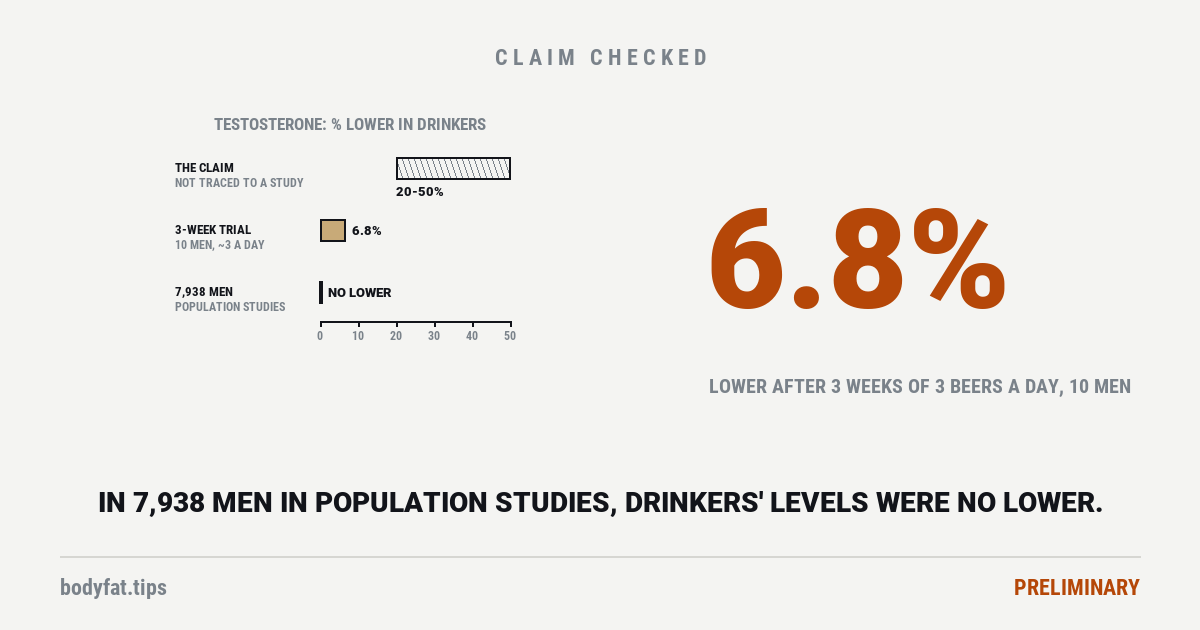
A heavy session can lower it, for hours. About three drinks a day for three weeks lowered it a little, 6.8%, in the one small trial that tested that [2]. And in the two largest studies of ordinary men, the drinkers’ testosterone was no lower than the non-drinkers’ [3] [4]. The most-quoted number, that heavy drinkers lose 20% to 50% of theirs, we could not trace to a study at all [1].
Two units before the numbers. An American lab report gives testosterone in ng/dL, nanograms per decilitre; most studies report nmol/L, and we convert at 28.84 ng/dL to the nmol/L, the factor our other testosterone pages use. A US standard drink holds 14 g of alcohol: a 12-ounce beer, a 5-ounce glass of wine or 1.5 ounces of spirits [5]. Where a study dosed by body weight, our drink counts are for an 80 kg (176 lb) man.
What happens to testosterone after a night of drinking?
It depends on how much you drink, and when the blood is drawn. The cleanest tests are crossover experiments: the same men drink alcohol on one occasion and nothing, or a dummy drink, on another, so each man is compared with himself.
At a small dose the results point both ways. In a Finnish trial, 13 men drank 0.5 g of alcohol per kilogram of body weight, about three drinks, or a placebo drink, without knowing which. Their testosterone rose, from about 389 to 461 ng/dL (13.5 to 16.0 nmol/L) [6]. The researchers traced the rise to the liver: when they slowed the breakdown of alcohol with a drug, the rise was not seen [6].
An American experiment went the other way. At the US alcohol institute, 12 young men and 12 older men had alcohol dripped into a vein and held at a breath alcohol of 0.05% for three hours, and on another day a saline drip, without being told which. In the young men, free testosterone, the small part not bound to proteins in the blood, worked out here from the total, fell by about 11 pg/mL (picograms per millilitre) on alcohol and rose by about 2 on saline; in the older men it rose on both days, by less on alcohol [7]. The authors’ test found that alcohol’s effect depended on how much testosterone a person started with, which they read as a fall seen mainly in men; that test took in all 48 volunteers, women included, and the paper reports no test of the young men on their own [7]. And in 8 men given the Finnish dose, with no dummy drink to compare, testosterone came out about 47 ng/dL lower on average afterwards, a difference that was not statistically significant [8].
| Study | Dose, and our drink count for a 176 lb man | Testosterone |
|---|---|---|
| 13 men, against a dummy drink [6] | 0.5 g per kg; about 3 drinks | Rose, from about 389 to 461 ng/dL |
| 8 men, before and after, with no dummy drink [8] | 0.5 g per kg; about 3 drinks | About 47 ng/dL lower on average; not statistically significant |
| 12 young and 12 older men, a drip into a vein against a saline drip [7] | Held at a breath alcohol of 0.05% for 3 hours | Free testosterone fell on average in the young men, against a small rise on saline, a difference the paper does not test on its own; in the older men it rose, by less than on saline |
| 10 men, beer against alcohol-free beer [9] | 1 g per kg; about 6 drinks | The authors report the beer “did not change” the morning hormones |
| 56 young men, against 20 given orange juice and water [10] | About 94 g; about 7 drinks; blood alcohol about 0.11% | No significant difference, measured in saliva |
| 7 men, whisky [11] | 1.3 g per kg; about 7 drinks | Lower at 30 minutes only |
| 16 men [12] | To a blood alcohol of about 0.11% | Fell as alcohol rose and stayed down as it fell |
| 8 men, each against a day without alcohol [13] | Kept at a blood alcohol of 0.11% to 0.14% | Did not shift, the authors report, in samples taken over 6 hours |
| 12 men, each against a day on water [14] | 1.5 g per kg; about 9 drinks | No significant difference over 20 hours |
| 8 men, each against his own session without alcohol [15] | 1.5 g per kg; about 9 drinks | 23% lower on average, 10 to 16 hours after drinking began |
| 8 men, each against his own alcohol-free day [16] | 1.75 g per kg; about 10 drinks | Lowest 12 hours later, still down at 24 |
| 72 men, each against his own sample the day before [17] | 0.9 to 2.1 g per kg, beer or wine; about 5 to 12 drinks | Lower or higher, depending on the timing and the amount |
| 8 trained men after lifting, against no alcohol [18] | 1.09 g per kg of lean mass | Higher 2 to 5 hours later: about 649 against 401 ng/dL |
| 9 trained men after lifting, against no alcohol [19] | To a blood alcohol of about 0.10% (our conversion) | “Not affected”, in the authors’ words |
| 9 volunteers after lifting, against alcohol-free drinks [20] | 1.4 g per kg; about 8 drinks | Cortisol up; ratio of free testosterone to cortisol down |
| 9 rugby league players after a match, against a matched alcohol-free drink [21] | 1 g per kg; about 6 drinks | No significant difference the next morning |
| 10 rugby union players after a simulated match, against an alcohol-free drink [22] | 1 g per kg; about 6 drinks | No significant difference over 48 hours |
| Men after exhausting exercise; the summary gives no number [23] | 1.5 g per kg; about 9 drinks | Lower, and the exercise made the fall last longer |
Drink until properly drunk, and it more often goes the other way. In 16 men taken to a blood alcohol of about 0.11%, testosterone fell as the alcohol climbed and stayed down as it cleared [12]. Eight men given about ten drinks’ worth (1.75 g per kg) over three hours had their lowest testosterone 12 hours later, and it was still down at 24 hours, compared with the same men on a day without alcohol [16]; in eight more, about nine drinks’ worth in an evening left testosterone 23% lower on average 10 to 16 hours after drinking began, against the same men without alcohol [15]. Seven men given whisky and water, about seven drinks’ worth in half an hour, showed a dip only at the 30-minute mark [11].
Not every heavy dose found a fall. Twelve men given about nine drinks’ worth, compared with a day on water, showed no significant difference in testosterone over 20 hours [14]. In eight men kept at a blood alcohol of 0.11% to 0.14%, the authors report that testosterone did not shift in samples taken at the start, after 90 minutes and after six hours [13]. And in a 2024 German experiment, 56 young men drank vodka and orange juice to a blood alcohol of about 0.11% while 20 drank orange juice and water; the testosterone in their saliva rose in both groups over about 100 minutes, with no significant difference between the two [10].
In between, and after exercise, the results scatter. Eight trained men who drank alcohol after a heavy lifting session had higher testosterone two to five hours later than when they drank none: about 649 against 401 ng/dL (22.5 against 13.9 nmol/L) [18]. In nine volunteers given a high dose after lifting, cortisol, a stress hormone, rose and the ratio of free testosterone to cortisol fell [20]. Nine other trained men, taken to a blood alcohol of about 0.10% after lifting, had testosterone “not affected”, in the authors’ words [19], and rugby players given about six drinks’ worth after a match, nine in one study and ten in another, showed no significant difference against an alcohol-free drink [21] [22]. In men who drank about nine drinks’ worth after exhausting exercise, the exercise made alcohol’s fall in testosterone last longer [23]. In a Brazilian trial, ten men drank beer at 1 g per kg or alcohol-free beer the evening before a blood test, and the authors report that the beer “did not change” the morning hormones they measured, testosterone among them [9]. And 72 men who drank beer or wine heavily, in a pattern meant to copy ordinary drinking, and were sampled five to ten hours later, came out with testosterone lower in some groups and higher in others, depending on the timing and the amount [17].
A 2024 pooling of five comparisons from four such studies found no significant difference overall [24]. So, for one night out: a heavy one can lower testosterone for hours, possibly into the next day, at doses that leave most people drunk, though several experiments at those doses found no significant difference. At smaller doses the studies do not agree: a rise in the Finnish trial; a fall that was not statistically significant in a second; and on the American drip, a fall in the young men’s average that the paper does not test on its own. Every study here is small.
Does drinking regularly lower testosterone?
The study the modern story starts from is from 1976. Healthy male volunteers at a New York clinical research centre were given alcohol every three hours, around the clock, for up to four weeks: about 220 g a day, nearly 16 US drinks, with a full diet so that nobody lost weight. Their testosterone fell, and so did the rate their bodies made it [25] [26]. We read the abstract; the number of men is given neither there nor in the 1998 review that describes the dose [25] [26].
A year later, 40 patients with alcoholism spent two weeks on a research ward, sober for the first. In the second week, 30 chosen at random were allowed unlimited alcohol, cigarettes or both, and testosterone fell “rapidly and significantly” in those allowed to drink [27]. The summary we read does not say whether all 40 were men, or how many of the 30 drank [27].
Those are doses most drinkers never reach. The one trial at an amount many drinkers do reach was Dutch, from 2004 [2]. Ten middle-aged men who already drank moderately had beer with dinner for three weeks, 40 g of alcohol a day, about three US drinks, and alcohol-free beer for another three, in random order, on meals the researchers supplied. On the beer, their testosterone was 6.8% lower. The confidence interval, the range the true average probably sits in, ran from 1.0% to 12.5% lower, so in these ten men the fall was small but probably not chance [2]. The trial was paid for by the Dutch Foundation for Alcohol Research, and three later papers with this trial’s senior author among their authors describe that foundation in their funding statements as “representing Dutch producers of and traders in beer, wine and spirits” [2]. It is an alcohol-industry foundation. So the one trial at an amount many men drink was paid for by a foundation described as representing the trade that sells the drink. The result it reported, a fall in testosterone, is not one a seller would choose, and the funding does not change the arithmetic; but the 6.8% in this page’s title comes from ten men in one industry-funded trial, and we found no other trial at that amount [28].
A 2022 Japanese trial went much lower: 15 men and 27 women had a drink with about 4 g of alcohol a day, under a third of a standard drink, for four weeks, and a placebo drink for four more. Free testosterone did not differ significantly between the two [29]. All three of its authors work for the research company of a Japanese brewing group [29]. The longest experiments we found that set men’s drinking and measured testosterone ran four weeks [28].
What do the large studies of ordinary drinkers show?
Experiments are small. The large numbers come from population studies, which compare men who drink with men who don’t. They show an association, which cannot by itself prove that one thing causes another: drinkers differ from non-drinkers in a great many ways.
The largest pooled the raw data of 25 studies and 12,330 men aged 25 to 85, nearly nine in ten of them white, and allowed for age, weight and smoking [3]. Men who drank nothing averaged about 441 ng/dL (15.3 nmol/L) of testosterone; men who drank 70 g a day or more, five US drinks or more, averaged about 444 (15.4), and no drinking group stood apart from the others [3]. By our count from its chart, 7,938 of the men had both testosterone and drinking recorded. The authors’ reading: these amounts may not have been “sufficient to induce a detrimental biological effect” [3].
The next largest leaned the other way. In a survey of 8,344 young and fertile men in Europe and the US, among the 6,472 young men, those who had drunk more than 20 drinks in the week before (Danish-sized drinks of 12 g, about 17 US drinks) had testosterone about 29 ng/dL (1.0 nmol/L) higher than those who had drunk one to ten, with a range from about 14 to 46 ng/dL; in the 1,872 fertile men the gap was similar and its range included no difference [4]. Before any adjustment, the young men who drank nothing had the lowest median of all, about 611 ng/dL (21.2 nmol/L), against about 666 (23.1) in the heaviest drinkers [4]. Beer, wine and spirits each showed the same pattern [4]. The authors flag the obvious catch themselves: men with more testosterone may simply be the ones who drink more [4].
Men with a diagnosis of alcohol dependence are a different group, and the largest dataset of them is not what the slogan predicts either. In UK Biobank, 2,076 such men had higher total testosterone than 187,124 men without the diagnosis, about 376 against 345 ng/dL (13.0 against 12.0 nmol/L) on average, and the gap held after allowing for age and weight [30]. The reason is a carrier protein. SHBG, sex hormone-binding globulin, holds testosterone in the blood and keeps it out of the body’s cells; it was higher in the dependent men, and their bioavailable testosterone, the part not tightly bound, was slightly lower once age and weight were allowed for [30]. Why a normal total can hide a low free level is on our free versus total testosterone page.
One group may differ. In 314 Korean men, those whose faces flush red when they drink, a sign of how their bodies break alcohol down, and who drank more than eight drinks a week averaged about 400 ng/dL of testosterone against 510 in non-drinkers; in men who did not flush, neither light nor heavier drinking made a significant difference [31]. It is one hospital’s records, and the flushing drinkers numbered 96 in all, the heavier drinkers among them fewer [31].
Where does the pooled “lower testosterone” figure come from?
A pooling, or meta-analysis, combines studies to get one estimate. Three teams have pooled these studies, and they disagree.
| Pooling | What went in | What it reported for testosterone |
|---|---|---|
| 2024 [24] | 21 studies it calls “controlled clinical trials”; its own table lists 16 of the 17 regular-drinking studies as measured by questionnaire or screening score | 4.02 nmol/L lower overall, about 116 ng/dL; without three rows whose comparison group averages 56.94 nmol/L, about 0.25 lower and not distinguishable from no difference (our arithmetic) |
| 2024 [32] | 17 population studies | No significant difference overall; light and moderate drinkers slightly higher |
| 2023 [33] | 17 studies with testosterone, 13,373 men, several of men treated for alcoholism | Much lower overall; no significant difference in moderate drinkers |
The 2024 pooling is the one that sounds like the slogan. It reported testosterone 4.02 nmol/L lower in drinkers, about 116 ng/dL by our conversion, and 4.86 lower, about 140 ng/dL, for regular drinking [24]. Two problems with it are visible in its own pages.
First, the label. It says it took only “controlled clinical trials” [24]. Its own table lists 16 of its 17 regular-drinking studies as measuring drinking by questionnaire or a screening score, its two largest are population surveys, and the only one that set the dose is the Dutch beer trial above [24].
Second, a number that cannot be right. Three of its rows come from one Danish study of 347 young men [34]. In them the drinkers average 16 to 18 nmol/L of testosterone, and the men who had not drunk average 56.94, about 1,640 ng/dL by our conversion [24]. That is more than one and a half times the next-highest comparison group on the same chart, 34.7 [24], and the other 2024 pooling lists that study’s non-drinkers with slightly lower testosterone than its drinkers [32]. Each of the three rows reports a gap of about 40 nmol/L, ten times the pooled result [24].
So we re-ran the pooling from the numbers printed on its chart, by the method the chart names. With every row in, we get its figures exactly. With those three rows out, the regular-drinking result moves from 4.86 nmol/L lower to 0.37 lower, with a range from 2.97 lower to 2.24 higher, and the overall result from 4.02 lower to 0.25 lower, with a range that again includes no difference at all [24]. That is our arithmetic, not the authors’, and we mark it as ours.
Before printing a pooled figure we look for the biggest study inside it. Here it is the young men of the 8,344-man survey above, whose 5,339 drinkers are half of the pooling’s 10,199, and in all three of its rows the drinkers’ testosterone is higher [24] [4]. Its 1,133 non-drinkers are counted three times over [24].
The second pooling took 17 population studies and found no significant difference overall: a standardised difference of 0.03, the gap expressed in units of how much people varied, where 0.2 is what researchers call small and 0.8 large. Light and moderate drinkers came out slightly higher, about 0.2 [32]. Its own conclusion nonetheless speaks of a “negative significant effect” on testosterone, which its pooled numbers do not show [32].
The third, from 2023, pooled 17 studies with 13,373 men and reported a standardised difference of 1.60 lower, twice what researchers call large [33]. Among moderate drinkers, one to seven of its units a week, a unit being 7.9 g of alcohol (so up to about four US drinks a week, our arithmetic), it found no significant difference, 0.05; the fall sat in its heavy-drinking group, and its studies include several of men being treated for alcoholism [33]. Its largest testosterone study is again the 8,344-man survey [33].
Will quitting alcohol increase testosterone?
For very heavy drinkers whose testosterone is low, it seems to come back, and fairly fast. In 32 heavy drinkers going through withdrawal, testosterone started below that of healthy men and rose over the next 15 days [35]. In another 32, the four men with low testosterone on admission were back in the normal range within a week, and the group’s average rose 19% [36]. In 29 men it was low-normal on days two and five and higher after three weeks sober [37], and in 21 patients free testosterone was low on admission and normal by day ten [38].
Read those with care. They are before-and-after studies with no comparison group, so some of the rise may be recovery from the binge that brought the men in. And not every study found testosterone low to begin with: in 12 men in withdrawal it was normal [39], and in 18 men followed for 127 sober days it was higher than in healthy men throughout [40].
For a moderate drinker, the only controlled evidence is the Dutch beer trial: the gap between three weeks on beer and three weeks on alcohol-free beer was the 6.8% above, in ten men [2]. None of these studies can tell you how long your own level would take to move, or whether it would.
Does beer increase estrogen in men?
The theory runs through aromatase, the enzyme in fat and the liver that turns testosterone into estradiol, the main estrogen [26], and through the hops, whose 8-prenylnaringenin was more potent than other known plant estrogens in laboratory tests [41].
Measured in men, ordinary drinking has mostly not raised it, though the tests are few and small. In the Dutch trial, three weeks of beer left estradiol unaffected, in the authors’ word; but the comparison drink was alcohol-free beer, so the trial tested the alcohol in beer, not the rest of what beer contains [2]. In the 12,330-man pooling, men who drank 70 g a day or more had estradiol of about 29 pg/mL (108 pmol/L) against about 31 (114) in non-drinkers, by our conversion, and the authors found drinking “not associated with estrogens” [3]. On the American drip, at a breath alcohol of 0.05%, the authors read men’s estradiol as lower on alcohol than on saline, from tests across men and women together; the paper does not test the men on their own [7]. The 2023 pooling found no significant difference overall, or in moderate drinkers; but in its three studies of men who drank more than seven of its 7.9 g units a week, more than about four US drinks, 855 men, estradiol was slightly higher than in non-drinkers, a standardised difference of 0.22, from 0.00 to 0.44, a range that touches no difference; and in its four studies setting that heavier group against moderate drinkers, 1,808 men, it was higher, 0.54, from 0.06 to 1.02, a range clear of no difference [33].
Heavy drinking is less clear. In the 72 men sampled after a heavy night, estradiol was significantly higher, and rose with the amount drunk per kilogram, after wine as well as beer [17]; in eight men given about ten drinks’ worth in three hours, it showed no significant change [16]. In men in withdrawal it was raised, and fell over three sober weeks [39]. Alcohol-dependent men in UK Biobank had slightly higher total estradiol, though less of it bioavailable [30]. And the 2024 pooling found estradiol higher with regular drinking, a result we have not checked against its chart [24].
What about the hops? The 1999 paper that identified 8-prenylnaringenin in hops found it in beer too, at levels its authors said “should not pose any cause for concern” [41]. A 2021 study of cells in a dish reported estrogen-like activity in cells from the lining of the womb at levels it estimated strongly hopped beer could produce [42]. A 2026 computer model, by a team including that study’s first author, put the level in the womb after a beer a day at 0.03 nanomolar at most, against an effect in the cells at 1, and judged a daily beer “unlikely to elicit estrogenic effects”, while adding that bouts of heavy drinking of highly hopped beer could push it higher [43]. Both are about women’s tissue. The nearest test in people that we found is a 2016 Austrian trial in which 11 men and 11 women drank, for two weeks, a drink with 12 mg a day of xanthohumol, a hop compound found in beer, and for another two weeks a matching drink without it; the authors put the daily dose at what several litres of a beer rich in it would hold, though even at the highest level they cite, 690 micrograms a litre, it comes to about four and a half US gallons, 17 litres (our arithmetic). Estradiol did not change significantly, in the men or in the group as a whole [44]. The drink was supplied, and the work partly paid for, by the company that makes it, and one author’s affiliation is a hop-processing company [44]. It did not measure testosterone, and no study we found has given men hops or a hop compound apart from beer and measured their testosterone [28].
And the breasts? Breast growth in men is a recorded feature of alcoholic cirrhosis, the liver failure of long, heavy drinking, and that is where the beer version of the idea comes from [45] [26]. Whether drinking adds the fat that a beer belly is made of is a separate question, on our alcohol and weight page.
Does whiskey, wine or beer matter more?
In the 8,344 men, beer, wine and spirits each tracked testosterone the same way [4]. In the 72 men sampled after a night out, estradiol rose after wine as well as beer [17]. The Japanese dose study used whisky and found a dip that lasted half an hour [11]. None of the studies on this page singles out one drink as worse for testosterone; what they measured was the alcohol, and how much of it.
Does alcohol affect women’s testosterone?
It seems to push it the other way. Across 218,907 women in three large datasets, each 10 g a day of alcohol, under one US drink, went with total testosterone about 3% to 4% higher [46]. A genetic analysis in the same study, Mendelian randomisation, which compares people by inherited variants that change how much they drink and so is less exposed to the habits that travel with drinking, pointed the same way, 4.1% higher [46]. Women brought drunk to an emergency department had higher testosterone than sober volunteers, while men had lower [47], and the Dutch beer trial found no fall in its nine women [2]. We found no genetic study of this kind in men [28].
Can you drink alcohol while on testosterone?
None of the studies on this page tested drinking while on testosterone therapy, so we do not rate it. That is a question for whoever prescribed it. What the therapy itself does to blood pressure is on our testosterone and blood pressure page.
What boosts testosterone, and what lowers it most?
For men carrying extra weight, losing it is the one lever our testosterone verdict rates Established: how to increase testosterone naturally. On what lowers it, our page on normal levels by age describes a long study in which men without chronic illness, prescription medicines, obesity or heavy drinking carried androgen levels 10 to 15% higher. Whether a pill can do the job is on our testosterone booster verdict.
Who these studies were done on
The experiments were in small groups of healthy men, mostly young, in Finland, Japan, the US, Norway, Brazil, the Netherlands, Germany, Australia and elsewhere [6] [11] [18] [20] [9] [2] [7] [10] [21]; the withdrawal studies were in men being treated for alcoholism [35] [37]. The population studies were mostly of white men averaging 60 [3], young European and fertile men [4], British men in UK Biobank [30] and Korean men from one hospital [31].
So read yourself against them. If you drink a few times a week, the large studies were about men like you, and their testosterone was no lower. If you drink three or more a day, the closest evidence is ten men in a Dutch trial and a fall of 6.8%. If you drink until drunk, four of the small experiments found testosterone lower for hours afterwards, up to a day, while at least seven at similar doses did not. And if you have been diagnosed with alcohol dependence, a total testosterone result may look normal or high while the free part is lower, which is a conversation for a clinician.
If heavy drinking lowers testosterone, why don’t drinkers have less of it?
This section is the desk’s own reasoning, and it is labelled as such. The experiments find falls at heavy doses; the big population studies find drinkers’ testosterone no lower, or higher. Here are three ways to fit that together, each rated.
Answer one: the test reads the total, and heavy drinking raises the carrier. In dependent men, SHBG was higher and total testosterone with it, while the part free to act was lower [30]; in another study SHBG was three times normal and free testosterone low on admission [38]. That is measured, in dependent men. It does not explain the young men in the European survey, whose SHBG was lower and free testosterone higher with drinking [4].
Answer two: the doses never meet. Most of the falls in the experiments came at roughly 7 to 16 drinks at a sitting or a day [11] [16] [25]; the exception is the Dutch trial’s small fall at about three a day [2], and, less firmly, the drip study at a breath alcohol of 0.05%, whose young men’s fall is an average the paper does not test on its own [7]; both sit nearer what ordinary drinkers reach, so the gap explains part of the conflict and not all of it. The top group in the 12,330-man pooling was five drinks a day or more, 271 men [3], and in the European survey about 8% of young men drank more than 30 a week [4]. That is arithmetic, not a measurement.
Answer three: the timing. In the experiments the dip lasted hours to a day [16], and in withdrawal low levels recovered within days to weeks [35] [36]. A blood test taken at a clinic visit will rarely land in that window. That is a surmise, with the timing studies on its side and no study that tested it.
Put the three together and here is what we think is true, stated plainly so you can disagree with it: alcohol lowers testosterone at doses that make you drunk, for hours to days, though not every time; at the amounts most men drink, the large studies cannot find it, while the one trial of three a day found a small fall, and a drip study at a modest blood alcohol points the same way, though it did not test the young men on their own.
What we could not find, and would like to: a randomised trial lasting months, in men, of their usual drinking against stopping or cutting down, measuring total and free testosterone by mass spectrometry, the accurate laboratory method. The longest such experiments we found ran four weeks [28]. A genetic study in men, like the one in women [46], would help too. If you know of either, the corrections line on this site is open.
Where “alcohol lowers testosterone” came from
The research is real and old, and most of it is about very heavy drinking. The 1976 hospital study gave men about 16 drinks a day [25] [26], and studies of heavy drinkers and of men with alcoholic cirrhosis described shrunken testes and lost libido [26]. In 1998 the US alcohol institute’s journal gathered it up: “Studies found that heavy alcohol consumption results in reduced testosterone levels in the blood” [26]. The same issue carried the beer version, a review titled “Alcoholic Beverages as a Source of Estrogens”, which started from the feminisation of men with cirrhosis [45].
On the way, the numbers came loose from the doses they belonged to. Ask Google today and its AI answer opens “Yes, drinking alcohol can lower testosterone levels in men”, and says regular heavy drinking, “more than 15 drinks a week for men”, can cut testosterone “by 20% to 50% or more” [1]. Fifteen drinks a week is about two a day; the 1976 study gave about 16 a day [25] [26]. The 15-drink line is the US Centers for Disease Control and Prevention’s definition of heavy drinking for men, which the health-information site repeats [5] [1]. Google cites four sources for that sentence: the 2023 review, whose summary we read and which gives no such range there [48]; a blood-testing company; the health-information site; and a supplement seller’s blog from January 2026. Only the blog prints the range, credited to “Research Team”, beside “14 drinks per week” and “an average 6.8% reduction” [1]. The same sentence, word for word, was on a US at-home testing company’s article more than five months earlier, dated 6 August 2025 and signed by a physician; it attaches no reference to the sentence, though the six references at the end of the article include the Dutch trial behind the 6.8%, and the company sells an at-home hormone test [1]. The 6.8% is the Dutch trial’s, whose men drank about 20 drinks a week, not 14 [2]. The 20% to 50% we could not trace to a study; neither the blog nor the testing company’s article gives one [1] [28]. We could not trace who first said that drinking lowers testosterone, either.
And it sells. For this search the AI answer also cites a private blood-testing company whose article ends by offering a testosterone test, a home-testing company that also offers testosterone therapy, and the supplement seller’s blog, which tells older men that hops make beer “particularly problematic” [1]. The review the answer cites from PubMed says the opposite of the slogan for small amounts: a low-to-moderate dose “increases testosterone concentrations in men” [48].
None of this is aimed at anyone who drinks and wonders what it does to them. The question is a fair one. It is the range of 20% to 50%, with no study we could find behind it, that we could not let stand.
What this is rated, and what the rating covers
Preliminary — for the claim that alcohol lowers testosterone, as it circulates.
It is rated Preliminary because the evidence for it is small and conflicting. Experiments at very heavy doses mostly point down, though several found no significant difference, and one three-week trial at about three drinks a day points down too [25] [27] [16] [15] [14] [2]; experiments at smaller doses found a rise in one, in the drip study a fall in young men’s free testosterone that the paper did not test on its own, and no significant difference in two [6] [7] [8] [9]; the two largest population studies found drinkers’ testosterone no lower, in one of them higher [3] [4]; and the pooled figure that shows a large fall rests on three rows that cannot be right [24]. It is not Unsupported because the controlled experiments that found falls are real, if small and old.
Each part, rated alone, in words. That one heavy night lowers testosterone for hours: Preliminary; four small experiments at rest found falls at about seven drinks or more and three at similar doses found no significant difference, while others, after exercise, the next morning or at lower doses, found a rise, a fall or no significant difference, and one found both directions depending on the timing [12] [16] [15] [11] [14] [13] [10] [18] [23] [19] [21] [22] [7] [9] [17].
That weeks of very heavy drinking lower it while the drinking lasts: Preliminary, on two small controlled experiments that agree, against the largest study of dependent men, who had higher total testosterone [25] [27] [30].
That light or moderate drinking lowers it: Preliminary, on one ten-man trial at three a day, against population studies of thousands that found drinkers’ levels no lower [2] [3] [4].
The opposite version, that a drink or two raises it: Preliminary, on 13 men for an hour or two and an association, in young men, between heavier weekly drinking and higher testosterone, against a drip experiment at a modest blood alcohol whose authors read a fall in men from a test across all its volunteers, and a small study at the 13-man trial’s dose that found no significant difference [6] [4] [7] [8].
That quitting raises it: Preliminary, on before-and-after studies of dependent men with no comparison group, some of which found nothing low to recover [35] [37] [40].
That beer raises estrogen in men who drink ordinary amounts: Preliminary, with the evidence leaning against it. The one trial, of the alcohol in about three beers a day against alcohol-free beer, found no rise in ten men; the 12,330-man pooling found estradiol slightly lower in the heaviest drinkers; a drip at a modest blood alcohol was read by its authors as lowering it in men, though the paper does not test the men on their own; and a hop-compound drink did not raise it significantly. In its favour is one pooling of mixed studies: against non-drinkers, a small rise in men drinking more than about four US drinks a week, with a range that touches no difference, and against moderate drinkers a larger rise in that heavier group, with a range clear of no difference [2] [3] [7] [44] [33]. That heavy drinking raises it: Preliminary [17] [39] [30]. That the hops in beer feminise men: Preliminary, on cell studies in its favour, against a 2026 model and the one trial of a hop compound that we found to have measured a sex hormone in men, in which 11 men and 11 women showed no significant change in estradiol [42] [43] [44].
What is not rated here: drinking while on testosterone therapy; sperm and fertility; alcohol and cancer or weight, which have their own verdicts; and the frame above, which is this desk’s reasoning from the evidence rather than a result the evidence delivered. It is marked as ours so that you can weigh it as ours.
This is journalism, not medical advice. If you are worried about your drinking, or about your testosterone, talk to a clinician who knows your history; whether to get tested, and how to read the result, belongs there too. How we read a study, and what each tier means, is set out here.
- Does Testosterone Raise Blood Pressure? A Little: About 1.5 Points Against Placebo in the Biggest Trial, and 4.9 on One Oral Form
supported - Does Ozempic Cause Vision Loss? In Diabetes, Europe’s Regulator Says a Rare Optic-Nerve Stroke Shows Up About Twice as Often on It: Roughly 1 Extra Case per 10,000 a Year. The Trials Are Too Small to Tell.
preliminary - Do Statins Raise Blood Sugar? Yes, by About 0.7 mg/dL. On a Standard Dose, That Is About One Extra Diabetes Diagnosis per 1,000 People a Year.
established