Is Peanut Butter Bad for Cholesterol? Not in Nine Trials of Peanuts and Peanut Butter. In Place of Saturated Fat, LDL Fell About 14%; Otherwise It Came Out About Even.

“Sadly, peanut butter isn’t very good for you — at least in the amounts that we’re used to consuming.” That is a hospital’s health blog, in July 2020, and the cardiologist it quotes goes further. To lower cholesterol, cut saturated fats, “Meats, butter, cheese”, and “Cutting down on those, including peanut butter, should be the ultimate goal” [1].
The worry is common enough to be a search of its own: “is peanut butter bad for cholesterol” is typed into Google about 3,600 times a month in the United States (from a paid keyword database, pulled 20 October 2026) [1]. A forum thread that Google’s AI answer cites puts it the way a lot of people do: “Safe foods with saturated fats? Is peanut butter really ok?” The AI answer itself says the opposite, that peanut butter “can actually support healthy cholesterol levels” [1].
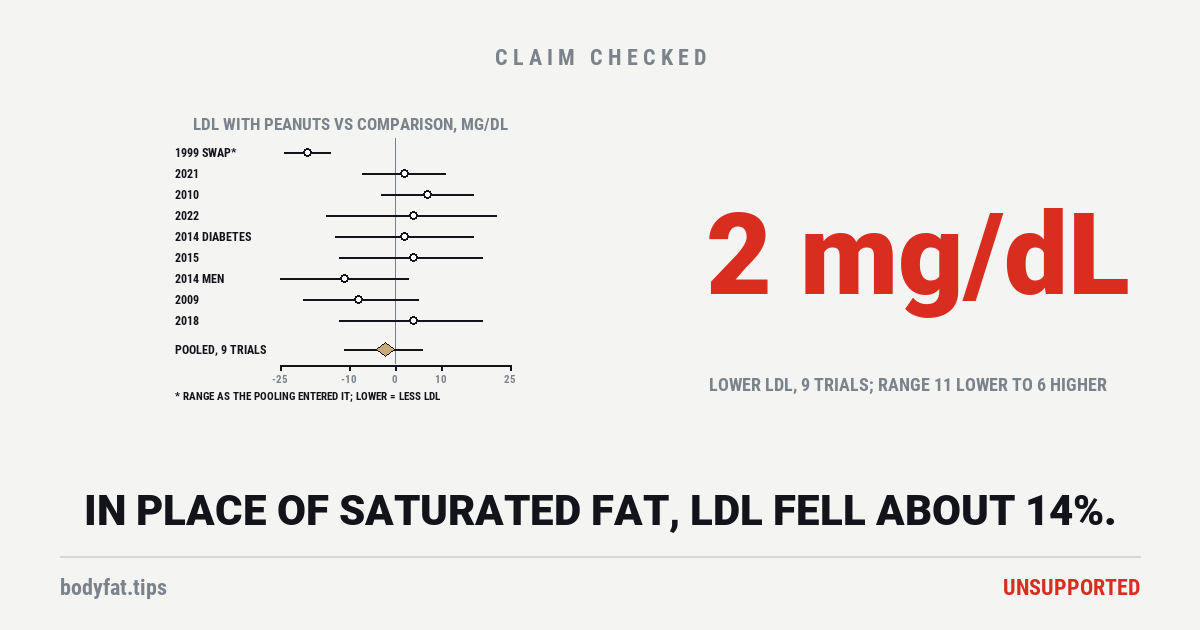
Not in the trials. Pool nine randomised trials of peanuts and peanut butter that measured LDL, and LDL came out about 2 mg/dL lower than on the comparison diets, with a range from about 11 lower to 6 higher [2]. Where peanut butter and peanuts replaced saturated fat in a typical American diet, LDL fell by about 14% [3]. Set against snacks, rice bars or people’s usual food, it came out about even [2].
LDL is the cholesterol that guidelines and cholesterol drugs mainly target. Triglycerides are a fat carried in the blood and measured on the same test, and HDL is the kind often called good cholesterol. American lab reports give them in mg/dL, milligrams per decilitre; many of the trials used mmol/L, and where we convert, we say so.
Does peanut butter raise cholesterol?
The fullest count of the trials is a 2022 pooling, a meta-analysis that combines trials to get one estimate, of 11 randomised trials of peanuts and peanut butter in 643 adults, 9 of which measured LDL [2]. Its LDL result was 0.06 mmol/L lower with peanuts, about 2 mg/dL by our conversion, with a confidence interval, the range the true average probably sits in, from about 11 mg/dL lower to 6 higher (−0.28 to 0.16 mmol/L) [2]. No difference at all is well inside that range, and so is a small difference either way. It is a range for an average across trials, not a forecast for any one person. Six of the nine trials gave whole peanuts and three included peanut butter [2]. For a jar made only from roasted peanuts that is, by our reading, a fair stand-in for its fats: the European regulator’s panel says such peanut butter has the same fatty acid composition, the mix of saturated and unsaturated fats, as peanuts [4]. It is not a perfect one: the 2022 pooling’s authors cite a trial in which more of the fat in whole peanuts went unabsorbed, passing out in the stool, than with peanut butter, peanut oil or peanut flour [2].
| Trial | What the comparison group ate | LDL with peanuts, mg/dL |
|---|---|---|
| 1999, 22 US adults, 24 days on each diet, all food provided [3] | A typical American diet, 16% of calories from saturated fat | About 19 lower (−0.49); range 24 to 14 lower |
| 2021, 224 Chinese adults with or near the metabolic syndrome, 12 weeks [5] | White rice snack bars, same calories | About 2 higher (0.05); range 7 lower to 11 higher |
| 2010, 54 Iranian men with high cholesterol, 4 weeks [6] | Their usual food; the peanuts were added on top | About 7 higher (0.18); range 3 lower to 17 higher |
| 2022, 63 young Spanish adults, 6 months; peanut butter and peanut groups together [2] | A butter made from peanut oil, on top of their usual food | About 4 higher (0.10); range 15 lower to 22 higher |
| 2014, 57 US adults with type 2 diabetes, 24 weeks [7] | A peanut-free diabetes meal plan with extra meat and fat servings | About 2 higher (0.05); range 13 lower to 17 higher |
| 2015, 61 Australian adults, average age 65, 12 weeks on each diet [8] | A nut-free diet | About 4 higher (0.10); range 12 lower to 19 higher |
| 2014, 65 men with overweight or obesity, 4 weeks [2] | A calorie-cut diet without peanuts | About 11 lower (−0.29); range 25 lower to 3 higher |
| 2009, 25 young adults, 2 weeks of overeating [2] | Sweets, same calories | About 8 lower (−0.20); range 20 lower to 5 higher |
| 2018, 25 adults with type 2 diabetes, 12 weeks [2] | Almonds | About 4 higher (0.10); range 12 lower to 19 higher |
| All nine, pooled: about 594 people (668 as the pooling counts them) [2] | About 2 lower (−0.06); range 11 lower to 6 higher |
Read down the table and one row stands apart. In eight of the nine trials the range for LDL included no difference at all. The ninth, the 1999 feeding trial, found LDL about 19 mg/dL lower [2], and it is the trial whose comparison diet carried twice the peanut diet’s saturated fat [3]. Take it out and the other eight average about 1 mg/dL higher with peanuts, with a range from about 4 lower to 5 higher, by our arithmetic from the pooling’s chart [2]. So the pooled 2 mg/dL fall is mostly that one trial’s swap.
Before printing a pooled figure we look for the biggest study inside it. The largest trial in the pooling, 224 Chinese adults given 56 g (2 oz) of peanuts or white rice bars as a daily snack for 12 weeks, nearly two-fifths of the roughly 594 people pooled, found the two groups’ blood fats within chance of each other [5]. At 12.7% of the pooling’s weight it carries a little less than the 1999 trial’s 14.3%, and no trial carries more than about a seventh [2].
So is the worry backwards? Not quite. The worry assumes peanut butter adds bad fat to the blood. The trials say something less dramatic: what peanut butter does to LDL depends on what leaves the plate when it arrives.
What happened when peanut butter replaced saturated fat?
The 1999 trial is the cleanest test, and it was small. At Penn State, 22 adults aged 21 to 54 with ordinary cholesterol finished five diets of 24 days each, with every meal provided: a typical American diet with 16% of calories from saturated fat; a low-fat diet; and three diets with about the same total fat as the American one but about half its saturated fat, built on olive oil, peanut oil, or peanuts and peanut butter [3]. The peanut diet took 8% of its calories from saturated fat [3]. The three diets rich in olive and peanut fat brought LDL down by 14% on average against the American diet, about as much as the low-fat diet did, and on the peanut diet it fell from 3.52 to 3.03 mmol/L, about 136 to 117 mg/dL by our conversion [3], and the peanut diet could not be told apart from olive oil, peanut oil or the low-fat diet [4]. Triglycerides were 13% lower on the diets rich in olive and peanut fat, and 11% higher on the low-fat diet [3]. The peanut industry’s research body paid for the trial [3].
The European Food Safety Authority read it the same way. In an opinion published in 2011, its nutrition panel weighed a proposed claim that peanuts, peanut oil and peanut butter made only from roasted peanuts help keep LDL normal, and concluded that a cause-and-effect link had not been established “beyond what could be expected from the fatty acid composition of peanuts”; it said part of the effect came from replacing saturated fat [4]. In plain terms: peanut butter lowered LDL when it took saturated fat’s place, as olive oil did, and the regulator found nothing established beyond that. Swapping saturated fat for unsaturated fat is rated on our foods verdict and our saturated fat verdict.
What if you just add peanut butter to what you already eat?
That is how most people eat it, and it is what most of the other trials tested. The one built around peanut butter, ARISTOTLE in Barcelona, randomised 90 healthy young adults to two tablespoons (32 g) a day of peanut butter made only of peanuts and sea salt, a small handful (25 g, about 0.9 oz) of skin-on roasted peanuts, or two tablespoons of a control butter made from peanut oil, on top of their usual food for six months; 63 finished, aged 18 to 33 and about seven in ten of them women [2]. LDL ended about 8 mg/dL higher than it started in the peanut butter group (2.60 to 2.80 mmol/L) and about 7 higher in the control group, by our conversion, and about 9 higher in the peanut group; none of the three rises was statistically significant, and the peanut butter and control groups could not be told apart [2]. The peanut group, not the peanut butter group, did end with lower ratios of total and LDL cholesterol to HDL than the control group, but it had started lower, and its ratios rose about as much as the control group’s: LDL to HDL went from 1.29 to 1.48 in the peanut group and from 1.56 to 1.76 in the control group [2]. Its control was peanut oil, so the trial asked what the rest of the peanut adds, not what peanut butter does against no peanut butter [2].
In Tehran, 60 men with high cholesterol were randomised to the order of two four-week periods, their usual food and their usual food plus 60 to 93 g (about 2.1 to 3.3 oz) of lightly salted peanuts a day; 54 finished [6]. By their food records, calories rose from about 2,550 to about 2,930 a day, our conversion [6]. LDL rose 6.8 mg/dL during the peanut weeks and fell 0.1 during the usual-food weeks, a peanut effect of 7.0 mg/dL with a P value of 0.16, short of the line researchers use for “probably not chance” [6]. HDL rose 17% [6]. The paper sums up its LDL result as no change; we print the number, because 7 mg/dL in men whose LDL started near 170 is the closest any trial on this page comes to the worry, and it was not statistically significant.
In California, 60 adults with type 2 diabetes followed a diabetes meal plan for 24 weeks, half of them with about 20% of their calories from peanuts or peanut butter, 46 g (1.6 oz) a day, and half with extra meat and fat servings instead; 57 finished [7]. LDL fell about 3% in both groups, and the difference between them had a P value of 0.76 [7]. The peanut butter they were given had added salt and oil [7]. In Australia, 61 adults averaging 65 years of age ate high-oleic peanuts or no nuts for 12 weeks each, and their blood fats could not be told apart between the two [8]; in a US trial, 50 adults with raised blood sugar ate 1 oz (28 g) of peanuts or crackers with low-fat cheese at night for six weeks each, with the same result for blood fats [9].
And in people who already have heart disease: in a 2024 trial, 388 Brazilian adults recovering from a heart attack ate a heart-healthy diet with or without 30 g (about 1 oz) a day of mixed nuts, a third of them peanuts, for 16 weeks. LDL ended 3.5 mg/dL higher in the nut group, with a range from 3.5 lower to 10.4 higher, adjusted for their statins [10]. It tested mixed nuts, not peanut butter, and it is the one trial on this page in people after a heart attack.
Who paid? Of the eight peanut trials whose funding we read for this page, six had money, peanuts or a research partnership from peanut growers’ or makers’ bodies [3] [2] [5] [7] [8] [9]; a seventh was paid for by a US government peanut research programme [11]; the Iranian trial was paid for by Iranian government funds [6]. Three of the six say their funders had no role in the work [2] [5] [7]. None of the six found peanuts clearly ahead of the comparison diet on LDL except the 1999 swap for saturated fat [2] [9].
Don’t nuts lower cholesterol?
Tree nuts do, a little: our foods verdict rates it Established, about 4 mg/dL less LDL per ounce of tree nuts a day in pooled randomised trials, from a 2015 pooling [12]. That pooling left peanuts out: it excluded “legumes (e.g., peanuts)” [12]. Peanuts are a legume, a relative of beans, and the trials treat them as their own question.
Put them side by side and peanuts come off worse. A 2025 network meta-analysis, a method for ranking several options against each other across many trials at once, pooled 76 trials of six kinds of nut [13]. Almonds and walnuts lowered LDL against the comparison diets; peanuts, in eight trials, did not, and ranked last of the seven options for LDL, behind the comparison diets themselves, a ranking built on overlapping ranges [13]. In the network’s own estimate, which draws on every comparison in the pooling, peanuts came out at a standardised difference of 0.08 towards higher LDL, the gap expressed in units of how much people varied, where 0.2 is what researchers call small, with a range from −0.13 to 0.30 that includes no difference [13]. In the eight trials that set peanuts directly against a comparison diet, the difference was 0.11, with a range from −0.06 to 0.27 [13]. Leave out one of those trials, a 1997 study the European regulator noted was not randomised, and that direct range just cleared zero, at 0.14 (0.002 to 0.28) [13] [4]; leave out the Iranian trial instead and it shrank to 0.06 [13]. That pooling left out the 1999 feeding trial, judging its comparison diet unsuitable [13].
An older, 2020 pooling of 13 peanut trials, some of them testing peanut oil or a peanut-sprout extract rather than peanuts, found LDL 3.3 mg/dL lower with a P value of 0.47, nowhere near the line; we read it as its abstract [14]. Two more poolings of nut trials report peanuts on their own. A 2023 pooling, funded by an Australian nut industry council, found LDL 0.08 mmol/L higher in its peanut group, about 3 mg/dL by our conversion, with a range from about 2 lower to 8 higher; that group, 10 analyses and about 895 people (1,021 as the pooling counts them, the people in its three crossover trials counted twice; our count from its chart), includes the 1999 feeding trial and two trials of peanut oil [15]. A 2025 pooling found LDL 0.02 mmol/L higher, about 1 mg/dL, with a range from about 8 lower to 10 higher, in 6 analyses and 478 participants [16]. Of the five poolings we read that report peanuts on their own, then, two came out a shade lower and three a shade higher, and none of them could tell peanuts from the comparison diets on LDL.
Do peanuts raise triglycerides?
The worry runs the other way here. The 2022 pooling found triglycerides about 11.5 mg/dL lower with peanuts (0.13 mmol/L), with a range from about 6 to 18 lower, our conversion, and rated that evidence moderate [2]. But that fall leans on the same trial as the LDL fall: the 1999 swap for saturated fat carries 63% of the pooling’s weight for triglycerides [2]. Take it out and the other eight trials average about 6 mg/dL lower, with a range from about 15 lower to 3 higher, which includes no difference, by our arithmetic from the pooling’s chart [2]. And the 63% comes from how the pooling entered the trial, not from its size. The paper gives triglycerides of about 103 mg/dL on the peanut diet and 118 on the American diet (1.16 and 1.33 mmol/L, our conversion), each with a standard error of 0.13 mmol/L, for 22 people [3]; the pooling’s chart enters 0.13 as the standard deviation, for 20, as it does in the trial’s LDL row [2]. Enter the trial with the spread its standard errors imply instead, and it carries about 8% of the weight, and the nine trials together come out about 7 mg/dL lower, with a range from about 16 lower to 2 higher, which includes no difference, by our arithmetic [3] [2]. So the 2022 pooling’s fall cleared chance because of how it weighted that one trial.
Two later poolings that report peanuts on their own found falls that did clear chance. A 2023 pooling, whose peanut group includes the 1999 trial and two trials of peanut oil, found triglycerides about 8 mg/dL lower (0.09 mmol/L), with a range from about 2 to 14 lower [15]; a 2025 pooling, whose peanut group does not include the 1999 trial, found them about 9 lower (0.10 mmol/L), with a range from about 3 to 16 lower, our conversions [16]. Neither leans on the 1999 swap. The 2023 pooling enters that trial with spreads about four times as wide as the 2022 chart’s, which leaves it about 6% of the peanut weight; without it the fall is about the same, about 8 mg/dL lower with a range from about 1 to 16 lower, and without the two peanut-oil trials it is about 10 lower, all by our arithmetic from its chart [15]. Both charts print every trial, and in both, leaving out any one trial still leaves a fall that clears chance, by our arithmetic from them [15] [16]. Both share several trials with the 2022 pooling, and five of the 2025 pooling’s six trials are in the 2023 one, so the three are not independent results. And both lean most on the same trial, a six-week crossover of 50 US adults that, by our arithmetic, carries about two-fifths of the weight in each, and whose own result could not be separated from chance; without it, the 2023 pooling’s range only just stays clear of no difference [15] [16] [9]. The 2020 pooling found a fall of 7.6 mg/dL it could not separate from chance [14], and so did the 2025 network pooling, a standardised difference of 0.12 in its network estimate [13]. In the 1999 feeding trial, triglycerides were 13% lower on the peanut diet than on the American diet [3].
HDL tells a similar story. The 2020 pooling found it 2.7 mg/dL higher with peanuts [14], and the 2025 network pooling found peanuts the one nut that raised it, with a network estimate of 0.16 whose range only just cleared zero [13]. Look inside that second result, though, and it is mostly one trial: in the direct comparisons of peanuts with comparison diets the HDL difference was 0.17, and without the Iranian men it shrank to 0.02 [13]. Whether a higher HDL from food protects the heart is its own question, on our HDL verdict.
What’s in the jar: fat, sugar, salt and hydrogenated oil
Here is what the worry gets right. Peanut butter is about half fat by weight, and some of that fat is saturated: USDA’s reference entry for smooth, unsalted peanut butter gives 16.4 g of fat and 3.3 g of saturated fat in two tablespoons (32 g), with 8.3 g of monounsaturated and 4.0 g of polyunsaturated fat, by our arithmetic from its per-100-gram figures [17]. That is about 190 calories [17]. The saturated share of the fat is 20% in USDA’s smooth entry and 15% in its chunky one [17]. It contains no cholesterol [17], which is the first thing Google’s AI answer points out [1]; the fat is the part to look at.
Sugar and salt depend on the jar. The smooth entry lists 10.5 g of total sugars per 100 g, about 3.4 g in two tablespoons, without saying how much was added [17], and 17 mg of sodium per 100 g for the unsalted kind [17]; so, by our reading, nearly all the salt in a salted jar is salt that was added. Under the US standard for anything sold as “peanut butter”, seasonings and stabilisers together may make up no more than 10% of the weight, artificial sweeteners and colours are not allowed, and every ingredient has to be on the label [18]. That is the honest answer to the related search for the “best peanut butter for high cholesterol”: the ingredient list tells you whether there is anything in the jar besides peanuts and salt. We do not recommend brands.
And the hydrogenated oil? The standard says that oils used as stabilisers “must be hydrogenated vegetable oils” [18]. The harmful kind, partially hydrogenated oil, the main source of artificial trans fat, lost its “generally recognized as safe” status in 2015, with a compliance date of 18 June 2018 [19], and in 2023 the FDA deleted it from the peanut butter standard [18]. What is left is fully hydrogenated oil, hydrogenated “to complete or near complete saturation”, which the FDA put outside its ruling and which can carry trans fat below 2% from incomplete hydrogenation [19]. So the hydrogenated oil in a jar sold as peanut butter today is saturated fat, inside the standard’s 10% cap on additions, not the partially hydrogenated kind that carried trans fat. The European regulator’s 2011 description, that a jar “may contain added palm oil or partially hydrogenated vegetable oil”, describes a recipe the US standard no longer allows, at least for the second half [4]. Our vegetable oil verdict tells the trans-fat story, and our palm oil verdict covers the other stabiliser people find on labels: in place of liquid oils, palm oil raised LDL in the trials. By our reading of the standard’s wording, a jar stabilised with ordinary palm oil does not meet it; the name on the jar and the ingredient list will tell you.
Can I have peanut butter on a low-fat diet?
In the 1999 trial, the peanut diet carried 36% of its calories as fat and the low-fat diet 25%, and the two lowered LDL by about the same amount; the low-fat diet also lowered HDL by 4% and raised triglycerides [3]. So in that trial a diet built to lower LDL did not need to be low in fat to do it. Two tablespoons still bring 16 g of fat and about 190 calories [17], and in the 2022 pooling, adults at high cardiometabolic risk who were given peanuts ended about 2.1 lb (0.97 kg) heavier than the comparison groups, in six trials [2]. Whether it fits a diet a doctor has prescribed is a question for that doctor or a dietitian. What losing weight does to cholesterol is on our weight-loss and cholesterol verdict.
Does peanut butter affect blood pressure?
Not in a way the poolings could separate from chance. The 2020 pooling found systolic pressure 0.09 mmHg lower, with a P value of 0.94 [14], and the three trials in the 2022 pooling that measured it found no clear difference from the comparison groups [2]. Salt is the part of a jar most likely to matter for blood pressure, and it is on the label [18]. This page does not rate blood pressure; our blood pressure verdict covers what lowers it.
Is peanut butter healthy for kids?
The trials pooled for this page were in adults, aged 18 to 84 in the 2022 pooling [2], so they do not answer it. For children the question that matters most is often allergy, and that belongs with a paediatrician, not a website.
Does eating peanut butter mean fewer heart attacks?
That needs a trial that counts heart attacks, and we found none: no randomised trial of peanuts or peanut butter that counted heart attacks, strokes or heart deaths [20]. The mixed-nut trial above, a third of its nuts peanuts, did record heart trouble, but only among what the paper calls “serious adverse events unrelated to the intervention”, adverse events being the health problems a trial logs whether or not the treatment caused them: a new heart attack, angina or a hospital stay in 14 of the 193 people given nuts and 18 of the 195 not, over 16 weeks, and the paper reports no statistically significant difference in adverse events between the groups [10]. It was built to measure LDL, not to count heart events. Beyond that, what exists is cohort studies, which follow people for years and count who falls ill; they show what goes with what, not what causes what.
In three US cohorts of 210,836 nurses and health professionals, followed for up to 32 years, people who ate peanuts twice a week or more had 13% fewer cases of cardiovascular disease than people who never did, a hazard ratio of 0.87, with a range from 0.82 to 0.93 [21]. A hazard ratio compares how often something happens over time in two groups: 1.00 means no difference, 0.87 means 13% fewer. Peanut butter was a different story: its link with cardiovascular disease was not significant across the three cohorts, though one of them, on its own, linked it with less [21]. In the NIH-AARP study, 380,351 Americans aged 50 to 71, followed for a median of 15.5 years, the people who ate the most peanut butter, or other nut butter, died of cardiovascular disease at 0.99 times the rate of people who ate none, with a range from 0.95 to 1.04 [22].
Neither study, taken whole, shows peanut butter hurting the heart or helping it. Both papers name the problem: peanut butter eaters differed in other ways, more of them smoking and eating red meat in the AARP study [22], and in the US cohorts “residual confounding by dietary pattern remains a strong possibility” [21].
What are the worst foods for cholesterol?
We do not keep a list of five. In feeding trials, saturated fat raises LDL and swapping it for unsaturated fat lowers it; our saturated fat verdict and our foods verdict set out that evidence, and our fibre verdict the soluble fibre that lowers LDL a little. On that map peanut butter sits with the unsaturated fats, with a fifth or less of its fat saturated [17].
Who these studies were done on
The trial that replaced saturated fat was 22 American adults aged 21 to 54 with ordinary cholesterol [3]. The peanut butter trial was young, healthy Spanish adults, about seven in ten of them women [2]. The others were Iranian men with high cholesterol [6], Americans with type 2 diabetes [7], Chinese adults with or near the metabolic syndrome [5], Australians averaging 65 years of age [8] and, in the mixed-nut trial, Brazilians recovering from a heart attack [10]. The cohorts were American nurses and health professionals, and AARP members aged 50 to 71 [21] [22].
So read yourself against them. If your LDL is high and you want it lower, the trial that matters is the one where peanut butter replaced saturated fat, and it was 22 people for 24 days per diet [3]. If you have type 2 diabetes or have had a heart attack, the trials closest to you found LDL about even with peanuts in the diet [7] [10].
If peanuts are mostly unsaturated fat, why don’t they lower LDL the way almonds do?
This section is the desk’s own reasoning, and it is labelled as such. Peanut fat is mostly unsaturated [4], tree nuts lower LDL a little in the trials [12], and peanuts, in five poolings, could not be told apart from the comparison diets [2] [13] [14] [15] [16]. Here are three ways to fit that together, each rated.
Answer one: it depends on what the peanuts pushed off the plate. In the 1999 trial, whose peanut diet was designed to cut saturated fat, LDL fell about 14% [3]; where peanuts were added on top of the usual diet or set against rice bars, crackers or a nut-free diet, LDL could not be told apart from the comparison [6] [5] [9] [8]. The regulator’s panel drew the same line, crediting part of the effect to replacing saturated fat [4]. The trial designs are measured; that this explains the gap between peanuts and tree nuts is our inference, and the tree-nut trials, which we have not sorted by what they replaced, could cut against it.
Answer two: the peanut trials are too few and too small to see a small fall. Tree nuts lowered LDL by about 4 mg/dL per ounce a day in the pooled trials on our foods verdict. The 2022 pooling’s range for peanuts ran from 11 mg/dL lower to 6 higher [2], and the 2025 network’s from a small fall to a small rise [13]: wide enough to hold a tree-nut-sized fall, and a rise of the same size. That is arithmetic from the poolings’ own ranges, not a measurement of anything.
Answer three: something in peanuts themselves. Peanuts are a legume, not a tree nut, and about 14% of their fat is saturated [4]. But the regulator found nothing established beyond what peanuts’ fatty acids would predict [4], which cuts against a special peanut effect in either direction. It is a hunch, with nothing tested behind it; we include it because it is the explanation a reader will reach for first.
Put the three together and here is what we think is true, stated plainly so you can disagree with it: peanut butter is not a cholesterol food in either direction; what it does to LDL depends on what it replaces: in place of saturated fat it helps, and against crackers, rice bars or nothing at all it comes out about even.
What we could not find, and would like to: a randomised trial of peanuts or peanut butter that counted heart attacks, strokes or heart deaths. We found none [20]. The peanut butter trials registered now are small and measure gut bacteria, blood sugar and blood fats [20]. We would also like a longer test of the 1999 swap, peanut butter in place of butter or cheese, calorie for calorie, in people’s own kitchens for six months; the diabetes trial on this page came partway, setting peanuts against extra meat and fat servings [7]. If you know of a trial that counted heart events, the corrections line on this site is open.
Where “peanut butter is bad for your cholesterol” came from
We could not trace who first said it. The raw material is real: peanut butter is about half fat by weight [17], and the long-standing advice on cholesterol is to cut saturated fat, which our saturated fat verdict rates. The clearest modern version we found is the hospital blog quoted at the top, from July 2020, whose cardiologist put peanut butter on the list of saturated-fat foods to cut [1].
It spreads as a question more than a claim. Google’s AI answer for this search cites the cholesterol forum thread asking whether peanut butter is “really ok”, and a hospital system’s post that opens “Patients frequently ask doctors” whether peanut butter is bad for cholesterol [1]. People Also Ask adds “Can I have peanut butter on a low-fat diet?” [1].
And it sells, in both directions. A powdered peanut butter maker, 11th in Google’s results for this search, calls its product “the Smarter Heart-Healthy Choice”, with “90% less fat and 70% fewer calories than traditional peanut butter” [1]. From the other side, the peanut industry’s research body ranks 7th with a page headed “Daily Peanut Consumption Decreases Blood Pressure and Cholesterol Regardless of Flavoring” [1]. It describes a trial in which every participant ate peanuts, so there was no group without them to compare against, and the cholesterol fall it reports was in the 24 participants classed as at higher risk [11]. The AI answer also cites a cholesterol-lowering-spread maker telling readers that peanut butter’s fats “can help reduce bad cholesterol levels” [1]. The trials found neither the harm nor, outside a swap for saturated fat, the help [2] [13] [4].
None of this is aimed at anyone who has stood in a supermarket aisle wondering whether to put the jar back. The worry is reasonable on its face: the jar is half fat. It is the trials that do not bear it out.
What this is rated, and what the rating covers
Unsupported, of the tested kind — for the claim that peanut butter is bad for your cholesterol, meaning that it raises LDL.
It is rated Unsupported, of the tested kind, because the claim has been tested and did not hold up. In nine randomised trials pooled in 2022, LDL with peanuts and peanut butter averaged about 2 mg/dL lower than on the comparison diets, a range that includes no difference [2]; in place of saturated fat, LDL fell about 14% [3]; and the European regulator’s panel found nothing established beyond what peanuts’ fats would predict [4]. Findings lean the other way too, and we report them: three of the five poolings put peanuts slightly towards higher LDL, all within chance [13] [15] [16], and one trial that added peanuts to men’s usual food found LDL 7 mg/dL higher, not statistically significant [6]. How big a rise do the trials leave room for? Without the 1999 swap, the other eight trials in the 2022 pooling reach about 5 mg/dL higher at the top of their range, by our arithmetic [2]; the 2023 and 2025 poolings’ peanut groups reach about 8 and 10 higher [15] [16]. So a rise of a few mg/dL is not ruled out; an average rise of more than about 10 mg/dL sits outside all of those ranges. The cohorts do not link peanut butter with more heart disease either [21] [22].
The reverse claim, rated alone, in words. That peanut butter lowers LDL in its own right: also Unsupported, of the tested kind; the poolings could not separate it from the comparison diets, and the regulator’s panel found the claim not established [2] [13] [14] [15] [16] [4]. In place of saturated fat it lowered LDL as olive oil and peanut oil did in the 1999 trial [3], the fat swap that our foods verdict rates Established. That it lowers triglycerides, a little: Supported; all five poolings point that way, and in the 2023 and 2025 poolings the fall, about 8 to 9 mg/dL, clears chance whichever single trial is left out and does not depend on the 1999 swap, by our arithmetic from their charts; the 2022 pooling’s fall cleared chance only through the weight it gave the 1999 trial. The limits are known: the trials are mostly small and short, the poolings share many of them, and one six-week trial of 50 adults carries about two-fifths of the weight in both newer poolings [15] [16] [2] [14] [13].
What is not rated here: peanut allergy; contamination; the cancer and diabetes links some cohorts report; blood pressure and body weight, which we report but do not rate; and the frame above, which is this desk’s reasoning from the evidence rather than a result the evidence delivered. It is marked as ours so that you can weigh it as ours.
This is journalism, not medical advice. Anyone managing high cholesterol, or a peanut allergy, should take diet advice from a clinician or dietitian. How we read a study, and what each tier means, is set out here.
- Is Avocado Oil Good for You? Its Fat Is Close to Olive Oil’s, Its Own Trials Are Small, and Most Bottles Tested in 2020 Were Stale or Mixed
preliminary - Does Caffeine Stunt Your Growth? The Warning Was Selling a Coffee Substitute in 1900, and the Tests Since Do Not Back It
unsupported - Is Palm Oil Bad for You? Against Liquid Oils It Raised LDL About 9 mg/dL in 26 Trials. The Cancer Worry Rests on Animal Studies.
supported