Soluble vs Insoluble Fiber: The Gel-Forming Kind Lowers LDL, About 10 mg/dL in Trials. For Constipation, the Best-Tested Fiber Is Soluble Too.

Search for soluble vs insoluble fiber and you get a chart. Two columns. Soluble: dissolves in water, turns to gel, lowers cholesterol, steadies blood sugar. Insoluble: does not dissolve, adds bulk, keeps you regular. Then two lists of foods, so you can sort your shopping. Google’s AI answer draws exactly that table, with “Heart health & blood sugar” as the soluble column’s “Primary goal” and “Bowel regularity & constipation relief” as the insoluble one’s [1]. The phrase “insoluble vs soluble fiber” is searched about 33,100 times a month in the United States (from a paid keyword database, pulled 20 October 2026) [1].
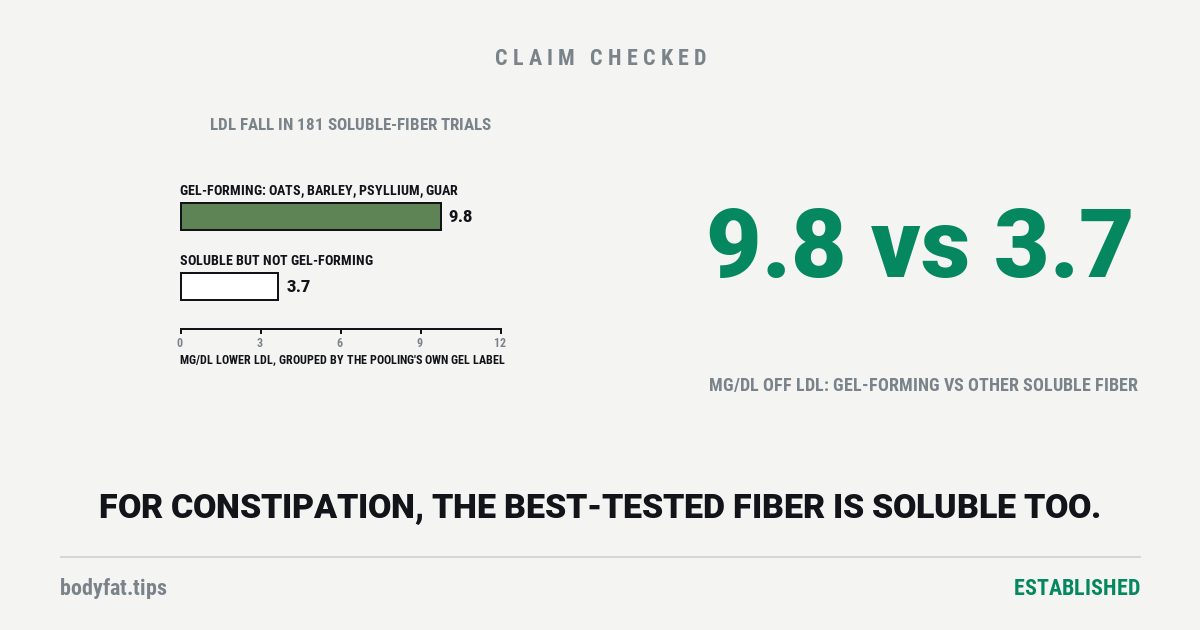
Half the chart holds up. The gel-forming soluble fibers, the kind in oats, barley and psyllium, do lower LDL cholesterol, by a small amount: about 10 mg/dL in a 2023 pooling of supplement trials, against about 4 for the soluble fibers that do not gel [2]. The other half is shakier. For constipation, the fiber with the best trials behind it is psyllium, which is soluble, and wheat bran, the textbook insoluble fiber, has had very little testing in people who are actually constipated [3] [4].
Two words before the numbers. LDL is the cholesterol that guidelines and cholesterol drugs mainly target, the kind people call bad, reported in mg/dL, milligrams per decilitre, on an American lab report. Viscous means a fiber thickens into a gel in water, the way porridge goes gluey. Hold on to that word. It does more work on this page than “soluble” does.
| The chart says | What the trials found |
|---|---|
| Soluble fiber lowers cholesterol | Gel-forming soluble fibers: LDL about 9.8 mg/dL lower. Soluble fibers that do not gel: about 3.7 lower [2] |
| Soluble fiber steadies blood sugar | Gel-forming fibers, in type 2 diabetes: HbA1c about 0.6 points lower over weeks [5] |
| Insoluble fiber keeps you regular | In chronic constipation, one small trial of wheat bran in the 2022 pooling; the best-tested fiber was psyllium, which is soluble [3] |
| Sort your food by the two lists | Most foods carry both kinds; oat bran need be only one-third soluble to count as oat bran under US rules [6]. One trial of whole diets: LDL 4.8% lower on the soluble foods, HDL 3.4% lower too [7] |
What does soluble actually mean?
It means what happened in a laboratory, not in you. The split comes from the way fiber is measured. By 1981 laboratories were weighing foods’ fiber in soluble and insoluble fractions [8]; an assay that measures the two separately was published in 1983 [9], and in 1988 thirteen laboratories tested a method for the official US body of analytical chemists that weighs a food’s fiber in two fractions, insoluble and soluble [10]. Even its authors wrote that the separate measurement “requires further study” [10].
In 2001 a panel of the US Institute of Medicine, the body that sets American nutrient intakes, looked at what the two fractions do in people. The fibers that lower cholesterol, it wrote, are “viscous dietary fibers that usually analyze as soluble”, and the ones that bulk up stool are the slowly fermented kinds that “usually analyze as insoluble” [11]. Fermented means broken down by gut bacteria. So it recommended that “the terms soluble and insoluble fiber be phased out”, replaced by the two properties that track what happens in the body: how viscous a fiber is, and how readily it is fermented [11]. Usually. That word is the whole page.
Twenty-five years on, the old words are still on the box. The US Nutrition Facts rule, in its version of 1 October 2026, still lets a food maker add a “Soluble fiber” line and an “Insoluble fiber” line under dietary fiber [12].
Does soluble fiber lower cholesterol?
Yes, a little, and how much depends on the gel. The largest pooling, published in 2023, gathered 181 randomised trials of soluble fiber supplements in what it counts as 14,505 participants [2]. A pooling is a meta-analysis, which combines trials to get one estimate. This one’s count adds up each arm of each trial with its comparison group, so a comparison group shared by several arms is counted again for each, and 29% of the trials were crossovers, in which the same people take the fiber and the comparison in turn [2]. In the 165 trials that measured LDL, with 199 comparisons and 12,773 people, LDL ended 8.3 mg/dL lower on soluble fiber than in the comparison groups; the confidence interval, the range the true average probably sits in, ran from 5.2 to 11.4 mg/dL [2]. That is a range for an average across trials, not a forecast for any one person.
Now split the comparisons the way the pooling’s authors labelled them, by whether the fiber is a gel-former. In 141 of those 199 the fiber was viscous, and LDL fell 9.8 mg/dL, with a range from 6.1 to 13.5. In the 54 comparisons of soluble fibers that do not gel, such as inulin and resistant maltodextrin, it fell 3.7 mg/dL, with a range from 0.4 to 6.9. The other four of the 199 did not record whether the fiber gels, and the biggest comparison described below is one of them. A second split in the same table, by gel and fermentation, does not add up to the first: it counts 138 gel-forming comparisons, not 141, so treat both as the paper’s labels. In its four comparisons of fibers that neither gel nor get fermented, the range ran from a fall of 10.6 to a rise of 12.3, so those trials could not tell either way [2].
Three things to know before leaning on those numbers. First, the authors graded their certainty in the LDL result very low, using GRADE, a standard system for rating how far evidence can be trusted, because the trials’ results varied far more than chance would explain and smaller trials with bigger effects looked over-represented [2]. The I-squared, the share of the spread between the trials’ results that is more than chance would produce, was 98.5% [2].
Second, before printing a pooled figure we look for the biggest study inside it. The biggest comparison in the pooling’s own table, 719 of the 14,505 people, about 5% by our arithmetic, was not a supplement: it was advice to eat more fruit, vegetables and oats, given to British men with angina in a larger heart trial, and the table does not say whether that fiber gelled, so it sits outside the 9.8 figure [2] [13]. The largest gel-forming comparison was 248 people, under 2% of the LDL analysis, by our arithmetic, so no single trial carries the result [2]. Third, these were trials of added fiber, given as powders, capsules, cereals and other fortified foods, not of the food lists [2].
An older pooling found the same thing in a different unit. In 1999 a Harvard team pooled 67 trials of oat products, psyllium, pectin and guar gum, all of them gel-forming fibers, in 2,990 people [14]. Each extra gram of soluble fiber a day went with LDL about 1.1 mg/dL lower (0.029 mmol/L) across the 55 trials that measured it, and about 2.2 mg/dL lower (0.057 mmol/L) in the 22 trials that used 2 to 10 g a day [14]. Its worked example: 3 g of soluble fiber from oats, about three 1-oz (28 g) servings of oatmeal, would lower LDL by about 5 mg/dL (0.13 mmol/L), and it concluded that soluble fiber “can make only a small contribution” to lowering cholesterol by diet [14]. A later pooling of 28 oat trials, which our oatmeal verdict reports, found about 9.7 mg/dL (0.25 mmol/L) at 3 g of oat beta-glucan a day or more. The 1999 and 2023 poolings share many of the same older trials, so the 2023 one is a bigger, newer count of much the same evidence, not a separate check.
Look at what the comparison groups were given. In 57 of the 67 trials it was a fiber low in soluble fiber, such as wheat bran, a cellulose placebo or corn flakes [14]. The insoluble fiber was the dummy. By our count of the 2023 pooling’s table, wheat bran was the comparison in 19 of its comparisons and cellulose in 21 [2]. In the study the 2001 panel cited, wheat bran had not significantly lowered blood cholesterol [11].
A Toronto group, the same one behind the blood-sugar pooling below, pooled exactly that pairing in 2023: gel-forming fibers against a fiber its authors call insoluble, mostly cereal fiber from wheat, rice or maize, and in 15 of its 89 trials cellulose, an isolated fiber. Across 80 trials and 102 comparisons, LDL ended about 10 mg/dL lower on the gel-formers (0.26 mmol/L), with a range from 8.5 to 11.6 (0.22 to 0.30), and the authors graded that evidence moderate [15]. Nearly half of those comparisons, 47 of 102, were of oat beta-glucan; neither the paper nor its supplement gives results trial by trial, so we cannot name its biggest one [15]. Industry alone funded a third of its trials, and its authors include one who previously held patents on a viscous fiber blend and one who part-owns a contract research company [15]. It shares trials with the 181-trial pooling above, the oat trial below among them, so it is the same evidence cut a third way, not a separate check [15] [2]. And because it sets a gel against a fiber that does not dissolve, it backs the chart’s cholesterol line without telling the gel apart from the solubility.
The cleanest test of the gel kept the fiber the same and changed only how thick it gets. In a 2010 trial at five centres in Canada, Australia and the UK, two of them contract research companies, 367 adults with raised LDL were assigned a breakfast cereal with wheat fiber, the comparison, or one of four oat cereals whose beta-glucan, the soluble fiber in oats, had been cut to different molecular sizes, which sets how viscous it gets [16]. After four weeks the three thicker versions had LDL 7.3 to 10.1 mg/dL lower than wheat fiber (0.19 to 0.26 mmol/L); the thinnest, at 4 g a day, 3.9 mg/dL (0.10 mmol/L), a difference within chance [16]. Same fiber, still soluble, and by the authors’ account its efficacy “was reduced by 50%”. An oat beta-glucan supplier paid for that trial and designed its cereals, the first author’s contract research company is its registered sponsor, and its four comparisons are inside the 2023 pooling above, the 181-trial one, all four of them, the thinned one included, counted there as viscous [16] [2]. So the trial does not explain that pooling’s split, and it is not a separate check on it either. What it shows is that within one fiber the gel mattered. The pooling’s “viscous” is a label for a kind of fiber, not a measured gel: the same label covers oat and barley beta-glucan cut to smaller molecules and guar gum that had been broken down [2].
The regulators drew the line in the same place. US rules let a food claim a lower risk of heart disease for soluble fiber only from named sources, whole-oat and barley beta-glucan at 3 g a day or psyllium husk at 7 g, eaten in a diet low in saturated fat and cholesterol [6]. Not soluble fiber in general. Our oatmeal verdict and our psyllium verdict rate those two on their own trials, and our foods that lower cholesterol verdict puts them beside nuts, soy and plant sterols.
Does soluble fiber steady blood sugar?
The gel-forming kinds do, in people with type 2 diabetes, and the reason again looks like the gel. In 1978 a team gave groups of four to six volunteers a 50 g glucose drink with one of several fibers and thickeners; the more viscous the additive, the more it flattened the rise in blood sugar, and guar gum lost its effect once it was broken down into a form that does not gel [17]. We read that study as its abstract.
Over weeks, a 2019 pooling from a Toronto group gathered 27 trial comparisons of viscous fiber supplements in 1,156 adults with type 2 diabetes, taken on top of their usual care [5]. HbA1c, a blood test that reflects roughly the past three months of blood sugar, was 0.61 percentage points lower than in the comparison groups, with a range from 0.29 to 0.92, in the 19 comparisons and 910 people that measured it; fasting blood sugar was about 15 mg/dL lower (0.85 mmol/L) [5]. The authors graded that evidence moderate, and the results varied a lot, with an I-squared of 91% for HbA1c [5]. Those are the corrected figures. In August 2019 the journal removed one comparison that had been counted twice and corrected the paper’s charts and its table of trials, but not its text, which still gives the earlier figures: 28 comparisons, 1,394 people and 0.58 points. We read the corrected charts in the Internet Archive’s copies; the median dose and length the text gives, about 13 g a day for eight weeks, date from before the correction [5].
Read that pooling with its ties in view. Its senior author holds patents on a viscous fiber blend for lowering blood sugar, and in its uncorrected count 12 of 28 trials did not report who paid for them [5]. Its biggest HbA1c comparison, a 2016 trial with 228 of the 910 people, counted for 6.5% of the pooled result in the corrected chart, where the weights ran from 2.4% to 6.8% and six smaller trials each counted for slightly more, so no one trial carries it; the authors report that taking out any single study did not change the result [5]. For people whose blood sugar is normal, our psyllium verdict reports no significant lowering in the pooling it read.
One finding cuts across the chart. The same Toronto authors note what they call the “strong and consistent paradoxical association”, in long studies of ordinary eaters, between non-viscous cereal fiber and whole grains and lower rates of type 2 diabetes [5]. Those studies follow people rather than assigning them anything, so they cannot show cause. But the fiber in them is not the gel-forming kind the chart files under blood sugar.
What helps you poop, soluble or insoluble fiber?
On the trials, a soluble one. The newest pooling we could read in full, from King’s College London in 2022, gathered 16 randomised trials of fiber supplements in 1,251 adults with chronic constipation, defined by symptoms such as fewer than three bowel movements a week, hard stools or straining [3]. Across the nine trials and 802 people that counted it, 66% improved on fiber against 41% on a dummy, a risk ratio of 1.48: the share improving was 48% higher [3]. A 2026 pooling of 14 trials, which we could read only as its abstract, reports the same direction [18]. That abstract also says “Soluble/fermentable fibers at >10 g/day for ≥4 weeks showed greater efficacy”; which fibers it put in that group, and which trials, the abstract does not say, and we could not read its table [18].
Which fiber did the work? Psyllium, which is soluble and forms a gel. In its three trials 1.82 times as many people improved as on the dummy, and it raised bowel movements and eased straining; the pooling’s authors call it “the most efficacious investigated fiber” [3]. The soluble fibers that do not gel, polydextrose, inulin and galacto-oligosaccharides, did not clearly raise how often people went, though inulin softened stools and caused more wind [3]. Doses above 10 g a day, taken for four weeks or more, did best [3]. One trial published after that pooling’s search, in 250 Chinese adults with functional constipation, long-standing constipation with no disease found to explain it, gave four weeks of 5 g of psyllium a day, 5 g of wheat bran with 2 g of psyllium, a fiber mix or a two-strain probiotic, each with added oligosaccharides, against a dummy of maltodextrin, a starch-derived powder [19]. How often people went rose in every arm, the dummy’s included (on the dummy, from about 3 a week to about 5.3), and no arm raised it significantly more than the dummy did [19]. Stools got softer in every active arm; compared directly with the dummy, the four-week change in stool form was significantly bigger on psyllium and on the probiotic, and just short of significance on the bran mix and the fiber mix [19]. Its psyllium sachets also held mannitol, a sugar alcohol, so that arm was not psyllium alone. Its psyllium dose was half the 10 g above which the 2022 pooling found fiber did best, and a supplement company part-funded it, supplied the sachets and employed three of its 25 authors [19].
Look inside the psyllium figure, though. Its three trials held 275 people, and 201 of them, about 73% by our arithmetic, came from one 1986 general-practice trial that lasted two weeks and compared psyllium with a powder of sugar, citric acid and undisclosed ingredients [3]. No trial in the pooling was at low risk of bias [3]. The guideline from the two big US gastroenterology societies, which pooled psyllium separately, says “only psyllium appears to be effective”, “with very limited and uncertain data on bran and inulin”, and that even psyllium’s data are of low quality [4].
And the insoluble fiber? Of the 16 trials in the 2022 pooling, one tested wheat bran: a small Italian crossover trial from 1995, in which each person took bran and a dummy for four weeks in turn, 24 people in its published summary and 29 in the reviews’ counts [3] [20]. Its summary says bran beat the dummy on how often people went and how fast food passed through, and that symptoms did not differ significantly [20]. Read by the US guideline, the gain was about 1.3 more spontaneous bowel movements a week, with a range from 1.0 fewer to 3.6 more, and the guideline rated that evidence very low [4]. One participant on bran withdrew with “unbearable” abdominal pain [3].
The British Dietetic Association’s 2025 guideline, built on the same pooling, said that with one trial no statement could be made about bran at all [21]. Its one cereal food was rye bread, which did slightly better on frequency and worse on comfort: in two trials of 48 people, six to eight slices a day for three weeks gave 0.43 more bowel movements a week than white bread, and worse overall gut symptoms [21]. Even the general advice to eat a high-fiber diet for constipation rests, by that guideline’s search, on a single randomised trial, too few for it to make a recommendation [21].
A trial that set the two kinds side by side, against a dummy, was done in irritable bowel syndrome, or IBS, a long-running mix of belly pain and disturbed bowel habit with no structural cause; more than half its patients had the constipation type [22]. In Dutch general practices, 275 adults took 10 g a day of psyllium (85 people), bran (97) or rice flour as a dummy (93) for 12 weeks [22]. In month one, 57% on psyllium reported adequate relief against 35% on the dummy; in month two, 59% against 41% [22]. Bran did not clearly beat the dummy in either month.
Month three went the other way. Bran beat the dummy, 57% against 32%, and psyllium no longer clearly did, 46% against 32% [22]. But 40% of the patients had dropped out by then, and when everyone who dropped out was counted as not relieved, bran’s month-three lead was no longer clear either [22]. Eighteen people stopped bran because they could not tolerate it, against seven on psyllium and nine on the dummy, and the authors concluded that bran should be advised “only with caution” [22]. A 2014 pooling of 14 trials in IBS, which we read as its abstract, found the benefit in the soluble-fiber trials, 17% fewer people still troubled, while bran’s 10% was within chance [23]. Its reference list includes the Dutch trial above, whose 275 patients would be about 30% of its 906 by our arithmetic, so it is partly the same evidence, not a fully separate check; we could not read its table of trials to confirm the share [23].
Where the insoluble half of the chart does have numbers is stool weight in healthy people. A 2016 review of intervention studies, sponsored by a breakfast-cereal maker that employed three of its five authors, found that each extra gram of cereal fiber a day went with about 2.2 g more stool a day, vegetable fiber about 2.0 g and fruit fiber about 0.9 g, and that the fibers gut bacteria break down least added the most, 2.9 g per gram against 0.9 [24]. More stool is not the same thing as relief from constipation, which is what the trials above measured. Our kiwi verdict covers a fruit tried against psyllium in constipation.
Is it better to take soluble fiber or insoluble fiber?
It depends what you are taking it for, and “soluble” is not quite the right word for either answer. For LDL, the trials favour the gel-forming fibers: oats, barley, psyllium and the gums [2] [14]. For chronic constipation, the best-tested supplement is psyllium, which is soluble and gel-forming, at more than 10 g a day, which the pooling’s authors judged best taken for at least four weeks [3] [21]. For IBS, psyllium again, and bran only with caution [22]. If you are not taking anything, the question mostly dissolves, because the foods carry both kinds.
Fiber supplements come with their own instructions. The US guideline notes that they are usually taken with 8 to 10 ounces of fluid, and that wind is the common side effect [4]. Psyllium sold as a laxative carries a choking warning and a note about spacing it from other medicines; our psyllium verdict quotes them. Whether fiber helps with weight is a separate question, with its own verdict.
Soluble vs insoluble fiber foods: does the list hold up?
As a rough guide, partly. In a 1993 trial, 43 adults with high blood fats, 15 men and 28 women past menopause, ate diets built from foods high in soluble fiber and diets built from foods high in insoluble fiber, four months each in random order, and their LDL was 4.8% lower on the soluble foods [7]. That is not the whole result. HDL, the cholesterol people call good, was 3.4% lower on the soluble foods too, and the ratio of total to HDL cholesterol did not differ significantly until the authors also adjusted for weight change and calories [7]. Most of the LDL difference was in the men, 9.6%; in the women it was 2.2%, a difference within chance [7]. And these were not everyday meals. Every food was packed centrally and delivered to people’s homes, both diets held more than 24 g of fiber for every 1,000 calories, nobody was blinded to which diet they were on, and the soluble side’s barley, lentils, peas, beans and oat bran came with a breakfast cereal that had psyllium, the gel-forming supplement fiber, added to it [7]. A US government heart institute and a Canadian grocery company paid for the trial, fourteen food companies donated products, the grocery company’s own-brand line among them, and one of its 16 authors was at a food company’s research centre [7]. As a sorting rule, no, because most foods carry both. Google’s own AI answer says so near its end, and puts nuts and seeds on both of its lists [1]. A probiotic seller’s blog that the answer cites lists barley, beans, lentils, apples, pears, almonds and flaxseed under both headings [1]. The US rules show it from the other side: to count as oat bran for the heart claim, at least one-third of its fiber must be soluble, which leaves up to two-thirds that is not [6].
What the lists cannot tell you is the thing that tracked the effect in the trials: whether the fiber gels, and how thick. Oat beta-glucan cut to smaller molecules was still soluble and lowered LDL half as much [16]. Its size and solubility can be changed by “normal methods of processing and storage”, the authors of that trial write [16]. A Nutrition Facts panel can give grams of soluble fiber; nothing on it says how thick that fiber gets [12].
Are chia seeds insoluble or soluble fiber?
Both, and mostly insoluble. A 2026 Scottish laboratory analysis of shop-bought chia, quinoa, pumpkin seed, flaxseed and triticale measured the main part of their fiber, the plant cell-wall carbohydrates, in soluble and insoluble fractions: insoluble predominated in all five, and chia had the most soluble fiber of the five [25]. So chia belongs on both lists, which is where most foods belong.
Do gut bacteria eat soluble or insoluble fiber?
Mostly the soluble kinds, but solubility is not the switch. The 2001 panel wrote that the fibers gut bacteria ferment slowly or not at all usually analyze as insoluble, and that most soluble fibers are “rapidly fermented” [11]. The exceptions are the interesting part. Psyllium is soluble, yet the constipation pooling’s authors describe it as resistant to fermentation and holding water instead, which is their explanation for why it softens stool [3]. Inulin is soluble and readily fermented, and in the constipation trials its fermentation showed up as wind [3]. Starch that escapes digestion is fermented too, and resistant starch has its own verdict.
Who these studies were done on
Nearly all of this evidence is supplements, not the food lists. The cholesterol pooling’s trials ran 4 to 52 weeks in adults whose average ages ranged from 26 to 67; about a quarter of the trials recruited people with high blood fats, a fifth people with type 2 diabetes, and 13% healthy people [2]. The blood-sugar pooling was adults with type 2 diabetes, median age 60 and a median of eight weeks by its uncorrected text [5]. The constipation trials ran two to eight weeks, and in the 14 that reported it, 61% to 100% of the participants were women [3]. The IBS trial was Dutch general practice, 78% women, average age 34 [22]. The stool-weight review was healthy people, 4 to 81 per study, for five days to 14 weeks [24].
So read yourself against them. If your LDL is high, these trials were about people like you, and the fall they found is small. If you have type 2 diabetes, the blood-sugar trials were about you, over weeks rather than years. If you are constipated, the trials were short and mostly in women; four of the 16 in the 2022 pooling tested psyllium, and psyllium did best. And if your question is how to sort your shopping, nearly all of these trials tested added fiber; the one trial on this page that built whole diets from the two lists measured cholesterol.
If “soluble” comes from a lab test, why does the chart get cholesterol right?
This section is the desk’s own reasoning, and it is labelled as such. The two words describe how a fiber behaves in a laboratory method. Yet the soluble column’s cholesterol line holds up, and the insoluble column’s constipation line mostly does not. Here are three ways to fit that together, each rated.
Answer one: the gel-formers happen to dissolve. The gel-forming fibers, the pectins, gums and mucilages, are soluble ones [14], but not every soluble fiber gels, and the ones that do not lowered LDL under half as much in the 181-trial pooling, 3.7 mg/dL against 9.8 [2]. Within one fiber, thinning the gel halved the effect [16]. The pooled split and the trial are measured. That the soluble label works for cholesterol only because it rides along with viscosity is the 2001 panel’s reading [11], and ours.
Answer two: the regularity column was built from stool weight, not from relief. The fibers gut bacteria break down least, which usually test as insoluble, add the most stool weight in healthy people [24] [11]. In people who are actually constipated, the 2022 pooling held one small trial of wheat bran, and in IBS bran did not clearly beat a dummy until month three [3] [22]. The weights are measured. That the chart’s constipation column was drawn from them is a surmise: we could not trace who first put the two kinds into two columns, each with a job.
Answer three: the words are on the label. The Nutrition Facts rule still offers both lines, and the heart claim is worded around “soluble fiber” [12] [6], 25 years after the 2001 panel recommended the terms be dropped [11]. Sellers sort by them too: “insoluble fiber supplement” is one of Google’s related searches, and the AI answer closes by offering to plan a “supplement routine” [1]. That a printed word outlives a recommendation to drop it is an observation from the rules and the search results, not a trial, and we mark it as one.
Put the three together and here is what we think is true, stated plainly so you can disagree with it: sort fiber by what it does in water, not by whether it dissolves; for cholesterol and blood sugar the trials keep finding the gel, and for constipation the best-tested fiber is a gel that gut bacteria leave largely alone.
What we could not find, and would like to: the bowel results of a small US trial that gave 35 people with Parkinson’s disease and constipation symptoms 10 g a day of psyllium, coarse wheat bran or a dummy for eight weeks, the same three arms as the Dutch IBS trial. Its registry record lists stool frequency and consistency among its outcomes, gives a completion date of 28 April 2024 and shows no results [26]; by 20 October 2026 we found no published report [27]. Beyond it, we would like the same three arms, with bran on its own and both fibers at more than 10 g a day, in adults with ordinary chronic constipation, run for months rather than weeks; the four-week Chinese trial above gave bran only mixed with psyllium, and at lower doses. If you know of either, the corrections line on this site is open.
Where the two-column chart came from
The split began as chemistry. By 1981 laboratories were weighing foods’ fiber in soluble and insoluble fractions, and one such paper opened by noting that certain soluble fibers lower cholesterol, then found a bigger share of soluble fiber in oats, corn and cooked beans than in wheat and green vegetables [8]. Its abstract already sets the soluble list beside the cholesterol line. An assay for the two fractions was published in 1983 [9], and when thirteen laboratories tested a method for them in 1988, its authors said the split needed more work [10]. The 1981 paper made its split by modifying an older method, which we did not read, so we cannot say when the two fractions were first measured. The framing came with the rules. A US health-claim regulation whose history begins in January 1997 lets labels link soluble fiber from named sources with a lower risk of heart disease; today it names oat and barley beta-glucan and psyllium husk [6], and the label rule offers the two lines [12]. In 2001 the Institute of Medicine’s panel recommended dropping the terms [11].
Then it spread as a chart. A US government consumer medical encyclopedia, cited by Google’s AI answer, says soluble fiber “helps lower cholesterol” and that insoluble fiber “adds bulk to the stool” [1]. The AI answer turns that into two columns with a primary goal each, adds blood sugar and constipation relief, and offers to plan a supplement routine [1].
And it sells. A probiotic seller’s blog that the AI answer cites calls insoluble fiber “The Broom of the Gut” and closes its summary by pairing both kinds with its own supplement [1]. The case against bran is made by a seller too: a 2020 review by two employees of a psyllium laxative’s maker and two academics says gel-forming psyllium was 3.4 times more effective than wheat bran at increasing stool output, and the US guideline cites it for the point that finely ground bran can harden stool; one of the review’s two academics is among the guideline’s three joint first authors [28] [4]. A seller can be right, and this one’s case matches the trials above. It is still a seller’s case, and we mark it as one.
None of this is aimed at anyone sorting their shopping by the chart. Eating both kinds is what the foods give you anyway. It is the promise that the label tells you the job that the trials did not keep.
What this is rated, and what the rating covers
Established — for the claim that gel-forming soluble fiber, the kind in oats, barley, psyllium and guar gum, lowers LDL cholesterol, by a small amount.
It is rated Established because two poolings 24 years apart, of 67 and 181 trials, found LDL lower on soluble fiber, with the gel-forming comparisons driving the larger fall [14] [2]; a 2023 pooling that set gel-formers against cereal fiber found about 10 mg/dL, graded moderate [15]; a trial that changed only the gel found the effect followed it [16]; our psyllium verdict rates psyllium Established for LDL, and our oatmeal verdict rates the oat effect Established in words, each on its own poolings; and US rules allow the heart claim for oat and barley beta-glucan and psyllium [6]. The size is the uncertain part: about 10 mg/dL in the 181-trial pooling, whose authors graded the LDL evidence very low because the trials varied so much, and in the gel-against-cereal one, graded moderate; and about 2 mg/dL per gram in the 1999 one’s practical dose range [2] [14]. These trials measured cholesterol, not heart attacks.
Each other part, rated alone, in words. That soluble fibers which do not form a gel lower LDL: Preliminary. They lowered it under half as much, in a subgroup of a pooling whose LDL evidence its authors graded very low, and the four comparisons of fibers that neither gel nor ferment could not tell a fall from a rise [2].
That gel-forming fiber steadies blood sugar: Supported in type 2 diabetes, about 0.6 points off HbA1c over weeks in a pooling graded moderate, whose senior author holds patents on a viscous fiber blend [5]. The single-meal flattening comes from small early studies [17], and the long-term claim for people without diabetes is not rated here.
That insoluble fiber relieves constipation: Preliminary. In chronic constipation, one small trial of wheat bran pointed its way, with a range that, as the US guideline read it, included no gain; the British guideline could make no statement on bran at all; and in IBS, bran did not clearly beat a dummy in the first two months, and was the one people most often stopped [3] [4] [21] [22].
That insoluble fiber adds stool bulk: Supported, in healthy people, from studies pooled by a review a cereal maker paid for, and in the 2001 panel’s account [24] [11].
That psyllium, a soluble fiber, relieves chronic constipation: Supported, on old, small trials that the guidelines rate low in certainty, with most of the people in its pooled result coming from one two-week trial in 1986 [3] [4] [21].
That a food’s place on the soluble or insoluble list tells you what it will do depends on the job, so we rate the two halves apart. For cholesterol, as a rough guide: Preliminary, in the list’s favour. In the one trial on this page that built whole diets from the two lists, LDL ended 4.8% lower on the soluble foods, but HDL was 3.4% lower too, the ratio of total to HDL cholesterol did not differ significantly in the main comparison, and the trial was 43 people on very high-fiber diets whose soluble side included oat bran and a psyllium-enriched cereal [7]. In the supplement trials the soluble fibers lowered LDL whether or not they gel, though the ones that do not gel did under half as much [2]. For constipation: Unsupported, of the tested kind. The list sends you to the insoluble side, and in the supplement trials the best-tested constipation fiber is soluble psyllium, the soluble fibers that do not gel did not clearly change how often constipated people went, and wheat bran, the classic insoluble fiber, had one small trial among the 2022 pooling’s 16 [3] [4]. As a sorting rule for whole foods it also fails for a simpler reason: most foods carry both kinds [6]. The Toronto authors’ note that long studies of ordinary eaters tie non-viscous cereal fiber and whole grains to less type 2 diabetes is an association, not a test of the list, so it is not counted here [5].
What is not rated here: weight loss, which has its own verdict; heart attacks and deaths, which the trials on this page did not measure; the individual foods, which have their own pages; and the frame above, which is this desk’s reasoning from the evidence rather than a result the evidence delivered. It is marked as ours so that you can weigh it as ours.
This is journalism, not medical advice. A sudden change in bowel habit, constipation that does not settle, or a question about taking fiber alongside a medicine belongs with a clinician or pharmacist who knows you. How we read a study, and what each tier means, is set out here.
- Are Ultra-Processed Foods Bad for You? In Short Feeding Trials, People Gained More or Lost Less. Why Is Still Open.
supported - How to Reverse Insulin Resistance: A 5% Weight Loss Improved It by About a Quarter. In Pooled Type 2 Diabetes Trials, Low-Carb’s Lead on Blood Sugar Had Halved by 12 Months.
established - Is Breakfast the Most Important Meal of the Day? Not for Your Weight. People Assigned to Eat It Lost No More Than People Assigned to Skip It.
supported