Does Fiber Help You Lose Weight? Yes — But the Average Is Easy to Misread

Yes — but the honest answer comes in two halves, and almost every article you will read on this welds them together.
Fibre from food. The largest evidence review ever run on this found trials showing lower bodyweight in people eating more fibre, alongside substantially lower rates of heart disease, stroke, type 2 diabetes and bowel cancer [2].
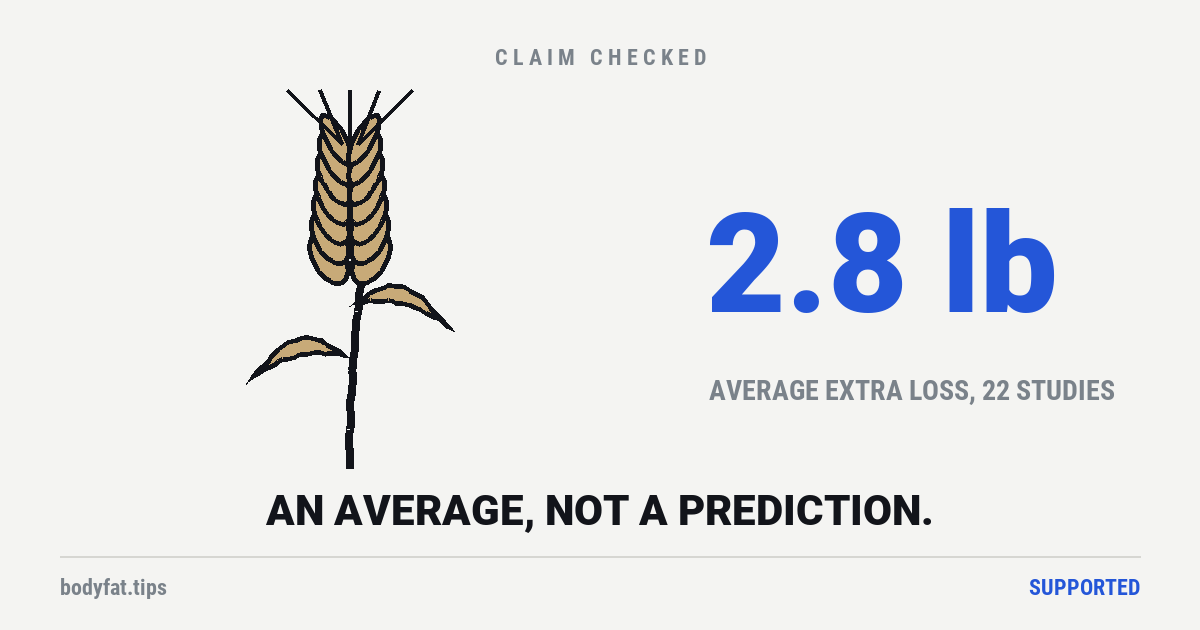
Fibre from a capsule. A separate set of trials, testing isolated soluble fibre supplements, found an average of about 2.8 lb more weight lost than in comparison groups [1].
Those are two different questions with two different evidence bases, and the 2.8 lb belongs strictly to the second one. Hold onto that, because the number is about to get more interesting than it looks.
What the supplement trials actually did
The 2022 review gathered 26 reports covering 22 randomised trials, reported as 27 separate groups, totalling 1,428 people who were overweight or obese [1]. Every one was a parallel trial and nine in ten were double-blinded — neither the participants nor the people assessing them knew who was getting fibre.
Soluble fibre is the kind that dissolves and forms a gel in water. It turns up in oats, barley, beans and some fruit; psyllium is a concentrated supplemental form of it. Most plant foods carry a mix of soluble and insoluble fibre rather than one or the other.
The trials ran from 12 to 52 weeks — averaging about 17 weeks, though the typical trial was 12 [1]. Doses ranged from 2.6 g to 29 g a day, averaging 11 g [1].
And here is something worth knowing before you picture what these trials looked like. Only 11 of the 27 groups took fibre and changed nothing else. The other 16 got a second intervention alongside it — in 13 cases a calorie-restricted diet, plus one bariatric surgery and one exercise programme [1].
So this is not a clean picture of “swallow fibre, change nothing, lose weight”. For most of the evidence, fibre was an add-on to something else people were already doing.
The number everybody misreads — including us
The pooled result: people given soluble fibre lost an average of 2.8 lb (1.25 kg) more than their comparison groups. The researchers put a 95% interval around that average running from about 0.6 lb to 4.9 lb [1].
Now: what is that interval actually telling you?
It is describing how precisely the study set has pinned down the average. It says the true average effect is probably somewhere in that band. It is not a forecast of what any individual person will lose.
That distinction matters more than it sounds, and we got it wrong in the first version of this article. An individual taking soluble fibre might lose considerably more than 4.9 lb, or nothing, or gain weight, and all three are entirely compatible with the finding above. Averages of groups and outcomes for people are different objects. A range around one is not a range around the other.
Which means the useful takeaway is the plain one: a modest average effect, roughly three pounds, over about four months — and even that is a blend across different fibres, different doses, different durations, and trials where most people were doing something else as well.
One thing the interval does establish: it does not include zero, so the pooled effect cleared the usual threshold for statistical significance. That is a real result. It is not the same as settling the question for every fibre type, dose, population and person — which is why this verdict reads Supported rather than Established.
The reviewers rated their own confidence in the estimate as high [1], and they registered their plan publicly before starting, which does not physically prevent a team from changing course but does make any change visible afterwards.
The other half: fibre from food
In 2019 The Lancet published a review spanning 185 long-term population studies and 58 clinical trials [2]. Its trials found significantly lower bodyweight at higher fibre intakes.
Across a whole range of outcomes, the strongest evidence of benefit showed up at 25 to 29 grams a day [2]. Note the wording carefully, because we got this wrong the first time too: that is where the benefit was greatest in the data they had, not a ceiling. The same paper says its dose-response curves suggested intakes above that range could deliver more still [2].
The much-quoted “135 million person-years” attached to this review comes from the observational half — people followed over time, not assigned to anything. It is an enormous amount of watching, and watching is not the same as testing.
And the detail that governs how you read all of it: this review excluded weight-loss trials and every supplement trial as a condition of entry [2]. It is stated plainly in the eligibility criteria. The researchers were not hiding anything — it is the secondary coverage that drops the distinction, and once it is dropped, a food finding starts being used to sell a capsule.
About that “only 5% of people get enough” statistic
You have seen it. It usually appears immediately before someone sells you something.
One prominent source that put it into circulation is a write-up of a Food & Fiber Summit held in Washington in January 2014, reporting that national surveys show around 5% of the population meeting fibre recommendations [3].
Read that paper’s author note and you find this: one author is an employee of the Kellogg Company. The other, a nutrition consultant, was paid by the Kellogg Company to develop the article. The summit itself ran on an unrestricted educational grant from Kellogg [3].
Two caveats on our side of the ledger. That paper cites national surveys rather than measuring anything itself. And we cannot show it originated the figure — establishing that would take a citation history we have not done. What we can say is that a heavily circulated statistic about a fibre shortfall was developed under paid arrangement with a company selling fibre-fortified cereal.
That does not make it false. Fibre underconsumption is not a controversial claim. It means you should price the number knowing who commissioned it — which is the entire purpose of a disclosure, and the reason we read them.
The seller’s own meta-analysis
There is a more recent and more favourable analysis, and leaving it out would be its own kind of dishonesty.
A 2023 review looked at psyllium specifically: six trials, 354 people, averaging 10.8 g a day for about 4.8 months. It reported an average of 4.6 lb (2.1 kg) more weight lost, with a tighter interval than the 2022 analysis [4].
A bigger effect, then. With one thing attached: all three authors are employees of Procter & Gamble, which manufactures Metamucil — a psyllium product [4].
They disclose it, in plain language, in the paper. Good. It is also six studies against twenty-two, and it is the manufacturer reporting a larger benefit for its own ingredient. We treat it as supporting evidence with a material conflict, which is why the 2.8 lb figure and not the 4.6 lb one is the one at the top of this page.
What to actually do
Aim at 25 to 29 grams a day from food, and treat that as a floor rather than a target — it is where the evidence is strongest, and the same review suggests more may be better [2]. That intake buys you a great deal more than a few pounds.
If you use a supplement, go in with the right expectation: a small average effect, around three pounds over four months, mostly measured in people who were also doing something else [1]. It is a helper, not a mechanism, and it is not a substitute for how you eat generally.
Two practical cautions, both from the researchers rather than from us. Increase the dose gradually — going up quickly brings flatulence, diarrhoea, abdominal distention and nausea. And they advise caution above 25 g a day of soluble fibre specifically, because digestive side effects climb [1]. Psyllium in particular needs to be taken with plenty of fluid, and fibre can interfere with the absorption of some medicines, so if you take any regularly that is a conversation for a pharmacist or doctor rather than for us. This site reads research and reports it; it is journalism, not medical advice, and it does not know your history.
And when you next see “95% of people don’t get enough fibre” on a label, you now know who paid to develop the paper that helped that number travel.
An earlier version of this article, published 28 July 2026, treated the meta-analysis confidence interval as the range an individual reader might lose — it said the spread ran “from half a pound to five pounds” and that “nobody can tell you which end you personally land on.” That was wrong, and it was the most memorable line in the piece. A confidence interval around a pooled result describes uncertainty about the average effect across the studied groups; an individual can fall well outside it in either direction. The earlier version also described the study set as 27 independent trials (it is 22 studies reported as 27 groups), put an inclusion criterion in the follow-up field, said the Lancet risk curves “bottom out” at 25–29 g when that paper explicitly suggests higher intakes may do more, omitted that 16 of the 27 groups also received a second intervention, and stated the Kellogg connection less precisely than the disclosure itself does. The verdict is unchanged at Supported. The article has been rebuilt from the study's full text rather than its abstract, and a 2023 psyllium meta-analysis written by the manufacturer has been added and labelled.