Creatine HCl vs Monohydrate: Eight Studies Compared Them, and Only One Put HCl Ahead, on Sprints, Not Muscle

Creatine hydrochloride, sold as creatine HCl, comes with a tidy story. It dissolves far better than ordinary creatine monohydrate, so, the story goes, more of it gets absorbed, so you need less, so you get the muscle without the bloat. A large online supplement retailer’s guide puts it plainly: because HCl is absorbed more efficiently, “a smaller dosage is required to achieve the same muscle saturation levels as monohydrate”, 1 to 2 g a day [1]. Ask Google and its AI answer calls HCl “generally easier on the stomach with fewer reports of bloating or cramping” [1].
“Creatine hcl vs monohydrate” is searched about 14,800 times a month in the United States (from a paid keyword database, pulled 20 October 2026) [1]. So we read every study we could find that put the two side by side, and the patents the story comes from.
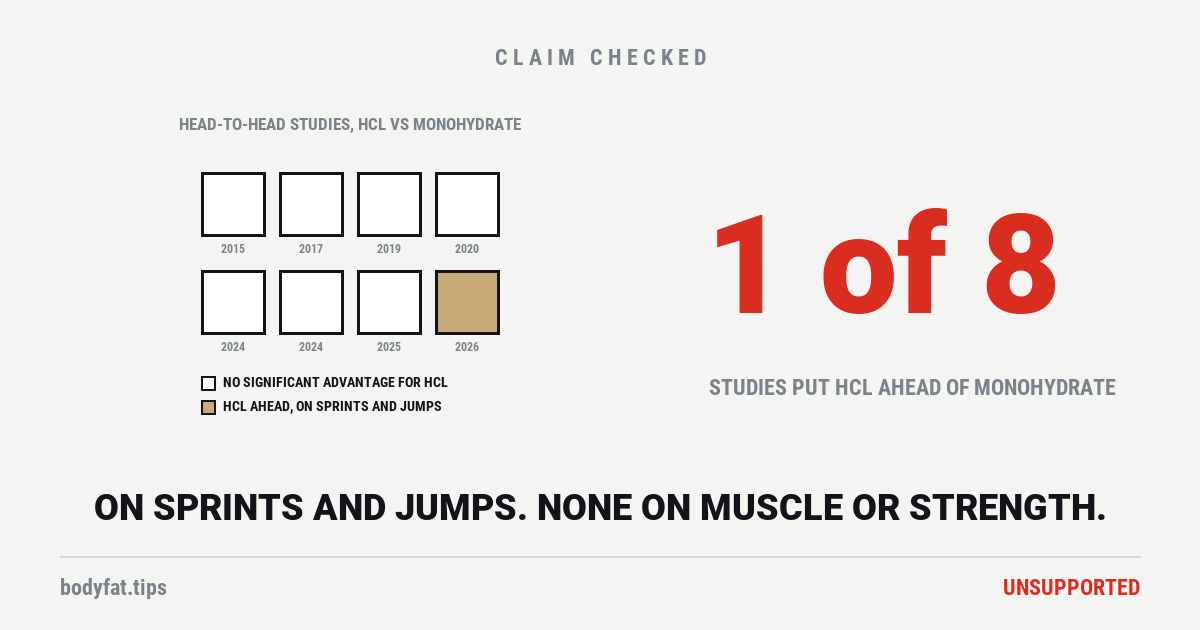
Creatine HCl is creatine, and it does dissolve far better in a glass of water. In the eight studies we found that compared it with monohydrate on muscle, strength or performance, seven found no statistically significant advantage for HCl and one found it ahead on sprints and jumps; none found more muscle or strength. The claim that it is better absorbed rests on a two-hour blood test described in a patent, which we found no version of in a journal [2] [3].
This is journalism, not medical advice. If you have kidney disease, take advice from a clinician before you take creatine in any form; our creatine safety verdict explains why the usual kidney blood test reads high on creatine.
| Study | Who, and for how long | Daily doses | What it found |
|---|---|---|---|
| 2015 [4] | 27 recreational lifters, men and women; 4 weeks | 1.5 g or 5 g HCl, 5 g monohydrate, or a dummy powder | No statistically significant difference between any of the groups |
| 2017 [5] | 16 recreational runners, men and women; 4 weeks | 1.5 g HCl after a week at 6 g, 5 g monohydrate after a week at 20 g, or a dummy powder; one dose of caffeine for everyone before the final run | No statistically significant difference between the groups in 10 km time, weight, body fat or stomach discomfort |
| 2019 [6] | 11 elite male gymnasts aged 18 to 25: monohydrate first, then a month on a starch dummy, then HCl last, in the run-up to their main competition; 30 days of each | 1.5 g HCl and 5 g monohydrate | Body water and weight rose within the monohydrate month; within the HCl month body water did not change significantly and weight fell. The paper reports no difference between the forms on body water, lean mass or strength [6]. Its authors say HCl coming second, before the main competition, may have influenced the result; the laboratory’s 2023 review adds that the short gap between the months makes it hard to conclude about weight on HCl [7] |
| 2020 [8] | 36 trained young men; 1 week | 3 g HCl, 3 g or 20 g monohydrate, or a dummy | No significant differences in power or hormones |
| 2024 [9] | 40 young lifters; 8 weeks | HCl or monohydrate at the same dose by body weight, monohydrate after a loading week, or a dummy | All three creatine groups beat the dummy; HCl not significantly different from monohydrate |
| 2024 [10] | 36 male soldiers; 8 weeks | HCl, monohydrate or a dummy | Both beat the dummy; HCl “does not cause more effects” than monohydrate |
| 2025 [11] | 31 handball and softball players, men and women; 8 weeks | 5 g HCl, 5 g monohydrate or a dummy | No statistically significant difference between groups on any measure |
| 2026 [12] | 40 male college soccer players; 4 weeks | 5 g HCl, 5 g monohydrate, 5 g of a third form (ethyl ester) or a dummy | HCl and ethyl ester ahead of monohydrate on jump, sprint, agility and peak-power tests; not on 30-second power or aerobic fitness |
What’s the difference between creatine HCl and regular creatine?
Regular creatine, the kind in most tubs, is creatine monohydrate: a creatine molecule with a molecule of water attached. Of 343 randomised creatine trials published up to the end of 2023, 80% used monohydrate, and most of the rest did not say which form [14]. Creatine HCl is creatine bonded to hydrochloric acid instead. Two things follow, and both are measured.
First, it dissolves. In the patent holders’ laboratory, HCl dissolved at 679 mg per millilitre of water and monohydrate at 17.9, about 38 times less [2]. By our arithmetic from those figures, a 5 g scoop of monohydrate needs about 9.4 fl oz (279 ml) of water to dissolve completely, and 5 g of HCl about a quarter of a fluid ounce (7.4 ml). The catch is acidity. The HCl solution in that test had a pH of 0.3, strongly acidic; the monohydrate solution’s was 8.6, mildly alkaline [2]. Creatine dissolves better in acid, and a 2022 review of creatine forms notes that monohydrate also dissolves better in acidic drinks such as juice, and that the comparison was made at those two very different acidities [15].
Second, it carries less creatine. Creatine is 87.9% of monohydrate’s weight and 78.2% of HCl’s [15]. So 1.5 g of HCl holds about 1.2 g of creatine, and 5 g of monohydrate about 4.4 g, by our arithmetic.
The second patent adds a third difference: dissolved in water and left on a shelf, HCl kept about 95% of its creatine after 45 days, against about 75% for monohydrate [2]. That matters for a ready-mixed drink; for a powder you stir and drink at once it matters little, on our reading. In published tests of creatine gummies, one made with HCl held more of creatine’s breakdown product than creatine, a reading its maker disputes; that is on our creatine gummies page.
Is creatine HCl better absorbed than monohydrate?
This is the claim everything else hangs on: the smaller dose and the missing bloat are both supposed to follow from it. Here is all the evidence we found.
In people, one test, in a patent. A patent application filed in 2010 by the University of Nebraska and a supplement company that co-owned and licensed the HCl patents describes healthy volunteers who took 5 g of each form, a week apart and in random order, with blood drawn over the next two hours. Blood creatine rose after both. The area under the curve, a measure of how much creatine was in the blood across those two hours, averaged 117.4 after HCl and 82.2 after monohydrate, and from the standard formula for comparing two formulations, which adjusts for dose, the patent gives HCl a relative bioavailability, the share of a dose that reaches the bloodstream compared with the other form, of 1.65: “an approximately 50 percent increase” [2]. The two averages themselves give 1.43, and about 1.6 once HCl’s lower creatine content is allowed for, both by our arithmetic; the patent does not show how it reached 1.65. The text we read does not say how many volunteers there were, and the blood was followed for two hours, not until the creatine had cleared. We found no version of this test published in a journal [3]; a book chapter on creatine absorption by the inventors and others might describe it, and its publisher refused our requests [2].
In rats, a prediction. A 2018 study whose authors include the patents’ two university inventors gave rats labelled monohydrate and found that 53% of a small dose and 16% of a large one reached the blood. It did not give the rats HCl: HCl’s advantage there, 66% against 17%, came out of a computer model [16]. The study was paid for by the university’s medical centre and the company that co-owned and licensed the patents [16].
In a dish, no significant difference. The 2010 laboratory paper that measured HCl’s solubility also tested how well each form crossed a layer of human gut cells grown in a dish, a standard stand-in for the intestine. Apart from creatine citrate, which did worse, the forms tested, HCl among them, did not differ significantly from monohydrate [17].
Is HCl absorbed at all? Yes; it is creatine. In a 2026 trial of 36 women around menopause, split into four groups, the group given 1.5 g of HCl a day for eight weeks saw creatine in the front of the brain rise more than the group given a dummy capsule, by the abstract’s figures “0.9 vs. 16.4%” in HCl’s favour [18]. That trial had no monohydrate group.
And monohydrate? A 2022 review calls it “nearly 100% bioavailable”, on the reasoning that what is swallowed either ends up in tissue or comes out in urine [15]. On our reading that is an inference from what the body keeps and excretes, not the blood comparison against an injection that measures bioavailability directly; the rat study above is where the HCl patents’ inventors challenged it [16]. For people, neither side has the decisive measurement: we found no study that compared how much creatine reaches muscle from equal amounts of the two forms [3].
Creatine HCl vs monohydrate for muscle growth
Here the trials are the evidence, and there are more of them than the sellers’ guides suggest. The fullest is a 2024 Iranian trial of 40 young lifters, eight weeks of training, in four groups of ten: HCl, or monohydrate, at the same dose by body weight; monohydrate after a high-dose loading week; or a dummy powder [9]. All three creatine groups gained more than the dummy group. On the leg press, the HCl group added 43 lb (19.6 kg), the two monohydrate groups 37 lb (17.0 kg) and 41 lb (18.4 kg), and the dummy group 22 lb (10.1 kg). The HCl group was “not significantly different” from either monohydrate group on any measure, and the authors conclude that HCl showed “no benefit over” monohydrate [9]. The HCl it used was the brand of the company that co-owned and licensed the patents [9].
Its muscle figures need a fence. Muscle was estimated with a bioimpedance scale and with formulas from tape measurements and skinfolds [9], methods that assume the body’s water content holds steady, which creatine changes, as the authors of the 2015 trial below point out [4]. The strength results do not have that problem.
A trial of 36 male soldiers, from the same research group, found the same: both forms beat a dummy, and “Cr-HCl does not cause more effects than CrM” [10]. So did a 2025 trial of 31 handball and softball players, 11 given 5 g of monohydrate, 10 the same of HCl and 10 a dummy, for eight weeks: “no statistically significant differences in any measure” between the groups, though only the monohydrate group showed a significant rise in lean mass relative to height [11]. A one-week trial of 36 trained men in four groups found no significant differences between 3 g of HCl and 3 g or 20 g of monohydrate in power or hormones [8].
The oldest, from 2015, gave 27 recreational lifters 1.5 g of HCl, 5 g of HCl, 5 g of monohydrate or a dummy powder for four weeks. Its title says only HCl changed body composition. Its results say something narrower: within the HCl groups fat fell, and on 5 g lean mass rose by enough to pass a significance test, while between the groups, in the authors’ words, “there was no statistically significant difference” [4]. Lean mass rose 3.7 lb (1.7 kg) on monohydrate and 3.5 lb (1.6 kg) on 5 g of HCl, against 2.4 lb (1.1 kg) on the dummy powder [4]. A change that passes a test inside one group and not inside another is not a difference between the groups. Its supplements came from a company that sells creatine HCl [4].
Two cautions before reading anything into the count. Three of these trials come from one senior researcher’s group in Iran and three from one group in Brazil, so eight studies are not eight independent labs [8] [9] [10] [4] [5] [6]. And none analysed more than 40 people or gave either form for longer than eight weeks: they are too small to rule out a modest difference in either direction. What they do not contain is one finding more muscle or strength on HCl. Monohydrate’s own record on muscle, which we rate Established, is on our creatine benefits page.
Does HCl do anything monohydrate doesn’t? The one trial that says yes
Published in September 2026, a trial from a Chinese medical university split 40 male college soccer players into four groups of ten and gave them 5 g a day of monohydrate, HCl, a third form called creatine ethyl ester, or a dummy capsule, through four weeks of sprint training [12]. All three creatines beat the dummy. And HCl beat monohydrate on four tests: the jump rose 1.3 in (3.2 cm) on HCl against 1.0 in (2.5 cm) on monohydrate; the 20-metre sprint fell from 3.85 to 3.63 seconds against 3.87 to 3.70; a change-of-direction run fell by 0.55 seconds against 0.38; and peak power in a 30-second bike sprint rose more [12]. The p-values ran from 0.001 to 0.048, all under the 0.05 line researchers use for “probably not chance”. On average power over the 30 seconds and on aerobic fitness, the groups did not differ significantly [12].
That is a real result, and it points the sellers’ way. Four things to weigh it by. It is one trial, ten players to a group, with no registration we could find and no measurement of creatine in blood or muscle [12]. Ethyl ester, a form that an earlier trial found raised muscle creatine less than monohydrate does, beat monohydrate too [12] [15]. The groups got different amounts of creatine, as the authors acknowledge, and HCl’s group got less [12]. And one of its four HCl results does not add up: the paper prints HCl’s peak-power gain as 10.0%, but its own before and after figures, 805 to 859 watts, make it 6.7%, the same 54 watts monohydrate gained going from 796 to 850 watts, by our arithmetic [12]. By its own numbers, the two forms tied on peak power.
Does a smaller dose of creatine HCl work as well?
The dose claim is written into the second patent: HCl’s effective dose is “at least about 50 percent less” than monohydrate’s, about 500 to 1,500 mg per 100 lb of body weight [2]. The retailer’s guide says 1 to 2 g a day [1]. In a 2022 survey of creatine products on the dominant online marketplace, the stand-alone HCl products listed about 0.9 g a serving on average, against about 4.5 g for monohydrate [19].
One maker that sells both forms disagrees with the patent. Its own guide calls it a “common myth that HCl brings the same benefits with a lower dose” and says both forms need 3 to 5 g a day [1].
In the trials we found, the 1.5 g dose has been set beside a dummy powder three times, and in none was it shown to do better than the dummy. In the 2015 trial, 1.5 g of HCl, “the dose proposed by the manufacturer as enough to promote the same effects of 5 g” of monohydrate in the authors’ words, raised lean mass by 2.2 lb (1.0 kg) in four weeks; the dummy group gained 2.4 lb (1.1 kg) [4]. On the leg press the low-dose group added 69 lb (31.4 kg) and the dummy group 73 lb (33.3 kg) [4]. The authors read the low dose as “as good as 5 g of Cr in promoting strength gains” [4], which it was. But 5 g of monohydrate added 74 lb (33.7 kg), within a pound of the dummy group [4]. With six to eight people a group the trial could not tell any of its creatine groups from the dummy, so the low dose’s tie with monohydrate there tells you little. In the 2017 runners’ trial, 1.5 g of HCl after a loading week at 6 g did not differ significantly from the dummy on the 10 km run, weight, body fat or lean mass, and neither did monohydrate [5]. The 2019 gymnasts took the low dose in a month of its own, after a month on a starch dummy that followed their month on monohydrate; the paper compares each month with its own start and reports no test of the HCl month against the dummy month [6] [7]. Looking back over all three, the laboratory behind them wrote in 2023 that there is “still no consistent data demonstrating that the 1.5g dose of CrHCl induces an ergogenic effect when compared with placebo supplementation”, ergogenic meaning performance-improving [7]. Outside sport, the 2026 menopause trial above found that 1.5 g a day raised brain creatine more than a dummy capsule did, which shows the low dose is absorbed; its abstract reports no muscle measure [18].
Then the arithmetic, which is ours. 1.5 g of HCl carries about 1.2 g of creatine. A normal diet already supplies 1 to 2 g a day, which leaves muscle creatine about 60 to 80% full [20]. The slow route to filling the rest is 3 g of monohydrate a day for 28 days [20], which carries about 2.6 g of creatine. Grant the patent its figure of 1.65 and 1.2 g of creatine from HCl behaves like about 1.9 g: still short of 2.6. Read the patent’s figure per gram of powder instead of per gram of creatine and the answer is about 2.2 g, still short. How much monohydrate to take, and why loading is optional, is on our creatine dose page.
Does creatine HCl cause less bloating?
The weight creatine adds is real, a pound or two on average, and fat mass did not move; whether all of it is water held in muscle is a question the trials leave open; the trials are on our creatine weight-gain page, which also found the gain did not depend on the form of creatine. The second patent says monohydrate users “often experience excessive water retention (bloating), cramps, and significant gastrointestinal problems due to the large dosages” [2]. One maker tells readers that HCl means “less bloating and water retention” [1].
Here is what has been measured. At equal 5 g doses in the 2015 trial, the monohydrate group’s body weight rose 1.8 lb (0.8 kg) and the HCl group’s 0.8 lb (0.37 kg), with eight and six people in the groups and no statistically significant difference between groups reported [4]. In the 2017 runners’ trial, on 1.5 g of HCl against 5 g of monohydrate after loading weeks, weight rose 1.5 lb (0.7 kg) on monohydrate and fell 1.8 lb (0.8 kg) on HCl, a difference between the groups that was not statistically significant; body water was not measured. The runners were weighed the day after their final 10 km run, which, the authors say, kept the run from affecting the weight; they suggest the hard training may have left the runners dehydrated [5]. The laboratory’s 2023 review, noting that the run was at about 77°F (25°C), thinks dehydration may have hidden a rise in weight [7]. In the 2025 trial of handball and softball players, at 5 g of each, the groups did not differ significantly on any measure, among them body composition by a DXA scan, the low-dose X-ray that measures fat and lean tissue [11]. In the 2019 gymnast study, 11 elite male gymnasts took monohydrate for a month, then a starch dummy for a month, then HCl for a month, in that order, not shuffled, though the paper’s abstract calls the design randomised: body water rose about 61 fl oz (1.81 L) in the month on 5 g of monohydrate and about 8 fl oz (0.24 L) in the month on 1.5 g of HCl, with about a quarter of the creatine [6] [15]. The rise was significant within the monohydrate month and not within the HCl month, but the paper found no difference between the two, and its authors say that HCl coming second, while the athletes trained for the most important competition of their year, may have influenced the result [6]. The laboratory that ran it adds that the short gap between the months makes it hard to conclude about weight gain on HCl [7]. And a 2017 master’s thesis gave 15 men 4 g of HCl a day for a week, with no comparison group: body weight rose, the only body measure that changed significantly [21].
So: in the four parallel-group trials we read that compared weight or body composition between the forms, the difference was not statistically significant [4] [5] [9] [11]; the gymnast crossover also found no difference between its two months [6]; and a fifth parallel trial, of soldiers, whose measures included body fat and muscle, reports that HCl “does not cause more effects” than monohydrate [10]. Where HCl’s groups gained less, they mostly took less creatine. We found no study that compared water weight on HCl and monohydrate at the same amount of creatine [3]. There is a reason to doubt the promise, which the section on the desk’s reasoning below works through.
Is creatine HCl easier on the stomach?
Two small trials recorded stomach symptoms on both forms, and neither found HCl easier on the stomach. In the 2017 runners’ trial, discomfort was scored from 0 to 10 straight after a 10 km run, at the start and after four weeks. It rose in both creatine groups, from 0.5 to 2.8 on monohydrate and from 0.8 to 2.4 on HCl, against 2.6 to 3.0 on the dummy, and the difference between the groups was not statistically significant [5]. Three things fence that result. There were five or six runners in each group. The final run came 15 minutes after a dose of caffeine that every group took; the authors think the caffeine, and nerves before the run, probably explain the discomfort, but with no group left without caffeine they could not tell. And the second score came after four weeks, three weeks after the loading week, when the groups were taking 5 g of monohydrate and 1.5 g of HCl a day [5]. The 2026 soccer trial reported no stomach problems on either form, or on the dummy, at 5 g a day [12]. Neither trial gave the two forms in equal amounts of creatine, and neither scored stomachs during a loading week of monohydrate. What is known is that monohydrate’s stomach trouble depends on how it is taken: in one trial a single 10 g serving roughly doubled the rate of diarrhoea compared with the same amount split in two, which is on our weight-gain page. The claim that HCl causes less stomach trouble is asserted in the patents [2] and repeated by sellers [1]; in the two trials that asked, it did not show.
Creatine HCl vs monohydrate for weight loss
Neither form is a fat-burner: we rate the claim that creatine helps burn fat Unsupported, on its own page. What creatine does to the scale is add water weight, and the only comparisons of weight between the two forms are the small ones above [4] [5] [9] [11] [15].
What are the different types of creatine?
Plenty. A 2022 survey of 175 creatine products on the dominant online marketplace found 16 forms other than monohydrate, among them salts such as HCl, citrate and pyruvate, an ethyl ester, and blends of up to 11 forms in one product [19]. The products using other forms cost about twice as much per gram of creatine as the monohydrate-only products on average; the stand-alone HCl products, of which three had prices, more than four times as much, by our arithmetic from its tables [19]. Using the grading in the 2022 review of creatine forms, its authors class 14 of the 16 other forms they found as having limited or no evidence for absorption, effect and safety; the other two had not been graded [19] [15].
The 2022 review of creatine forms puts monohydrate alone in its strong-evidence group and HCl among the forms with some evidence of working against a dummy, and concludes that claims of HCl being more bioavailable, more effective or safer than monohydrate “are not supported” [15]. A sports-nutrition society’s 2017 position stand called claims that other forms reach muscle better “currently unfounded” [20]. Read those with their ties in view: the 2022 review’s special-issue fees were paid by a monohydrate manufacturer whose creatine advisory board its first author chairs, and the position stand’s preparation was supported by the supplement industry’s trade association [15] [20]. The trials above are a separate check, with ties of their own on both sides, and they say much the same thing.
What foods are high in creatine?
Red meat and seafood [20]. A normal diet contains 1 to 2 g of creatine a day, by the position stand’s figure [20]. The 1 to 2 g of HCl a day the retailer’s guide recommends carries about 0.8 to 1.6 g of creatine, by our arithmetic: in the range of what a diet with meat and fish already provides [1].
Is creatine HCl safe?
Monohydrate has the safety record: we rate creatine’s kidney safety in healthy people at ordinary doses Supported, on its own page, from trials that used monohydrate. HCl’s own record is thin. The one study we found that set out to test its safety gave 11 adults, ten of them women, 750 mg a day for 28 days with no comparison group, and reported no clinically meaningful changes in routine blood tests; it is a preprint, not yet peer reviewed, registered after it ended, with the company that co-owned and licensed the patents as its sponsor [22]. The head-to-head trials were not designed to test safety. If you have kidney disease, the advice at the top of this page applies to every form of creatine.
Who these studies were done on
Young people who train: recreational lifters and runners, college soccer players, soldiers, elite handball, softball and gymnastics athletes, mostly men, aged roughly 18 to 40, for one to eight weeks [4] [5] [9] [10] [11] [12]. Three trials included women, about a third of the people in one of them, and a fourth trial was all women but measured only blood markers [4] [5] [11] [13]. We found no head-to-head trial in older adults, in people with a medical condition, or giving either form for longer than eight weeks [3].
So read yourself against them. If you are young and training, these were people like you, and over a few weeks they found the two forms much alike. If you are older, or taking creatine for the brain or for a medical reason, they say nothing about you either way.
If HCl doesn’t make you hold water, where did the creatine go?
This section is the desk’s own reasoning, and it is labelled as such. The sellers’ story has HCl delivering more creatine to muscle while leaving less water behind. Those two promises pull against each other. Here are three ways to think about that, each rated.
Answer one: the water is the creatine. When creatine fills a muscle, water follows it in; that is why monohydrate adds a pound or two, and why the trials on it found the gain was not fat. In the 2019 gymnast study, body water rose about an eighth as much in the athletes’ month on HCl as in their month on monohydrate, though the paper found no difference between the two months and HCl came second [6], and in the HCl month they took about a quarter of the creatine, 35.1 g against 131.9 g by the 2022 review’s figures [15]; the laboratory that ran it says the short gap between the two months makes it hard to conclude about weight gain on HCl [7]. That creatine brings water with it is measured. That the smaller dose explains most of the smaller rise is our reading of those figures; the study was too small, and too differently dosed, to test it.
Answer two: the bottleneck is not the glass. HCl’s advantage is solubility, and solubility was measured in water, strongly acidic for HCl and mildly alkaline for monohydrate [2]. Creatine dissolves better in acid, and a swallowed dose goes into the acid of the stomach [15]. In the one laboratory test of crossing gut cells, HCl did not differ significantly from monohydrate [17]. That the solubility differs is measured; that the difference stops mattering once the powder reaches the stomach is a surmise, with one cell study on its side.
Answer three: faster is not the same as more. The patent’s human test followed blood creatine for two hours [2]. A form that arrives already dissolved can reach the blood sooner, and show a taller two-hour curve, without more of it getting in overall. That speed and total can come apart has been seen with another way of taking creatine: from food bars it reached the blood four to eight times more slowly than from a drink, and the total was the same, as our gummies page reports. This one is a hunch: nobody, in anything we found, has followed both forms long enough after a dose, or measured muscle creatine, to say [3].
Put the three together and here is what we think is true, stated plainly so you can disagree with it: creatine HCl solves a problem in the shaker bottle, and nobody has shown that the muscle ever had that problem.
What we could not find, and would like to: a trial that gave people equal amounts of creatine as HCl and as monohydrate, measured the creatine in their muscle, weighed them, and asked both groups the same questions about their stomachs. A 2026 review of 343 creatine trials found that the few comparing forms mostly gave unequal amounts [14]. If you know of that trial, the corrections line on this site is open.
Where “HCl is better” came from
We could not trace who first said that HCl causes less bloating. The earliest written version we found is in the patents. In May 2003 researchers at the University of Nebraska applied for a patent on creatine hydrochloride, reporting that in their laboratory it dissolved at 150 mg per millilitre or more, against about 10 to 15 for monohydrate, and stating that monohydrate’s “oral absorption is limited”; it was granted in 2009, and the patent office’s records show one inventor’s share assigned to a supplement company in 2011 [23]. In 2010 two of the inventors published the solubility measurements, 38 times monohydrate’s [17]. The same year the university and that company filed the patent that calls HCl “a third generation form of creatine”, sets its effective dose at half monohydrate’s or less, and puts the bloating and the cramps in writing [2].
Then it spread. A 2015 trial put the body-composition claim in its title, on a result inside groups rather than between them [4]. A 2018 rat study by two of the inventors and colleagues, paid for partly by that company, modelled HCl’s absorption rather than measuring it [16]; the 2022 review reports that marketing turned the 38-times solubility into “38 times greater bioavailability” [15]. By 2025 a large retailer’s guide was telling readers to take 1 to 2 g, with no loading phase, because HCl “is absorbed more efficiently” [1]. Ask Google now and its AI answer, citing a maker and a retailer among its sources, says HCl is easier on the stomach [1].
And it sells. The stand-alone HCl products in the 2022 survey cost more than four times as much per gram of creatine as monohydrate [19]. The maker that sells both forms promises HCl buyers less bloating while calling the low-dose claim a myth [1].
None of this is aimed at anyone who bought a tub of HCl. It is creatine, and in three of the trials it beat a dummy powder, as monohydrate did [9] [10] [12]. It is the “better than” that the trials do not carry, and the price that goes with it.
What this is rated, and what the rating covers
Unsupported, of the tested kind — for the claim that creatine HCl works better than monohydrate.
What was tested: HCl against monohydrate in eight small studies of young people who train, for one to eight weeks, on muscle, strength and performance [4] [5] [6] [8] [9] [10] [11] [12]. What it found: seven found no statistically significant advantage for HCl; one, four weeks in 40 soccer players, ten to a group, found HCl ahead on sprint and jump tests [12]. Unsupported here does not mean HCl is worse: in most of these trials it did about as well as monohydrate. It means the claim that it works better did not hold up when it was tested, though the trials were too small to rule out a modest difference.
Each part of the sellers’ claim, rated alone, in words. That HCl dissolves far better in water: Supported, measured in the inventors’ laboratory and accepted by the review that rejects the rest of the claim [2] [17] [15]. That it is better absorbed: Preliminary, on one two-hour blood test in a patent that does not give its number of volunteers, beside a rat computer model and a cell study that found no significant difference [2] [16] [17].
That a smaller dose does the same job: Unsupported, of the untested kind. Three small trials set the manufacturer’s 1.5 g beside 5 g of monohydrate and a dummy powder. In the two that compared groups, 5 g of monohydrate was not significantly better than the dummy either, so neither could show the low dose matching it; the third, the gymnasts’ crossover, compared each month with its own start, not the HCl month with the dummy month, and the laboratory behind all three found no consistent evidence that the low dose improves performance more than a dummy. So the claim has not been put to a test able to settle it, and nothing we read shows the low dose doing 5 g’s job [4] [5] [6] [7]. That HCl builds more muscle or strength than monohydrate: Unsupported, of the tested kind, in seven studies [4] [5] [6] [8] [9] [10] [11]. That it improves sprints and jumps more than monohydrate: Preliminary, on one four-week trial of ten players a group [12].
That HCl causes less water weight: Unsupported, of the tested kind; in four small trials whose reports we read that compared weight or body composition between the forms the difference was not statistically significant, a fifth reports that HCl “does not cause more effects” than monohydrate, and where HCl’s groups gained less they mostly took less creatine; in the gymnast crossover body water rose within the month on monohydrate and not within the month on HCl, on about a quarter of the creatine, but the paper found no difference between the two months, and HCl came last, before the athletes’ main competition; a thesis found weight rose on HCl [4] [5] [9] [11] [10] [15] [6] [21]. That HCl is easier on the stomach: Unsupported, of the tested kind; two small trials recorded stomach symptoms on both forms and neither found HCl easier, one scoring discomfort after a run on caffeine, after four weeks, by then at 5 g of monohydrate against 1.5 g of HCl, the other reporting no problems on either at 5 g a day; neither gave equal amounts of creatine, and neither scored stomachs during a loading week of monohydrate [5] [12].
Monohydrate itself is not re-rated here. That it adds lean mass with training is rated Established on our creatine benefits page; that 3 to 5 g a day is enough, Established on our dose page; that it adds a little weight that is not fat, Established on our weight-gain page; and its kidney safety, Supported on our safety page.
What is not rated here: creatine for the brain or in older adults; whether creatine can be taken with particular medicines, such as the antidepressant people ask about alongside this search; the other alternative forms; and the frame above, which is this desk’s reasoning from the evidence rather than a result the evidence delivered. It is marked as ours so that you can weigh it as ours.
This is journalism, not medical advice. If you have kidney disease, or take a medicine that affects the kidneys, ask a clinician before taking creatine in any form. How we read a study, and what each tier means, is set out here.
Corrected on 20 October 2026. We wrote that the weight creatine adds is water drawn into muscle. Our creatine weight-gain page, which carries the trials, says less: fat mass did not move, but the review it rests on does not say the gain is water held in muscle, and lists the lack of trials built to test that among its own limits. The sentence now says the same. Nothing else on the page, and no rating, changed.
- How Much Protein Is Too Much? At About Twice the Recommended Amount, for Up to Two Years, Trials Found No Consistent Sign of Damage to Healthy Kidneys
unsupported - Should You Take Calcium Supplements? The Trial That Cut Hip Fractures Was in French Care Homes. At Home, the Best Trials Found No Clear Drop.
unsupported - Do You Need a B12 Supplement? If You Eat No Animal Foods, Yes. Energy at Normal Levels: Not Shown.
established