Kiwi Benefits: For Constipation, Two a Day Kept Pace With Mostly Low-Dose Fiber Supplements Over Weeks, Not 24 Hours. Against a Dummy, No Clear Difference Yet.

“The surprising benefits of kiwi for gut health and how it can improve your digestion in just 24 hours.” That line is from the description of “Eat THIS to Lose Fat, Prevent Disease, & Feel Better Now”, posted on 12 April 2025 by a physician-author’s food-and-health channel. It had 603,579 views when we read it on 10 October 2026 [1]. Two of the channel’s videos from May 2026 carry chapters called “The 24-Hour Kiwi Shift” and “The 24-Hour Gut Reset: Why You Should Eat a Kiwi Daily” [1].
It lands on a busy question. In the United States, “kiwi benefits” is searched about 49,500 times a month (from a paid keyword database, pulled 10 October 2026) [2].
So we read the research behind the fruit, which turned out to be mostly research about one thing. Here is the short version; the rest of the page is the working.
Two kiwifruit a day did about as well as a fiber supplement. In trials of adults with constipation, they added roughly one to three complete bowel movements a week to where people started, over four weeks, about what a fiber supplement did [3] [4].
Against a dummy, the fruit has not clearly won. The one randomised trial that compared it with a calorie-matched starch powder found no clear difference across everyone in it, in belly pain (by the team’s own 2026 congress abstract and a news report of its 2024 poster) or in bowel movements (by the news report); its small group with IBS-C did have less belly pain on the fruit [39] [40]. So the evidence is real, and not yet good enough to say the fruit itself relieves constipation.
The 24 hours is a different matter. We found no trial of the fruit that reported what happens on the first day; the trials counted in weeks [5].
Who paid matters here. Most of this research was paid for, at least in part, by a New Zealand kiwifruit marketer. The European food-safety regulator that read it still concluded the fruit works, and found no evidence that it does more than its fiber would [6].
What are the health benefits of kiwi fruit?
The one that has been tested most is the one above: going to the bathroom. Since 20 August 2025, sellers of fresh green kiwifruit in the European Union have been allowed to print “Consumption of green kiwifruit contributes to normal bowel function by increasing stool frequency”, as long as they add that the effect comes from 7 oz (200 g) of fresh kiwi flesh a day [7]. The date is our arithmetic: the regulation was published on 31 July 2025 and entered into force on the twentieth day after [7].
Mind the size. The trials used large fruit, 90 to 115 g of flesh apiece, so two came to about the 7 oz (200 g) the claim names [6]. A kiwifruit of the size the US Department of Agriculture uses as standard weighs 2.4 oz (69 g) [8]; it would take about three of those to make 200 g, by our arithmetic.
The rest of the “benefits” lists in the search results are mostly the nutrition label [2]. A green kiwifruit carries 92.7 mg of vitamin C and 3.0 g of fiber in every 3.5 oz (100 g); one of those standard 2.4 oz (69 g) fruits holds about 64 mg of vitamin C, by our arithmetic [8]. That is a fact about the fruit, not a health effect. The effects people ask about most, sleep, platelets and blood pressure, are further down, each rated on its own.
Does kiwi help with constipation?
Against a fiber supplement, about as well; against a dummy, not clearly. Here is how we know. The biggest trial ran in New Zealand, Italy and Japan from 2014 to 2017 [3]. It took 121 adults with constipation and 63 without. About half of the constipated group had functional constipation (constipation with no disease or drug behind it); the other half had IBS-C, irritable bowel syndrome with constipation, which is constipation that comes with belly pain [3]. It was a crossover trial: each person ate two green kiwifruit a day for four weeks and took 7.5 g of psyllium a day for four weeks, in an order decided by chance, with a four-week break between [3]. Psyllium is a fiber supplement made from seed husks and a standard first treatment for constipation; the two doses were matched to give about the same 6 g of fiber [3].
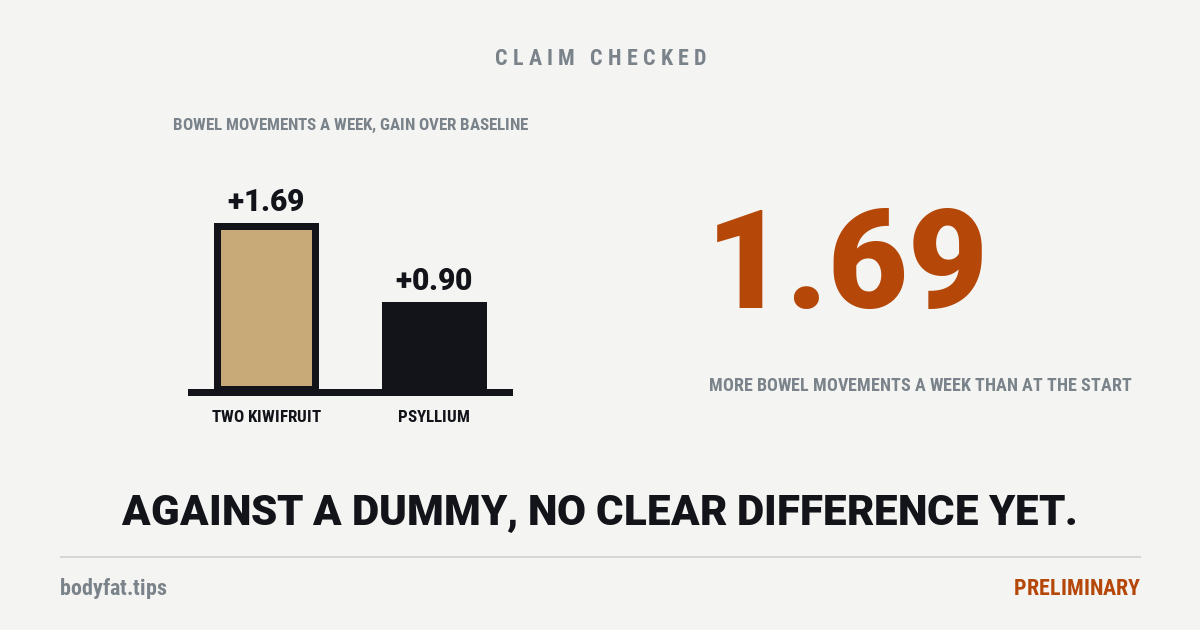
The count that mattered was complete spontaneous bowel movements: ones that came without a laxative and left the person feeling they had finished. Researchers count those because they are the ones that say constipation is easing. On kiwifruit, the constipated group gained 1.69 a week over where they started. On psyllium, they gained 0.90 [3]. The gap was small and only just on the “probably not chance” side of the line researchers use; split into the two kinds of constipation, neither gap cleared that line, and in the functional-constipation half psyllium’s own gain, 0.67 a week, did not clear it either [3]. Neither treatment was set against nothing, so these are gains over where people started, not proof of what caused them. The healthy volunteers went more often too, by about one a week on either [3].
Two things about that trial are worth knowing. The European regulator, which read it before it was published, noted that some psyllium effect may have carried over into the kiwifruit weeks and that two ways of analysing the numbers did not agree [6]. And the trial says in its own text that it was conducted “to establish further substantive evidence that could contribute to a positive opinion” from that regulator, and that its publication waited for the opinion [3].
Three more studies gave the fruit to people with constipation with no comparison group at all [9], and one compared it with dummy capsules without assigning people by chance, which is what makes a trial randomised; the regulator drew no conclusions from studies of either kind [6]. The trials that count are these.
The American trial gave 79 adults with chronic constipation two green kiwifruit a day, 12 g of psyllium or 3.5 oz (100 g) of prunes for four weeks [10]. It was not a clean comparison: the first 30 people were put on kiwifruit “to accommodate the limited growing season and fruit availability”, and only the rest were assigned by chance [9]. Kiwifruit came last of the three on the main measure: 13 of 29 people improved on it, against 14 of 22 on psyllium and 16 of 24 on prunes, a spread that could be chance [6]. Where it won was comfort: side effects were reported by 32% on kiwifruit, 45% on prunes and 66% on psyllium [9], and 68% of the kiwifruit group were satisfied with their treatment, against 48% on the other two, by the university’s account [11].
Two smaller New Zealand trials used gold kiwifruit. In one, two a day added about one complete bowel movement a week, and psyllium added about one and a half; the difference could be chance [12]. Its psyllium was matched to the gold fruit’s 2.5 g of fiber, which its authors say is below the recommended dose and list as a limitation [12]. In the other, 32 women with mild constipation went from 3.3 a week to 6.3 on three gold kiwifruit a day, and were at 4.5 at the end of their psyllium weeks, a rise on psyllium (5 g of fiber a day) that could have been chance [13].
| Trial | Kiwifruit, against what | Complete bowel movements a week, change from where people started |
|---|---|---|
| New Zealand, Italy, Japan; 121 with constipation, plus 63 healthy; each person tried both for four weeks [3] | Two green a day, against 7.5 g of psyllium | +1.69 on kiwifruit, +0.90 on psyllium [3] |
| United States; 79 with chronic constipation, four weeks [10] [9] | Two green a day, against 12 g of psyllium or 3.5 oz (100 g) of prunes; the first 30 people were put on kiwifruit, not assigned by chance [9] | +1.0 on kiwifruit, +1.7 on psyllium, +2.7 on prunes; the share of people who improved did not differ clearly [6] |
| New Zealand; 24 with constipation, plus 32 healthy; each tried both [12] | Two gold a day, against 7.5 g of psyllium | About +1.0 on kiwifruit, about +1.6 on psyllium; no clear difference [12] |
| New Zealand; 32 women with mild constipation; each tried both [13] | Three gold a day, against a branded psyllium powder (5 g of fiber) | From 3.3 to 6.3 on kiwifruit; 4.5 at the end of the psyllium weeks [13] |
Pool them and the picture turns out to be one trial. A 2024 review for the British Dietetic Association combined three of these trials and reported that kiwifruit added 0.36 bowel movements a week more than psyllium [9]. That is about one extra every three weeks, by our arithmetic. The range the true answer probably sits in, by the review’s figures, ran from 0.24 to 0.48 [9]. But the review’s own chart, which also holds a trial of prunes, gives 98.5% of its weight to one of these three, the biggest trial’s group with functional constipation; the other two pointed opposite ways, one a bowel movement a week ahead on kiwifruit and one half a bowel movement behind, both well within chance [9]. The pooled figure is that one group’s figure. Its narrow range rests on a spread of 0.31 bowel movements a week entered for both groups, less than a tenth of the spread in the other two trials, which looks like a standard error (how precisely an average is known) rather than how much people differed. If it is one, the range would run from about half a bowel movement fewer to a little over one more a week, which takes in no difference at all; that arithmetic is ours [9]. The trial’s own paper found no significant difference between kiwifruit and psyllium in how often people went in any week [3], and the European regulator noted that counting raw weekly stools, rather than gains, gave no clear difference [6]. The Association’s guideline graded that evidence “low”, its word for a result that further trials could well change, and still says two to three kiwifruit a day for at least four weeks “may be recommended”, and that kiwifruit may suit people better than psyllium if psyllium gives them bloating, pain or gas [4].
Two more reviews agree on the direction and on the weakness. A 2022 pooling of seven randomised trials found low-certainty evidence that kiwifruit helps, and every trial in it that used a dummy comparison tested capsules or powders, not the fruit [14]. A 2026 network meta-analysis, a method for ranking several options against each other across many trials at once, ranked “fruit-based foods” above fiber supplements and above a dummy for how often people went [15]. Its own supplementary tables show what that rests on: its kiwifruit trials were all compared with psyllium, and its one trial of a fruit against a dummy was a fig paste [15]. Not every pooling agrees. A 2024 meeting abstract that pooled eight trials of the fruit and its extracts together concluded that in people with constipation there was “no evidence” they add complete bowel movements against a dummy or psyllium [41]. It does not name its trials, and one of its own ranges, 0.01 to 0.36, sits beside the words “did not significantly affect”, so we could not check it [41].
Which leaves one more reader to hear from. The European regulator was asked by the marketer in 2020 to approve a claim about kiwifruit and the gut. It set aside most of the 18 studies it was sent, found faults in all six it used, and still concluded that “a cause and effect relationship has been established” between green kiwifruit and normal bowel movements [6]. In the four studies of healthy people, it worked out roughly half an extra stool to two extra stools a week; in people with constipation, kiwifruit did at least as well as the comparison treatment [6]. And then this sentence: “the scientific evidence does not establish that the effect of green kiwifruit on normal defecation is over and above what could be expected by its content in dietary fibre” [6].
One trial has asked the plainer question: does the fruit beat nothing? In Christchurch, New Zealand, 63 adults with constipation were assigned by chance to two green kiwifruit a day or a calorie-matched starch powder (maltodextrin) for four weeks; everyone knew which they were getting, and the main measure was belly pain [40] [39]. The team showed its first results on a poster at a gastroenterology meeting in May 2024, three years after the regulator’s opinion. The poster’s abstract is printed in the meeting’s journal supplement, but the publisher’s pages served us bot checks and no index or archive we tried held its text, so we have not read it [42]. A medical news service’s report of the poster says that across the 57 people analysed there was no significant difference in belly pain, in total bowel movements (p = 0.46) or in complete bowel movements (p = 0.07, just short of the line for “probably not chance”), while the 18 with IBS-C did better on belly pain and constipation scores [40]. The report quotes the team describing “a clinically relevant impact on complete spontaneous bowel movements”; the p-value it gives for that measure is the 0.07 above [40]. The team’s own abstract for a European nutrition congress in September 2026 gives the main measure the same shape: across 52 people, belly-pain scores fell by 0.48 on the fruit and 0.33 on the powder, a gap that could easily be chance (p = 0.48); in 17 with IBS-C, by 0.86 against 0.17 (p = 0.024) [39]. Neither report says how many more bowel movements the fruit produced, if any. Both report scans showing more water in the colon on the fruit [40] [39]. A gap inside a small subgroup is a lead, not a finding: cut a trial into enough slices and one of them will clear the line by chance.
Does kiwi work in 24 hours?
Not that any trial of the fruit has shown, because none we found looked that closely. The constipation trials of whole kiwifruit we read kept daily diaries and reported them as averages over a week or longer [3] [10] [12] [13] [5]. The quickest look was the first-week average in the biggest trial, which had already risen, on kiwifruit and on psyllium alike, by the trial’s own chart [3]. A week is not a day.
The fastest measurements of the fruit came from a Nottingham MRI study [16]. Fourteen healthy volunteers, median age 26, ate two large green kiwifruit twice a day, four a day, for two days, then were scanned every hour on the third day [16]. Water in the small intestine was higher than on a calorie-matched control drink at every scan after the fasting one, and the authors think the effect “disappears overnight” [16]. The trial’s main measure, how watery the contents of the first stretch of the colon were across the whole day, came out at p = 0.056, just the wrong side of the line researchers use for “probably not chance”; the abstract leads with the second half of the day, where it cleared the line [16]. Stools ran at 1.46 a day against 1.14, counted over days three to six, not the first day [16].
If “digestion” means digesting a meal, there are two quicker studies, both small and both comparing one kind of kiwifruit with another. Ten healthy men ate a 14 oz (400 g) steak with two green or two gold kiwifruit: bloating was lower with the green, and the stomach emptied no faster [17]. Twelve older adults ate beef after 14 days of each kind: amino acids, the building blocks of protein, reached the blood faster with the green, and the total absorbed was the same [18]. Green kiwifruit carries an enzyme that breaks down protein, actinidin; the gold variety in those studies had none [18].
So where does a day come from? The one trial we found that reported the first 24 hours tested capsules of a kiwifruit extract, not the fruit, in 58 people in China with constipation that had started recently [19]. Its authors, led by the extract maker’s chief scientific officer, wrote that people improved “within the first 24 hours of consumption of the kiwifruit extract” [19]. They also wrote this: “Within 24 hours of starting the placebo, participants were experiencing an increase in bowel movement, improvement in abdominal discomfort and a softening of the stool” [19]. The people on dummy capsules improved on day one too; the authors suggest some were getting better on their own, and the improvement on the dummy faded over several days [19]. The same maker’s patent, granted in 2016, describes nursing staff counting bowel movements in the 24 hours after doses of its extract drinks, in elderly people aged 65 to 95 at three facilities [20]. Neither is the fruit, and the patent is not a trial.
We could not trace where the channel’s 24 hours came from. None of the three video descriptions cites a study [1].
Kiwi pills, powders and extracts are a different claim
The European authorisation covers fresh green kiwifruit only. The regulation says the regulator could draw no conclusions from the studies of other kiwifruit foods [7]. The British guideline is blunter: kiwifruit supplements “do not impact stool frequency or stool consistency in constipation” [4]. Pooled, they changed how often people went by 0.24 a week, with a range from 0.32 fewer to 0.80 more: “does nothing” sits inside it [4].
The extract trials we read, one by one, are a study in who runs them. A capsule trial paid for by one extract company found no difference from a dummy in any week [21]. Another company paid for and supplied a six-week trial of a green-kiwifruit extract in 64 healthy adults with mild gut discomfort, 41 of whom finished: how often people went changed in neither group, though some symptom scores improved from where people started only on the extract [43]. A powder trial sponsored by the maker of the extract in the 24-hour trial above found more bowel movements than on a dummy in weeks two to four, on one measure or another; after its first 50 people it ran an interim check and, it says, “It was determined that additional subjects would be necessary to reach statistical significance”, and it went on to 87 [22]. The same maker paid for a trial of 186 adults with IBS-C, enrolled from 2013 to 2015 and published in 2025: it missed its primary endpoint, the main result it was designed to judge itself by, 24% against 26% on the dummy, while more people on the extract went more often, 54% against 36% [23]. A 2024 Indian trial tested a kiwi-pulp drink made and sold by a company whose research staff are two of its authors; it was run at a clinic whose founder is the lead author, and it declares no conflicts of interest [24]. And the largest extract trial of all, of two kiwifruit powders, was registered by an industry sponsor as 240 people at one Canadian centre, started in March 2018, and lists no results [25]. It has been published, in a journal PubMed does not index, which is why our first searches missed it [5]. A 2023 paper’s chart of who took part shows 288 people assigned by chance to seven groups: a green or a gold powder at two doses each, a formula, or one of two dummy powders [44]. The papers and the registration do not match: 288 people against 240, seven groups against six, and four centres in the 2025 paper against one [25] [44]. A 2024 paper’s title says 600 mg a day of the green powder “improves stool form and relieves occasional constipation” [45]. A 2025 paper, whose abstract names the registration, compared 600 mg a day of the gold powder with a dummy in 85 people and was designed around complete bowel movements; its abstract says they improved “over baseline”, that is, against where people started, and gives no comparison with the dummy on that measure [46]. The publisher refused our automated reading and we found no other copy, so we have read only their titles, that one abstract and their charts, and cannot say what they found against the dummies. Their authors include staff of the trial’s registered sponsor, of the research firm that ran it, and of the New Zealand company that supplied the same powders to an earlier trial [44] [45] [46] [47].
For more on what sells as a gut supplement, the site’s ranking of gut-health supplements puts each against its trials.
Who paid for the kiwi research?
Here is the count. Of the nine studies on this page that gave people whole kiwifruit to test the gut, all nine had money, fruit or staff from the New Zealand marketer, which one of the papers describes as “a consortium of kiwifruit growers” [16]. It was the principal sponsor of the biggest trial, with two of its employees among the authors [3]; it paid for the MRI and steak studies, each with an employee as an author [16] [17], and the protein study [18]; it co-funded the two gold trials with the New Zealand government [12] [13]; it part-funded the American trial, by the university’s own account [11]; and it supported the first trial, in 2002 [26], and co-funded the trial against a starch powder described above, supplying its fruit [27].
Industry money does not make a result wrong. It is why the funding is on this page, and why the independent readings matter: a regulator, a dietetic guideline and three reviews read these trials and concluded that the fruit helps, the guideline and the 2022 review grading the evidence low [6] [4] [9] [14] [15]; the 2024 meeting abstract above concluded the opposite, in a form we could not check [41]. Four of the whole-fruit trials compared kiwifruit with psyllium, a choice one team explained by saying a fruit “cannot be easily adequately matched by a simple control material for a placebo” [12]. That is fair, and it means what those trials show is that the fruit does about as well as psyllium at the doses they used, and three of the four gave psyllium at 6 g of fiber a day or less, below the more than 10 g a day at which the dietetic guideline’s pooling found fiber supplements beat a dummy; one team calls its own dose below the recommended dose, while the largest trial’s authors held that 6 g was enough [3] [4] [12] [13]. The one randomised trial we found that pits the fruit against a dummy has reported only in a poster, a congress abstract and a news report, and across everyone in it found no clear difference [40] [39].
Is it the kiwi, or just the fiber?
This section is the desk’s own reasoning, and it is labelled as such. The regulator’s sentence about fiber [6] is the question the evidence leaves open. Three answers, each rated.
Answer one: it is mostly the fiber. Two of the large green kiwifruit in the biggest trial carry about 6 g of it, and that trial matched it with psyllium; the gold trials matched smaller amounts, 2.5 g and 5 g; and the results came out close [3] [12] [13]. The regulator could find nothing beyond it [6]. This is the regulator’s reading of the trials, which is as close to a measurement as this question has come.
Answer two: the fruit’s fiber holds more water than a spoonful of powder. The MRI study’s authors cite laboratory work in which kiwifruit cell walls swelled to more than three times their volume, about one and a half times as much as psyllium, and their scans showed the small intestine holding more water all day [16]. That could explain an edge over psyllium, if there is one. The swelling and the water are measured: in a lab, in 14 healthy people, and, as more water in the colon, in the trial against a starch powder [39]; that they explain the edge in people with constipation is a surmise.
Answer three: it is the enzyme. This is the version that sells “digestion”, and the evidence mostly leans against it. Gold kiwifruit has about an eighth of the green’s enzyme activity, by the gold trial’s own account [12], and people with constipation went more often on gold kiwifruit in both of its trials [12] [13]. The same paper mentions, as an unpublished result, that an older gold variety with no enzyme activity did not relieve gut discomfort, which points the other way; an unpublished result is one we cannot check [12]. The enzyme’s measured effects are on how a protein-heavy meal is handled, not on constipation [18] [17]. And actinidin is the fruit’s main allergen, linked to its most severe reactions [28]. This is a surmise from two small trials that never set out to test the enzyme, with one unchecked result on the other side.
Put the three together and here is what we think is true, stated plainly so you can disagree with it: two kiwifruit a day are a fiber supplement you can peel. They did about as well as one, mostly at low doses, in the trials, over about the same weeks, though against a dummy the fruit has not yet clearly won; the 24 hours, the enzyme and the “gut reset” are packaging until someone tests them.
What we could not find, and would like to. The full paper of the one randomised trial of the whole fruit against a dummy. Its last data were collected on 13 July 2022 [29]; its protocol, published in 2026, says the analysis is complete and the results were expected by April 2026 [27]; so far we have found only the poster, the congress abstract and the news report above [5]. It should say how many more bowel movements, if any, the fruit produced than the starch powder, which neither report gives. We would also like a trial of the whole fruit that counts the first day, and to read the three papers from the powder trial in full [44] [45] [46]. If you know of any of them, the corrections line on this site is open.
Can kiwi help you sleep?
Maybe a little; the evidence is small and points both ways. The earliest study we found is a 2011 Taiwanese one: 24 adults with sleep problems, 22 of them women, ate two kiwifruit an hour before bed for four weeks and reported sleeping better; their sleep-questionnaire score improved by 42.4%, and their total sleep time rose by 13.4% by their own diaries and by 16.9% by a wrist monitor [30]. There was no comparison group, the authors say they could not tell how much was expectation, and the study was supported by the kiwifruit marketer’s office in Taiwan [30].
The trials since then disagree. In a Norwegian randomised trial of 74 students with insomnia symptoms, 4.6 oz (130 g) of kiwi an hour before bed for four weeks did better than the same amount of pear on 2 of 12 measures, both from sleep diaries, and on none measured by wrist monitor [48]. In a randomised trial of 26 Saudi female students, sleep improved over six weeks in the kiwifruit group and in the comparison group alike, with no difference between them [31]. In 24 young New Zealand men, one evening of two fresh kiwifruit did not change how long they slept by wrist monitor, against water; some morning ratings were better after a dried-kiwi drink [32]. In 36 children aged 8 to 12 with overweight and sleep problems, kiwifruit plus a soccer programme improved sleep more than soccer alone [33]. Rated alone: Preliminary. The site’s melatonin verdict weighs the best-known sleep supplement.
Kiwi benefits for platelets
Two different questions travel under this search. The first is whether kiwifruit makes platelets, the blood cells that start a clot, less likely to clump. Two trials from one Oslo group say a little: healthy volunteers eating two or three kiwifruit a day for 28 days had an 18% smaller clumping response than in their comparison period [34], and in a trial of 102 male smokers, the group given three a day for eight weeks had 15% less [35]. We read both as abstracts. Rated alone: Preliminary.
The second question, which circulates around dengue fever, is whether kiwifruit raises a low platelet count. The one trial we found gave 100 patients in a hospital in Pune, India, with low counts from dengue or another viral fever, either green kiwi or guava, 3.5 to 10.6 oz (100 to 300 g) a day depending on appetite, with no group that ate neither [49] [5]. Counts in the kiwi group dropped over the first few days before they rose, and the guava group recovered sooner [49]. It cannot answer the question. With no group that ate neither fruit, it cannot say whether either raised anything; the two groups did not start alike (12 of the 50 on guava began in the paper’s lowest band of counts, under 20,000, against 1 of the 50 on kiwi); everyone knew which fruit they were eating; and it was registered for 40 patients and reports 100 [49]. Rated alone: Unsupported, of the tested kind: tested once, against another fruit, and nothing in that test supports it. What to eat during dengue fever is a question for the clinician treating it.
Does kiwi lower blood pressure?
The site’s blood-pressure verdict already weighs it, with the pooled kiwifruit trials and the largest of them, and rates the fruit’s effect Preliminary. We have not repeated that work here.
Which is healthier, apple or kiwi?
Neither has been tested against the other for constipation in any trial on this page. On the label, per 3.5 oz (100 g), green kiwifruit has 92.7 mg of vitamin C to an apple’s 4.6 mg, 3.0 g of fiber to 2.4 g, and 312 mg of potassium to 107 mg [8] [36]. “Healthier” is not something those numbers settle, but for vitamin C it is not close.
Who these studies were done on
Mostly women, mostly under 65, mostly with mild constipation. Women were 74% of the biggest trial and 82% of its constipated group; its volunteers were 18 to 65, and anyone with severe IBS symptoms was turned away [3]. Most of the trials, a 2022 review notes, took people with occasional or mild constipation [14]. The American trial was 87% women [10]; one gold trial was all women [13]; the other’s constipated volunteers were over 90% women [12]. The one bowel-habit trial of older people we read gave 38 healthy adults over 60 a kiwifruit for every 66 lb (30 kg) of body weight, and they went more often [26].
Some people were left out on purpose. The two largest trials excluded women who were pregnant or breastfeeding [3] [37], so the searches for “kiwi benefits pregnancy” land on a population these trials did not test. The American trial also excluded anyone taking opioid painkillers and anyone with warning signs such as bleeding or unexplained weight loss [37]; those are questions for a clinician, not a fruit bowl. A 2022 review that put no limit on age included no trial in children [14]; a children’s trial of a kiwifruit-extract chew against a standard laxative is registered and was listed as not yet recruiting [38]. None of the trials we read reported men and women separately, and there were few men in them.
People with a kiwi allergy are the clearest exception. Kiwifruit has become one of the main plant foods people are allergic to [28]. Its main allergen is actinidin, the same enzyme in the digestion story; it makes up about half of the fruit’s soluble protein and is linked to the most severe reactions [28]. Reactions run from an itchy mouth to anaphylaxis, children are more likely than adults to react in several parts of the body at once, and people allergic to latex, birch or grass pollen, banana or avocado can react to kiwifruit too [28]. The biggest constipation trial excluded anyone with a known kiwifruit or latex allergy [3].
Where “kiwi fixes your digestion in 24 hours” came from
The research came first, and it came from New Zealand. In 2002 a trial titled “Kiwifruit promotes laxation in the elderly” gave 38 healthy people over 60 kiwifruit for three weeks; they went more often, and the study was supported by a university, a cancer charity and the kiwifruit marketer [26]. In the younger group the same paper describes, how often people went did not change [26]. Nineteen years later the regulator called the statistics in both studies “not interpretable” [6].
Then the framing, which went through a regulator. The marketer’s 2020 application first asked to say that “Regular consumption of green kiwifruit contributes to gastrointestinal comfort” [6]. The regulator narrowed it to bowel movements in 2021, the big trial was published once that opinion was in [3], and in 2025 the European Commission authorised the stool-frequency wording, for the fresh fruit, at 7 oz (200 g) a day [7]. The American trial reached the public through a university news item in November 2020 [11].
The earliest 24-hour counts we found belong to the extract business: an extract maker’s 2016 patent counting bowel movements in the 24 hours after a dose [20], and the same maker’s 2018 trial, in which people on dummy capsules also improved within a day [19]. Whether either reached the channel we cannot say. The channel’s video from April 2025 put the 24 hours on the fruit itself, and two videos in May 2026 made it a chapter title [1]. In the search results for “kiwi benefits”, as they appear there, a hospital’s “10 Benefits of Kiwi Fruit for Health” lists “aids digestion”, and a national newspaper’s “Why a Kiwi May Be the Perfect Snack” carries the line that kiwi fiber helps “address constipation” [2].
None of this is aimed at anyone with a bowl of kiwifruit on the counter. Two or three a day for ordinary constipation is what a dietetic guideline suggests, on the evidence above [4]. It is the 24-hour stopwatch that the evidence does not carry.
What this is rated, and what the rating covers
Preliminary — for the claim that eating kiwifruit relieves constipation.
It is rated Preliminary because the trials are real and point the fruit’s way, but they are not yet good enough to show it does more than nothing. Three randomised trials, and one in which the kiwifruit group was not chosen by chance, found more complete bowel movements on two or three kiwifruit a day than at the start, about as many as on a fiber supplement [3] [10] [12] [13]. None of the four had a group given nothing, so they show gains over where people started rather than what caused them, and three of them gave psyllium at 6 g of fiber a day or less, below the more than 10 g a day at which the dietetic guideline found fiber supplements beat a dummy [3] [4] [12] [13]. The pooled edge over psyllium is one trial’s figure, with a precision that looks too good [9]. The one randomised trial against a dummy, a calorie-matched starch powder, found no clear difference across everyone in it, in belly pain, its main measure, by its team’s congress abstract and a news report of its poster, or in bowel movements, by the news report; we have not found its full paper [39] [40] [27] [5]. On the other side, a European regulator in 2021 and a dietetic guideline in 2025 concluded that the fruit helps, the guideline grading the evidence low; neither cites the trial against a starch powder [6] [4]. The trials were small, could not hide from people what they were eating, took mostly women with mild constipation, and every one of them had money from the kiwifruit marketer [3] [11] [12] [13]. The rating would move to Supported if the dummy-controlled trial’s full results, or a second trial like it, showed the fruit clearly ahead on bowel movements.
Rated alone, in words. That two kiwifruit a day do about as well as psyllium at the doses those trials used, over four weeks: Preliminary. In four small trials the fruit was never clearly behind psyllium and was ahead on complete bowel movements in two, but three of the four gave psyllium at 6 g of fiber a day or less, a dose at which the dietetic guideline’s own pooling found fiber supplements no better than a dummy, and none was built to show the two are equal [3] [4] [10] [12] [13]. That kiwifruit works “in just 24 hours”: Unsupported, of the untested kind; no trial of the fruit we found reported the first day, and the one extract trial that did saw its dummy capsules work that fast too [5] [19]. An untested claim is not a disproven one. That kiwifruit capsules, powders or extracts relieve constipation: Preliminary; the trials conflict, the most positive were paid for by a maker, the largest reports its main measure, in the one abstract we could read, only against where people started, and the independent pooling found no change in how often people went [4] [21] [23] [43] [46]. That kiwifruit makes a meal’s protein digest faster: Preliminary, two small studies comparing one kiwifruit with another [17] [18]. Sleep: Preliminary. Platelets clumping less: Preliminary. Raising a low platelet count: Unsupported, of the tested kind; the one trial we found set kiwi against guava, with no group given neither [49]. Blood pressure: Preliminary, on the site’s own verdict.
What is not rated here: kiwi for immunity, skin, weight loss or cancer, which this page did not weigh; the comparison with prunes, which did better than kiwifruit on the numbers in the American trial, though not by a clear margin, and is its own question; and the frame above, which is this desk’s reasoning from the evidence rather than a result the evidence delivered. It is marked as ours so that you can weigh it as ours. This is journalism, not medical advice: constipation that is new, severe or comes with warning signs is a reason to see a clinician. The site’s psyllium verdict rates what that supplement does for cholesterol, and the fiber verdict what fiber does for weight. How we read a study, and what each tier means, is set out here.
- Resistant Starch: Chilled Rice Cut the Blood-Sugar Rise 18% in the Study a 3-Million-View Video Cites. A 40-Person Rice Trial Found No Difference.
preliminary - Does Alcohol Make You Gain Weight? Fat-Burning Drops By A Third. Thirty-One Studies Still Could Not Agree.
preliminary - Does Alcohol Cause Cancer? Yes, and More Drinking Means More Risk
established