Do You Need a B12 Supplement? If You Eat No Animal Foods, Yes. Energy at Normal Levels: Not Shown.

“Vegetarians and vegans are at a higher risk of developing a vitamin B12 deficiency, as plant-based foods do not contain significant amounts of this nutrient. Supplementation or fortified foods may be necessary for those who do not consume animal products.” That is the description under “This Vitamin can change your life because.. #shorts”, posted on 4 May 2023 by a physicians’ explainer channel run by two orthopaedic surgeons with guest specialists. It had 2,161,808 views when we read its numbers on 10 October 2026 [1].
Its longer companion, “Vitamin B12: Why You Should Take It”, posted on 17 March 2023 and seen 1,345,832 times, opens differently: “Are you feeling tired, weak, or experiencing tingling in your fingers and toes? You may be one of the millions of people who are deficient in vitamin B12.” It names the groups at risk as “vegetarians and vegans, as well as older adults and those with certain medical conditions” [1].
Plenty of people are asking. “B12 supplement” is searched about 27,100 times a month in the United States, and Google answers it mostly with shop pages and best-of lists; “b12 deficiency vegan” about 390 times, “vitamin b12 deficiency elderly” about 210 and “do vegans need b12” about 70 (from a paid keyword database, pulled 10 October 2026) [2].
So who actually needs one? Here is the short version; the rest of the page is the working.
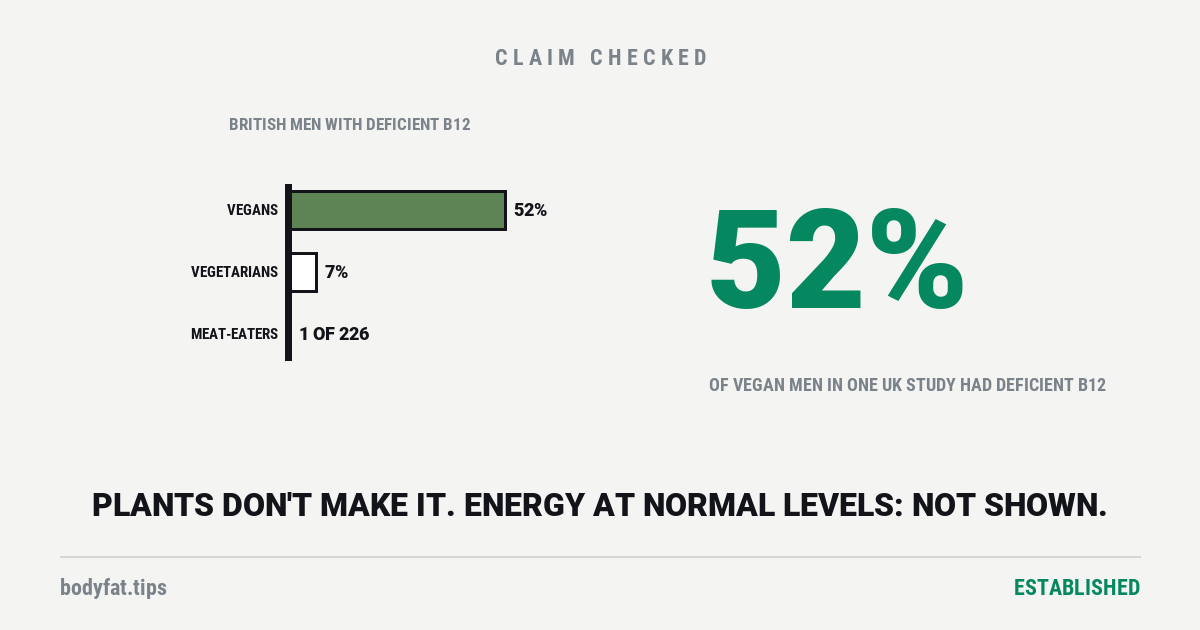
If you eat no animal foods, yes: you need B12 from a supplement or a fortified food. Plants do not make it. In a British study of 689 men, 52% of the vegans had blood levels in the deficient range, against 7% of the vegetarians and one meat-eater [3].
Over 50, the US advice is to get most of your B12 from fortified foods or a supplement. A stomach that makes less acid absorbs less from food [4]. But in trials of older people without symptoms of deficiency, some of them with low levels, B12 did not improve nerves or memory [5] [6], and B12 given with folic acid did not significantly cut fractures [7].
If you are simply tired and your levels are normal, B12 has not been shown to help. In the small placebo-controlled trials of B12 on its own that we found, people mostly improved about as much on the dummy [8] [9]. One common medicine does lower B12: the diabetes drug metformin, in two randomised trials [10] [11].
Do vegans need B12?
Yes, and the reason is simple. B12 is made by bacteria, not by plants or by animals; animals carry it because it builds up in their tissues [12]. The US Office of Dietary Supplements puts it flatly: “Plant foods do not naturally contain vitamin B12” [13]. Your body needs it to make red blood cells and DNA and to keep nerves working. Run short for long enough and you get anaemia with oversized red cells, nerve damage, or both; the nerve problems “can occur without anemia”, the fact sheet notes [13].
The clearest single picture comes from EPIC-Oxford, a long-running British study that recruited its volunteers in the 1990s. Of 689 men, 226 ate meat, 231 were vegetarian and 232 vegan. Average B12 in the blood was 281 pmol/L for the meat-eaters, 182 for the vegetarians and 122 for the vegans; pmol/L, picomoles per litre, is simply how much is in each litre of blood. Below 118 counted as deficient (about 160 pg/mL, the unit most US labs print, by our conversion). That was 52% of the vegans, 7% of the vegetarians and one meat-eater, and another 21% of the vegans sat just above the line [3].
Two details in that paper are worth keeping. Time on the diet made no difference: the long-standing vegans were no lower than the new ones. And the vegans and vegetarians who said they took a B12 supplement did not have significantly higher levels than those who did not. The authors suggest the supplements may have been misreported, may have held an inactive plant form of B12, or may have been started after a diagnosis [3]. A tablet you say you take is not the same as a dose that reaches your blood.
A 2024 review gathered 19 studies, 930 vegans among them, and pooled 17 of them on four blood markers at once. Serum B12 is the total in the blood. Holotranscobalamin, or “active B12”, is the part bound to the protein that delivers it into cells. Methylmalonic acid and homocysteine are substances that build up when cells run short of B12, so they rise as B12 falls [14].
Against meat-eaters, vegans had lower serum B12 and higher homocysteine, both clearly. Their methylmalonic acid was higher and their active B12 lower, but neither difference was statistically significant: p = 0.06 and 0.09, just the wrong side of the line researchers use for “probably not chance” [14]. The review reported these as standardised differences, a way of comparing results measured in different units, where 0.2 is small, 0.5 moderate and 0.8 large: 0.72 for serum B12, 0.57 for homocysteine. For serum B12 the I-squared was 93%, the share of the spread between the studies’ results that is more than chance would produce [14]. The review also judged 16 of its 19 studies at moderate to poor risk of bias [14]. And its serum B12 comparison pooled 13 studies and set EPIC-Oxford and one other study aside as outliers, so it is a separate piece of evidence from the British study above, not a repeat of it [14].
In the four studies that split vegans by whether they took B12, 123 who did and 64 who did not, the supplement users looked better on every marker: serum B12 277 against 184 pmol/L, active B12 43 against 26, methylmalonic acid 340 against 485 nmol/L [14]. Small numbers, and not a trial: people who choose a supplement may differ in other ways too. But it points the same way as everything else.
What the official bodies say
The advisory bodies we read point the same way, though their numbers differ.
The United States. The 1998 report that set the recommended intake, 2.4 micrograms a day for adults (written mcg on US labels), lists “Insufficient B12 intake, as seen in complete vegetarians” among the causes of deficiency [4] [15]. The Office of Dietary Supplements says fortified foods and supplements “can substantially reduce the risk” [13].
The Academy of Nutrition and Dietetics, the US dietitians’ body, in its 2025 position paper: “Using B12 supplements may be the easiest and most reliable way to ensure adequate B12 status among all vegetarians, particularly for vegans.” It also says “higher intake may be needed … especially in older vegans and vegetarians”, and that supplement advice should follow an individual assessment [16]. One honest detail: it grades the evidence on low B12 among vegans, along with its other concerns about vegan diets, as “of low or very low quality” [16]. That is a judgement on studies comparing people who chose their own diets, which cannot rule out other differences between vegans and everyone else; the paper gives the supplement advice all the same.
Europe. The European Food Safety Authority, whose opinion we read only in summary, sets an adequate intake of 4 mcg a day for adults, judged from the same four blood markers [17].
Britain. The British Dietetic Association tells long-term vegetarians and vegans to have their B12 checked and, “If a vitamin B12 supplement is needed”, recommends “a 10mcg daily supplement or at least 2mg per week” [18]. The national guideline for doctors lists a vegan diet among the common risk factors for deficiency [19].
How do vegans get B12? Fortified foods, and the case for nori
Fortified foods work: the fact sheet calls fortified breakfast cereals and nutritional yeasts “readily available sources of vitamin B12 that have high bioavailability”, meaning the body can use what is in them [13]. Fortified plant milks, yogurt alternatives and yeast extract spreads carry it too [18].
The natural plant sources are where it gets interesting. Spirulina and similar algae tablets often test high for B12 on the label, but much of it is “pseudovitamin B12”, a look-alike that is “biologically inactive in humans” [20]. Tempeh, the fermented soybean cake, can contain B12, apparently from bacteria that get in while it is made, in amounts that vary [20]. A 1991 Dutch study of children on a macrobiotic diet found that algae and fermented foods raised the B12 reading in their blood while their red cells kept getting worse; they improved on fish or a supplement [21].
Nori, the dried seaweed sheet used for sushi, is the exception worth watching. Laboratory analyses have confirmed real B12 in it, in amounts that vary from about 32 to 134 mcg per 100 g dried; at the review’s figure of 77.6 mcg, about 4 g would cover a day’s need. In a laboratory model of a stomach that makes little acid, though, only about 2.5% of it was released [20]. In 2024 a Taiwanese trial gave 30 vegetarians who took no supplements either 5 g of roasted nori a day, 8 g, or none, for four weeks. On 5 g, serum B12 rose by 59 pmol/L more than in the group without nori, active B12 by 28 and homocysteine fell; methylmalonic acid did not differ significantly between groups [22]. That is one small, short, open trial, in which everybody knew what they were eating, and 80% of its volunteers were vegetarians who ate eggs and dairy, not vegans [22]. Pointing the other way, a German study followed 10 vegans who ate nori and sun-dried mushrooms instead of a supplement for eight months: their methylmalonic acid was raised, and the authors called their B12 supply borderline [23]. A chlorella supplement lowered methylmalonic acid in 17 vegans and vegetarians over two months, in a study with no comparison group [24].
So nori may yet earn a place. For now, the advisory bodies we read rely on fortified foods and supplements [13] [18] [16].
What about vegetarians who eat eggs and dairy?
They are in between. In the British study their average was 182 pmol/L against 281 for meat-eaters, and 7% were in the deficient range [3]. In the 2024 pooling, vegans had lower serum B12 and higher homocysteine than vegetarians, small differences but clear ones (0.25 and 0.24 on the scale above), while the two groups did not differ significantly on active B12 or methylmalonic acid [14]. The dietitians’ position paper recommends B12 supplements for “all vegetarians, particularly for vegans” [16]. Higher risk, then, but most vegetarians in the largest study were not deficient.
Vitamin B12 deficiency in the elderly: why the over-50 advice exists
B12 in food comes bound to protein, and stomach acid helps release it. With age, more people develop atrophic gastritis, a thinning of the stomach lining that makes less acid [4]. The 1998 report estimated that 10 to 30 percent of people over 50 have it, and drew the conclusion that the claim rests on: “it is advisable for those older than 50 years to meet their RDA mainly by consuming foods fortified with vitamin B12 or a vitamin B12-containing supplement” [4].
Why would a supplement work when food does not? Because the B12 in tablets and fortified foods is not bound to protein, and the fact sheet notes that people who have trouble absorbing B12 from food “absorb free vitamin B12 normally” [13]. How many older people are actually short? It depends on where you draw the line: “between 3% and 43%” of older adults living at home, by the fact sheet’s count across studies [13].
Does B12 help older adults’ memory, nerves or bones?
Here the claim and the trials part company. Correcting a low level is one thing. Making people sharper or steadier is another, and the second is the promise in “can change your life”.
The cleanest test is a 2015 English trial. It took 201 people aged 75 and over whose B12 was moderately low, 107 to 210 pmol/L, with no anaemia, and gave them 1 mg of B12 a day or a dummy tablet for a year. Their blood levels rose as expected, from 231 to 641 pmol/L, and active B12 roughly quadrupled. Their nerves did not change: the main nerve measure differed by -0.2 mV, with a range the true answer probably sits in of -0.8 to 0.3, and there was “no evidence of an effect” on memory tests or the doctor’s examination either [5].
A 2021 review pooled 16 trials and 6,276 people without serious neurological disease or obvious deficiency, with average ages from 66 to 82. It found no evidence of an effect of B12, alone or with other B vitamins, on any area of thinking, or on depression [6]. The largest trial in it, 2,919 Dutch people over 65, counts twice, once for thinking and once for mood [6]. The longest trial of B12 on its own in that review’s list, in Hong Kong, gave 271 people with diabetes, aged 70 and over, whose B12 was borderline low, 1,000 mcg of methylcobalamin a day or a dummy for 27 months. Their methylmalonic acid and homocysteine fell; their memory and thinking scores and their dementia ratings did not differ significantly between the groups [25].
Bones and falls come from that same Dutch trial. It gave 500 mcg of B12 with folic acid, or a dummy, for two years. Fractures: 4.2% against 5.1%, a hazard ratio of 0.84 (1 means no difference; 0.84 means 16% fewer), with a range of 0.58 to 1.21, which still includes no difference at all [7]. The trial was paid for by Dutch public funds, the Dutch Dairy Association and the supplement company that made its tablets [26]. Falls: a hazard ratio of 1.0 [27]. Followed for about four and a half years, with fewer than half the volunteers still taking part, the fracture difference was still not significant, though the authors saw a possible benefit in people with the highest homocysteine that they say needs repeating [28]. An American trial of 4,810 women at high heart risk, given B12 with folic acid and B6 for 7.3 years, found no significant effect on fractures, including in the women whose B12 was low at the start [29].
There are favourable results, and they belong here too. In the Dutch trial, the over-80s who took their tablets as told had fewer fractures, a result the authors call exploratory [7]. And a 2010 Oxford trial in 271 people over 70 with mild memory problems found that a mix of folic acid, B12 and B6 slowed the shrinking of the brain on scans, 0.76% a year against 1.08% [30]. That trial measured scans, not dementia, used three vitamins at once, and its lead author is named on university patents on folic acid for Alzheimer’s disease [30]. This site’s dementia verdict covers the wider question.
The Dutch trial also counted more cancers in the vitamin group, 63 against 42, which the authors note the trial was not designed to assess [7]; more on that under safety.
Metformin, heartburn pills and B12
This is the part of the claim with the firmest trials behind it. In a Dutch trial, 390 people with type 2 diabetes on insulin took metformin or a dummy for 4.3 years. B12 fell 19% more on metformin, and the share with deficiency was 7.2 percentage points higher [10]. In the US Diabetes Prevention Program, low B12 was more common on metformin at five years, 4.3% against 2.3%; at 13 years the gap, 7.4% against 5.4%, was no longer significant, though low-or-borderline levels still were, 20.3% against 15.6% [11]. Each year on the drug raised the odds of deficiency by about 13% [11].
The American Diabetes Association’s 2026 standards say metformin is “associated with increased risk of vitamin B12 deficiency and worsening of symptoms of neuropathy” and suggest “periodic testing” [31]. That is a test, not a blanket supplement. If you take berberine because it is sold as a natural metformin, our berberine verdict covers that comparison.
Acid-suppressing drugs are a weaker case. In a California study of about 26,000 people diagnosed with B12 deficiency and 184,000 without, two or more years of proton pump inhibitors, the common heartburn pills, went with 1.65 times the odds of deficiency, and H2 blockers with 1.25 [32]. A 2023 pooling of 25 studies found a smaller link, said most studies found no difference in B12 levels, and called the result “too low to imply an association clearly” [33]. These are studies of people who were prescribed the drugs, not trials; they cannot separate the drug from the reasons it was prescribed.
Britain’s guideline lists both, with several other medicines, among the risk factors a doctor should ask about, and says that for medicine-related deficiency B12 can be given by mouth or by injection [19].
Pernicious anaemia: not a diet problem
One cause of deficiency has nothing to do with what you eat. In pernicious anaemia, which Britain’s guideline now calls autoimmune gastritis, inflammation of the stomach can destroy the cells that make acid and intrinsic factor, the protein the gut needs to absorb B12 [19]. The fact sheet says people with pernicious anaemia “cannot absorb either food-bound or free vitamin B12” [13], and the guideline recommends lifelong injections [19]. This is a diagnosis, made with tests, by a doctor.
Does B12 give you energy?
This is the “can change your life” part, and the second video’s hashtags make the pitch explicit: #energy, #injections and #shots, beside cosmetic-clinic tags such as #dermalfillers [1]. Tiredness is a real symptom of B12 deficiency [13]. The question is whether extra B12 does anything for people who are not short of it.
Here are the placebo-controlled trials of B12 on its own that we found [34]:
| Trial | Who, and what they were given | What happened | Who paid |
|---|---|---|---|
| England, 1973 [35] | 28 or 29 tired adults with normal blood tests finished (the paper gives both); two weeks of B12 injections and two of dummy injections, in random order | Felt better in general on B12, but only in the 14 given the dummy first, an analysis chosen after the results were in; tiredness itself was not significantly different [35] | No statement in the paper; the authors worked in a hospital pathology department [35] |
| Netherlands, 2018 [9] | 95 adults with irritable bowel syndrome or inflammatory bowel disease, severe tiredness and normal B12; 1,000 mcg a day by mouth for eight weeks, or a dummy | Tiredness scores fell about equally, 8.1 and 8.3 points; one sub-score, motivation, improved significantly on B12 [9] | Not read: summary only [9] |
| United States, 2021 [8] | 20 singers with mild vocal symptoms, such as tiring easily, and no known deficiency; one 1,000 mcg injection and one of salt water, in random order | “The improvements after either placebo or vitamin B12 injections were comparable” [8] | No conflicts reported [8] |
Read across, the three trials found people improving about as much on the dummy, with one exception: the 1973 pilot, whose positive result came from half its volunteers, picked after the data were in [35]. The US fact sheet’s verdict on B12 as a performance booster: it “appears to have no beneficial effect on performance in the absence of a nutritional deficit” [13].
Some trials of vitamin mixtures that include B12 are larger and longer, and they point both ways. The longest gave 2,501 French survivors of a heart attack, unstable angina or a stroke folate, B6 and a small dose of B12 (20 mcg), or a dummy; after about three years, the 2,029 who answered the questionnaire scored about the same for vitality, 54.6 against 54.8 out of 100 [36]. A 1996 German trial of injections of B12, folic acid and B6 in 213 older adults found a vitality score better at eight weeks only, with the groups already different at the start; the 2021 review that included it said the evidence “precludes robust conclusions” [6]. Injections of liver extract with folic acid and B12 made no significant difference in 15 people with chronic fatigue syndrome [37], and a drink of many nutrients, B12 among them, made no significant difference to fatigue in 202 people on dialysis in Japan over 12 weeks [38].
On the other side: in a trial sponsored by its maker, a B-complex tablet with vitamin C and minerals gave 215 working men better “vigour” scores and less self-rated mental tiredness after 33 days, though their fatigue score did not differ significantly [39]. A B-complex tablet part-funded by its maker let 32 young adults in Taiwan run 1.26 times longer on a treadmill [40]. B1, B6 and B12 with magnesium lowered fatigue scores over four weeks in 98 Iranian adults with inflammatory bowel disease in remission, in a trial that did not measure anyone’s B12 [41]. And a 2013 pooling of eight multivitamin-and-mineral trials found less fatigue, a small effect of 0.27 on the scale used above [42]. None of these can say what the B12 in the mix did.
What are the symptoms of B12 deficiency?
Britain’s 2024 guideline lists the common ones: anaemia or large red cells on a blood count; trouble concentrating or short-term memory loss, sometimes called brain fog; pins and needles or numbness; balance problems and falls; a sore, inflamed tongue; eyesight problems; and unexplained tiredness [43]. It warns doctors not to rule deficiency out because there is no anaemia, and it recommends testing people who have at least one symptom and at least one risk factor, such as a vegan diet or metformin [43].
This is journalism, not medical advice. If you have numbness, tingling, balance problems or anaemia, or you are pregnant and eat no animal foods, testing and treatment belong with a clinician, and the guideline says treatment should not wait for test results when the anaemia of B12 deficiency is suspected alongside nerve symptoms [19].
What is a good B12 supplement? Forms, doses and the methylcobalamin pitch
Search for a B12 supplement and Google suggests “Best B12 supplement methylcobalamin”; its AI answer calls methylcobalamin, a form found in the body, “preferred by some practitioners for its bioavailability”, against cyanocobalamin, the cheap stable form in most tablets [2]. The fact sheet: “No evidence indicates that absorption rates of vitamin B12 in supplements vary by form” [13]. A 2015 review found every form is converted inside cells into the same working forms. The studies comparing the forms, it says, “do not support consistent clear differences between Cbl forms in term of absorption, tissue clearance, or clinical effect”, and it concludes that cyanocobalamin “may be superior as oral supplementation because of its stability” [44].
Head-to-head tests are few and small [34]. In the one randomised comparison we found, from 1996, 20 healthy German clinic staff took 3 mg a day of one form or the other for two weeks, with no dummy group. Blood B12 rose more on cyanocobalamin, though that group started higher; a concentration test showed no difference between the groups; and the authors credited methylcobalamin alone with an “alerting” effect, judged from changes within each group, such as shorter sleep [45]. In 158 toddlers with low B12, in a look back through their records, methylcobalamin under the tongue raised levels as well as cyanocobalamin by mouth or injection, with the form and the route changing together [46]. In 42 Romanian vegans who chose their own supplements, active B12 was higher in those taking cyanocobalamin, though nobody was assigned a form [47]. A trial built to settle the question, planned for 54 vegetarians with marginal deficiency, given one form, the other or a dummy for 12 weeks, was registered on ClinicalTrials.gov by a research centre in Spain in 2023; when we read its registry record on 10 October 2026 it had posted no results [48]. Britain’s guideline accepts cyanocobalamin, methylcobalamin or adenosylcobalamin [19].
Why are the pills so big? The normal route, through intrinsic factor, handles about 1.5 mcg a meal [44], so the fact sheet puts absorption at about 50% for doses up to 1 to 2 mcg, about 2% at 500 mcg and 1.3% at 1,000 mcg [13]. By our arithmetic, 1.3% of a 1,000 mcg tablet is about 13 mcg, several times the 2.4 mcg a day adults need. The British dietitians note that the higher the dose, the lower the share absorbed, and pair a small daily dose, 10 mcg, with a much larger weekly one, 2 mg [18].
Pills, under the tongue, or injections?
For most people with deficiency, swallowing works. A Cochrane review, the kind that pools every trial it can find, found three trials comparing tablets with injections, 153 people in all, and judged that low-quality evidence showed similar results for blood levels; none of its three trials reported symptoms [49]. Its search ended in July 2017. Since then a Spanish trial of 283 people over 65 found both routes brought more than 90% to normal levels by eight weeks; at a year, 73.6% on tablets and 80.4% on injections were still normal, and the trial could not show the tablets were as good over that span [50]. 83.4% preferred the tablets [50]. A 2025 pooling of 16 studies, trials and observational studies together, found no significant difference between tablets, under-the-tongue forms and injections, with a great deal of spread between studies [12].
The exceptions are the ones the guideline names. For autoimmune gastritis, or after removal of the whole stomach or the end of the small intestine, it says to offer lifelong injections; when a deficiency caused by diet comes with a nerve or blood problem that could get worse quickly, it says to consider injections instead of tablets [19].
Can you take too much B12?
There is no official upper limit, the tolerable upper intake level set for most nutrients as the most you can take daily without likely harm. The 1998 report found “not sufficient scientific evidence” to set one, noted that people with pernicious anaemia have long been given large doses, and added a caveat worth knowing: the studies of high intakes “were not designed to assess adverse effects” [4].
Four findings get quoted as warnings, and each needs its context. First, in 333,667 Danes sent for a B12 test, those with high levels were several times more likely to be diagnosed with cancer in the next year, though people on B12 treatment had been excluded [51]. The authors read the high levels as “markers” of cancer and suggest the cancer itself may be what raises them [51]. Second, in a US cohort of 77,118 people, men whose supplements had averaged more than 55 mcg of B12 a day over ten years had about twice the risk of lung cancer, and the link showed for B12 from single-vitamin pills, not multivitamins; in women there was none [52]. A study of 159,232 women found no link between B12 supplements and lung cancer [53]. Third, the Dutch trial’s cancer excess: after longer follow-up, 13.6% against 11.3% overall, a hazard ratio of 1.25 with a range of 1.00 to 1.53, and more colorectal cancer, with folic acid given alongside the B12 [54]. Fourth, two Norwegian trials gave 6,837 people with heart disease folic acid with 0.4 mg of B12 a day, or B6 alone or a dummy, for a median of 39 months. Counting cancers for about three more years after the pills stopped, 10.0% of those given folic acid with B12 were diagnosed with cancer against 8.4%, a hazard ratio of 1.21 (1.03 to 1.41), mostly from more lung cancer [55]. A pooling of the 13 large folic-acid trials completed before 2011, each with at least 500 people and a year of treatment, 49,621 people with the two Norwegian trials among them (the Dutch trial above came later and is not), found no significant effect on cancer overall during the years the pills were taken: a rate ratio, read like the hazard ratios above, of 1.06, with a range of 0.99 to 1.13 that includes no difference at all. Many of its trials gave B12 as well, but folic acid was what it tested [56]. None of these trials gave B12 on its own, so none can say what B12 did by itself. We found no trial that did and counted cancers [34], and neither did a 2022 review of B12 and cancer, whose search ran to March 2022 and which was funded by a drug company that also paid its author lecture and consulting fees [57].
What can a cohort, a study that follows people who chose their own habits, show? That two things go together; not which caused which. Heavy supplement users may differ in ways the researchers did not measure, and people who are already ill get tested more. These signals are worth watching, not a reason for anyone who needs B12 to stop.
What foods are rich in vitamin B12?
Animal foods: fish, meat, poultry, eggs and dairy [13]. By the British dietitians’ figures, a 2.5 oz (70 g) serving of beef holds 1.4 to 2.1 mcg and a glass (200 ml) of semi-skimmed milk 1.8 mcg; a glass of fortified plant milk 0.8 mcg, a small bowl of fortified cereal 0.5 to 1.0 mcg, and yeast extract on two slices of toast 0.6 mcg [18]. Fortified foods vary by brand; the label tells you.
If B12 only helps people who are short of it, why do so many people say a shot perks them up?
This section is the desk’s own reasoning, and it is labelled as such. The trials say B12 does little for tired people with normal levels [8] [9]. Yet B12 shots are sold as an energy fix, and people who have them often say they feel better. Both can be true. Three possible reasons, each rated.
Answer one: in the trials, everyone felt better, the dummy groups included. The singers improved after salt-water injections about as much as after B12 [8]. In the bowel trial, tiredness scores fell by 8.3 points on the dummy and 8.1 on B12 [9]. In the chronic fatigue trial the response to the dummy “appeared to be strong” [37]. This is measured.
Answer two: some of the people who feel a difference really were short. Tiredness is a symptom of deficiency [13], and a shot given without a test will sometimes land on a real deficiency, whose recovery is real. That recovery then becomes the story told about everyone. This is a surmise: none of the studies we read counted how often it happens.
Answer three: people reach for a fix when they feel worst, and the worst usually passes. Tiredness comes and goes, and someone who books a shot on a bad week will often feel better the next, shot or no shot. This is a surmise, consistent with the improvement in every dummy group above.
Put the three together and here is what we think is true, stated plainly so you can disagree with it: B12 is a repair, not a boost. It fixes what a shortage breaks; in the trials of people who were not short, the dummy did about as well.
What we could not find, and would like to: a large trial that tested adults’ B12 first, gave those with normal levels B12 or a dummy for tiredness, and followed them for months. The largest trial in the table above had 95 people and none ran past eight weeks; the bigger and longer trials we found all gave B12 in mixtures. And for older adults, a trial of B12 on its own in people whose levels are low but not deficient, run for several years and measuring nerves and falls: the longest B12-only trial in the 2021 review’s list ran a little over two years [6]. If you know of either, the corrections line on this site is open.
Who these studies were done on
The vegan evidence is mostly European adults, with the largest group British men [3] [14]. The older-adult trials were English people over 75, Dutch people over 65 with raised homocysteine and American women at high heart risk [5] [7] [29]. The metformin trials were Dutch people with diabetes on insulin and Americans at high risk of diabetes [10] [11]. The energy trials of B12 on its own were small groups, from singers to people with bowel disease [8] [9]; the trials of mixtures ran from young adults in Taiwan to French survivors of heart disease and stroke [40] [36].
Three things change the answer for a reader. What you eat: no animal foods at all puts you in the group the evidence is clearest on. Your age and your stomach: past 50, absorption from food matters more [4]. Your medicines: metformin especially [10]. Pregnancy, breastfeeding and children are outside what this page covers, but one warning belongs here. The fact sheet says breastfed infants of vegan mothers can become deficient early, and that an undetected, untreated deficiency in an infant can cause nerve damage, failure to thrive and delays in development [13]. If you are pregnant or breastfeeding and eat no animal foods, ask a clinician about testing and the right dose.
Where “vegans need B12” came from
The research is old and unglamorous. The 1998 US report set the adult intake at 2.4 mcg a day, listed “complete vegetarians” among the causes of deficiency, and advised everyone over 50 to get most of their B12 from fortified food or supplements [4] [15]. The British study of 2010 put a number on it: 52% of vegan men in the deficient range [3].
Then the framing, by the bodies that advise: the dietitians’ 2025 line that supplements “may be the easiest and most reliable way” [16], and the British dietitians’ 10 mcg a day [18].
Then the spread. The physicians’ channel put the vegan advice into a Short seen 2,161,808 times, and a longer video, seen 1,345,832 times, that opens by asking whether you feel tired [1]. The channel’s 2026 list of five evidence-based supplements includes B12, “important for nerve function and energy”, beside magnesium, omega-3, creatine and vitamin D [1]. This site rates those separately: magnesium, fish oil, creatine and vitamin D, whose big trials, like B12’s, mostly tested people who were not short of it.
Then the product. Search “b12 supplement” and the first ordinary result is a pharmacy chain’s shop page; Google’s AI answer lists who may need B12, then points to an online retailer’s best-seller list and asks why you want it, offering “low energy” as one reason [2]. B12 also turns up where the evidence is thinnest: the American Diabetes Association warns about compounded copies of the newer diabetes and weight-loss injections that add “additional ingredients not clinically tested”, B12 among them [31]. The prescription drugs themselves are compared in our tirzepatide and semaglutide verdict. We link no product.
None of this is aimed at anyone who takes B12. If you eat no animal foods, taking it is the right call, and if you are over 50 or on metformin, asking for a test is a reasonable one. It is the energy promise, sold to people whose levels are fine, that the evidence does not carry. For the wider question of a daily multivitamin, see our multivitamin verdict; for what going vegan does to muscle in older adults, our vegan diet verdict.
What this is rated, and what the rating covers
Established — for the claim that people who eat no animal foods need vitamin B12 from a supplement or a fortified food.
It is rated Established because the pieces agree and each is well measured. Plant foods do not naturally contain B12 [13]. In a pooling of studies that set the British study aside, vegans had lower serum B12 and higher homocysteine than meat-eaters [14], and in that British study, the one with the most vegans, half the vegan men were in the deficient range [3]. Vegans who take supplements look better [14], and the US, British and dietitians’ bodies we read in full treat a diet without animal foods as a reason for a reliable B12 source or a test [4] [16] [18] [19]. Its limits: the evidence is blood measurements and physiology, not trials of illness; the dietitians grade the comparison studies as low or very low quality [16]; two of the four markers did not differ significantly in the pooling [14]; and one small trial suggests nori may one day count as a third source [22].
Rated alone, in words. That adults over 50 should get most of their B12 from fortified food or a supplement: Supported; it rests on measured malabsorption and the way free B12 is absorbed [4] [13], not on trials showing better health. That vegetarians who eat eggs and dairy are at higher risk than meat-eaters: Supported [3] [16]. That long-term metformin lowers B12: Established, in two randomised trials [10] [11]. That acid-suppressing drugs lower B12: Preliminary; a link in studies of prescriptions, smaller in a pooling whose authors call it unclear [32] [33].
That B12 improves nerves, memory, mood, falls or fractures in older people who are not clearly deficient: Unsupported, of the tested kind; trials of up to seven years found no significant benefit, apart from subgroup findings their authors call exploratory and one brain-scan result [5] [25] [6] [7] [29] [30]. That B12 boosts energy in people whose levels are normal: Unsupported, of the tested kind; three trials of B12 on its own, of 20 to 95 people and none longer than eight weeks, found people about as much improved on the dummy, and the one positive pilot rests on an analysis chosen after the results [35] [9] [8]. Trials of mixtures that include B12 point both ways and cannot say what the B12 did [36] [39]. That methylcobalamin is better absorbed, or a better source of B12, than cyanocobalamin: Unsupported, of the tested kind; the tests are few. The head-to-head absorption data a 2015 review could cite come from one 1971 study of single doses of 1 to 25 micrograms, which in the review’s reading show no consistent difference between the forms, and the review lists absorption at supplement doses as an open question; in the one small randomised comparison at a supplement dose, blood B12 rose more on cyanocobalamin, in a group that started higher [44] [45]. That methylcobalamin makes you more alert: Preliminary, on that one 20-person trial with no dummy group, whose authors drew it from changes within each group [45].
That nori is a reliable B12 source for vegans: Preliminary; one four-week trial of 30 people, most of them vegetarians who ate dairy, in its favour, against a study of 10 vegans whose markers stayed borderline and older doubts about algae [22] [23] [21]. That B12 tablets work as well as injections for most deficiency: Supported for the first months, on low-quality evidence in the Cochrane review and one later trial, which could not show tablets as good as injections at a year [49] [50]. That B12 supplements raise cancer risk: Preliminary. For B12 on its own we found no trial, only cohorts, and they conflict: a signal in men taking single-vitamin B12, none in a large cohort of women [52] [53] [57]. Given with folic acid, B12 went with more cancers in the Dutch and Norwegian trials, while a pooling of 13 folic-acid trials completed before 2011, the Norwegian ones included, found no significant overall effect in the years the pills were taken; those trials cannot separate the B12 from the folic acid [54] [55] [56].
What is not rated here: the videos’ spoken words, which we did not hear; pregnancy, breastfeeding and children; and the frame above, which is this desk’s reasoning from the evidence rather than a result the evidence delivered. It is marked as ours so that you can weigh it as ours. This is journalism, not medical advice: testing for and treating a deficiency belongs with a clinician, especially if you have numbness, tingling or anaemia. How we read a study, and what each tier means, is set out here.
- Glycine Benefits: Three Sleep Trials, 37 People, the Maker’s Staff on Every Paper. GlyNAC: a Trial of 24, and a Bigger One That Missed.
preliminary - Turmeric Benefits: Capsules May Take the Edge Off Knee Arthritis Pain. The Biggest Numbers Came From the Smallest Trials.
preliminary - Aged Garlic Extract: Six Small Trials Slowed a Number on a Heart Scan. None Showed an Artery Unclogging.
preliminary