How Much Vitamin D Should I Take? The Big Trials Mostly Tested People Who Were Not Short of It.

Vitamin D prevents and treats the bone diseases of real deficiency: rickets in children, and osteomalacia, which is soft, painful bone, in adults. That part is settled. Almost everything else it is sold for was tested mostly in people who already had enough, and in the smaller groups who started low, the trials mostly found no clear benefit either.
The enormous trials you have seen reported as “vitamin D does nothing” were, to a large extent, testing supplements in people who already had enough. [1][2]
“Enough” has a number, and the number depends on who you ask. Vitamin D status is read from a blood test for 25-hydroxyvitamin D, the form your liver turns the vitamin into, written 25(OH)D. It is reported in two units: nanograms per millilitre (ng/mL), which the American trials below use, and nanomoles per litre (nmol/L), which the British, Australian and Finnish ones use; 1 ng/mL is 2.5 nmol/L. [21] The US National Academies’ 2011 report, the one that set the American intake figures, says practically everyone is covered at 20 ng/mL (50 nmol/L) and puts the risk of deficiency below 12 ng/mL (30 nmol/L). [20]
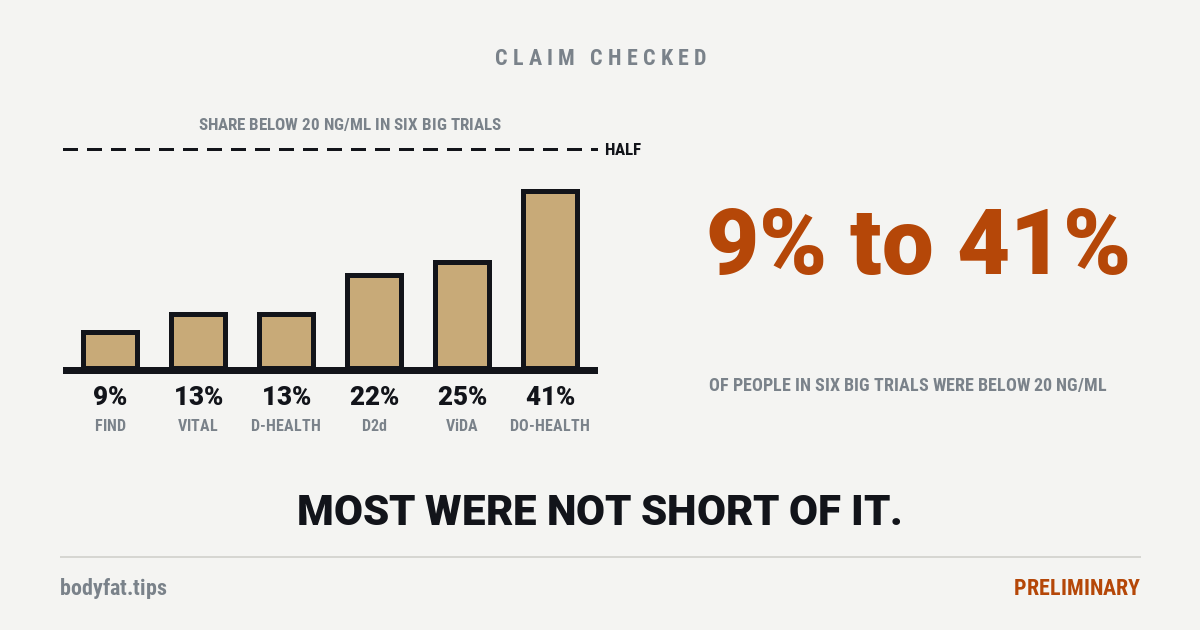
We opened six of the biggest trials to see who was in them. The share of people who started below 20 ng/mL was 9%, 13%, 13%, 22%, 25% and 41%. [10][5][7][11][8][9] In all six it was a minority, and in the largest, the American VITAL trial, 2.4% started below 12. [6] One of the six, Australia’s D-Health, took no blood at the start; its 13% is read from the placebo group during the trial. [7]
Which is a bit like testing whether water helps thirst by giving it to people who have just had a drink. The comparison only goes so far. We know water cures thirst. Whether vitamin D does anything for a heart, a cold or a tumour in people who are short of it is the part still unproven, and the trials that looked are further down this page.
| Outcome | What the evidence shows |
| Rickets and osteomalacia | established: prevents and treats |
| Fractures | not reduced by vitamin D alone |
| Respiratory infections | no clear effect in the newest pooling |
| Cancer deaths | not significant overall; lower with daily doses |
| Multiple sclerosis | genetic link; trials mixed |
| Type 2 diabetes | 15% fewer cases in prediabetes; not otherwise |
| Heart disease and stroke | not reduced in trials |
| Weight and body fat | no meaningful effect |
| Most neuropsychiatric | not consistently supported |
The strongest finding, and how they got it
A 2026 review did something more useful than pooling trials. It triangulated — comparing what three different kinds of study say, and looking for where they agree. [1]
Those three are: observational studies, which can be confounded by everything about a person’s life; randomised trials, which cannot be, but which are limited by who they recruit; and Mendelian randomisation, which is the clever one. It uses inherited genetic differences in vitamin D handling as a natural experiment — you did not choose your genes, so they are not confounded by your diet, your income or how much you go outside.
Where all three point the same way, you are probably looking at cause rather than coincidence. On rickets and osteomalacia they do: the review rates that evidence “High” and calls the cause established. [1] The proof is older than the modern trial. In 1917, doctors gave cod liver oil, whose active ingredient is vitamin D, to 49 infants at high risk of rickets and compared them with 16 in the same community who got none: 8 of the 49 developed rickets, and 15 of the 16. [3] Controlled trials since then are few. A Cochrane review in 2007 counted four, about 1,700 children in all; in the one from Turkey, in children up to three years old, those given vitamin D were far less likely to develop rickets than those given nothing (relative risk 0.04, with a range from near zero to 0.71). [34] For children and teenagers from age 1, the Endocrine Society’s 2024 guideline reports that its evidence review found no randomised trial of vitamin D for preventing rickets, and says why: the vitamin was in use “long before clinical trial methodology was standardized”, and a placebo-controlled trial “would currently be considered unethical”. [3]
On fractures they do not, and the review’s own text says so. Its abstract, which is what this page first quoted, credits vitamin D with “fracture risk reduction among vitamin D–deficient and older populations”. Its conclusion words the same sentence differently: “fracture risk reduction among institutionalized or deficient individuals in combination with calcium”. In between, it reports that the genetic studies find low vitamin D “is not causally associated with an increased risk of fractures” in the general population, and that vitamin D on its own “does not significantly reduce fracture risk” in adults living at home. [1] Two of the three kinds of study do not point where the abstract does, and the word the abstract dropped is calcium.
A bigger count arrived in May 2026, after the review’s search had closed: a BMJ analysis of 69 trials. For vitamin D on its own it pooled 36 of them, more than 92,000 people, and got a risk ratio of 1.00, with a range of 0.95 to 1.06. [4] A risk ratio is one group’s rate divided by the other’s: 1.00 means the people given vitamin D broke bones exactly as often as the people given a dummy pill, and the range is where the true average effect probably sits. The analysis found no sign that trials in people who started lower did better. It also shows how thin that test is: of its 69 trials, 2 had an average starting level below 10 ng/mL (25 nmol/L). [4]
Two official bodies had already reached the same place. The Endocrine Society’s evidence review for its 2024 guideline found “little to no difference in fractures” at 75 and over, and a risk ratio of 0.97 (0.91 to 1.03) at ages 50 to 74. [3] The US Preventive Services Task Force’s draft statement of December 2024 recommends against vitamin D, with or without calcium, for preventing fractures in women past the menopause and men of 60 and over who live at home; when we checked on 30 September 2026 it was still a draft. [19] The newest trial report, from Finland in September 2026, found no reduction at either dose it tested in people who mostly started with enough: more fractures than placebo at 1,600 IU a day, no difference at 3,200 IU, a pattern that does not track the dose. [32]
Add calcium and the pooled figure tips: 0.91 (0.84 to 0.99) across 15 trials. [4] But a fifth of that result’s weight is one French trial from 1992: 3,270 women of average age 84, given 800 IU with 1.2 grams of calcium a day. [33] The 2026 analysis describes them as living in residential care, short of calcium, with vitamin D averaging about 8 ng/mL (20 nmol/L), and says many “may have had unrecognised osteomalacia”. Take that one trial out and the figure is 0.96 (0.91 to 1.01). [4] That is this whole page in one trial. The fracture benefit that does show up came from frail women whose vitamin D sat far below the averages of 22 to 31 ng/mL in the six big trials above, it came with calcium, and later trials did not repeat it.
Why the famous trials came back empty
Here is the sentence that explains a decade of contradictory headlines. Among the review’s listed problems with the field: “RCT designs that frequently enroll vitamin D-replete populations.” [1] An RCT is a randomised controlled trial, and replete is the trade word for already having enough. The Endocrine Society’s guideline panel says the same in plainer words: average starting levels in many large trials “were in a range that most would consider adequate”. [3]
A second 2026 paper put a number on that. Researchers took two of the biggest vitamin D trials, VITAL in the US and D-Health in Australia, and rebuilt each inside the UK Biobank, a long-running study of about half a million British volunteers who were aged 40 to 69 when they joined. They picked out the volunteers who met each trial’s entry rules (237,502 for one, 185,809 for the other, both groups drawn from the same pool) and asked what those trials should have found. [2] The number: by the paper’s count, 15% of VITAL’s participants and an estimated 14% of D-Health’s started below 20 ng/mL (50 nmol/L), against 53% and 50% of the British volunteers. [2]
One thing to hold on to before the results. Nobody in this study was assigned vitamin D, and nobody’s level was raised. Each volunteer had one blood test when they joined, between 2006 and 2010. The researchers compared people whose reading was higher with people whose reading was lower, adjusted for 46 other things about them, and scaled the gap to the rise the two trials achieved. [2]
“When participants were weighted to match the trial baseline 25-hydroxyvitamin-D distributions, the expected effects became more similar to the largely null findings reported in the original trials.” [2]
That holds for one of the two rebuilds. The rebuilt D-Health came out flat on all four outcomes. The rebuilt VITAL did not: it predicted about a tenth fewer cardiovascular deaths, heart attacks and major cardiovascular events, with hazard ratios of 0.88, 0.89 and 0.90 and ranges that stay below 1. [2] A hazard ratio compares how fast something happens in two groups: 1.00 is no difference, 0.88 is a rate 12% lower. The real VITAL, which randomised 25,871 people, found 1.11, 0.96 and 0.97 for the same three, each with a range that includes no effect. [5] And the real D-Health found fewer heart attacks (0.81, range 0.67 to 0.98), which its rebuild missed. [7] The authors’ own wording is that the rebuilt results became “more similar” to the trials’, “although differences remained across some outcomes”. [2] One inference of our own: a method that predicts a benefit which a randomised trial of the same kind of people did not find is a shakier guide to what people with low levels would gain.
And here our two sources disagree
We are going to leave this one open, because they genuinely do not agree and we have no business pretending otherwise.
That second paper found that among volunteers whose one blood test read below 20 ng/mL (50 nmol/L), which it calls insufficient, or below 12 ng/mL (30 nmol/L), which it calls deficient, those whose reading was 12 to 15 ng/mL (30 to 38 nmol/L) higher went on to have fewer cardiovascular deaths: hazard ratios of 0.74 to 0.79. [2] Roughly a fifth to a quarter lower. The paper describes those two cut-offs as “operational rather than universally accepted definitions”. [2]
But it is a trial emulation, not a trial. It is observational work dressed in a trial’s clothing, and it can be confounded by things randomisation would have handled.
Meanwhile the triangulated review, which includes the genetic evidence, says flatly that cardiovascular associations are “not consistently supported by genetic or interventional evidence”. [1]
So: one paper says there is a real cardiovascular benefit hiding in the deficient, and another says the genetics do not back that up. Both were published this year.
The genetics had moved before either paper appeared. The strongest genetic case for a benefit confined to people with low levels was a 2021 analysis of 386,406 people. It was retracted and republished in January 2024 with the opposite result: null findings for heart disease, stroke and death “at all observed levels” of vitamin D in the blood. [15]
And since this page was first published, a randomised trial has put the idea to a direct test. TARGET-D took 630 people at a health system based in Utah who had just had a heart attack and either left their care as usual or tested their blood and dosed vitamin D until it passed 40 ng/mL; about half of those treated started at 5,000 IU, with repeat blood tests to adjust the dose. After about four years its main measure (death, another heart attack, a hospital stay for heart failure, or a stroke) stood at 15.7% against 18.4%: a hazard ratio of 0.85 with a range from 0.58 to 1.24, which includes no effect. One of its secondary measures, repeat heart attacks, was lower: 3.8% against 7.9%, a hazard ratio of 0.48. [16] A secondary result in a trial that missed its main one is a reason to run another trial, and that is all it is. The trial was not blinded, a family foundation paid for it, and we have read it as its abstract and its registration: the paper itself is behind a paywall.
Where that leaves the heart question: a rebuild from observational data that says a benefit is hiding in the deficient, a genetic test that says it is not, and randomised trials whose main results show no clear effect, with two secondary findings on heart attacks, in D-Health and in TARGET-D, that point the other way and would need a trial of their own. We are still leaving it open. It is a narrower opening than this page first described.
What the trials found in the people who started low
This is the direct test of “it works if you are short of it”, so here it is, outcome by outcome. Most of the big trials planned in advance to look separately at the people who started low. Each figure compares the vitamin D group with the placebo group: 1.00 is no difference, 0.90 is 10% fewer, 1.10 is 10% more, and the bracket is the range the true average effect probably sits in.
| Who | Vitamin D against placebo |
| VITAL, below 20 ng/mL: 2,001 people, planned in advance [5] | cancer 0.97 (0.68 to 1.39); heart attack, stroke or cardiovascular death 1.09 (0.68 to 1.76) |
| VITAL, lowest quarter, 24 ng/mL and under: 4,270 people, planned in advance [6] | fractures 1.04 (0.80 to 1.36) |
| ViDA, below 20 ng/mL: 1,270 people, planned in advance [8] | cardiovascular disease 1.00 (0.74 to 1.35) |
| D-Health, below 20 ng/mL (50 nmol/L) as predicted by a model, not measured; planned in advance [7] | major cardiovascular events 1.04 (0.84 to 1.27); in those predicted to have enough, 0.87 (0.76 to 0.98) |
| The same three trials’ low starters, pooled for the 2024 guideline (not new people) [3] | death 1.11 (0.85 to 1.46); cancer 0.91 (0.70 to 1.19); cardiovascular events 1.02 (0.87 to 1.19) |
| Infection trials pooled, below 10 ng/mL (25 nmol/L): 3,806 people in 22 trials [12] | any respiratory infection 0.98 (0.80 to 1.20) |
| 8,851 Mongolian schoolchildren, 95.6% of them below 20 ng/mL, three years [13][14] | tuberculosis infection 1.10 (0.87 to 1.38); fractures 1.10 (0.93 to 1.29) |
| D2d, adults with prediabetes, below 12 ng/mL: 103 people, picked out after the results were in [11] | diabetes 0.38 (0.18 to 0.80) |
Read down the right-hand column and it is mostly a row of ones. That is not proof of nothing. The brackets are wide enough to hide a modest benefit or a modest harm, because the groups are small: VITAL’s low starters had 68 heart attacks, strokes and cardiovascular deaths between them. [5] And “low” in these trials mostly means under 20 ng/mL, not the single digits where the settled bone disease lives. An analysis commissioned by the World Health Organization in 2024 put the average level of children with rickets at about 9 ng/mL (23 nmol/L). [28]
Where a benefit does show up, it is in small groups who were very low or already ill. The last row of the table is 103 people with prediabetes, picked out after the results were known. Patients with the lung disease COPD who started below 10 ng/mL (25 nmol/L) had 45% fewer flare-ups on vitamin D in a pooling of three trials and 469 people, and those who started higher had no fewer. [27] In people in hospital with COVID-19 who were deficient, a 2025 pooling of nine small trials and 870 people found fewer deaths with vitamin D (a risk ratio of 0.76, range 0.60 to 0.97), a result its own authors found did not hold when the trials were dropped one at a time. [36] And there are the frail women of the 1992 fracture trial, who got calcium too. Each of those is a finding in patients or the very frail, and each would need repeating. They are also the reason this page does not now say vitamin D does nothing for people who are short of it. It says the trials have mostly failed to show that it does.
The infection row is the one most often quoted the other way round. A 2017 pooling of 25 trials found a large benefit in people who started below 10 ng/mL (25 nmol/L) and took vitamin D daily or weekly: an odds ratio of 0.30. [31] The same research group has updated it twice. By 2025, with 46 trials and 64,086 people, the overall effect was 0.94 with a range that touches 1.00, the figure for the lowest starters was 0.98, and the authors wrote that the earlier result may have been “driven by small study effects”, meaning small trials with striking results that bigger ones did not repeat. [12] Children aged 1 to 15 still show fewer infections in that analysis (0.74), and so do trials that gave daily doses; the authors tested whether those differences were real and could not show that they were. [12]
Cancer deaths make the same point from another angle. A 2023 pooling of 14 trials and 104,727 people found 6% fewer cancer deaths with vitamin D, a gap small enough to be chance (0.94, range 0.86 to 1.02). In the ten trials that gave it daily the figure was 0.88 (0.78 to 0.98); in the four that gave large occasional doses it was 1.07. The pooling looked for a difference by starting blood level and did not find one, while calling that data “too sparse” to settle. [25] What varies in those trials is the dosing schedule, not how low people started.
What would settle it is a large trial in people who start properly low, and by the 2024 guideline panel’s own account that is what is thin. It lists “the paucity of RCTs addressing the efficacy and safety of vitamin D supplementation in populations with low baseline 25(OH)D levels” as a major limitation of its own recommendations. [3] The trialists give a reason. Keeping deficient people on a placebo for five years, VITAL’s authors write, “would be neither ethical nor feasible”. [5]
The list of nulls, and its one footnote
The review is unambiguous about where the evidence does not go: “associations with cardiovascular disease, metabolic disorders, obesity, and most neuropsychiatric outcomes are not consistently supported by genetic or interventional evidence, suggesting limited or non-causal effects.” [1]
Obesity is on that list, and the review is specific about it: the trials show no meaningful change in body weight, waist or fat mass, and the genetic evidence runs the other way round, from carrying more weight to having less vitamin D in the blood. [1] If you are taking vitamin D because you read it helps with weight, that is the sentence to read twice.
Metabolic disorders need a footnote, and the review’s abstract left it out. In adults who already have prediabetes (blood sugar raised, short of diabetes), a pooling of three trials found 15% fewer went on to type 2 diabetes: a hazard ratio of 0.85, range 0.75 to 0.96, or about 3 fewer people in every 100 over three years. [24] The review’s own conclusion reports it [1], and the 2024 guideline suggests vitamin D for adults with “high-risk prediabetes”, alongside diet and exercise and not instead of them. [3] It is a finding about that group, under trial conditions. Two of the three trials used 4,000 IU a day or 20,000 IU a week, the third an active vitamin D analogue, which is a drug and not the supplement, and the pooling’s authors say such studies “do not apply to the general population”. [24]
The shape of the whole thing
One line captures why vitamin D behaves so strangely in the literature: the relationship is “non-linear… with increased risk concentrated at low 25-hydroxyvitamin D concentrations and limited benefit beyond sufficiency.” [1]
Steep at the bottom, flat after that. That is the shape of what gets observed: people with low levels do worse, and above sufficiency more buys nothing. What the curve cannot tell you is whether the low level is doing the damage or travelling with it, since poor health, excess weight and little time outdoors all push vitamin D down. [1] The genetic test of that came back empty at every level [15], and the trials in people who started low mostly did the same. Being twice as sufficient as you need to be is not twice as good, and probably not any better at all.
The verdict
Preliminary. The rating is for the claim this page used to open with, that vitamin D helps people who are short of it. For the bone diseases of outright deficiency it does: it prevents and treats rickets and osteomalacia, and that part is settled. For heart disease, cancer, fractures, infections and death, the randomised trials that looked at people who started low mostly did not find a clear benefit, in groups too small to rule a modest one out. Real trials exist and are not yet good enough to answer the question, which is what Preliminary means here. The finding in our title stands on its own: in all six of the large trials we opened, most participants were not short of vitamin D when they started. And a list of the things vitamin D is sold for — weight loss, heart protection, most mental health outcomes — is not supported.
The reviewers’ own summing up is better than ours: vitamin D “should be regarded neither as a universal panacea nor as a trivial supplement, but as a context-dependent hormone whose clinical value lies in outcome-specific correction of deficiency.” [1] And their recommendation follows: the findings “argue against indiscriminate population-wide supplementation”.
Which brings us to the question in the title. We are not going to give you a dose of our own; that is not a website’s job. But the bodies whose job it is have answered in print, and they do not agree with each other.
So how much? What the bodies that set the numbers say
| Who says | Daily intake | Ceiling | Blood level it aims at |
| US National Academies, 2011 [20] | 600 IU (15 micrograms) from age 1 to 70; 800 IU (20 micrograms) over 70 | 4,000 IU (100 micrograms) from age 9 | 20 ng/mL (50 nmol/L) |
| UK Scientific Advisory Committee on Nutrition, 2016 [22] | 400 IU (10 micrograms) from age 4 | reports the US and European figure | 10 ng/mL (25 nmol/L) |
| European Food Safety Authority, 2016 and 2023 [23] | 600 IU (15 micrograms) from age 1 | 4,000 IU (100 micrograms) from age 11 | 20 ng/mL (50 nmol/L) |
| Endocrine Society, 2024 [3] | under 75: the US figure, and it suggests against taking more to prevent disease | sets none of its own | none: it withdrew its 30 ng/mL target |
Those are their numbers, not ours. They are daily totals from everything: food, fortified food and pills together, and the American ones assume almost no sun. [20] Two things belong beside them. A recommended intake is the amount judged to keep nearly all healthy people’s bones and blood calcium in order [21]; it is not proof that taking that dose prevents any disease. And the American and British committees land 200 IU apart for a reason that is on the face of their reports: they aim at different blood levels, 20 ng/mL and 10 ng/mL. [20][22]
For healthy adults under 75, the Endocrine Society’s 2024 guideline goes a step beyond not recommending extra: it suggests against taking more than the American figure to prevent disease. [3] It does suggest a supplement, with no blood test first, for four groups: children and teenagers from 1 to 18, adults of 75 and over, pregnancy, and adults with high-risk prediabetes. For those it names no dose. It reports the averages used in the trials it pooled (about 900 IU a day for the over-75s, about 1,200 IU for children) and says the best doses “remain unclear”. [3]
The over-75s are where the bodies split. The Endocrine Society suggests a supplement for everyone of 75 and over, for a possible small cut in deaths: about 6 fewer per 1,000 people, with a range from 11 fewer to none at all. [3] The Task Force’s draft recommends against vitamin D for preventing fractures and falls in women past the menopause and men of 60 and over who live at home. [19] They are answering different questions from overlapping trials.
Should you get tested first?
This page used to say “get the blood test” at this point. The guidelines we have now read do not say that to a healthy adult, and the main one says the reverse. Recommendation 12 of the Endocrine Society’s 2024 guideline: “In healthy adults, we suggest against routine screening for 25(OH)D levels.” [3] It says the same for adults under 50, from 50 to 74 and from 75 up, in pregnancy, for adults with dark skin and for adults with obesity. Each of those is what guideline writers call a conditional recommendation, their weaker grade, resting on evidence the panel itself rates very low in certainty. Its stated reason is that blood levels “that provide outcome-specific benefits have not been established in clinical trials”. [3] Even what counts as “deficient” is still being argued over in the journals: below 12 ng/mL for the US National Academies [20], below 10 ng/mL for the British committee [22], and in 2024 the Endocrine Society withdrew the 30 ng/mL target its 2011 guideline had set [29] and said it “no longer endorses specific 25(OH)D levels to define vitamin D sufficiency, insufficiency, and deficiency”. [3]
The other bodies are no warmer. The US Preventive Services Task Force concluded in 2021 that the evidence is “insufficient to assess the balance of benefits and harms of screening for vitamin D deficiency in asymptomatic adults”. [18] The National Institutes of Health fact sheet, updated in June 2025, puts it this way: “No studies have examined whether such screening for vitamin D deficiency results in improved health outcomes.” [21]
A trial has come close since, and it did not flatter the idea. CORONAVIT, in Britain, offered 3,100 adults a postal blood test and six months of vitamin D if they read below 30 ng/mL (75 nmol/L), and offered another 3,100 nothing. Most of those tested qualified. Respiratory infections were no rarer in the tested-and-treated groups: 5.7% and 5.0% at the two doses, against 4.6%. [17] TARGET-D, above, is another test-then-dose trial, and it missed its main measure too. [16] In pregnancy, an Iranian programme that screened and treated women in one city and not in another reported fewer complications in the screened city; a comparison of two cities is not a randomised one. [35]
“Routine” is the word doing the work in all of this. Those statements are about healthy adults with no symptoms. For some people whether to test is an ordinary clinical question, and the same documents say so. The guideline sets aside anyone with a condition that changes how the body handles vitamin D, naming poor absorption from the gut (after gastric bypass, for one), nephrotic syndrome and chronic kidney disease. [3] The Task Force’s statements do not cover people with signs or symptoms of deficiency (it gives bone pain and muscle weakness), a diagnosis of osteoporosis, a past osteoporotic fracture, or a condition linked to deficiency or poor absorption. [18][19] The NIH lists the groups more likely to run low: breastfed infants, older adults, people who get little sun, people with dark skin, people with conditions that limit fat absorption (it names some liver disease, cystic fibrosis, coeliac disease, Crohn’s disease and ulcerative colitis) and people with obesity or a gastric bypass. [21] If that is you, or you have symptoms that worry you, whether to test is a conversation to have with a clinician. This page does not settle it in either direction.
What too much looks like
The same bodies set a ceiling, and it is nearer the bottles on the shelf than you might expect. The US National Academies and the European Food Safety Authority both put the upper level for adults at 4,000 IU (100 micrograms) a day from all sources. [20][23] The European figure was set in 2023 from two trials in which 10,000 IU (250 micrograms) a day, taken with calcium, left people with persistently high calcium in their urine, an early sign of excess; the panel divided that dose by a safety factor of 2.5. [23] In a national survey, 3.2% of American adults were taking 4,000 IU or more a day by 2013–2014, and 18.2% were taking 1,000 IU or more, up from 0.3% in 1999–2000. [30]
Outright toxicity sits well above that ceiling, by the NIH fact sheet’s account. It means a markedly high level of calcium in the blood, with vitamin D typically above 150 ng/mL (375 nmol/L): nausea, vomiting, muscle weakness, excessive thirst and kidney stones, and in extreme cases kidney failure, abnormal heart rhythm and death. It is “almost always” the result of supplements, including products that held far more than intended because of manufacturing errors; sunshine, the fact sheet says, is not thought to cause it. It says symptoms are unlikely below 10,000 IU a day. It also says intakes under the ceiling “might have adverse health effects over time”, and that the US committee advised staying below a blood level of about 50 to 60 ng/mL (125 to 150 nmol/L). [21]
Kidney stones are a harm measured at ordinary doses, and the size of it depends on calcium. The Task Force’s draft pooled ten trials and 99,036 people and got a risk ratio of 1.11 (1.03 to 1.21): about 2 more people with a stone in every 1,000 over 2.5 to 7 years. [19] More than a third of those people come from one trial, which gave 36,282 women 400 IU with 1,000 mg of calcium a day and found 17% more stones. In the seven trials of vitamin D without calcium the figure was 1.08, with a range (0.97 to 1.19) that includes no difference. [19]
Big occasional doses have their own record. In a trial of 2,256 Australian women of 70 and over at high risk of fracture, 500,000 IU once a year meant 15% more falls than placebo (rate ratio 1.15, range 1.02 to 1.30) and 26% more fractures (1.26, with a range that starts at 1.00). [26] The 2024 guideline found a lean towards more fractures with large intermittent doses (1.08, range 0.98 to 1.19) and, for adults of 50 and over who have a reason to take vitamin D, suggests daily lower doses over large occasional ones. [3]
And vitamin D meets some medicines. The NIH names four kinds: the weight-loss drug orlistat, which lowers absorption; the statins atorvastatin, lovastatin and simvastatin, whose potency high intakes of vitamin D “might reduce”; steroids such as prednisone, which impair how the body handles it; and thiazide diuretics, the water pills used for blood pressure, which together with supplements might push blood calcium too high, especially in older people and people with kidney problems. Its advice to anyone taking these regularly is to “discuss their vitamin D intakes and status with their health care providers”. [21]
That is a duller answer than one number on a bottle. It is several numbers, each with a name and a date on it, a ceiling, and a gap where the trials in people who start low ought to be. Journalism, not medical advice: what you take, whether you are tested, and what any medicine you are on has to do with it are questions for a clinician who can see your history. We cannot.
Related: magnesium benefits · does zinc help with colds · NAD+ supplements · methylene blue · every claim we’ve checked
This page was rewritten on 30 September 2026 after an independent editorial review found that its central claims did not survive a full reading of its own sources. We wrote it from two abstracts and said the papers were paywalled. Both are free to read, and both say things their abstracts do not. We said three kinds of study agree that vitamin D cuts fractures. The review we were quoting reports that the genetic studies find no such link and that vitamin D alone does not reduce fractures, and a BMJ analysis of 36 trials published in May 2026 found no difference at all. We said a second paper found that “raising vitamin D” lowered cardiovascular risk in deficient people. It compared single blood tests and raised nobody’s vitamin D, and its rebuilt version of one trial predicted benefits the real trial did not find. We opened with “Vitamin D works if you are short of it”. The randomised trials that looked at people who started low mostly found no clear benefit for heart disease, cancer, fractures, infections or death. What is established is narrower: vitamin D prevents and treats rickets and osteomalacia.
We also told every reader to “get the blood test” and called that the only answer the evidence supports. The Endocrine Society’s 2024 guideline suggests against routine testing in healthy adults, and the instruction has been replaced with what the guidelines say. The page now gives the intakes and ceilings published by the bodies that set them, which it had withheld, and the safety information it lacked. Also corrected: the table’s rows on infections and cancer deaths, which rested on results that later and larger analyses did not repeat; the statement that metabolic claims are unsupported, which needed an exception for prediabetes; a quotation we had altered by one letter (“argues” for “argue”); the funding row, which said funding was not stated when both papers state it and two of the trials behind the headline had pills or blood tests supplied by companies; and the account of where the claim came from, which began in 2026 and now begins in 2011. A heart trial published after this page, TARGET-D, has been added. The statement in our title held up: in all six of the big trials we opened, most people were not short of vitamin D. The rating has changed, from Supported to Preliminary. Supported rated a sentence with two halves. The half about the trials held. The half a reader takes from the badge, that vitamin D helps people who are short of it, holds for the bone diseases of deficiency, and for everything else it rests on trials that are not yet good enough.
Corrected on 9 October 2026. The provenance chain gave a search figure, about 201,000 US Google searches a month for “vitamin d deficiency”, without saying where it came from or when we pulled it. It comes from a paid keyword database, pulled on 16 August 2026, and the chain now says so. The rating is unchanged.