Going Vegan Cost Over-65s 2.5 lb of Lean Mass. Protein Fell, So Did Weight

A trial published in August 2026 is going to be misread in both directions, so here is what it actually did.
Seventy-two healthy adults aged 65 and over were randomised into three groups for twelve weeks [1]. One group went vegan. One carried on eating as they always had. One went vegan and lifted weights twice a week.
Then researchers put them in an MRI scanner and measured the actual volume of their thigh muscle — before and after. Not a questionnaire. Not a bathroom scale. A picture of the muscle.
| Vegan | Vegan + lifting | Omnivore | |
|---|---|---|---|
| Thigh muscle volume | −0.61 L | −0.35 L | −0.01 L |
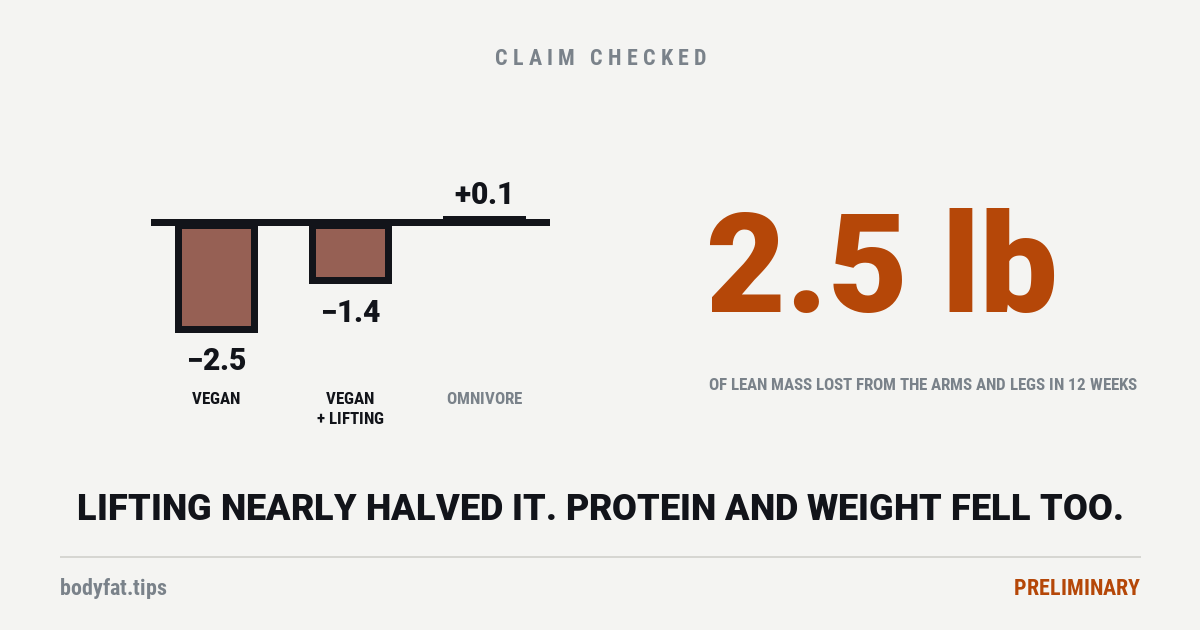
| Lean mass, arms and legs | −2.5 lb | −1.4 lb | +0.1 lb |
| Muscle building rate, per day (first 10 days) | 1.09% | 1.24% | 1.27% |
| Protein intake at 12 weeks | fell 19 g/day | fell, same as vegan | unchanged |
The vegan group lost 2.5 lb (1.15 kg) of lean mass from their arms and legs. The omnivore group gained a tenth of a pound, which is another way of saying they did not change [1].
That is a real result, measured properly, and it should not be waved away.
Now the sentence that decides what it means
It was a self-selected vegan diet.
Nobody handed these people a meal plan; they chose their own food. They were not left alone with it, either. A research dietitian ran three monthly meetings on eating vegan, the third with a particular emphasis on protein, and every other week they were given plant-based products of their own choosing [1]. Their protein intake fell by between 19 and 28 grams a day anyway, at every measurement point, for twelve weeks [1].
So what is this trial a test of? Not veganism as a nutritional philosophy. It is a test of switching to a vegan diet and choosing your own food, with advice but no set menu. The researchers chose that on purpose, so the result would say something about real life [1].
But it means the headline writes itself wrongly. “Vegan diets shrink your muscles” is not what happened here. What happened is that people ate substantially less protein and lost muscle, which is what the protein literature has predicted for thirty years, and the authors put the loss mainly down to that [1].
They also lost weight: 6.4 lb (2.9 kg) in the vegan group by week twelve, while the omnivores’ weight did not move [1]. Their food diaries showed no drop in calories, but the authors think the food may have yielded less usable energy, with fiber intake up about 45%. Either way, they say, the vegan group was burning more energy than it took in, and that “likely contributed” to the muscle loss on top of the protein drop [1]. The trial cannot pull the two apart.
How do we know it is the protein and not the plants?
Because researchers have tried to separate those two things, and so far the answer is: mostly the amount, though not only.
A meta-analysis pooled sixteen randomised trials comparing animal protein against plant protein for lean mass and strength [4]. Across those trials, protein source made no significant difference to absolute lean mass or muscle strength overall, though animal protein came out slightly ahead on percent lean mass, and on absolute lean mass in adults under 50.
And the detail that makes it fit: in those trials, total protein intake was generally above the recommended daily allowance at the start and at the end [4]. Nobody was going short. Change the protein source while keeping the amount, and in those trials the muscle did not notice much. But 15 of the review’s 18 trials added the protein as a supplement, and the review notes that those trials did not report what else people ate, so somebody taking a plant supplement could still have been eating plenty of meat [4].
Whole diets are the harder test. A 2025 review pooled seven trials in which people moved to a plant-based diet against an omnivorous one with, by the review’s account, the same amount of protein, and found less muscle mass on the plant diet: a standardised difference of 0.51, which researchers call moderate (0.2 is small) [6]. Most of those seven were in people with overweight or obesity, diabetes, metabolic syndrome or polycystic ovary syndrome, and two were in older adults. Across the review’s nine trials in people over 60, whatever form the protein took, plant and animal protein came out about even [6].
There is a wrinkle, and this page is not going to hide it because it points the awkward way.
The same research group fed older adults a vegan meal matched to an omnivorous meal for both calories and protein — identical numbers on paper — and still measured a lower rate of muscle building afterwards [3]. That study was paid for in part by a US beef producers’ marketing fund and a Dutch meat processor; the paper says they had no role in collecting or analysing the data or in writing it up [3]. Plant proteins tend to be lower in leucine, the amino acid that acts as the trigger, and are often digested a little less completely.
The same group then tested a whole diet, and the meal result did not carry over. Thirty-four older adults ate a vegan diet with enough protein, 1.3 grams per kilogram of bodyweight a day, for ten days, and their muscle-building rate matched the omnivore diet’s: 1.23% a day against 1.29%, the kind of gap chance produces [7]. The trial this page is about cites that study as the reason the meal finding was “not confirmed” [1]. A three-day trial of a high-protein vegan diet built on mycoprotein, in 19 older adults and sponsored by the company that makes those foods, found no difference in muscle building either [8].
So: the amount of protein is most of the story, the weight loss is a part this trial cannot separate from it, and the plants themselves may be a smaller part. Somebody eating plant protein may need somewhat more of it, not merely the same amount — and that is a live question rather than a settled one.
The third group is the practical one
The group that went vegan and lifted twice a week lost about half as much: 0.35 L of thigh volume against 0.61, and 1.4 lb of lean mass against 2.5 [1]. Their muscle-building rate, measured over the first ten days, was almost exactly the omnivores’ figure.
Read that carefully though, because it is a mitigation and not a cure. They still lost muscle. Lifting halved the damage; it did not cancel it.
Which is a familiar shape on this site. It is the same answer we reached about intermittent fasting and lean mass: the dietary pattern is not the villain, the protein and the training are the variables, and the people who lift keep more of what they have.
What a reader over 65 should take from this
The expert recommendation for healthy older adults is at least 1.0 to 1.2 grams of protein per kilogram of bodyweight per day [5] — for someone weighing 154 lb (70 kg), that is 70 to 84 grams. Many older adults need more than younger ones, not less, because ageing muscle can respond less to the same dose [5].
If you eat plants and you are over 65, the finding here is not that you have made a mistake. It is that the protein does not look after itself, and on a plant diet it is easier to drift down without noticing. In this trial, a dietitian’s monthly meetings did not stop the drift. Count it for a week. Most people are surprised in one direction or the other. And watch the scale: the vegan group here lost 6.4 lb (2.9 kg) on a diet with no calorie limit, and the authors think that cost muscle too [1].
And lift something twice a week, which the evidence in older adults supports about as strongly as anything on this site.
Two more things the trial measured. Strength: knee strength did not differ significantly between the vegan and omnivore groups after twelve weeks. The lifting group gained some and the vegan-only group lost some, a gap that stopped counting as significant once the researchers corrected for testing many outcomes at once [1]. And these were active people: the three groups averaged about 13,500 to 13,900 steps a day before the trial began, and the authors say the losses could be larger in frailer, inactive people who switch without extra dietary guidance [1].
A conflict worth stating plainly
One of this trial’s six authors declares research grants, consulting fees and speaking honoraria whose sources include companies that make dairy and meat products [1]. On a paper reporting that vegan diets cost older people muscle, you should know that. The senior author and one other declare grants from the Dutch government, the European Union and a Dutch public-private food research institute whose funding includes food-industry money. The trial itself was paid for by a Dutch regional grant, Regio Deal Foodvalley, which the paper says had no role [1].
Two things are also true. That author’s declaration also lists funding from companies producing plant-derived proteins, so the interest does not point cleanly in one direction. And the finding rests on MRI volumes and heavy-water tracers, with its main outcome registered before the trial began (NCT05809466) and a protocol paper published before the results [2] — the parts of a study that are hardest for an interested party to nudge.
We are telling you it is there. We are not telling you it invalidates the measurement, because we have no evidence that it did.
What this is rated, and what the rating covers
Preliminary. One randomised trial, 72 people, twelve weeks.
It is rated Preliminary rather than Supported because a single trial is a single trial, however well it was measured — and this one was measured unusually well [1]. Nothing has replicated it yet. If it replicates, this page gets upgraded and the change will be recorded on it.
A trial published in September 2026, after this page, asked a neighbouring question [9]. It counselled 108 adults aged 55 and over onto either a vegetarian diet that kept dairy and eggs or an omnivorous one, with a protein target for both, and had everyone lift three times a week. Both groups gained muscle in their arms and legs, the vegetarians a little over half as much: 0.8 lb (0.38 kg) against 1.5 lb (0.66 kg). Their protein intake came out lower despite the counselling, and strength gains did not differ. The researchers had set out to show that the vegetarian diet was no worse, and could not [9]. It was funded through a Dutch public-private grant with a dairy cooperative as its industrial partner [9]. It is a different diet in a different design, so it is not a replication, and it does not change the rating.
What is not rated here: whether a vegan diet is good or bad for you generally, which is a much larger question this page does not touch; anything about people under 65, who were not studied; and whether plant protein is inferior at matched intake, where the 2021 meta-analysis, mostly of supplement trials, found no significant difference in absolute lean mass overall, with a small edge for animal protein on percent lean mass [4]; the 2025 review found less muscle on whole plant-based diets, though across its trials in people over 60 plant and animal protein came out about even [6]; and the meal study says maybe for the acute response [3], where the ten-day diet study did not [7].
Related: how much protein actually builds muscle, whey against plant protein, and the opposite end of the same argument, the carnivore diet. How we read a study, and what each tier means, is set out here.
Corrected on 9 October 2026, after our whey-versus-plant-protein verdict was corrected the same day. This page said a meta-analysis of 16 trials found that protein source did not affect lean mass or strength at all, in trials where protein intake stayed at or above the recommended amount throughout. The review found no significant difference in absolute lean mass or strength overall, but a small edge for animal protein on percent lean mass and, in adults under 50, on absolute lean mass; and intake was generally above the recommended amount, not in every trial. The sentences now say that. The rating, for the trial this page is about, is unchanged.
Corrected again on 9 October 2026, after an independent editorial review of the page. This page said nobody coached the trial’s participants on protein. They were coached: a research dietitian ran three monthly meetings, the third with a particular emphasis on protein, and their protein intake fell anyway. The page also put the muscle loss down to protein alone. The vegan group lost 6.4 lb (2.9 kg) of body weight while the omnivores’ weight did not change, and the authors say that energy shortfall likely contributed; the headline and the verdict now name both. The trial’s industry declaration was credited to its senior author; it belongs to another of its six authors. The single-meal study the page called the awkward wrinkle was paid for in part by a US beef producers’ marketing fund and a Dutch meat processor, and the page did not say so. The arms were 23, 26 and 23, not 24 each. And the protocol was not published in advance: the trial was registered before it began, while the protocol paper was written up after it started and published before the results.
Also changed: the section on protein against plants now says that most trials in the 2021 review tested supplements, reports a 2025 review in which whole plant-based diets with matched protein produced less muscle, and adds two short controlled-diet trials in older adults that found no difference in muscle building, one of them the same group’s ten-day study that did not confirm the meal result. The page now gives the strength results and how active the participants were, reports a trial of a vegetarian diet published since, and no longer says the vegan lifters’ muscle-building rate “came back up”, since it was measured once. The rating is unchanged.