Creatine Benefits: They Screened 250 Supplements. Two Survived.

In 2003 two researchers did something the supplement industry has never quite recovered from. They took every dietary supplement claimed to build muscle, set a minimum standard of evidence, and counted how many cleared it.
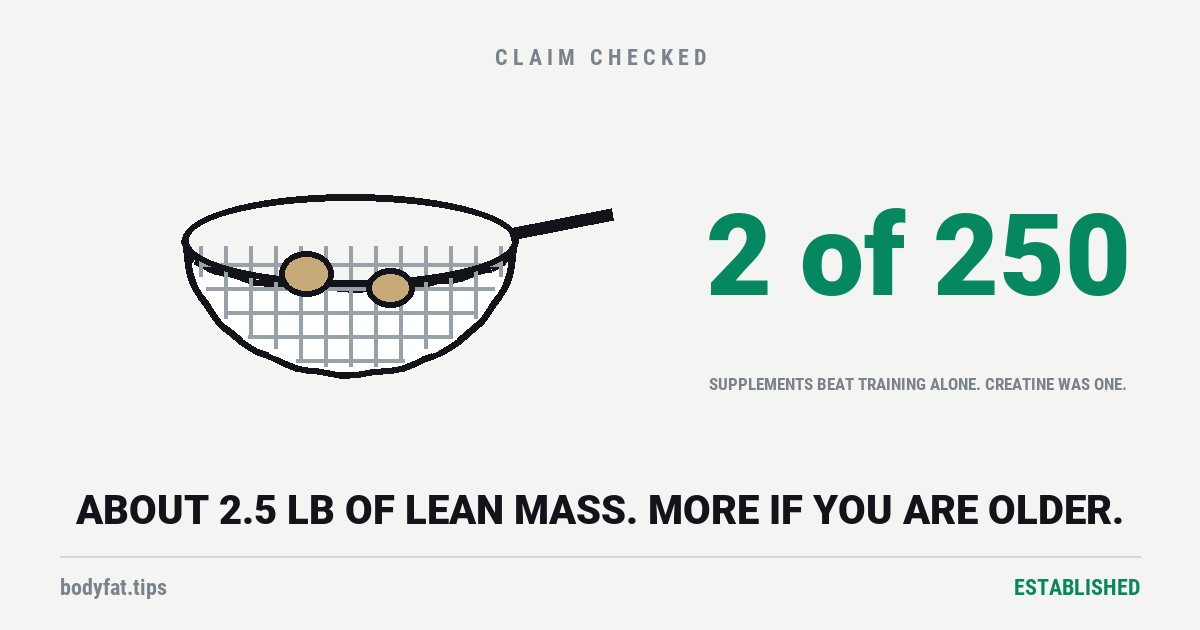
They examined 250 supplements. Only six had more than two studies that met the entry criteria — three weeks minimum, resistance training at least twice a week. [1]
Of those six, two produced a significant effect.
| Supplement | Lean mass | Strength |
| Creatine | +0.36%/wk | +1.09%/wk |
| HMB | +0.28%/wk | +1.40%/wk |
| Chromium | no effect | no effect |
| DHEA | no effect | no effect |
| Androstenedione | no effect | no effect |
| Protein (in this 2003 analysis) | no effect | no effect |
Creatine was one of them. Twenty-odd years and several meta-analyses later, it still is.
How much muscle, actually
The most carefully run analysis we found, preregistered and published in 2024, pooled twelve trials in adults under fifty, with the protocol registered in advance so the authors could not go fishing after the fact. [2]
Against resistance training alone, adding creatine produced 1.14 kg — about 2.5 lb — of extra lean body mass (95% confidence interval 0.69 to 1.59 kg). Body fat mass fell by 0.73 kg, roughly 1.6 lb, and body fat percentage by 0.88 points. [2] Those twelve trials were almost entirely men (13% women) and mostly experienced lifters, and the authors say plainly that the number cannot be generalised to women; the older-adult trials below included both sexes.
The authors put it in practical terms: about 7 grams a day, or 0.3 grams per kilogram of bodyweight, “is likely to increase LBM by 1 kg and reduce fat mass by 0.7 kg more than RT alone.” [2]
Two and a half pounds is not a transformation. It is also two and a half pounds you would not otherwise have, from a compound that costs pennies a day and has been studied for thirty years. Almost nothing else in the supplement aisle can make that claim — which is rather the point of the table above.
The finding that runs against the marketing
Creatine is sold to young men. It appears to work at least as well in people considerably older.
A meta-analysis of 22 trials covering 721 participants with a mean age between 57 and 70, training two to three days a week for anything from seven weeks to a year, found creatine added 1.37 kg of lean tissue — about 3 lb (95% CI 0.97 to 1.76, p < 0.00001). [3]
Strength improved too: standardised effect sizes of 0.35 for chest press and 0.24 for leg press.
Compare that with the 1.14 kg in the under-fifties. The older group’s number is a little higher, but the two come from different meta-analyses, their ranges overlap, and the older-adult trials ran far longer (seven weeks to a year, against an average of about eight weeks), so more is not something the evidence establishes. What it does establish is that creatine works at all in people the marketing never addresses. The idea that people who have lost muscle with age have more room to top up is the desk’s surmise, not a finding.
What it actually does, in one paragraph
Your muscles hold a small store of phosphocreatine, which regenerates ATP — the molecule that powers a contraction — during very short, very hard efforts. That store runs out in seconds, which is why the eighth rep is harder than the second.
Supplementing raises the size of that store. The International Society of Sports Nutrition’s position stand puts it plainly: creatine “increases intramuscular creatine concentrations which may help explain the observed improvements in high intensity exercise performance leading to greater training adaptations.” [5]
Note the causal chain, because it matters. The best-established route is indirect. It lets you do slightly more work, and the extra work builds the muscle. That is why every study on this page pairs it with resistance training — on its own it is a full fuel tank in a parked car.
Where the effect is biggest, and where it is smallest
The largest early meta-analysis pooled 100 randomised, placebo-controlled studies and broke the results down by the kind of exercise. [4]
Effect sizes — a standard scale where 0.2 counts as small, 0.5 moderate and 0.8 large — came out at 0.42 for upper-body exercise, 0.21 for lower body, and 0.13 for whole-body work. Laboratory tasks like isometric or isokinetic testing showed larger effects (0.25) than field tasks like running or swimming (0.14). [4]
Two honest observations follow. Creatine helps most with short, hard, repeated efforts — which is what a set of bench press is, and is not what a five-kilometre run is. And every one of those numbers is small on the conventional scale.
That is worth sitting with, because it is why we rate creatine Established rather than remarkable. Established means the evidence is consistent and the direction is not in doubt. It does not mean the effect is large.
A caveat on that table, because a date matters
Look back at the 2003 comparison and you will see protein listed as having no significant effect on lean mass or strength. [1]
That was 2003. Protein’s evidence base has moved a very long way since, and it would be dishonest to leave a twenty-three-year-old null standing as a current verdict. We flag it here rather than quietly cropping the row, because cropping inconvenient rows is what this site exists to catch.
What the 2003 result does tell you is how thin the evidence for everything else was, even then. Chromium, DHEA and androstenedione were all being sold hard at the time. None of them cleared the bar.
About “before and after”
This is one of the most searched questions about creatine, so here is the honest version.
Some of what you see in the first fortnight is water. The position stand quoted above describes creatine loading bringing on a short-term gain of about two to four cups (0.5–1.0 L) of body water, roughly in step with the early rise on the scale [5]. Where that water ends up is less settled than most articles say, and than this page used to say: we told you it is drawn into the muscle cell, and the studies that have measured it do not establish that. Either way, water is not muscle tissue. Over weeks and months, the lean mass numbers above are what accumulates on top of it. We covered the weight question, and what the water studies found, in its own verdict.
Two and a half pounds of lean mass over a training block does not photograph dramatically. Anyone showing you a picture that does is showing you training, lighting, and time — with creatine somewhere in the mix.
The verdict
Creatine builds muscle and strength. That is Established — replicated across independent meta-analyses in young adults and older adults, in a hundred randomised placebo-controlled studies, with a known dose, a known mechanism, and a direction nobody contests.
Expect roughly 2.5 lb of extra lean mass in adults under fifty — a figure drawn mostly from trained men — and a similar 3 lb in older adults of both sexes, on top of what the training itself delivers. It works best for short, hard, repeated efforts. It does nothing for muscle without the training.
The reason it stands out is not that the effect is big. It is that in a field where 250 candidate supplements were screened and only two cleared a modest evidence bar, this one keeps clearing it — and it is one of very few things in this whole corpus that the supplement aisle sells and the evidence actually supports.
The rest of what you probably want to know is already covered: how much to take, whether it is safe, the weight gain, and the hair loss question.
Related: is creatine safe · how much creatine should you take · do testosterone boosters work · fish oil benefits
The evidence panel’s funding field was wrong on this page from 5 August to 15 September 2026, and an independent editorial review caught it. It said no funding was stated in the sources; in fact the journal that published the 250-supplement screen printed a corrigendum in April 2003 disclosing that the lead author ran the company licensing the HMB patents, and the position stand this page quotes states it was prepared with funding from a supplement-industry trade body and lists industry creatine ties for several authors. The field now says so, and the source entry carries the corrigendum. The creatine result rests on the other sources and the rating is unchanged.
Also changed: the older-adults section no longer presents a comparison across two different meta-analyses as a finding (their ranges overlap and their trial lengths differ several-fold); the 2.5 lb figure now carries its population, mostly trained men; “most recent” became “most carefully run, 2024”, since newer analyses have appeared and agree; and two absolutes were narrowed to what the sources support.
On 18 September 2026 an independent editorial review of our creatine weight verdict found that this page stated as settled something that is not. We wrote that the early water gain from creatine is “drawn into the muscle cell along with the creatine” and “genuinely makes muscles look fuller”. Body water does rise, and the position stand quoted here says so. Where the water goes has not been established — the weight verdict sets out the studies that measured it — and we had no source for the fuller look. The paragraph and the provenance chain now say only what is known. The rating is unchanged: Established.