Do Multivitamins Work? 9 Trials on Heart and Cancer: “Cannot Be Determined”

Thirty-one percent of American adults take a multivitamin. [2] The body that reviews this evidence for the United States had an evidence report of 84 studies and 739,803 people in front of it: 78 randomised trials, and six cohort studies, which follow people who chose their own supplements. The cohorts were there only to look for harms, and they held more than half of those people. The multivitamin question itself rested on nine trials and 51,945 people, most of them in three large trials, and on whether a daily multivitamin prevents heart disease or cancer the verdict was that the balance of benefits and harms “cannot be determined”. [1][2]
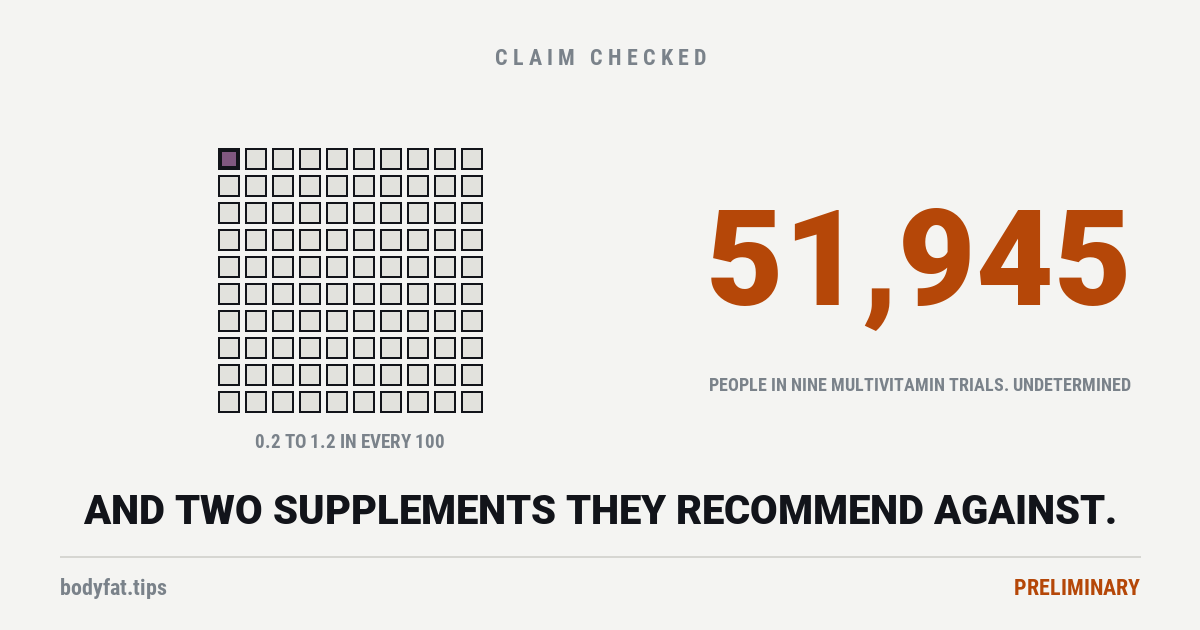
Not “it does nothing”. Cannot be determined. After nine trials and 51,945 people. That is a stranger result than a flat debunk and it is worth understanding, because two things in the wider review did get a verdict — and one of them is a warning.
The whole shelf, ingredient by ingredient
| Supplement | Finding | Trials |
| Multivitamin, any cancer | 7% lower odds — 0.2 to 1.2 in 100 | 4 RCTs, 48,859 |
| Multivitamin, heart deaths | No clear effect | 4 RCTs, 37,400 |
| Multivitamin, thinking (COSMOS) | +0.07 SD — below “small” | 1 RCT, 2,731 |
| Multivitamin, thinking (PHS II, men 65+) | No difference | 1 RCT, 5,947 |
| Vitamin D, dying of anything | No clear effect | 27 RCTs, 117,082 |
| Vitamin E, dying of anything | No effect | 9 RCTs, 107,772 |
| Beta carotene, lung cancer | 20% HIGHER odds | 4 RCTs, 94,830 |
| Beta carotene, heart death | 10% HIGHER odds | 5 RCTs, 94,506 |
The good news is real, and much smaller than it sounds
Multivitamin takers had 7% lower odds of being diagnosed with cancer across four trials and 48,859 people. [1] That is a genuine, statistically significant finding and we are not going to wave it away.
Now here is the same finding said the other way. The absolute risk difference — the actual gap in how many people got cancer — was 0.2% to 1.2%. [1]
Between two and twelve people in a thousand. That is what “7% lower” means once you attach it to real people. Both numbers describe the same result; only one of them sounds like a reason to buy.
And the reviewers add a sentence of their own about it: the evidence for multivitamins “had important limitations”. [1] Of the three large trials behind the result, one was male doctors only, one tested an antioxidant capsule rather than a full multivitamin, and the largest, in Americans aged 60 and over, found no significant difference on its own. [1][2] Which is why the task force, holding a significant result in its hand, still declined to call it. [2] One more thing, for women reading this: in the antioxidant trial, run in France, cancer fell among the men and not among the women, a difference between the sexes too large to put down to chance. [7]
And the heart, the other half of what the task force was asked? Across four trials and 37,400 people, multivitamin takers were not clearly less likely to die of heart disease or stroke: their odds came out 6% lower, with a range of plausible answers running from 17% lower to 6% higher, so “no difference” sits comfortably inside it. [1][2] The reviewers’ summary for the heart is no benefit, on evidence they rate low in strength. [1] On its own, the heart part of the multivitamin claim would be rated Unsupported here, which is why the rating on this page is for the brain and cancer.
The memory finding, and what a 0.07 actually is
A large trial called COSMOS tested a daily multivitamin in adults over 60 and looked at thinking and memory. It found a real effect: +0.07 on global cognition, from two of its three substudies and 2,731 people (the third, run online, did not measure it), and +0.06 on episodic memory, the memory for what happened and when, from all three and 5,203 people, over two to three years. Both were statistically significant, meaning unlikely to be chance. [3]
Those are effect sizes, and the scale researchers use runs 0.2 for small, 0.5 moderate, 0.8 large. 0.07 is a third of the way to “small”.
The trial itself translated that as being “equivalent to reducing cognitive aging by 2 y”. [3] That sentence was not the first of its kind: the trial’s telephone substudy had put its own result at 1.8 years less cognitive ageing in 2022, and its web-based one at 3.1 years of memory ageing in 2023. [5][6] It is the researchers’ own framing, it is not dishonest, and it travels a great deal further than 0.07 does.
One more thing about that result, because it is described in a way that misleads by accident. It is reported as a meta-analysis of three studies. All three are substudies of the same parent trial, with the same supplement, each testing a different group of its participants. That is not three independent replications — it is one trial examined three ways.
And COSMOS is not the only long test. The cognition paper itself names one other long trial of a daily multivitamin and thinking in older adults: the Physicians’ Health Study II, which gave an earlier formulation of the same brand of multivitamin to 5,947 male doctors aged 65 and over and tested them up to four times over 12 years. [3][4] It found no difference: −0.01 on its overall thinking score, with a range of plausible answers from −0.04 to +0.02, which sits around zero. [4] The COSMOS authors offer reasons the two could differ: that trial was men only, began its testing about two and a half years in, and used slightly different tablets. [3] Reasons are not a result. One more trial ran for a year: 910 people aged 65 and over in Scotland took a daily tablet of eleven vitamins and five minerals or a placebo, and two tests, one of short-term memory and one of thinking, showed no benefit [8]. An independent 2024 pooling of ten trials in people aged 65 and over, those three among them, found one memory measure better, recalling a word list after a delay, by an effect size of 0.09, under the 0.2 that researchers call small, and no difference on the other measures it could pool. That one result rests mostly on COSMOS’s web-based study, entered three times, once for each year of testing [9]. On thinking and memory, one trial found a small benefit, and two others that ran a year or longer found none.
The two ingredients they tell you to stop
Beta carotene raised the odds of lung cancer by 20% and of dying of a cardiovascular cause by 10%, across trials of 94,830 and 94,506 people. [1] Those trials gave 20 to 50 mg a day, and the lung cancer harm turned up above all in people who smoked or had worked with asbestos. [1][2]
The task force does not hedge on this one. It recommends against taking beta carotene to prevent heart disease or cancer, concluding that the harms outweigh the benefits. [2] It recommends against vitamin E supplements as well, for a different reason: it concluded there is no net benefit from them. [2]
Those are the two clear verdicts in the whole review, and they both point the same way. The reviewers also found limited evidence that some single supplements may carry serious harms — hip fracture with vitamin A (a signal from two studies of women that could not be told apart from chance), hemorrhagic stroke (bleeding into the brain) with vitamin E, and kidney stones with vitamin C and calcium. [1] For multivitamins themselves they found no rise in serious harms, though serious events were few. [1] “It cannot hurt” is doing a lot of unearned work on the single-vitamin shelf.
Vitamin D and vitamin E: no clear effect on dying of anything
Vitamin D across 27 trials and 117,082 people: no clear effect on dying of anything. Vitamin E across 9 trials and 107,772 people: nothing. [1] Not “too little data”. Measured, at enormous scale. Vitamin E is flat. Vitamin D is not quite: the range of plausible answers runs from 9% lower odds of dying to 2% higher, which the reviewers read as at most a very small benefit; whether it reaches statistical significance, they add, depends on which trials go into the pool. [1]
Which fits what we found looking at vitamin D on its own and at fish oil. With fish oil, the benefit that held up needed a prescription and a blood test. With vitamin D it turned out narrower than the bottle suggests: it prevents and treats the bone diseases of real deficiency, and for anything else the trials in people who started low mostly found no clear benefit. Our vitamin D page also covers the Endocrine Society’s 2024 guideline, which suggests vitamin D for everyone 75 and over for a possible small cut in deaths.
So should you take one
For a healthy adult who is not pregnant, the honest answer is that nobody can tell you, and that is the finding rather than a dodge. There is a small cancer signal the reviewers do not fully trust, seen in men and not clearly in women; a small cognitive signal from one trial in over-60s that a longer trial in older men did not find; nothing for the heart; no clear help from vitamin D or vitamin E; and one ingredient, beta carotene, to avoid if you smoke or have worked with asbestos.
There are two kinds of no evidence, and this is mostly neither of them: not a claim nobody tested and, the heart apart, not one that came back empty, but a question that nine trials and 51,945 people were not enough to settle — because the trials that got run were not the trials that would have settled it.
The task force’s verdict is for adults who live at home, are not pregnant and could not become pregnant, and are not ill. [2] If you could become pregnant, the same task force says take 400 to 800 micrograms of folic acid a day, an amount a multivitamin can supply: the ones tested in the big American trials had 400. [2][3] Children, people with a long-term illness, people in hospital and anyone with a diagnosed deficiency are outside this verdict, and that is a conversation with a clinician.
What follows practically: if you take a multivitamin, the evidence does not tell you to stop, and it does not promise you anything much either. If you smoke or have worked with asbestos, the beta carotene warning is aimed at you: that is where the harm turned up, in trials giving 20 and 30 mg a day, so a beta carotene supplement is the one to leave on the shelf. [2] The task force recommends against vitamin E supplements too, because they did nothing rather than because they did harm. [2] The multivitamins in the big trials carried some of both, and the two American trials, pooled, found less lung cancer among the people taking them, not more. [1][3][7] And if you are taking it to cover a specific deficiency a blood test found, none of this applies to you — that is treatment, and it is a different question with a different answer.
Where it is worth aiming your annoyance: a category this large, this old and this profitable should have produced a clear answer by now. It has not, and the reason is that nobody selling it needs one. The same pattern shows up on the greens shelf and magnesium is the rare case where something specific survived. Here is how we grade all of it, and here is the muscle-growth shelf ranked by what held up.
Corrected on 30 September 2026. This page said the real benefit of vitamin D, like that of fish oil, turned out to need a prescription and a blood test. Our vitamin D verdict, corrected today after an independent editorial review, no longer says that. It finds the benefit settled for the bone diseases of real deficiency and, for anything else, no clear benefit in the trials of people who started low, and the Endocrine Society’s 2024 guideline it reads suggests against routine blood tests in healthy adults. The sentence now says so. The fish oil half stands. Nothing else on this page changed.
This page was corrected on 9 October 2026 after an independent editorial review. It said the task force looked at 84 randomised trials covering 739,803 people. The evidence report’s 84 studies were 78 randomised trials and six cohort studies, the cohorts holding more than half of those people and included only to look for harms; the multivitamin question itself rested on nine trials and 51,945 people, and the verdict that the balance “cannot be determined” is about preventing heart disease and cancer in adults who are not pregnant. The title, the opening, the table, the evidence panel, the search description and the summary now say so. We also called beta carotene the one ingredient with a recommendation against it. The task force recommends against vitamin E supplements as well, and the beta carotene harm turned up at 20 and 30 mg a day in people who smoked or had worked with asbestos; the practical advice now says who it is for, and adds what the same task force tells anyone who could become pregnant: take folic acid.
Also corrected: the funding row, which said funding was not stated, when every source states it and the trial behind the memory finding was paid for partly by a confectionery company’s grant, with pills from the multivitamin’s maker; the memory finding, which now gives the right counts and durations and adds the longer trial in older men that found no benefit, a year-long trial that found none, and an independent pooling whose one positive result counts a COSMOS substudy three times; the claim that the brain-clock headline began in 2024, when the trial’s first two cognition papers had already put their results in years of ageing; the heart, which the page never answered and now does; vitamin D’s figure for deaths, which is not quite flat, and a heading that called vitamins D and E the two biggest sellers; our description of the other page on two kinds of no evidence, which had it backwards; the harms sentence, which had dropped the reviewers’ own hedge; the provenance chain’s spread step, which now names a thing that exists; and a link label. The claim this page rates now names the brain and cancer, because the heart part, rated alone, would be Unsupported. The rating, Preliminary, is unchanged.