Does Seed Cycling Work? A Few Small Studies, Mostly in PCOS, Lean Its Way. None We Found Tested the Timing.

“Seed cycling” is searched about 14,800 times a month in the United States, the database’s figure for the past year, though July, August and September each came in at 12,100 (from a paid keyword database, pulled 23 October 2026) [1]. The idea is simple and is sold as hormone balance: a tablespoon each of flax and pumpkin seeds in the first half of your menstrual cycle, then sesame and sunflower seeds in the second [2] [3]. So does seed cycling actually help?
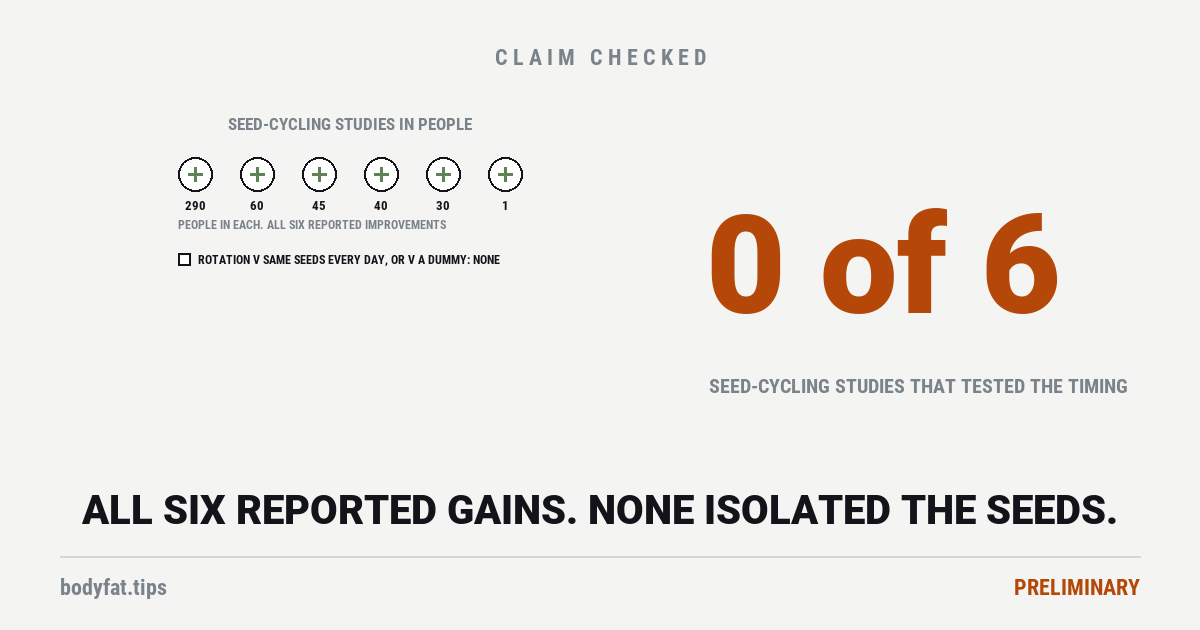
Not yet shown. The studies of seed cycling are few and small, nearly all in women with PCOS, polycystic ovary syndrome, a common hormonal condition, and each either mixed the seeds with something else, a diet, a diabetes drug, exercise or a herb, or had nothing to compare them with. None we found compared the rotation with a dummy, or with the same seeds eaten every day. That is why it is rated Preliminary below, not Unsupported: the few seed-cycling studies there are all report improvements, and those deserve to be reported as plainly as their limits.
This is journalism, not medical advice. Periods that are irregular, very heavy or absent can have causes a doctor should look for, among them thyroid problems, a raised level of the hormone prolactin, fibroids and PCOS itself [4]. Severe low mood, irritability or tension before periods can be premenstrual dysphoric disorder, a condition of its own, for which doctors also check the thyroid and other causes [5], and PCOS is a leading cause of trouble getting pregnant [6]. Nobody should put off that check, or stop a treatment they have been prescribed, for a seed rotation. And if you are allergic to sesame or other seeds, this is not for you: sesame is one of the nine major food allergens in US law [7].
What is seed cycling and how does it work?
As it is sold, you eat one tablespoon each of ground flaxseed and pumpkin seeds a day from the first day of your period to ovulation, then one tablespoon each of ground sesame and sunflower seeds until your next period, and you keep going for a few months [2] [8] [9]. That is how to start, as the sellers describe it, and this is the seed cycling chart they print.
| Days | Seeds | What the sellers say they do |
|---|---|---|
| 1 to 14: first day of your period to ovulation | 1 tablespoon each of ground flaxseed and ground pumpkin seeds a day | Flaxseed’s lignans, plant compounds that can weakly mimic or block estrogen, are said to support estrogen; pumpkin seeds’ zinc is said to prepare for progesterone [2] [8] |
| 15 to 28: ovulation to your next period | 1 tablespoon each of ground sesame and ground sunflower seeds a day | Sesame’s lignans are said to stop estrogen rising too far; sunflower seeds’ vitamin E, and selenium, are said to support progesterone [2] [8] [1] |
| No regular cycle, or after menopause | The same seeds, timed by the moon: day 1 at the new moon, day 15 at the full moon | Advised by a birth centre and described by a health publisher [9] [2] |
The chart assumes a 28-day cycle with ovulation on day 14. Real cycles are rarely that tidy. In one period app’s database of 612,613 cycles, only 13% were 28 days long, and even in those the phase before ovulation lasted 15.4 days on average, not 14 [10]. The app’s maker paid for that analysis [10], and it publishes its own seed-cycling guide [8].
Does seed cycling actually help?
We found six studies in people that test something under the name, from one woman to 290 [11]. Here they are, largest first.
| Study | Who, and what else they got | What it reported | What to know |
|---|---|---|---|
| India, 2024 [12] | 290 women with PCOS, aged 18 to 40, split at random, 145 to a group, for 12 weeks: a portion-controlled diet with seed cycling, against the same diet with metformin, a diabetes drug | Significant improvements in body measurements, blood tests and hormones in the seed group, in its summary’s words | Read as its summary only. Its title calls it a cohort study; the summary does not say clearly whether the seed group also took metformin |
| Pakistan, 2023 [13] | 90 women with PCOS enrolled; three groups of 20 reported: no treatment, a diet with metformin, or a diet with seed cycling, all for 90 days; the diet groups had 1,500 calories a day and daily walks | In the seed group FSH fell from 6.5 to 3.5 mIU/mL and LH from 11.0 to 6.2 IU/L, the two hormones from the pituitary gland that drive the ovaries; in the untreated group both rose | Allocation by chance is not described; 30 of the 90 are not accounted for; its prolactin table repeats its body-weight table number for number |
| India, 2022 [14] | 45 women with PCOS in three groups of 15, for 16 weeks: moderate or high-intensity exercise training, each with seed cycling, or no treatment | Blood sugar, stress and anxiety improved in the two exercise groups | Exercise and seeds came together; no hormone measured; elsewhere the paper describes 30 women in two groups |
| United States, 2026 [15] | 40 women with symptoms of premenstrual syndrome (PMS) and regular cycles, online, two cycles of capsules: flaxseed and pumpkin seed, then sesame, sunflower, psyllium (a fiber) and chasteberry, a herb sold for PMS | A menstrual-symptom score fell about 17%; cramp pain from 6.9 to 5.2 out of 10 | No comparison group; no hormone measured; paid for by the capsules’ maker, whose co-founder is an author; 800 mg of flaxseed a day; registered more than eight months after it ended, without that score among its registered main measures |
| India, 2024 [16] | 32 women with PCOS, 30 finished, no comparison group, 3 months | Body-mass index from 25.9 to 22.8; more regular cycles; no improvement in hair growth, and blood sugar not significantly changed | The seeds were not cycled: all four, 10 g each, every day. Its percentages do not match its count of 30 women |
| India, 2025 [17] | One woman of 29 with PCOS, trying to conceive: seed cycling with myo-inositol (a supplement sold for PCOS), folic acid, metformin, a diet and daily walking or yoga, for 6 months | Cycles shortened from 45 to 60 days to 32 to 35; she then became pregnant through IVF | One person, many treatments at once |
Read the table for what each study could and could not show. The largest, 290 women, reported improvements, but as its summary describes it, it set seed cycling against another treatment, metformin, rather than against a dummy, and that summary is all we could read [12]. In the Pakistani trial, the weight table has the seed group losing about 25 lb (11.45 kg) in 90 days on a 1,500-calorie diet with daily walks, so the seeds cannot be pulled apart from the diet [13]. Its tables also do not hold together: the prolactin figures repeat the body-weight figures exactly, and its text calls a fall in FSH of about 46%, by our arithmetic, a fall of “1.2% to 2.5%” [13]. Its own discussion lists a raised ratio of LH to FSH among the signs of PCOS; by our arithmetic from its tables’ group averages, that ratio rose slightly in the seed group, from 1.68 to 1.77, and fell in the untreated group, from 1.87 to 1.57 [13].
Two more are registered: a California study of 20 women with irregular cycles, finished in May 2026 with no results posted, and a Turkish study of 48 women due to finish in March 2027. Neither has a comparison group [18].
The newest systematic review of seed cycling, from 2025, gathered ten studies and 635 people and called its own conclusion “based on small sample sizes and moderate-quality evidence” [19]. Six of its ten tested a single seed rather than the rotation, four of them flaxseed alone [19]. It also credits one flaxseed trial with improving testosterone and unwanted hair growth. That trial’s own table shows testosterone moving from 0.93 to 0.95 ng/mL on flaxseed and from 0.94 to 0.96 without it, a difference that was not significant, and no significant difference in hair growth either [19] [20]. A 2026 review of foods for PCOS put it more plainly: the seed-cycling evidence comes mostly from mixed-seed studies or case reports and “should be considered hypothesis-generating”, a reason to run proper trials rather than a result [21].
Which leaves the question the name raises. Is it the timing that helps, or just the seeds? No study we found has tested that [11]. The one study that never rotated the seeds, giving all four every day, reported more regular cycles too [16], which, without a comparison group, settles nothing either way.
What flaxseed and the other seeds did on their own
Flaxseed is where the science behind seed cycling starts. In 1993, 18 women with regular cycles added flaxseed to their usual diet for three cycles and ate their usual diet for three, in random order [22]. The dose was 10 g (0.35 oz) a day [23], every day of the cycle, not half of it [22]. On flax, none of the 36 cycles went without ovulation, against three of 36 on the usual diet. The luteal phase, the part of the cycle after ovulation, averaged 12.6 days against 11.4. And estradiol and estrone, the main estrogens, did not differ significantly; nor did progesterone, though its ratio to estradiol was higher [22].
Ten years later a team that included two of the same authors gave 16 women the same 10 g a day, baked into food, for two cycles at a time, and found “no changes in serum hormone concentrations” [24].
A 2023 pooling, a meta-analysis that combines trials to get one estimate, gathered ten randomised trials of flaxseed and found no significant change in FSH, testosterone, DHEA-S (a hormone made mainly by the adrenal glands) or the free-androgen index, a measure of how much testosterone is free to act [25]. It put the trials on one scale with a standardised mean difference, which lets results measured in different units be compared: 0.2 is small, 0.8 large. For SHBG, the protein that carries sex hormones in the blood, it was 0.35, with a confidence interval, the range the true average probably sits in, of −0.02 to 0.72, so no difference at all is still in range [25]. Two limits work in seed cycling’s favour: estradiol and progesterone were not among the hormones it pooled, and its trials were mostly in women past menopause, men with prostate cancer and women with PCOS, not women with regular cycles [25]. The largest of its studies with women in it had 99, all past menopause [25].
In women with PCOS, we found four randomised trials of ground flaxseed itself. Two come from one hospital in Iran, at 30 g a day, which is about four tablespoons of ground seed, by our arithmetic from USDA’s 7 g tablespoon [26]. Both compared flaxseed plus lifestyle advice with lifestyle advice alone, and both were open-label, meaning the women knew which group they were in. In the first, 41 of the 48 women randomised finished 12 weeks, and 17 of the 21 on flaxseed reported regular cycles at the end, against 10 of the 20 without it; testosterone did not differ significantly [20]. In the second, 70 women, 35 to a group, FSH rose slightly more on flaxseed, a difference of 0.87 with a confidence interval of 0.09 to 1.75, and the ratio of LH to FSH fell; LH, estradiol and the androgens, the male-type hormones, did not change significantly [27]. Each names a university as its funder [20] [27]. The two papers print the same trial registration. Its record, filed in January 2018 and not updated since, describes a 56-woman trial at that hospital with testosterone, SHBG and insulin as its main measures, which fits the first; the second reports recruiting from April 2019 to March 2022, with FSH as its main measure, so the registration it prints does not describe the result above [27] [20].
The other two had a comparison group eating something else in the seed’s place. In another Iranian city, 68 women took 15 g (0.5 oz) of flaxseed or a look-alike dummy packet every day for 12 weeks, alongside a weight-loss diet, in a double-blind trial, meaning neither the women nor the researchers knew who had which; body-mass index fell more on flaxseed, and the difference in weight landed at p = 0.05, right on the line researchers use for “probably not chance” [28]. Its registration names total testosterone, free testosterone and SHBG as the trial’s only main measures, but the paper reports weight and body measures and none of those hormones, and we found no other report of them [28] [11]. In China, 104 women with PCOS and infertility were randomised to a two-month programme, a light fasting diet in the first month and ordinary eating in the second, with 20 g (0.7 oz) of flaxseed powder twice a day as part of the diet, or with rice flour in place of a staple food; the paper calls the rice flour a placebo, but the trial was not blinded. Insulin resistance and blood fats came out lower with flaxseed. FSH, LH, estradiol and progesterone fell in both groups, with no significant difference between the groups at the end [29].
Flaxseed oil, in capsules, has been tried too. A 2023 systematic review counted nine trials of flaxseed or its oil in women with PCOS, published from 2011 to 2021, and called high-quality studies scarce; we read its summary, not its table of trials [30]. In a US trial, 51 women finished six weeks of flaxseed oil, fish oil or soybean oil; flaxseed oil lowered triglycerides, a blood fat, against its own starting point, and showed no significant change in testosterone, SHBG or DHEA-S [31]. In an Iranian trial of 60 women, flaxseed-oil capsules for 12 weeks lowered insulin, a score of unwanted hair growth and some blood fats more than a dummy did, with no significant difference in sex hormones; the journal has since attached a note saying that serious concerns were raised about the integrity of its methods, results and analysis [32]. And a Pakistani hospital registered a randomised trial of 15 to 25 g of flaxseed a day in 120 women with PCOS, with FSH and LH among its main measures; it finished in January 2018, was registered nine months later, has posted no results, and we found no paper from it [33] [11].
The best result any of the four seeds has on a cycle symptom is for breast pain. A 2022 pooling of herbal remedies for cyclical breast pain combined two flaxseed trials and found less pain on flaxseed, a standardised mean difference of −0.63, between the small and large marks [34]. One of the two compared flaxseed with omega-3 capsules rather than a dummy, and the authors warn that some of their studies were of low quality [34].
The sesame trial the guides cite gave 24 women past menopause 50 g (1.8 oz) of sesame powder a day for five weeks and rice powder for five, in random order. DHEA-S fell 18%; SHBG rose 15%. The fall in DHEA-S was a significant difference from the rice powder; the rise in SHBG was not, at p = 0.065, just the wrong side of the line researchers use for “probably not chance” [35] [2]. Two smaller sesame studies were in younger women. In Iran, 56 women with infrequent periods, about half of them with PCOS, were randomised to 60 g (2.1 oz) of ground sesame boiled in water each day for a week, or to a progestin, a drug like progesterone that is used to bring on a period: fewer bled within two weeks on sesame, 72% against 93%, but of the 23 women followed to their next period, it came on time for 4 of the 8 on sesame and 1 of the 15 on the drug, a difference the authors report as significant [36]. And 24 students who ate 15 g (0.5 oz) of sesame a day around their periods reported less period pain, and used less medication for it, in the two months they ate it than in a month without it; there was no separate comparison group [37]. The one pumpkin trial in women we found that reported menopausal symptoms used pumpkin seed oil, not the seeds; a registered trial that also gave women the seeds has posted no results, and we found no paper from it [38] [39] [11]. And we found no trial that fed women sunflower seeds on their own, rather than as one of the four seeds in the seed-cycling studies above, and measured a hormone [11].
The mechanism as sold, against the label
The story is that flax and pumpkin seeds bring lignans and zinc for the first half of the cycle, and sesame and sunflower seeds bring vitamin E and selenium for the second [1] [2]. Look the seeds up in the food tables and they do not split that way.
| Seed | Half of the chart | Zinc | Vitamin E | Selenium | Largest lignan |
|---|---|---|---|---|---|
| Flaxseed | First | 4.34 mg | 0.31 mg | 25.4 µg | about 258 mg (secoisolariciresinol) |
| Pumpkin seeds | First | 7.81 mg | 2.18 mg | 9.4 µg | no entry for the seeds in the database we used |
| Sesame seeds | Second | 7.75 mg | 0.25 mg | 34.4 µg | about 538 mg (sesamin), one measurement |
| Sunflower seeds | Second | 5.0 mg | 35.2 mg | 53.0 µg | under 2 mg, all four measured together |
Sesame, a second-half seed, carries about as much zinc as pumpkin seeds, the first half’s zinc seed [26]. It also carries more lignan by weight than flaxseed in the database we used, mostly a different lignan called sesamin [40], though the chart has it eaten in the second half to keep estrogen in check, while flaxseed’s lignans are eaten in the first half to support it [2]. The vitamin E is almost all in the sunflower seeds [26]. A nutrient being in a seed does not show it does anything to a hormone. But the rotation’s logic, one set of nutrients for each half, is not what the seeds contain.
The doses do not match either. The flaxseed trials above used 10 to 30 g a day, every day [22] [23] [20]; the chart asks for one tablespoon, 7 g, for half the month [26] [2]; and the capsules in the 2026 trial held 800 mg of flaxseed a day, about a ninth of a tablespoon, by our arithmetic [15] [26].
Seed cycling for PCOS
PCOS, polycystic ovary syndrome, now also called polyendocrine metabolic ovary syndrome, is a hormonal condition whose signs include irregular or absent periods, unwanted hair growth and trouble getting pregnant [6]. It is where nearly everything about seed cycling has been tested: five of the six studies above are in women with PCOS [12] [13] [14] [16] [17]. Every one either added a diet, a drug, exercise or other supplements, or had nothing to compare with. Flaxseed alone, in two small open-label reports from one Iranian hospital that print one registration, moved cycle regularity and FSH in the direction their authors count as better, early, small evidence in its favour [20] [27]. The other two randomised trials of the seed found changes in weight, insulin or blood fats and no hormone result in its favour: the Chinese trial found no significant difference in four sex hormones, and the double-blind trial’s paper does not report the hormones it registered [28] [29]. None of this is the rotation.
Other things sold for PCOS have their own verdicts here: turmeric, whose PCOS trials are small and split, and berberine, whose PCOS trials a 2026 integrity review rated at high risk.
Is seed cycling good for conceiving?
This is the question where a wrong answer costs the most, so plainly: we found no study that counted pregnancies on seed cycling against a comparison group, and two that did so for one of its seeds, flaxseed: a small study of the ground seed that leans its way, and a randomised trial of flaxseed oil that found no significant difference [11]. In Egypt, 30 women with PCOS who finished a three-month study had been divided into three groups of 10, all on a diet low in carbohydrates and protein with their usual medicines, which the paper does not name: one group also took metformin, one took nothing more, and one took 20 g (0.7 oz) of ground flaxseed a day. Four women became pregnant in the flaxseed group, two in the diet-only group and none in the metformin group [41]. The paper does not describe the groups as chosen at random, it reports no test of whether those counts differ by more than chance, and its own tables show the flaxseed group starting ahead: lower LH and AMH (a hormone from the ovaries that doctors use to gauge how many eggs remain), the two hormones whose fall the paper counts as improvement, and a lower body-mass index, 35.0 against 36.1 and 36.0, which by our reading may mean milder PCOS to begin with [41]. By our arithmetic, a standard test for counts this small puts neither difference past the line researchers use for “probably not chance”. The randomised trial was of flaxseed oil, not the seeds, and not in PCOS. In China, 256 women with a low egg reserve, meaning fewer eggs left in the ovaries than usual for their age, who were about to have IVF were randomised to flaxseed-oil capsules twice a day, from a month before treatment until a pregnancy was confirmed, or to nothing added; women with PCOS were excluded. Of the 218 analysed, 41 of 108 on the oil (38.0%) and 40 of 110 without it (36.4%) had a clinical pregnancy, one seen on an ultrasound scan, a difference far from the line for “probably not chance” (p = 0.81). Pregnancy was not the trial’s main measure, which was the share of mature eggs collected, and it did not follow the pregnancies to birth. Neither the women nor the researchers were blinded, there was no dummy capsule, and the 20 women who stopped taking the oil and 18 in the other group who gave up treatment were left out of the count [42]. The pregnancy in the case report that Google’s AI answer cites is one woman’s, after six months of seeds alongside myo-inositol, folic acid, metformin, a diet and exercise, and it came through IVF with sperm injected into the egg [17] [1]. The 2025 review of seed cycling above also reports pregnancies in 3 of 30 women in an Indian flaxseed study [19]. We read that study: 32 women with PCOS took 15 g (0.5 oz) of flaxseed powder in milk each morning for three months, with no comparison group, and 3 of the 30 who finished became pregnant [43]. The Chinese trial above was in women with PCOS and infertility, and its full text reports no pregnancy figures [29]. In the 1993 trial, fewer cycles went without ovulation on flax, none against three in 36 cycles each [22]. That is a hint in 18 women, not a pregnancy result.
PCOS is a leading cause of infertility, and many women with it do get pregnant [6]. Neither comparison we found shows flaxseed changing those odds: the one that leans its way had 10 women a group and, by our arithmetic, falls short of the line, and the randomised one, of the oil in IVF, found no significant difference.
Seed cycling and menopause
For women past menopause, the guides say to time the rotation by the moon [2] [9]. No study we found tested that [11]. Flaxseed itself has been tested for hot flashes. In the two largest placebo-controlled trials we found, meaning one group got a dummy, 199 women were given either 40 g (1.4 oz) of flaxseed a day for a year (101 women) or wheat germ (98), and 188 were enrolled to eat either a flaxseed bar or a dummy bar each day for six weeks, 146 of them analysed [44] [45]. In the first, symptoms eased in both groups with no significant difference between them [44]. In the second, the hot-flash score fell 4.9 points on flaxseed and 3.5 on the dummy bar, a difference that was not significant [45]. A 2026 review of diets for menopausal symptoms calls the flaxseed evidence “inconsistent” [46]. Two smaller trials show what that means. In India in 2024, 123 women nearing menopause finished three months of 10 g of flaxseed powder or roasted wheat flour a day, in a single-blind trial, where only the women were kept from knowing which they had; a menopausal symptom index fell 47% on flaxseed and 4% on the flour, and the authors report the difference between the groups as significant [47]. In Brazil in 2012, a trial of 90 women found symptoms fell within both of its flaxseed groups over six months, but the difference from a dummy came out at p = 0.084, just the wrong side of the line researchers use for “probably not chance” [48]. The two larger trials were double-blind, and in both the dummy groups improved too, by amounts not significantly different from flaxseed’s, where the Indian trial’s flour group barely moved [44] [45]. A 2013 systematic review of controlled flax trials found the same pattern: improvement on flax and on the comparisons alike [49].
Pumpkin seed oil has one small pilot that measured menopausal symptoms: scores in 21 women taking it fell from 18.1 to 13.2 over 12 weeks; the summary does not give that score’s comparison with the 14 women on wheat germ oil [38].
Can you lose weight with seed cycling?
No seed-cycling study separated the seeds from anything else that moves weight. Where women’s weight or body measurements improved, they were also on a diet, metformin or other treatments [13] [12] [17], and in the one study with nothing added, the seeds were not rotated and there was no comparison group [16]. In the first Iranian flaxseed trial in PCOS, women on 30 g a day lost 2.0 lb (0.9 kg) over 12 weeks while the comparison group gained 2.0 lb (0.91 kg) [20]. In the double-blind one, with a weight-loss diet in both groups, body-mass index fell more on 15 g a day [28]. Seeds also add calories: a tablespoon of ground flaxseed is about 37, by our arithmetic from USDA’s figures [26]. Our verdict on fiber and weight covers the broader question.
Seed cycling side effects
The seeds are food, and for most people the side effect to expect is the one fiber brings. In the first Iranian flaxseed trial in PCOS, some women on flaxseed complained of bloating or abdominal pain [20]. In the hot-flash trial, both the flaxseed and the dummy bars brought bloating, wind, diarrhea and nausea, which the authors put down to fiber [45].
Allergy is the serious one. Sesame became a major food allergen under US law in 2023 [7]. Flaxseed allergy is rarer but reported: a 2026 case series describes a man allergic to pumpkin seeds who turned out to be sensitised to flaxseed, sunflower and sesame as well, and a woman whose “sesame” allergy was flaxseed [50]. The birth centre’s own guide makes the same exception [9].
Who these studies were done on
The seed-cycling studies were almost entirely in women with PCOS in India and Pakistan, aged 15 to 40 [12] [13] [16] [14]; the randomised flaxseed trials in PCOS we found were in Iran, China and the US [20] [27] [28] [29] [31] [32]. The one seed-cycling study we found in women with regular cycles was online, in the US, in women averaging 36, mostly white, and measured symptoms, not hormones [15]. No study we found has measured hormones in women with regular cycles on seed cycling; the one study we found of seed cycling in healthy females used rats [51] [11]. The flaxseed hormone trials were mostly in women past menopause [25].
So read yourself against them. If you have regular cycles and want to “balance” them, we found no study of seed cycling in people like you that measured a hormone. If you have PCOS, the studies are about you, and they are small and mixed with other treatments.
If the studies cannot show the timing works, why do so many women say it worked?
This section is the desk’s own reasoning, and it is labelled as such. The studies cannot separate the seeds from everything around them. Plenty of women say seed cycling changed their cycles. Here are three ways those fit together, each rated.
Answer one: cycles swing on their own, and people start in a bad month. In the capsule trial the average cycle went from 28.4 days to 21.5 after the first month and 24.7 after the second, on the same capsules, and its own authors say that may be normal variation or regression to the mean, the tendency of an unusual month to be followed by a more ordinary one [15]. The swing is measured. That it explains the testimonials is our surmise.
Answer two: the seeds rarely come alone. In the studies they came with a diet, metformin, exercise, myo-inositol or chasteberry [12] [13] [14] [17] [15]. The company the seeds kept in the studies is measured, in their designs. That the same happens at home, with a new diet or a new routine starting the same month, is a surmise.
Answer three: tracking changes what you notice. Seed cycling means watching your cycle day by day, and the birth centre’s guide tells you to keep a journal of each cycle’s symptoms [9]. A cycle you watch closely is a cycle you describe differently. That is a hunch; nothing on this page measured it.
Put the three together and here is what we think is true, stated plainly so you can disagree with it: seed cycling is a seed habit with a calendar attached; some of the seeds show small effects in some trials, and nobody we found has tested the calendar.
What we could not find, and would like to: a randomised trial in women with irregular cycles or PCOS that compares three groups for at least three cycles, the rotation, the same four seeds eaten every day, and no seeds, with ovulation confirmed by a progesterone blood test [11]. The two registered studies have one group each [18]. If you know of the trial we describe, the corrections line on this site is open.
Where seed cycling came from
We could not trace who first proposed timing seeds to the cycle [11]. A naturopathic physician’s guide, first posted in 2019, says its author learned it in naturopathic medical school from a mentor who wrote a book on “seed rotation” about 20 years earlier; it does not name the book [52]. A hospital system’s blog says it has “been around for hundreds of years”, with no source [53].
The research it leans on is the 1993 flaxseed trial. A naturopathic university’s 2019 news page cites it [54], and so do both period apps and the birth centre [3] [8] [9]. That trial gave flax every day of the cycle and found the luteal phase longer [22], the very phase in which the chart tells you to stop eating flax [2].
Wikipedia’s article on it dates from April 2019 [55]. One period app wrote in 2020 that “Instagram seemed to be ground zero” for promoting it, and that evidence on seed cycling was “non-existent” [3]. The other app’s article, last updated in 2024, describes a 45-woman study as showing that seed cycling with exercise beat exercise alone [8]; in that study the comparison group got no treatment at all [14]. Google’s AI answer today cites both apps, a health publisher, the birth centre, a different hospital system’s blog, which refused our requests, and the one-woman case report, and beside them two shopping listings for seed-cycling kits [1].
And it sells: kits of the four seeds, ready-mixed blends and capsules. In Google Trends this month the fastest-rising searches for seed cycling include a named seed blend, kits and side effects (Google Trends, through a paid data service, pulled 23 October 2026) [1]. One capsule maker paid for the 2026 trial of its own capsules, which add chasteberry, a herb that is not a seed [15]. “Balances your hormones” is a claim this site has checked before, for cortisol detoxes and for sea moss.
None of this is aimed at anyone who has tried seed cycling. Wanting to understand your cycle, and to try something cheap and food-based first, is reasonable, and the seeds are ordinary food; sesame’s oil has its own verdict. It is the kits and capsules that put a price on a calendar no study we found has tested.
What this is rated, and what the rating covers
Preliminary — for the claim that seed cycling balances your hormones.
The rotation itself has not been tested against anything that could isolate it, in any study we found, and what has been tested points its way only in small, early studies, nearly all in women with PCOS and each with something else added or nothing to compare with [12] [13] [15] [16]. That is what Preliminary means here: early, small evidence in its favour, not enough to act on alone.
Each part, rated alone, in words. That flaxseed changes hormone levels or cycle length: Preliminary. One 18-woman trial found a longer luteal phase and fewer cycles without ovulation; a 16-woman trial at the same dose reported “no changes in serum hormone concentrations”; a pooling of ten trials found no significant change in the hormones it pooled; in PCOS, one open-label trial found more regular cycles, and a second report from the same hospital, under the first one’s registration, a small rise in FSH, while an unblinded Chinese trial found no significant difference in four sex hormones, two trials of flaxseed oil found no significant change in sex hormones, and a double-blind trial’s paper does not report the hormones it registered [22] [24] [25] [20] [27] [29] [31] [32] [28].
That seed cycling eases PMS: Preliminary, on one study of 40 women with no comparison group, paid for by a capsule maker, with a herb added, and registered only after it ended [15]. That it helps PCOS: Preliminary, on small studies all mixed with other treatments, the largest read only as a summary [12] [13]. That it helps you conceive: Unsupported, of the untested kind. Nobody we found has counted pregnancies on seed cycling against a comparison group, and what has been tested on flaxseed does not back it: the one randomised trial, of flaxseed oil in women having IVF, found no significant difference, and the one comparison that leans its way, an Egyptian study of 10 women a group not described as randomised, falls short of the line for “probably not chance” by our arithmetic, with a flaxseed group that started ahead. Beside them are one woman who conceived through IVF after seed cycling and several other treatments, and one flaxseed study with no comparison group [42] [41] [17] [43].
That flaxseed eases hot flashes: Unsupported, of the tested kind. In the two largest placebo-controlled trials we found, it did no significantly better than the comparison [44] [45], and an earlier systematic review found the same [49]; two smaller trials that point its way, one single-blind and one just short of significance, do not outweigh them [47] [48]; the rotation itself has not been tried in menopause in any study we found. That flaxseed eases cyclical breast pain: Preliminary, on two small trials pooled [34].
What is not rated here: weight, side effects, and the frame in the section above, which is this desk’s reasoning from the evidence rather than a result the evidence delivered. It is marked as ours so that you can weigh it as ours.
This is journalism, not medical advice. Irregular, heavy or absent periods, severe symptoms before periods, trouble conceiving and signs of PCOS are worth a clinician’s time, and a seed rotation is not a reason to wait. How we read a study, and what each tier means, is set out here.
- Spearmint Tea Benefits: Free Testosterone Dipped in Two Small Studies of Women. We Found No Acne Study of the Tea
preliminary - Black Tea vs Green Tea: Green Has Nearly 5 Times the Catechins, No Clear Winner in Trials
preliminary - Is Oatmeal Good for Diabetics? Less Processed Oats Beat Refined Cereal; Instant Doesn’t
supported