Are Seed Oils Bad For You? Both Sides Are Quoting Half The Evidence

There is a fight about cooking oil, and the strange thing about it is that both sides are winning.
Not because the question is unanswerable. Because each side is arguing from a different half of the same filing cabinet, and neither one opens the other drawer.
We are going to open both.
| What the alarm side skips | What the reassurance side skips |
| Cut dietary linoleic acid by up to 90% and tissue arachidonic acid does not move. Raise it six-fold — also nothing. | In the Sydney trial the men given safflower oil died more — 17.6% versus 11.8%. |
| Thirty randomised trials measuring inflammation found no effect on CRP, IL-6, TNF or fibrinogen. | The Minnesota trial lowered cholesterol by 13.8% and delivered no mortality benefit at all. |
| Across 68,659 people, higher linoleic acid tracked lower cardiovascular death — a hazard ratio of 0.78. | A BMJ meta-analysis of five trials found no benefit on coronary or all-cause mortality. |
First, take the concern seriously — because something really did change
It would be easy to open by calling this a moral panic about salad dressing. That would be unfair, because the underlying observation is true and it is large.
Linoleic acid is the main fat in soybean, corn, sunflower, safflower and cottonseed oil, though lower-linoleic versions of sunflower and safflower oil are sold too [5]. It is what people mean by “omega-6”. And the amount of it stored in American bodies has gone up enormously.
A systematic review of studies measuring linoleic acid in the fat under Americans’ skin found it has risen 136% over the last half century, closely tracking the rise in how much people eat [8]. Body fat composition is a slow, honest record of a long-term diet — it is much harder to fool than a food questionnaire.
So the exposure is real, it is recent, and it is big. Anyone who answers “nothing has changed, relax” is not being straight with you. The question is what the change did.
The mechanism everyone names, and what happened when it was tested
Ask why seed oils are supposed to be harmful and you will get a specific biochemical story. It goes like this.
Linoleic acid is the raw material your body converts into arachidonic acid. Arachidonic acid is the raw material for a family of signalling molecules that drive inflammation. Eat more of the first, get more of the second, get more inflammation. Textbook biochemistry, and every step of it is real.
It is also, as a chain, testable. You can feed people more linoleic acid and measure whether arachidonic acid in their tissue actually rises. People did.
A systematic review gathered the human trials that changed dietary linoleic acid in adults eating Western-style diets and measured the arachidonic acid in their blood — thirty-six papers met its standards [1]. The results are not subtle.
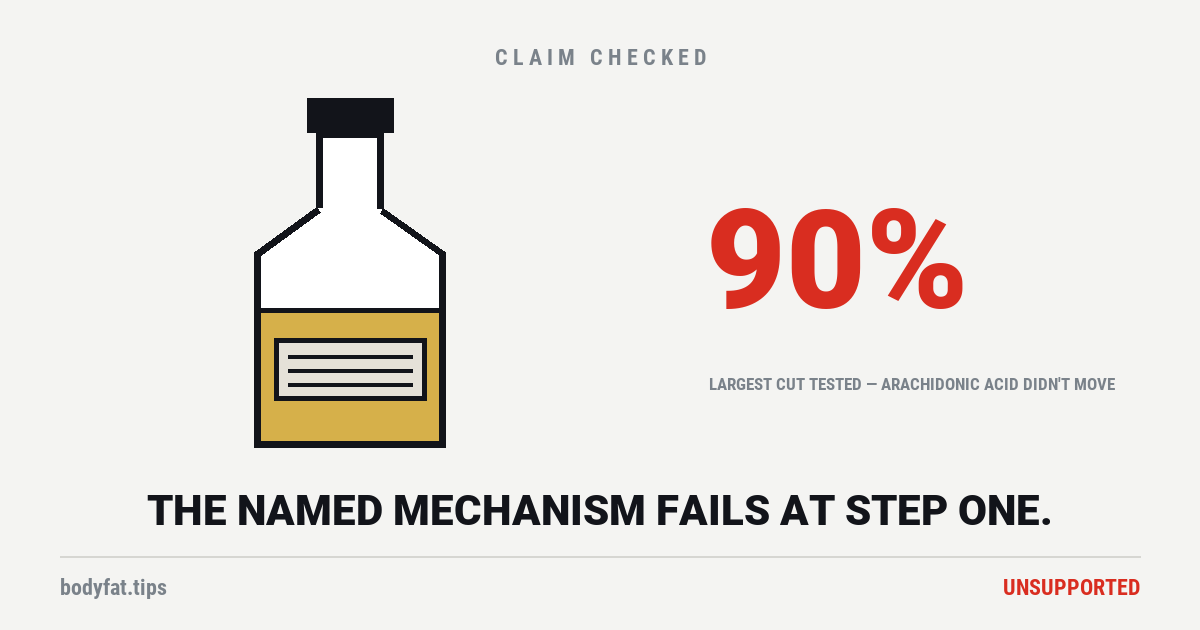
Cutting dietary linoleic acid by up to 90% was not significantly correlated with any change in arachidonic acid (p = 0.44, nowhere near the line researchers use for “probably not chance”). Raising it by up to six-fold was not either (p = 0.45) [1]. In red blood cells, same answer. Of seven red-cell studies, the one that found a significant change found it going the wrong way: cutting linoleic acid by 29% produced a 4% rise in arachidonic acid [1].
Now, is that because the measurement is insensitive? No — and this is the detail that closes the door. In the same review, two other dietary fats did raise arachidonic acid: gamma-linolenic acid, and arachidonic acid itself [1]. The assay works fine. It is linoleic acid specifically that does not do this.
If you prefer your evidence prospective rather than pooled, there is a controlled feeding trial too. Sixty-six premenopausal women with overweight or obesity were randomised to three twelve-week diets where the food was provided, and the 62 who stayed at least four weeks were analysed. The low-linoleic-acid diets successfully lowered linoleic acid in the blood — so the intervention worked — and produced no difference in arachidonic acid between groups [2]. The authors’ own summary: lowering dietary linoleic acid “did not result in the expected changes in fatty acids associated with the LA-ARA [linoleic acid to arachidonic acid] inflammatory axis in women with overweight and obesity.” They add a caution of their own: body fat takes about two years to turn over half its linoleic acid, so “a much longer study may be needed” to see the full effect [2].
And downstream, where the inflammation itself would show up? Fifteen randomised trials, reviewed: none found a significant effect on C-reactive protein, fibrinogen, cytokines, adhesion molecules or TNF-alpha [3]. A later meta-analysis, which took in several of the same trials, pooled thirty trials in 1,377 people and found nothing either [4]. One thing to know about the first of those reviews, since funding comes up on both sides of this fight: it was paid for by a grant from the dietary-lipids committee of ILSI North America, a nonprofit that says it “receives support primarily from its industry membership”, and its lead author had consulted for Monsanto and for Bunge, which calls itself a world leader in oilseed processing [3]. We could not read the later meta-analysis’s funding statement.
One honest asterisk on that last one, because it is the only crack in this wall: the same meta-analysis reported that among people whose linoleic acid intake went up by an especially large amount, CRP might rise [4]. That is a subgroup signal, not a main finding, and it deserves to be followed up rather than either buried or brandished.
So: the named mechanism, examined at the step where it would have to happen, does not happen. That is what carries the Unsupported rating on this page, and we want to be precise that it is that claim we are rating — not the whole subject.
Now the drawer the reassurance articles never open
Here is where the confident “the science is settled, seed oils are fine” version of this article stops being honest.
Because there were randomised controlled trials. Real ones, large ones, with the food actually provided. And they did not go well.
In Sydney between 1966 and 1973, 458 men aged 30 to 59 were randomised to replace animal fats, common margarines and shortenings with safflower oil and a safflower oil margarine [5]. All had had a recent coronary event: most a heart attack, about one in seven a bout of angina or coronary insufficiency, chest pain from a heart short of blood that stopped short of a heart attack. They were outpatients at a hospital coronary clinic, and by the time they joined, most were back to normal activity [5]. The extra deaths in the oil group were reported in 1978, but not which of them were heart deaths; that breakdown waited until a team recovered the data and published it in the BMJ in 2013 [5].
The men on safflower oil died more. All causes: 17.6% versus 11.8%. Cardiovascular death: 17.2% versus 11.0%. Coronary death: 16.3% versus 10.1% [5]. Every one of those differences was at or inside the conventional threshold for statistical significance. The authors fence the result themselves: their men had heart disease, their linoleic acid went from about 6% of calories to 15%, and the finding is “not necessarily generalizable” to women, to younger or older men, to people without established heart disease or to lower intakes [5].
Then the bigger one. The Minnesota Coronary Experiment ran from 1968 to 1973 across one nursing home and six state mental hospitals, randomising 9,423 people aged 20 to 97, double-blind, with every meal provided [6]. It replaced the kitchens’ usual cooking fats, hydrogenated oils included, with liquid corn oil, and butter with a soft corn-oil margarine [6].
It worked, mechanically. Serum cholesterol fell 13.8% in the intervention group against 1.0% in the control [6]. The diet did precisely what it was designed to do.
And it saved nobody. No mortality benefit in the full cohort or in any subgroup the original investigators had specified in advance. No benefit in coronary atherosclerosis or heart attacks found at autopsy [6]. The absence of a benefit on deaths was published in 1989; the subgroups, the cholesterol records and the autopsy findings were not, until the same team that recovered Sydney recovered them and published in the BMJ in 2016 [6].
One more result, and it needs care. Among the people who stayed on the diets a year or more, those whose cholesterol fell furthest were more likely to die: 22% more likely for every 30 mg/dL drop — a hazard ratio of 1.22, with the plausible range running 1.14 to 1.32 [6]. But that figure counts both groups together, and the link was just as strong in the control group, which never got the corn oil (1.28). It came from the people aged 65 and over; under 65 there was no link at all. And the authors call the analysis “observational in nature”: it cannot separate a cholesterol drop caused by the diet from one caused by anything else, though allowing for two markers of frailty did not make it go away [6]. What it does do is fail the idea the diet was built on, that the further cholesterol falls the more lives are saved; the authors say it “does not provide support for the traditional diet-heart hypothesis” [6].
The same paper pooled five such trials covering 10,808 people and found no benefit on coronary mortality (1.13, 0.83 to 1.54) or death from any cause (1.07, 0.90 to 1.27) [6].
Bigger pools of trials have been built since, and none finds a clear effect on deaths. A risk ratio compares the rate in one group with the rate in the other: 1 means no difference, and each range below is where the true answer probably sits. A 2020 Cochrane review of 15 trials in 56,675 people found cutting saturated fat made little or no difference to death from any cause (0.96, 0.90 to 1.03) [9]; a 2018 Cochrane review of 19 trials of omega-6 fats found the same (1.00, 0.88 to 1.12) [10]; and a 2026 review of 17 trials in 66,337 people put the figure at 0.96 (0.88 to 1.06) [11]. All three ranges include 1, so “no effect on deaths” is still on the table.
On heart attacks and other cardiovascular events, though, the pools lean the other way. The 2020 review found 17% fewer cardiovascular events of all kinds combined (0.83, 0.70 to 0.98), in evidence it graded moderate quality, and whether the saturated fat was replaced with polyunsaturated fat or with carbohydrate made no clear difference [9]. The 2026 review, which worked out the effects separately for people at low and high starting risk, found fewer non-fatal heart attacks when the replacement was polyunsaturated fat (0.75, 0.58 to 0.99), a subgroup result its authors rate as moderately credible; on low- to moderate-certainty evidence, it judged that people already at high cardiovascular risk may see important reductions in deaths and major cardiovascular events, particularly heart attacks, and people at low risk little or none [11]. Both Cochrane pools include the Sydney trial, recovered data and all [9][10]. So the trial record is not one-sided: no clear effect on deaths, and a modest drop in cardiovascular events.
If you have only ever read that seed oil worries are internet nonsense, that is the material you were not shown. It is in the BMJ. It was publicly funded, and its authors declare no financial relationships with any organisation that might have an interest in the work [6]. Who paid for the research is worth saying out loud on this topic, and it cuts both ways: two of the sources this page uses for the reassuring half were partly paid for by food-industry money, and we say so where we use them.
And now the problems with those trials, which the alarm side never mentions
We read both papers in full rather than their abstracts, and three things turned up that change how much weight those results can carry.
One: the margarine, and the trans fat nobody measured. Both trials took the era’s ordinary margarines and shortenings off the oil group’s menu and gave that group a polyunsaturated margarine instead: “Miracle” safflower margarine in Sydney, a soft corn-oil margarine in Minnesota [5][6]. That matters because of trans fat, the kind made when vegetable oil is partly hydrogenated, which raises LDL, the “bad” cholesterol, and has been tied to higher heart risk [5]. The American Heart Association’s 2017 advisory argues that Sydney’s margarine was “high in trans unsaturated fat”, so the trial “inadvertently tested substitution of saturated with an even more atherogenic trans fat” (atherogenic: more prone to build plaque in the arteries), and it raises the same concern about Minnesota’s “lightly hydrogenated corn oil margarine” [12].
The trials’ recoverers answer both points. Sydney’s margarine may have carried small amounts, they concede, but it was chosen for traits that go with comparatively little trans fat, and dropping the ordinary margarines should have cut the oil group’s trans fat overall [5]. Minnesota’s margarine “likely contained some trans fat”, but the trans-fat-rich margarines and shortenings were in the control diet, which makes trans fat “an exceedingly unlikely explanation” for the corn oil’s lack of benefit [6]. Neither side can settle it, because neither trial measured it: in Sydney “the trans fatty acid content of participants’ diets was not recorded”, and Minnesota’s figures “are not available” [5][6].
Two: the control group’s linoleic acid went up too. Compared with what the hospitals served before the trial, the control diet raised linoleic acid by about 38%, from 3.4% to 4.7% of calories [6]. It was not a seed-oil-free comparison.
Three: the dose was enormous. The intervention took linoleic acid from 3.4% of calories to 13.2% — a rise of more than 280% — while halving saturated fat [6]. That is not what happens when you fry an egg in canola oil. It is an extreme substitution, engineered to move cholesterol as far as possible.
Add that only about 2,400 of the 9,423 stayed on the diets a year or more (2,355 of them with cholesterol records recovered), and that only 149 of the trial’s 295 autopsy files have been found — in which, provisionally, more of the corn-oil group had had a heart attack (41% against 22%) [6], and you have a trial that is genuinely important and genuinely limited at the same time. Both of those, together.
Then there is what people’s blood shows
If the trials are messy, is there anything cleaner? There is one thing, and it is very large.
In 2019, thirty long-running studies from thirteen countries each re-analysed their own participants to one shared plan, and the results were pooled: 68,659 people, 15,198 cardiovascular events, with the typical follow-up in each study running from two and a half to nearly thirty-two years [7]. Unilever partly paid for that analysis through a restricted grant to Tufts University; the paper says Unilever had no role in the design, analysis or writing. Two of its authors report Unilever research support for the work, and a third reports fees from Bunge, among other companies, outside it [7].
Crucially, they did not ask anyone what they ate. They measured the linoleic acid in people’s blood and fat tissue, which sidesteps the well-known unreliability of food questionnaires.
People with more linoleic acid in them had less cardiovascular disease. Total cardiovascular disease: hazard ratio 0.93. Ischaemic stroke: 0.88. And cardiovascular death: 0.78 [7] — a 22% lower rate, with the whole plausible range sitting below 1.
Arachidonic acid, the supposed villain of the mechanism, was not associated with higher risk at all. The people with the most of it had slightly less cardiovascular disease [7].
This is observational, so it cannot prove causation, and healthy-user effects are a real problem in this kind of data. But the blood measurements have only grown since. In 2025 a study of 172,891 people without heart disease or stroke at the start, in three European cohorts, together with an updated pooling of 49 earlier studies, called itself “the largest and most extensive investigation to date” [13]. It pointed the same way: more linoleic acid in the blood went with fewer strokes and, in the pooled studies, less coronary heart disease, and arachidonic acid “was not associated with higher CHD or stroke risk” [13]. One wrinkle it flags: dihomo-gamma-linolenic acid, an omega-6 fat the body makes from linoleic acid on the way to arachidonic acid, went with more heart disease and stroke, not less [13]. Taken together, the blood measurements point the opposite way from the two recovered trials.
So how can the trials and the cohorts both be right?
This is the part neither camp gets to, and it is where the answer actually lives.
They are not answering the same question.
The trials asked: if we take men recovering from a heart attack or angina in Sydney, or residents of Minnesota mental hospitals and a nursing home, and swap much of their saturated fat for a great deal of safflower or corn oil, do fewer of them die? The answer was no; in Sydney, more did.
The cohorts asked: do people walking around with more linoleic acid in their blood and fat have less cardiovascular disease? The answer was yes for cardiovascular disease overall, cardiovascular deaths and strokes. For coronary heart disease alone, the 2019 pooling pointed the same way without clearing the bar for chance (0.94, 0.88 to 1.00) [7]; the larger 2025 pooling did clear it [13].
Those can both be true, because a substitution trial and an exposure measured once and then followed for years are different things. And there is a third question, which is the one you are actually asking, and which no trial has answered.
Nobody has tested the modern exposure for long. The trials tested replacing saturated fat with seed oil. Nobody’s diet in 2026 works like that. The realistic modern exposure is seed oil added — to fried food, packaged snacks, sauces, restaurant cooking — on top of everything else, usually inside foods that are also energy-dense and heavily processed.
Short trials have tested a piece of it. In two Swedish trials, muffins baked with sunflower oil or with palm oil were added on top of people’s normal diets until they gained weight. In 39 young, lean adults over seven weeks, the palm oil put on markedly more liver fat and twice as much visceral fat, the fat packed around the organs, while the sunflower oil put on nearly three times as much lean tissue [14]. In 61 adults with overweight or obesity over eight weeks, both groups gained about the same, 4.4 to 5.1 lb (2.01 to 2.31 kg); the palm oil raised liver fat by half and the sunflower oil did not raise it, but visceral and total body fat rose alike [15]. Those trials compared one added fat with another, and neither ran long enough to count heart attacks or deaths; a trial that did would be enormous, expensive and probably unethical. Which means the honest answer to “what does the seed oil in my diet do to me” is that the specific experiment has not been done.
What we can say is that the reason usually offered for worrying — the route through arachidonic acid to inflammation — has been checked and does not hold up. The recovered trials’ own authors suspected a different route: linoleic acid oxidised inside LDL, the particles that carry cholesterol in the blood, which they proposed may feed the build-up of fatty plaque in the arteries, especially in smokers and heavy drinkers [5]. That is a proposal, not a finding, and this page does not test or rate it.
What we are rating, exactly
Unsupported: the claim that seed oils harm you by raising arachidonic acid and driving inflammation. Tested by systematic review, by controlled feeding trial, and by thirty randomised trials measuring inflammation itself. It fails at the first step and never recovers.
Not rated Unsupported, and genuinely open: whether replacing saturated fat with large amounts of linoleic acid lowers mortality. Two recovered trials say no, and so does a meta-analysis of five. Larger pools of trials find no clear effect on deaths either, though they find fewer cardiovascular events [9][11]. The biggest studies of linoleic acid measured in the blood find less cardiovascular disease in the people with the most of it [7][13]. That is a live disagreement and we are not going to pretend otherwise.
Untested beyond a few weeks: what seed oils do when added to an already ultra-processed diet, which is how almost everyone actually eats them. Two short overfeeding trials are the closest anyone has come [14][15].
Official advice split on the same question in January 2026. The Dietary Guidelines for Americans, 2025–2030, issued by the US Departments of Agriculture and of Health and Human Services on 7 January, say: “When cooking with or adding fats to meals, prioritize oils with essential fatty acids, such as olive oil. Other options can include butter or beef tallow.” They add: “More high-quality research is needed to determine which types of dietary fats best support long-term health” [16]. The World Health Organization’s healthy-diet fact sheet, dated 26 January, advises “replacing butter, lard and ghee with oils rich in polyunsaturated fat, such as soybean, canola (rapeseed), corn, safflower and sunflower oils” [17]. Both are dietary-advice documents, not trials. Neither is evidence about the claim this page rates, and neither moves its rating.
What to actually do
Stop treating the oil as the villain in the meal. Almost all the seed oil most people eat arrives inside fried and packaged food. If you cut those, your linoleic acid drops as a side effect — and you will have changed a dozen other things at the same time, most of which have better evidence against them.
Cooking at home with canola or sunflower oil is not the problem worth solving. The arachidonic acid route usually cited for fearing it has been tested and does not hold; the oxidation route the recovered trials’ authors proposed is untested here [5]. And the people with the most linoleic acid in their bodies have less cardiovascular disease, not more [7]. Our verdicts on canola oil, vegetable oil and olive oil take each oil in turn.
Be suspicious of the price of the alternative. “Seed-oil-free” has become a badge you can charge for, on snacks and restaurant menus and skincare. The badge is currently better evidenced as a marketing position than as a health intervention.
And if you switched to tallow and you feel better, we are not going to argue with you about your own body. Just know which part of that is measured and which part is not. Nobody has run the trial on your kitchen.
This is journalism, not medical advice. If you have heart disease or you are managing cholesterol with a clinician, that conversation should involve them rather than a website. Our other pages on contested nutrition claims: fibre, artificial sweeteners and erythritol, where a similar marker-versus-cause problem runs through the whole literature.
This page was corrected on 16 September 2026. The link on source [7] went to an editorial printed straight after the Marklund paper in the same issue of Circulation, not to the paper the source line cites. It now goes to the paper. We found it by checking every DOI link on this site against the title, volume and pages of the document it actually belongs to. Nothing the page reports from the paper has changed, and neither has the rating.
An independent editorial review on 18 September 2026 found that this page read one of its own sources backwards and turned an association into a harm. We said the Minnesota trial’s control group ate trans fat, as if that weakened the result; the trial’s authors use that fact to argue trans fat cannot explain the corn oil’s lack of benefit. The real dispute is over the oil groups’ own margarines, which the American Heart Association argues carried trans fat and which neither trial measured, and the section now says so. We also presented the link between falling cholesterol and death as the corn oil killing people. That figure counts both groups, held in the control group too, came from people aged 65 and over, and its authors call it observational. We said most results sat unpublished for four decades; Sydney reported its extra deaths in 1978 and Minnesota its null result in 1989. And we merged the two trials, gave the cohorts’ result on heart attacks as a yes when it was not statistically clear, and wrote as if the arachidonic acid route were the only reason offered for worry, when the recovered trials’ authors proposed another.
The funding row showed only the clean half. Two sources we used for the reassuring side were partly paid for by food-industry money: the 2012 inflammation review, which was funded by a grant from ILSI North America’s dietary-lipids committee and whose lead author had consulted for Monsanto and Bunge; and the 2019 biomarker pooling, partly funded by Unilever. Both are now listed by role, in the panel and where we use them, and where we could not read a funding statement the entry says so. We have added the larger pools of trials, which find no clear effect on deaths but fewer cardiovascular events; a larger 2025 blood study; two short overfeeding trials, which retire our line that no randomised trial had added seed oil to a normal diet; and the January 2026 US and World Health Organization dietary advice, which disagree and do not move the rating. Smaller fixes: the feeding trial’s population and full quotation, the Sydney men’s condition, the Minnesota autopsy count, two p-values now taken from the review’s results rather than its abstract, and the provenance chain, which no longer quotes a sentence we could not source. The rating is unchanged: Unsupported.