Spearmint Tea Benefits: Free Testosterone Dipped in Two Small Studies of Women. We Found No Acne Study of the Tea

Ask Google about spearmint tea benefits and its AI answer goes straight to hormones: “Studies show that drinking two cups of spearmint tea daily can help lower free and total testosterone levels and boost reproductive hormones like luteinizing hormone (LH) and follicle-stimulating hormone (FSH), which may benefit women dealing with PCOS or hormonal acne” [1]. Plenty of people are asking. A paid keyword database puts US searches for “spearmint tea benefits” at 18,100 a month, its figure for the past year, and at 14,800 in each month from May to September (from a paid keyword database, pulled 23 October 2026) [1].
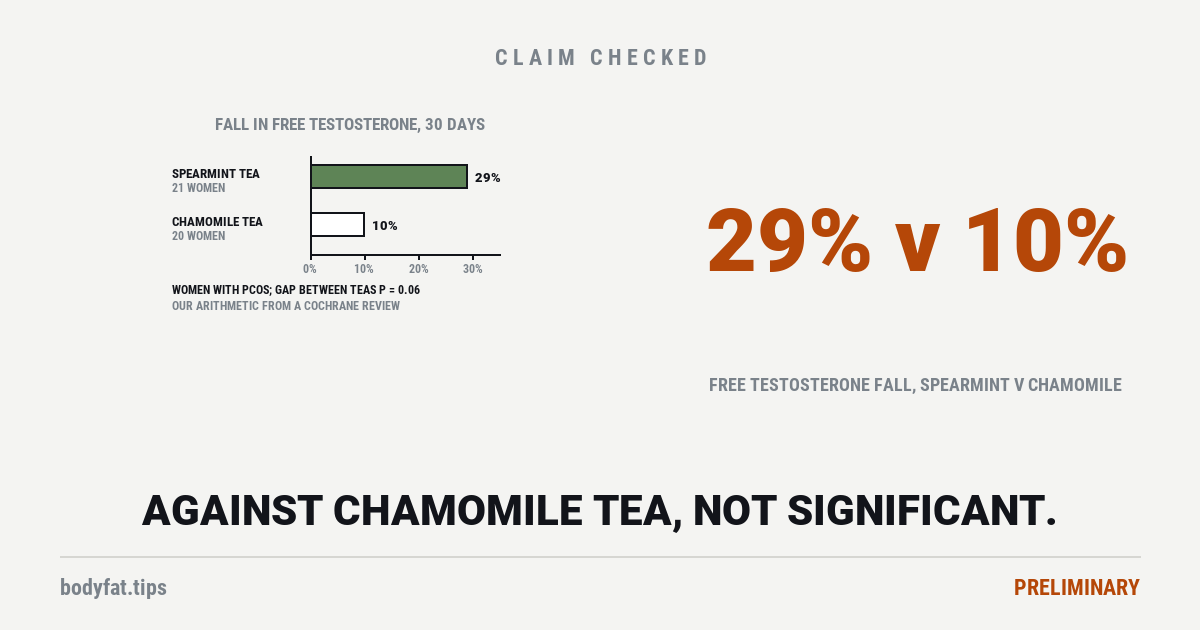
The testosterone half has a little evidence behind it. The acne and PCOS half has almost none. Two small studies of women with excess hair found free testosterone, the small share of testosterone not held by a carrier protein in the blood and, on the leading theory, the part that acts on the body, lower after spearmint tea: one over five days with no comparison group [2], one over 30 days against chamomile tea [3]. In that trial it fell further on spearmint, about 29% against 10% by our arithmetic, but when a Cochrane review compared the two groups, the gap could still have been chance [4]. Hair growth scored by a doctor did not differ [3]. And no study we found measured acne in people drinking spearmint tea [5].
This is journalism, not medical advice. Excess hair, irregular periods and acne can have causes a doctor should look for. The most common cause of excess hair in women is polycystic ovary syndrome, PCOS [4], a hormonal condition that some pages now call by a newer name, PMOS [1]. If you are pregnant, trying to conceive or on hormonal treatment, ask a clinician before drinking spearmint tea daily as a remedy: the hormones it moved in these studies include LH and FSH, which act on the ovaries [2] [3], and no study we found measured its hormone effects in pregnancy. No tea replaces a treatment you have been prescribed.
Is spearmint tea good to drink?
As a flavouring, the US government treats it as safe. Federal rules list spearmint, Mentha spicata, both the leaf and its oil, among the flavourings “generally recognized as safe for their intended use” [6]. That is a judgment about flavouring food. It says nothing about two cups a day taken to change a hormone. Whether it does that is what the rest of this page checks, one claim at a time.
Does spearmint tea lower testosterone?
The story starts in Isparta, in south-west Turkey, with a hunch. In that town, a research group wrote, “clinicians thought that consumption of tea steeped with M. spicata or M. piperita caused a diminished libido” [2]. So the group gave 21 women with excess hair, 12 of them with PCOS, a cup of spearmint tea twice a day for five days, in the first half of the menstrual cycle [2]. Free testosterone fell, significantly. Total testosterone, all of it, bound and free, did not fall significantly. LH, FSH and estradiol, a form of estrogen, rose [2]. There was no comparison group, so the study cannot separate the tea from anything else that changed in those five days.
The fair test came next. In an English trial run at two centres, 42 women with PCOS and excess hair, women who had not responded to, or could not tolerate, the usual medicines, were assigned by chance to drink spearmint tea or chamomile tea twice a day for 30 days [7] [4]. Chamomile was the comparison: a tea with, as a 2024 review puts it, “no known effect on the endocrine system” [8]. Forty-one women finished; the one who left was in the chamomile group, put off by the taste [4]. How much leaf went into each cup is not in the parts of the trial we could read.
Inside the spearmint group, free and total testosterone fell over the month, significantly by the paper’s own test, and LH and FSH rose [3]. Free testosterone went from an average of 5.12 to about 3.64 pg/mL on spearmint, and from 4.98 to about 4.49 on chamomile [4] [9]. By our arithmetic, those are falls of about 29% and 10%.
| Measure | Spearmint tea (21 women) | Chamomile tea (20 analysed) | The two groups compared |
|---|---|---|---|
| Free testosterone, pg/mL | 5.12 at the start; down 1.48, about 29% | 4.98 at the start; down 0.49, about 10% | 0.99 lower on spearmint; range 2.04 lower to 0.06 higher; p = 0.06 |
| Total testosterone, ng/mL | 0.81 at the start; down 0.19 | 0.87 at the start; down 0.07 | 0.12 lower on spearmint; range 0.29 lower to 0.05 higher; p = 0.16 |
| Hair scored by a doctor (0 to 36) | 17 at the start; down about 1 | 17 at the start; down about 1 | Not significantly different (p = 0.12) |
| Women’s own rating, skin questionnaire (0 to 30) | 17 to 11 | 18 to 15 | Reported by the author as significant |
But a fall inside one group is not the test of a treatment. The test is whether it fell more than in the women drinking chamomile, and on that the trial comes up just short. When the Cochrane review compared the two groups’ changes, free testosterone came out 0.99 pg/mL lower on spearmint, with a p-value of 0.06, just the wrong side of the line researchers use for “probably not chance” [4]. Its confidence interval, the range the true average difference probably sits in, ran from 2.04 lower to 0.06 higher, so no difference at all is still on the table [4]. For total testosterone, p = 0.16. The review’s conclusion: “There were no statistically significant changes in androgen levels between the two treatment groups” [4].
Two later poolings, meta-analyses that combine trials into one estimate, include this trial as their only spearmint trial. A 2021 pooling of tea trials in PCOS describes the spearmint result as “within-group data” [10]. Its summary adds that herbal tea “can also reduce FT levels” (FT is free testosterone), on the strength of this one trial, printed as a significant gap of 0.18 [10]. We do not use that figure. The pooling’s chart prints the identical row, to the decimal, for the same trial’s total testosterone, and 0.18 is the gap between the two groups’ total testosterone after the month (0.62 against 0.80 ng/mL, by our arithmetic from the Cochrane review’s figures) [10] [4]. It looks like a total-testosterone figure entered as a free-testosterone one; this page follows the Cochrane review’s analysis. A 2024 pooling of six tea trials, four of them of green tea and one of marjoram tea, found no significant effect of tea on total testosterone [9].
So does spearmint tea lower testosterone? In women with high androgens, the male-pattern hormones of which testosterone is the main one, it may lower free testosterone a little. That has been seen within the spearmint group twice, in 21 women each time, over five days and 30 days, and against a comparison tea once, where the gap fell just short of the usual bar. It is a hint worth a proper trial. It is not yet a result. Our verdict on free and total testosterone explains why the two numbers can move differently.
Does spearmint tea help PCOS?
PCOS is more than a testosterone number. Its signs include irregular periods, trouble ovulating, excess hair and weight changes [11]. In the parts of the two spearmint studies we could read, neither reports periods, ovulation or blood sugar [2] [4].
The nearest anyone has come is a four-herb capsule. In a 2020 Iranian trial, 75 infertile women with PCOS were assigned to clomiphene, a fertility drug, to a 700 mg daily capsule of spearmint (250 mg of it), ginger, cinnamon and orange peel, or to both, for three months; 60 finished, 20 a group. Testosterone, insulin resistance and LDL cholesterol came out lower in one or both capsule groups than on clomiphene alone [12].
The same trial also recorded acne, excess hair and periods on checklists the researchers filled in, asking the women about acne and hair at the end of treatment; only the statistician was blinded [12]. Acne eased in all three groups, clomiphene alone included, and the groups did not differ significantly. Infrequent periods, fewer cycles a year than usual, became less common in all three as well, from 55% to 20% of the women on the capsule alone and from 65% to 31% on clomiphene alone, counted three months after treatment among the women who had not become pregnant, again with no significant difference between the groups. Excess hair was the exception: 16 of 20 women on the capsule alone ended with none, against 6 of 20 on clomiphene alone, and across the three groups the difference was significant, though the capsule group had started with more women without it, 7 against 4 [12]. With four plants in one capsule, spearmint’s share cannot be told apart.
Period pain is a different question from irregular periods, and there a mint-oil drop has been tried. Two reviews describe an Iranian trial in which 100 women aged 18 to 22 with painful periods took 40 drops of a mint oil sold in Iran, or ibuprofen, a painkiller; pain eased in both groups, and the difference between them was not significant [13] [14]. The review written by a scientist at the drops’ maker calls the oil spearmint; the other review’s table calls it peppermint [13] [14]. We could not find the trial’s own paper [5]. It measured pain, not how regular periods were.
What about the “2024 trial”? A New York fertility clinic’s guide to spearmint tea, one of the pages Google’s AI answer cites, says the case rests on two randomised trials: the 2010 trial and a 2024 trial of 150 people over 12 weeks, in which testosterone fell about 15% in the PCOS group and 12% in the group without PCOS [1]. The record it links to is a one-page item in the supplement to a nutrition journal’s October 2024 issue, listed under a different author’s name from the one the clinic gives [15]. We could not open it: the publisher’s sites refused us or put up a robot check, and we found no archived copy [15]. So we cannot say whether it was randomised, or check a single figure in it. The clinic’s own description names no group that went without the tea: its two groups were people with and without PCOS, and it reports testosterone falling in both after twice-daily tea [1]. Until someone can read the item, those numbers are the clinic’s description, not a result this page counts.
A 2024 review of herbal remedies for excess hair also lists an eight-woman, three-month trial of spearmint and green tea capsules, with hair scores down 25 to 50% [8]. We could not find that report in PubMed, Europe PMC or Crossref, and the journal’s site refused our requests [8]. It is not counted here either.
Does spearmint tea reduce facial hair?
Excess hair in a male pattern, on the face, chest or stomach, is called hirsutism. Doctors score it on the modified Ferriman-Gallwey scale: nine body areas, each rated from 0 for no hair to 4, so 0 to 36 in all; under 8 is normal, 16 to 25 moderate [4]. The women in the 2010 trial started at 17 in both groups [4].
After a month, the doctor-scored hair had dropped by about 1 point in both groups, and the difference between them was not significant [3] [4]. The women’s own view was different. On a skin quality-of-life questionnaire, scored 0 to 30, the spearmint group went from 17 to 11 and the chamomile group from 18 to 15, a difference the author reports as significant [4]. The women were not blinded to which tea they drank, which the review judged a high risk of bias for the trial’s results [4]. The Cochrane reviewers called a three-point gap “difficult to interpret” [4].
Was a month long enough to tell? Probably not, and the trial’s author said as much: “Simply put, the study duration was not long enough” [3]. The Cochrane review counts anything under six months as short-term for hirsutism and says a treatment has to last at least as long as the hair growth cycle of the area being treated [4]. So the hair question has been asked once, too briefly to answer.
Spearmint tea for skin and acne: what has been tested?
Hormonal acne is the claim that sells the most tea, and it is the one with the least behind it. No study we found gave people spearmint tea, or spearmint alone by mouth, and then counted their spots [5]. The case is a chain of reasoning. As a dermatology practice’s online shop puts it, spearmint “may help improve acne by reducing androgen levels, hormones that contribute to excess oil production and breakouts” [1]. Each link in that chain may be true. No study we found has tested the whole of it.
The one acne trial with spearmint in it that we found put spearmint oil on the skin, mixed with a barberry root extract, against clindamycin, an antibiotic lotion, for four weeks in 60 people; spots fell on the herbal solution, and the two groups did not differ significantly [16]. That is a lotion, with a second plant in it and no dummy. It says nothing about the tea.
Spearmint by mouth has met acne once that we found, inside a mix: in the four-herb fertility trial above, acne eased on the capsule, on clomiphene alone and on both, and the groups did not differ significantly [12]. And a reader searching for an acne trial of the tea may meet one described in a way the record does not support. An acne-information website near the top of an ordinary web search describes “a 2015 randomized controlled trial with 42 female participants” in which acne lesions were counted and fell; the only study it names, in a chart’s source line, is the 2010 trial above, which measured hormones and hair, not acne [1] [4].
None of that has stopped it being sold. The same dermatology practice’s shop sells a “Hormonal Acne Tea” of spearmint, nettle root, dandelion, gotu kola and rose, cites the 2007 and 2010 studies, and tells buyers to “Drink 2 cups daily to control hormonal acne breakouts” [1]. Neither study reports acne [2] [4]. Two reviews published this year land in the same place: spearmint tea lowered free testosterone in small, short studies of women, and an objective benefit, for hair at least, has not been shown [17] [18].
Is spearmint tea good for men?
Some pages warn men off it. The warning has a real starting point, and it is rats. Before testing women, the Isparta group had tested its town’s suspicion in animals, prompted by “major complaints in our area from men about the adverse effects of these herbs on male reproductive function” [19]. Rats given spearmint tea in place of drinking water, brewed at 20 or 40 g of leaf per litre (about 0.7 or 1.3 oz per quart, by our conversion), had lower total testosterone than rats on plain water, and their testes showed damage that grew with the dose, up to a loss of the cells that make sperm [19]. Peppermint tea lowered testosterone in the same study, with milder damage [19]. A 2008 study of rats given a water extract of spearmint found the same direction [20]. A 2014 Iranian study gave rats an extract for 45 days: testosterone, sperm count and sperm movement all fell, but none of the changes was significant, and the rats’ fertility and offspring were not different [21].
By then the town’s hunch had hardened into a statement of fact. The 2014 rat paper’s introduction says “daily consumption of four cups of spearmint tea can diminish libido in men”, citing the 2007 study [21]. That study was of 21 women, and its summary reports only that local clinicians “thought” mint tea dimmed libido [2]. We could not read the full paper to see whether four cups appears in it.
And men themselves? No study we found measured testosterone in men drinking spearmint tea [5]. The nearest is a 90-day trial of a spearmint extract capsule, 600 or 900 mg a day against a dummy, in 90 adults, 30 of them men, paid for by the extract’s maker [22]. Its safety report found no significant change in LH or FSH, the pituitary hormones that tell the testes to make testosterone; its summary does not mention testosterone itself [23]. A capsule of extract is not a cup of tea, and LH is not testosterone.
So the worry about men rests on rats drinking spearmint tea as their only water, at strengths no study we found has matched to a cup, and one of three rat studies found nothing significant. If your real question is how to raise testosterone, our verdict on raising it naturally and our verdict on testosterone boosters cover what has been measured in men. As for any benefit to men in particular, the extract trials that included men were about memory, attention and sleep, covered below.
Spearmint tea for weight loss
We found no trial that reported the weight of people drinking spearmint tea, or taking spearmint alone, against people who took none [5]. The nearest is a 16-week Canadian trial in which 62 adults with knee arthritis were assigned to two cups a day of one of two spearmint teas, one made from a variety rich in rosmarinic acid, a plant compound, and an ordinary commercial one; 46 were analysed, with an average body mass index (weight scaled for height) of 32.9, in the range doctors call obese [24]. They were weighed at the start and the end, but the paper prints their weights only for the start. For the end, it says the two groups’ body measurements were not significantly different at any point, with the figures “not shown”, and, in one sentence of its discussion, that body measurements “did not change” over the 16 weeks, a point the authors make to rule out weight loss as the reason the knee pain eased [24]. Weight was not one of the outcomes the trial was registered to measure [24], and both groups drank spearmint, so the trial cannot compare the tea with no tea. It is the authors’ word, without figures, about four months of two cups a day; it is not a test of whether spearmint changes weight. The 90-day extract trial also weighed everyone at each visit, and its paper reports no weight result [22]. The 2024 pooling of tea trials in PCOS did find a small weight loss, but its weight results came from green tea and marjoram tea trials; its one spearmint trial did not weigh anyone [9] [10]. Green tea’s weight evidence has its own verdict.
The case for spearmint itself is animal work. In a 2017 study of rats given a form of PCOS with a drug, the higher dose of spearmint oil left them lighter than untreated rats with PCOS; in ordinary rats, weight was not significantly different on the oil [25]. Male rats given a spearmint extract for 45 days did not differ significantly in weight from untreated rats either [21]. That is oil and extract, not tea, in rats, not people.
Spearmint tea before bed: does it help you sleep?
No trial we found tested spearmint tea for sleep [5]. Three tested a spearmint extract, each with a maker of the extract involved. In the 90-day memory trial, adults taking 900 mg a day with breakfast rated themselves better at getting to sleep than those on a dummy capsule; it was one of several sleep and mood scores, tested without the correction researchers make when they test many things at once [22]. In a second trial, 142 younger adults on 900 mg for 90 days showed no significant difference in sleep [26]. In a third, a 30-day trial of a spearmint-and-green-tea extract blend taken 30 minutes before bed, run by a US university with the maker as collaborator, time to fall asleep shortened by about 2 minutes on the blend and about 2.5 minutes on the dummy [27].
What is the best time to drink spearmint tea? No study we found compared times of day [5]. The five-day study timed its cups to the first half of the menstrual cycle, and the 2010 trial asked for two cups a day [2] [7].
Can you drink spearmint tea if you have acid reflux?
The one experiment on this that we found put a pressure sensor and an acid probe at the bottom of the gullet of healthy volunteers, then gave them spearmint at a flavouring dose (0.5 mg), a high dose (500 mg) or a dummy, each on a different occasion, without anyone knowing which [28]. The pressure of the valve at the bottom of the gullet did not change significantly with any of the three, and reflux episodes did not differ significantly [28]. After the high dose, six volunteers reported symptoms, against one after the dummy, without more reflux [28]. Healthy volunteers are not people with reflux disease, so this is a reassurance about the valve, not a promise about your heartburn. In the 90-day extract trial, one person taking 600 mg a day left with heartburn that the researchers judged “probably related” to the capsules [22].
The heartburn warning on many pages comes from peppermint. Europe’s medicines agency tells people with reflux to avoid peppermint leaf preparations “because heartburn may increase” [29]. That warning is about a different plant.
Spearmint tea for digestion
For indigestion and gas, Europe’s medicines agency accepts peppermint leaf tea as a traditional remedy for “digestive disorders such as dyspepsia and flatulence”, a judgment it bases on long use rather than trials [29]. We found no such monograph for spearmint [5]. No trial we found gave people spearmint tea for their gut [5]. The trials we found gave spearmint oil, or spearmint in a mix, and two of them we know only through the company that sells the oil. In Iran a mint-oil drop is sold for gas and indigestion, and a 2021 review by a scientist at its maker’s research centre, which describes the drop as 2% spearmint oil, gathers the trials of it, most of them published in Iranian journals [13]. As that review tells it, 107 women after a caesarean section had significantly less pain and gas on the drops than on a dummy, and 60 people with irritable bowel syndrome had significantly less gas on the drops than on dimethicone, an anti-gas medicine, a week after the three weeks of treatment ended, though not two weeks into it [13]. We read the review’s account of those two, not the trials. A trial of 101 children given the same drops, whose own summary calls them peppermint oil, reports less pain and more satisfaction during a colonoscopy on 20 drops than on a dummy [30]. And one trial the review counts was not of spearmint drops: by its own paper, an Indian company tested two of its indigestion products in 79 people, one of peppermint oil and one mostly of peppermint oil with a little spearmint oil [13] [31].
One trial we could read in full came from a university team declaring no funding and no conflicts. In 2022, 102 Iranian women were given mint drops, which the paper’s methods name as spearmint though its title says peppermint, or a dummy, after a caesarean section; their bowel sounds came back after about 6 hours against 9, and they first passed gas after about 8 hours against 12, both significant differences [32]. And one 32-person pilot of a three-herb product, of lemon balm, spearmint and coriander, in irritable bowel syndrome, found pain and bloating eased more than on a dummy [33]. Small, short trials of an oil, not the tea, two of them known to us only through the oil’s maker: a lead, not an answer.
Spearmint vs peppermint tea: what is the difference?
“Mint” covers a family of plants. Spearmint and peppermint are different species: spearmint is Mentha spicata, peppermint is Mentha × piperita [6] [29]. The hormone studies on this page are of spearmint; the reflux warning and the European monograph are about peppermint [2] [3] [29]. A result for one plant does not carry over to the other.
Spearmint tea disadvantages: is it safe?
In the amounts used to flavour food, US rules treat spearmint as safe for that use [6]. In the trials, side effects were few: none reported in either group of the 2010 trial [4]; in the 90-day extract trial, no serious side effects and no significant difference between the groups in how many people reported one [23]; and symptoms after the high dose in the reflux experiment [28]. In the 16-week trial of two spearmint teas, two cups a day, nobody reported a serious side effect; the ones reported, headache, constipation, loose stools, a dry mouth, itchy skin and stained dentures, one to three people each, were all short-lived, and one person left the trial with a sensitivity to mint that nobody had known about [24]. A single case report in a nursing journal, published on 2 October 2026, describes a woman around menopause with low sex drive and low testosterone whose hormone results its author ties to heavy mint tea drinking [34]. We read its summary only; it does not say which mint, and one case cannot show what caused what.
Is spearmint tea safe during pregnancy?
We found no trial of spearmint tea in pregnancy and no regulator’s guidance on spearmint in pregnancy [5]. The nearest trial gave 74 pregnant women with morning sickness either vitamin B6 or B6 plus a pomegranate-and-spearmint syrup, a teaspoon (5 mL) three times a day for one week; it was not blinded, 24 women on the syrup were analysed, nobody reported side effects, and they were followed for two weeks, not to the end of pregnancy [35]. A 2019 Turkish journal article on mint tea in pregnancy turned up in our search, and we could not open it, so we cannot say whether it studied people or animals [5]. For peppermint, Europe’s medicines agency says safety in pregnancy “has not been established” and does not recommend it [29]. The hospital-system page Google cites tells pregnant readers to check with their provider [1]. Spearmint is sold for a hormone effect, and no study we found measured that effect in pregnancy. Ask before drinking it daily as a remedy.
Who these studies were done on
Women, almost entirely. The hormone evidence is 21 Turkish women aged 18 to 40 with excess hair, and 42 British women with PCOS aged 19 to 42, average age 26 [8] [10] [4]. The testosterone evidence about men is from rats [19] [20] [21]. The longest study we could read of people drinking the tea, 16 weeks, was of 46 adults with knee arthritis, 14 of them men, average age about 61, and it measured pain and body measurements, not hormones [24]. No study we found of spearmint tea, or of spearmint alone by mouth, chose people for their acne, and the only spearmint study in pregnancy we found was a week of syrup for morning sickness [5] [35].
So read yourself against them. If you are a woman with PCOS and high androgens, the hormone evidence is about people like you, and it is small and short: weeks, not months. If you are a man, a teenager, pregnant, or drinking it for your skin, the studies are not about you yet.
If spearmint tea lowers testosterone, why has nobody shown it clearing skin or hair?
This section is the desk’s own reasoning, and it is labelled as such. The tea moved a blood test, a little, in small studies. The skin and hair it is sold for have not followed. Here are three ways those fit together, each rated.
Answer one: too short to see. Hair grows in cycles, and the review that gathered the hirsutism trials says a treatment has to last at least as long as the cycle of the area treated; the one hair trial we could read lasted 30 days [4] [3]. The rule is the review’s, drawn from how hair grows. That a longer trial would show the hair changing is the author’s surmise, and ours to doubt. It explains nothing about acne, which no study we found of the tea measured.
Answer two: too small to tell. With 21 women a group, the gap in free testosterone between spearmint and chamomile came out at p = 0.06 [4]. A trial that size can miss a modest real difference, or turn up a chance one. The p-value is measured. That the effect is real and small is a surmise with one trial on its side, just short of the bar.
Answer three: the trials stopped and the selling started. The 2010 trial was published online in July 2009, and it is still the only randomised trial we found of spearmint tea alone against another drink on hormones or hair, setting aside the 2024 item we could not open [3] [5] [15]. Since then the claim has moved to video and forums: of 238 TikTok videos about PCOS that researchers analysed in April 2024, 13 discussed spearmint tea [11], and a 2025 analysis of a PCOS forum found spearmint tea among the treatments users described most warmly for irregular periods, while its authors found only two studies of the tea [36]. The dates and the counts are measured. Why we found no longer trial, we can only guess: a tea sold in every supermarket gives no company a product of its own to prove. That is a hunch we cannot test.
Put the three together and here is what we think is true, stated plainly so you can disagree with it: spearmint tea is a blood-test result being sold as a skin and hair result; it nudged free testosterone in small, short studies of women, and no study we found has yet shown the skin or the hair following.
What we could not find, and would like to: a trial lasting six months or more, in women with PCOS and excess hair or acne, against a dummy tea, with hair scored by doctors who do not know who drank what and spots counted the same way; and any measurement of testosterone in men who drink spearmint tea every day [5]. If you know of either, the corrections line on this site is open.
Where “spearmint tea lowers testosterone” came from
The research behind it is a town’s suspicion tested in rats: in 2004 the Isparta group reported lower testosterone and damaged testes in rats given spearmint tea to drink [19]. The framing came with the human studies. The 2007 study, five days with no comparison group, concluded that “Spearmint can be an alternative to antiandrogenic treatment for mild hirsutism” [2]. The 2010 trial’s title says “Spearmint herbal tea has significant anti-androgen effects in polycystic ovarian syndrome”, though the falls its summary reports as significant are within the spearmint group, and the Cochrane review found the comparison with chamomile not significant [3] [4].
Then it spread. Thirteen of 238 TikTok videos about PCOS discussed it in April 2024 [11]; six of the same videos described a “moon face”, which our cortisol face verdict covers [11]. On 23 October 2026, Google’s AI answer for “spearmint tea benefits” told readers that two cups a day can lower free and total testosterone “which may benefit women dealing with PCOS or hormonal acne”, and cited a hospital system, a fertility clinic, health publishers, a tea seller and a forum [1]. We could not trace who first tied spearmint tea to acne.
And it sells. A tea seller’s page cited by that AI answer says regular spearmint tea can help “regularize menstrual cycles”, which no study we found of the tea, or of spearmint alone, measured; in a four-herb capsule trial with spearmint in it, infrequent periods became less common on a fertility drug alone too, with no significant difference between the groups [1] [5] [12]. A fertility clinic cites a 2024 trial that we could not open [1] [15]. A dermatology practice’s shop sells its own spearmint blend as a hormonal acne tea [1]. Spearmint is not the only tea sold on a body claim: hibiscus tea, sold for blood pressure, has its own verdict.
None of this is aimed at anyone who has tried spearmint tea for their skin, their hair or their cycle. A cheap, pleasant tea with a hormone study behind it is an understandable thing to try. It is the sellers who turned a month-long hormone result into a promise about acne.
What this is rated, and what the rating covers
Preliminary — for the claim that drinking spearmint tea lowers testosterone in women with PCOS or excess hair.
The claim usually travels with a second half: that the tea clears hormonal acne and PCOS symptoms. Rated alone, that half would be Unsupported, of the untested kind: no study we found gave people spearmint tea, or spearmint alone, and measured acne or how regular periods were, and in the one trial we found of a four-herb capsule containing it, acne and infrequent periods improved on a fertility drug alone too, with no significant difference between the groups [5] [12]. Excess hair, the one PCOS sign the tea itself has been tested on, is rated on its own below.
The evidence in its favour is early, small and conflicting. Free testosterone fell within the spearmint groups of a five-day study with no comparison group and a 30-day trial of 41 women; against chamomile tea the gap fell just short of significance; the women’s own rating of their hair improved, while the doctor-scored hair did not differ [2] [3] [4]. Total testosterone fell within the 30-day trial’s spearmint group, not significantly in the five-day study, and against chamomile its gap had a p-value of 0.16 [2] [3] [4]. The acne and PCOS-symptom half is rated separately, above.
Each part, rated alone, in words. That it lowers free testosterone in women with high androgens: Preliminary, on two small studies, one without a comparison group and one where the gap from chamomile tea had a p-value of 0.06 [2] [4].
That it reduces excess hair growth: Preliminary, on one 30-day trial in which the women rated their hair better and the doctors’ scores did not differ, too short to settle it, and the women were not blinded [3] [4]. In the four-herb capsule trial, more women ended with no excess hair on the capsule alone than on clomiphene alone, on a checklist the researchers filled in by asking the women, from a group that started with more such women; four plants in one capsule cannot be told apart [12].
That it clears acne: Unsupported, of the untested kind. No study we found measured acne in people drinking spearmint tea or taking spearmint alone by mouth, and nothing tested on acne supports it: the one trial we found that chose people for their acne and had spearmint in it was of an oil-and-barberry lotion, and in the four-herb capsule trial acne eased on clomiphene alone too, with no significant difference between the groups [5] [16] [12]. The hormone result is the reason people expect it to work, not a test of whether it does.
That it lowers testosterone in men: Preliminary, on rat studies alone, two finding falls and one finding nothing significant [19] [20] [21]. No study we found measured testosterone in men drinking it.
That it helps weight loss: Preliminary, on rat studies that point both ways. In its favour: the higher dose of spearmint oil left rats given a drug-induced form of PCOS lighter than untreated rats with PCOS [25]. Against it: ordinary rats on the oil, and male rats on a spearmint extract, did not differ significantly in weight from untreated rats [25] [21]. We found no trial that reported the weight of people taking spearmint against people taking none [5]. The one trial we could read that weighed people drinking spearmint tea for months was about knee pain, both its groups drank spearmint, weight was not one of its registered outcomes, and it says, without printing the figures, that body measurements did not change over 16 weeks; that is not a test of the claim [24].
That it helps digestion: Preliminary, on small trials of spearmint-oil drops rather than the tea: two known to us only through a review written at the drops’ maker, one through its own summary, and one double-blind trial after a caesarean section that we read in full [13] [30] [32]. For the tea itself, we found no trial [5].
Sleep is not rated here; its evidence is described above. What is not rated here either: memory, which the extract trials were mainly about, and the frame in the section above, which is this desk’s reasoning from the evidence rather than a result the evidence delivered. It is marked as ours so that you can weigh it as ours.
This is journalism, not medical advice. If excess hair, irregular periods or acne are bothering you, a doctor can look for the cause, and if you are pregnant, trying to conceive or on hormonal treatment, ask before making spearmint tea a daily remedy. How we read a study, and what each tier means, is set out here.
- Black Tea vs Green Tea: Green Has Nearly 5 Times the Catechins, No Clear Winner in Trials
preliminary - Is Oatmeal Good for Diabetics? Less Processed Oats Beat Refined Cereal; Instant Doesn’t
supported - Does Green Tea Help You Lose Weight? About 1.4 lb in Short Extract Trials, Less in the Best-Run Ones
preliminary