Sea Moss Benefits: The NIH’s Own Database Says No Medicinal Value Has Been Proven.

Sea moss is sold as a superfood: 92 minerals, balanced hormones, heavy metals carried out of your body. So what has it actually been shown to do?
The United States National Institutes of Health keeps a database on substances and breastfeeding. It has an entry for sea moss, last revised on 15 February 2026. Here is its first sentence, in full:
“Sea moss or Irish moss (Chondrus crispus) is a type of red seaweed that is used as food and medicine, although no medicinal value has been proven.” [1]
That is not a health blog. That is the National Institute of Child Health and Human Development, in its own reference work, in the opening line.
One thing before going further, because it changes how to read everything below. That entry is about one species: Chondrus crispus, the Irish moss of the North Atlantic. “Sea moss” on a label can be a different seaweed. A guide the United Nations’ Food and Agriculture Organization wrote for Caribbean growers in 2025 uses the name for Kappaphycus alvarezii, the species it teaches them to farm. [4] And when food scientists at Cornell University bought 53 dried sea moss products from US online retailers, 25 were labelled St. Lucia and one Ireland; the study did not check which species was in any bag. [5] So the NIH’s entry, the studies below and the jar in your kitchen may be three different seaweeds. We say which one each source is about.
| Measure | Eating seaweed | Six weeks off |
| Estimated iodine a day | 658 µg | 189 µg |
| Iodine in urine | 270 µg/L | 87 µg/L |
| Thyroid marker (TSH) | median 1.4 before, 1.1 after: both inside the laboratory’s normal range of 0.4 to 4.5. The biggest falls were in the people taking in the most iodine | |
Four metals, and where they come from
The same entry lists what is in it: carrageenan, various polysaccharides, and minerals. Then it says this.
“It also contains numerous minerals, including iodine and some toxic heavy metals such as arsenic, lead, cadmium and mercury that come from the water where it was grown.” [1]
Read the last clause carefully, because it is the important one. The metals are not an additive or a manufacturing fault. Seaweed absorbs what is around it, so what is in the product depends on what was in the sea. Two bags of the same thing are not the same thing.
Note the words “such as”. The entry is naming examples. It reports no test of any product, and a label cannot tell you what is in your jar.
What has been found in particular jars
What a laboratory measured. In September 2026 food scientists at Cornell University published tests of 66 sea moss products bought from large US online retailers: 53 dried and 13 gels. [5] In the dried products they found arsenic, averaging 6.76 milligrams per kilogram and reaching 18.78, and mercury at very low levels. In the gels they detected no arsenic. Lead was not detected in any product. The paper’s text says the same of cadmium, though its table leaves the cadmium row for the dried products blank.
Read those results with their limits in mind. The 66 are what the team managed to buy; it says many of its orders could not be filled. The arsenic figure is total arsenic: the test did not separate the inorganic form, an established cause of cancer, from the organic forms that make up most of the arsenic in seaweed and about which much less is known. [6] “Not detected” means under 2 milligrams per kilogram, the lowest the method could see; European food monitoring puts the average for dried carrageen moss, the category Irish moss belongs to, at 0.36 for lead and 0.77 for cadmium, both under that floor. [7] Two bulk samples of farmed Kappaphycus from Fiji, analysed by an Australian team, held 0.15 of lead and 0.07 of cadmium. [29] The Cornell paper did not measure iodine. And it did not check which species was in any bag, or that a bag came from where its label said. The work was paid for by the US Department of Agriculture. [5]
The same tests grew bacteria from every product. Cultures flagged possible Salmonella on 12 of the 53 dried products and 3 of the 13 gels, and genetic checks on the 20 bacterial colonies that could be sequenced identified Salmonella in two. The authors caution that their culture results and their genetic results did not reliably agree. [5]
What regulators recorded. On 9 January 2026 one brand recalled every lot and all 14 flavours of its sea moss gel: about 5.4 million jars, by the Food and Drug Administration’s enforcement report. [8] The reason on the FDA’s record is “potential Clostridium botulinum contamination”, the bacterium that causes botulism. The company’s announcement says what that meant: the gel lacked the authorisation and the temperature records required for a food that relies on its acidity to stay safe. It does not say the bacterium was found in any jar, and it says no illness had been reported. The FDA graded the recall Class II, the middle of its three grades, for a product that may cause temporary or reversible harm or where serious harm is a remote chance, and closed it on 11 August 2026. A second recall, begun on 6 April 2026 and still open when we checked, covers a sea moss tonic, one of 13 tonics from one seller, as possibly under-processed. [9]
Why do gels draw this attention? The Cornell team measured acidity in its 13 gels on the pH scale, where lower is more acid: from 2.71 to 7.05, with several above 4.6, the point at which the paper says botulism control has to be considered. Nine of the 13 were vacuum packed, the airless condition the bacterium grows in. The authors add that those readings alone cannot show that any product would grow it. [5]
What has been alleged. California’s attorney general keeps a public list of notices served under Proposition 65, a state law that requires a warning on products exposing people to listed chemicals. Searched on 30 September 2026, it held 64 notices since December 2023 in which private groups or individuals allege that a named sea moss product exposes buyers to lead, cadmium or both without that warning, and these are allegations by private parties, not findings by a regulator or a court. [10] A notice is the letter a private party must send 60 days before it can sue. The one we read in full stated no measured amount. Twelve of the 64 have a settlement on record, five a withdrawal, and ten amend or add to an earlier notice.
None of that tells you what is in the jar you own. It does mean the question is not hypothetical.
The claim being sold, next to that sentence
We sampled 25 sea moss videos on YouTube in August 2026 and read every description. Seven linked a shop, a storefront or a product page, three of them for sea moss itself. None carried a discount code. One description, under a video that linked nothing, put the pitch in a sentence:
“Rich in over 92 essential minerals, it helps balance hormones, detoxifies heavy metals…”
Set that beside the NIH’s sentence. The product is being sold as something that removes heavy metals from you, by people describing a seaweed that the national reference work lists as containing arsenic, lead, cadmium and mercury.
We are not going to claim the two cancel out, or model what happens in a body. We are pointing out that one of these sentences was written for a video description and the other by the National Institute of Child Health and Human Development.
Has anyone tested the detox claim? We found no study that tested whether sea moss removes any metal from anyone. What has been measured runs the other way, and in other seaweeds: when eleven volunteers at Dartmouth College ate nori, kombu and wakame for three days each, the arsenic compounds in their urine went up, [6] and a later analysis of the same volunteers found their iodine up too, with no real change in cadmium. [11] That is the seaweed’s own arsenic passing through. It does not show harm, and none of those seaweeds is sea moss. The Norwegian study further down registered the same kind of measurement, cadmium and inorganic arsenic in urine before and after six weeks without seaweed; its paper reports neither, and we found no second paper from it. [12] One thing a web search will show you: a seaweed seller’s blog describes a 2022 study in which 24 adults took a sea moss supplement and had their cadmium tracked for three weeks, and names the journal. PubMed indexes that journal in full, and neither PubMed nor Crossref holds such a paper. [30]
Sellers put the claim the same way on their own pages. One company’s sea moss page, as we fetched it on 30 September 2026, says sea moss works by “binding to heavy metals such as lead, mercury, and cadmium” and carrying them out through bile and urine. It names no study for that; its next sentence mentions “preliminary trials” and names none. The same company’s page on minerals, first published in October 2023, opens by saying that the man the company is named after “often mentioned that sea moss has 92 of 102 minerals needed in the body”. That is the only source it gives for the number. The page is headed a complete breakdown of the 92. It names nine and cites no analysis. [13]
So where does 92 come from? We looked for a published analysis behind it and found none. For scale, the FDA’s food-labelling table sets a daily value for 14 minerals, not 102. [14] And finding an element in a seaweed is not the same as your body needing it: the NIH’s examples of what sea moss takes up from seawater include arsenic and lead. [1]
The claims are older than the videos. In June 2020 a recall ordered by a court and recorded by the FDA included a two-ounce bag labelled “SEA MOSS/IRISH MOSS” with its uses printed on it, “THYROID” and “DETOX” among them; the FDA’s stated reason was that the labels’ claims made the products unapproved drugs. [15] In March 2021 the agency sent a warning letter to another seller, quoting its website’s pitch for capsules of sea moss, bladderwrack and burdock root to “those struggling with a sluggish thyroid”. [16]
And “balances hormones”? We found no study that measured any hormone in people given sea moss to see whether it balanced anything. The nearest trial a search turns up used a different seaweed: fifteen women past menopause took about a sixth of an ounce (5 g) a day of Alaria, a brown seaweed, for seven weeks, and the bigger the dose for a woman’s weight, the lower her oestradiol, the main form of oestrogen, against a placebo. [31] Alaria is not sea moss, and a hormone going down in fifteen women is not a hormone being balanced. The one hormone system sea moss has a known route to is the thyroid, through its iodine, and that evidence is next.
The iodine, measured in people
Iodine is the part with the most human data behind it. The study this page leans on is an unusual one: 49 habitual seaweed eaters in Norway who agreed to stop for six weeks. [2]
While eating seaweed, their estimated iodine intake ran at a median of 658 micrograms a day. Six weeks after stopping, 189.
The finding that matters is whose limit that is over. The paper reports that the median “exceeded the Tolerable Upper Intake Level (UL) for iodine”, and the limit it uses is the one European regulators endorse for adults: 600 micrograms a day. [2] The American limit is 1,100. [3] So the middle person in this group was over Europe’s line and under America’s, and the top third of the group, at more than 1,155 a day, was over both. [2] An upper limit is not a cliff edge. The NIH defines it as the largest daily intake unlikely to cause harm, and says that long-term intakes above it raise the risk, and that some people, those with autoimmune thyroid disease among them, can react to amounts considered safe for everyone else. [17]
And their thyroid markers moved when they stopped
TSH is the hormone that tells your thyroid to work harder. When these participants stopped eating seaweed, their median TSH fell, from 1.4 to 1.1, a drop the paper’s statistics put down to more than chance — and “the largest decrease in TSH was seen in participants with the highest estimated iodine intakes pre-intervention”, that is, while they were still eating seaweed. [2]
How big a move? Small. Both figures sit inside the laboratory’s normal range, 0.4 to 4.5, and the thyroid hormones themselves did not change. TSH fell in 34 of the 41 people tested twice and rose in seven. The authors call the fall modest and say it is not clear that it matters for anyone’s health. [2]
The middle figure hides a few people at the edge. While they were eating seaweed, five of the 45 tested had a TSH above the normal range and two had one below it. After six weeks off it, one of the five was still above the range, one of the two was still below it, and two people who had been in range were now over it. [2] That is what these people’s blood tests showed. It is not a forecast for any one seaweed eater.
And it says very little about sea moss. One of the 49 reported eating dried Irish moss. The high intakes sat with the eleven who ate oarweed, sugar kelp or kombu, three brown kelps: their median was 1,490 micrograms a day, against 447 for everyone else. [2]
Now the honest limits, because this is one study and it is not a strong design. Forty-nine people, recruited by convenience, no control group, and it measured seaweed in general rather than sea moss specifically. It is a signal, not a verdict. Eleven of the 49 came back before the six weeks were up, nine ate some seaweed during the break and six took an iodine supplement in it. The paper itself points to stronger designs, randomised trials in which seaweed or iodine supplements pushed TSH up; none of the ones it cites used sea moss. [2]
What it sits alongside is uncontroversial: a 2026 review of iodine notes that “both iodine deficiency and excess remain significant global public health challenges”, with excess linked to thyroid dysfunction and autoimmunity. [3] Too little iodine is the famous problem. Too much is a problem too.
So how much iodine is in sea moss itself? It depends on the bag, by a factor of more than a hundred. Published figures for Irish moss, per gram: about 4 micrograms in dried samples analysed at a Spanish university, [18] 16 in the one dried product in a survey of Norwegian shops, [19] 47 in a household sample from East Greenland, [20] 186 on average in four dried samples from European food monitoring, [7] and 193 to 550 in five dried batches listed by France’s food-safety agency. [21] The French table gives another red seaweed, Gracilaria verrucosa, 227 to 7,770. [21] For Kappaphycus and Eucheuma, the species grown as sea moss in the Caribbean, we found two figures, neither from the Caribbean and neither from a survey. An Australian team analysed dried Kappaphycus from farms in Fiji before feeding it to rats, and its iodine was below what their method could see, which was 200 micrograms per gram. [29] An Indonesian team that mixed Eucheuma into quail feed states that theirs held about 58, without saying how the seaweed was measured. [32] None of those numbers is for a gel, and the Cornell tests did not measure iodine. [5]
What does that mean in a portion? The Norwegian survey worked it out for its own product: a portion of just over a quarter of an ounce (8 g) carried 128 micrograms, a little under the 150 an adult is advised to get in a day. [19] The same portion of the strongest Irish moss batch on the French list, at 550 per gram, would carry 4,400, four times the American upper limit. That second sum is ours. It describes a bag, not what would happen to anyone who ate from it.
The line that should stop some readers here
Back to the NIH entry, because it exists for one purpose and that purpose is relevant to some of you.
“Maternal consumption of excess iodine from seaweed has caused thyroid suppression in breastfed infants.” And: “Sea moss should be avoided during breastfeeding unless the levels of iodine and heavy metals have been shown to be low enough to be safe.” [1]
If you are pregnant, breastfeeding, or being treated for anything thyroid-related, that is a conversation for your doctor and not for a website. We are reporting what the reference work says; we are not going to tell you what to do about it.
The NIH entry is not the only warning of its kind. France’s food-safety agency advised in 2018 that people with thyroid problems, heart disease or kidney failure, people taking medicines that contain iodine or lithium, and pregnant or breastfeeding women should not eat seaweed foods or supplements without medical advice. [21] And doctors have published case reports. In 2021: a 28-year-old woman with Graves’ disease, a condition that overworks the thyroid, whose thyroid hormone level came down a week after she stopped a shop-bought sea moss and bladderwrack supplement. [22] In 2026: a 37-year-old woman with type 1 diabetes, admitted with thyroid storm, a dangerous surge of thyroid hormone, six days into a diet of fruit juice and Irish sea moss supplements. [23] Each is one patient, and both had a thyroid problem on record before the sea moss: the second woman’s thyroid tests were already abnormal two years earlier, and her doctors write that she may have had undiagnosed Graves’ disease. The first supplement contained a second seaweed. The iodine in the second was never measured, which its authors call a limitation. A case report cannot show how often this happens or prove the cause.
Three more single-patient reports, each a short abstract from a medical meeting, blame sea moss for something other than the thyroid: liver injury in a 44-year-old woman who often drank sea moss smoothies, [33] liver injury in a 52-year-old man taking Irish moss with two other herbs, [34] and dangerously high potassium in a 72-year-old man two weeks into a diet of fruit, water and sea moss supplements. [35] Each abstract carries another possible cause in its own text. The woman had a history of alcohol use disorder and was on three medicines, a cholesterol drug and a painkiller among them. The 52-year-old drank spirits at weekends, and nothing in his report separates the Irish moss from the other two herbs. The 72-year-old had kidney disease and was taking a blood-pressure drug that his doctors name beside the sea moss in their conclusion. Two of the three end on the same point, that doctors should ask patients what supplements they take. None is a count of how often sea moss does harm.
The verdict
Unsupported. Nothing we found shows sea moss doing any of the three things it is sold for. Here is what does exist, including several studies we missed when this page was first published.
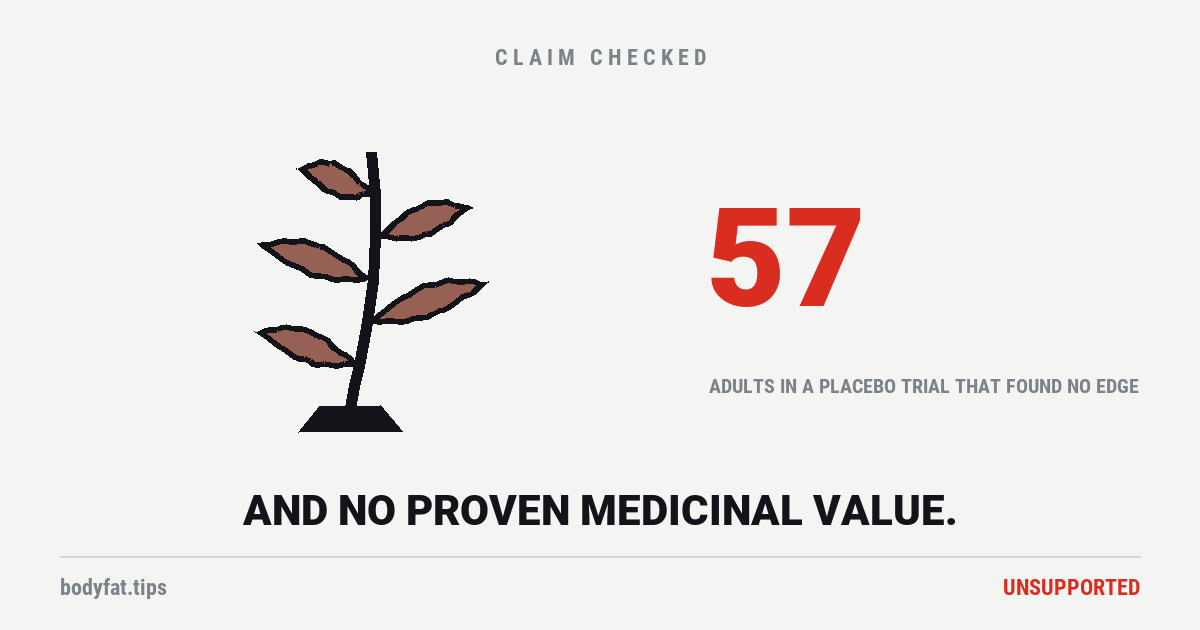
Two studies of a sea moss supplement. Both gave people a daily dose of Chondrus crispus, and neither is in PubMed, the main index of medical research. The stronger one is a randomised, double-blind, placebo-controlled trial published in June 2026: 57 adults were assigned by chance to 500 milligrams a day, 250, or a placebo (an inactive stand-in), with neither side meant to know who had which. [24] After 30 days the 500-milligram group’s score on VO2max, a measure of aerobic fitness, had risen. So did it beat the placebo? No. The paper says so itself: comparisons between the groups “did not achieve formal statistical significance”. The byline gives one affiliation for all five authors, a Brazilian ingredients company, and a website carrying that company’s two names sells a Chondrus crispus ingredient for supplements. The paper does not say what form the seaweed took or name the product it tested. It carries no funding statement, no conflict-of-interest statement and no trial registration number, and the journal accepted it five days after receiving it. [24]
The other, from Italy in 2018, went back through the records of 80 patients who had taken capsules of one of two Chondrus crispus powders for three weeks and compared how they said they felt. More of those on a branded powder said they felt better. [25] There was no placebo group and nobody was assigned by chance, so it cannot show that either powder did anything.
Small Indonesian studies of seaweed foods. The warm-water seaweeds sold as sea moss are farmed and eaten in Indonesia, and midwifery researchers there have tested them against anaemia in pregnancy: a shortage of haemoglobin, the protein in blood that carries oxygen and is built around iron. It is the nearest thing we found to a test of the minerals claim, and we read three of these studies in full. In 2021, 45 pregnant women were put into three groups without random assignment: two biscuits a day made with Kappaphycus, the biscuits plus an iron tablet, or the iron tablet alone. After eight weeks haemoglobin had risen in all three groups, a little more in the two that ate the biscuits. [36] By the paper’s own sums the two biscuits supplied under 1 milligram of iron a day, against 60 in the tablet. They were also made of egg, milk powder and wheat flour, and there was no group that got neither. In 2014, 30 pregnant women with mild anaemia took iron tablets for seven days, one group of them with Eucheuma as well; haemoglobin rose more in the seaweed group, and a blood measure of the women’s iron stores did not differ. [37] A third study gave 30 anaemic pregnant women a Eucheuma juice for eight days and reported a rise, with no comparison group, and its own tables disagree about the size of the rise. [38] None of the three was blinded, none can separate the seaweed from everything else that changed for the women, and none counted minerals. Their reference lists name four more studies of the same kind, which we have not read.
One more tested blood sugar. Ten healthy students ate the same meal twice, a week apart, the second time with about 3.5 ounces (100 g) of a Eucheuma pudding, and their blood sugar over the next three hours did not differ. [39] An index also lists a 2006 Indonesian study of the seaweed and blood sugar in people with type 2 diabetes, which we have not read.
Two registered studies with no results. A supplement company has registered a study of a gummy that contains sea moss extract and six other ingredients: 35 people, eight weeks, no comparison group, results reported by the participants themselves. It ended in April 2025, was registered almost sixteen months later, and has posted nothing. The gummy’s name includes the number 102. [26] A Canadian university has registered a test of whether adding Chondrus crispus to a meal changes how full 32 young men feel two hours later, with a seaweed producer as its collaborator; the registry lists it as still recruiting. [27]
Two tests of iodine absorption. In East Greenland, eight people ate about an ounce and a half (45 g) of local seaweed, Irish moss among the kinds tested, and about half the Irish moss’s iodine was in their urine within two days. [20] Eighteen adults in France and Belgium absorbed most of the iodine from a Gracilaria. [28] These show the iodine gets in. They test no benefit.
One thing a web search will show you. A medical news site’s article on sea moss, last updated in July 2025, says two small randomised trials of Chondrus crispus, each with fewer than 60 adults, found modestly lower fasting blood sugar, improved bowel habits and slightly more antioxidant capacity in blood. [40] Its source for that is two review papers. We read both in full. Neither describes a trial in which people ate Chondrus crispus: the one randomised trial in the first is of a nasal spray containing carrageenan, a gelling agent extracted from red seaweeds, tested against covid in 394 health workers, and the second describes no trial of that seaweed in people at all. [41] [42] Our own searches did not find the two trials either.
So, for the three claims: no study of the 92 minerals, none of any hormone being balanced, none of a metal being removed. We searched PubMed, Europe PMC, Crossref, OpenAlex, the Directory of Open Access Journals and ClinicalTrials.gov under every name sea moss is sold by. The search also turned up skin creams, a rice substitute made with seaweed flour, and carrageenan gels and nasal sprays, which are not about eating sea moss for these claims. Most of the studies in people above sit in journals PubMed does not list, which is how we missed them the first time.
That is our search rather than a census, and somebody may yet point us at a trial we missed. But it matches what the NIH database says, and the NIH says it flatly: no medicinal value has been proven.
Sea moss is a seaweed. It is food, it has been eaten for a very long time, and nothing here says otherwise. What it is not is a supplement that any test has shown to work — and it is being sold as one, at scale, to people who would reasonably assume somebody had checked.
Related: NAD+ supplements · colostrum benefits · does zinc help with colds · beetroot juice benefits · every claim we’ve checked
This page was corrected on 30 September 2026 after an independent editorial review, and re-checking the review turned up more than the review had. We said we had found no study in which people were given sea moss and measured, and that there was “nothing to replicate”. Both were wrong. Two studies of a Chondrus crispus supplement exist, in journals PubMed does not list. One is a placebo-controlled trial whose byline gives an ingredients company as its authors’ only affiliation, and a website carrying that company’s two names sells a Chondrus crispus ingredient; the trial found no significant difference from placebo. Three small Indonesian studies also gave pregnant women a food made with the warm-water species and measured their haemoglobin; none had a placebo food. We said we could not tell you that any particular tub is a problem. The FDA had recorded a recall of about 5.4 million jars of one brand’s gel seven months before we published, and California lists 64 notices in which private parties allege lead or cadmium in named products, which are allegations and not findings. We said the Norwegian seaweed eaters were over “the upper limit, the number above which intake is no longer considered safe”. The limit was Europe’s 600 micrograms; the American one is 1,100; the group’s median thyroid marker stayed inside the normal range; and one of the 49 reported eating Irish moss.
Also changed. The NIH record is dated 15 February 2026, not 2006, which is the year its database began, and it covers one species where the jar may hold another. We said eight of 25 video descriptions “carried a commerce link or code”; read one by one, seven link a shop and none has a code. The description we quoted links nothing, so “written by a marketer” is gone and a seller’s own page is quoted beside it. The search figures (“90,000 people a month” here, “90,500 searches” in the panel) were in none of our saved data and are removed; the page now opens on the question. The funding row said “Not stated in the sources read” of papers that state it. Both journal papers have now been read in full, 39 sources have been added, and the source list says how each was read. Two claims a web search returns, a seller’s account of a cadmium study and a news site’s account of two trials showing benefits, could not be traced to any paper, and the page says so. The rating is unchanged: Unsupported.