Does Sucralose Raise Blood Sugar? Not on Its Own. Whether Weeks of It Change How You Handle Sugar Is Still Split.

“Does sucralose raise blood sugar” and “does sucralose spike blood sugar” are each searched about 4,400 times a month in the United States, by the database’s figure for the past year, and 3,600 times in September (from a paid keyword database, pulled 23 October 2026) [1]. The answers people find split down the middle. One health publisher tells readers sucralose “may raise blood sugar levels by 14%”; another says sweeteners “generally do not raise blood glucose directly” [1]. A blog post from a doctors’ practice is titled “How Some Artificial Sweeteners Still Spike Your Blood Sugar” [1]. Somebody is wrong. Who?
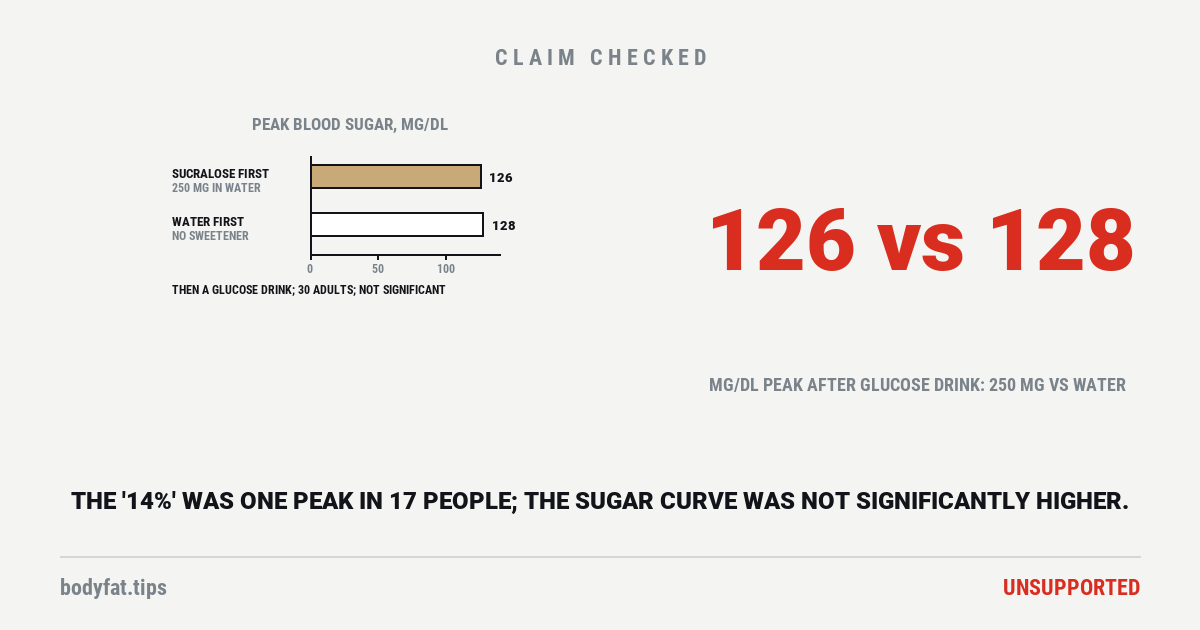
Not on its own. Drunk in water, or before a glucose drink, sucralose left blood sugar where plain water did in most tests. In one US government lab, 30 adults drank up to 250 mg of it, about 20 packets’ worth, before a glucose drink; their blood sugar peaked at 126 mg/dL on average, against 128 after plain water [2]. The FDA’s own summary is that sweeteners “generally will not raise blood sugar levels” [3]. Europe’s food-safety regulator, re-examining sucralose in 2026, judged with moderate confidence that it does not adversely affect the body’s control of blood sugar and insulin [4]. The question that is still open is a different one: whether drinking sucralose every day for weeks changes how your body handles the sugar you eat. Some small trials say a little; others say not measurably. We go through both.
This is journalism, not medical advice. If you use insulin or another diabetes medicine that can cause low blood sugar, check your glucose when you change what you drink or sweeten with, and do not change your medicines without your clinician. Swapping sugar for sucralose takes carbohydrate out of your day: in one trial in people with type 2 diabetes, the swap removed up to about three teaspoons of sugar a day [5]. A reading that stays very high, or a low with confusion, sweating or shaking, needs care at once.
What does sucralose do to blood sugar on its own?
Start with the chemistry, because it explains most of the answer. Sucralose is table sugar with three of its oxygen-hydrogen groups swapped for chlorine atoms, which makes it about 600 times sweeter [6] [3]. Your body absorbs little of it, about 14% of a dose by one review’s reading of the research, and the rest passes through the gut without being broken down [6]. It is not broken down into glucose, the sugar in your blood. So the direct route to a spike is closed.
Is there an indirect one? Researchers have looked, mostly by giving people sucralose and then sampling their blood every few minutes. In Australia, 7 healthy adults had sucralose, 80 mg one day and 800 mg another, put straight into the stomach through a tube: blood sugar rose only on the day they got table sugar [7]. In London, 8 adults drank sucralose in water and GLP-1, a gut hormone that prompts the pancreas to release insulin, did not rise; tasting it without swallowing did not raise insulin either [8].
The cleanest test is the one in the table below. At the US National Institutes of Health, 30 adults each came in four times and drank water with 0, 68, 170 or 250 mg of sucralose, then a 75 g glucose drink, the standard sugar challenge doctors use to test for diabetes [2]. The authors found no statistically significant difference in blood sugar, insulin or gut hormones at any dose: “Sucralose alone (at any concentration) did not affect metabolic outcomes” [2].
| Sucralose first | Highest blood sugar afterwards, on average | Highest insulin, on average |
|---|---|---|
| None (plain water) | 128 mg/dL (7.1 mmol/L) | 420 pmol/L |
| 68 mg, about five packets’ worth | 132 mg/dL (7.3) | 415 |
| 170 mg, about 13 packets’ worth | 128 mg/dL (7.1) | 404 |
| 250 mg, about 20 packets’ worth | 126 mg/dL (7.0) | 374 |
Two poolings, meta-analyses that combine trials to get one estimate, point the same way. A 2020 one gathered 34 trials in which people had a low-calorie sweetener, alone or with food, and found blood sugar on average 0.4 mg/dL lower than on the comparison (−0.02 mmol/L), with a range of 1.6 lower to 0.9 higher [9]. That range is a confidence interval: the range the true average probably sits in, here straddling zero. In the trials of people with type 2 diabetes, the rise was about 5 mg/dL smaller with the sweetener (−0.3 mmol/L) [9]. Most of that pooling is not sucralose. We read it as its summary and its blood-sugar chart: the tests with the most weight in it are of erythritol, stevia and acesulfame K, and the 13 rows that test sucralose alone carry 23.4% of the weight, by our addition of the chart, among them the 2013 St. Louis test below, above zero, and the 2015 test’s healthy volunteers, below it [9]. So it is evidence on low-calorie sweeteners in general. Its first author worked at a food company’s research centre, and Crossref lists that company as the funder [9]. A 2023 network pooling, a method that ranks several options against each other at once, could combine three tests of sucralose alone against water, 29 people in all, and found a difference too small to tell from zero [10]. Its trials held between 6 and 32 people each, and its funding and authors have ties to the sweetener industry [10]. So the acute evidence for sucralose by itself is consistent, and it is small.
People with diabetes were tested early. In 1996, 13 adults with type 1 and 13 with type 2 diabetes took 1,000 mg of sucralose in a capsule, about 77 packets’ worth by our arithmetic, or a dummy capsule, before a liquid breakfast; blood sugar over the next four hours was not significantly different [11]. In a 2015 test, 8 adults newly diagnosed with type 2 diabetes drank 24 mg before a glucose drink, and nothing measured differed significantly from water; in the 8 healthy volunteers in the same test, blood sugar came out lower after the sucralose [12]. A 2012 test of diet cola sweetened with sucralose and acesulfame K, before a glucose drink, in 19 young people with type 1 or type 2 diabetes and 25 without, found the blood-sugar curves not statistically different [13].
With a meal, one test leans the other way. In a 2025 master’s thesis, 13 adults aged 40 and over with prediabetes ate the same breakfast with a lemonade and capsules on three mornings, one of them carrying sucralose at about half the daily limit [14]. Blood sugar peaked at about the same height (137 against 135 mg/dL), but two hours later it sat at 82 mg/dL on the sucralose morning against 73 on the plain one [14]. What the author found significant was the change over the two hours: from fasting, blood sugar ended 15 mg/dL lower on the sucralose morning and 28 lower on the plain one. The blood-sugar curve added up over the two hours was not significantly different (p = 0.082, short of the line researchers use for “probably not chance”) [14]. It is one small test, written up as a thesis rather than a journal paper, with one participant left out of the analysis as an outlier.
Where did “14%” come from?
From one test of 17 people, and it is worth reading what it found, because it found something. In 2013 a St. Louis lab recruited 17 adults with severe obesity, 15 of them women, who did not use sweeteners [15]. Each came in twice. Once they drank 48 mg of sucralose in water, about what a 12 oz can of diet soda holds if sucralose is its only sweetener, and once plain water; ten minutes later, a 75 g glucose drink [15].
After the sucralose, blood sugar peaked higher: it rose about 86 mg/dL above where it started, against about 76 after water (4.8 and 4.2 mmol/L) [15]. That gap is the 14%, by our arithmetic. Insulin came out 20% higher, measured as the area under the curve, which adds up how high it went and for how long [15]. And insulin sensitivity, how readily the body clears sugar for a given amount of insulin, came out 23% lower after the sucralose [15]. Those findings are real and the authors stand by them. But the same paper reports that the total rise in blood sugar over the test, its own area under the curve, was not significantly different: “No significant differences in the incremental AUC of glucose” [15]. The peak was higher; the curve as a whole was not.
The university’s release called it evidence that sucralose “can modify how the body handles sugar,” and quoted the lead author saying a 20% insulin rise “may or may not be clinically significant” [16]. The sweetener’s maker answered in the journal: two employees wrote that the test was not blinded, the peak stayed in the normal range and the drink was about five times sweeter than a diet soft drink [17]. The authors replied point by point, and added a sentence worth keeping beside the 14%: “we completely agree … that the results from our study should not be used to imply that sucralose is not safe” [18].
The same lead researcher’s team tried again in 2019, in the same St. Louis unit, with 21 people who did not use sweeteners, 10 of normal weight and 11 with obesity [19]. Swallowing 48 mg of sucralose before the glucose drink raised the total blood-sugar curve by about 30% in both groups, so the 2019 test found what the 2013 one did not [19]. Tasting it and spitting it out did not. And insulin went opposite ways: down early in the people of normal weight, up late in the people with obesity, while insulin sensitivity rose 52% in the normal-weight group [19]. That is not the result of a sweetener that simply raises blood sugar.
Does sucralose raise insulin?
Sometimes a little, in some tests, and not in others. Taken alone it mostly does not: no significant insulin rise in the Australian test, the London tasting test or the NIH test above [7] [8] [2]. The idea that tasting something sweet makes the pancreas release a puff of insulin, the “cephalic phase” response, has been tested too. In 28 adults who tasted sucralose, the average insulin rise two minutes later was not significant, though each person’s highest reading in the minutes after tasting it was, on average, significantly above the start, as it was for glucose [20].
Before a glucose drink, the results scatter. Insulin came out higher after sucralose in the 2013 test of 17 people [15] and in a 2019 Mexican test of 45 young adults, 25 given sucralose and 20 water, where blood sugar itself was not significantly different [21]. It came out lower early in the normal-weight people of the 2019 St. Louis test [19], and not significantly different in the NIH test [2]. A 2025 review, the one Google’s AI answer cites, counted 16 studies of insulin response: 8 found it higher after sucralose, 7 found no impact and 1 a favourable one [22]. Those counts are from inside that review, and we read it only as its summary.
What about weeks of sucralose?
This is where the honest answer gets messier. A test that lasts a morning cannot show what a daily habit does, so several trials have given people sucralose for one to thirteen weeks and then run the glucose drink again. Here is every one we read.
| Trial | Who, how much, how long | What it found | Paid for by |
|---|---|---|---|
| Type 2 diabetes, 2003 [23] | 136 adults: 67 on 667 mg a day in capsules, 69 on dummy capsules; 13 weeks | A1C, fasting blood sugar and C-peptide changes not significantly different | First author worked for the sweetener’s maker; statement not read |
| Healthy men, 2017 [24] | 47 men: about 1,000 mg a day or dummy capsules; 12 weeks | Fasting blood sugar, insulin, A1C and glucose-test curves not significantly different | First author at the maker, with a consultancy; statement not read |
| Healthy adults, 2018 [25] | 66 non-users, 33 a group: 15% of the daily limit from store-bought packets, or nothing; 2 weeks | Insulin sensitivity fell by a median 17.7%, against 2.8% in the comparison group | The authors report no funding |
| Healthy adults, 2018 [26] | 15 non-users, each in turn: 200 mg pills or dummy pills; 4 weeks each | Insulin sensitivity lower on sucralose; early insulin release lower | Thai university and endocrine society grants; statement not read |
| Healthy men, 2019 [27] | 34 men, 17 a group: 780 mg a day or dummy capsules; 1 week | Blood sugar control and insulin resistance not significantly affected | Chilean university and science-fund grants |
| Overweight adults, 2019 [28] | 154 adults in five drink groups, 28 of them on sucralose drinks; 12 weeks | Glucose tolerance not significantly affected by any sweetener | US Department of Agriculture; statement not read |
| Healthy adults, 2020 [29] | 17 adults, each in turn: 136 mg of pure sucralose a day, or aspartame; 2 weeks | Blood sugar and insulin curves similar to the start; insulin sensitivity not significantly different | Statement not read |
| Healthy young adults, 2020 [30] | 137 in three groups: 48 mg or 96 mg a day in water, or water; 95 finished; 10 weeks | Within the 48 mg group, insulin rose and insulin sensitivity fell; not within the 96 mg group; the group-by-time test for the blood-sugar curve was p = 1.00; A1C rose within the 96 mg group, 5.15% to 5.25%, and was not significantly different between the groups at ten weeks | Mexico’s science council |
| Healthy adults, 2020 [31] | 45 recruited, 39 analysed, 13 a group: seven drinks over two weeks of sucralose, of sugar, or of sucralose with 1.1 oz (31.83 g) of maltodextrin | An insulin measure worsened only in the sucralose-with-maltodextrin group; a whole-body insulin sensitivity score did not differ significantly between groups | US National Institutes of Health |
| Type 2 diabetes, 2020 [32] | 34 adults in Iran who finished: 19 on a sucralose tablet in tea each day, 15 on tea with stevia extract; 8 weeks | A1C, fasting blood sugar and insulin not significantly different from the stevia group | An Iranian nutrition research institute; the stevia tea came from a company with a patent on it; no conflicts declared |
| Healthy young adults, 2021 [33] | 38 in three groups, 13 on four store-bought 1 g sucralose packets a day, the others on sugar or stevia packets; 6 weeks | “No differences were observed in glycaemia”, by its summary | Statement not read |
| Healthy young adults, 2022 [34] | 40 analysed, 20 a group, not blinded: 48 mg a day in water, or water; 10 weeks; reported under the 2020 trial’s registration | Within the sucralose group, the blood-sugar curve after a glucose drink rose 8% and the insulin peak 32%; at the end neither curve was significantly different from the water group’s | Mexico’s science council |
| Healthy adults, 2022 [35] | 120 in six groups of 20: four sweeteners in store-bought packets that contain glucose, the glucose alone, or nothing; sucralose 102 mg a day; 2 weeks | The rise after a glucose drink was bigger during the sucralose weeks than in either comparison group; A1C and blood insulin not significantly changed | Foundations and governments; two authors co-founded a personalised-nutrition company |
| Healthy women, 2023 [36] | 42 women in four groups, one on sucralose-sweetened water; 4 weeks | Blood sugar, insulin and A1C not significantly different from water | Turkey’s science council; statement not read |
| Type 2 diabetes, 2024 [5] | 210 adults in India, 105 a group: sucralose in place of sugar in tea and coffee, about 14 mg a day, or sugar as usual; 179 finished; 12 weeks | A1C difference 0.0 points, with a range of −0.3 to 0.3 | A maker of sucralose sweetener, which supplied it |
| Healthy lean adults, 2025 [37] | 40 enrolled, 39 analysed: 270 mg of pure sucralose a day in capsules, or cornstarch capsules; 30 days | After a test meal, blood sugar and insulin rose more than in the dummy group; insulin sensitivity fell 24.1% against 3.8%, a significant difference; fasting blood sugar not significantly changed | Mexico’s science agency; no competing interests declared |
| Prediabetes, results posted 2026 [38] | 31 older adults on a set diet, about 10 a group: sucralose, aspartame or no sweetener; 4 weeks | The glucose-monitor average rose by about the same amount on sucralose as on no sweetener, p = 0.935 in a dissertation reporting the trial [39] | A US university |
Read down the third column and count. Four trials found something going the wrong way against their comparison group. In Mexico in 2018, 66 people who rarely used sweeteners, 33 a group, either took store-bought sucralose packets worth 15% of the daily limit or took nothing, for two weeks; insulin sensitivity fell by a median 17.7% in the sucralose group, against 2.8% in the comparison group [25]. In a Thai crossover trial, where each person takes both treatments in turn, 15 people had lower insulin sensitivity after four weeks of 200 mg sucralose pills than after dummy pills [26]. In Israel, 120 healthy adults were split into six groups of 20; the group given sucralose packets for two weeks had a bigger rise after a glucose drink, measured at home on a glucose monitor, than either comparison group [35].
The same Mexican team tested it again with pure sucralose in capsules against cornstarch capsules, so nobody knew which they had, at 270 mg a day for 30 days, in 39 lean adults [37]. After a test meal, blood sugar and insulin rose more in the sucralose group than in the dummy group, and insulin sensitivity fell 24.1% against 3.8%, a difference between the groups the authors found significant [37]. The paper’s summary gives that as a fall of 20.3%, the gap between the two, by our arithmetic. Fasting blood sugar did not change significantly [37].
The 2022 Mexican trial in the table is not one of the four, though its summary reads as if it were. After ten weeks of 48 mg a day, the blood-sugar curve after a glucose drink was 8% higher and the insulin peak 32% higher, but against the sucralose group’s own start: at the end, neither the blood-sugar curve nor the insulin curve was significantly different from the water group’s (p = 0.27 and 0.96), though the summary says “compared to water” [34]. Everyone knew what they were drinking, and the paper reports “partial results” of the same registered trial as the 2020 ten-week trial below, from the same hospital, with the same dose and grant, so the two may share participants [34] [30].
Now the other column. A US trial gave 47 men about 1,000 mg a day for twelve weeks, and fasting blood sugar, insulin, A1C and the glucose-test curves were not significantly different from a dummy [24]; its first author worked for the sweetener’s maker. A Chilean trial gave 34 men 780 mg a day for a week, and blood-sugar control and insulin resistance were not significantly affected [27]. A Canadian crossover of 17 adults, two weeks on 136 mg of pure sucralose, found glucose and insulin curves similar to the start [29]. A US trial of 154 adults with overweight or obesity in five drink groups, 28 of them on sucralose drinks for twelve weeks, found glucose tolerance not significantly affected by any sweetener [28]. A Turkish trial of 42 women in four groups found nothing significantly different after four weeks [36]. A 2021 Mexican trial gave 13 young adults four store-bought sucralose packets a day for six weeks, against sugar or stevia packets for the others, and reported “No differences were observed in glycaemia” [33]. And a US trial in older adults with prediabetes, on a set diet, has posted its results: the average reading on a glucose monitor moved by about the same amount on sucralose as on no sweetener, from 97.9 to 99.5 against 93.4 to 94.9 in the unit the record gives [38], and a 2026 dissertation reporting the trial gives the comparison as p = 0.935 [39].
A 2026 pooling of short sucralose trials, which found ten of 8 to 61 people each and could pool seven, found fasting blood sugar and an insulin-resistance score not significantly different from the comparison: on a scale where 0.2 is a small effect, −0.04 and −0.13, with ranges that include zero [40].
Two trials sit in the middle, and they matter for the packet question below. A 2020 US trial recruited 45 healthy adults and analysed 39, 13 a group, who had seven drinks over two weeks: sucralose alone, sugar, or sucralose with 1.1 oz (31.83 g) of maltodextrin, a starch that digests to glucose [31]. An insulin measure worsened only in the sucralose-with-maltodextrin group; sucralose alone did not do it, and a whole-body insulin-sensitivity score did not differ significantly between the groups [31]. Two Toronto researchers re-analysed the data and argued the carbohydrate, not the sweetener, explained the change [41]; their disclosures include work for a sucralose maker. And a 2020 Mexican trial of 137 young adults, 95 of whom finished, found insulin up and insulin sensitivity down within the 48 mg group over ten weeks, but not within the 96 mg group, and its own test of the groups against each other over time gave p = 1.00 for the blood-sugar curve, as far from “probably not chance” as a p-value goes [30]. A1C after ten weeks: 5.26%, 5.25% and 5.24% in the three groups, not significantly different (p = 0.94), though within the 96 mg group it had risen from 5.15% [30].
Add up all seventeen daily-use trials in the table, and the tally, which is ours, runs like this. Four found sugar handled worse than in their comparison group, two of them with pure sucralose against a dummy. Two, the Mexican trials of 2020 and 2022, found changes only against the sucralose group’s own start. One found a change only when sucralose came with maltodextrin. Ten found no significant difference: five against a dummy, water or nothing, and five against sugar or another sweetener.
Europe’s food-safety regulator worked from a longer list for its 2026 re-evaluation of sucralose: 29 trials and one survey that measured blood sugar or insulin [4]. Many of them, it noted, used sucralose as the comparison for something else, at low doses, and few looked at changes over weeks; it found “no consistent effects” and concluded, with what it rated moderate confidence, that sucralose “does not adversely affect glucose and insulin homeostasis”, the body’s control of blood sugar and insulin [4]. That is a safety judgement at permitted amounts, not evidence that sucralose helps, and it does not set the ratings on this page. Its search ended in March 2025, before the 2025 capsule trial was published, and its list holds daily-use trials we have not read, among them a 12-week trial that used a sucralose drink as the dummy for another sweetener and a one-month trial of 50 women at Europe’s daily limit [4].
If sucralose doesn’t raise blood sugar by itself, why do some trials find people handling sugar worse after a few weeks?
This section is the desk’s own reasoning, and it is labelled as such. The acute tests say sucralose does not raise blood sugar. Several week-long trials say some people’s insulin works a little less well afterwards. Both can be true. Here are three explanations, and how much evidence each one has.
Answer one: what came with it. Store-bought sucralose packets are mostly glucose-type fillers [42], and two of the trials that found a change used them: the Israeli trial’s packets contained glucose [35], and the 2018 Mexican trial compared its packets with taking nothing [25]. The 2020 US trial found its change only when sucralose came with maltodextrin [31]. But the Israeli trial gave a separate group the packets’ glucose alone, and that group’s glucose tolerance did not change significantly [35], and the Thai pills and the 2025 Mexican capsules were pure sucralose against a dummy, and found the same direction [26] [37]. The single-morning tests that found blood sugar higher gave sucralose just before or with carbohydrate, a glucose drink or a breakfast [19] [14], though so did the NIH test, which found no significant difference [2]. So the filler is measured in part, and the measurement cuts both ways: it cannot be the whole answer.
Answer two: the ruler. These trials are small, and each measured many things: peaks, curves, several insulin indexes, at several time points. In the 2013 test the peak differed and the curve did not [15]; in the 2020 US trial a 30-minute index differed and the whole-body score did not [31]; in the 2020 Mexican trial the blood-sugar curve changed within one group but not differently from the water group, the insulin changes appeared at the lower dose but not the higher, and A1C rose within the higher-dose group only [30]; and the 2022 trial’s changes were within its sucralose group, not against water [34]. With enough measures in enough small trials, some will cross the line by chance. That is our reading of how the trials were analysed, not a measurement of sucralose, and it does not explain away the trials whose main result was the change [25] [37].
Answer three: the person, and their gut bacteria. In the Israeli trial, responses varied a great deal from person to person, and mice given gut bacteria from the people who responded most developed bigger blood-sugar responses themselves [35]. In the Indian trial’s stool samples, swapping sugar for sucralose reduced the variety of gut bacteria in people with diabetes but not in a parallel trial of people with overweight [43]. Against it, the 2026 pooling found no significant change in gut-bacteria variety across three trials [40]. Most of these trials also recruited people who did not use sweeteners [15] [25] [26], which is not who drinks diet soda every day. That some people respond and most do not is a surmise with one trial on its side.
Put the three together and here is what we think is true, stated plainly so you can disagree with it: sucralose does not put sugar in your blood; whether a daily habit of it nudges how your body handles the sugar you eat is a real question, small trials answer it both ways, and where they see a nudge, A1C has not come out significantly higher than on a dummy, water or nothing in any trial we read.
What we could not find, and would like to: a trial that gave people with prediabetes or type 2 diabetes pure sucralose or a matching dummy for longer than three months, measured glucose tolerance and A1C, and was not paid for by a sweetener maker [44]. Trials are registered that will answer parts of it, including a two-week test in healthy adults and adults with type 2 diabetes in Australia and a 30-day test of six packets a day in prediabetes in the US [44]. A three-month trial of sucralose in water against water in newly diagnosed type 2 diabetes, registered in Shanghai in December 2019 with A1C among its main measures, has a record last updated that month and no results posted [44]. If you know of the longer one, the corrections line on this site is open.
Is sucralose bad for diabetics?
For blood sugar, the trials in people with diabetes have not found it worse than a dummy, the sugar it replaced or stevia. They are fewer and thinner than they should be.
| Trial | Who and how long | What it found |
|---|---|---|
| Single high dose, 1996 [11] | 13 adults with type 1 and 13 with type 2 diabetes; 1,000 mg in a capsule or a dummy, before breakfast | Blood sugar over four hours not significantly different |
| Placebo-controlled, 2003 [23] | 136 adults with type 2 diabetes; 667 mg a day or a dummy; 13 weeks | A1C and fasting blood sugar changes not significantly different |
| Before a glucose drink, 2012 [13] | 10 young people with type 2 and 9 with type 1 diabetes; diet cola with sucralose, or fizzy water | Blood-sugar curves not statistically different |
| Before a glucose drink, 2015 [12] | 8 adults newly diagnosed with type 2 diabetes; 24 mg in water, or water | Blood sugar, insulin and GLP-1 not statistically different |
| A trial’s dummy drink, results posted [45] | 184 adults with type 2 diabetes on Splenda, 1.5 g three times a day, as the comparison for another sweetener; one year | A1C 0.09 points above the start, give or take 0.07, against 0.11 below in the tagatose group, a difference the registry gives as significant; no group without Splenda |
| Against stevia, 2020 [32] | 34 adults with type 2 diabetes in Iran who finished, 19 on a sucralose tablet in tea and 15 on stevia tea; 8 weeks | A1C, fasting blood sugar and insulin not significantly different between the groups |
| Sugar swapped for sucralose, 2024 [5] | 179 adults with type 2 diabetes who finished; 12 weeks | A1C difference 0.0 points against keeping the sugar |
| Diet drinks swapped for water, 2026 [46] | 181 adults with type 2 diabetes who drank diet drinks, 39 of them drinks with sucralose; 24 weeks | A1C ended 0.29 points higher in the group that switched to water |
The longest published test of sucralose against a dummy in people with diabetes that we found ran 13 weeks: 136 adults with type 2 diabetes, 67 taking 667 mg a day, half again the FDA’s daily limit by weight, and 69 taking dummy capsules [23] [44]. A1C, fasting blood sugar and C-peptide, a marker of how much insulin the body makes, were not significantly different [23]. Its first author worked for the sweetener’s maker, and we read it only as its summary [23].
The newest is from India: 210 adults with type 2 diabetes, 105 a group, either swapped the sugar in their tea and coffee for a sucralose sweetener or kept the sugar, for twelve weeks [5]. Of the 179 who finished, A1C went from 8.8% to 8.9% in both groups, a difference of 0.0 points, with a range of plausible answers from 0.3 lower to 0.3 higher [5]. Fasting blood sugar came out 4.6 mg/dL lower with sucralose, within chance [5]. The sweetener’s maker paid for the trial and supplied the sweetener [5]. Note what it does and does not show: A1C came out the same on sucralose as on sugar, to the first decimal place, so dropping up to about three teaspoons of sugar a day did not lower it either.
An eight-week trial in Iran set sucralose against stevia, each in tea. Of the 34 adults with type 2 diabetes who finished, A1C went from 6.95% to 6.93% on sucralose and from 7.07% to 6.89% on stevia, not a significant difference (p = 0.53), and fasting blood sugar and insulin did not differ significantly between the groups either [32]. And the one-year tagatose trial in the table, which used Splenda as its comparison, ended with A1C higher on Splenda than on tagatose, the sweetener being tested as a treatment, by a margin the trial’s registry gives as significant [45]; with no group going without Splenda, that is a result for tagatose, not evidence that Splenda raised A1C.
One trial pointed the other way from the claim, and it was not about sucralose alone. In a US trial published in February 2026, 181 adults with type 2 diabetes who habitually drank diet drinks either kept drinking them or switched to water for 24 weeks [46]. A1C fell from 7.19% to 7.14% in the group that kept the diet drinks and rose from 7.20% to 7.44% in the water group, a difference of 0.29 points that the authors judge unlikely to be chance [46]. Most of those drinks were sweetened with aspartame; 39 of the 181 people drank ones containing sucralose [46]. It is a test of diet drinks, not of sucralose, and it found no sign that they were worsening blood sugar.
The pooled verdict is cautious. A 2020 Cochrane review of non-nutritive sweeteners in diabetes found A1C 0% different from a dummy across four trials and 360 people, and graded the evidence very low certainty, meaning further research could easily change the estimate [47]. The American Diabetes Association’s 2026 standards say sweeteners “do not appear to have a significant effect on glycemic management,” recommend water first, and say they can replace sugar-sweetened products “if consumed in moderation and for the short term” [48].
Does Splenda raise blood sugar?
Here the claim has half a point. A Splenda packet weighs 1 g, and its ingredients are dextrose, maltodextrin and sucralose [42]. Dextrose is the food industry’s name for glucose. The sucralose is about 13 mg of the gram, by our arithmetic from the FDA’s packet count [3]; the rest is filler that digests to glucose, and the label gives total carbohydrate as under 1 g [42]. The FDA reckons a packet as sweet as two teaspoons of sugar, about 8 g [3]. So a packet carries under an eighth of the carbohydrate of the sugar it replaces. Not zero, and not much. For what maltodextrin does gram for gram, see our maltodextrin verdict.
What does a packet’s worth do to blood sugar, measured? We found no test that measured blood sugar in the hours after a packet’s dextrose and maltodextrin on their own [44]. The nearest evidence we read is a 2011 test whose sucralose drink was 6 g of the brand’s granulated sweetener, by the European regulator’s description of it, after which blood sugar and insulin changed differently over time only between the drinks with sugar and those without [49] [4]; the Israeli trial’s group that took the packets’ glucose without a sweetener, 5 g a day for two weeks, whose glucose tolerance did not change significantly [35]; and a drug trial that used Splenda as its dummy, 4.5 g a day, in which A1C was 0.09 points above the start after a year in 184 people with type 2 diabetes, give or take 0.07, with no group going without Splenda to compare against [45]. The regulator’s list holds two more single-morning tests of the brand’s product, one of them baked into a muffin, which we have not read [4]. The brand’s handout for health professionals says one serving “does not impact blood sugars” [50]; the studies it lists beside that sentence do not test a packet. The packet itself says “suitable for people with diabetes” [42]. If you use packets by the dozen, or granulated sweetener by the cup in baking, the filler adds up; the carbohydrate line on the label is the number to count.
How much sucralose is too much?
The FDA’s acceptable daily intake, the amount regulators judge safe to eat every day for life, is 5 mg per kilogram of body weight, about 2.3 mg per pound [3]. The FDA works that out as 23 packets a day for a 132 lb (60 kg) person [3]; for a 180 lb person it is about 31 packets, by our arithmetic. Europe’s regulator sets a higher figure, 15 mg per kilogram, and its 2026 re-evaluation saw no need to change it [4]; our sucralose safety verdict covers that review’s other findings. That limit is a safety number, not a blood-sugar number. The trials above ran from about 14 mg a day [5] to about 1,000 [24], and the blood-sugar results do not line up with the dose: the 1,000 mg trial found nothing significant, and the ten-week Mexican trial found its insulin changes at 48 mg and not at 96, while A1C rose a little within the 96 mg group only [30].
Is sucralose a sugar?
No, though it is made from one. US regulations define it by a chemical name that describes a sugar molecule carrying three chlorine atoms, and allow it as a general-purpose sweetener [51]. The body absorbs little of it and the rest passes through without being broken down [6], and the FDA counts sweeteners like it as contributing only a few calories or none [3]. The carbohydrate on a packet’s label comes from the filler, not from the sucralose [42].
Is sucralose worse than sugar?
For blood sugar, no. Sugar raises it directly; sucralose, in the tests above, did not. In the 2011 test of 8 women, glucose and insulin over time differed significantly only between the drinks with sugar and those without, whether or not sucralose was added, and its sucralose drink was the brand’s granulated sweetener, not pure sucralose [49] [4].
Whether swapping sugar for sucralose helps blood sugar is a separate question, and the Indian trial found A1C 0.0 points different after twelve weeks of the swap [5]. The randomised trials of swapping sugary drinks for sweetened ones, and for water, are on our artificial sweeteners verdict, and the drinks themselves on our diet soda verdict.
Is sucralose better than aspartame, or stevia?
For blood sugar, the head-to-head trials are few and do not agree. In the Israeli trial, sucralose and saccharin raised the response to a glucose drink, and aspartame and stevia did not significantly [35]. In the Canadian crossover, neither sucralose nor aspartame significantly altered glucose metabolism [29], and in the US prediabetes trial the two moved about alike [38]; in the same university’s single-morning test with a meal, blood sugar sat higher two hours after sucralose and not significantly higher after aspartame [14]. The other questions about each have their own pages: aspartame, stevia, and all the sweeteners side by side.
Who these studies were done on
Mostly young, healthy adults who did not use sweeteners, in groups of 15 to 40 [25] [26] [35]. People with type 2 diabetes appear in a 13-week trial against a dummy, a 12-week swap trial in India, an 8-week trial against stevia in Iran and a handful of single-morning tests [23] [5] [32] [11] [12]. People with type 1 diabetes appear in two single-morning tests, 22 people in all [11] [13]. Teenagers appear in the 2012 test, aged 12 and up [13], and in a teenage arm of the 2020 US trial that was stopped early [31]. People with prediabetes appear in one small sucralose trial whose results are posted and reported in a dissertation [38] [39], and in one single-morning test written up as a thesis [14]. Nine of the seventeen daily-use trials in the table above lasted a month or less; the longest against a dummy that we found ran thirteen weeks [23]. If you have diabetes and drink diet soda daily, the trial closest to you is the 24-week diet-drink trial [46], and it is about diet drinks in general.
Where “sucralose spikes your blood sugar” came from
The idea starts in a dish. In 2007, researchers found that cells from the human gut have the same sweet-taste receptors as the tongue, and that a line of those cells grown in a dish released GLP-1, the hormone that prompts insulin, when bathed in sucralose [52]. If the gut can taste sweetness, perhaps a sweetener could nudge insulin. A reasonable hypothesis, and the tests in people above are what came of it.
In 2013 it reached the news, carefully. The university release on the 17-person test said sucralose “can modify how the body handles sugar” and quoted the lead author’s caution about clinical significance [16]. Seven years later a health publisher’s article, still live and medically reviewed in June 2026, turned the peak into “may raise blood sugar levels by 14% and insulin levels by 20% in people with severe obesity who don’t regularly use artificial sweeteners”, added that it “may have little effect on regular users”, and made its bottom line “it may raise blood sugar levels” [1]. Google’s AI answer cited that article on 23 October 2026, beside a primary-care practice’s post on how sweeteners “still spike your blood sugar” [1].
And where it lives now: a symptom-checker app’s page, “Stop Now: Why Artificial Sweeteners Spike Your Insulin Today,” which ends by offering a free online symptom check; and a glucose-monitor company’s guide to sweeteners and insulin under a banner offering 15% off its monitoring programme [1]. We could not trace who first said “sucralose raises your blood sugar” in those words; the earliest version of the idea we read is the 2013 release, which said something narrower [44]. The other side sells too: the packet that says “suitable for people with diabetes” [42], and the maker’s handout calling the sweeteners “absolutely safe” [50].
None of this is aimed at anyone who has watched a glucose monitor jump after a diet drink and wondered. A diet drink with a meal is not a test of sucralose; the meal is in the reading. That is a fair thing to notice, and the trials above are the way to separate the two.
What this is rated, and what the rating covers
Unsupported, of the tested kind — for the claim that sucralose raises your blood sugar on its own.
It was tested, and it did not hold up. Delivered by tube into the stomach, sucralose left blood sugar flat; it rose only after table sugar [7]. Drunk in water before a glucose drink, at up to 250 mg, it did not significantly raise blood sugar in the NIH test [2]. In people with type 1 and type 2 diabetes, before a breakfast or a glucose drink, the tests found no significant difference [11] [13] [12], and a pooling of 34 trials of low-calorie sweeteners in general, most of its weight from sweeteners other than sucralose, found an average difference too small to tell from zero [9]. Over weeks, A1C was not significantly higher than on a dummy, water or nothing in any trial we read that measured it, nor significantly higher than on sugar or stevia in the trials in people with diabetes [23] [5] [32] [30] [35]. It rose within one group of one trial, from 5.15% to 5.25%, against its own start and not against the water group, and in a drug trial it ended higher on Splenda than on tagatose, the sweetener being tested as a treatment [30] [45]. Fasting blood sugar rose significantly in one group of one trial, from 87.9 to 91.4 mg/dL against its own start, not against the water group [30]. Europe’s food-safety regulator, from a longer list of trials, judged with moderate confidence that sucralose does not adversely affect the body’s control of blood sugar and insulin [4].
What did find blood sugar higher were some tests where sucralose came just before or with carbohydrate: the 2013 peak, the 2019 St. Louis test, a 2025 thesis test with breakfast in 13 people with prediabetes, and, after weeks of it, the 2022 Israeli trial and the 2025 Mexican capsule trial, against their comparison groups [15] [19] [14] [35] [37]. Those are findings about how the body handled the sugar that came with it, not about sucralose putting sugar in the blood, and they are the reason the narrower claims below are rated Preliminary rather than Unsupported.
The narrower claims, rated alone, in words. That sucralose spikes blood sugar on its own: Unsupported, of the tested kind; the tests are many and agree, though each is small. That it makes a glucose drink or a meal raise blood sugar more, the same morning: Preliminary; three small tests found it and others, with two poolings, did not [15] [19] [14] [2] [10]. That it raises insulin: Preliminary; some tests found more insulin after a glucose drink, others less or no significant difference, and taken alone it mostly did not [15] [21] [19] [2]. That weeks of it worsen glucose tolerance or insulin sensitivity: Preliminary; four small trials found it against their comparison group, two of them with pure sucralose against a dummy, ten found no significant difference, five of them against a dummy, water or nothing, two more found changes only within the sucralose group, and one found a change only when sucralose came with maltodextrin [25] [26] [35] [37] [24] [27] [36] [30] [34] [31]. That it is bad for people with diabetes, on blood-sugar measures: Unsupported, of the tested kind, on trials that are few, short and partly paid for by sweetener makers; the one in which A1C came out higher compared Splenda with a sweetener being tested as a treatment [23] [5] [32] [47] [45].
What is not rated here: weight, appetite, cancer and DNA, which our sucralose verdict covers; gut health beyond its link to blood sugar; and the frame in the section above, which is this desk’s reasoning from the evidence rather than a result the evidence delivered. Other foods people ask the same question about have their own pages: coffee and peanuts.
This is journalism, not medical advice. What you sweeten with, and any change to your diabetes medicines, belongs with the clinician who knows your numbers. How we read a study, and what each tier means, is set out here.
- Is Allulose Safe? Diarrhea at Big Doses, an HDL Dip, and No EU Clearance
supported - Are Emulsifiers Bad for You? They Inflamed Mouse Guts. In People, the Trials Are Small, Short and Split.
preliminary - Is Maltodextrin Bad for You? Gram for Gram, It Does Spike Blood Sugar More Than Table Sugar. “Worse Than Sugar” for Your Liver and Belly Fat Is Not What the Trials Found.
established