Is Melatonin Bad for Your Heart? The Heart-Failure Study Counted Only Prescriptions

In November 2025 a sleep aid most people think of as harmless picked up a headline it has not shaken: melatonin, linked to heart failure. In the United States, “is melatonin bad for your heart” went from 140 searches in October 2025 to 27,100 that November, and from February to September 2026 it was searched 1,900 to 2,900 times a month (from a paid keyword database, pulled 22 October 2026) [1].
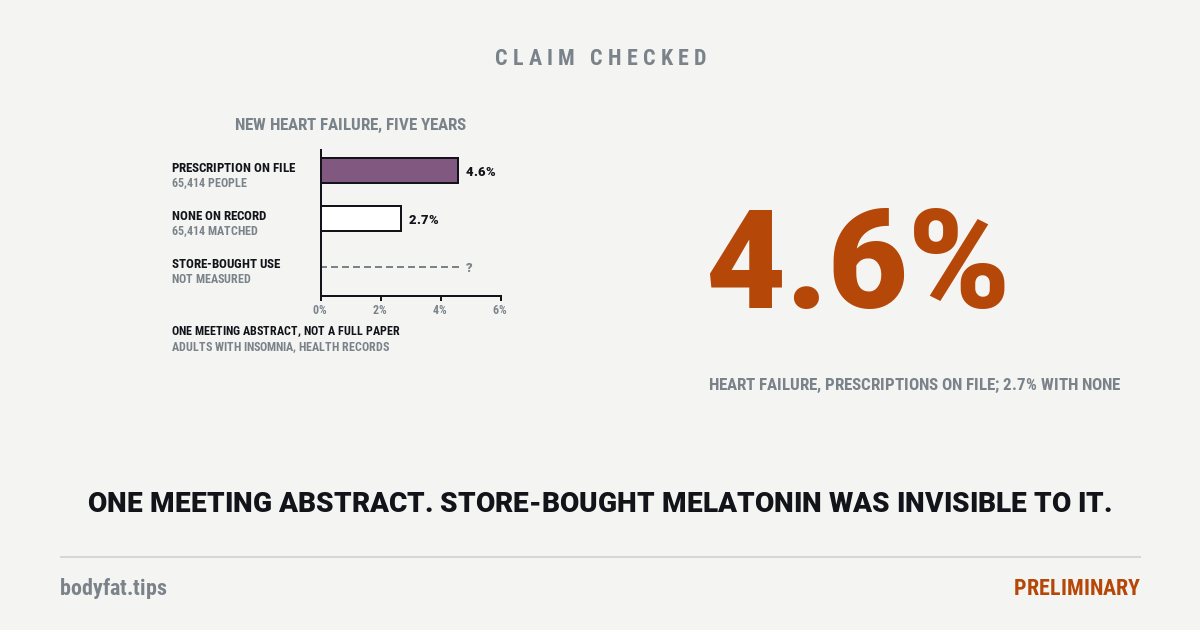
The study behind the scare is a conference abstract, a one-page summary, that has still not appeared as a full paper. It compared people whose health records showed a year of melatonin prescriptions with matched people whose records showed none, and found heart failure in 4.6% of the first group and 2.7% of the second over five years [2]. It could not see melatonin bought off the shelf, and it cannot tell melatonin apart from the reasons people take it. Studies that looked for harm in other ways mostly did not find it: three large US cohorts, groups of people followed for years, that asked about supplements found heart attacks and strokes not significantly more common in users [3], and small trials in people with heart disease reported no serious side effect put down to melatonin [4], with one unfavourable result we come to.
This is journalism, not medical advice. If you have heart disease, or take medicine for your heart or your blood pressure, talk to your clinician before you start or stop any sleep aid, melatonin included. Chest pain, fainting, or palpitations with breathlessness need care at once, not a website.
What the melatonin heart failure study found
The study came from a team of doctors led from a Brooklyn teaching hospital, and it was presented as a five-minute digital poster at the American Heart Association’s annual meeting in New Orleans on 10 November 2025 [2]. Its abstract, a one-page summary, appeared a week earlier in a supplement to the association’s journal Circulation, which is where meeting abstracts are printed. It is not a peer-reviewed paper, and the association’s own release says so [5].
The team searched TriNetX, a network that pools de-identified health records from health-care organisations in several countries, for adults diagnosed with insomnia [2] [5]. Anyone whose record showed at least one melatonin prescription and at least 365 days of recorded use went into the melatonin group: 65,414 people. Each was paired with one person with insomnia whose record showed no melatonin at all. The pairing is a statistical method called propensity-score matching, which picks comparison people who look alike on paper; the abstract lists age, sex and race, 15 illnesses, heart and metabolic medicines, lab results, vital signs and how much health care they used [2]. People already diagnosed with heart failure, or prescribed other sleeping pills, were left out.
Over the next five years, 3,021 of the melatonin group were diagnosed with heart failure, 4.6%, against 1,797 of the matched group, 2.7% [2]. The study reports that as a hazard ratio of 1.89: the rate of new heart failure ran 1.89 times as high, which is where the “90% higher” headlines come from. Its confidence interval, 1.78 to 2.00, is the range the true ratio probably sits in for these records; it is not a range for anyone reading this. In plain counts the gap is 1.9 percentage points, about 19 more diagnoses for every 1,000 people over five years (our arithmetic).
Two more numbers travelled with it. Heart-failure hospital stays: 19.0% of the melatonin group against 6.6%. Deaths from any cause: 7.8% against 4.3% [2]. Counting only people who had filled two prescriptions at least 90 days apart gave a hazard ratio of 1.82.
| Study | Who, and for how long | What it found |
|---|---|---|
| Health-records study, 2025, a conference abstract [2] | 130,828 adults with insomnia, half with a year of melatonin prescriptions on file; five years | New heart failure in 4.6% of the melatonin group against 2.7% of matched people with no melatonin on record |
| Three US cohorts, 2024 [3] | 159,072 nurses and health professionals asked about supplements; up to 23 years | Heart attacks, coronary procedures and strokes not significantly different in regular users; heart failure not counted |
| National survey analysis, 2026 [6] | 50,929 US adults, 267 of them recent users; one survey visit | Reported heart failure not significantly different in users; the range is wide |
| Review of 14 randomised trials, 2026 [4] | 1,027 people with heart disease; days to 24 weeks | No serious adverse event put down to melatonin in any trial |
What the study could not see
So why isn’t that the end of it? Three reasons, and the association’s own release raises all three [5].
It counted prescriptions, not pills. TriNetX holds records from countries where melatonin needs a prescription, such as the United Kingdom, and countries where it does not, such as the United States, and the researchers could not see which country a patient lived in [5]. In the US melatonin is sold as a dietary supplement [7]; in the UK it is available on prescription only [8]. So an American who bought melatonin at a pharmacy for years, and never had it typed into a record, counted as a non-user. The comparison is between people with a melatonin prescription on file and people without one, which is not the same thing as people who take it and people who don’t.
Its hospital numbers don’t add up the usual way. Among the melatonin users, 12,411 had a heart-failure hospital stay and 3,021 had a new heart-failure diagnosis [2]: about four hospital stays for every new case (our arithmetic), in people who had no heart failure at the start. The release explains that hospital records may carry a range of related codes without the code for a new diagnosis [5]. Whatever the reason, the “nearly 3.5 times as likely” to be hospitalised that the release reports counts something broader than heart failure diagnosed for the first time.
It did not know why people were taking it. The researchers had no measure of how bad anyone’s insomnia was, and no information on depression, anxiety or other psychiatric illness [5]. The lead author named the problem himself: worse insomnia, depression or anxiety, or other sleep medicines “might be linked to both melatonin use and heart risk” [5]. The abstract gives no dose [2].
Who paid for it, and whether its authors have interests, is not on the record either: the abstract names no funder, and the meeting’s planner lists seven of the eight authors with the line “Financial relationships have not been disclosed at this time” [2].
Has the full study been published?
Not that we could find. Two days after the abstract went online, a newspaper reported that the lead author planned to submit the paper for review in early 2026 [9]. On 22 October 2026, Crossref held the abstract and nothing more from the team on this question, PubMed and Europe PMC held nothing from them on it, and an ordinary web search turned up coverage of the abstract only [10]. Until a paper appears, the abstract and the release are what there is to check the 4.6% against.
Has any regulator warned about melatonin and heart failure?
One has raised it. In April 2026 Saudi Arabia’s drug regulator, the Saudi Food and Drug Authority, published a safety signal on melatonin and heart failure, asking health professionals to be aware of a possible risk [11]. A safety signal is reported information on a possible link between a drug and a harm, one that has not been well documented before. The authority’s own definition calls a signal “a hypothesis” that is “not only uncertain but also preliminary in nature”. The notice asks for awareness; it does not order a label change or restrict sales, and it is not a finding that melatonin causes heart failure.
What it rested on is the useful part. In March 2026 the authority searched its own national database and the World Health Organization’s global database of suspected side-effect reports. It found no Saudi cases and four from elsewhere, and said the four “lacked sufficient information for a proper assessment”. Its search of the research found one published study suggesting a possible link: the records abstract above [11] [2]. From those it judged the evidence “suggestive for causal association”. So the signal is the same abstract, read by a regulator, plus four reports the regulator could not assess. It is not a second study, and it does not change our rating.
It is the one regulator’s opinion on melatonin and heart failure that we found. Melatonin does not appear in the agendas, minutes or signal decisions of the European Medicines Agency’s drug-safety committee that we read, from October 2025 to October 2026; the UK and Canadian regulators’ searchable safety notices turned up nothing on melatonin and the heart; and web searches naming the Australian and US regulators turned up nothing either [10].
Do larger studies of melatonin users show heart harm?
Two studies that looked at melatonin users’ hearts in other ways are worth setting beside it. Neither saw what the abstract saw, and neither settles it.
The bigger of the two followed nurses and other health professionals in three long-running US cohorts, 159,072 people, for up to 23 years [3]. Every few years they were asked whether they took melatonin regularly, which catches the store-bought use the records study missed. Across more than 2.6 million person-years (one person followed for one year counts as one) there were 16,917 heart attacks, coronary artery procedures and strokes. For regular melatonin users the hazard ratio was 0.94, with a range from 0.83 to 1.06 that takes in both a small benefit and a small harm, and the authors report it as not significantly different [3].
Two limits keep it from answering the abstract. These cohorts did not count heart failure: their heart outcomes were coronary disease and stroke. And the users were few: 266 of the 16,917 events happened in people who reported taking melatonin. People who reported it in more than one survey came out at 1.11, range 0.88 to 1.40, also not significant [3].
The second is a national US health survey, analysed in 2026 by two doctors at a Tennessee university medical centre as a direct reply to the abstract [6]. Of 50,929 adults, 267 had taken melatonin in the previous 30 days. After adjustment, melatonin use was not significantly linked with reported heart disease or heart failure; for heart failure the odds ratio, a cousin of the hazard ratio for a single snapshot, was 0.88, with a range from 0.43 to 1.80 too wide to rule much in or out. It is one survey visit, people’s heart history taken the same day as their supplement list, and the authors call it a “hypothesis-generating” counterpoint, not evidence of safety [6].
What happens to the heart in randomised trials of melatonin?
An observational study watches what people chose to do. A randomised trial decides for them, by chance, so the groups differ only in the pill. Melatonin has been trialled in people who already have heart disease, mostly to see whether it protects the heart, which also makes these trials a test of whether it harms it.
The newest review of them, searched to January 2026, found 14 trials with 1,027 people: seven around bypass surgery, four in heart attacks treated by angioplasty (opening the blocked artery with a balloon and usually a stent), and three in people living with heart failure [4]. They were small, 34 to 130 people each, and short, and the doses ran from 3 mg by mouth to 60 mg, some of it given by drip. Not everyone in them took melatonin: by our count from the review’s table, 45 of the 1,027 were in extra arms of two trials that got a different supplement instead. No trial reported a serious adverse event put down to melatonin. The ejection fraction, the share of blood the main pumping chamber pushes out with each beat, improved 3.95 points more on melatonin from start to finish, mostly in the bypass trials; the final values were not significantly different [4].
The three heart-failure trials ask the abstract’s question from the other side: give melatonin every night to people whose hearts are already failing, and watch. They ran 8 to 24 weeks, with 39, 92 and 70 people; the last compared melatonin, an amino-acid supplement and the two together with a dummy, so 36 of its 70 took melatonin [4]. In the 24-week one, 92 people with weak hearts, 87% of them men, took 10 mg or a dummy pill at bedtime [12]. NT-proBNP, a blood marker that rises as the heart strains, came out lower on melatonin, and quality-of-life scores better; the ejection fraction was not significantly different. One person on melatonin and two on placebo were admitted with worsening heart failure. Side effects were reported by 9 people on melatonin and 4 on placebo, a gap the trial could not tell from chance, and no serious side effect was seen [12].
The unfavourable result came from a heart-attack trial. In Spain, 146 people having angioplasty for a major heart attack were given melatonin or a dummy by drip and straight into the artery [13]. The amount of heart muscle that died was not significantly different. But over the following four months or so, the ejection fraction recovered more in the placebo group, and the authors called melatonin’s effect on it unfavourable [13]. That was a high dose in the middle of a heart attack, not a bedtime tablet, and we read the trial as its abstract only. A later pilot trial from the same group went the other way: 94 heart-attack patients were given 12 mg of melatonin or salt water by drip before angioplasty, in an open trial without blinding, and over two years 3 on melatonin and 10 on salt water died or were readmitted with heart failure [14]. Its hazard ratio of 0.3 has a range from 0.08 to 1.08, which crosses 1, the point where the two groups would be equal.
And one more result that points against melatonin, from a trial in insomnia. In a six-month trial of a 2 mg slow-release tablet in 791 adults with insomnia, paid for by the tablet’s maker, 15 of 534 people on melatonin reported a heart-related side effect during the long phase of the trial, against 2 of 177 on the dummy, 2.8% against 1.1% [15]. The authors ran no statistical test on the safety data and called the safety profile very similar to placebo. One woman of 68, with a three-year history of palpitations, had palpitations serious enough to be reported as possibly caused by the drug [15].
Does melatonin raise or lower blood pressure?
Blood pressure is where melatonin has been measured most, and it mostly goes down a little.
A pooling of 63 trials, which combines their results into one estimate, published at the turn of 2026, found systolic pressure, the top number, 2.34 mmHg (millimetres of mercury, the unit on a blood-pressure cuff) lower on melatonin, across 23 comparisons and, by the review’s own count, 1,157 people, with a range from 4.13 to 0.55 lower [16]. That count is generous. It counts the placebo group of the bypass trial below, 18 people, twice, because that trial’s two doses were entered as two comparisons; and it lists a crossover trial, in which each person takes melatonin and the dummy in turn, as 65 people a side, when 17 men completed it [16] [17]. The bottom number was not significantly different, and the reviewers rated the certainty low. No trial in its blood-pressure analysis enrolled more than 100 people, going by its table and, for the crossover trial, that trial’s own paper.
Read the chart behind that average and it is less tidy. The two trials carrying the most weight in it found systolic drops of about 1 point or less; the drops of 7 to 12 points came from trials of 18 to 50 people; and in one trial, of 60 people recovering from bypass surgery, systolic pressure rose by about 2 to 4 points on melatonin and fell by about 3 on a dummy pill, in a group that had started 5 to 6 points higher, so the chart puts melatonin about 5 to 7 points higher; the trial reports no significant difference between its groups [16] [18]. That reading of the chart is ours, and we checked the surprising rows against the bypass trial’s own table.
In people with high blood pressure, a 2022 review found four trials and 137 people [19]. Slow-release melatonin lowered systolic pressure during sleep by 4.67 mmHg, with a range from 8.79 to 0.55. The review’s own summary gives a smaller 3.57 for sleep, with a range that crosses zero; in its results section, that figure is the daytime one (our reading of the paper). An earlier pooling, of seven trials and 221 people, found a night-time drop of 6.1 mmHg with slow-release tablets only; two of its three authors worked for the company that makes the licensed slow-release tablet, and the third had research grants from it [20].
The exception matters if you take blood-pressure medicine. In 47 people whose high blood pressure was well controlled on nifedipine, a common blood-pressure drug of the calcium-channel-blocker kind, 5 mg of fast-release melatonin at bedtime for four weeks raised blood pressure by 6.5/4.9 mmHg over 24 hours, and heart rate by 3.9 beats a minute, compared with placebo [21] [19]. The authors suspect the two drugs compete. It is one small trial, but it is a measured interaction, and it is why melatonin belongs on the medicine list your doctor sees. For what actually moves blood pressure, our verdict on lowering it naturally has the numbers, and magnesium is rated Supported for blood pressure on its own page.
That melatonin lowers blood pressure: Preliminary. The poolings lean that way, by 2 to 6 mmHg depending on who was studied and which tablet; the certainty is low; and one trial in people on nifedipine went the other way.
Can melatonin cause heart palpitations or an irregular heartbeat?
It has been reported. How often is a number the evidence does not give.
The licensed slow-release tablet’s European product information lists palpitations, an uncomfortable awareness of your own heartbeat, and angina, chest pain from the heart, among its rare reactions, between 1 in 10,000 and 1 in 1,000 people, and high blood pressure among the uncommon ones, between 1 in 1,000 and 1 in 100 [22]. The list comes from trials with 1,931 people on the tablet and from reports sent in after it went on sale.
Doctors have written up individual patients. In the Netherlands, two men of 72 and 63 taking 1 mg had frequent extra beats from the heart’s lower chambers that stopped when they stopped melatonin [23]. In Qatar, a man of 22 came to an emergency department with palpitations and dizziness after 20 mg and was found to have a very slow heart rate, which settled within hours [24]. In Spain, a man of 63 on 10 mg a day had palpitations and, on a 24-hour recording, heart block, a delay or drop-out in the signal passing from the heart’s upper chambers to its lower ones, which cleared after he stopped [25]. A case report shows that something happened to someone and went away when the drug did. It cannot say how often, or rule out coincidence, and the authors of the 2026 report, who searched for others like it, call the number they found small [25].
In the trials in people with high blood pressure, melatonin slowed the sleeping heart by about 3 beats a minute [19].
That melatonin causes palpitations or an irregular heartbeat: Preliminary. There are case reports in which the problem stopped when melatonin stopped, and the licensed tablet’s label lists palpitations as rare; neither tells you how often it happens.
Is it safe to take melatonin every night?
For the heart, this is what nightly use has been tested against. Trials: 24 weeks of 10 mg every night in people with heart failure [12], and six months of 2 mg in adults with insomnia [15], both above. Cohorts: regular users followed for up to 23 years, with heart attacks and strokes not significantly different [3], and the records abstract, with its rise in heart-failure diagnoses among people with a year of prescriptions [2]. The US health institutes’ summary is that short-term use appears safe for most people and that information on long-term safety is lacking [7]. Europe licenses its prescription tablet for up to 13 weeks [22]; what each regulator says about dose is on our melatonin dosage page.
An expert the heart association asked to comment put it more bluntly, in its release: melatonin “should not be taken chronically without a proper indication” [5].
Is melatonin bad for your heart in kids?
The heart-failure abstract counted adults only, 18 and over [2]. For children the evidence is about side effects in general, not the heart in particular. A 2023 review for Denmark’s health authority went through 22 trials with 1,350 children and teenagers with insomnia: melatonin was not associated with more serious adverse events, and non-serious ones were more common, with a relative risk of 1.56, meaning about one and a half times as many children reported one [26]. One small 2004 trial gave 21 teenagers, 11 of them with type 1 diabetes, 5 mg for a week and saw the bottom blood-pressure number dip slightly further at night in the diabetes group [27]. Accidental swallowing is the children’s risk with hard numbers, and our dosage page has them.
What is the best sleep aid for heart patients?
We are not going to pick one for you; that is a conversation with whoever treats your heart. The US health institutes’ summary of the guidelines is that the evidence is not strong enough to recommend melatonin for long-running insomnia, and that the physicians’ college strongly recommends structured talking therapy for insomnia, called CBT-I, as the first treatment [7]. The guidelines our dosage page reviews put it ahead of any pill, and our sleep hygiene verdict covers why the simple tips alone fall short of it.
There is one more reason to have that conversation. Sleep apnoea, in which breathing stops and starts during the night, can cause insomnia, and outside experts asked about the abstract suggested undiagnosed apnoea as one explanation for its result [9].
Then why did the melatonin users get more heart failure?
This section is the desk’s own reasoning, and it is labelled as such. If melatonin did not do it, something else made 65,414 people with a melatonin prescription more likely to be diagnosed with heart failure. Here are three candidates, and what each rests on.
Answer one: the reason for the pill. Nobody gets a year of sleep medicine at random. In the national survey, melatonin users were nearly three times as likely as non-users to report trouble sleeping, 57.9% against 20.5%, and more than twice as likely to report depression [6]. In the records study every comparison person had insomnia too, but the researchers had no measure of how severe it was, and nothing on depression or anxiety [5]. Someone whose insomnia is bad enough to be treated for a year may be sicker in ways a computer match cannot see. That users differ is measured. That the difference explains this result is a surmise, and the abstract’s own authors raise it.
Answer two: heart failure keeps you awake. Heart failure that has not yet been diagnosed can worsen sleep, which brings on the sleep aid, so the pill shows up in the record first and the diagnosis second [6]. The abstract does not say when its five-year clock started [2]. This is a surmise, raised in the 2026 reply, and nothing in the abstract tests it.
Answer three: the record is the exposure. The groups were defined by what was written in the record, so the melatonin users were, by definition, people who had a prescriber write down a sleep medicine and keep it on file for a year [2]. More contact with doctors means more chances for a heart-failure code to be entered, and the abstract’s own counts show those codes being used loosely, and more loosely among the users: about four heart-failure hospital stays for every new diagnosis in the melatonin group, against nearly two and a half in the comparison group (our arithmetic). The comparison group had an insomnia diagnosis on file too, and the matching took in how much health care people used, which was meant to blunt this [2]. That it did not blunt it enough is our inference, which nothing in the abstract tests either.
Put the three together and here is what we think, stated plainly so you can disagree with it: the abstract measured who ends up with a year of melatonin in their medical record, not what melatonin does to a heart.
What we could not find, and would like to: a randomised trial that gives adults with insomnia melatonin or a dummy every night for years and counts new heart failure [10]; short of that, a records study that captures store-bought use, starts the clock at the first dose, and compares melatonin users with people starting a different treatment for insomnia; and the full paper behind the abstract. A Cochrane review of melatonin and blood pressure is under way, with its protocol published in 2025 [28]. If you know of any of these, the corrections line on this site is open.
Where “melatonin is bad for your heart” came from
The research step is the abstract, published online on 3 November 2025 and presented a week later [2].
The framing came the same morning, in the heart association’s news release, embargoed to 5 a.m. Eastern on 3 November [5]. Its headline, like the abstract’s title, spoke of melatonin “supplements”, though the study could see only prescriptions. Its first highlight described “more than 130,000 adults with insomnia who had used melatonin for at least a year”; the 130,828 in its own details is both groups together, and 65,414 of them had the prescription. To its credit, the release called the work preliminary, said it could not prove cause and effect, and set out the over-the-counter problem itself [5].
The spread took hours. The same day, a health-news syndication service’s story, republished on hospital websites, opened: “Folks using melatonin supplements as a sleep aid might be putting themselves at risk for future heart problems, a new study says” [29]. On 4 November a TV-station network’s syndicated story went further: “The long-term use of melatonin could lead to heart failure, according to the American Heart Association” [30]. The release had said the opposite: that the study could not prove cause and effect. On 5 November a major US newspaper’s explainer, later syndicated abroad, put the question in the words people now search, “Is melatonin bad for your heart?”, and quoted the lead author saying some headlines were “a little more alarming than the data really support” [9]. We could not trace who first put it as “bad for your heart”.
Then the story stopped being news and kept being repeated. Hospital health pages explained it, most of them carefully; one, from a Los Angeles academic health system in June 2026, said the study was “published in the American Heart Association journal Circulation”, which is true only of the abstract; another, from a Chicago academic health system, put the 90% rise in people “who took melatonin for five years”, when a year of prescriptions qualified and five years was the follow-up [1]. On 29 August 2026, ten months after the meeting, a science-news aggregator ran the release as a new story under the headline “Long-term melatonin use linked to 90% higher heart failure risk”, still carrying a sentence about supplement regulation that the association had rewritten on 5 November 2025 [31] [5]. It is one of the pages Google’s AI answer cites for this search [1].
And the shelf moved with it. A mattress seller’s blog post, “Is Melatonin Really Bad for Heart Failure?”, published on 21 November 2025, ends with “Safer Alternatives”: a supportive mattress, and supplements including magnesium glycinate, L-theanine and valerian [1]. The post links no research; its links go to two other posts on the seller’s blog and to a collection in its shop. Magnesium glycinate has its own verdict on this site.
None of this is aimed at anyone who takes melatonin to sleep. You saw a headline that named the heart association and did the sensible thing, which was to look it up. The trouble is a summary that travelled faster than its caveats.
Who these studies were done on
The records study: adults with a diagnosis of insomnia, average age 55.7, 61.4% women, in health systems in several countries [5]. The three cohorts: mostly white American nurses and health professionals, middle-aged and older [3]. The heart trials: people who already had heart disease, most of the trials in Iran [4], and the 24-week heart-failure trial mostly men [12]. If you are healthy and take melatonin now and then for jet lag, the records study and the heart trials were not about you; the national survey, which counted anyone who had taken it in the past month, comes closest [6]. If you have heart failure, the trials are closer to you than the abstract is, and still small.
What this is rated, and what the rating covers
Preliminary — for the claim that melatonin is bad for your heart, as it circulates.
It is rated Preliminary because there is early, conflicting evidence in its favour: one large records study, still a conference abstract, linked a year of prescribed melatonin with more heart failure [2], and case reports describe rhythm problems that stopped when melatonin did [23] [25]. Against it: three US cohorts that asked about store-bought use found heart attacks and strokes not significantly more common in users [3], a national survey found no significant link with heart failure [6], and trials in people with heart disease reported no serious side effect put down to melatonin, while two trials of melatonin by drip during heart attacks pointed opposite ways [4] [13] [14]. A Saudi regulator’s 2026 safety signal does not change the rating: it rests on the same abstract and on four case reports the regulator said it could not assess [11]. It is not rated Unsupported because the one study on this page that followed people using melatonin in daily life for new heart failure found more of it; it is not rated Supported because that study cannot separate melatonin from the reasons people take it.
The narrower claims, rated in words. That long-term melatonin use is linked with heart failure in health records: Preliminary; one records study found it, and it has not been published in full or repeated, and its comparison counted prescriptions, not use. That melatonin causes heart failure: Preliminary, with the evidence leaning against it; the evidence in its favour is an association that cannot show cause, and in the small trials in people who already have heart failure, 8 to 24 weeks long, the review that pooled them describes a generally favourable signal [4]. That melatonin lowers blood pressure, and that it causes palpitations or an irregular heartbeat: Preliminary, as above. That melatonin protects the heart, the opposite claim in circulation, is not rated here; the trials behind it are the small ones above.
What is not rated here: the frame in the section above, which is this desk’s reasoning from the evidence rather than a result the evidence delivered. It is marked as ours so that you can weigh it as ours. How we read a study, and what each tier means, is set out here.
- Why Does Caffeine Make Me Sleepy? It Doesn’t While It’s Working. Going Without It Does, and the Next Cup Mostly Just Gets You Back to Normal.
supported - Vagus Nerve Reset: The Neck Device’s 56% Drop in “Stress Symptoms” Was a Depression Score, From a Study With No Sham Group
preliminary - Mouth Taping: The Best Result Was in Mild Sleep Apnea, With a Working Nose
preliminary