Mouth Taping: The Best Result Was in Mild Sleep Apnea, With a Working Nose

Here is something that almost never happens.
When we pulled the first fifteen videos a YouTube search for “mouth taping” returned in August 2026, the most-watched of them was not a tutorial, an influencer, or a product. It was a news segment titled Doctors Warn About Risks of TikTok Mouth Taping Trend, with over 1.2 million views.
On most trends we check, the warning is buried somewhere below the fourteenth how-to. Here it is top of the list. That is worth paying attention to.
But this is not a simple debunk either, because there is a real finding underneath this one. It just does not belong to the person who saw it on their phone.
What has actually been studied
A systematic review published in 2025 went looking for every study of nocturnal mouth taping. After duplicates were removed, two independent reviewers screened 86 articles down to 10 studies, covering 233 patients in total. (The review’s abstract says 213; the ten studies in its own table add up to 233.) [1]
A second review the same year, working separately, screened 202 articles and found nine. (Its abstract says 177, which its own flow chart gives as the number of duplicates removed.) [2]
Between them, the two reviews hold about a dozen small studies and roughly 330 people. A few more trials have appeared since, and they are small too. We come to them below.
Two of those studies found something real. Significant improvements in the apnea-hypopnea index — the count of how many times an hour your breathing stops or goes shallow — or in oxygen desaturation. That is not nothing, and we are not going to pretend it is. The systematic review’s own verdict is cooler: it calls the improvements very minor, finds the evidence minimal outside mild sleep apnea, and rates all ten studies poor quality [1].
The two reviews do not even agree on which two studies count. The second review’s other success is a different trial: mouth strips added to a mouthguard that pulls the lower jaw forward beat the mouthguard alone, while the strips on their own made no significant difference [2] [9]. That trial was paid for by a company that sells mouth strips [9].
The best study, and the fine print that changes it
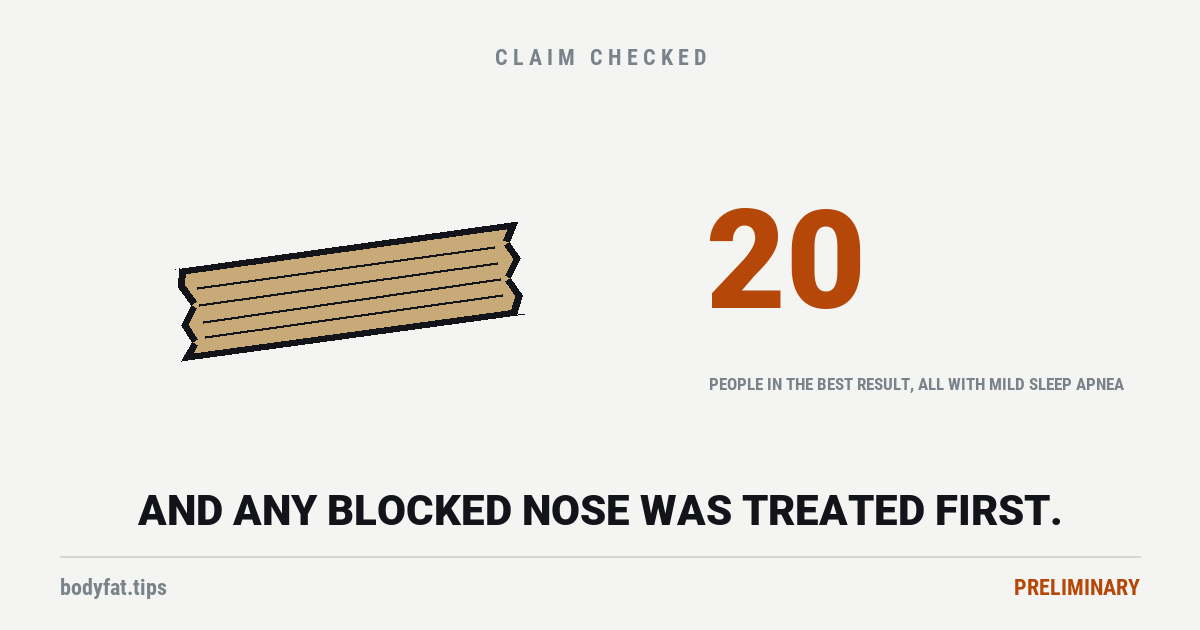
The strongest positive result comes from a 2022 study of twenty people. It found breathing pauses roughly halved, snoring roughly halved, and the lowest oxygen level of the night improved. [3]
| What was measured | Before | Taped |
| Breathing pauses per hour | 8.3 | 4.7 |
| Snoring events per hour | 303.8 | 121.1 |
| Lowest oxygen level | 82.5% | 87% |
Those are good numbers. Now read who was in the study.
Every participant had diagnosed mild obstructive sleep apnea. Every participant had been seen breathing through the mouth in their sleep and woke with a dry throat. And every participant had been pre-screened for whether they could tolerate having their mouth sealed at all — the ones who could not were never enrolled.
Inside that filtered group, the authors report that apnea severity fell in all twenty, and thirteen cut their snoring by at least half, which is how the study defined a responder [3]. Nineteen of the twenty were men, none was obese, and each was tested at home once before taping and once taped, a week later [3].
The authors are careful about what they are proposing: mouth taping as a possible alternative for people with mild sleep apnea, before moving to a CPAP machine or surgery. That is a clinical decision about a diagnosed condition. It is a different sentence from “tape your mouth for better sleep”.
The line that should stop you
The systematic review’s abstract ends its results with one line that reframes the whole trend:
“Many studies excluded anyone with nasal obstruction or pathology.” [1]
Sit with that for a second.
The full text puts a number on “many”: four of the ten. One of those four, the study with the best result, treated blocked noses with medication and nasal spray before the tape went on [1] [3]. And why does a person breathe through their mouth at night? Very often, because their nose is blocked.
So the group most likely to reach for the tape is close to the group much of this research left out, or treated before taping. The best result was gathered from people whose noses worked, or were treated until they did. If you tape your mouth shut and your nose is not a functioning route, you have not fixed your breathing. You have removed your backup. A 2026 review pooled eight studies that blocked people’s noses, in experiments or with packing after nose surgery or a nosebleed: breathing stops and shallow spells rose by about 14 an hour on average (13.78) [4].
The reviewers’ conclusion is that there seems to be a potentially serious risk of harm for people practising this indiscriminately. In four of the ten studies, the authors had warned that a closed mouth could risk asphyxiation, suffocation, if the nose is blocked or stomach contents come up in the night. The review reports that as a warning, not as something that happened to anyone. [1]
And the rest of the claims?
The second review did something clever: alongside the medical literature, it analysed the first fifty qualifying TikTok videos on the subject to see what was actually being promised. [2]
The most common promises were better sleep and better oral health. Elsewhere the trend has been credited with more energy, better immunity and a sharper jawline.
The last two, as far as we can find, have never been tested at all. Not disproven — untested. We found no study of mouth taping and immunity, and the claims about facial structure have not been tested in the literature these reviews searched, or in anything our own searches turned up: the nearest are studies of taping a newborn’s cleft lip before surgery, a different practice for a different problem. The studies have measured energy only one way, as daytime sleepiness in people with sleep apnea: better in two small studies, unchanged in a third [1] [5]. A randomised trial in asthma patients, 51 people taping for four weeks, found no benefit [6]; a smaller one, in 30 young adults, set mouth tape against tape on the chest rather than against no tape [13].
A practice can have a genuine, narrow, clinical effect and still have a marketing story that has never been examined. This is one.
What we would want before changing this rating
Three things: a trial in people without diagnosed sleep apnea, since that is who is doing it; one that reports what happens to people whose noses are blocked; and outcomes measured over weeks rather than a night. Two of the three now exist, and they are small.
Outside sleep apnea, we found four published randomised trials that taped people for weeks. In 51 adults with asthma, four weeks of nightly taping made no difference to asthma control [6]. In 30 young adults with asthma, a 2025 trial compared two weeks of nightly mouth tape not with no tape but with kinesiology tape, the stretchy sports tape, on the ribs and shoulders, and taught both groups the same breathing method; both groups improved on peak flow and an asthma-control questionnaire, the chest-tape group more, so it cannot say what the mouth tape did on its own, and one person in the mouth-tape group dropped out over discomfort [13]. In 50 snorers without sleep apnea, tape was one of four parts of a home treatment compared with a mouthguard, so the trial cannot say what the tape did on its own [7]. And in 14 women with what the researchers called dysfunctional breathing, adding tape at night to a six-week breathing programme made no measurable difference between the groups in heart-rate variability, the trial’s main measure: how much the gap between heartbeats varies, used as a sign of how relaxed the body is [8].
In sleep apnea, a randomised crossover trial gave 62 people who use CPAP machines (a bedside pump and mask that push air in to hold the airway open) 30 nights with tape and 30 without. With tape they used the machine about 52 minutes a day longer and reported less daytime sleepiness, snoring, dryness and night waking; side effects were reported too [5]. A registered crossover trial of an adhesive mouthpiece, in 25 people recruited for sleep apnea, posted almost identical breathing-stop counts with and without it, a median of 16.4 an hour against 15.8, one night each; snoring fell in the eight who only snored, from a median of 30.4 snores an hour to 3.0 [10]. And an online report from an independent research group, not peer reviewed, had 91 healthy adults with sleep trackers switch at random, night by night for 30 nights, between tape over the lips and a dummy strip above them: an early gain in deep sleep did not hold up as more data came in, while people rated their sleep better, and those it classed as mouth-breathers slept longer by their trackers [12]. The longest follow-up we found is six months, in a chin-strap study of CPAP users that four people completed [1].
We found no study that reports what happens to people who tape at home while the nose stays blocked, which is the case that matters most here. Several studies excluded blocked noses, the best one treated them first, and a three-month trial registered in 2024, which lists its start as March 2027, will take only people who can breathe through the nose for three minutes with the tape on [11].
So the sleep claim has real trials behind it: small, mostly in people already diagnosed with sleep apnea, and pointing different ways. The studies have measured energy only as daytime sleepiness, and, as far as we can find, the jawline claim not at all.
The verdict
Preliminary. Two reviews holding about a dozen small studies, two of them showing real improvement in sleep apnea measures, both in patients already diagnosed with it, and a few small trials since that point in different directions. That rating is for the sleep promise. The other two, rated on their own as they are sold, would read Unsupported: energy has been measured only as daytime sleepiness, and only in people with sleep apnea, and we found no study of the jawline at all. The reviewers call the literature markedly heterogeneous with little consensus, and that is the honest state of it.
If you snore heavily, wake unrefreshed, or someone has watched you stop breathing in your sleep — that is a sleep study, not a roll of tape. Sleep apnea is a diagnosable condition with real treatments, and the fastest way to waste a year is to manage a suspected case with a hack you saw online.
And if you breathe through your mouth because your nose is blocked, the study with the best result dealt with that before any tape went on, with medication and nasal spray. Find out why the nose is blocked first. That is the actual problem, and it is usually treatable.
Related: sleep hygiene, how much melatonin people actually take, and doomscrolling — the rest of what we have checked about sleep, where the boring answers keep outperforming the interesting ones. If you want the breathing angle, there is also box breathing.
If you want to know what earns each rating, we wrote down how we read a study, and everything we have checked is in one place.
This page was corrected on 7 October 2026 after an independent editorial review. Its headline said the studies excluded anyone with a blocked nose. The systematic review says four of its ten studies did, and one of those four, the study with the best result, in fact treated blocked noses with medication and nasal spray before taping; the title and every sentence built on it have changed. The page also said that no trial had tested people without sleep apnea, or measured anything past a week, and gave that as the reason for its rating. Both exist: randomised trials of two to six weeks in people with asthma, in snorers and in women, a 30-night crossover in CPAP users, and a chin-strap study with a six-month follow-up. They are now on the page. We printed 213 patients from the review’s abstract; the ten studies in its own table add up to 233. And we wrote that seven of the 2022 study’s twenty “did not” respond, when a response there meant halving snoring and the authors report that apnea severity fell in all twenty.
Also corrected: the funding row said funding was not stated, when the systematic review, the 2022 study and a 2026 meta-analysis each declare none, and a maker of mouth strips paid for one of the trials the scoping review counts as positive; the asthma sentence now names the two randomised trials, because a smaller asthma pilot also exists; energy is no longer called unevaluated, since daytime sleepiness has been measured in sleep-apnea patients; the review’s conclusion is quoted as the cautious sentence it is; the videos are described as the first fifteen search results, not the most-watched; the scoping review’s screening count now matches its own flow chart; and a monthly search figure we could not trace to any saved data has been removed. The 2026 meta-analysis, published six days after this page went up, and trials the page had missed have been added. The rating is still Preliminary, but it now sits beside the claim it rates: the provenance chain’s claim was the whole viral sentence, deeper sleep, more energy and a sharper jawline, and is now the sleep promise alone. The verdict says what the other two would be rated on their own.