Ikigai: The Evidence Is Real. The Four-Circle Diagram Is Not Japanese.

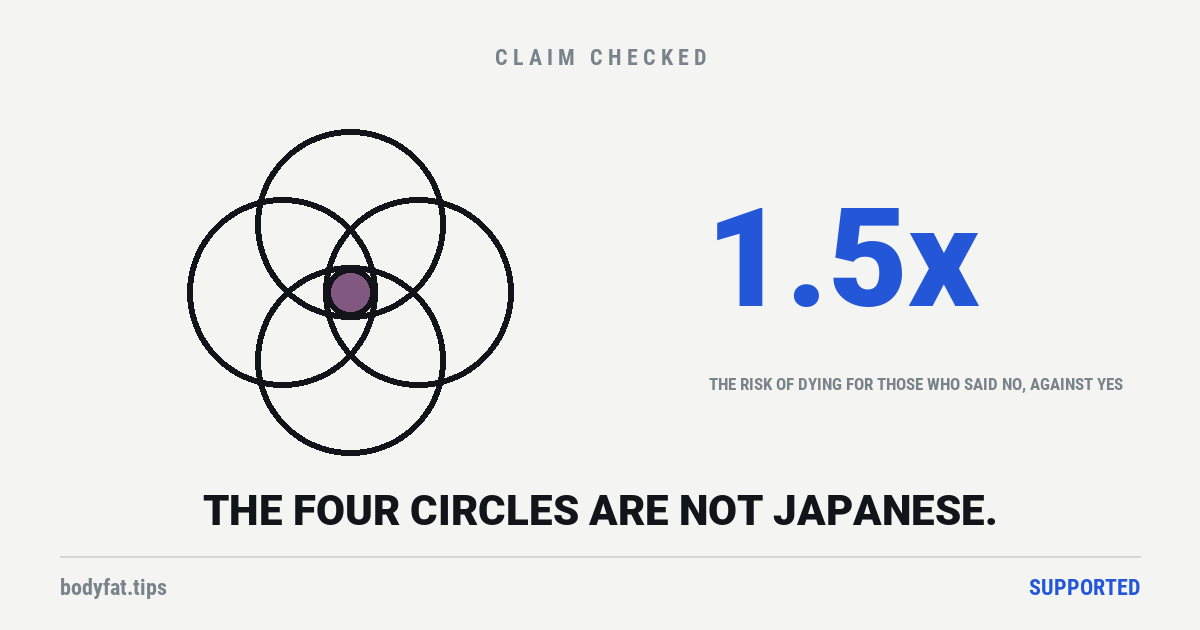
You have seen the diagram. Four circles — what you love, what you are good at, what the world needs, what you can be paid for — and in the middle, where all four overlap, the word ikigai.
The research on ikigai is real, and it is bigger than you would expect. Around 117,000 Japanese adults, followed for years.
None of it studied that diagram.
| The studied thing | The sold thing | |
| What it is | A sense that life is worth living | A four-circle career diagram |
| Where it comes from | A Japanese word since at least the 14th century [4]; studied since 1966 [3] | A 2012 diagram about purpose, relabelled on a blog in 2014 |
| Mentions money | no | yes — one whole circle |
| Studied in ~117,000 people | yes | never |
What the studies actually measured
The Ohsaki Study followed 43,391 Japanese adults for seven years. All were aged 40 to 79, with no history of cancer, heart attack or stroke at the start. [1] The exposure — the entire thing being measured — was one question:
“Do you have ikigai in your life?”
That is it. No four circles, no career audit, no worksheet. One question about whether your life feels worth living, with three possible answers: yes, uncertain or no.
Over those seven years, 3,048 people died. The 4.6% who answered no — about 1 in 22 — had a 1.5 times higher risk of dying than the 59% who answered yes, after adjusting for the usual confounders (other differences between people, such as age, smoking and how healthy they felt, that could produce a gap on their own). That compares the smallest group with the largest. The big middle group, the 36% who said they were uncertain, came out barely different from the yes group: 1.1 times, in a range running from 1.0 to 1.2. [1] The gap showed up in cardiovascular deaths and in deaths from external causes. It did not show up for cancer.
The bigger one, with a smarter design
A second cohort — 30,155 men and 43,117 women, aged 40 to 79, followed for an average of 12.5 years — found the same thing from the other direction. [2] It asked the same question with four possible answers: definitely yes, yes, maybe yes or no. In the cohort’s own 2007 report, just under half said definitely yes or yes, just under half said maybe yes, and the remaining 9% said no. [5] The 2009 paper reports its results for people “with ikigai”. Which answers it counted and which group it measured them against are in the full paper, which is paywalled; we have not been able to check them.
What makes this one better is a detail most write-ups skip. The researchers split the follow-up into the first five years and everything after. That is a deliberate guard against the obvious objection: that people who are already dying stop feeling their life is worth living. If the link were just illness talking, it would show up in those early years and fade after them. The Ohsaki team ran a shorter version of the same check, setting aside deaths in the first two years and then in the first three to four, and its result held. [1] The figures below come from the years after the first five.
In the long-term period, men who reported having ikigai had a 15% lower risk of dying from any cause. For women the estimate was 7% lower — with a range running right up to “no difference at all”. [2] We are flagging that because it is the weakest number on the page and it belongs in daylight, not a footnote.
Both sexes showed a clear drop in deaths from external causes, which in this kind of data mostly means accidents and suicide.
So where did the four circles come from?
Not from any of that.
A 2023 paper in Europe’s Journal of Psychology went looking for the diagram’s lineage and reported, plainly, that it “does not come from the scientific literature and its origins are uncertain.” [3]
What they could trace is this. In 2012, Andrés Zuzunaga published a Venn diagram in Spanish. Its four circles were much the same — but the word in the middle was Propósito. Purpose. Not ikigai. It was never a Japanese diagram; it was a diagram about purpose that happened to have four circles. [3]
Separately, a 2009 TED talk introduced a largely North American audience to ikigai as an explanation for Okinawan longevity. [3]
Then in 2014, a blog post by Marc Winn adapted the purpose diagram and renamed the middle “ikigai”. That version is the one that spread. The paper is careful here: it says only that those two earlier sources may have inspired the blog post. [3] We can go further, because the two men involved have since said so themselves. The diagram’s creator pointed out the copy in a comment under the post in 2017, and his own page dates the original to 2011, a year before it was first published. [6] [7] The post’s author has added a note to it saying “The diagram is not mine”, and has written that he came across the purpose diagram in a self-help book, had watched the TED talk, and swapped “Purpose” for “Ikigai”. [6] [8]
One more detail: the money circle was on the diagram before the relabel, and it already looked forward. Zuzunaga’s Spanish reads por lo que te pagarán, “what they will pay you for” [7], and the post’s author describes the original’s circle as “what you can be paid for”. [8] The 2023 review treats the post’s “that which you can be paid for” as a change from “what you are paid for”, made “without elaborating on his choice” [3]. The Spanish suggests the forward look was there first.
This is not a case of anybody being a villain
Nobody in that chain did anything wrong. Zuzunaga drew a diagram about purpose and labelled it in his own language. Winn wrote a blog post. Neither claimed to be publishing Japanese scholarship.
The same paper is generous about the diagram, and we will quote it: its appeal “could be due to its simplicity and accessibility”, and it is “inspiring as it prompts anyone to question life meaningfulness.” [3] It usefully separates what you care about, what you are rewarded for, and what other people need. That is a decent afternoon’s thinking.
What happened afterwards is the part worth being annoyed about. A blog adaptation of a Spanish purpose diagram got sold back to the world as an ancient Japanese secret to long life, though the trail that shows otherwise was never hidden. The long-life line was in the 2014 post from the start, beside a link to the TED talk. [6] The corrections came later, and in public: the creator’s comment under the post in 2017, and the author’s own description of the diagram as “a Western adaptation, not an authentic representation of Japanese philosophy”. [8] The 2016 bestseller that followed carries the promise in its English title: the Japanese secret to a long and happy life.
How big is the industry, actually
On 6 August 2026 we searched YouTube for “ikigai japanese secret to a long happy life”, a shortened form of the 2016 bestseller’s English title, and added up the twenty videos the search returned first. They carry over four million views between them (4,322,326), the largest single one over 900,000. Because we searched with the book’s title, most of them summarise or read out that one book. Seven of the twenty descriptions carry Amazon links, and four of those label some of their links as affiliate links, or possible ones — to their credit.
That is a measurement of how far the claim travels and what it sells. It says nothing whatever about whether ikigai extends your life, and we are not using it that way.
The honest caveats
No trial has run long enough to count deaths. Nobody has assigned half a town a reason for living and followed both halves for a decade. The one randomised trial we found that set out to raise ikigai is a 2019 study in a Japanese hospital rehabilitation ward: 72 patients, average age about 75, split at random between ordinary occupational therapy (retraining everyday tasks such as dressing, walking and cooking) and a version in which each task was pitched to match what the patient could manage. [9] On a nine-question ikigai scale scored from 9 to 45, the adjusted group gained about 4 points by discharge while the other group stayed flat — an effect size of 0.76, where researchers call 0.8 large and 0.2 barely there. Three months after going home, the adjusted group had kept about half of its gain and the other group had slipped a little; the formal test of the gap that was left came out just the wrong side of the line researchers use for “probably not chance”. Nobody followed anyone further. Every mortality figure on this page is observational.
It might not travel. The 2023 review notes that research published only in Japanese supports the cultural specificity of the concept, which “may question the portability of this life philosophy to other cultures.” [3] Both cohorts above were run in Japan, on Japanese adults, using a Japanese word that the researchers did not have to translate.
The link, though, seems to travel. A 2026 meta-analysis — a study that pools the results of other studies — gathered 25 groups of people whose deaths were tracked, both cohorts above among them. [10] Fifteen of the groups were in the United States, Britain, continental Europe and Australia, where people were asked about purpose or meaning in life rather than about ikigai. The link turned up in 13 of those 15, and the American groups looked no different from the rest. It shrank, but held, once exercise, smoking and conditions such as diabetes and high blood pressure were accounted for; in the groups where depression was measured, it held after that as well. Two cautions: the studies disagreed a lot about how big the effect is, and a standard test hinted that weaker results may be missing from the published ones, though allowing for that barely moved the average.
And it is one question. A single self-reported answer, picked from three or four options, is a thin instrument for something this large.
The verdict
A sense that your life is worth living tracks with living longer. That is Supported — roughly 117,000 people across two independent Japanese cohorts, one of them analysed specifically to test the “they were already dying” objection, with the link still there after the first five years. It is observational and it is one question. The Japanese word may not export; the link between purpose and survival has turned up outside Japan too.
The four-circle diagram is not what was studied, is not from the scientific literature, and started life with a different word in the middle.
Which leaves an odd situation. The thing with the evidence behind it is the thing nobody is selling: not a diagram, not a framework, not a worksheet. Just whether, when somebody asks, you can say yes.
Related: how many steps a day · does lack of sleep cause weight gain · ashwagandha benefits · magnesium benefits · does walking help you lose weight
This page was corrected on 18 September 2026 after an independent editorial review found four errors. It called the Ohsaki question a yes-or-no. The question offered three answers — yes, uncertain or no — and the 1.5 times figure compares the 4.6% who said no with the 59% who said yes, while the 36% who were uncertain came out barely different from the yes group. It said no trial had tried to create ikigai; a 2019 randomised trial in 72 rehabilitation patients did raise ikigai scores, though about half of the gain was gone three months after discharge, and nobody has followed such people to see who lives longer. It said the funding of its sources was not stated; all three papers state it, and the panel now names the funders. And it dated ikigai’s arrival in Japanese writing to 1966; a Japanese historical dictionary finds the word in a 14th-century chronicle, and 1966 is when a book made it a subject of study.
Also changed: the page no longer says the sourcing of the four-circle diagram was never done, or guesses at why. The diagram’s creator and the blog post’s author have both described its lineage in public, and the page now cites them, including the fact that the long-life promise was in the 2014 post from the start. Two lines we could not source are gone: that neither man was selling anything, and that the relabelling was casual, since the Spanish original’s money circle already looked forward. We have added a 2026 meta-analysis that finds the link between purpose and survival in American, British, European and Australian cohorts too, and the second cohort’s four answer options. We had said that cohort’s link did not concentrate in its first five years; its paper’s summary reports only the years after, so the page now says that. The video count now gives the platform, the search and the date, and counts the twenty videos the search returned rather than sixteen. The rating is unchanged.