Can You Die of a Broken Heart? After a Spouse Dies, the Survivor’s Death Rate Runs About Two-Thirds Higher for Three Months. Then the Excess Shrinks.

On 25 August 2026 a large health-video channel posted two videos, one of 24 minutes and one under three. By 7 October they had been watched 719,984 and 521,528 times [1]. The longer one’s description puts its claim in two sentences: “after a long-married spouse dies, the survivor’s own risk of dying rises sharply over the next 12 to 18 months. It isn’t poetry. It’s biology.” [1]
It is an old idea with a newer name, the widowhood effect, and it lands on a question that 14,800 people a month type into a search box (from a paid keyword database, pulled 10 October 2026): can you die of a broken heart? [2]
Ask it, and the AI answer at the top of the page replies to a different question. It says yes, “though it is rare”, and talks only about broken heart syndrome, a sudden weakening of the heart muscle after a shock [2]. The video means something slower: the rise in deaths among people whose husband or wife has just died. Both are real. They are not the same thing, and they are nowhere near the same size.
Can you die of a broken heart?
Two answers, because the phrase means two things.
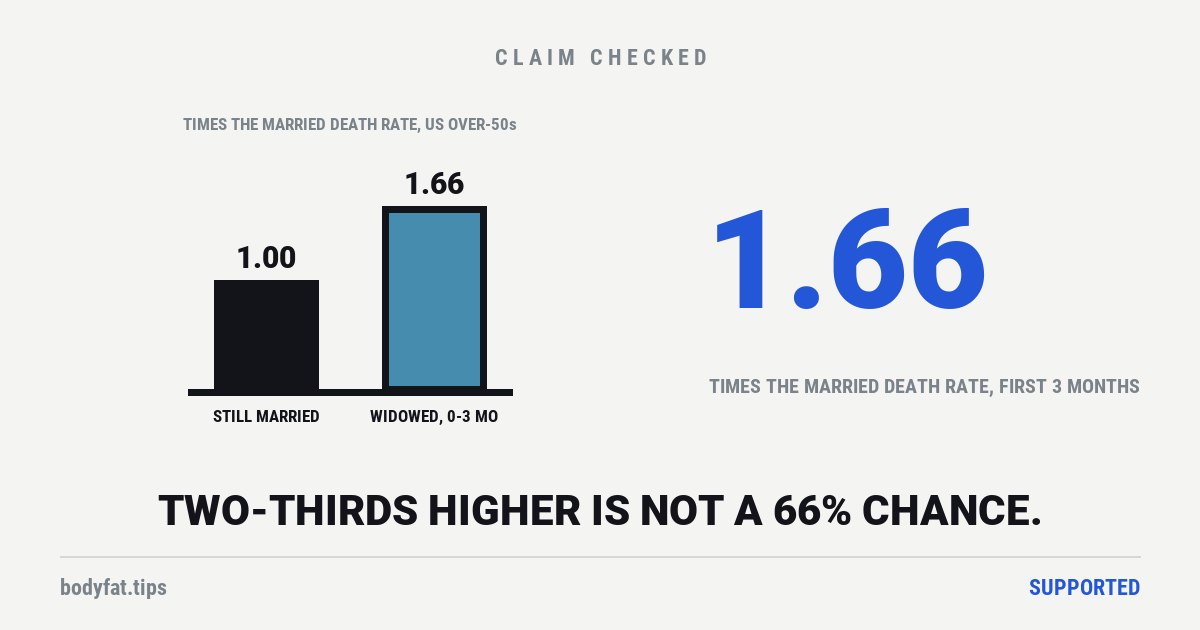
The widowhood effect: yes, on average, and mostly early. Across studies of millions of people, the widowed die at higher rates than married people of the same age [3] [4]. The rise is steepest in the first three months. In an American study of 12,316 married people over 50, the death rate among the newly widowed in those months ran about two-thirds higher than among the still-married [5], and a British study that compared each person with themselves found much the same [7]. After that, the excess shrinks. That is the claim this page rates, and it rates Supported.
Broken heart syndrome: yes, but rarely when a painful emotion sets it off. In the largest international registry of the condition, 5 of the 465 patients whose attack followed a painful emotional event died in hospital, about 1 in 100 [26]. Grief or loss was the trigger for 107 of the 465; the registry’s report does not give their deaths separately [26]. Across all American hospital admissions for it, whatever set them off, 6.5% died in hospital [28].
One warning before any more numbers. “Two-thirds higher” is a relative figure: the death rate in one group divided by the rate in another over the same stretch of time. Researchers print it as a ratio, where 1.00 means no difference and 1.66 means 66% higher. It is not a 66% chance of anything. When the rate being compared is small, two-thirds higher is still small. In a British study of 30,447 people aged 60 to 89 who lost a partner, 50 had a heart attack or a stroke in the next 30 days, 0.16%, against 0.08% of matched people whose partner was alive [12]. That is twice the rate, and about 1 extra case for every 1,200 bereaved people, by our arithmetic.
The first three months
The American study followed married people from the Health and Retirement Study, a national survey of Americans over 50, from 1998 to 2008 [5]. Over those ten years, 2,373 of the 12,316 lost a husband or wife. The researchers allowed for education, income, wealth, smoking, drinking, weight, high blood pressure, diabetes and depression, the things that could make a couple die young together. In the first three months after a spouse’s death, the widowed still died at 1.66 times the rate of the still-married (strictly, the odds; for an event this rare in any one month the two are almost the same) [5].
Then the gap closed. From three to six months and from six to twelve, the widowed were not clearly different from the married; after a year a small excess, 12%, reappeared, just at the line researchers use for “probably not chance” [5]. The authors’ summary: “mortality almost doubled in the first 3 months following widowhood and then tapered dramatically” [5]. Their university’s news release put the same result as “a 66% increased chance of dying” [6]: 66% higher than the married rate, which is a different thing from a 66% chance.
The British study used a design that takes away one of the biggest doubts about this subject. It is called a self-controlled case series: it looked only at people who died, aged 50 to 99, and asked whether their deaths bunched up in the months after their partner’s death compared with the rest of the time they were watched [7]. Each person is their own comparison, so anything about them that does not change, their genes, their education, their lifelong habits, cancels out.
| Months after the partner died | Men (rate against their own usual) | Women |
|---|---|---|
| 0 to 3 | 1.63 | 1.70 |
| 3 to 6 | 1.32 | 1.27 |
| 6 to 9 | 1.17 | 1.32 |
| 9 to 12 | 1.26 | 1.26 |
| 12 to 15 | 1.29 | 1.15, at the edge of clearly different |
| 15 to 18 | 1.05, not clearly different from usual | 1.14, not clearly different |
| 18 to 21 | 1.09, not clearly different | 1.16 |
| 21 to 24 | 1.10, not clearly different | 0.92, not clearly different |
In the first three months the death rate was 1.63 times the person’s own usual rate for men and 1.70 for women [7]. It stayed somewhat raised through the first year. For men it was no longer clearly raised after the fifteenth month; for women it mostly faded across the second year, with one later stretch still raised [7]. A pooling of fifteen studies with 2,263,888 people found the same shape: in the first six months the widowed died at 1.41 times the married rate, and after that at 1.14 [3].
What about the first days? Here the studies disagree. In Finland in the 1970s, deaths from natural causes in the first week of widowhood ran at over twice the expected rate [11]. A Danish study found widowed women’s death rate in the first week at 3.61 times that of married women, while for men the first week and month were not clearly different [10]. A larger Danish study found death rates lower than expected in the first weeks, in both sexes and every age group, before the excess appeared [8]. The first three months, as a block, are well established. The first week is not.
How long does the widowhood effect last?
Not 12 to 18 months of “sharply”. The steep part is three to six months long [3] [5] [7]. After that the answer depends on the study. In the British data the excess had faded by about a year and a half [7]. In the American data it was not clear after the third month until a small one appeared after a year [5]. In Scotland the excess was greatest in the first six months and still there ten years later [18]. A pooling of 124 publications found the largest excess in studies that followed people for two years or less and a smaller one, still present, in studies running for decades [4].
So the video’s window is roughly where the excess ends in the British study. It is not where it is sharp. If there is a dangerous stretch, the evidence puts it in the first three months.
Widowhood effect: men vs women
Both large poolings found a bigger rise in men. One put widowed men’s death rate at 1.23 times married men’s and widowed women’s at 1.04, too close to 1.00 to tell from no difference [3]. The other found 1.27 for men and 1.15 for women [4].
The figure that travels is starker: men 70% more likely to die in the year after losing a wife, women 27%. A news magazine printed it in March 2023 as the study’s overall finding [9], and the AI answer at the top of a search for “widowhood effect” repeats it [2]. The Danish study it came from reports those figures for people aged 65 to 69, the youngest group it followed [8]. Across all ages, widowed men’s death rate in the first year was 13% higher than married men’s, and widowed women’s was 8% lower than married women’s [8].
Not every study splits that way. The American study found no difference between the sexes [5]; in the British within-person study women’s first-three-month figure, 1.70, was a little higher than men’s, 1.63 [7]; and in Taiwan, among about 800,000 widowed people followed for seven to eight years on average, widowed men died at 1.32 times the rate of a matched comparison group and widowed women at 1.27 times (we read it as its abstract) [41]. The rise in men is the more consistent finding. In women it depends on the study.
Widowhood effect by age
In most studies, younger widows and widowers show the bigger rise. In the 124-publication pooling the excess was largest in people in their fifties (1.38), smaller in their sixties (1.24) and seventies (1.19), and by about 90 the authors’ model put it at roughly nothing for either sex [4]. A Danish register study found no difference between widowed and married men from 95 or women from 90 [10]. Not every study agrees. The fifteen-study pooling found no clear difference between people widowed before and after 65 [3], and in Scotland women widowed at 80 or older were at higher risk than women widowed at 60 to 74, with a smaller version of the same in men [18]. Below 40, there are too few studies to say [4].
What do the widowed actually die of?
Mostly the same things everyone dies of, a little more often. A Danish study of 223,500 married people aged 65 and over counted causes of death over three years after a spouse died, against matched people whose spouse lived [14]. Among men, heart and blood-vessel disease killed 60 in every 1,000 widowed against 52 in every 1,000 still married; lung disease 28 against 24; digestive disease 8 against 5; mental illness or suicide 4 against 1. Cancer deaths did not differ, and deaths from dementia or Parkinson’s were fewer, 12 against 16 [14]. Among women, heart disease went from 20 to 25 in every 1,000, and mental illness or suicide from 1 to 2 [14]. The authors call the extra risk “small of magnitude” [14].
Read the size of each rise against how common the cause is, and the picture changes. In 1.58 million married Finns aged 35 to 84, deaths from accidents, violence and alcohol rose by 50% to 150% after a spouse died, heart disease and lung cancer by 20% to 35%, and other causes by 5% to 15% [15]. Heart disease adds the most extra deaths because it is common. Accidents, alcohol and suicide rise the most for their size.
And then there is the heart in the first days. A study of 1,985 heart-attack patients asked each one whether someone important to them had died recently: the rate of heart attacks in the 24 hours after such a death was 21 times the rate at other times, falling day by day after that [13]. In plain numbers, the authors estimate 1 extra heart attack in the first week for every 1,394 bereaved people at low heart risk, and 1 for every 320 at high risk [13]. That study counted any significant person, not only a spouse [13].
Is the widowhood effect real, or do couples just share a fate?
This is the objection worth taking seriously. Couples share a home, food, money, habits, air and often a doctor. If both die early, perhaps they were always going to, and the second death only looks like a consequence of the first. Nobody can assign widowhood at random, so researchers have built tests that a shared fate should fail.
The ex-wife test. In over a million older Americans, a wife’s death raised her husband’s death rate by about a fifth, and an ex-wife’s death had no clear effect [16]. If like simply married like and shared a fate, the ex-wife, who shared years of it, should have counted too.
The twin test. In 1,993 Swedish twin pairs where one twin was widowed and the other still married, the widowed twin was more likely to die; the authors say the results “support a causal effect” [17]. Twins share much of their genes and their childhoods, so those are largely held equal.
The cause-of-death test. Some deaths, such as those from smoking, drinking or accidents, are tied to a life a couple shares; others are not. In Scotland, the survivor’s risk rose by much the same whichever way the spouse died, a 40% higher rate for men and 36% for women; the one exception was men whose wives died of a risky cause, which in that study mostly meant one related to smoking, who fared worse. The authors conclude it is “a causal effect, rather than a result of selection” [18]. The British within-person design, above, deals with fixed traits a different way and found the early rise too [7].
Now the other side. An American study using the same national survey put about a third of the excess down to selection, because the people who were widowed were poorer to begin with [20]. An economics study using the cause-of-death test concluded that the excess in women was explained by traits the couples shared, while in men it looked causal [19]. And a Norwegian study that allowed for health habits, how healthy people felt and how lonely they were found a 14% higher death rate among the widowed in one of three periods it followed and no clear difference in the other two [21]. Loneliness is one of the ways widowhood might do harm, so allowing for it may remove part of the very thing being measured; that reading is ours.
Taken together: most of the tests built to catch a false widowhood effect did not catch one, and the ones that did explained part of it, or explained it in women. That is the main reason this page says Supported rather than Established.
What are the symptoms of takotsubo syndrome?
Takotsubo syndrome, also called stress cardiomyopathy or broken heart syndrome, is a sudden weakening of part of the heart’s main pumping chamber, usually after a shock [23]. The name comes from the Japanese word for an octopus trap, the shape the weakened chamber takes [23]. Its commonest symptoms are sudden chest pain, breathlessness or fainting, with changes on the heart tracing and raised heart enzymes in the blood: at first sight it cannot be told from a heart attack [23]. About 90% of patients are women, on average aged 67 to 70, and women over 55 have about five times the risk of younger women [23]. The heart muscle typically recovers in four to eight weeks [24].
Grief is one trigger among many, and not the most common. In an international registry of 1,750 patients, 27.7% had an emotional trigger, 36.0% a physical one such as an acute illness or a medical procedure, and 28.5% none that anyone could find [25]. Among the 465 patients whose trigger was a painful emotion alone, 107 had lost someone or something, and 30 had lost a husband or wife [26]. That is 30 of the registry’s 1,750 patients, under 2%, by our arithmetic. The count covers only patients whose emotional trigger stood alone; patients who also had a physical trigger are not broken down this way, so 30 is the least the number could be [26].
Can you die of broken heart syndrome?
Yes. Its in-hospital complications and deaths run at about the rate of a heart attack’s, and the patients who do worst are those whose attack came with a physical illness [24] [25]. In American hospital records for 2016 to 2020, 199,890 admissions for the syndrome, 6.5% of patients died in hospital, men 11.2% and women 5.5% [28]. Those records cannot separate grief from physical triggers [28]. The registry can: when a painful emotion was the trigger, 5 of 465 patients died in hospital [26], and over the following years they did better than heart-attack patients of the same age and sex, while patients with a physical trigger did worse [27].
The AI answer’s “1% to 5%” [2] sits between the registry’s figure for attacks set off by a painful emotion and the all-causes hospital figure. Either way, chest pain, sudden breathlessness or fainting after a shock is not something to wait out at home: the symptoms match a heart attack’s, and only a hospital can tell them apart [23]. In the US that is a 911 call. This is journalism, not medical advice.
If broken heart syndrome is that rare, what is killing the widowed?
This section is the desk’s own reasoning, and it is labelled as such. Start with what can be counted. In the registry, a spouse’s death was the only recorded trigger in 30 of 1,750 cases, and about 1 in 100 patients whose attack followed a painful emotion, grief among them, died in hospital [26]. We found no study that counted how many of the widowhood effect’s extra deaths were broken heart syndrome [33]. Our reading of those registry numbers is that it can only be a small part; that is arithmetic and inference, not a count. So where do the rest come from? Three answers, with the evidence for each.
Answer one: the heart in the first days. Heart attacks bunch up in the 24 hours after a death that matters to someone [13]; in the 30 days after a partner died, heart attacks and strokes ran at twice the rate seen in matched people whose partner was alive [12]; and in Finland, natural deaths in the first week of widowhood ran at over twice the expected rate, with a larger rise for heart disease [11]. This is measured, in several designs, though not in every study: the larger Danish study found fewer deaths than expected in the first weeks [8].
Answer two: losing the person who kept watch. Researchers call it the guardian role: married people watch each other’s health, encourage each other to stick to their treatment, and discourage drinking and smoking [3]. The causes of death that rise most for their size after widowhood are accidents, violence and alcohol [15], and in Denmark mental illness or suicide rose in both sexes [14]. The senior author of the American study, quoted in the university’s release from a news-agency interview, offered three possibilities: a grief-related mechanism, illness brought on by caring for a sick spouse, or that, “as one’s spouse gets sicker, the surviving spouse stops taking care of their own health” [6]. The third is about the months while the spouse is ill, not about life without a minder after the death. The pattern of causes is measured; that losing a minder is the reason is a surmise, and the authors of the fifteen-study pooling offer the guardian role as one explanation among several [3].
Answer three: some of it was never the loss. One American study put about a third of the excess down to the widowed being poorer to begin with [20], and an economics study found women’s excess explained by what couples share [19]. The ex-wife, twin and cause-of-death tests pointed to a causal effect instead [16] [17] [18]. This is measured, and the designs disagree about how big a part it is.
Put the three together and here is what we think is true, stated plainly so you can disagree with it: the widowhood effect is real, but “it’s biology” undersells it: a short spike on the heart in the first weeks, then a longer, quieter cost of living without the person who kept an eye on you, and broken heart syndrome is a sliver of the first.
What we could not find, and would like to: a randomised trial that gave newly widowed people support, or anything else, and counted their deaths [33]. A 2022 review of help for older bereaved spouses found 22 studies, 13 of them randomised trials, nearly all measuring grief and mood and a few measuring daily functioning [30]; the newest we found, a 2026 review of online and other technology-based help, found seven, which measured grief, sleep, mood, loneliness and daily routines [36]. The nearest things to an answer either were not trials or did not count deaths. The largest is an American study that matched 30,838 older couples in which the dying spouse had hospice care with 30,838 in which the dying spouse did not. After the authors’ adjustments, 4.9% of the widows whose husband had hospice care had died within 18 months of his death, against 5.4% of those whose husband had not: a small difference, only just on the “probably not chance” side of the line. Among the widowers it was 13.2% against 13.7%, which could be chance (we read it as its abstract) [37]. That is care for the dying spouse, not help for the survivor after the death, and families who chose hospice may have differed in ways the matching could not see; that caution is ours. A small randomised trial of hospital hospice care in the 1980s followed 96 of its patients’ survivors for 18 months after the death: their anxiety, depression and health did not differ from the usual-care group’s, and their deaths were not counted (we read it as its abstract) [40]. A 2024 Utah study of 37,271 pairs, each a person who died in hospice and a husband, wife or grown child, found that a longer hospice stay went with a higher later death rate among widowers and daughters, not among widows or sons: for widowers, about 2% higher for each extra month their wife had spent in hospice. It compared hospice families with one another, not with families who had none [38]. A Swedish study gave 50 older bereaved people counselling, not randomised; their death rate over the next years was similar to married people’s, and the authors asked for a controlled trial [31]. And an Australian trial gave 85 recently bereaved people a low dose of a blood-pressure drug and aspirin, or a dummy pill, for six weeks; it lowered blood pressure, heart rate and anxiety and was not built to count deaths [32]. We would also like the count this section had to reason around: how many of the extra deaths are broken heart syndrome. If you know of either, the corrections line on this site is open.
Who these studies were done on
If you are wondering whether any of this applies to you, here is who was counted. Almost everyone in these studies was over 50, most over 65, in the United States, Britain or the Nordic countries [4] [5] [7] [8] [10] [14], with one large study from Taiwan [41]. Almost all were married or living with a partner of the opposite sex; a Danish study of same-sex partners suggests their risk may be higher than mixed-sex partners’ in the first three years, depending on the comparison [35]. In most studies the rise is bigger in people widowed in their fifties and sixties than in their eighties, and in several it was gone by 85 to 95 [4] [8] [10]; in Scotland, though, women widowed at 80 or older fared worse than women widowed at 60 to 74 [18]. It is more consistent in men than in women [3] [4] [8]. And it is bigger when the death was sudden: in British couples over 60, the first-year rate was 1.61 times the married rate after a partner died with no recorded chronic illness, against 1.21 after a death that followed known illness [22]. One British study points the other way for deaths that were expected. Among 92,129 people over 40 in family-doctor records, counted from six months before the death, those whose partner died of cancer were less likely to die over the following years (a median of four) than people of the same age and sex whose partner lived: 0.71 times their rate [39]. Its authors suggest the support that often comes with cancer care, and the end of the strain of caring; they also note that bereaved people who left their doctor’s practice, who may have been at higher risk, could not be followed [39]. When the same database was later analysed by comparing each person with themselves, a partner’s death after cancer was followed by the early rise as well: 1.48 times the person’s usual rate for men and 1.72 for women in the first three months [7].
None of these numbers is a forecast for one person. They are averages over thousands of people, and the ranges researchers print around them are ranges for the average, not for you. The same is true of the other measures that predict death in large groups, such as grip strength: a strong predictor in a population is not a personal countdown.
Where “broken heart”, “66%” and “70%” came from
The effect itself is old news to demographers, documented for more than 150 years by one paper’s count [16]. The phrase entered the medical journals in 1969, when a British study titled “Broken heart” followed 4,486 widowers aged 55 and over: in the first six months, deaths ran 40% above the expected rate, with the biggest rise in deaths from heart disease [29].
Then the numbers began to travel. In 2013 a university news release described an odds ratio of 1.66 as “a 66% increased chance of dying”, a relative figure that reads easily as a chance [6]. In 2023 a news magazine reported that “Overall” widowed men were “70% more likely to die” in the year after their loss and women 27% [9], figures the Danish study it described gives for people aged 65 to 69 [8]. By the time of our search, the AI answer for “widowhood effect” repeated the 70% and 27% and spoke of “a roughly 66% to 90% higher chance of mortality” in the first three months, and a hospital system’s social-media post, as the search results show it, said the chance a partner “will also pass” within three months “is between 30 – 90%” [2]. A relative rise had become a probability.
The 12-to-18-month window is harder to trace. Neither video’s description names a study for it [1]. The nearest we found is the AI answer’s line that “many surviving spouses begin to stabilize around 18 months”, which cites a news magazine and a consumer health site [2]. Of the studies on this page, the British within-person one fits it best [7].
No product is sold with the claim. The long video’s description uses it to urge caregivers to look after their own health, carries a disclaimer that its presenter is a researcher, not a clinician, and names the same presenter as the head of an in-home senior-care service [1]. None of this is aimed at anyone who has lost a husband or wife, or who lies awake worrying about it. It is aimed at the step where “66% higher” becomes a 66% chance, a subgroup becomes “men”, and three months become eighteen.
How to nurse a broken heart: what the evidence can and cannot say
This page cannot answer that with a trial; we found none that tested whether help after a death lowers the survivor’s risk of dying [30] [33], and the largest study that came near, of hospice care for the dying spouse, was not a trial [37]. What the studies above do say is when the risk sits: the first weeks and months. Chest pain, breathlessness or fainting in that time is a reason to call 911, not to wait. Grief that does not lift, or thoughts of not wanting to go on, are reasons to talk to a doctor or a grief counsellor. In the US you can call or text 988, the Suicide & Crisis Lifeline, which also takes calls from people who simply need someone to talk to [34].
The wider evidence on company and purpose in later life has its own verdict, including a Finnish trial that gave lonely people over 74 a place in small groups and counted who was alive two years later. Stress and the hormone blamed for it have another, and the long-life places that are often held up as proof that connection keeps people alive have a third. Social isolation also sits among the risk factors on our dementia verdict.
What this is rated, and what the rating covers
Supported — for the claim, in its measurable part, that after a spouse dies the survivor’s own risk of dying rises, most of all in the first months.
It is rated Supported because the rise has been found in two large poolings of studies from North America, Europe and East Asia [3] [4] and in recent national registers [10] [14], it is concentrated in the first months in a national American survey and in a design that compares people with themselves [5] [7], and most of the tests built to expose a shared fate did not [16] [17] [18]. It is not Established because the rise in women is inconsistent [3] [8], the first weeks are disputed [8] [10] [11], one design attributes about a third of the excess to selection [20], one British study found the partners of people who died of cancer less likely to die than people whose partner lived [39], and no trial can assign widowhood. Rated alone, the plain description, that widowed people die at higher rates than married people of the same age, most of all soon after the loss, would be Established for men below the oldest ages, and Supported for women, in whom most studies but not all find it [3] [8].
The other parts, rated alone. “Sharply”: true in relative terms for about three months, and small in absolute terms [5] [12] [14]. “12 to 18 months”: roughly where the excess fades in one British study, not where it peaks [7]. “It’s biology”, as the whole explanation: Preliminary, because the heart’s spike in the first days is measured [12] [13] while the causes that rise most for their size include accidents, alcohol and suicide [14] [15]. Broken heart syndrome as real, able to follow grief and able to kill: Established [23] [26] [28]. Broken heart syndrome as what kills most of the widowed: Unsupported, because no study we found has counted it and the registry’s numbers make it small [26] [33]; an uncounted claim is not a disproven one.
What is not rated here: advice on grieving, which no trial on this page tested; the companion claim in the same video, that the stress of caregiving shortens caregivers’ lives, which is a separate question with separate evidence, rated in its own verdict; and the frame in the section above, which is this desk’s reasoning from the evidence rather than a result the evidence delivered. It is marked as ours so that you can weigh it as ours. This page is journalism, not medical advice. How we read a study, and what each tier means, is set out here.