Does Caregiving Shorten Your Life? The 63% Came From Strained Spouses. The Big Studies Since Found Caregivers Dying Less Often.

On 25 August 2026 a large health-video channel for caregivers posted two videos built around a public figure’s death. The long one, 24 minutes, had been watched 719,984 times by 7 October; the short one, 521,528 times [1]. The long video’s description answers a question it poses itself, why caregivers are at higher risk: “Chronic stress keeps cortisol elevated for months or years, driving inflammation, weakened immunity, and higher blood pressure” [1].
It is a story most caregivers will recognise from the inside. The broken sleep, the skipped appointments, the sense of running on fumes. The same channel gives it a number, one that has been repeated for more than a quarter of a century. A nine-minute video it posted on 8 September, built around the same death and watched 42,811 times by 7 October, asks in its description: “Why does your risk of dying skyrocket by 63%?” [1]
So does caring for someone shorten your life? Researchers have been counting deaths among caregivers since the 1990s, in some studies by the hundred thousand. The counts came out the other way.
Does caregiver stress shorten your life?
In the large studies, caregivers died less often than similar people who were not caregivers. One famous study found more deaths, and only among older spouses who said the caring was a strain [2]. Every larger study we read since found caregivers, as a group, dying at the same rate or a lower one [3] [4] [5] [6] [7] [8].
That is the claim this verdict rates, and it rates Unsupported: it was tested, repeatedly, and it did not hold up. Further down, the parts of the video’s story are rated one at a time, because they are not all equally weak. One of them, that caring for someone raises depression and stress, holds up well.
Where the 63% came from
In the mid-1990s, researchers at the University of Pittsburgh studied 819 people aged 66 to 96 who lived with their husband or wife, in four American communities [2]. Some had a spouse who needed help with everyday tasks; some did not. Those who were helping were asked how much of a mental or emotional strain it was. Then the researchers waited about four and a half years and counted deaths [2].
Of the 179 caregivers who reported strain, 31 died: 17.3%. Of the 427 whose spouse was not disabled, 40 died: 9.4%. Caregivers who reported no strain fell in between, at 13.8% [2]. After allowing for age, sex, race, education, recent stressful events and existing disease, the strained caregivers’ risk of dying was 1.63 times the comparison group’s, which is where “63% higher” comes from [2].
Two details travelled less well than the number. The range the true answer probably sits in, the confidence interval, ran from 1.00 to 2.65 [2], and 1.00 means no difference at all: the result sat right on the edge. And the people whose spouse was disabled but who did not help died at the same raw rate as the strained caregivers, 17.3%; the authors traced that to their own higher rates of existing disease [2]. The authors were careful about scope. The link, they wrote, “applies only to a subset of the caregiving population” [2].
By 2021 the subset could vanish entirely. An essay on the website of a large membership organisation for Americans over 50 told its readers: “The National Institutes of Health reported that caregivers have a 63 percent higher mortality rate than non-caregivers” [9]. Strained, spouses, aged 66 to 96, one study, 819 people: all of it fell away, and what was left was a statement about every caregiver.
The channel behind the videos shows the subset coming and going. Of its 816 video descriptions, read in the same 7 October pull, four carry the 63% figure for caregivers’ deaths [1]. One, for a 22-minute video posted on 5 September, keeps the subset: in “the landmark Caregiver Health Effects Study”, “strained spousal caregivers had a 63% higher mortality risk than non-caregiving controls”. One keeps the spouses and drops the strain. Two put the number on every caregiver: “caregivers face up to a 63% higher risk of early death”, in July, and, three days after the careful version, the 8 September question about “your risk of dying”, though that description’s own reading list, a few lines further down, still sums up the 1999 study as “Strain-related mortality increases” [1].
What happened when bigger studies counted
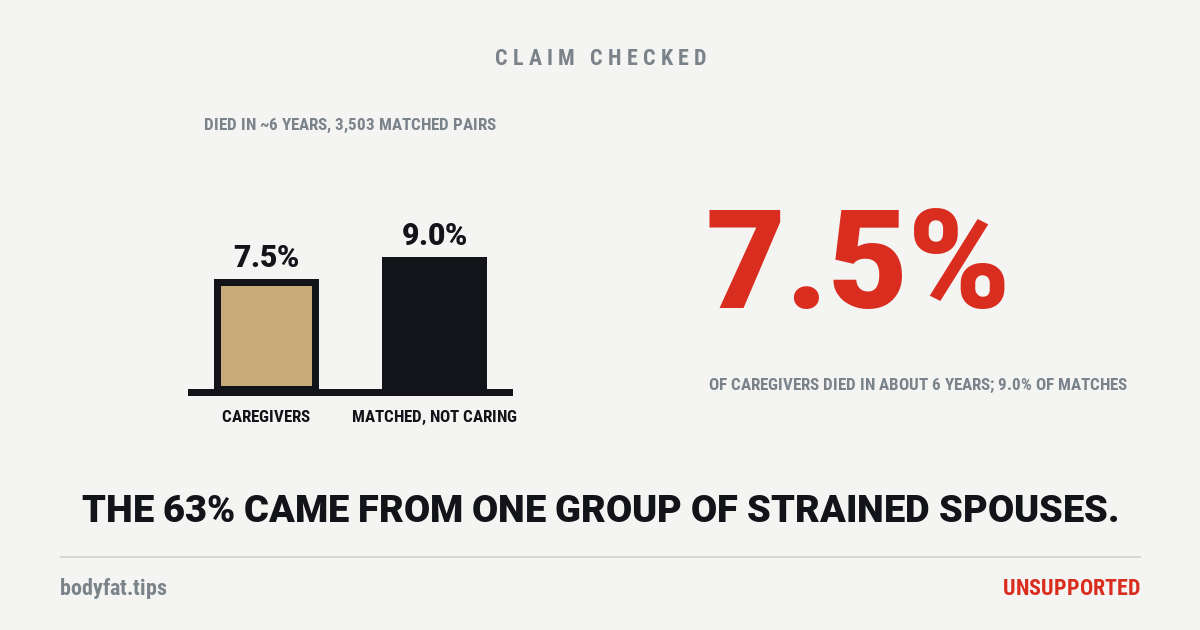
The test that followed was a national one. REGARDS, an American study that has followed about 30,000 adults aged 45 and over since 2003, asked every participant whether they were caring for a family member with a chronic illness or disability [3]. In 2013 its team took 3,503 who said yes and had complete records, and paired each one with a non-caregiver who looked the same on paper: the same age, sex, race, region, education, income, marital status, habits and health history, 15 measures in all. Researchers call this propensity matching [3].
Over about six years, 7.5% of the caregivers died, against 9.0% of their matched non-caregivers [3]. The hazard ratio, the death rate in one group divided by the rate in the other, where 1.00 means no difference and lower means fewer deaths, was 0.82 [3]. The team then looked for any kind of caregiver who did worse: spouses, the strained, the highly strained, women, men, Black and white caregivers. In that study, none showed even a trend towards more deaths. The 578 caregivers who reported a lot of strain died at 8.1%, against 8.0% of their matches [3].
The same direction turned up wherever we looked.
| Study | Who | Deaths, caregivers vs not |
|---|---|---|
| Caregiver Health Effects Study, 1999 [2] | 819 people aged 66 to 96 living with a spouse; about 4.5 years | Strained spouse caregivers 17.3%, against 9.4% with a spouse who was not disabled; caregivers without strain 13.8% |
| REGARDS, 2013 [3] | 3,503 caregivers aged 45 and over, each paired with a similar non-caregiver; about 6 years | 7.5% against 9.0% |
| Older women, 2010 [4] | 1,069 women, average age 81; 8 years | 19.7% against 27.4% |
| Northern Ireland census, 2015 [5] | 1.1 million people in a national census; under 3 years | Deaths at 72% of the non-caregivers’ rate, after allowing for differences |
| Women’s Health Initiative, 2024 [6] | 158,987 women aged 50 to 79 at the start; 17.5 years | Deaths at 91% of the non-caregivers’ rate |
| NIH-AARP study, 2026 [7] | 148,792 people, average age 71; 12.9 years | Deaths at 90% of the non-caregivers’ rate among those caring for adults |
| ARIC, 2025 [8] | 5,239 people, average age 75; about 5 years | 18.7% against 23.8%; after allowing for differences, too close to call |
Two reviews have pulled these studies together. A 2021 meta-analysis, a study that combines the results of other studies, pooled 12 of them from the United States, Britain, Northern Ireland, Japan and Australia and found caregivers’ death rate 16% lower [10]. It also found two things that cut the other way: the American studies on their own showed no clear difference, and the advantage disappeared in the studies that defined caregiving most precisely, as helping someone wash, dress, eat or manage daily tasks [10]. A 2022 systematic review kept only studies it rated at low risk of bias and found five that counted deaths; all five found fewer in caregivers [11].
So the claim fails the test it set itself. Our guess at why the 1999 number lasted, and it is only a guess: by its authors’ account it was the first study of its kind, it was in a famous journal, a tidy mechanism could be attached to it, and it confirmed what caregivers feel. None of that is a reason to doubt the people who repeated it. It is a reason to check which group of people a number came from.
Is strain different from caregiving?
Yes, and this is where the old study still has something to say. Inside REGARDS, the caregivers who reported “a lot” of strain, about one in six, died at a higher rate than the caregivers who reported none: a hazard ratio of 1.55 after allowing for age, health and other differences [12]. In a cohort of older women, high everyday stress went with more deaths over the first three years whether or not the women were caregivers; the authors concluded it was “higher stress, rather than caregiving per se” [4].
But set the most strained caregivers beside matched people who were not caregivers at all, and the excess does not appear: 8.1% against 8.0% over six years [3], and a hazard ratio of 0.73 over seven years, with a range that still includes no difference [13]. Rated alone, “strained caregivers die sooner” is Preliminary: a real pattern inside groups of caregivers, from studies that watch rather than test, and not confirmed when the comparison is with people who never took the job on.
Does caregiving keep cortisol high for months or years?
Cortisol is a hormone the adrenal glands release in a daily rhythm, highest soon after waking, and in bursts under stress. The idea that caregiving keeps it high has real support in studies of dementia caregivers. A 2017 systematic review of studies of dementia caregivers found 31 that measured cortisol; 16 of them found it higher in caregivers [14]. That is a majority, and a narrow one, and the review’s authors note that the studies collected saliva at different times of day, which makes them hard to compare [14].
When cortisol was measured in a large general population, the picture changed. Whitehall II, a long-running study of British civil servants, collected six saliva samples across one weekday from 3,727 people [15]. The overall shape of the day’s cortisol was no different in caregivers. Male caregivers had a smaller jump in cortisol in the half hour after waking, the opposite direction from “elevated”, though its authors note that a blunted morning rise has itself been linked to chronic stress and burnout; women caregivers as a group showed no clear difference, though women caring for a husband had a larger morning jump; and the differences were small, about 0.1 on a scale where 0.2 is what researchers call small [15]. One day of saliva is not “months or years”, but it does not show a body stuck on high.
Rated alone, “caregiving keeps cortisol high” is Preliminary: a pattern in about half of the studies of dementia caregivers, not seen as a raised level in a large population study. Our verdicts on how to lower cortisol and on what high cortisol actually looks like cover the hormone itself.
Inflammation and immunity
A much-quoted biology result in caregiving comes from Ohio. In 2003 researchers followed 119 people caring for a spouse with dementia and 106 non-caregivers for six years, measuring interleukin-6, or IL-6, a protein in the blood that rises with inflammation [16]. The caregivers’ IL-6 rose about four times as fast [16]. The caregivers were recruited from dementia clinics, support groups and respite programmes, the comparison group through newspaper advertisements, notices in senior centres and referrals [16].
Most studies in this field recruit that way, from small groups of volunteers, as a 2019 meta-analysis found when it pooled 30 of them, 1,848 caregivers against 3,640 non-caregivers [17]. Across all the immune and inflammation measures, the average difference was 0.16 on the effect-size scale where 0.2 is small and 0.8 large: “somewhat below” small, in the authors’ words [17]. In the studies they rated least open to bias, the inflammation difference shrank to 0.06, indistinguishable from none; of the three studies in the review that sampled the general population, none found a difference [17]. The immune measures, counts and activity of white blood cells such as T cells and natural killer cells, showed a little more, at 0.22 [17], and in the studies least open to bias they held at 0.20, small but unlikely to be chance [17].
Then the same team ran the test the field had lacked, by its own account. REGARDS had taken blood from its participants when they joined. Nine years later it took blood again from 239 people who had become caregivers in between, averaging 43 hours of care a week, and from 241 matched people who had not [18]. Of six markers of inflammation, one rose a little more in the caregivers, by 0.14 on the same scale, and none did in the 45 who were caring for a spouse with dementia [18]. A 2026 English study of 1,162 older adults found no link between caregiving and two common markers, C-reactive protein and white cells, and a higher chance of an abnormal third marker only in the 4.6% whose caregiving went from intensive to moderate over six years [19].
Rated alone, “caregiving drives inflammation and weakens immunity” is Preliminary: small differences, largest in the weakest studies. For inflammation, close to nothing in the better studies and little or nothing in the one study that measured people before they became caregivers; for immunity, a small difference that held in the better studies, and the before-and-after study measured inflammation only.
Does caregiving raise blood pressure?
Here the evidence points at the load, not the role. In a national American study of 5,708 married people aged 50 and over, those helping a spouse with daily tasks for 14 or more hours a week were diagnosed with high blood pressure at 1.36 times the rate of those who were not, and those who kept it up across two surveys at 2.29 times [20]. In 453 Black women aged 21 to 44, it was caregiving stress that went with new high blood pressure, a hazard ratio of 1.39; caring for a young child, a disabled child or an older adult did not, on its own [21]. A 2023 review of nine studies of heart disease and stroke found no clear difference between caregivers and non-caregivers overall, with more heart disease in two studies of people caring for more than 9 or 20 hours a week [22]. A 2022 review that also counted signs of risk, such as blood tests, blood pressure and risk scores, 41 studies in all, concluded that caregivers “are at high risk” of heart disease; its authors note that long-term studies were few (we read it as its abstract) [34]. The two differ in what they counted: new cases of disease in the 2023 review, signs of risk in the 2022 one.
Rated alone, “caregiving raises blood pressure” is Preliminary: a few cohorts, all observational, all pointing at heavy or stressful caregiving rather than caregiving itself. What lowers blood pressure, and by how much, has its own verdict.
What are the signs of caregiver stress?
The most consistent finding we read is the one the death counts can hide: caregivers feel worse. A 2003 meta-analysis of 84 studies found caregivers more depressed and more stressed than non-caregivers, by 0.55 to 0.58 on the effect-size scale, which researchers call moderate; the difference in physical health was 0.18, small [23]. In REGARDS, 43.5% of caregivers reported at least one depressive symptom in the past week, against 37.1% of their matches; that percentage is our arithmetic from the paper’s counts [13]. Over nine years, the people who became caregivers grew more stressed and more depressed than matched people who did not [24]. In German health-insurance records, caregivers were more likely than non-caregivers to be newly diagnosed with depression over five years [11].
Rated alone, “caregiving raises depression and stress” is Supported. The AI answer at the top of a search for “caregiver burnout”, the more-searched phrasing at about 5,400 searches a month against 880 for “caregiver stress” (from a paid keyword database, pulled 10 October 2026), lists exhaustion, irritability, withdrawal and poor sleep, and also “a lowered immune system leading to more sickness” [25]. The mood and sleep items match the research. The immune item is the weakest part of it.
How do you fix caregiver burnout?
Trials can answer part of this. A 2026 meta-analysis gathered 21 randomised trials, experiments that assign people to a programme or not by chance, of exercise and other lifestyle programmes for caregivers of older adults, 2,099 caregivers in all [26]. Mostly exercise programmes, they reduced depressive symptoms a little, by 0.34 on the effect-size scale; they did not consistently reduce burden, stress or sleep problems, and most of the trials were rated at high risk of bias [26]. That is modest, and it is something.
The rest is not a question a verdict can answer for you. This page is journalism, not medical advice. If caring for someone is wearing you down, your own doctor and the caregiver services in your area are the people to tell. The research points at the strain, not the caring, as the part that matters, and strain is something other people can share.
If caregivers die less often, why does it feel like it is killing you?
This section is the desk’s own reasoning, and it is labelled as such. The surveys and the death counts seem to disagree: caregivers report more stress and more depression, and they die at lower rates. Both can be true, and here are three ways, with the evidence for each.
Answer one: the healthiest person takes the job. In a family, the person who becomes the caregiver tends to be the one who can. In a cohort of older women, caregivers functioned better than non-caregivers at every screening [27]; in REGARDS, before matching, caregivers were less likely to report heart disease or stroke [3], and the most strained caregivers were the least likely to have diabetes, stroke or heart disease [12]. Researchers call this the healthy caregiver effect, after the healthy worker effect: people in jobs look healthier than people out of them partly because illness keeps people out. It is not the whole story. Matching on 15 health and background measures did not erase the gap [3], and in the Women’s Health Initiative caregivers and non-caregivers started out in similar health [6]. This is measured in part: caregivers start out healthier in several cohorts; how much of the gap it explains is not known. One review reads its own results the other way: the authors of the 2021 meta-analysis concluded that, once other differences between people were allowed for, their results gave “more support for stress theory”, the idea that caregiving’s strain harms health, “than the healthy caregiver hypothesis” [10]. We read that review only as its abstract and reference list, which do not show the analysis behind the sentence.
Answer two: helping may soften the stress it causes. In REGARDS, depressive symptoms and stress predicted earlier death among the matched non-caregivers but not among the caregivers [13]. Its authors’ explanation is that helping someone carries benefits of its own that blunt the effect of stress on the body [13]. One analysis in one cohort found the pattern; the explanation for it is a hypothesis, not a measurement.
Answer three: the average hides the people who are drowning. About one caregiver in six in REGARDS reported a lot of strain [12]. A pooled result averages them with everyone else, including the roughly one in three REGARDS caregivers who gave fewer than 10 hours of care a week [12]. The strain pattern is measured, inside groups of caregivers [12] [4]; that strain causes the deaths is a surmise, and the comparison with non-caregivers did not confirm it [3] [13].
Put the three together and here is what we think is true, stated plainly so you can disagree with it: caregiving is not what the death counts point at; if anything harms caregivers’ health, it travels with being overwhelmed, which is a minority of caregivers and a different problem.
What we could not find, and would like to: a randomised trial that gave overwhelmed caregivers real relief, paid respite hours, say, and then followed their blood pressure, heart attacks and deaths for years. The closest we found to that kind of relief gave 55 dementia caregivers ten days of in-home help and measured stress hormones and blood-pressure responses over about a month: no overall difference in blood pressure, heart rate or one of the two stress hormones, as a review of 14 such trials, published online in December 2023, describes it [28]. The trials we found that followed caregivers’ blood pressure for six months or more were small, and they did not agree. In 100 women caring for a relative with dementia, a year of brisk walking shrank how far the top number of their blood pressure rose during a stress test, from about 22 mmHg (the unit a blood-pressure monitor reads in) to 12, while it stayed near 18 with nutrition classes (we read it as its abstract) [32]. In 116 dementia caregivers, a video coping-skills course lowered blood pressure measured around a stress test by about 8 mmHg on the top number and 4 on the bottom at six months; the caregivers were assigned alternately rather than by chance, and the company that sells the course ran the trial [30]. In 142 Black dementia caregivers, a culturally tailored education programme was followed by a lower bottom number at six months, and the same programme with exercise added was not, according to a 2025 meeting abstract [35]. And in a Spanish trial in which family doctors gave 176 dementia caregivers advice on physical activity, the 2023 review reports an improvement in the top number; the trial’s own paper reports it rising by about 6 mmHg in the advised group, which had started lower, against a fall too small to rule out chance in the others [31]. None of these counted heart attacks or deaths. One trial still running will report blood pressure after a year: 300 Chinese and Korean American dementia caregivers, assigned by chance to counselling and family support or to an online chat group, due to finish in mid-2027 [33]. The 2026 review of 21 lifestyle trials measured mood, burden and sleep, not deaths [26]. We found no trial that counted the caregivers’ own deaths, heart attacks or strokes [29]. If you know of one, the corrections line on this site is open.
Who these studies were done on
If you are wondering whether any of this applies to you: most of the death studies are of people in their sixties or older, two of them only of women [4] [6], and the biology studies are mostly of people caring for someone with dementia, often a husband or wife [14] [17]. REGARDS enrolled only Black and white Americans [3]. Here is what the studies say for different caregivers, and where they say nothing.
| If you are | What the studies found |
|---|---|
| An older spouse caring at home | The 1999 study’s higher death rate was in strained spouses [2]. In REGARDS, spouse caregivers died at about the same rate as matched non-caregivers, 11.1% against 12.3% [3]. |
| An adult child caring for a parent | The clearest lower death rate in REGARDS: 3.0% against 5.2% [3]. |
| An older woman | Two cohorts of women, both lower death rates in caregivers [4] [6]. |
| Caring for long hours | Fewer deaths even at 50-plus hours in the census study [5]; more heart disease with intense caregiving in two of nine studies in a 2023 review [22]; more new high blood pressure with 14-plus hours of spousal care [20]. |
| Overwhelmed by it | A higher death rate than less strained caregivers in one cohort [12], but not than matched non-caregivers [3] [13]. |
| Under 45 | One cohort of 453 Black women aged 21 to 44: caregiving stress, not caregiving itself, went with new high blood pressure [21]. The death studies on this page are mostly of people in their sixties or older; the census study, which counted everyone aged 25 and over, found no evidence that caregivers’ lower death rate changed with age [5]. |
| Caring for a child with a disability | One finding, from REGARDS, where everyone was 45 or over: people caring for a son or daughter with an illness or disability died at 1.65 times the rate of spouse caregivers once age, health, strain and other differences were allowed for; before those allowances the gap was too small to rule out chance [12]. That compares caregivers with caregivers, not with non-caregivers, and it is one analysis. The wider research on parents of disabled children is a different literature, not reviewed for this page. |
A gap worth naming: none of these studies can say what happens to a particular caregiver. They describe groups. Most caregivers also report good sides to the role [18]; purpose and belonging have their own verdict, and so does the slow breathing technique often recommended for stress, box breathing. Many of the people in the biology studies were caring for someone with dementia; what prevents it is covered here.
What this is rated, and what the rating covers
Unsupported — for the claim as the channel’s videos sell it: that caregiving stress shortens caregivers’ lives, so that caregivers are at higher risk of dying early.
It is the first kind of Unsupported: the claim was tested and did not hold up. Cohorts from the United States and Northern Ireland, with up to 1.1 million people and up to 17.5 years of follow-up, found caregivers dying at the same rate as non-caregivers or a lower one [3] [5] [6] [7], and the two reviews that gathered such studies agree on the direction [10] [11]. None of it is a trial, because nobody can be randomly assigned to care for a sick husband, and the lower death rates do not prove that caregiving lengthens life; the healthy caregiver effect above is one reason why.
The other parts, rated alone: strained caregivers dying sooner, Preliminary [12] [4]; caregiving keeping cortisol high, Preliminary [14] [15]; inflammation and weaker immunity, Preliminary [17] [18]; higher blood pressure, Preliminary [20] [21]; more depression and stress, Supported [23] [13].
None of this is aimed at anyone caring for someone they love, or at anyone who repeated the 63%. It is aimed at a number that lost its subset on the way to becoming a fact. This page is journalism, not medical advice.
What is not rated here: the widowhood effect, the risk after a spouse dies, which the same video also discusses and which is a different question with different evidence, rated in its own verdict; caring for children; paid care work; and the frame in the section above, which is this desk’s reasoning from the evidence rather than a result the evidence delivered. It is marked as ours so that you can weigh it as ours. How we read a study, and what each tier means, is set out here.
- Can You Die of a Broken Heart? After a Spouse Dies, the Survivor’s Death Rate Runs About Two-Thirds Higher for Three Months. Then the Excess Shrinks.
supported - How to Prevent Dementia: The “Never” Habit Is Untested; Habit Trials Fell Short
unsupported - Blue Zones: Ten Places Carry the Name. Three Have the Data, Two Are Fading.
preliminary