Protein for Fat Loss: It Works — For Most Dieters, Your Target Is a Third Too High

Protein does something. That needs saying first, because this is one of the few supplement-adjacent claims that survives contact with the evidence.
Eat more of it while you are dieting and you hold onto more lean tissue. Three research groups, in four separate meta-analyses, have now pooled the trials and found the same thing [1][2][3][4]. That is a real, replicated finding and we are not going to pretend otherwise.
What does not survive is the reason you were given for it.
The size of the actual effect
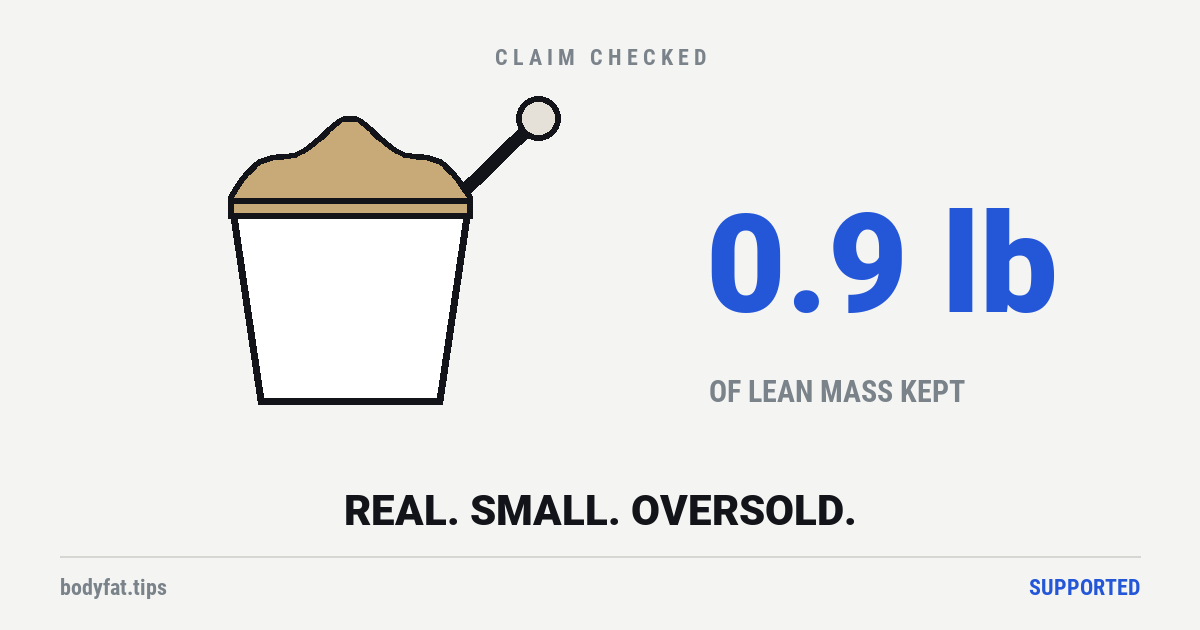
In calorie-matched trials — same calories, more protein — higher intake produced about 0.9 lb (0.4 kg) more fat-free mass and roughly 2.0 lb (0.9 kg) more fat lost than standard intake [2]. Other reviews land in a similar range, up to around 1.8 lb (0.8 kg) of lean mass [3].
Worth having. Not worth the aisle.
And one detail the marketing never carries: the largest recent review found protein preserved muscle mass but did not significantly protect muscle strength or physical function [1]. You keep the tissue. Whether it does more for you is not established.
The metabolism claim, refuted by its own funders
The pitch is that protein burns fat because digesting it costs energy. The first half is true: your body spends roughly 20 to 30 percent of protein’s calories processing it, against 5 to 10 for carbohydrate [5].
Then it fades. A 2024 review of 52 studies found the effect clearly present in single meals — and not statistically significant over time [6]. What did persist in the longer studies, four days to a year, was a slightly higher total and resting energy expenditure on the higher-protein diets — the calories burned over a whole day, and the calories burned doing nothing: effect sizes of 0.29 and 0.18, on a scale where 0.2 is barely there and 0.8 is large [6]. The calorie-matched dieting trials put the resting part at roughly 140 kcal a day (595 kJ) of metabolism not lost while dieting, though the range of plausible answers ran from about 16 to 270 [2]. Real, modest, and not a fat-burning mechanism.
Here is the part that ought to settle it. A 2015 review, produced from a summit funded by the beef, dairy, egg and pork industries, concluded that the thermic difference is “modest, highly variable, and difficult to quantify, and hence, probably has minimal impact on weight loss” [7].
The people paying for the research said the mechanism doesn’t matter. The people selling the powder are still using it.
A unit that quietly changed
This is the best-documented distortion we found, and it is worth following closely because it explains why your protein target may be a third too high.
In 2014 a review of resistance-trained athletes in a deficit recommended 2.3 to 3.1 grams per kilogram of fat-free mass [10] — that is, per kilogram of you that isn’t fat.
Three years later a widely-cited position stand restated the same range as 2.3 to 3.1 grams per kilogram, in a document that elsewhere defines its units as grams per kilogram of body weight [11].
Fat-free mass became body weight. For someone carrying 25 percent body fat, that single substitution inflates the target by about a third. Nobody appears to have done it deliberately. It just never got caught, and it is now downstream in a great deal of advice.
What the evidence actually supports
The most-cited ceiling comes from a 2018 analysis of 49 studies, which found benefits levelling off around 1.6 g/kg of body weight per day [9]. Read the fine print, though: the confidence interval runs from 1.03 to 2.20, and the breakpoint itself missed statistical significance. It is softer than its reputation.
A 2025 review focused specifically on dieting lifters reads differently. On average, lean-mass loss stopped at about 1.9 g/kg of bodyweight (2.5 g/kg of fat-free mass), and intakes above that, up to the 3.2 g/kg it had data for, went with more lean mass kept. Its practical table runs from “up to 1.9” when losing lean mass is unlikely and unimportant, to 1.9–3.2 g/kg when it is both likely and costly. The authors say plainly that the heterogeneity between studies makes their findings exploratory, with only five studies making a true high-versus-low comparison [15].
So the answer splits by who you are. For the ordinary dieter, roughly 1.6 grams per kilogram of bodyweight is a defensible target, and above about 2 the evidence thins quickly — remembering that the 1.6 was measured in healthy adults who were lifting and were not required to be dieting, which the 2025 authors call an energy-balance figure. The 2.3-to-3.1 range you may have been given did reach the mainstream through the unit error above. But a lean lifter in a deficit now has a separate, exploratory case for a range that high, made by an author of the original 2014 review by a different route.
Does it work without the gym?
Yes, and this is the finding most likely to change what you actually do.
The diet-only trials answer it directly. The 20-trial review in older adults [3] admitted only trials with no exercise programme at all, and the higher-protein groups still kept about 1.8 lb (0.83 kg) more lean mass.
A separate review of 22 comparisons sorted them by what the participants were put through [4]. In the 14 dieting comparisons, 12 of them with no resistance training, extra protein kept about 0.8 lb (0.36 kg) more lean mass. In the 3 that involved lifting, it added about 1.7 lb (0.77 kg). In the 7 where people were neither dieting nor training, it made no measurable difference. The stressor that makes protein matter can be the diet itself. The gym is not required; it adds.
The trial usually quoted the other way split 100 older adults four ways: control, extra protein, exercise, or both. Only the group that got protein and lifting gained fat-free mass significantly [12]. But read the intake figures. The “high protein” groups managed 1.13 g/kg against 0.98 in the control groups — about 16 g a day apart, less than a third of the gap the trial was designed to test — and the authors say that made it difficult to draw firm conclusions about protein at all.
So protein on its own is not a treatment for anything. It is raw material, and a calorie deficit is enough of a signal for it to matter. Resistance training sends a louder one.
Where the trial everyone quotes came from
You have probably heard you can build muscle while losing fat on high protein. That comes from one 2016 study, and it is worth knowing what it was.
Forty overweight young men, four weeks, six training days a week, every meal provided by the researchers, and — the detail that matters — none of them were regularly lifting beforehand [16]. The authors themselves call it a proof-of-principle trial. Untrained people gaining muscle quickly under supervised feeding is the most predictable result in exercise science.
And a detail almost never repeated: the lower-protein comparison group also held onto their lean mass.
The honest limits
Four things cut against the claim, and they belong here.
The biggest and longest trial found nothing. 811 people, two years, 25 percent versus 15 percent protein: 7.9 lb (3.6 kg) versus 6.6 lb (3.0 kg) lost. The conclusion was that calorie-reduced diets work regardless of which macronutrient they emphasise [13].
There is a documented trade-off. In one trial, higher protein cut the loss of lean tissue by about 45 percent — and simultaneously prevented the improvement in insulin sensitivity that weight loss normally brings [14]. Small study, but it is a real cost and it is almost never mentioned beside the muscle claim.
Women are under-represented. In the 2025 analysis of dieting lifters, the dose-response — more protein, more lean mass kept — was clear in men and flat in women, who were 274 of its 729 participants. The authors offer both explanations and settle neither: women may genuinely need less, since there is evidence they burn less protein for fuel during exercise, or there were simply too few women in the data to tell [15].
The source doesn’t matter. Beef against whey, across seven trials: no difference in lean mass or fat mass [17]. Total intake is what counts. The powder is a convenience, not a mechanism.
The claims grew. The product didn’t.
One number captures the whole business. Between 2013 and 2023 the count of high-protein products in a major retail database went from 289 to 1,230. Slimming claims doubled. Muscle-gain claims rose three and a half times. And the protein content stayed consistent at about 20 grams a serving [18].
Nothing in the tub changed. Only the sentence on the front.
So what to do
If you are dieting and lifting, aim somewhere around 1.6 grams per kilogram of bodyweight and stop optimising. Get it from food where you can; use powder when it is easier, because it is a convenient food and nothing more.
Do not expect it to raise your metabolism in any way you will notice. Expect a modest lean-mass benefit from the protein on its own while you diet, and a larger one if you lift.
The protein works. The story attached to it was written by people selling protein.
Four descriptions of the evidence were corrected on 15 September 2026 after an independent editorial review. The section on training said protein did little without the gym and cited a 22-comparison review for it. That review’s null result is for people who were neither dieting nor training; in its dieting comparisons, most with no resistance training, extra protein kept about 0.8 lb (0.36 kg) more lean mass, and the page’s own diet-only review in older adults found the same. The section, its heading and the closing advice now say so, and the four-arm trial quoted there now carries its authors’ own caveat that the protein groups ended up only about 16 g a day apart. The 2025 review of dieting lifters was described as putting the practical range at about 1.9 g/kg; it reports 1.9 g/kg of bodyweight as the intake where lean-mass loss stopped on average and recommends 1.9 to 3.2 for lean lifters at high risk, so the page and its title now scope “a third too high” to the ordinary dieter. The metabolism section now reports the slightly higher resting and total energy expenditure that the 2024 review and the calorie-matched trials found, alongside the thermic effect that did not persist.
Also changed: the evidence panel’s funding row said industry funding was pervasive across the key reviews. The four lean-mass meta-analyses report government, university and charity support and no industry money; the row now names the sources that do carry conflicts, and the source list now records the 1.6 g/kg analysis’s dairy-council funding and its 2020 correction, the 2025 review’s diet-company funding, and the 40-man trial’s dairy links. “Four independent research groups” is now three groups and four meta-analyses, because two share a Purdue laboratory, and the note on women now gives both explanations its authors offer. On the date: this page was rebuilt from a June 2024 post on 25 July 2026 and last revised on 10 September 2026, which is why it cites papers newer than the date shown. The rating is unchanged.
- Caffeine Before a Workout: 21 Meta-Analyses Say It Works. And Your Daily Coffee Habit Does Not Blunt It.
established - Lion’s Mane: The Trial Everyone Cites Had Fifteen People Per Group. Four Weeks After They Stopped, It Was Gone.
preliminary - Glutathione Benefits: It Does Absorb. That Is the Part Everyone Got Wrong, and It Is Not the Part That Matters.
preliminary