Is Fruit Sugar Bad for You? Told to Eat More Fruit or Less, People With Type 2 Diabetes Showed No Clear Difference in Blood Sugar.

“Fruit is evil.” That is the whole title of a 59-second video posted on 2 June 2024 by a physician’s low-carb and fasting video channel. It had 1,372,507 views when we read its numbers on 10 October 2026 [1]. Almost ten months later the same channel posted “You were lied to about fruit!”, 56 seconds, now at 1,451,139 views [1].
Lied to about what, exactly? We cannot tell you. The descriptions under both videos are lists of links, to the channel’s books, courses, ketone powders and test kits, and they give no reason and name no study [1]. We read the descriptions, not the videos, so the reason given on camera is one we could not read. An older and longer video from 2021, “Why You DON’T NEED FRUIT in Your Diet at All”, says in its description that “The history of Native Americans holds a surprising answer that connects health and this important vitamin” [1]. It does not name the vitamin, and we will not guess it.
So this page takes the claim as the titles put it, and as people search for it. In the United States, “fruit and diabetes” is searched about 8,100 times a month, “can diabetics eat fruit” about 3,600 times, “is fruit sugar bad for you” about 2,900 times and “is fruit healthy” about 2,400 times a month (from a paid keyword database, pulled 10 October 2026) [2].
Sugar eaten as whole fruit has not shown up as harmful in the trials. In a Danish trial, people with newly diagnosed type 2 diabetes were told to eat more fruit or less for 12 weeks; their long-term blood sugar fell in both groups, with no clear difference between them [3]. Across 10 trials that swapped fruit in for other food at the same calories, people ended slightly lighter, not heavier [4].
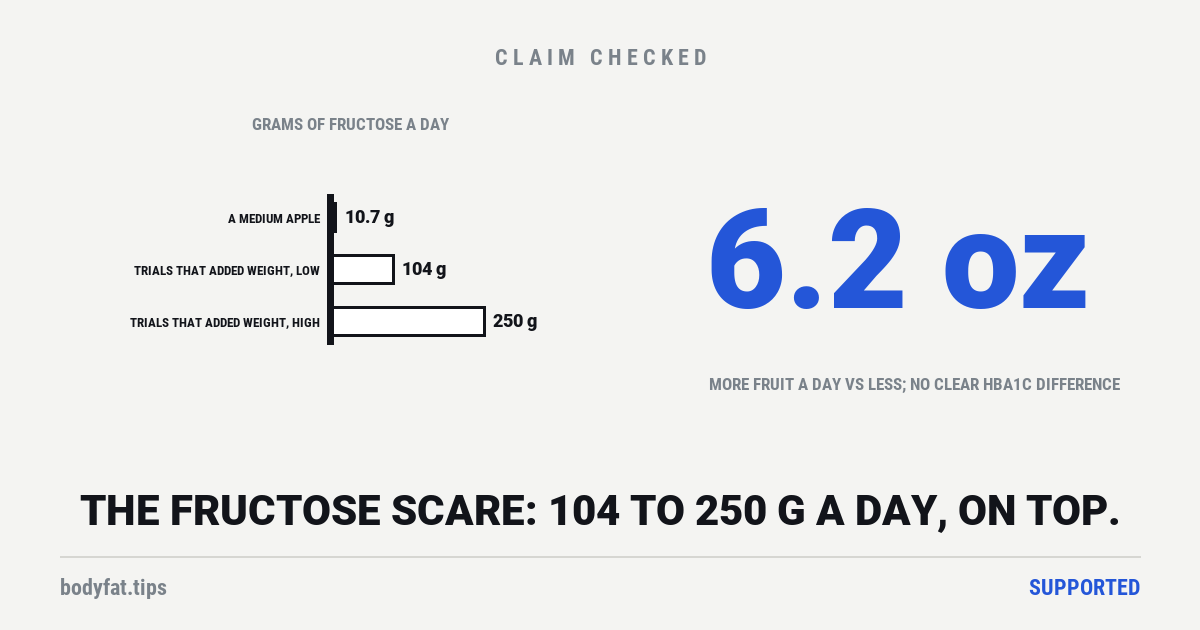
The fructose scare came from doses far beyond a fruit bowl, added on top of a diet. In the trials where fructose put weight on, people were given 104 to 250 g of it a day on top of their usual food [5]. A medium apple holds about 10.7 g, so that is the fructose of roughly 10 to 23 apples a day, by our arithmetic from the US Department of Agriculture’s tables [6].
Juice is a separate question, and its answer is less tidy. It has its own section below.
Does fruit raise blood sugar?
Yes, a little and for a while, like any food with carbohydrate in it. The measure for that is the glycemic index: a score of how far a food’s carbohydrate raises blood sugar over two hours, against the same amount of pure glucose, set at 100 [7]. Averaged across labs, a raw apple scores 36, an orange 43, a banana 51, a mango 51 and pineapple 59, against 75 for white bread and 73 for boiled white rice [7]. On that scale 55 or less counts as low and 70 or more as high, which puts most whole fruit at the low end [7]. Our maltodextrin verdict explains the scale at more length.
A rise after a snack is not the number that decides much in diabetes, though. That one is HbA1c, the blood test that works as a roughly three-month average of blood sugar. It is reported as a percentage, and a fall means better control. So the question that matters is not whether an apple moves your blood sugar for an hour. It is whether eating fruit, week after week, pushes HbA1c up.
Can diabetics eat fruit?
A hospital team in Denmark tested the advice directly [3]. Sixty-three adults whose type 2 diabetes had been found within the past year all got the same advice from a dietitian, which for those who were overweight included eating less; the only difference was the fruit [3]. Half were told to eat at least two pieces a day and half no more than two, a piece being about 10 g of carbohydrate: 3.5 oz (100 g) of apple, 1.8 oz (50 g) of banana or 4.4 oz (125 g) of orange [3].
The advice worked as advice. The more-fruit group went from 6.8 oz (194 g) of fruit a day to 11.3 oz (319 g); the less-fruit group from 6.6 oz (186 g) to 4.8 oz (135 g), a gap of about 6.2 oz (175 g) a day, roughly two pieces [3]. After 12 weeks HbA1c had fallen in both groups: from 6.74% to 6.26% on more fruit and from 6.53% to 6.24% on less [3]. The more-fruit group’s fall was the bigger, 0.49 points against 0.29, but the gap was well within what chance produces, and it shrank to almost nothing once the authors allowed for the more-fruit group having started with more people on diabetes tablets [3]. Weight fell in both groups too, 5.5 lb (2.5 kg) on more fruit and 3.7 lb (1.7 kg) on less, with no clear difference [3].
It is one trial: 63 people for 12 weeks, open, meaning everyone knew which advice they had, and stopped short of its planned size for want of time and money [3]. Its people had mild, newly found diabetes, with an HbA1c of about 6.6% at the start [3]. But it tested the thing the warning is about, fruit eaten as fruit, and found no clear sign of the harm the warning predicts; a trial this small could miss a modest difference in either direction.
| Study | What they ate | What happened |
|---|---|---|
| Denmark, 2013; 63 adults, 12 weeks, randomised [3] | Advice to eat at least two pieces of fruit a day, or no more than two | HbA1c fell in both groups; no clear difference between them [3] |
| India, 2013; 123 adults, 3 months [8] | Two low-calorie fruits a day, or standard care | HbA1c fell more with the fruit, by the summary [8] |
| Bahrain, 2022; 79 adults, 12 weeks, randomised [9] | 2.1 oz (60 g) a day of dates, or of raisins | No clear change in HbA1c on either [9] |
| Greece, 2014; 48 adults, 24 weeks, randomised [10] | 1.3 oz (36 g) of raisins a day in place of other snacks | Blood-sugar control “not affected”, by the summary [10] |
| United States, 2020; 52 men, 8 weeks, randomised [11] | 0.8 oz (22 g) a day of freeze-dried blueberry powder, or a dummy powder | HbA1c 7.1% against 7.5% at the end [11] |
| India, 2025; 35 adults, 8 weeks, randomised [12] | 8.8 oz (250 g) a day of mango, prepared as pulp, in place of bread at breakfast, within a calorie-reduced diet | HbA1c fell 0.6 and 0.2 points on two kinds of mango and rose 0.3 on bread, by the summary [12] |
| United States, 2019–2023; 34 started, 10 analysed, 12 weeks, no comparison group [13] | Half of all calories as fruit, about 16 servings a day: a frozen-fruit smoothie, fresh fruit and dried fruit [14] | Six of the eight on diabetes medicines came off them; allowing for that, 24-hour blood sugar 12 mg/dL lower, range includes no change [15] [13]; fasting blood sugar 123.5 to 131.5 mg/dL, with no allowance [16] |
The other trials point the same way, or better. Dried fruit concentrates the sugar, so two trials of it are the hardest test. In Bahrain, 79 adults with type 2 diabetes ate 2.1 oz (60 g) a day of dates or of raisins for 12 weeks: HbA1c went from 7.6% to 7.5% on dates and from 7.7% to 7.6% on raisins, no clear change on either [9]. In Greece, 48 people ate 1.3 oz (36 g) of raisins a day in place of other snacks for 24 weeks, and blood-sugar control was “not affected”; we read that one as its summary, and its paper says it was funded by a raisin cooperative, within a European Union development programme [10]. In India, 123 adults given two low-calorie fruits a day for three months saw HbA1c fall more than people on standard care; we read that one as its summary too, which does not say how people were assigned [8].
And one test went much further. At the University of Alabama at Birmingham, adults with type 2 diabetes ate half their calories as fruit, about 16 servings a day, for 12 weeks, with their meals provided and their weight held steady [13] [14]. A quarter of their calories came as a frozen-fruit smoothie, an eighth as fresh fruit salad and an eighth as dried fruit [14]. Its main results are posted on the trial registry, and its authors summarised them in a 2025 conference abstract; we found no full paper of them [13] [15] [18]. Of 34 people who started, 12 finished and 10 met the study’s rules for analysis [13]. Six of the eight who were taking diabetes medicines came off them [15]. Allowing for those medicine changes, average blood sugar over 24 hours, read by a glucose monitor, was 12 mg/dL lower at the end than at the start, with a range running from about 26 lower to 2 higher, by our arithmetic from the posted figures [13]. Without that allowance the picture is less tidy. In a three-hour test after a glucose drink, average blood sugar was 11 mg/dL higher at the end across all ten, and 20 mg/dL lower in the four whose medicines did not change; both changes are within what chance could produce, by our arithmetic from the posted figures [13]. The ten’s fasting blood sugar went from 123.5 to 131.5 mg/dL on average [16]. The authors’ own summary reports results both ways. Blood-sugar control improved in 9 of the 10 by its measures, half of the six taken off their medicines reached the blood-sugar line for remission at week 12, and the top blood-pressure number fell by 11 points; and 24-hour blood sugar rose for a while before it fell, and triglycerides, a blood fat, rose by 31 mg/dL [15]. There was no comparison group, so none of that can be credited to the fruit, or blamed on it. What it does show is narrow: allowing for the medicines they stopped, half a diet of fruit did not send these ten people’s 24-hour blood sugar up.
The study also points at a hazard that is easy to miss. Doses of diabetes medicine were cut as blood sugar fell [16], and eighteen of the 34 who started reported low blood sugar at some point during the study, while fifteen reported high blood sugar [13]. When what you eat changes a lot, the doses of diabetes medicine may need to change with it, and that is a job for the clinician who manages them. A supplement sold for blood sugar has its own verdict here.
What about the reviews that say fruit lowers blood sugar?
Two reviews pool trials of fruit in diabetes, and both are worth opening, because neither is quite what its title suggests.
A 2023 review pooled 19 trials and reported fasting blood sugar 8.4 mg/dL lower with fruit, and no clear change in HbA1c [19]. Open its table of trials and most of the “fruit” is not fruit as anyone eats it: five trials of capsules made from Citrullus colocynthis, a plant used in herbal medicine; four of pomegranate juice, two of cranberry juice and one each of barberry and noni juice; freeze-dried berry powders; only one of fresh fruit, red guava or papaya for two weeks; and a homeopathic remedy: the table lists jambolan at “30 potency”, and that trial’s own report says its patients took “homoeopathy Syzygium 30 potency”, bought from a homoeopathic pharmacy; its first and corresponding authors work at a homoeopathic medical college and a faculty of homoeopathy [19] [20]. The authors’ own caution: “most of the fruits included in this meta-analysis have a certain medicinal value” [19]. Three trials carry almost two-thirds of the fasting-sugar result: the homeopathic jambolan remedy, 26% of the weight, a blueberry powder, 21%, and pomegranate juice in 19 people, 17% [19]. The Danish trial above is not among the 19.
A 2026 review, searching to April 2024, kept only “whole fruit-based products” and found HbA1c 0.33 points lower with fruit, with a range from 0.11 to 0.54 lower [21]. Its five trials were a flour made from passion-fruit rind, dried jujubes, raisins, freeze-dried strawberry powder and freeze-dried blueberry powder [21]. None was fresh fruit, and the Danish trial is not among them either. One trial carries 65% of the weight of the HbA1c result: 52 American veterans who took 0.8 oz (22 g) a day of freeze-dried blueberries or a dummy powder for eight weeks, in a trial paid for and supplied by a blueberry growers’ council [21] [11].
Here the numbers stop adding up. The review’s chart gives that trial’s spreads as 0.1 and 0.2 points [21]. The trial’s own paper gives those same numbers as standard errors [11]. A standard deviation describes how spread out the people in a group are; a standard error describes how precisely the group’s average is known, and it is smaller by the square root of the group size. Enter the second where the first belongs and a trial of 26 a side looks about five times as precise as it was, and the pooling leans on it. The 2023 review entered the same two numbers the same way [19].
Put back the spreads those standard errors imply, run the review’s own method on its own five rows, and by our arithmetic the pooled figure becomes 0.26 points lower, with a range from 0.55 lower to 0.02 higher: “no difference at all” is back on the table [21] [11]. We left the other four trials’ spreads as the review printed them.
The largest pooling of fruit fed in place of other food at the same calories, from a Toronto group in 2018, found HbA1c 0.19 points lower across six trial comparisons [22]. Its chart of those six includes the Danish trial and two freeze-dried berry products, and its biggest by number of people is the Indian trial above, which found a fall of 0.80 points [22] [8]. Leave that one out and, by our arithmetic from the review’s chart, the pooled fall is 0.11 points with a range that includes no difference; leaving out the two berry products does the same [22]. Three of the six were not run in people with diabetes at all: healthy adults, slightly overweight women and adults with metabolic syndrome [22].
So: fruit lowering HbA1c is a hope with a few small trials behind it, the newest a 2025 trial in India in which 35 adults with type 2 diabetes ate mango or bread at breakfast for eight weeks, and HbA1c fell on mango and rose on bread, by its summary [12]. Whole or dried fruit clearly raising HbA1c has not turned up in any trial on this page.
Is sugar from fruit as bad as refined sugar?
The sugar is the same stuff. The USDA’s tables list fruit’s sugar as fructose, glucose and sucrose, the molecules of table sugar and syrup; a medium apple carries about 18.9 g of sugar, 10.7 g of it fructose, by our arithmetic from those tables [6]. Fructose is the one with the bad reputation, and the reputation was earned in trials like one from the University of California in 2009: overweight adults drank a quarter of their daily calories as fructose-sweetened drinks for 10 weeks, and only they, not a group drinking glucose, added visceral fat, the fat packed around the organs [23]. Our no-sugar diet verdict covers that trial and what cutting sugar does.
Then the trials were sorted by how they were run. A 2012 pooling found that where fructose replaced other carbohydrates at the same calories, in 31 trials, weight did not clearly change: 0.31 lb (0.14 kg) lower, with a range from 0.82 lb lower to 0.22 lb higher [5]. Where it was added on top of the diet, in 10 trials at 104 to 250 g a day, people gained 1.2 lb (0.53 kg), which the authors say may have been the extra calories rather than the fructose; we read that review as its summary [5]. In people with diabetes, a pooling of 18 small trials by the same group found that fructose in place of other carbohydrate, at a median 60 g a day, slightly improved long-term blood-sugar markers [24]. Europe’s food-safety authority, reviewing the trials in 2022, found that free fructose and free glucose did not appear to differ in their effects on weight, liver fat, blood-sugar tolerance, blood fats or blood pressure, whereas free fructose appeared to raise the liver’s resistance to insulin, and uric acid, more than the same amount of glucose [25]. The authority weighs high uric acid as a marker of gout risk, and notes that it has been proposed as a risk factor for high blood pressure [25]. Those were trials of free fructose, not of fruit: the liver effect appeared in trials of one to six weeks that gave fructose in drinks at 16% of calories or more, and the uric-acid effect at 9 to 25% of calories [25]. Sixteen per cent was the lowest dose tested for the liver effect, and the authority says the trials cannot show an intake at which the risk is not raised; it also says the liver effect was generally not seen with the same amounts of sucrose, table sugar, in which fructose comes bound to glucose [25]. Those are the doses the trials tested, not a safe limit. On 2,000 calories a day, 9% is about 45 g of fructose, the fructose of about four medium apples, and 16% is about 80 g, about seven and a half apples’ worth, by our arithmetic [6]. The authority also notes that none of the trials it weighed changed the sugar people ate in whole fruit [25].
Is it the sugar or the package, then? A New Zealand trial matched the two [26]. For four weeks, 41 overweight adults were given either a banana, three apples and two small boxes of raisins a day, or about 32 fl oz (955 mL) of sugar-sweetened soft drink, both carrying about 52 g of fructose and the same calories [26]. Neither group’s weight or heart-risk measures clearly worsened, and the two did not clearly differ, apart from uric acid in the men, which ended higher on soft drink than on fruit, in an analysis the authors call post hoc, meaning it was chosen after the data were in [26]. Four weeks is short. It tested whether either did harm at that dose over a month, not which is better over a year.
Over months, the pooled trials say the package matters. In the 2018 Toronto review, fruit swapped in at the same calories did no harm to blood-sugar measures, while fruit juice added on top of a diet raised fasting blood sugar, in two trial comparisons [22]. In its 2023 sister review of body weight, sugary drinks added to a diet put on 1.1 lb (0.49 kg) across 21 trials, while fruit added at up to a tenth of calories went with 1.3 lb (0.60 kg) less, across 14 [4]. Swapping sugar for sweeteners has its own verdict.
Do fruit sugars count?
Not in the two sets of guidelines we read, as long as the fruit is whole. The World Health Organization’s limits are for free sugars, which it defines as sugars added by a maker, cook or consumer “and sugars naturally present in honey, syrups, fruit juices and fruit juice concentrates” [27]. Sugars inside intact fruit are left out, and the WHO says why: “there is no reported evidence of adverse effects of consumption of intrinsic sugars” [27]. The US guidelines for 2025 to 2030 say the same in their own words: fruits have naturally occurring sugars, and “The sugars in these foods are not considered added sugars” [28].
So the sugar in a whole apple counts toward nothing on either list. The sugar in a glass of 100% apple juice counts as free sugar on the WHO’s.
How much natural sugar per day?
Neither guideline sets a limit on the sugar in whole fruit [27] [28]. The WHO’s limit is for free sugars: under 10% of daily calories, and ideally under 5% [27]. On 2,000 calories, 10% is 50 g, by our arithmetic. The US guidelines recommend two servings of fruit a day on 2,000 calories, a serving being a cup raw or half a cup dried, and say no meal should carry more than 10 g of added sugars [28]. Two cups of apple slices carry about 23 g of sugar, by our arithmetic from the USDA’s tables [6].
Worst fruits for diabetics: which fruits raise blood sugar most?
Google’s AI answer for “fruit and diabetes” lists ripe bananas, mangoes, pineapples, watermelon, dried fruit and fruit juices as fruits to limit [2]. Here is what was measured. By the glycemic index, watermelon scores highest of the fruits in the 2008 international tables’ list of common foods, 76 on average, then pineapple at 59 [7]. Bananas vary with where and how ripe: one table gives 47 for an Australian banana, 62 for a Canadian one and 70 for a South African one [7].
But the index scores the same amount of carbohydrate, not the same serving. The fix is the glycemic load: the glycemic index multiplied by the grams of carbohydrate in a serving, divided by 100. A 4.2 oz (120 g) serving of watermelon holds only 6 g of carbohydrate and scores a load of 4 or 5; a 2.1 oz (60 g) serving of raisins holds 44 g and scores 28 [7]. By our reading, the measurements say the thing to watch is how much sugar a serving carries, which is why dried fruit and juice stand out, not which fresh fruit it is.
Do the higher scores matter over years? In people with type 2 diabetes, an Italian test of eight common fruits found no significant differences in glycemic index between them; we read it as its summary [29]. In three large American cohorts, the fruits with the highest glycemic index, cantaloupe, bananas, grapes and raisins, went with neither more nor less diabetes as a group, and the authors concluded that a fruit’s glycemic index did not decide its link with diabetes [30]. And the dates and raisins in the trials above left HbA1c without a clear change over 12 to 24 weeks [9] [10]. Kiwi, which the same AI answer lists among the better choices, has its own verdict, for constipation.
Can a diabetic eat grapes every day?
Here is what was measured. Black grapes scored 59 on the glycemic index in one Australian test of 11 people, and a 4.2 oz (120 g) serving carries 18 g of carbohydrate and a glycemic load of 11 [7]. In the three American cohorts, every three servings a week of grapes and raisins went with 12% less type 2 diabetes, and five or more servings a week with 19% less [30]. The two trials on this page that gave grapes to people with type 2 diabetes gave them dried, as raisins, and HbA1c did not clearly change [9] [10].
These studies cannot tell you whether a bunch every day is better for you than none. Nothing in them suggests it does harm. Portion is the lever: a cup of grapes holds about 23 g of sugar with 1.4 g of fibre, by our arithmetic from the USDA’s tables [6].
Does fruit make you fat?
Not in the trials. In the 2023 Toronto pooling of controlled feeding trials, fruit swapped in for other food at the same calories went with 0.84 lb (0.38 kg) less weight across 10 trials and 580 people; fruit added to a diet at up to a tenth of calories went with 1.3 lb (0.60 kg) less across 14 trials; and fruit added at more than that, five trials, showed no clear change either way [4]. We read that review as its summary and its summary chart, and did not see which trials it pooled [4]. In the Danish trial, the more-fruit group lost a little more weight than the less-fruit group, not less [3].
Over decades, the cohorts lean the same way. Following 133,468 American men and women for up to 24 years, researchers found that each extra daily serving of fruit went with 0.53 lb (0.24 kg) less weight gained over four years; berries went with 1.11 lb less and apples and pears with 1.24 lb less [31]. A published correction to that study fixed its funding statement and changed no result [31].
Is fruit good for weight loss?
A little, at best. The pooled effects above are under 1.5 lb, in trials of a few weeks to a few months [4]. Fruit is not a weight-loss tool so much as a food that has not been shown to work against one. Cutting carbohydrates as a whole is a different question, with its own verdict: the first week’s loss is mostly water.
What about fruit juice?
Juice is fruit with the fibre taken out and the portion made easy. A cup of 100% apple juice holds about 24 g of sugar and half a gram of fibre; a medium apple holds about 19 g of sugar and 4.4 g of fibre, by our arithmetic from the USDA’s tables [6].
In the three American cohorts, every three servings a week of juice went with 8% more type 2 diabetes, and a serving a day or more with 21% more; swapping three servings a week of juice for whole fruit went with 7% less [30]. A 2015 pooling of 13 cohorts found 7% more diabetes per daily serving of juice after allowing for body weight, a link that was not clear in the studies that confirmed diabetes by tests rather than by asking, and that its authors say is likely to involve bias [32]. A 2025 pooling of 14 cohorts found no clear link for 100% juice and 15% more diabetes with juice that was not 100% juice; we read it as its summary [33]. Europe’s food-safety authority, weighing the cohorts in 2022, judged its certainty that juice causes type 2 diabetes “moderate”, while noting that most studies did not hold calories constant [25].
On weight, the 2024 pooling of juice studies found that each daily serving of 100% juice went with a slightly higher body mass index in children, 0.03 points, at a certainty it graded very low; in adults, 19 trials found no clear change in weight [34]. In six adult cohorts, each daily 8 oz (237 mL) serving went with no clear change in weight overall; in the three that did not allow for calories it went with 0.46 lb (0.21 kg) more, and in the three that did, with 0.18 lb (0.08 kg) less [34]. The 2023 Toronto pooling found small amounts of 100% juice added to diets went with weight lost, not gained, across nine trials [4]. The evidence on juice points in more than one direction, and the guidelines hedge accordingly: the US guidelines say 100% juice “should be consumed in limited portions or diluted with water” [28]. Juice drunk by the cupful for sleep has its own verdict.
Does eating fruit lower your risk of diabetes?
The large studies say people who eat more fruit get type 2 diabetes slightly less often. Those are cohort studies: measure what people eat, then wait and see who falls ill. They show what goes together. They cannot show what causes what, because people who eat more fruit tend to differ in other ways too, and the studies cannot allow for all of them.
A 2021 pooling of 20 cohort studies and 1,542,306 people found 7% less type 2 diabetes in those eating the most fruit than in those eating the least, and 8 to 12% less at 3.5 oz to 1.1 lb (100 to 500 g) a day [35]. Its chart prints no weights for each study; the three American cohorts above are three of its 20 [35] [30]. In those three, the link differed fruit by fruit: per three servings a week, blueberries went with 26% less diabetes, grapes and raisins 12% less, apples and pears 7% less and bananas 5% less, while cantaloupe went with 10% more and strawberries and oranges with no clear difference [30]. The authors warn that they tested many fruits at once, which raises the chance of a fluke [30].
If fruit is mostly sugar, why doesn’t it act like sugar in the trials?
This section is the desk’s own reasoning, and it is labelled as such. The warning has a logic to it: fruit is mostly sugar and water, sugar has a case to answer, so fruit should too. Yet in the trials on this page, fruit did not raise HbA1c or weight [3] [4]. Three answers, each rated.
Answer one: the dose. The trials where fructose put weight on gave 104 to 250 g a day on top of a diet [5]; that is the fructose of about 10 to 23 medium apples a day, and the Danish trial’s more-fruit group ate about 11 oz of fruit a day [6] [3]. This is arithmetic, not a measurement: it compares numbers from different studies.
Answer two: what the fruit replaces. When fruit took the place of other food at the same calories, pooled trials found HbA1c and weight a little lower, not higher [22] [4]. The Danish authors think that changing fruit changed other parts of their volunteers’ diets too [3]. The pooled results are measured, at low to moderate certainty; the explanation for the Danish trial is its authors’ surmise.
Answer three: how hard it is to eat a lot of it. A medium apple brings 4.4 g of fibre with its 19 g of sugar; a cup of juice brings half a gram with 24 g [6]. The idea is that whole fruit is self-limiting and juice is not. The cohorts lean that way, with juice going with more diabetes and whole fruit with less [30]. But one pooling of juice trials points the other way [4], and in the New Zealand trial people seemed to make room for about a quart (955 mL) of soft drink a day as readily as for the fruit [26]. This is a surmise with some evidence on its side and some against it.
Put the three together and here is what we think is true, stated plainly so you can disagree with it: the sugar in an apple is the same sugar as in a soft drink, and what has not been shown to do harm is the apple, eaten at the size of a fruit bowl.
What we could not find, and would like to. We found no randomised trial that ran a year or longer comparing more whole fruit with less in people with type 2 diabetes [18]. The longest trials of fruit in people with type 2 diabetes on this page ran 24 weeks, and the trial built to test the two-piece rule ran 12 [10] [3]. Two trials registered in January 2026 will not settle it either: a single-group repeat of the half-fruit diet at a US school of public health, planned for 25 people over 17 weeks and not yet recruiting, and a 12-week randomised trial of freeze-dried berries against freeze-dried apple in people with prediabetes or type 2 diabetes [36] [37]. We would also like to read the Alabama study’s full results in a paper, with its HbA1c, which neither its registry entry nor its authors’ 2025 summary reports as a figure [13] [15]. If you know of either, the corrections line on this site is open.
Who these studies were done on
The trials in diabetes: Danish adults with mild, newly found type 2 diabetes, average age near 58 [3]; adults in Bahrain, India and Greece [9] [8] [12] [10]; American veterans, all men, average age 67 [11]; and ten finishers of the Alabama study, eight of them women, none on insulin [13]. The cohorts are mostly American health professionals [30] [31].
Three things change the answer for a reader. Your medicines: the blueberry trial asked people to keep theirs unchanged [11], but in the Danish trial family doctors treated people as they saw fit and five raised their tablet dose [3], and in the Alabama study doses were cut as blood sugar fell [16]. A big change in diet can make the same doses too strong. The medicines most likely to push blood sugar too low are insulin and two classes of tablets, sulfonylureas and meglitinides; with other diabetes medicines a serious low is rare [38]. The form of the fruit: whole fruit and juice are different questions, and dried fruit packs a serving’s sugar into a small handful [7]. And who you are: the fruit trials on this page were in adults, and none was in type 1 diabetes or diabetes in pregnancy. The blood-pressure question about fruit is answered on its own page.
Where “fruit is evil” came from
The research came first, and it was about drinks. In 2009 a University of California trial gave overweight adults a quarter of their calories as fructose-sweetened drinks and found visceral fat rising only on fructose [23]; the overfeeding trials pooled in 2012 gave 104 to 250 g of fructose a day on top of a diet [5].
The framing was a clinic rule. In 2013 the Danish team wrote that health professionals “often” told people with type 2 diabetes to cap fruit at two pieces a day because of its sugar, and ran their trial because nobody had tested the cap [3]. We could not trace who first wrote the two-piece cap down.
Then the spread. “Why You DON’T NEED FRUIT in Your Diet at All” in 2021, “Fruit is evil” in 2024 and “You were lied to about fruit!” in 2025, the last two together past 2.8 million views [1]. Search “is fruit sugar bad for you” in October 2026 and the results include a video titled “Why Fruit is Evil – Sugar in Fruit is Bad for Your Health”, while the AI answer above them opens “No, sugar from whole fruit is not bad for you” [2]. The opposite claim travels too: a caregiving channel’s “New Research: This type of SUGAR is good for you?” says natural sugars from fruit and honey helped fuel the growth of the human brain, and a physician-author’s channel posted “WHY YOU SHOULDN’T STOP EATING FRUITS” [39]. We rate neither of those.
The product is the rest of the plate. The same video descriptions carry links to the channel’s keto food guide, its ketone powders, a vitamin D and K2 supplement and an at-home A1C test kit [1]. None of them is fruit.
None of this is aimed at anyone who has stopped eating fruit to protect their blood sugar. That is a careful instinct, and the advice behind it once came from clinics as well as videos. It is the word “evil” that the evidence does not carry.
What this is rated, and what the rating covers
Supported — for the claim that whole fruit, eaten in everyday amounts, does not measurably raise blood sugar or body weight: in controlled trials it has done neither, and the few small trials in people with type 2 diabetes found no clear difference either way.
It is rated Supported because the direction holds across every kind of evidence we read. In randomised trials in people with type 2 diabetes, more fruit, dates and raisins did not clearly raise HbA1c [3] [9] [10], and mango eaten in place of bread went with lower HbA1c than bread, by that trial’s summary [12]; in pooled feeding trials, fruit swapped in at the same calories went with slightly lower HbA1c and weight [22] [4]; and in cohorts, people eating more whole fruit gained less weight and got diabetes slightly less often [31] [35]. It is not Established because the diabetes trials are few, small, 12 to 24 weeks long and mostly open; none ran a year; the pooled fructose and fruit reviews come largely from one research group whose senior author lists many food-industry ties [22] [4]; and cohorts cannot show cause. We do not count the Alabama half-fruit study among the reasons: it had no comparison group, it fed far more fruit than anyone eats every day, and its blood-sugar results point both ways [13] [15].
Rated alone, in words. That fruit is evil, or bad for you, as the titles have it: Unsupported, of the tested kind. It has been tested in trials and cohorts, and none of those we read found fruit doing harm [3] [4] [35]. That fruit makes you fat: Unsupported, of the tested kind. Pooled feeding trials found slightly lower weight, not higher [4]. That the sugar in fruit, at the doses fruit delivers, is harmful: Unsupported, of the tested kind. The weight gain in the fructose trials came at doses added on top of a diet that equal 10 to 23 apples a day [5]. The liver and uric-acid effects that Europe’s food-safety authority found came from free fructose, mostly in drinks, in trials whose doses started at 9% of calories, about four apples’ worth a day by our arithmetic, and that did not change how much whole fruit anyone ate; the authority could not name an intake at which the risk is not raised [25]; and in the New Zealand trial, men’s uric acid ended higher on soft drink than on fruit carrying the same fructose [26].
And three in the middle. That eating more fruit lowers HbA1c in type 2 diabetes: Preliminary. A few small trials found a fall, the newest of them the mango trial [12]; the largest pooling, half of whose six fruit comparisons were not in people with diabetes, has a fall that rests on one or two of them, and the newest review’s rests on an entry error, by our arithmetic [22] [21]. That eating fruit lowers your risk of getting type 2 diabetes: Preliminary. The link is small and found in cohorts only, and it varies fruit by fruit [35] [30]. That 100% fruit juice raises your risk of type 2 diabetes or your weight: Preliminary. The cohorts mostly lean that way, but the poolings disagree, the children’s weight signal is tiny and graded very low, and adult trials found no clear change [32] [33] [25] [34].
What is not rated here: the 2021 video’s vitamin, which its description does not name; the channel’s wider low-carb advice (a 2025 analysis pooling two Alabama trials, one of them the fruit-rich diet, found the biggest gain in insulin sensitivity on a carbohydrate-restricted diet [16]); and the frame above, which is this desk’s reasoning from the evidence rather than a result the evidence delivered. It is marked as ours so that you can weigh it as ours.
This is journalism, not medical advice. If you have diabetes and take medicine for it, take any change in what you eat, more fruit or less, to the clinician who manages your treatment first. How we read a study, and what each tier means, is set out here.
- Dark Chocolate Benefits: Cocoa Shaved About 1.8 mmHg Off Blood Pressure in Short Trials. The 21,442-Person Heart Trial Used Capsules, and Missed Its Main Goal.
preliminary - Lycopene Benefits: Cook Tomatoes With Oil and More Gets Into Your Blood. In Seven Trials, Tomatoes Didn’t Clearly Move the Scale.
supported - The Study Behind Clove Coffee’s Blood-Sugar Claim: 13 People, No Comparison Group, Maker-Paid
preliminary