Does Coffee Raise Blood Sugar? Before a Meal, Caffeinated Coffee Makes the Rise Bigger

“Yes, coffee can raise blood sugar levels, though the effect depends on the caffeine, how you drink it, and your individual biology,” Google’s AI answer begins, when you type the question into the search box, as Americans do: “does coffee raise your blood sugar” is searched about 4,400 times a month in the United States (from a paid keyword database, pulled 20 October 2026) [1]. The CDC goes a step further. Its list of surprising things that can spike your blood sugar includes “Coffee—even without sweetener. Some people’s blood sugar is extra-sensitive to caffeine.” [2] Further down, the same AI answer says that “Plain black coffee has a minimal direct effect on glucose” [1], and then it tells you that coffee drinkers get less type 2 diabetes, citing a review that says both [3].
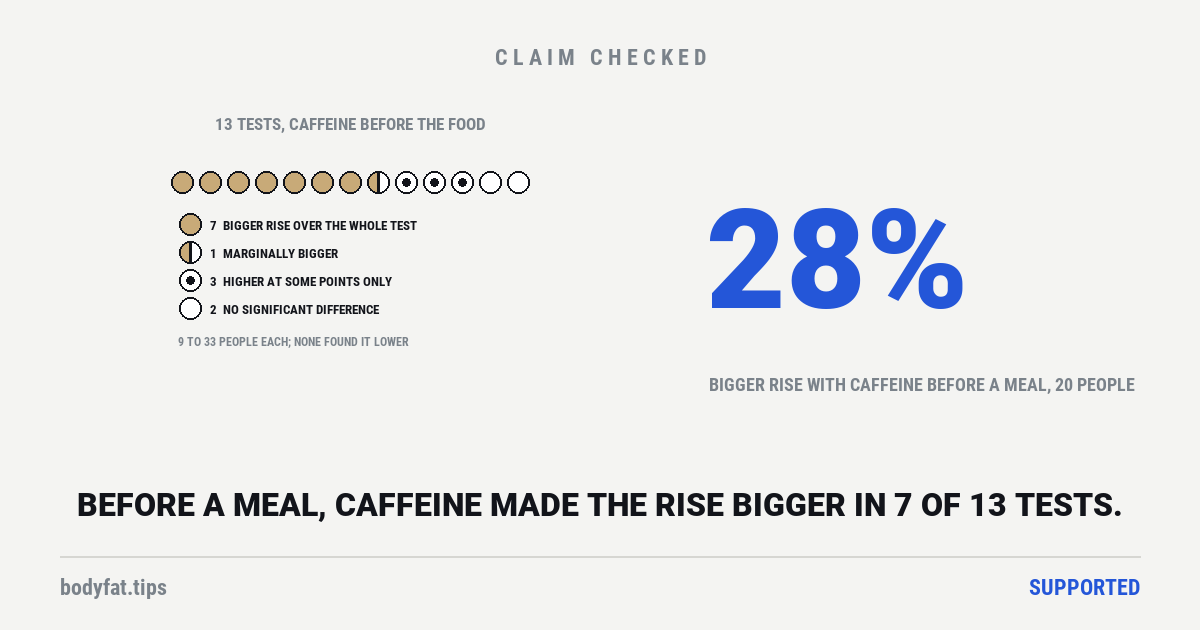
So which is it? Black coffee on its own did not significantly raise blood sugar in the small tests that measured it. Caffeine, from coffee or a capsule, taken before a meal made the rise after it bigger in most of the one-dose tests we read: 28% bigger in 20 people with type 2 diabetes. Drunk with the food, the tests split. Over whole days, 10 people with type 2 diabetes on caffeine capsules averaged 8% higher, while in 87 adults, nearly all without diabetes, the average with coffee was within 1 mg/dL of the average without. In trials lasting weeks, fasting blood sugar was not significantly higher. What you stir in is its own question: plain brewed coffee carries no carbohydrate, and a teaspoon of sugar carries 4.2 g [4].
Does black coffee raise blood sugar on its own?
Start with the version on the CDC’s list: coffee with nothing in it, and nothing to eat. A 2021 test gave 10 young adults 8 oz of black coffee or water after a 10-hour fast. Half an hour later their blood sugar was 0.4 mg/dL higher after the coffee (mg/dL, milligrams per decilitre, is the US unit on a home meter), with a P value of 0.84 — P is the measure researchers use for “probably not chance”, and anything above 0.05 sits on the chance side of the line [5].
People with type 2 diabetes have been tested the same way, as the first step of longer experiments. In a 2004 study at Duke University, 14 coffee drinkers with type 2 diabetes swallowed 250 mg of caffeine or a dummy capsule and waited an hour. Their blood sugar before the meal did not differ between the two days [6]. In an 18-person test, the change in blood sugar over the hour after a double espresso did not differ from the change after decaf or hot water [7]. A 2025 pilot in 19 healthy adults put both halves of this page in one sentence: “Prior to CHO, coffee did not increase blood glucose, but potentiated increases after CHO” [8]. CHO is carbohydrate; potentiated means made bigger.
Small tests, 10 to 19 people, none of them longer than a morning. But on the narrow question — does the cup itself lift the number? — they agree: not by much, and not within the hour. If your reading climbs in the morning before you have eaten, the CDC’s same list names other suspects, a short night’s sleep and the dawn phenomenon, an early-morning surge of hormones, among them [2]. The interesting part starts when food arrives.
What happens when the coffee meets a meal?
In 2007 the same Duke group gave 20 coffee drinkers with type 2 diabetes 16 oz of decaf with 250 mg of caffeine stirred in — about 2½ cups of brewed coffee’s worth, by the USDA’s figure of 95 mg a cup (our arithmetic) [4] — or the decaf alone, and then a meal. With the caffeine, the meal’s blood-sugar rise was 28% bigger [9]. That rise is measured as the area under the curve: the total climb over the two hours, worked out from blood drawn before the meal and one and two hours after, rather than the single highest reading. Insulin, the hormone that moves sugar out of the blood, rose 19% more as well.
Why would a drink with no sugar in it make a meal’s sugar climb higher? The trials point at insulin sensitivity: how readily muscle and other cells take up sugar when insulin tells them to. Caffeine turns it down for a few hours [10]. The body makes more insulin to compensate, and the sugar still runs higher. In 12 men with type 2 diabetes given caffeine capsules an hour before a glucose drink, insulin rose 25% more than on the dummy, blood sugar rose too, and their insulin-sensitivity score was 14% lower [11].
That is the pattern in most of the one-dose tests we read, in people with and without diabetes. Not in all of them:
| Who | What they drank, and when | Blood sugar afterwards |
|---|---|---|
| 14 people with type 2 diabetes [6] | 375 mg of caffeine in capsules, then a liquid meal | Rise 21% bigger; insulin 48% higher |
| 20 people with type 2 diabetes [9] | 250 mg of caffeine stirred into 16 oz of decaf, or the decaf alone, then a meal | Rise 28% bigger; insulin 19% higher |
| 12 men with type 2 diabetes [11] | Caffeine capsules, 5 mg per kg of body weight, an hour before a glucose drink | Higher; insulin 25% higher; insulin sensitivity 14% lower |
| 10 healthy men [12] | Caffeinated coffee or decaf, about 21 oz on average, an hour before a cereal breakfast | Rise 147% bigger with a fast-digesting cereal, 216% with a slow-digesting one |
| 33 adults, 16 of them women [13] | Instant coffee with 3 or 6 mg of caffeine per kg, or water, with a meal | Rise bigger with both amounts of coffee |
| 10 overweight men [14] | Instant coffee in a glucose drink, against the glucose drink alone | Rise bigger, from a single serving with 100 mg of caffeine |
| 9 adults [15] | Caffeinated coffee, decaf or water, each mixed with 25 g of glucose | Higher after caffeinated coffee, mostly in the first 30 minutes |
| 29 young adults after a night woken every hour [16] | Strong black coffee, about 300 mg of caffeine, 30 minutes before a glucose drink | Peak higher than after a normal night or a broken night without coffee; total rise higher than the broken night’s, not significantly different from the normal night’s |
| 11 men [17] | Caffeinated coffee or decaf, or caffeine or dummy capsules, an hour before a glucose drink | Higher over the whole test after the caffeine capsules, against both the dummy and decaf; after the coffee, against decaf, just short of the line (P = 0.07) |
| 19 healthy adults, 15 of them women, at least five on each drink in each arm [8] | Light, medium or dark roast black coffee, about 220 to 240 mg of caffeine in 10 oz (300 mL), or coloured water, an hour before, with, or an hour after a glucose drink or a cereal breakfast | Before the food: no rise in the first hour; then, against the coloured water, a bigger total rise with the glucose drink after all three roasts, the light roast least, and with the breakfast after the dark roast only. With the food: no bigger total rise, though the light roast read higher at one point with each; with the glucose drink, the medium roast left the total smaller. An hour after the food: no difference in total rise in the paper’s text, though its chart marks two roasts higher with the glucose drink |
| 18 people with type 2 diabetes [7] | A double espresso, decaf or hot water, an hour before a glucose drink | Marginally higher: bigger than after hot water, but the overall comparison just short of the line (P = 0.06), as was the comparison with decaf (P = 0.055) |
| 11 young men [18] | Caffeinated coffee, decaf, caffeine in water or plain water, an hour before a glucose drink | Higher at 10 and 30 minutes after caffeinated coffee; the total rise did not differ significantly from water |
| 11 volunteers [19] | Light or dark roast coffee, or water, 30 minutes before a glucose drink | Higher at 60 minutes after the dark roast; the total rise did not differ |
| 10 healthy adults [20] | Black espresso, instant, boiled or decaf coffee, or water, before a fast-digesting meal | Higher at 30 or 45 minutes after each black coffee, decaf included, by 8% to 16%, and still so for the three caffeinated ones once the authors allowed for the number of comparisons; total rise 26% and 35% bigger after the instant and boiled coffees, not significant once the authors allowed for the number of comparisons |
| 17 healthy men [21] | Regular coffee, decaf or water, an hour before a glucose drink | Not statistically different from water |
| 12 adults [22] | Ground caffeinated coffee, decaf or hot water, twice, the second with a glucose drink | Did not differ |
| 12 healthy adults [23] | Coffee with 150 or 300 mg of caffeine, drunk with a glucose drink | Did not differ from the glucose drink alone |
Of the 17 tests in the table, 10 found blood sugar significantly higher over the whole test after caffeine or caffeinated coffee, 1 found it marginally higher (the espresso test, where the overall comparison had a P value of 0.06), 3 found it higher at some points but not over the whole test, and 3 found no significant difference. The sizes jump around, from a modest bump to a total rise 147% and 216% bigger in 10 healthy men eating cereal an hour after about 21 oz of coffee on average (633 mL), with 5 mg of caffeine per kg of body weight [12]. Two reviews agree, though both draw largely on tests already in the table, so they are not separate evidence. One pooled seven crossover trials in 70 healthy people — each person tried both drinks on different days, so each is compared with themselves — and found insulin sensitivity lower after caffeine in all seven; three of the seven are in the table, and one gave its caffeine into a vein [10]. A review of nine trials in 134 people with diabetes found that in type 2 diabetes, about 200 to 500 mg of caffeine before a glucose load made the blood-sugar area 16% to 28% larger, figures that come from three of the table’s own tests and a 1967 study [24].
Notice what the doses were. The Duke tests used 250 to 500 mg of caffeine, roughly 2½ to 5 cups of brewed coffee by the USDA’s figure (our arithmetic) [9] [6] [4], and in every trial of the 2016 pooling the volunteers had gone without caffeine for at least 48 hours first [10]. One test found a bigger rise from a single serving of instant coffee with 100 mg [14]. That is close to an ordinary cup.
Does caffeine raise blood sugar in type 2 diabetes?
In the lab, yes, in three of the four tests in people with type 2 diabetes in the table above, and marginally in the fourth: 21% and 28% bigger rises after a meal in the Duke studies and higher blood sugar after a glucose drink in the capsule test in 12 men; in the espresso test the rise was bigger than after hot water, the comparison with decaf fell just short of the line, and the authors call the difference marginal [6] [9] [11] [7]. The question is whether it shows up outside the lab.
In 2008 the Duke group fitted 10 coffee drinkers with type 2 diabetes with a continuous glucose monitor, a sensor under the skin that reads blood sugar every few minutes, and gave them 250 mg of caffeine in capsules at breakfast and again at lunch, or dummy capsules, on two ordinary days. On the caffeine day their daytime average was about 144 mg/dL against 133 (8.0 against 7.4 mmol/L; mmol/L is the unit most of the world uses, and multiplying by 18 gives mg/dL), about 8% higher [25]. The three hours after dinner showed the biggest gap: about 155 against 123 mg/dL (8.6 against 6.8 mmol/L; our conversions) [25]. Ten people, one day on each.
And the other direction? In a 2012 pilot, 12 coffee drinkers with type 2 diabetes set out to give up caffeine for three months; 7 finished. Their HbA1c, a blood test that reads your average blood sugar over the past three months, fell, while their fasting glucose, in the authors’ words, “did not change” [26]. There was nobody to compare them with, so the fall could owe something to the attention of being in a study as well as to the missing caffeine. We read it as its summary. The longest controlled test on this page in people with type 2 diabetes used capsules, not coffee. A six-month trial in Iran gave 101 adults with type 2 diabetes and fatty liver two capsules a day, taken in the morning, holding 200 mg of caffeine, about two cups of brewed coffee’s worth (our arithmetic), 200 mg of chlorogenic acid, which with caffeine is one of the two most plentiful active compounds in coffee, both, or starch; 84 finished. Against the starch, none of the three changed fasting blood sugar, HbA1c or a standard score of insulin resistance significantly, though fasting insulin rose on the combination [27].
None of the people with diabetes in the Duke tests of a meal or a day used insulin [6] [9] [25], and the six-month capsule trial left out anyone using it [27]. If you do, these tests did not include people like you, and the place to plan any change is with your clinician or dietitian.
How long does coffee affect blood sugar?
For a few hours, on the evidence of these tests, which watched for two to three hours after the meal [6] [9] [11]. In the 2008 monitor study, caffeine taken at breakfast and lunch still went with a higher rise after dinner [25]. A week of 200 mg twice a day left insulin sensitivity 35% lower, measured after an overnight fast, which suggests the effect on insulin outlasts a single afternoon [28]. How fast the body clears caffeine and its main breakdown product has its own page.
But averaged over a whole day, in people without diabetes, it did not show. The 2023 CRAVE trial, run by a University of California, San Francisco team, gave 100 adults a glucose monitor and a text message each morning for 14 days, telling them at random to drink caffeinated coffee that day or to avoid caffeine. Among the 87 whose monitors worked, the daily average was 95 mg/dL on coffee days and 96 on caffeine-free days [29]. The confidence interval, the range the true average difference probably sits in, ran from 5.4 mg/dL lower to 4.6 higher. The authors were puzzling over the other half of this page’s question: coffee drinkers get less diabetes, so why was blood sugar not lower on coffee days? They suggest that “coffee consumption was accompanied by other intake rich in simple carbohydrates”, or that coffee’s effect on diabetes risk is long term [29].
So the two whole-day studies disagree, and they differ in nearly every way that could matter: 10 people with type 2 diabetes on caffeine capsules against 87 adults, nearly all without diabetes, drinking coffee however they liked it [25] [29].
Does drinking coffee every day raise your blood sugar over time?
Here the trials run for weeks, and fasting blood sugar — the number taken first thing, before food — is what most of them measured. A 2004 Dutch trial gave 40 healthy coffee drinkers a litre of filtered coffee a day, about 13 cups, for four weeks and nothing for four; 26 finished, and 7 of the 14 who stopped did so because of nausea and restlessness. After two weeks fasting blood sugar was 0.2 mmol/L higher on coffee, about 4 mg/dL (our conversion), with a P value of 0.08, just on the chance side of the line; after four weeks the difference was zero. Fasting insulin, though, was clearly higher on coffee [30]. A week of caffeine capsules did the same to insulin, with no difference in fasting blood sugar [28].
The longer trials: 47 coffee drinkers went a month without, then a month on four cups, then a month on eight, and in the authors’ summary none of the markers of glucose metabolism in their glucose-tolerance tests moved [31]. Forty-five overweight adults randomised to five cups of caffeinated or decaf instant coffee, or water, for eight weeks showed no significant differences in glucose tolerance or insulin sensitivity [32]. Forty-five Japanese men with raised fasting blood sugar, on five cups of caffeinated or decaf instant coffee, or none, for 16 weeks: allowing for changes in waist size, the blood sugar two hours after a glucose drink fell 8.2% on caffeinated coffee and 7.7% on decaf and rose 9.0% on none, a spread the authors could not separate from chance (P = 0.11) [33]. Forty young women given three small cups of Turkish coffee a day for four weeks showed no significant change in fasting blood sugar or HbA1c [34], though HbA1c reads the past three months, so four weeks can show only part of any change.
The largest trial in a 2021 pooling of four such trials ran 24 weeks in 126 overweight adults in Singapore: 62 on four cups a day of instant coffee and 64 on a coffee-like placebo, both made up mostly of non-dairy creamer at 30 calories a sachet. Insulin sensitivity, measured by the method researchers treat as the gold standard, did not differ significantly. Fasting blood sugar ended 2.9% higher on coffee, with a confidence interval from 0.4% lower to 6.3% higher and a P value of 0.09 [35]. The pooling of the four trials found insulin resistance slightly lower on coffee, a result that disappeared when one young, lean subgroup was set aside [36].
Put those together: none of the weeks-long trials on this page found fasting blood sugar significantly higher on coffee, two leaned that way without clearing chance, and two found fasting insulin higher, which the 2004 authors read as the body needing more insulin to hold the same blood sugar [30] [35] [28].
A word on who paid. The 24-week trial was funded by a coffee maker, which also made both drinks and employed three of its eleven authors [35]. The 16-week trial was paid for by a national coffee association [33], the three-month trial by an information institute run by European coffee companies, with its coffee provided by a coffee roaster and one author declaring paid lectures on coffee and health [31], and the eight-week trial’s coffee came from a coffee maker [32]. The trial that found insulin rising was backed by an alliance of Dutch food companies [30]. Money does not make a result wrong, and these are published, randomised trials. But the industry-funded ones are among those that found no significant rise, and you should know that when you weigh them.
Is decaf better for blood sugar?
For the meal that follows, mostly yes. In a 2006 test, decaf left the rise after a glucose drink 50% smaller than a dummy capsule did [17]. In 17 healthy men, decaf improved insulin sensitivity against water [21]. In 21 adults, decaf with milk and sugar, drunk before a fast-digesting meal, left the rise 14% smaller than water did [20]. Two exceptions. In 11 young men, decaf raised blood sugar and insulin in the first half hour, more than water did, and at the 30-minute mark its blood sugar was the highest of the four drinks; over the whole test, its blood sugar was lower than after caffeine [18]. And in the 10 adults who also drank their coffees black before the meal, black decaf, like each black coffee, left blood sugar higher than water at the 30- or 45-minute reading, though for the decaf the difference did not hold once the authors allowed for the number of comparisons [20].
Over weeks, the decaf arms of the trials above were not significantly different from caffeinated coffee or water [32] [33]. And in the long-term studies below, decaf drinkers had lower diabetes rates too [37]. If caffeine is what bothers your readings, these tests suggest decaf takes most of that away.
What can I put in my coffee that won’t spike my blood sugar?
Start with what is in the cup already: brewed coffee has 0 g of carbohydrate in the USDA’s food tables, and about 1 calorie per 100 g [4]. What raises blood sugar directly is what goes in. A teaspoon of sugar is 4.2 g of carbohydrate, so two teaspoons are 8.4 g. A tablespoon of whole milk is about 0.7 g and a tablespoon of half-and-half about 0.6 g; a full cup of milk, latte-sized, is about 12 g (our arithmetic from the USDA entries) [4]. A splash of milk or cream barely registers. The sugar, and anything else sweet, is where the carbohydrate is.
One test went further. In 21 healthy adults, the same coffees drunk with milk and sugar before a fast-digesting meal left a smaller rise afterwards than drunk black, by 12% to 35% in the 10 who tried both [20]. One small study, read as its summary, and the milk and sugar were the coffee’s companions here, not a treatment; it is not a reason to add sugar. Zero-calorie sweeteners have their own verdict, and a clove stirred into the cup has another.
Is black coffee good for diabetes? The long-term studies
Now the other half of the AI answer. Cohort studies follow large groups of people for years and compare what they ate and drank with what happened to them. A 2014 pooling of 28 of them, 1,109,272 people and 45,335 new cases of type 2 diabetes, found that people who drank one cup a day had an 8% lower risk than those who drank none, and people who drank six cups a 33% lower risk [37]. Each extra daily cup went with a 9% lower risk for caffeinated coffee and 6% for decaf, a gap too small to tell apart [37].
Before printing a pooled figure, we look for the biggest study inside it. Here it is a European study of 362,045 people, about a third of the total, which found the same direction: 37% lower risk at more than nine cups a day than at fewer than one [37]. Larger US studies in it found a lower risk too: 88,259 women at two or more cups a day, and 39,059 men and 74,749 women, followed for more than 20 years, at six or more cups of caffeinated coffee. A US study of 75,140 people found the lower risk in women but not, for total coffee, in men [37].
Cohort studies cannot prove that coffee causes anything: coffee drinkers may differ from non-drinkers in ways the studies did not measure. Mendelian randomisation is one way around that. It compares people by inherited gene variants that nudge how much coffee they drink, which are handed out at conception rather than chosen. Here the answers split three ways. In 93,179 Danes and a large genetics consortium, the genes for drinking more coffee were not linked with diabetes [38]; a second analysis of the consortia agreed [39]. A Korean study found them linked with less diabetes [40]. The study a 2025 review calls the largest available, with genetic data on 74,124 people with type 2 diabetes and 824,006 without, found the gene variants for drinking more coffee linked with more diabetes; its authors call the evidence suggestive, and the link did not hold once body weight was allowed for [41]. That review, of 59 genetic studies of coffee searched to 2022, grades the result suggestive in its table and text, meaning the methods it was checked with did not all point the same way, while its summary calls the evidence for a higher risk probable [42]. Later studies point both ways. Among them, a 2024 one found coffee drinking linked with more diabetes in a Finnish biobank but not in a British one [43]; a 2026 study of 26 lifestyle and social factors found the gene variants for drinking more coffee linked with very slightly higher odds of type 2 diabetes, and those for taking in more caffeine with 28% lower odds for each extra 80 mg a day, about a cup’s worth [44]; and a 2023 letter’s title reports coffee lowering the risk of type 2 diabetes in a two-stage genetic analysis, though we could read only the title [45]. And a 2023 study read the same gene regions from the other side. The variants that go with drinking more coffee also clear caffeine faster and leave less of it in the blood; the study used them as a measure of blood caffeine and found higher blood caffeine linked with 19% lower odds of diabetes, about 43% of it through lower body weight [46]. Its own authors name the catch: people with more caffeine in their blood drink less coffee, so the lower odds may come from less of something else in coffee [46].
If caffeine makes a meal’s blood sugar climb higher, why do coffee drinkers get less diabetes?
This section is the desk’s own reasoning, and it is labelled as such. The one-dose tests say caffeine makes the next meal’s blood sugar climb higher. The cohort studies say coffee drinkers get less type 2 diabetes. Both can be true, and here are three ways that could be, with the evidence for each.
Answer one: the rise may be too small and too brief to show in a day. In 87 adults, nearly all without diabetes, a day of coffee left the daily average within 1 mg/dL of a coffee-free day’s [29]. In 10 people with type 2 diabetes on caffeine capsules, it pushed the daytime average up 8% [25]. That is measured, in two studies that disagree, and that differ in who was tested and in how the caffeine came.
Answer two: whatever goes with the lower risk may not be the caffeine. Decaf carries nearly the same link in the cohort studies [37]. And in the tests on this page that set decaf against water or a dummy, it mostly did not push the rise up: in two it lowered it, in one of them only with milk and sugar added [17] [20], in one it improved insulin sensitivity [21], and in two it raised early blood sugar, in one of them black and by a margin that did not hold once the authors allowed for the number of comparisons [18] [20]. Coffee is hundreds of compounds besides caffeine. That is a surmise, with the cohorts and most of those decaf tests on its side. No trial on this page identified the compound: the one that separated caffeine from chlorogenic acid, in capsules for six months in type 2 diabetes, found that neither changed fasting blood sugar or HbA1c significantly [27].
Answer three: the link may not be coffee at all. Of the genetic studies of coffee drinking, two found no link, a Korean one found less diabetes, and the one a 2025 review calls the largest found more, a link that did not hold once body weight was allowed for [38] [39] [40] [41], and later ones point both ways [43] [44] [45]; the caffeine-gene study, reading the same gene regions as blood caffeine, ran nearly half its lower odds through body weight [46]. That is measured disagreement, and it leaves the cause unsettled.
Put the three together and here is what we think is true, stated plainly so you can disagree with it: a cup of caffeinated coffee can push up the blood sugar of the meal that follows for a few hours, and what years of coffee do to your diabetes risk is a separate question that the first answer does not settle.
What we could not find, and would like to: a randomised trial lasting a year or more that gave people with prediabetes or type 2 diabetes caffeinated coffee, decaf or no coffee and measured HbA1c and new cases of diabetes. The longest trial in the 2021 pooling ran 24 weeks [36] [35], and a registered three-month trial of coffee capsules in people with prediabetes has posted no results [47]. If you know of the longer one, the corrections line on this site is open.
Who these studies were done on
The one-dose tests in healthy people were mostly in young adults, and six of the seven trials in the 2016 pooling enrolled men only [10]. The Duke tests in type 2 diabetes were small, 10 to 20 people, older (average ages of 61 and 63 in the two we read in full), and all habitual coffee drinkers managing their diabetes with diet, exercise or tablets [6] [9] [25]. The 14-day trial enrolled adults, 1% of them with diabetes [29]. The weeks-long trials ran in the Netherlands, the US, Japan (men with raised fasting blood sugar), Singapore (Chinese, Malay and Indian adults) and Jordan (young women), several of them in overweight adults [30] [32] [33] [35] [34]. The cohort studies came from Europe, the US and Asia [37]. This page does not rate type 1 diabetes or diabetes in pregnancy; the 2013 review found trials in both, asking different questions [24].
Where “coffee raises your blood sugar” came from
The idea is old. A 1967 study in the Lancet reported that two cups of instant coffee impaired glucose tolerance in a small group of men with what was then called maturity-onset diabetes, as a 2004 paper describes it; we did not read the 1967 paper itself [6]. We could not trace who first put it the way people now repeat it, “coffee raises your blood sugar” [47].
What we can trace is how it got loud. In January 2008 Duke University’s press office turned its 10-person, one-day-each capsule study into a headline, “Cutting Caffeine May Help Control Diabetes”, and a summary saying daily caffeine “in coffee, tea or soft drinks increases blood sugar levels for people with type 2 diabetes” [48]. Its lead author was quoted saying that quitting coffee “doesn’t cost a dime, and there are no side effects” [48]. The study it described used capsules, not coffee [25].
In 2020 a University of Bath release, “Drink coffee after breakfast, not before”, said a strong black coffee “substantially increased the blood glucose response to breakfast by around 50%” [49]. In the paper’s own figures, a rise of about 50% is the comparison between a broken night with coffee and a broken night without (our arithmetic). Against a normal night’s sleep, the total rise after coffee was about 28% higher (our arithmetic again) and not significantly different [16]. The “breakfast” was a glucose drink, as the release itself says.
And where it lives now: the CDC’s list of surprising blood-sugar spikes, with “Coffee—even without sweetener. Some people’s blood sugar is extra-sensitive to caffeine.” and no study linked [2]; and Google’s AI answer, which opens “Yes, coffee can raise blood sugar levels, though the effect depends on the caffeine, how you drink it, and your individual biology” and closes by offering tips on “low-carb coffee creamers” [1]. Among the pages it cites, a telehealth company that offers diabetes management tells readers to test their blood sugar before and after a cup, and a health-information site suggests wearing a continuous glucose monitor to see how coffee affects you [1].
None of this is aimed at anyone who drinks coffee or checks their blood sugar after it. Watching your own numbers is reasonable. The trouble is the version that reaches you: a capsule test in 10 people became “coffee, tea or soft drinks”, and a comparison with a broken night without coffee became a 50% rise.
What this is rated, and what the rating covers
Supported — for the claim that caffeinated coffee, even black, drunk before a carbohydrate meal, makes the blood-sugar rise after it bigger for a few hours.
It is rated Supported because the evidence points one way, with known limits. Of the 13 tests in the table that gave the caffeine or coffee before the food (one of them a second time with it), 7 found the rise afterwards significantly bigger over the whole test, 1 marginally and 3 at some points, in people with and without type 2 diabetes [9] [6] [12] [16] [8]; 2 found no significant difference [21] [22]. Counting only coffee itself, drunk before the food, 4 of 11 found the rise significantly bigger over the whole test, 2 fell just short of the line, 3 found it higher at some points and 2 found no significant difference [7] [17] [18] [19] [20]. Black coffee is among them: in the three tests whose papers call the coffee black, the rise was bigger over the whole test in one [16], marginally in one [7] and at some points in the other [20], and the plain brewed coffee of a fourth made it significantly bigger [8]. Two reviews of largely the same tests agree [10] [24], and in 10 people with type 2 diabetes on caffeine capsules the daytime average ran 8% higher [25]. Drunk with the food, the tests split: three found a bigger rise and one did not [13] [14] [15] [23], and the one test in the table that varied the timing, with at least five people on each drink in each arm, found no bigger total rise with the food and a smaller one after one roast [8]. The limits: the tests are small, 9 to 33 people, and short, and at least six of the 17 were in men only; many gave 2½ to 5 cups’ worth of caffeine, some after two days without any; and over whole days, 87 adults, nearly all without diabetes, averaged within 1 mg/dL with coffee and without [29].
The other claims, rated alone, in words. That black coffee on its own, with nothing to eat, raises your blood sugar: Unsupported, of the tested kind: in four small tests of coffee or caffeine with nothing to eat, 10 to 19 people each, blood sugar did not rise significantly [5] [6] [7] [8]; tests that small cannot rule out a small rise. That drinking coffee every day raises your fasting blood sugar: Unsupported, of the tested kind: it was tested, in trials of one week to 24 weeks, and did not hold up [30] [32] [35]. Two leaned that way without clearing chance, so a small rise is not ruled out. That coffee lowers the risk of type 2 diabetes: Preliminary. The link in cohort studies is large and consistent [37]; whether coffee causes it is unsettled, because the genetic studies conflict, two finding no link, a Korean one less diabetes and the one a 2025 review calls the largest more [38] [39] [40] [41], later ones pointing both ways [43] [44] [45], and the coffee trials that exist are measured in weeks [36].
What is not rated here: coffee and weight; caffeine and exercise, sleepiness or hydration, which have their own verdicts; type 1 diabetes and diabetes in pregnancy; the symptoms of type 2 diabetes; and the frame above, which is this desk’s reasoning from the evidence rather than a result the evidence delivered. It is marked as ours so that you can weigh it as ours. Another food people worry about for the same reason, peanuts, has its own verdict, and so does a medicine, statins.
This is journalism, not medical advice. If you have diabetes and use insulin or another medicine that lowers blood sugar, plan any change to what you drink, or when, with your clinician or dietitian, who can read your own numbers. How we read a study, and what each tier means, is set out here.
Two source entries were corrected on 23 October 2026. We gave the groups of the 2011 trial of caffeinated and decaffeinated coffee [32] as 15 in each; the paper’s own table gives 16 on caffeinated coffee, 14 on decaffeinated and 15 on no coffee. And we had listed the funding of the 2026 Turkish-coffee trial [34] as not read; its own statement, now read, says the authors’ university paid for it, and they declare no conflict of interest. No figure in our findings changes, and the rating is unchanged.
- Do Peanuts Raise Blood Sugar? Hardly, in Glycemic Index Tests and 8 Trials
unsupported - Is Shrimp High in Cholesterol? Yes. Two-Thirds of a Pound a Day Raised LDL 7%, About as Much as Two Eggs.
preliminary - Is Peanut Butter Bad for Cholesterol? Not in Nine Trials of Peanuts and Peanut Butter. In Place of Saturated Fat, LDL Fell About 14%; Otherwise It Came Out About Even.
unsupported