Is Stevia Bad For You? “Natural” Is Not a Safety Category

Probably not. But almost certainly not for the reason you picked it.
Stevia sells on one word: natural. It comes from a leaf, so it feels like it should sit outside the argument about artificial sweeteners entirely.
It does not. And the organisation everyone quotes on sweetener safety wrote that into its definition on purpose.
The WHO put stevia in the same list as aspartame
Here is the guideline, word for word: the recommendation covers all non-sugar sweeteners, “defined in this guideline as all synthetic and naturally occurring or modified non-nutritive sweeteners that are not classified as sugars. Common NSS include acesulfame K, aspartame, advantame, cyclamates, neotame, saccharin, sucralose, stevia and stevia derivatives” [1].
Read the phrase and naturally occurring again. That is not an oversight or a technicality. Whoever drafted it anticipated exactly the assumption you are making and closed the door on it.
Whatever this guideline says about aspartame, it is saying about the green packet too.
Those two words are a correction, and here is what they are fixing. Until today this sentence read “whatever the WHO says”, full stop, which is not true and is contradicted by a footnote on the same page of the same document we quote. WHO has said aspartame-specific things it has never said about stevia. That footnote records two of them: JECFA was asked in 2021 to re-evaluate aspartame’s safety, and WHO’s cancer agency — the International Agency for Research on Cancer — had aspartame down as a priority for hazard assessment in June 2023 [1]. Neither exercise has a stevia counterpart in that footnote.
Which is a thinner sort of comfort than the packet implies. A regulator singling out one sweetener for extra scrutiny is not a statement about the other sweeteners, in either direction — so that is a point about aspartame, not a point in stevia’s favour.
Which means most of what is on our artificial sweeteners verdict applies here too: it is a conditional recommendation, graded low certainty, and the harm signal comes from observational studies — the kind that watch what people already do rather than assign them anything — where the WHO names reverse causation as a possible explanation. Reverse causation being the obvious suspicion: people switch to sweeteners because their weight or their blood sugar is already going the wrong way, so the sweetener shows up next to the problem it was a response to.
Two things this page owed you there, and did not print until today.
First, WHO does not leave that suspicion standing. The same document goes on: “although reverse causation and residual confounding may be contributing factors, the available evidence suggests that the associations observed between NSS use and health outcomes in observational studies cannot be dismissed as being solely a result of reverse causation or residual confounding” [1]. We named the caveat and skipped the rebuttal, which made the guidance read more reassuring than it is.
Second, and this is the one that matters most on a stevia page: the recommendation does not apply to everybody. We wrote “unchanged”. The guideline’s own Remarks say the opposite, in one sentence: “although individuals with diabetes can also reduce free sugars intake without the need for NSS, the recommendation does not apply to individuals with existing diabetes” [1]. It is not a technicality either — the evidence was assembled that way on purpose. “[S]tudies conducted exclusively in individuals with pre-existing diabetes were excluded” [1], because managing diabetes was outside what the guideline set out to do.
Read that next to who stevia is sold to. The green packet is marketed at people watching their blood sugar harder than anyone, and they are the single group the recommendation everybody quotes explicitly leaves out. If that is you, the WHO advice in this article is not addressed to you, and the question of what to sweeten with belongs with your clinician rather than with us.
Now the part that surprised us
If “natural” carried real safety information, you would expect stevia to be the best-studied of the bunch. Reassurance has to come from somewhere.
So we counted. PubMed indexes randomised controlled trials with a publication-type tag, which makes this a question anyone can answer in about ten seconds.
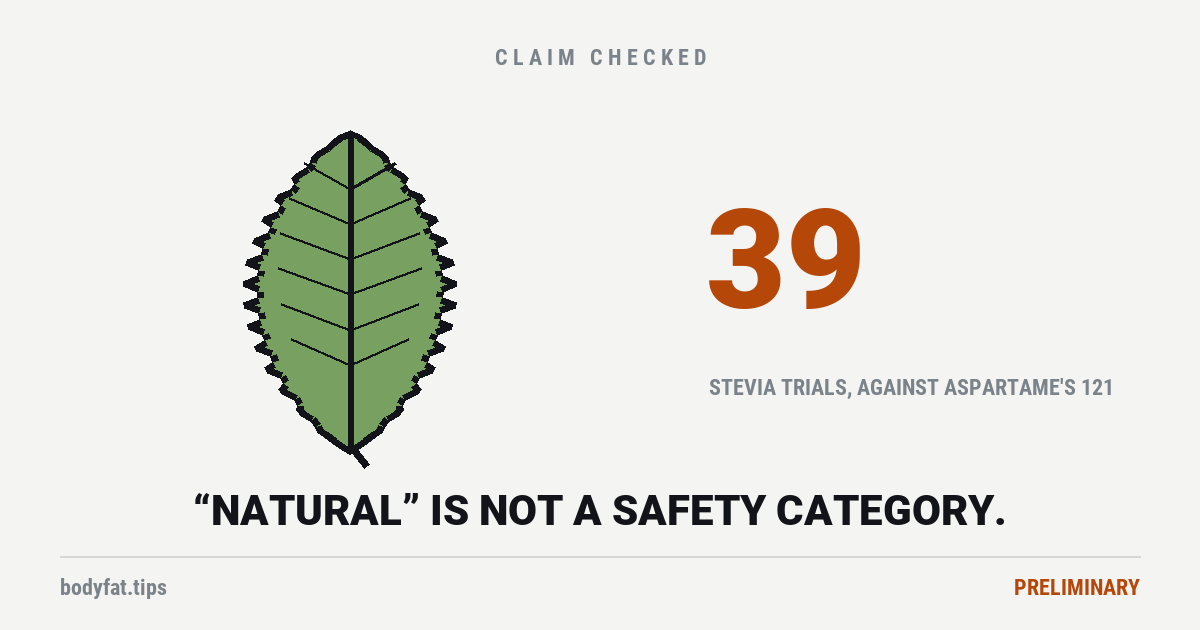
| Sweetener | Randomised trials indexed |
|---|---|
| Aspartame | 121 |
| Sucralose | 100 |
| Stevia | 39 |
The sweetener marketed as the natural, safer choice has roughly a third the randomised trial evidence of the one people are most frightened of [2].
Then we went back and checked our own instrument, because the reviewer who read this page did. That query is harder on stevia than on the other two, and not by accident of ours: PubMed quietly expands a sweetener’s name to its chemical synonyms, and stevia’s name expands only to the plant it comes from. Six more records tagged as randomised trials are filed under “rebaudioside”, “steviol glycoside” or “stevioside” and never surface [2]. Put them in and stevia reads 46 against aspartame’s 122 rather than 40 — a bit under two fifths instead of a bit under a third.
So the gap narrows. It does not close, and the honest version cuts both ways: of those six extra records we read all six, and only three or four are actually trials of the sweetener — one is a survey of what toddlers eat, another an infusion straight into the small intestine [2]. The bare query is also noisy in the opposite direction, because a plant-genus heading sweeps in studies of the Stevia rebaudiana plant that are not tests of a sweetener at all. Which is the point of the paragraph you are about to read.
Be careful how hard you lean on that. A database count is a crude measure: it does not weigh how big those trials were, how well they were run, or how long they lasted, and indexing is imperfect. It will not tell you stevia is riskier. What it does tell you is that the confidence people feel about stevia is not coming from a deep evidence base. It is coming from the word on the packet.
And here we owe you a straight correction, because this page used to finish that thought with “because there isn’t one”. There is one. It is thin and it is low-grade, but four reviews from three research teams have pooled stevia’s trials, and we had not read any of them. Here is what is in there.
So what happens when people actually eat it?
Each of those four reviews put a certainty grade on its own result — three of them using GRADE by name, the system reviewers use to score how much weight a finding will bear, running from high down to very low. Not one came out above low. Hold that in mind while you read the numbers.
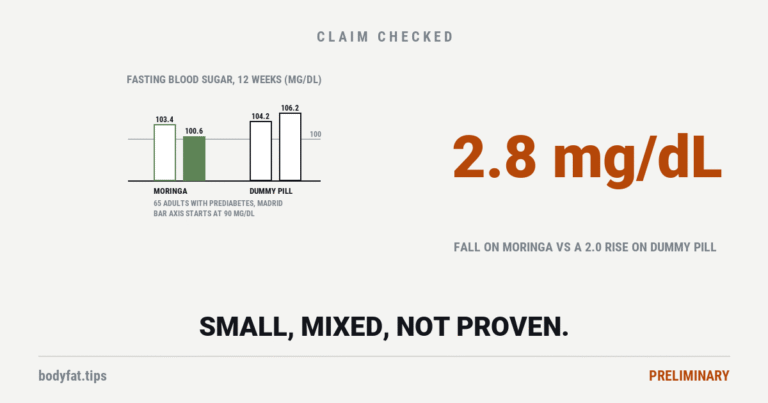
Blood sugar moves a little. Twelve randomised trials of steviol glycosides — the purified sweet molecules from the leaf, which is what is actually in the packet — in 871 adults, 48% of them women. Fasting blood sugar came down by 4.10 mg/dL against the comparison groups, with the range of plausible true averages running from 1.65 to 6.55 [4]. For scale: 100 mg/dL is roughly where American labs start calling a fasting reading prediabetes, so four points is a nudge, not a treatment. A bigger pool — 26 studies, 1,439 people — found the same direction, also at low certainty [3].
The three-month measure does not. HbA1c is the blood test that averages your blood sugar over about three months, and it is the one diabetes care actually runs on. It did not budge: 0.01% in the twelve-trial pool, with the plausible range straddling zero from −0.12% to +0.13% [4], and no significant change in the twenty-six-study one either [3].
Appetite does not. Eleven trials, 428 adults, no significant change in any appetite score — at certainty the authors themselves grade from very low to moderate [5]. One subgroup went the other way: people who drank it, rather than receiving it through a tube, reported slightly more desire to eat [5]. That is a hint, and we are calling it a hint.
Blood fats do not. Fourteen trials, no effect on triglycerides, on total or LDL cholesterol, or on HDL [6]. Two fences on that one, and they are ours to put up. The review pooled stevia in with the artificial sweeteners rather than testing it on its own, so it is a finding about sweeteners as a class. And it is not a clean nothing: in people whose LDL started in the normal range, under 100 mg/dL, LDL rose by about 4 mg/dL [6].
Now the part that keeps this page at Preliminary rather than moving it up. The two blood-sugar reviews cannot agree on whose benefit it is. The twenty-six-study pool reports the drop “especially in individuals with higher BMI, diabetes, and hypertension” [3]. The twelve-trial pool reports it in people without diabetes or high blood pressure at the start [4]. Same outcome, same couple of years, opposite groups of people. And the two of those four reviews that share a research team also share one study registration [3][5], so there are fewer independent looks here than four.
When pools of largely the same trials point at different people, “early, small and conflicting” is not us hedging. It is the finding.
One trial deserves naming, and it is the one our own count missed. In 2008, researchers gave 1,000 mg a day of rebaudioside A, or a placebo, to 122 men and women with type 2 diabetes, for sixteen weeks [7]. HbA1c moved 0.11% on rebaudioside A and 0.09% on placebo — p = 0.355, which is the statistical test’s way of saying that difference sits comfortably inside what chance produces. Fasting glucose, insulin, blood pressure, body weight and fasting blood fats: no differences either. It was well tolerated [7]. It is also an industry trial, whatever it found: three of its twelve authors worked for food and drink companies, and a fourth declared consulting fees from one of them [7].
That is a null result in both directions, and it is worth saying both out loud. It is not evidence stevia fixes your blood sugar. It is also not evidence it hurts it. Sixteen weeks is the longest single trial we could find on this question, which tells you something about the state of the file.
What we could not find, and would like to: anybody who has put people on stevia for a year. Everything above is measured in weeks and months. Until somebody runs that study, this page stays exactly where it is — and if you find one we have missed, tell us and we will print the correction.
What “natural” actually tells you
Very little, and this is worth internalising well beyond sweeteners.
Natural is a statement about where a molecule came from, not about what it does in you. Foxglove is natural. So is asbestos. The route by which something arrives in a packet carries no information about its dose response, and treating it as if it does is one of the most reliable ways to be sold something.
Meanwhile the actual regulatory position is more reassuring than the marketing: the Joint FAO/WHO Expert Committee on Food Additives has set acceptable daily intakes for most sweeteners in commercial use, and the evidence the WHO reviewed came from studies where people consumed amounts within those limits [1]. Nobody is basing this on overdose experiments. Worth knowing what that guideline is and is not, while we are here: it grades weight and disease risk. It is not a toxicological safety assessment, and it says so — safe intake levels are set elsewhere, by JECFA, before a sweetener goes on sale [1].
We called that reassurance “more reassuring” and then printed not one number, which is no way to let you check us. So: the acceptable daily intake for steviol glycosides is 4 mg per kilogram of body weight per day, expressed as steviol equivalents — the committee’s way of putting every steviol glycoside on one scale, since they all break down to the same molecule in you [8]. The FDA, which sits on JECFA, translates that into the only unit anyone can picture. A 132-pound (60 kg) person would have to get through 27 tabletop packets in a day to reach it [8]. On the same chart aspartame takes 75 packets and sucralose 23 [8]. Stevia’s allowance sits between the two sweeteners it is sold against. That is the reassurance, quantified — and those are the FDA’s own figures at its own stated body weight, not a conversion of ours.
Now the part that makes this page’s own headline better than we made it. Look at what US regulators actually cleared. The FDA has no objection to high-purity steviol glycosides — 95% minimum purity, Reb A, stevioside, Reb D and mixtures of them — obtained “from the leaves of the stevia plant … or fermentation-based processes” [8]. And whole-leaf stevia? “Whole-leaf and crude stevia extracts are subject to an Import Alert. They are also not permitted for use as sweeteners.” [8] The leaf itself is not GRAS — not Generally Recognized As Safe, the category a US food ingredient has to sit in to be sold — and it cannot legally be imported into the United States as a sweetener at all [8].
Sit with that for a second. The version regulators cleared is the refined one. The version closest to “natural” is the one they refuse. If plant origin carried the safety information the packet implies, that would be backwards.
Europe’s regulator has been over the same ground more recently, and none of the ten first-page web results we read for “is stevia bad for you” on 7 October 2026 mentions what it decided. In January 2024 the International Stevia Council — the industry’s own trade body — filed a dossier with the European Food Safety Authority asking for stevia to be allowed in more foods at higher levels, and asking EFSA to raise that daily intake limit from 4 mg/kg of body weight to 6, or to 16 [9]. EFSA’s panel noted that for the intake request “no new biological and toxicological data were provided” and turned it down: “there is insufficient justification to increase the current ADI” [9]. It also calculated that at the levels being requested, the heaviest-consuming toddlers would go over the existing limit — 6.9 mg/kg against an ADI of 4 [9].
EFSA fences that figure and so will we: the panel said the exceedances represented one country per age group and called its own exposure estimate an overestimation [9]. It is a modelled worst case, for toddlers, under permitted levels that were not granted. It is not a number about you.
And note what an intake limit does and does not settle. It is a ceiling on exposure. It says nothing about whether stevia helps anybody lose weight or steady their blood sugar — which is what most people buy it for, and which is the question the section above answers with a shrug and a low grade.
One last footnote for the word on the front of the packet. The newest and sweetest steviol glycosides are not squeezed out of a leaf at all. Rebaudioside M can be made by fermenting simple sugars with a genetically modified yeast; EFSA assessed that route in December 2023, found no viable cells or DNA of the production strain in the finished additive, got negative results on both genotoxicity tests, applied the same 4 mg/kg limit and concluded there was no safety concern [10]. The FDA’s own wording already allows for it: “or fermentation-based processes” [8].
We are not telling you that is a problem. Two regulators looked and said it is not. We are telling you that “natural” stopped describing the manufacturing a while ago, and the packet never mentioned it.
What to actually do
Use stevia if you prefer how it tastes. That is a completely legitimate reason and the only one the evidence clearly supports.
Do not use it believing you have stepped outside the sweetener question. You have not — the WHO put it in the same sentence as aspartame, and it has less trial evidence behind it than the alternatives you were avoiding.
And if you are switching away from sugary drinks, that swap is the part with real evidence behind it, whichever sweetener you land on. We covered the trials on that in the sweeteners verdict, and the in-vitro scare stories in the one on sucralose.
An independent editorial review on 18 September 2026 found that this page told you stevia had no deeper evidence base — and there is one. Four reviews, from three research teams, have pooled stevia’s randomised trials, and we had not read any of them. They are all graded low certainty or worse, and what they find is mildly reassuring: fasting blood sugar down about 4 mg/dL, HbA1c unchanged, appetite unchanged, and blood lipids unchanged for sweeteners as a class. So the omission cost this page a stronger version of its own answer. A new section reports all four, including the thing that keeps the rating where it is — the two blood-sugar reviews disagree about which people get the benefit, and two of the four share a team and a study registration. We also added a chronic trial in people with type 2 diabetes, sixteen weeks and 122 participants, which found nothing in either direction.
Four more corrections in the same pass, and one of them is the important one. This page said the WHO recommendation applied “unchanged”. The guideline’s own Remarks say it “does not apply to individuals with existing diabetes”, and that trials run only in that group were excluded from the evidence — which is the single group stevia is marketed at hardest, so that omission was the worst one here. It is now stated, with the WHO’s own rebuttal of the reverse-causation caveat that we had quoted only one side of. Second, “whatever the WHO says about aspartame, it is saying about the green packet too” is scoped to the guideline, because a footnote in that same document records two aspartame-specific exercises with no stevia counterpart. Third, our own trial count is harder on stevia than on the other two sweeteners: PubMed expands “aspartame” and “sucralose” to their chemical synonyms and expands “stevia” only to the plant, so six trial records filed under “rebaudioside” and “steviol glycoside” never showed up. The like-for-like figure is 46 against 122, not 40, and the bias ran in our own argument’s favour. Fourth, we called the regulatory position “more reassuring” and printed no number: the intake limit, the packet count, and the fact that US regulators cleared the refined extract and refuse the whole leaf are all now on the page, along with EFSA’s refusal, published in November 2024, of the stevia industry’s request to raise that limit. The rating is unchanged: Preliminary.
Corrected on 7 October 2026. Our search description called the WHO’s sweetener advice the advice everyone quotes, and this page said nobody quotes the European regulator’s more recent decision on stevia. We had not checked either. In an ordinary web search for this page’s question, none of the ten first-page results we read quotes the WHO advice, and none mentions the European decision. The description no longer says everyone quotes the advice, and the sentence now says what that search showed. The description also led with our first count, 39 stevia trials against 121, which this page shows understated stevia; it now gives the count made the same way for both, 46 against 122. The rating is unchanged: Preliminary.
Corrected on 9 October 2026. We said nobody could tell who paid for the 2008 trial of rebaudioside A in people with type 2 diabetes, and told you to read it with that gap in mind. The paper names no funder, but the answer was in its author list, which we had not read: two of its twelve authors, the corresponding author among them, worked for a food-ingredients company, one for a soft-drink company, and a fourth declares consulting fees from the first. The source entry, the evidence panel and the paragraph on the trial now say so, and our report on who paid for the studies now files this page with the ones that have company money behind them. What the trial found, and the rating, are unchanged.