Is Sucralose Bad For You? The DNA Headlines Skipped One Sentence

Nobody knows yet.
That is not us dodging. It is a direct paraphrase of the study everyone was quoting when they told you sucralose damages your DNA.
The headlines in 2023 read like a verdict: chemical found in common sweetener breaks up DNA, may cause DNA damage, cancer, scientists warn. The study is real, it was competently done, and nobody paid the authors to find what they found. It also contains a sentence none of that coverage carried.
What the researchers actually did
A team at North Carolina State University looked at a compound called sucralose-6-acetate — not sucralose itself, but a close relative [1].
It turns up in your Splenda two ways. It is an intermediate step in manufacturing sucralose and survives as an impurity — commercial samples tested contained up to 0.67% of it. And in rats given sucralose, it showed up in the faeces at up to 10% relative to the sucralose itself, which suggests your intestine may be making some of it for you [1].
They then ran that compound past human cells. Two standard genotoxicity screens — a MultiFlow assay and a micronucleus test — both flagged it, and the mechanism was classified as clastogenic, meaning it produces breaks in DNA strands [1].
They also grew human intestinal lining in a system called RepliGut, exposed it, and sequenced which genes switched on. Genes tied to inflammation, oxidative stress and cancer went up. And both sucralose-6-acetate and plain sucralose measurably weakened the gut barrier [1].
All of that is a real result. Now the part that matters.
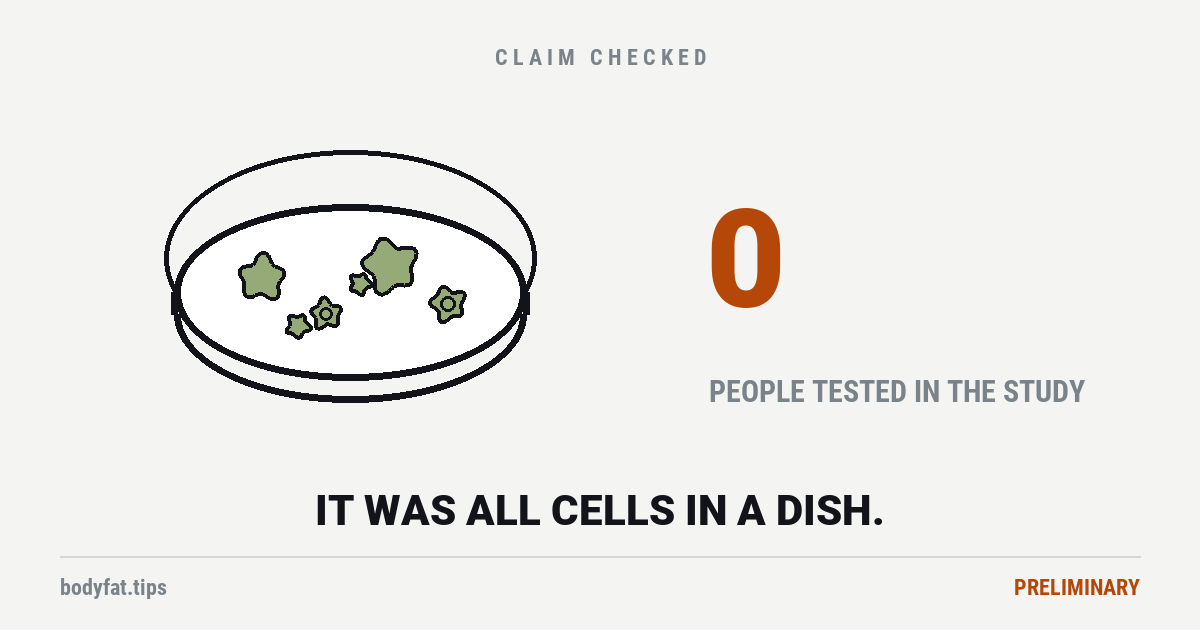
Every one of those experiments happened in a dish
There were no people in this study. No one drank anything. No one was followed for a decade. The human material was cells and cultured tissue in a laboratory [1].
Cells in a dish have no liver. No kidneys. No bloodstream diluting a compound across forty litres of body. No immune system, no DNA repair operating at the scale it does in a person. A compound that breaks DNA in a well plate may do nothing whatsoever in a human being — and that is not special pleading, it is why in-vitro screens exist. They are a filter for what deserves a proper study, not a substitute for one.
We have watched this exact thing happen on this site before, in the other direction: mouse cells in a dish grew neurites, and the number became a claim about your workout. Same machinery, opposite conclusion, identical mistake.
The sentence that got left out
Here is the paper, word for word:
“The potential adverse health effects of exposure to sucralose-6-acetate are not yet known because this chemical has not been tested individually with a toxicology battery of tests to assess human risks.” [1]
The authors say the health effects are unknown. The coverage said may cause cancer.
That is not the researchers overselling. It is the gap between a paper and a press cycle, and it is the single most reliable place to look whenever a study frightens you.
About that “exceeds the safety threshold” line
You may have read that a single daily sucralose drink blows past a safety limit. The paper does say a serving might far exceed something called the threshold of toxicological concern for genotoxicity — 0.15 micrograms per person per day [1].
It is worth understanding what that threshold is, because it is not what it sounds like.
The TTC is a screening level, not a harm level. It is the exposure below which regulators agree a compound can be presumed fine without gathering more data. Cross it and the correct response is “this one needs proper testing”. It is emphatically not a dose at which damage begins — nobody has established such a dose here, which is the entire point of the sentence quoted above.
Reading it as a poisoning threshold would be the same error as the headlines, just wearing a lab coat.
Two things worth knowing before you get angry
The impurity was never hidden. Per this same paper, the manufacturer disclosed sucralose-6-acetate in its Food Additive Petition to the US FDA before approval — stated as 0.8%, under 1.3% [1]. Whatever this study means, it is not the story of a concealed contaminant.
And nobody bought this result. The work was funded by an engineering foundation at a public university, and the authors declare no conflict of interest [1]. On a topic this heavily lobbied from both directions, that is worth saying out loud. It is also why we are not waving the study away.
What to actually do
If you drink the occasional diet soda, nothing here tells you to stop. There is no human evidence of harm, and the people who ran the study that scared you say the effects are not yet known.
If you were already minded to cut back, this is a perfectly reasonable nudge. An unresolved question is not nothing — the authors themselves argue a regulatory review is warranted, and reasonable people can decide they would rather not be the experiment.
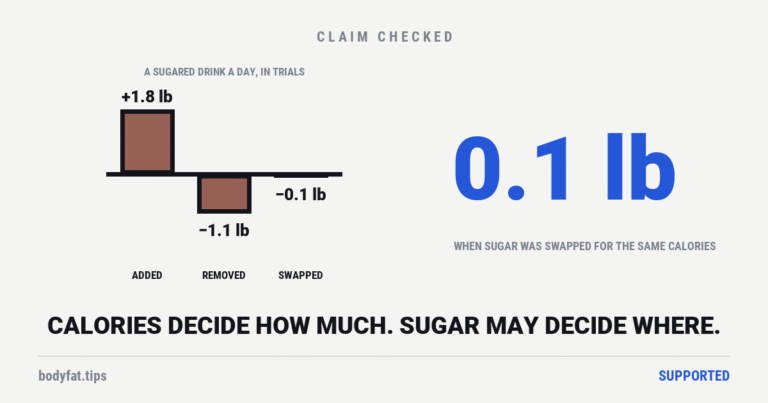
What we would not do is switch back to sugar over this. The evidence that sugary drinks cause problems is vastly stronger than anything in this paper, and the trial evidence on that swap is the closest thing to a settled answer in the whole sweetener argument.
And the transferable habit: when a study makes you afraid, find out whether anybody in it was a person.