Are Artificial Sweeteners Bad For You? The WHO Hedged — Here’s Why

Probably not. But this is the rare case where we are going to hand you a shrug rather than an answer, and then show you exactly why the shrug is the honest position.
You have likely seen the headline: the WHO says don’t use artificial sweeteners. That is real. It is also one of the most misreported documents in nutrition, and the misreporting is in the footnotes rather than the headline.
What the WHO guideline actually says
Here is the recommendation, word for word: “WHO suggests that non-sugar sweeteners not be used as a means of achieving weight control or reducing the risk of noncommunicable diseases (conditional recommendation)” [1].
Two things in that sentence do a lot of work.
“Suggests”, not “recommends”. And “conditional” — which in guideline language is a specific technical grade, not modesty. Here is WHO’s own definition of it: the committee was “less certain that the desirable consequences of implementing the recommendation outweigh the undesirable consequences or when the anticipated net benefits are very small”, and therefore “substantive discussion amongst policy-makers may be required before a conditional recommendation can be adopted as policy” [1].
Notice who that sentence hands the discretion to. Not you — policy-makers. Until today this page told you that “conditional” meant different people could reasonably decide differently on the same evidence, which is how the grade is read at the bedside and is not what WHO wrote. The document is addressed to governments: its own Target audience section says it is “intended for a wide audience involved in the development, design and implementation of policies and programmes in nutrition and public health”, and the first end users it lists are policy-makers [1]. It is a public-health target written to be turned into labelling rules and taxes. Nobody at WHO wrote it to tell you what to put in your coffee — which makes the headlines more misleading, not less.
Why so cautious? The document says it outright: “The recommendation is based on evidence of low certainty overall” [1].
Low certainty is also a formal grade. It means further research is likely to change the estimate. This is not a settled finding being announced; it is a cautious call made on thin evidence, and the WHO is transparent about that in the same paragraph the headlines were written from.
The part that got cut entirely
Buried in the same rationale is a sentence that flatly contradicts the popular reading.
“NSS use in any manner resulted in reduced sugars and energy intake, lower body weight and lower BMI in short-term RCTs (all low certainty evidence), the majority of which lasted 3 months or less” [1].
RCT is randomised controlled trial — the kind where people are assigned to a group by chance instead of choosing for themselves, which is what makes the comparison worth anything. And the parenthetical in the middle of that quote is there because WHO put it there. This page left it out until today, in a section about what got cut, which is the worst possible place to cut something.
So the WHO’s own review found that in controlled trials, sweeteners worked — and graded that finding low certainty, exactly as it graded the harm side. Both halves of WHO’s ledger are thin. That is the shape of this whole document, and it is the single most useful thing to know about it.
The catch is duration: most of those trials ran three months or less, and the handful lasting six to eighteen months did not show a lasting effect on body weight [1]. WHO adds a caveat there that we owe you, because it cuts against the argument we are making: that longer-term evidence “was difficult to interpret because of many differences in how these trials were conducted and results reported” [1]. So the six-to-eighteen-month null is not a clean null either.
Which is a genuinely useful thing to know. It is not the same thing as “bad for you”.
So where does the harm signal come from?
Observational studies — the kind where researchers watch large groups of people over years and record who develops what. Those studies found higher rates of type 2 diabetes, cardiovascular disease and death among heavier users of sweeteners [1].
That sounds damning until you ask the obvious question: who reaches for diet drinks in the first place?
People who are already worried about their weight. People who have just been told their blood sugar is creeping up. People whose doctor has had a word. The sweetener did not arrive first — the problem did.
This is called reverse causation: the thing you think is the cause is actually the consequence. It is the single most common way a population study gets misread, and it produces exactly this picture — a group of people who look sicker precisely because they were already sicker when they switched.
And WHO does name it, in its own rationale, as one of the things it was unsure about: “the possibility that reverse causation may have contributed to one or more of the associations observed… a conservative approach was taken, leading to a conditional recommendation” [1]. Read the full sentence and the word doing the work is including — reverse causation is one item on a list of things WHO could not be certain about, not its explanation for the harm signal.
Which brings us to what this page left out until today, and it is the part that actually matters. WHO did not raise reverse causation and move on. It gave the question its own section, went through what the original researchers had already done about it, and then said what it concluded.
The efforts first, because they are more thorough than you would expect. The authors of those population studies controlled for the things that could confuse the picture, body weight included. They split their results by body weight. They ran the numbers again using only people of normal weight. They removed anyone already at risk of disease at the start, and anyone who had deliberately lost weight before the study began. And they threw away the first several years of follow-up, on the reasoning that someone diagnosed in year two was probably already ill in year one [1].
Did the signal survive all that? Mostly. In WHO’s words: “in the majority of studies, particularly for type 2 diabetes, associations persisted in some way in fully adjusted models” [1]. And then the sentence this page should have carried from the day it went up:
“It was concluded that, although reverse causation and residual confounding may be contributing factors, the available evidence suggests that the associations observed between NSS use and health outcomes in observational studies cannot be dismissed as being solely a result of reverse causation or residual confounding” [1]. Residual confounding is the same objection wearing a different hat: some difference between the groups that nobody measured is doing the work.
There is a harder line in there too. WHO raises the possibility that the extra body weight is not the thing muddying the picture but the mechanism itself — that weight gained from long-term sweetener use “may be an intermediary step in the development of disease rather than a confounding factor” [1]. We do not think the evidence establishes that, and neither does WHO, which is why its word is possible. But it is the reverse of what this page was telling you, and it was sitting in the same paragraph as the quote we did print.
So the honest version is narrower than the one we published, and more interesting. Reverse causation is real. It is the first thing to suspect in a study shaped like this. And the people who found the harm signal suspected it too, tested it six ways, and reported that it did not account for what they saw. None of which makes the harm signal solid — it is still observational, still graded low certainty. It means nobody gets to wave it away. Including us.
Meanwhile, the swap people actually make
Almost nobody adds sweeteners to an otherwise sugar-free diet. They swap: regular cola becomes diet cola. So what happens when you study that specific exchange?
A 2022 analysis pooled 17 randomised trials covering 1,733 adults and looked at substitutions rather than sweeteners in the abstract [2].
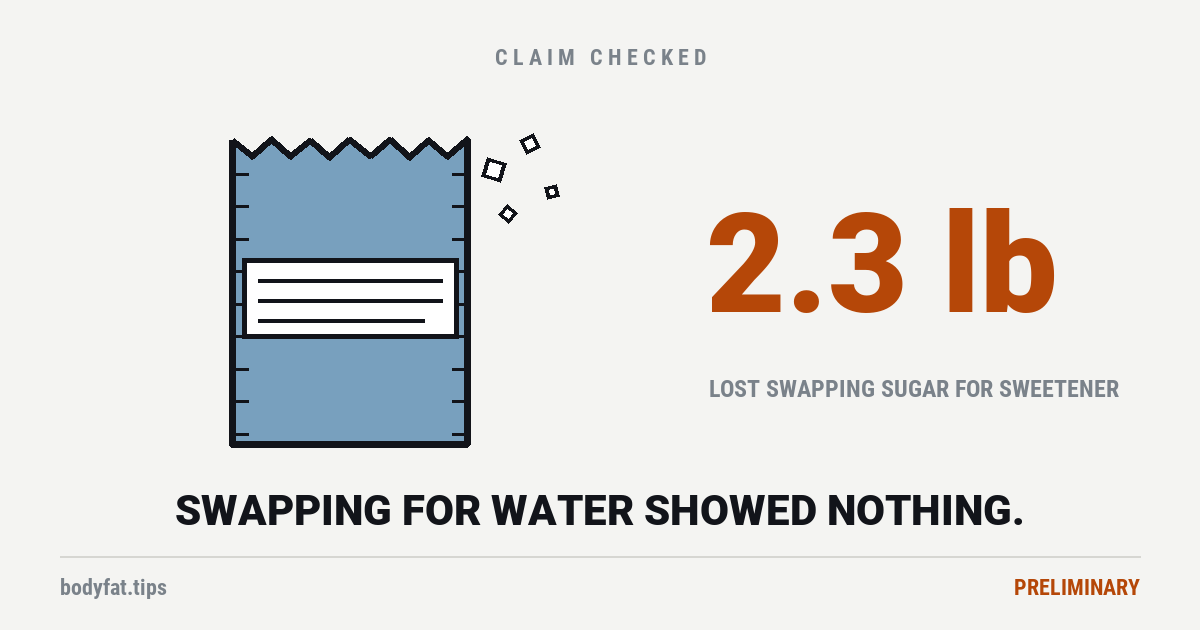
Swapping sugary drinks for sweetened ones: down 2.3 lb (1.06 kg), with body fat down 0.60 percentage points and less fat in the liver [2]. One thing to fix here, because this page had it loose until today: that figure is not the whole 1,733. The analysis ran three separate comparisons, and this is the biggest of them at 12 trials and 601 adults [2].
The certainty grade on it was moderate — one step up from the “low” WHO put on its own findings, harm and benefit alike. This is the firmest number on the page. It is worth being exact about what it is a number for: not whether sweeteners are good for you, but whether swapping a sugary drink for a sweetened one beats carrying on with the sugary drink.
Now the result nobody expects.
Swapping sugary drinks for water was “not associated with any outcome” [2].
Which is not the same thing as water losing — and until today this page read it as though it were. Here is what actually happened.
The sweetened swap was measured in 12 trials on 601 people. The water swap was measured in 3 trials on 429 [2]. On body weight the water swap came out at 0.02 lb (0.01 kg), and the range of plausible answers ran from 2.1 lb lost to 2.2 lb gained (−0.95 to 0.98 kg) [2]. A range that wide is not a finding. It is a shrug with error bars.
And the direction still went water’s way. The paper’s own discussion: water substitution showed “no significant improvements, although the direction of association favored water in all cases” [2].
The certainty grades say it again. Moderate for the sweetened swap; low for the water swap [2] — and low, as above, means further research is likely to move the estimate. Three trials is not enough to find a small effect even when there is one to find.
The authors are blunt about this, and they are the ones with standing to be. The sweetened swap delivered benefits “similar to those of water, the standard-of-care substitution”, which makes sweetened drinks “a viable alternative to water as a replacement strategy” [2]. Similar. A viable alternative. Not better.
So there is a real surprise here, but it is a different one. It is not that diet cola beats water. It is that the swap the major dietary guidelines actually tell you to make [2] — sugary drink to water — has been put through a randomised trial three times, while the swap they warn you off has been through twelve.
Be careful how far you carry it, though: these were adults with overweight or obesity who were at risk for or already had diabetes, three-quarters of them women [2]. It is not a finding about everyone, and “water does nothing” is not a sentence any sane person should build a diet on.
Four things worth knowing about scope
The WHO recommendation does not apply to people with diabetes. That exemption is written into the guideline [1], and it is routinely dropped from coverage aimed at exactly those readers.
It does apply to children, and to pregnant and breastfeeding women. WHO says so in the same breath as the diabetes exemption: “With the exception of individuals with diabetes (as noted below), this recommendation is relevant for everyone: children and adults of any age, including pregnant and lactating women” [1]. This page fenced the diabetes exemption and left those two out until today, which is a bad way round to do it, because pregnancy is the one place in this guideline where the evidence is specific.
Here is that evidence, and read the design before you read the number. Higher sweetener intake was associated with a 25% higher risk of preterm birth, pooled from three prospective population studies covering 129,009 pregnant women: odds ratio 1.25, with a range of plausible answers from 1.07 to 1.46 [1]. An odds ratio of 1.00 would mean no difference at all, and that range does not reach down to it, so this is not a result you can put down to chance. More sweetener went with more risk in the two studies that found a significant association — what researchers call a dose–response relationship, and one of the things that makes an association harder to explain away. The signal sat mainly in late preterm delivery, 34 to 37 weeks, rather than before 32 weeks [1].
WHO calls this limited evidence, and it is: three population studies, nobody randomised, no trial. But one detail in it lands directly on the argument this page has been making. The risk was “similar for lean and overweight women” [1]. That is the one place in the guideline where the body-weight explanation gets tested against a specific outcome, and it does not account for the result. If you are pregnant, this is a question for your own clinician, not for us — but you should not have had to leave this page to find out it existed.
And sugar alcohols are not included. Erythritol, xylitol and the other polyols are outside it entirely, because they are sugar derivatives that contain calories [1]. If a product is sweetened with erythritol, this guideline has nothing to say about it.
Everything else sweet and calorie-free is inside it, though, and this page previously printed WHO’s examples as if they were the whole list. They are not. WHO defines the category by a rule — “all synthetic and naturally occurring or modified non-nutritive sweeteners that are not classified as sugars” — and then says “common NSS include acesulfame K, aspartame, advantame, cyclamates, neotame, saccharin, sucralose, stevia and stevia derivatives” [1]. So if you were about to decide that monk fruit sits outside this guideline because it is not on the list: it is not on the list, and it is inside the guideline.
And this guideline is not a safety assessment. WHO puts that in its own overview of the document, in terms: the guidance “is not based on toxicological assessments of the safety of individual non-sugar sweeteners and is therefore not intended to update or replace guidance on safe or maximal levels of intake” set by the Joint FAO/WHO Expert Committee on Food Additives [1]. That committee — JECFA — is the one that sets acceptable daily intakes, and WHO notes that the studies behind this recommendation used sweeteners in amounts within them [1]. So this document is about weight and long-term disease risk. Whether a specific sweetener is toxic is a separate question with a separate committee, and we have a separate page on the one sweetener where that question actually blew up.
What to actually do
If you drink sugary drinks and want to stop, the trial evidence says switching to sweetened versions is a real, small win, and the WHO’s own review agrees on the short term [1][2].
If you are already drinking four diet colas a day and wondering whether you have been poisoning yourself: on this evidence, no. Two fences on that, both of which this page owed you and one of which it has been missing.
First, “this evidence” means evidence about weight and long-term disease risk. It is not a toxicology verdict, because the guideline it comes from says it is not one [1]. Second, the harm signal is observational and graded low certainty — but it does not come with a reverse-causation warning attached by the people who published it, which is what this page said until today. It comes with a reverse-causation test, which the harm signal survived [1]. Those are close to opposite, and the second one is what the document says.
And if you are pregnant, the section above applies to you and this paragraph does not settle it.
And if you have phenylketonuria, or PKU — a rare inherited condition in which the body cannot break down phenylalanine, one of the substances aspartame splits into — this paragraph does not apply to you at all. Regulators tell people with PKU to avoid or restrict aspartame, and the safety limits they set are not meant for them; our aspartame verdict carries their own wording and the sources.
One more thing has happened since, and you should hear who paid for it at the same time as you hear what it found. In 2025 an umbrella review — a review of other reviews — took up exactly the question this page calls unresolved, and reported that the population studies flip. Pooled the plain way, sweetener use goes with more obesity, diabetes, stroke and death. Pooled the other way, comparing sweeteners against the drink they were meant to replace, the same body of work goes with lower body weight, waist size, obesity, heart disease and death. Its own grading: the trial evidence generally moderate, the population evidence very low [3].
That is a genuinely useful idea and it points the same way this page does. It also comes from two of the authors of the substitution analysis above, and its declaration lists honoraria from the Calorie Control Council, the International Sweeteners Association and the International Stevia Council [3]. So we are not treating it as the answer, and we are telling you why rather than quietly leaving it out: a paper arguing that the right way to analyse this literature is the way that favours the product needs its method judged by somebody the product does not pay. We have not found that judgement, and we have not searched hard enough to tell you it does not exist.
Which is the one thing that would move this page off a shrug: the same bias-adjusted reanalysis, run by a group with no sweetener money and no sugar money in it. If it turns up, this page will say so.
If you want the safest available position, it is the boring one that nobody clicks on: fewer sweet drinks of any kind. Not because sweeteners are dangerous, but because that is the one recommendation no reading of this evidence argues against.
And when a guideline makes the news, read whether it says conditional. That word is doing more work than the headline above it.
This page was corrected on 16 September 2026. The link on source [2] went to a version of the McGlynn meta-analysis deposited in a university repository in 2024, not to the JAMA Network Open article the source line cites. It now goes to the article. We found it by checking every DOI link on this site against the document each one actually belongs to. Nothing the page reports from the paper has changed, and neither has the rating.
An independent editorial review on 18 September 2026 found that this page had read half of the WHO document it is built on. The page told you WHO “wrote down, in the same document, that the arrow might be pointing the other way” on the harm signal. The same section of that guideline gives reverse causation its own heading, lists the six things the original researchers did to rule it out, reports that the associations survived in most studies, and concludes that they “cannot be dismissed as being solely a result of reverse causation or residual confounding”. It goes further, raising the possibility that weight gained from long-term use is an intermediary step in disease rather than a confounder. All of that is now on the page, including the harder line. We had accused news coverage of compressing this document; on this passage we did the same thing in the other direction, and the provenance chain’s claim that reverse causation was WHO’s “reason for hedging” is corrected to what the sentence says — one item on a list of uncertainties.
Five more, and the evidence panel was wrong about the one row a sceptical reader checks. The panel called the substitution meta-analysis “academic”. It was commissioned by a European diabetes study group whose guidelines committee had input on all aspects of it, 9 of its 17 included trials carried industry money, and its authors declare grants and fees from the low-calorie sweetener trade — and, cutting the other way, from the sugar trade. The paper planned to test whether funding source changed the answer and could not, for want of trials; the row now says all of that. Next, the page turned a null into a finding: “replacing it with water did not” was three trials and 429 people against the sweetener arm’s twelve and 601, graded low certainty against moderate, pointing the same direction as the sweetener swap, and the paper’s own authors call the two similar. Next, we printed WHO’s benefit sentence with its “(all low certainty evidence)” cut out, in a section headed “the part that got cut entirely”. Next, the scope section fenced diabetes and sugar alcohols while never mentioning that the recommendation covers children and pregnant women, or that WHO reports a dose–response association with preterm birth across 129,009 pregnancies — the one place its body-weight explanation is tested on a specific outcome and does not hold. And “conditional” was glossed as a licence for individuals to differ, when WHO’s own definition hands that discretion to policy-makers, this being a document addressed to governments. The WHO guideline is now linked, which it should have been from the start on a page whose argument is to read the document. A 2025 umbrella review of this literature has been added, with its authors’ sweetener-trade ties named in the same breath and no weight placed on it. Later the same day, when our aspartame verdict was corrected for the same omission, a fence for readers with phenylketonuria was added beside the one for pregnancy. The rating is unchanged at Preliminary.
- Does Sucralose Raise Blood Sugar? Not on Its Own. Whether Weeks of It Change How You Handle Sugar Is Still Split.
unsupported - Is Allulose Safe? Diarrhea at Big Doses, an HDL Dip, and No EU Clearance
supported - Are Emulsifiers Bad for You? They Inflamed Mouse Guts. In People, the Trials Are Small, Short and Split.
preliminary