Is Diet Soda Bad For You? Better Than Regular — With One Catch

Better than the regular kind. Not as settled as either side tells you.
And there is one finding about diet cola specifically that almost nobody mentions, probably because everyone is too busy arguing about aspartame to read past it.
First, the swap — which is the thing you actually do
Nobody adds sweetener to a diet of plain water. The real-world question is what happens when a sugary drink becomes a diet one.
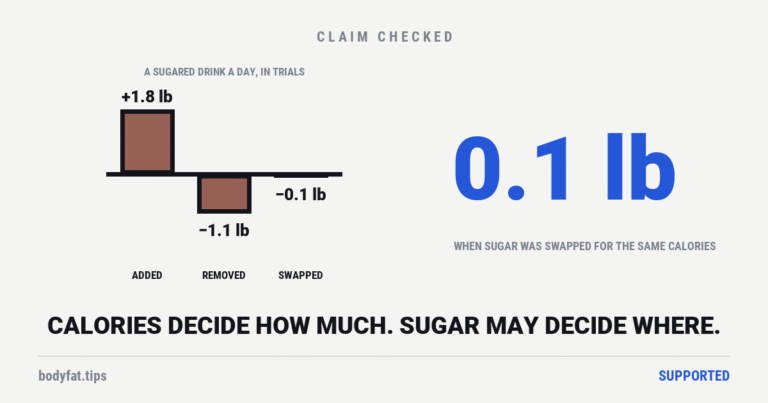
A 2022 analysis pooled 17 randomised trials covering 1,733 adults and looked at exactly that [1].
Swapping sugary drinks for diet ones: down 2.3 lb (1.06 kg), with body fat down 0.60 percentage points and less fat in the liver. The certainty grade on the weight finding was moderate [1].
And the one that always surprises people: swapping sugary drinks for water was “not associated with any outcome” in those trials [1].
Which is not permission to give up on water. Those were adults with overweight or obesity, most of them women, at risk for or living with diabetes — and a trial finding nothing is not the same as there being nothing. But it should make you suspicious of anyone who tells you the diet version is the problem.
As for whether the sweeteners themselves are harmful, that is a bigger question and it has its own verdict. Short version: the WHO advises against them as a conditional recommendation on evidence it grades low certainty, in a document that names reverse causation itself [3].
Now the bit about cola that survives the switch
Here is where a can of diet cola stops being a sweetener question. It also contains phosphoric acid and, usually, caffeine. Neither of those is in a sachet of sweetener, and neither goes away when you pick the silver can.
The Framingham Osteoporosis Study measured bone density by DXA scan in 1,413 women and 1,125 men, and compared it against how much soft drink they reported drinking [2].
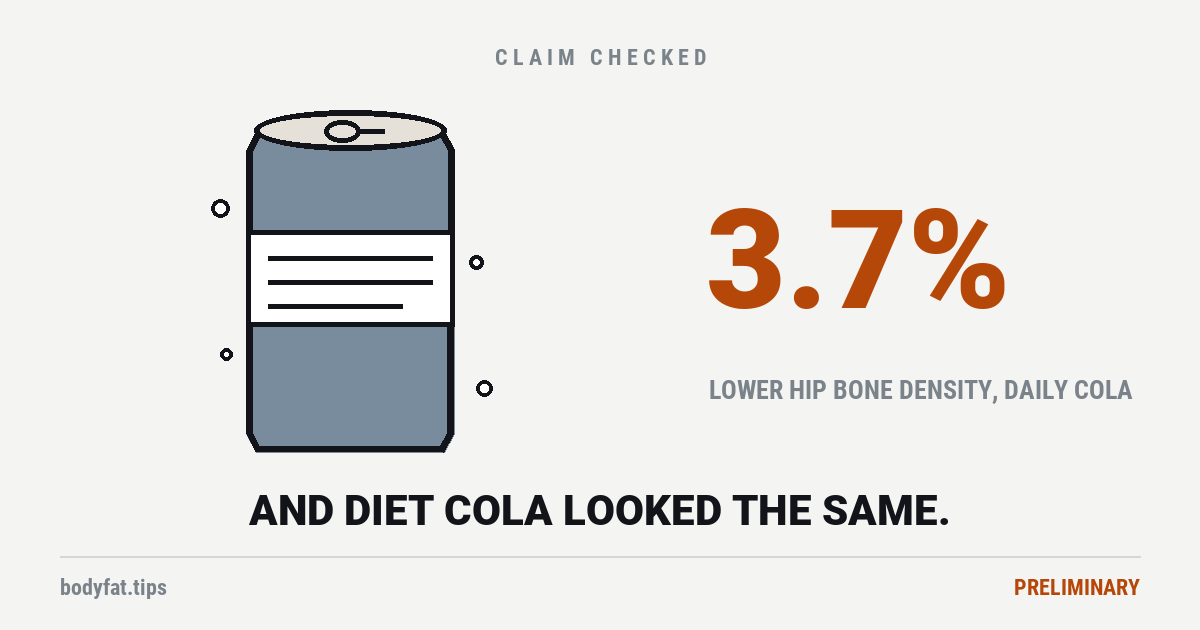
Women drinking cola daily had bone density about 3.7% lower at the femoral neck — the narrow part of the hip that breaks — and 5.4% lower at another hip site, compared with women drinking less than one cola a month [2].
Three details make this more interesting than the usual scare:
It was cola specifically. Other fizzy drinks showed no significant relationship at all [2]. So this is not about carbonation, which is the folk explanation everyone reaches for.
It was the hip, not the spine. And it was women, not men [2].
And diet cola looked the same. In the researchers’ words: “Similar results were seen for diet cola” [2]. Whatever is going on, sugar is not the explanation — which means switching to diet does not buy you out of this one.
How much should that worry you? Genuinely: not much, yet
This is an observational study. It watched what people already did rather than assigning them to drink cola, and that limits what it can tell you about cause.
The obvious rival explanation is displacement: if your daily drink is a cola, it is probably not milk. The researchers tried to handle that by adjusting for total calcium and vitamin D intake, along with body mass index, age, activity, smoking, alcohol, caffeine from non-cola sources and — for the women — menopausal status and oestrogen use [2]. That is a serious attempt, not a hand-wave.
But adjustment is never the same as randomisation, and the authors close with the line that ought to be in every headline written about them: “Additional research is needed to confirm these findings” [2].
So: a real signal, in a specific place, that nobody has yet explained. That is what an unresolved finding looks like, and it is why this verdict reads Preliminary rather than a clean yes or no.
One thing we have not checked
Dental erosion. Diet drinks are acidic, and acid erosion of enamel is a different process from tooth decay — decay needs sugar, erosion does not. It is entirely plausible that the diet can is no better on that front.
We have not read that literature, so we are not going to tell you either way. It deserves its own verdict rather than a confident sentence here.
What to actually do
If you are drinking sugary cola, switching to diet is a small real improvement on the thing most people are switching for [1]. Do that.
If you drink cola of either kind every single day, the bone finding is the one worth knowing about — not because it is proven, but because it is the one thing on this page that the diet version does not fix [2].
And if you were hoping this page would tell you diet soda is poison, or that it is completely fine: it is neither, and anyone offering you the clean version of that answer has not read the studies. For the in-vitro scare headlines about sweeteners, see the sucralose verdict.