Do Detox Teas Work? Nobody Will Name the Toxin

Start with the simplest question you can ask a detox tea: which toxin?
Nobody will say. Not the manufacturers, not the labels, not the influencers. In 2009 a group of scientists went and asked — they picked fifteen detox products off supermarket and pharmacy shelves and contacted the companies for their evidence and their definition of the word. They reported that no two companies used the same definition, that little or no evidence was offered, and that in most cases the makers “were forced to admit that they are renaming mundane things, like cleaning or brushing, as ‘detox’” [4].
The vagueness is not an accident. It is the product.
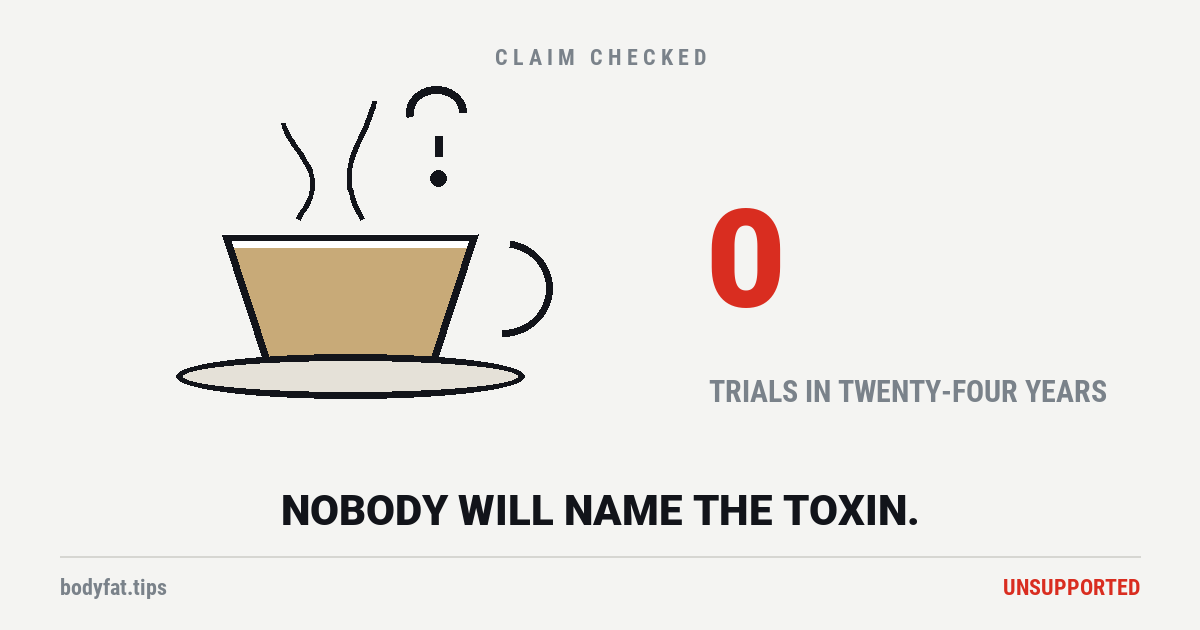
Twenty-three years, zero randomised trials
A review published this year went looking for evidence on diet and detox teas. It searched the medical literature from 2002 to 2024, retrieved 1,708 records, screened 1,667 of them, and pulled 35 for full reading.
It found ten studies in total. Five were single-patient case reports. One was in rats. One was a lab screen for adulterants, one a survey of website labels, one a chemical assay. That leaves one human study of whether these products do anything [1].
Not one randomised controlled trial of a commercial detox tea exists. An earlier review reached the same floor for detox diets generally [2].
The one study, reported properly
It is worth giving that single study its due before taking it apart.
Thirty-five volunteers, slightly overweight, drank two cups a day of a herbal slimming tea for two months. The authors reported about 2 kg of weight loss, less swelling, and no side effects [14]. That is a real published finding.
It also had no control group, no randomisation, no blinding, and no reported statistical analysis — and both authors worked at the research centre of the company that makes the tea.
One more thing, and it is the reason we read originals. The paper cannot agree with itself about how long it ran. Its abstract says two months and a loss of 4.4 lb (2 kg). Its methods say the study “was carried out for 16 weeks.” Its results report 3.3 to 4.4 lb (1.5 to 2 kg) “at the end of two months” [14]. The 2026 review that catalogues the study repeats both lengths — sixteen weeks in its table, two months in its text [1].
Neither version supports the product. But a citation can only be as consistent as its source, and this source says two things.
What is actually in the cup
Strip the branding and most of these teas are a stimulant laxative, usually senna, sometimes with a diuretic.
Senna is not absorbed. It passes to the colon, where bacteria activate it, and it then works by irritating the bowel and pulling water into it — it blocks water and electrolyte reabsorption and increases fluid secretion [6]. Every part of that mechanism is about water.
So the weight moves. It is stool and fluid, and it returns.
The number that ends the fat-loss claim
You might reasonably think that if you flush food through fast enough, fewer of its calories get absorbed. Someone measured it.
In a 1983 study, researchers directly measured calorie absorption in people using purgatives. Even extreme purging — four to six litres of diarrhoea — reduced calorie absorption by only about 12 percent. The authors’ conclusion was that the theoretical basis for using laxatives to control weight is unsound [5].
The reason is anatomy. Calories are absorbed in the small intestine. A colonic laxative acts further downstream, after the meal has already been banked. You are not intercepting anything. You are emptying a container that has already been unloaded.
The harm that is real
This is where the story stops being merely useless.
In a US network tracking serious liver injury, 839 patients were followed over nine years. 15.5 percent of the liver damage was caused by herbal and dietary supplements — and that share rose from 7 percent to 20 percent across the study period. Split by type, the worst outcomes were not in the bodybuilding products. Among the 85 cases attributed to other supplements — the group a detox tea would fall into — 13 percent ended in a liver transplant, against 3 percent of injuries from conventional medicines, though deaths were no more common (4 percent against 7 percent). The 45 bodybuilding-supplement cases led to no transplants and no deaths [7].
A specific case makes the point sharper than any statistic. A 36-year-old woman took an over-the-counter herbal liver detox tea for a month. Her liver enzymes went from normal to an ALT of 1,329. She was hospitalised for twelve days and treated with N-acetylcysteine — which is an actual detoxification drug, the one used for paracetamol poisoning [8].
A liver-detox tea caused a liver injury that required real detoxification to treat.
Electrolytes are the other danger. A previously healthy 51-year-old nurse drank about two cups of detox tea daily for four weeks and arrived at hospital with seizure-like activity, confusion and a blood sodium of 115 — dangerously low. She spent three days in intensive care [9].
And this is not a niche exposure. A national survey estimated that around 15.6 million American adults had taken at least one of six potentially liver-toxic botanicals in the previous month [10].
The harm that is overstated
We are going to correct the other side too, because getting this wrong is how debunking turns into scaremongering.
You will read that stimulant laxatives wreck your bowel and create permanent dependence — a “cathartic colon.” A 2024 critical review found no good evidence that stimulant laxatives cause structural damage to the gut at therapeutic doses, noted that no case of cathartic colon has been published since 1960, and called it a historical entity unlikely to occur with modern laxatives [11]. That review comes with a disclosure worth knowing: the drug company Sanofi provided financial support for its publication costs and medical writing, one of its three authors is a Sanofi employee, and another has consulted for or received research funding from Sanofi on other work [11]. The 1960 point itself comes from older work the review cites: a 1996 paper that described 41 alleged cases of cathartic colon from 18 earlier papers, all in women who began taking laxatives between 1910 and 1960.
The documented dangers here are your liver and your electrolytes. Not a ruined colon.
Where the idea came from
The theory is older than most people assume, and it was abandoned by medicine roughly a century ago.
In 1887 a French physician formalised “autointoxication” — the idea that waste sitting in the gut poisons you from within. It gained enormous credibility when a Nobel laureate at the Pasteur Institute took up a version of it in the early 1900s, and it reached its logical endpoint when surgeons began removing healthy colons to cure it, with results that included deaths [13].
By the 1930s medicine had let it go — the proposed mechanism didn’t hold up and the treatments were harming people. In fairness, historians note the story is usually told too neatly: there was never one decisive experiment that killed it [13]. It was abandoned rather than refuted.
But abandoned it was. What survives in your shopping cart is the marketing language of a theory medicine walked away from before your grandparents were born.
What the regulator did
In 2018 the FDA warned a detox tea seller over website claims that included “Detoxify: Parasites, Bacteria & Toxins” [3]. Note the shape of it — three categories, no compound.
In 2020 the FTC took action against a detox tea marketer, alleging weight loss and health claims made without reliable scientific evidence, alongside influencer endorsements whose paid nature was not properly disclosed. The judgment was $15.2 million — the total sales of the products — suspended to $1 million on inability to pay [12].
Two years later the refunds went out: about $930,000 to more than 20,000 people, averaging $45 each [12]. Against $15.2 million in sales. That is the recovery rate in this category, and it is why the business keeps working.
What your liver already does
The organ you are being sold a cleanse for is doing the job continuously, in two stages: it chemically alters fat-soluble compounds, then attaches them to molecules that make them water-soluble so your kidneys can excrete them [15].
No human study in that entire 2026 review tested whether these teas improve liver or kidney function [1]. The claim that these products improve the organs they are named after has, as far as we can establish, never been tested in a human. The nearest thing is a rat study in the same review, in which a slimming tea reduced fat in the livers of rats fed a high-fat diet [1].
Real detoxification exists — for paracetamol overdose, for heavy metal poisoning. It has a named toxin, a named agent, and a measured clearance. Detox tea marketing borrowed the word and left all three behind.
Four passages were corrected on 15 September 2026 after an independent editorial review. This page said the 2026 review had doubled the length of the one human study when citing it, and put that down to nobody going back to look. That was wrong, and unfair to the review. The 2002 paper disagrees with itself: its abstract and results say two months, its methods say 16 weeks, and the review repeated both. The paragraph and the evidence panel’s follow-up row now say so. The liver-injury figure of 13 percent against 3 percent was described as death or transplant across all supplement cases. The paper’s abstract does call it death or transplantation, but its own table shows the 13 percent is liver transplants alone, among the 85 cases from supplements other than bodybuilding products; deaths were 4 percent against 7 percent. The sentence now reports that.
Also changed: the 2024 review cited to show that stimulant laxatives do not ruin the colon declares that the drug company Sanofi provided financial support for its publication costs and medical writing, and that one of its authors is a Sanofi employee; the page did not say so, and now does beside the claim and in the source list. “Never been tested at all” now reads “never been tested in a human”, because a rat study in the same review measured liver fat, and the sentence before it no longer says that no study in the review measured liver function. On the date: the one shown at the top, 18 August 2024, belongs to an earlier post at this address; this page replaced it on 25 July 2026, which is why it calls a review published in April 2026 “this year”. Two smaller slips are fixed too: the review retrieved 1,708 records and screened 1,667 of them, where the page said it screened 1,708; and the heading, the panel figure and the search snippet said zero trials in twenty-four years, when the review searched 23 years of literature, 2002 to 2024, and the zero it found is of randomised trials — the one uncontrolled study the panel already lists is a trial of a kind. The rating is unchanged.