Caffeine Before a Workout Works. Does a Coffee Habit Blunt It? Not Settled.

Most of what this site has checked in the supplement aisle does not survive contact with the evidence. You have probably noticed that we say so a lot.
So here is one that does.
In 2019 a group of researchers did the thing you do when a field has produced too many reviews to read: they reviewed the reviews. Eleven of them, containing 21 separate meta-analyses published up to September 2018, every one rated moderate or high quality on a standard checklist [1].
Caffeine came out ahead for aerobic endurance, muscular strength, muscular endurance, power, jumping, and exercise speed. All six. Not every analysis agreed, though: 4 of the 21 found no effect they could separate from chance. And the researchers’ own grading of how far to trust the evidence was moderate for endurance, strength, muscular endurance and power, and only low or very low for jumping and speed, each of which rested on a single meta-analysis [1].
Which raises the only question that actually matters to you: how much, and when?
The dose, in the units you actually buy things in
| The dose | 3 to 6 mg per kg of bodyweight — for a 165 lb (75 kg) person, 225 to 450 mg |
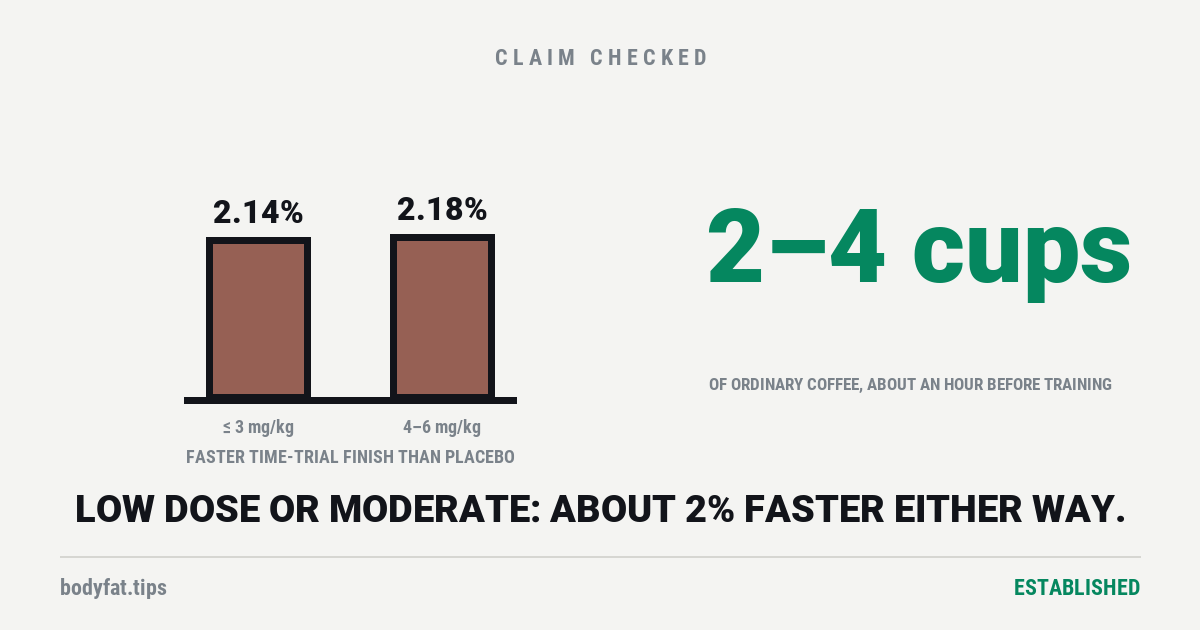
| In coffee | roughly 2 to 4 cups of ordinary hot-brewed or instant — 16 to 32 oz (473–946 ml) |
| Timing | most commonly 60 minutes before. Gum works faster than capsules |
| Lower bound | may work as low as 2 mg/kg. For lifting, a separate meta-analysis found 0.9–2 mg/kg still helped [6] |
| Upper bound | about 675 mg at 165 lb (9 mg/kg) brings a high rate of side effects and does not seem to be needed for the benefit |
| Who it works for | trained and untrained alike; men and women, though far fewer women and untrained people have been studied |
Three to six milligrams per kilogram of bodyweight, about an hour before you train [2]. For someone weighing 165 lb that is 225 to 450 mg, and in ordinary coffee it works out at roughly two to four cups — 16 to 32 oz [7].
If you have ever wondered whether 200 mg is a lot: for a 165 lb person that is about 2.7 mg/kg, which sits just under the bottom of the range the position stand recommends. It is a normal dose, not a big one.
And the ceiling is real. Nine milligrams per kilogram — roughly a double scoop of a strong pre-workout for many people — is “associated with a high incidence of side-effects”, and doses that high “do not seem to be required” for the benefit [2]. That is about 675 mg for a 165 lb person. And the side effects are not just jitters. In a 2026 pooling of trials in athletes, caffeine more than quadrupled the odds of a racing heart against a placebo and raised the odds of headache, stomach upset, anxiety and poor sleep; the racing heart, headaches, stomach upset and anxiety all became more common as the dose went up [9].
| Most adults, per day | 400 mg a day from all sources, about two to three 12 oz cups of coffee — the figure the US FDA [10], the EU’s food safety authority [11], Health Canada [12] and Australia and New Zealand’s food regulator give; the last applies it to athletes too [13] |
| In one go | up to 200 mg raises no concern, even in the two hours before hard exercise — about 3 mg/kg for a 154 lb (70 kg) adult [11]. Australia and New Zealand put the line at 210 mg and note rises in blood pressure and anxiety above it [13]. The FDA and Health Canada give no single-dose figure |
| Sports supplements | in March 2026 Australia and New Zealand’s regulator approved a cap of 200 mg of caffeine a day, in total from any source in the product, for sports supplements sold there once the change is gazetted, with two years for businesses to comply [13] |
| Pregnant or breastfeeding | 200 mg a day in pregnancy (EU; Australia and New Zealand) and up to 200 mg when breastfeeding (EU); 300 mg a day in Canada, which also applies it when planning a pregnancy or breastfeeding; the FDA says ask your health care provider [10] [11] [12] [13] |
| Under 18 | Canada: 2.5 mg per kg of body weight a day, about 150 mg for a 130 lb (59 kg) teenager, a figure it calls precautionary for healthy older, heavier teens [12]. The EU uses 3 mg per kg a day as a basis for children and teenagers [11]; Australia and New Zealand apply the adult figure to teenagers [13] |
| Where it turns dangerous | toxic effects such as seizures at around 1,200 mg taken quickly [10]; serious heart-rhythm problems or seizures at or above that amount [13] |
| What they do not cover | these are safety figures, not performance doses. Heart-rhythm conditions, anxiety and panic disorders, and medicines that interact with caffeine are on Australia and New Zealand’s list of reasons to manage caffeine with a doctor or pharmacist [13], and a family history of heart-rhythm problems calls for caution [7] |
How big is the effect, honestly?
Small to moderate. That is the truthful answer and it is worth sitting with, because it is the difference between a useful edge and a transformation.
Researchers measure this with something called a standardised effect size, and the working scale is: 0.2 is small, 0.5 is moderate, 0.8 is large. Pooling sixty studies, caffeine’s overall effect across all exercise types comes out at 0.25 [4]. Small, consistent, and real.
The 2026 dose-response analysis is more interesting, because it separates the doses. Across 48 randomised placebo-controlled trials and 689 people doing aerobic time trials, 93% of them men, in studies published up to mid-2022 [3]:
A low dose — up to about 225 mg for a 165 lb person (3 mg/kg or under) — improved finishing time with an effect size of 0.27, small on that scale. A moderate dose, about 300 to 450 mg (4 to 6 mg/kg), came out at 0.52, nearly double. Read that way, more caffeine did more, and the review’s own conclusion says a dose-response effect was observed. Its authors also say why that should be read with care. Measured in time, the low doses made people about 2.14% faster and the moderate doses about 2.18%; a bigger effect size reflects how much results vary as well as how much faster people went; two particular studies drove part of the gap; and of the trials that tested more than one dose, three found more at the higher dose and two found no difference [3].
Of the other syntheses on this page that split the doses, all but two side with the raw times. The sixty-study pooling above found the same effect size, 0.26, under 3 mg/kg and at 3 to 6 [4]. A 2025 network meta-analysis, which ranks every dose and form against the others, put low-dose capsules at 0.34 and moderate ones at 0.31 [14]. Food Standards Australia New Zealand, assessing 39 time-trial studies in March 2026, reported: “We did not find a relationship between caffeine dose and effect size” [13]. Three 2026 poolings in women that tested dose found no reliable difference either [25] [26] [27], and nor did a 2023 pooling of jumping studies in women [35]. The exceptions are a 2026 pooling of caffeine-gum trials, which did find bigger doses doing more [15], and the 2026 pooling of basketball trials in women described below, whose exploratory split put the middle dose band ahead of both the lowest and the highest for power output and for agility; by our count, that comparison rests largely on one ten-player trial that tested three doses [32]. For a time trial, then, about 225 mg for a 165 lb person (3 mg/kg) appears to do about as much as 450 mg (6 mg/kg).
And above 6 mg/kg? Not a single eligible trial existed. Eligible here meant capsules or caffeine in water only, finishing times reported with their spread, and publication by mid-2022 [3]. Trials at that dose do exist outside those rules; they are few and small, and the review itself names two of them. Two 2,000 m rowing studies from 2000 gave the equivalent of about 675 mg for a 165 lb person (9 mg/kg): in eight men it did no better than 6 mg/kg, both about 1.2% faster than a placebo [16], and in eight women it did a little better, 1.3% against 0.7% [17]. In the heat it did nothing: neither about 375 mg nor about 675 mg for a 165 lb runner (5 and 9 mg/kg) changed the times of seven runners racing 21 km in heat and humidity in 1996 [18], and 9 mg/kg did not change how much work ten men did in a 15-minute cycling time trial at 104°F (40°C) in 2009 [29]. A 2025 trial of 13 male rowers racing in the evening found the biggest gain at the top dose, about 675 mg at 165 lb (9 mg/kg), which also brought the most headaches, insomnia and stomach complaints [19]. Across all kinds of exercise, the sixty-study pooling found no clear benefit in its studies above about 450 mg for a 165 lb person (6 mg/kg); the range of plausible results still included no effect at all [4]. And Australia and New Zealand’s food regulator had only two of its 39 time-trial studies above 6 mg/kg, too few to pool [13].
For lifting, a small dose looks to be enough too
Lifting points the same way, and here the low end was tested on purpose.
A meta-analysis went looking for the minimum effective dose in resistance training and pooled twelve studies that used only 0.9 to 2 mg/kg — a fraction of the standard recommendation [6]. Strength improved (effect size 0.17), muscular endurance improved (0.21), and bar speed improved most of all (0.56, which is a moderate effect).
The author’s own conclusion is that these were “similar to that previously reported with higher caffeine doses” [6].
So for a barbell, a cup of coffee appears to do about as much as three, and for a time trial the raw gap between a low and a moderate dose was a few hundredths of a percent. If caffeine makes you feel wired and awful, that is useful news — you can take a lot less and keep most of the benefit.
“But I drink coffee all day, so it won’t work on me”
This is the single most common objection, and it sounds obviously true. Two kinds of evidence speak to it, and they do not say the same thing.
The first kind compares studies. Sixty studies that recorded their volunteers’ usual caffeine intake were pooled to ask whether heavier users got less out of a dose on the day [4]. The overall performance boost was there, as usual. The influence of habitual intake on it: p = 0.59 — nowhere near the line researchers use for “probably not chance”. Split by how long volunteers had gone without caffeine before testing, from under a day to more than two days, the boost held in every group [4]; in the coffee studies the usual pause was 12 to 48 hours [7]. What this compares is groups of people across studies, not the same people before and after a habit.
The second kind builds a habit on purpose, and once the habit runs to weeks it mostly points the other way. Fourteen cyclists given the equivalent of about 450 mg a day for a 165 lb rider (6 mg/kg) for four days still got the full boost from a dose on day five [20]. A week of daily coffee left it in place too: in 24 team-sport players who rarely had caffeine, a coffee dose of about 450 mg for a 165 lb man (6 mg/kg) still raised the power of the first three of twelve sprints after a week of drinking that much caffeine, or half of it, every day; across all twelve sprints it made no clear difference, before the week or after [30]. In a 20-day trial the boost held but shrank as the days went on [2]. When 18 light caffeine users were randomly assigned to daily caffeine or a placebo for four weeks, the benefit of a pre-ride dose was “no longer apparent” in the caffeine group by the end, while the placebo group kept it [21]. And in 80 inactive men randomly assigned to caffeine or a placebo for eight weeks, a pre-run dose of about 225 mg for a 165 lb man (3 mg/kg) still helped every group, but less in the men who had been taking caffeine [22]. One more four-week trial, reported only as a conference summary, gave 23 athletes about 225 mg for a 165 lb person (3 mg/kg) or a placebo every day while they trained, and gave both groups that dose before the final tests; the groups did not differ on any of them [31]. With no test after a placebo at the end, it cannot say how big the boost still was.
A 2023 trial tested people who already had the habit, without making them skip it. Ten recreational cyclists averaging about 400 mg a day took the equivalent of about 450 mg for a 165 lb rider (6 mg/kg) an hour before a 10 km time trial. When they had taken a small dose eight hours earlier to keep the habit going, it did no better than a placebo; it came out ahead only against days without that earlier dose [23].
So the honest answer is that it is not settled. For a regular drinker, the studies in which volunteers paused caffeine first found the dose still worked; whether it works on top of an unbroken habit is the open question, and the three trials that ran a habit for weeks and then tested a dose against a placebo found the boost shrinking or gone. The caffeine position stand calls the findings “equivocal” [2]; the coffee stand says habit matters “to a small degree” [7]. Rated on its own, the claim that a coffee habit leaves the effect intact would be Preliminary on this site.
The women’s data, and where it stops
The umbrella review is candid that most of the primary studies were done on young men [1], which is the standing problem in this entire field and not one we are going to pretend away.
There is a 2021 meta-analysis specifically in women: eight crossover trials, and caffeine significantly improved both muscular endurance (0.25) and muscular strength (0.18) [5]. The authors note these are similar in size to what has been found in men.
But read the subgroups. Split by body region, the upper-body results held. The lower-body ones did not reach significance — p = 0.09 for endurance, p = 0.11 for strength [5]. Eight studies split in half is a small pile, so this is probably a question of statistical power rather than a real difference in legs. But it is what the data says, and stating it is cheaper than being caught not stating it.
Women-only poolings have multiplied since. Later in 2021 came a second, of 18 studies in young women playing team sports, five of them using energy drinks rather than caffeine alone. Caffeine improved ball skills, match intensity, grip strength and the countermovement jump (a standing jump with a quick dip first), but not squat jumps, agility or repeated sprints [34]. In 2023 a pooling of 15 jumping studies in women, ten of them in athletes, found a small benefit that held across times of day, doses and jump types, and was largest in the follicular phase, the first half of the menstrual cycle [35]. Four from 2026, of 19 to 26 studies each, found the same small benefit, with effect sizes from 0.17 for maximal strength to 0.54 for muscular endurance, and graded their own confidence anywhere from very low to high [24] [25] [26] [27]. Three smaller 2026 poolings, each limited to particular sports, were more mixed. A review of nine studies in 118 female handball, volleyball and basketball players, more than half of them aged 15 to 19, pooled six and found the players quicker on agility tests and jumping higher, though sprints were not significantly faster [33]. The other two came from one university team. A pooling of five volleyball studies found no clear benefit on any outcome, with its certainty graded very low [28]. A pooling of seven basketball trials found a clear gain only in power output, a result resting on two of the seven; shooting, dribbling, jumping, agility and sprinting were not significantly better, though the estimates for jumping and sprinting leaned towards caffeine without crossing the line researchers use for “probably not chance” [32]. Ten of those twelve volleyball and basketball trials also sit inside the largest of the four 2026 poolings, 26 studies in team-sport players, which, with handball, soccer and other team sports beside them, found the small benefit [25]. And Food Standards Australia New Zealand, whose time-trial evidence was 8% women, has low certainty that its estimate applies to women [13]. Probably the same small edge, then, on thinner evidence than for men.
What it is not doing
It is not burning your fat. Caffeine’s effect on bodyweight is a different question with a different and much weaker evidence base, and this site rates it separately — see whether coffee helps you lose weight, which this site rates Unsupported, and which contains a $3.5 million FTC settlement. Nothing on this page upgrades that. Performance and fat loss are two claims, and only one of them is Established.
It is also not making you fitter. This is the mechanism, and it reframes the whole thing: caffeine works largely by blocking adenosine receptors in the central nervous system, which raises motor-unit firing rates and suppresses pain [2]. It does not add capacity. It reduces how hard the work feels, so you access more of the capacity you already had.
Worth pausing on that, given that this site has just spent a page explaining why soreness is not a progress gauge. Caffeine turns down a sensation. That is the mechanism, and it is a real one — but it is another reason to stop using sensation as your instrument.
And it is not free. Blocking the receptor that makes you sleepy is exactly what it sounds like, and what short sleep does to bodyweight is one of the better-evidenced findings on this site. A 6 pm pre-workout is a trade, not a freebie.
How much of the boost is expectation?
On 20 October 2026 a review came out with a finding that sounds as if it undoes this page. Its authors pooled 17 studies in which people were handed a dummy, most often a capsule, sometimes decaf, salt water or gum, and told it was caffeine. Against a session with nothing at all, the dummy improved performance by an effect size of 0.49, “small-to-moderate” in their words [36]. So is the boost all in your head?
No. But the reason is more interesting than a no, and it starts with what that 0.49 compares.
What the new review measured
The 0.49 sets a dummy that people were told was caffeine against a baseline: the same test, done with no capsule and no promise. It does not set the dummy against real caffeine, which is the comparison the trials behind this page’s rating make [3] [36]. And in most of the 17 the dummy came with a sales pitch. In ten the volunteers were shown scientific evidence that caffeine works, in ten they were told it would make them perform better, and in four the case was made in a presentation or a video [36]. On our reading, that is a harder sell than a cup of coffee usually comes with.
The studies were small: 257 people across all 17, 82% of them men; nine of them tested lifting, five running and three cycling [36]. The biggest, with 30 people, did not have performance as its main measure at all. It measured how hard a 30-minute finger exercise felt, after half the group were given decaf described as a strong dose of caffeine [36]. No single study carries more than about 9% of the weight in the pooled figure, and the review’s chart of the 17 adds up to the 0.49 it reports (our arithmetic).
The review is frank about the quality. It rated nine of the studies at high risk of bias, its judgement of how likely a study’s design is to tilt the result, and the other eight unclear; none came out at low risk. On GRADE, the scale reviewers use to say how far to trust a pooled result, it graded the evidence low, which in its own words means “the estimate of the effect is uncertain”. Its supplement prints a slightly smaller figure in the grading table, 0.45 from 197 people, beside the text’s 0.49 from 257, and the paper does not say why [36].
Split by what was measured, its biggest number was for riding or running to exhaustion: an effect size of 1.07, past the 0.8 that researchers call large, but it comes from two studies and 17 people, and the review graded that evidence very low. It also found moderate effects on how hard the work felt, across 11 studies, and on the repetitions and weight people lifted; on power output, across five studies, the dummy was not significantly better than baseline [36]. Two patterns came out of its meta-regressions, checks of whether the size of an effect tracks some feature of the studies. The dummy did more when the researchers handing it out did not know it was a dummy, which the authors suggest may be because researchers who know signal it without meaning to. And it did less the more women a study included. In the one study of women only, 13 women used to caffeine, the dummy came out slightly behind baseline [36].
Its search ran to July 2026. Since then a sports-science team at a Spanish university, two of whose members also ran one of the trials below, has published two more, and in neither was the dummy significantly better than nothing. Fourteen male runners doing five 1,000 m repeats were about 4 seconds quicker over roughly 17 minutes of running (1,017 against 1,022 seconds) [44]. Nineteen trained male cyclists riding to exhaustion did 1.6% more work, with a range of plausible results from about 7% less to 11% more (our arithmetic from the paper’s figures) [45].
The trials that separate the drug from the belief
To split the drug from the expectation you need a trial that crosses what people are told with what they get. It is called a balanced-placebo design, and it runs four sessions: told caffeine and given caffeine; told caffeine and given a dummy; told it is a dummy and given caffeine; told it is a dummy and given a dummy. The third is the one that matters here, because it is the drug with no expectation behind it.
A June 2026 review of study designs lists eight of these trials [37]. One of the eight is in fact an ordinary blinded trial that does not cross the two, and one tested footballers aged 15 to 17, which leaves six that tested adults’ performance. A seventh is missing from that list: a 2024 trial, which the October review set aside because it had no session with nothing at all [36] [51]. Beyond those seven, our own searches turned up no other trial in adults that crossed the two and measured exercise performance [50].
Four of the seven point mainly to the drug. In 2008, 14 male cyclists rode 40 km (about 25 miles) fourteen times, and the conditions were not randomised. Receiving caffeine raised their power by 3.5% on average; being told they had it added 0.7%, with a range of plausible results that includes nothing; and the drug did more, not less, on the days they were told they had not had it [38]. In 2016, 14 men given about 375 mg for a 165 lb man (5 mg/kg) gained the same knee strength whether they were told it was caffeine or a dummy, while the dummy sold as caffeine had, in the authors’ words, “no effect” [39]. In a 2026 trial of 16 trained adults, 5 of them women, about 225 mg for a 165 lb person (3 mg/kg) lengthened their standing triple jump by 2.1% and cut their 20 m (22-yard) sprint time by 0.8% on the day they were told it was a dummy; told it was caffeine when it was not, they did no better on any of the four tests [42]. And in another 2026 trial, 16 resistance-trained men gained a little knee strength, about 4%, from 5 mg/kg whatever they were told, while being told it was caffeine when it was not “did not improve” their strength or their muscular endurance, though it did raise the lactate in their blood, a by-product of hard muscle work [43].
Two point to the belief. In 2019, eight recreational soccer players ran to exhaustion after half an hour of shuttle running built to mimic a match. Told it was caffeine but given a dummy, they lasted about 10.4 minutes (623 seconds); given caffeine but told it was a dummy, about 9.6 (578); both beat the dummy sold as a dummy, about 8.9 (533); and the real thing with the promise beat everything, about 11.2 (672) [40]. In 2020, 11 trained male runners raced 1,000 m, after a talk from the trial’s first author, then an international-level runner, on how well caffeine had worked in their own racing. The dummy sold as caffeine made them faster than their baseline by as much as real caffeine sold as caffeine, effect sizes of 0.43 and 0.42; caffeine sold as a dummy did not significantly change their finishing time, at 0.21, though it quickened one split along the way [41]. The first author of that trial also led the 2026 review, and the review’s last author co-wrote the 2019 soccer trial [36] [40].
The seventh we could read only as its abstract. In 2024, 8 men did an incremental exercise test on four days, in random order, told it was caffeine or a dummy and given caffeine or a dummy in a drink. Caffeine sold as caffeine gave them significantly higher maximal power, and a higher fatigue threshold, a measure of muscle fatigue taken from electrodes on the skin, than either day they had the dummy; caffeine sold as a dummy came out not significantly different from caffeine sold as caffeine. The abstract does not say how caffeine sold as a dummy, or the dummy sold as caffeine, compared with the dummy sold as a dummy. The authors titled the paper “Caffeine expectancy does not influence the physical working capacity at the fatigue threshold”, and its abstract ends more cautiously than the title: expectancy “may serve as a cue” for how a supplement or a dummy affects performance [51].
Tallied up: in five of the seven, real caffeine improved a main result on a day people believed they had had no caffeine (told it was a dummy or, in 2008, that they had taken nothing), the soccer players among them; the exceptions are the 2020 runners, where it moved only a split time, and the 2024 trial, whose abstract does not say. Belief alone improved performance in two, the 2019 soccer players and the 2020 runners; in the 2008 cyclists its range included nothing; in three others it did not measurably help; and the 2024 abstract does not compare it with the dummy sold as a dummy [38] [39] [40] [41] [42] [43] [51]. And two of the 17 studies in the new review also gave real caffeine with the same promise attached. In 22 runners over 4 km and in nine people riding to exhaustion, the real caffeine did about as well as the dummy [36]. Every one of these trials is small, from 8 to 22 people, and six of the seven crossed trials tested only men.
Can people tell what they were given?
The trials behind this page’s rating do something different again. They give caffeine on one day and a dummy on another, and in the design most caffeine trials use, neither the volunteers nor the researchers know which is which [37]. Whatever expecting a boost does, it should do on both days, and cancel out.
That only works if people cannot tell, and some can. The coffee position stand reports that volunteers correctly pick out the coffee 56% to 72% of the time, where guessing blind would get half right [7]. In a 2017 trial, 42 trained cyclists rode a time trial of about half an hour after about 450 mg for a 165 lb rider (6 mg/kg), after a dummy, and after nothing. Caffeine beat the dummy by 3.0% and nothing by 4.1%, and the dummy was not significantly better than nothing. Asked before the ride, 17 of the 42 correctly named caffeine on the day they had it; they improved by 4.8% against nothing, a little more than the average, and those who named it correctly after the ride by 6.5%. The 12 who thought they had the dummy on the caffeine day still improved; the 13 who said they did not know showed no clear gain; and those who correctly named the dummy on its day did, on the authors’ reading, possibly worse than with nothing [46]. So guessing may widen the gap a blinded trial measures, from both ends, though here the drug still worked in riders who guessed wrong.
A 2021 pooling came at the question from the other side: 34 studies of caffeine, and of buffers such as sodium bicarbonate, that ran both a dummy and a session with nothing. The dummy beat nothing by an effect size of 0.09, very small. For caffeine, its authors put the dummy’s share of the whole effect against nothing at 59%, with a range of plausible answers from 34% to 94%, and that range is drawn more loosely than the usual one. We have read that pooling only as its abstract [48].
Both of the position stands this page takes its dose from have a section on this. The caffeine stand cites the 2008 cyclists, a 2006 study in which six cyclists were given a dummy every time, and the 2017 trial, and asks readers to check whether the studies they lean on “have examined and reported the efficacy of the blinding of the participants” [2]. The coffee stand reads the 2008 trial as showing gains from the dummy [7]. In both of those cycling studies, six riders and fourteen, the dummy’s gain came with a range of plausible results that included no gain at all [38] [47].
What this does to the rating
This page rates caffeine Established for a small improvement in performance on average, and what that rates is the gap between caffeine and a dummy, in trials built so that expecting a boost happens on both days [3] [37]. The new review measured something else, a dummy against nothing, and graded that evidence low [36]. The trials that crossed belief with the drug mostly found the drug still working when people thought they had had no caffeine [38] [39] [40] [42] [43]. The rating is unchanged.
Two things it does not settle. Imperfect blinding could add a little to the gap blinded trials measure [46]. And the cup of coffee you drink knowing it is coffee comes with both parts, the drug and the expectation. Blinded trials are built not to measure the second, and the trials that tried give answers running from nothing measurable to as much as the drug itself [36] [41] [42] [43] [48]. Bigger trials are planned: a Polish sports university has registered two, of 120 and 80 adults, one of them set up to test how beliefs about what was taken interact with what was taken; neither had started recruiting when we looked [49].
Rated in words, the two claims the new review’s headline invites. That a dummy you are told is caffeine improves performance against doing nothing: Preliminary. Seventeen small studies pooled to a small-to-moderate gain, but the review graded its own evidence low, none of its studies was at low risk of bias, the two trials published since found no significant gain, and belief alone was shown to help in two of the seven crossed trials [36] [44] [45] [38] [39] [40] [41] [42] [43] [51]. That caffeine’s boost is all expectation: Unsupported, of the tested kind. In five of the seven crossed trials the real drug improved a main result when people believed they had had no caffeine, and the blinded trials behind this page’s rating find it ahead of a dummy on average [1] [38] [39] [40] [42] [43].
Where this came from, and it starts with nine cyclists
In 1978 a three-person research team gave nine competitive cyclists, seven men and two women, coffee containing 330 mg of caffeine an hour before riding to exhaustion, and on another day gave them decaf [8].
Caffeinated, they lasted an average of 90.2 minutes. Decaffeinated, 75.5. About fifteen extra minutes, in nine people, in 1978. Nearly fifty years and dozens of meta-analyses later, the recommended timing is still “about an hour before”. That is when they gave it too, but the reason the position stand gives is different: blood levels of caffeine are believed to peak about an hour after you take it [2].
They credited two things. Their blood and breath measurements showed the riders burning more fat, and the same amount of carbohydrate, about 8.5 oz (240 g), lasting a ride fifteen minutes longer; the riders also rated the caffeinated ride as easier. So the team put the result down to fat use and caffeine’s effect on nerve signalling together [8]. The fat half became the story that ran for decades: caffeine spares your glycogen, the carbohydrate stored in your muscles, by making you run on fat instead. It was eventually dismissed. The effect is mostly in the brain [2].
Then it got the best endorsement any supplement has ever received: the International Olympic Committee banned it. In 1984, at a urine concentration above 15 micrograms per millilitre, tightened to 12 the following year, and carried over by the World Anti-Doping Agency in 2000 [2].
It came off the prohibited list in 2004 [2]. And here is the detail that tells you how the threshold related to the useful dose: 12 micrograms per millilitre corresponds to about 10 mg/kg taken over several hours — more than triple the intake that improves performance [2]. You could not have got there by using it properly.
Twenty years on a doping list is an advertisement no marketing budget can buy. And what does the market look like now? When we asked the biggest search engine this exact question on 10 September 2026, the AI summary at the top answered by citing a running-shoe brand, a supplement company, a calorie-counting app’s blog, a fitness app, a coffee-industry association, a coffee retailer, a discussion forum and a photo-sharing app. An umbrella review counted 21 meta-analyses published by 2018, and dozens more have appeared since. The answer cited none of them.
What this is rated, and what the rating covers
Established — for a small improvement in exercise performance on average, at 225 to 450 mg for a 165 lb person (3 to 6 mg per kg), taken roughly an hour before.
It is rated Established because the direction is consistent across the 21 meta-analyses in the umbrella review, from reviews of moderate-to-high quality [1], and across the larger poolings since [4] [14] [13], in women as well as men [5] [25]. The dose and timing come from the International Society of Sports Nutrition’s caffeine and coffee position stands, which give the same range [2] [7]; they are one society’s papers, with five authors in common, so they count once. The rating does not cover more than a small effect, whether more caffeine does more, or the coffee-habit question.
Two things temper it and belong in plain sight. The umbrella review graded the underlying evidence as generally moderate, with some low and very low [1]. And not every meta-analysis kept a definite direction once the prediction interval was considered — that is a stricter test than the usual confidence interval, because it asks what a brand new study would probably find rather than how precise the average is [1]. A finding can be solid on average and still fail to guarantee your next session.
A third belongs beside them. When Food Standards Australia New Zealand assessed 39 time-trial studies in March 2026, it found the same small benefit and rated its certainty in the estimate low: most trials did not say how they randomised, and most volunteers were young trained men, so it has low certainty the estimate applies to women or to untrained people [13]. The direction holds; how big the edge is for any one group is less sure.
What is not rated here: fat loss, which this site rates Unsupported and which lives on its own page; whether a daily caffeine habit blunts the effect, which the trials above leave open; whether more caffeine does more; how much of the boost comes from expecting one, set out above; anything about coffee and long-term health; and any specific pre-workout product, because a proprietary blend that will not tell you its caffeine dose cannot be assessed against a dose-response curve.
Others in this aisle with a real file behind them include creatine and beta-alanine. If you want the training variable that dwarfs all three, it is your VO2 max. How we read a study, and what each tier means, is set out here.
This page was corrected on 9 October 2026 after an independent editorial review. It said nobody had tested caffeine above 6 mg/kg on finishing times; the review it cited names two such trials, at least four exist, and the page now reports what they found. It said the dose “genuinely matters” for endurance; measured in time, the low and moderate doses in that review made people about equally faster, and all but one of the other syntheses the page now cites found low and moderate doses doing about the same, the exception being a pooling of caffeine gum, so the page now gives both readings. And its headline said a daily coffee habit does not blunt the effect; the analysis behind that compared studies rather than following people who kept a habit, while the trials that built a habit for four to eight weeks and then tested a dose against a placebo found the benefit shrinking or gone, so the headline, the search description and the habit section now say the question is open.
Also corrected: the regulators’ daily and single-dose limits and the side effects that rise with the dose now replace “it is just jittery”; the two position stands are described as one society’s papers rather than as independent, and the funding row now gives each source’s declared ties; the author lists of sources [3] and [7] are corrected; the 1978 study is credited with both explanations its authors gave, fat use and nerve signalling, and the hour-before timing with the reason the position stand gives; the umbrella review is dated 2019 and its 21 meta-analyses to its 2018 search; the coffee and weight page is described by its current rating, Unsupported; the women’s section adds the 2026 poolings; and the provenance chain’s first and last steps are rewritten. A later search added two small habit trials: a week of daily coffee left the boost in place, and a four-week trial reported only as a conference summary found no difference between its groups. The rating is unchanged, Established, and now says what it covers: a small improvement in performance on average. Whether a daily habit blunts it is reported at its own strength and is not part of the rating.
Corrected on 20 October 2026. Our section on women named one small 2026 pooling of women’s sport that found no clear benefit, in volleyball, and left out a second from the same university team: seven basketball trials, which found a clear gain only in power output. It also left out three other women-only poolings: one from 2021 of 18 team-sport studies and one from 2026 of nine studies in handball, volleyball and basketball players, each of which found benefits on some measures and not on others, and one from 2023 of 15 jumping studies, which found a small benefit. The section now reports what each found and what each pooled, and says that most of the volleyball and basketball trials also sit inside the largest 2026 pooling in women, which found the small benefit.
Because the basketball pooling also split its results by dose, the dose section now counts it among the exceptions and says what that split rests on, and adds the 2023 pooling, which found no difference by dose. The evidence panel is updated to match. The rating is unchanged: Established.