Benefits of Drinking Coconut Water: More Hydrating Than Water? Not Reliably

“Benefits of drinking coconut water” is searched about 60,500 times a month in the United States, and “is coconut water good for hydration” about 2,900 times (from a paid keyword database, pulled 22 October 2026) [1]. Coconut water is the clear liquid inside coconuts, mostly drunk from young green ones, and what the sellers in those results offer is a natural sports drink: “The perfect drink”, says a diabetic-supply seller; “nature’s ultimate hydration hero”, says a seller of breastfeeding supplements [1]. More hydrating than water, the pitch goes, and packed with electrolytes; the searches around it ask about hangovers, skin, blood sugar and the heart as well.
Is coconut water more hydrating than water? Not reliably. In small trials after sweaty exercise it hydrated about as well as water, and in a few of them people passed a little less urine afterwards. It is mostly water, some sugar and a lot of potassium, with little salt.
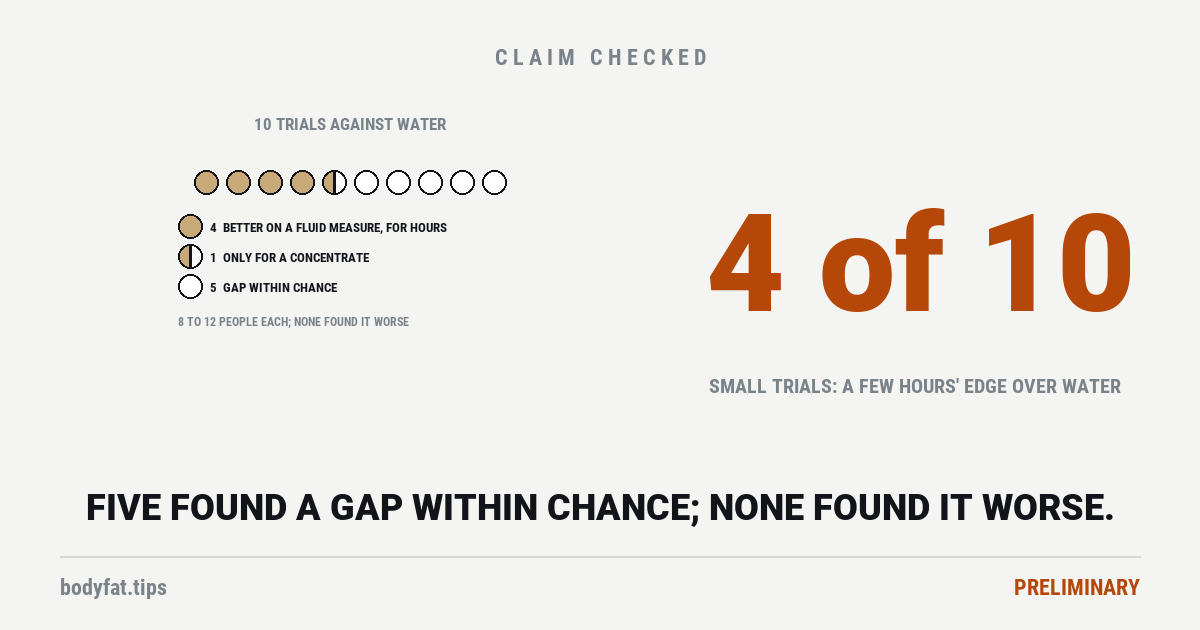
Of the ten trials we read that set coconut water against plain or flavoured water, four found it did significantly better on some measure of how much fluid people kept, meaning a gap big enough that chance is an unlikely explanation: three found less urine afterwards and two found more of the drink kept overall, one trial finding both. A fifth found an edge only for a coconut water made from concentrate, and five found no significant difference, a gap small enough that chance could explain it. None found coconut water significantly worse than water. The details, trial by trial, are below.
This is journalism, not medical advice. If you have kidney disease, or take a medicine that makes the body hold on to potassium, such as some blood-pressure drugs and some water pills, ask your clinician before drinking coconut water regularly [2]. A child who is vomiting or has diarrhoea needs oral rehydration solution, the salt-and-sugar drink made to a World Health Organization recipe, and medical care if they are vomiting again and again or drinking poorly [3].
Is coconut water more hydrating than water?
Most of the trials ran the same way. A handful of fit young people, mostly men, exercised until they had sweated off 1.4 to 3% of their body weight, about 2 to 5 lb for a 160-lb person by our arithmetic. Then, on different days and in random order, they drank coconut water, plain water or a sports drink, usually 1.2 to 1.5 times what they had lost, and the researchers collected their urine for the next two or three hours. Less urine means more of the drink stayed in the body [4] [5] [6].
| Trial | Who, and what they drank | What happened to the fluid |
|---|---|---|
| Malaysia, 2002 [4] | 8 men, after exercise in the heat; coconut water, a sports drink or plain water | Lost weight regained: 75% on coconut water, 73% on water, 80% on the sports drink; not significantly different |
| Malaysia, 2007 [5] | 10 men; coconut water, coconut water with salt added, a sports drink or plain water | Share of the drink kept after two hours: 65% on coconut water against 58% on water, significantly better by the paper’s results section, though its summary names only the salted coconut water and the sports drink; urine about 17 fl oz (514 mL) against 20 fl oz (591 mL), not significantly different; the salted coconut water (69%) and the sports drink (68%) also did significantly better than water |
| Costa Rica, 2011 [6] | 11 people, 5 of them women; coconut water, a sports drink or bottled water | Urine over three hours: about 13 fl oz (390 mL) after coconut water, 21 fl oz (625 mL) after water; 71% of the drink kept against 56%; the sports drink matched coconut water |
| United States, 2012 [7] | 12 men; a brand’s coconut water, coconut water from concentrate, a sports drink or bottled water | Fluid kept after three hours: about 40% on the coconut water and on the sports drink, 35% on water, 52% on the concentrate; only the concentrate against water was significant |
| Costa Rica, 2014 [8] | 12 people, 2 of them women; fresh coconut water, a potassium-rich drink, a sports drink or bottled water | Urine about 23 fl oz (686 mL) after coconut water and 30 fl oz (894 mL) after water, not significantly different; only the sports drink kept significantly more than water |
| Brazil, 2014 [9] | 8 men, who drank before cycling to exhaustion in the heat; coconut water, a flavoured drink or plain water | Urine about 5.4 fl oz (161 mL) after coconut water, 9.0 fl oz (267 mL) after the flavoured drink, 7.2 fl oz (214 mL) after water; lower than the flavoured drink, and than water by the paper’s text though not its table; overall fluid balance similar |
| United Kingdom, 2017 [10] | 10 men, who drank during an hour’s cycling and then as much as they liked | No significant difference in any hydration measure; free to choose, they drank about half as much coconut water as water |
| United States, 2018 [11] | 8 adults, 4 of them women; 68 fl oz (2 L) a day of coconut water or tap water, for four days each | Urine about 102 fl oz (3.03 L) a day on both |
| Canada, 2026 [12] | 8 people, 1 of them a woman; coconut water, a sports drink or flavoured water | Urine about 5.7 fl oz (170 mL) after coconut water, 9.5 fl oz (282 mL) after the sports drink and 18 fl oz (531 mL) after the flavoured water, by its results section (its summary prints 170 mL for the sports drink too); overall fluid status not significantly different |
| United Kingdom, 2026 [13] | 12 people, 5 of them women; coconut water, a salt-and-potassium drink or water, before and after cycling in the heat | No significant difference on any measure, body weight and body water included |
Four in favour, one more for a concentrate, five where the gap was within chance. A systematic review, a review that hunts for every trial on a question by a fixed method, published in 2025 for the international first-aid guidelines, searched to June 2022 and found four of these ten. It reported “no differences” between coconut water and water in urine, fluid balance or blood volume, and rated the certainty of that evidence very low to low [14], which means the true answer could well be different. A 2026 review of 16 studies, written with heat-exposed workers in mind, concluded that young coconut water “consistently contributes to the maintenance of hydration status” [15]. We read it only as its summary: its publisher’s page did not open for us, so we cannot say which studies it counted or how it judged them.
We also found conference abstracts and small studies in regional journals that we could not read in enough detail to count, and a registered basketball trial that has posted no results [16]. One more we did read and did not count: in a 2025 study in Côte d’Ivoire, 15 people drank 17 fl oz (500 mL) of mineral water one morning and coconut water, by the same procedure, on another, always in that order, and passed less urine over the next four hours after the coconut water. Its authors conclude that coconut water is the more hydrating, but they report no statistical test of the urine difference [17]. Our count is of the ten we read that tested the difference.
So: does coconut water hydrate you better than water? In some small trials, after hard sweating and a big drink, a little more of it stayed in for a few hours. In most, the gap was within chance. And in the trial on our list that tested ordinary life, four days of drinking 68 fl oz (2 L) a day, people passed the same amount of urine on coconut water as on tap water, about 102 fl oz (3.03 L) a day [11].
Coconut water vs sports drink
Six of the ten trials also tested a sports drink. Five reported the head-to-head, and in none of them were coconut water and the sports drink significantly different [4] [6] [7] [8] [12]. But on urine, in two trials the sports drink beat plain water and plain coconut water did not; in one of those, the 2007 trial, plain coconut water did beat water on the share of the drink kept, and coconut water with salt added did significantly better than water on both, as the sports drink did [5] [8].
Performance tells the same story. In the 2012 trial, men lasted about as long on a treadmill test to exhaustion on each drink: 11.9 minutes on water, 12.3 on the brand’s coconut water, 11.9 on the concentrate and 12.8 on the sports drink, none significantly different [7]. In a 2023 Australian trial, 19 experienced cyclists, 4 of them women, rode for 90 minutes and then a 20-km time trial (about 12.4 miles), drinking either a sports drink or a coconut-water drink with sugar and salt added to match it; no measure differed significantly [18]. The British trial found the same against water [10]. The one trial in our table that found a performance gain, the Brazilian one, gave coconut water with 11 g of sugar per 200 mL (about 7 fl oz) against water and a flavoured drink with almost none, and its authors themselves name the carbohydrate as a possible reason [9].
And in Mexico, a registered trial randomised adolescents in competitive endurance sport to coconut water or a commercial oral electrolyte drink, 17 to each, for four weekly training sessions. In the results posted on the registry record, fewer finished the fourth session dehydrated on coconut water, 1 against 9, with no significant difference in the other three, and the investigators concluded the two drinks had “the same effect” [19].
Who paid for these trials varies, and it matters. The 2012 trial was paid for by the coconut-water brand whose product it tested [7]; the Brazilian trial’s coconut water was donated by the soft-drink company that sells it [9]; the 2023 cyclists’ trial was funded by the company that developed its drink [18]. The 2011 and 2014 Costa Rican trials were funded by the sports-science institute of a sports-drink brand, alongside University of Costa Rica research projects: in 2011 the sports drink tested was that brand’s, and in 2014 the institute’s laboratory made up the sports drink and the potassium-rich drink [6] [8]. The 2002 and 2007 Malaysian, 2017 British and 2018 American trials name university or college money [4] [5] [10] [11]. The 2026 Canadian trial credits a university department and prints no conflict-of-interest statement in the copy we read; its sports drink was that same brand’s, and its senior author guest-edited the journal supplements the brand’s institute sponsored in 2019, 2021, 2022 and 2023, and declares honoraria from the institute in each, for writing the preface and, in the first three, for attending its expert panel as well [12] [20] [21] [22] [23]. It found coconut water and that drink not significantly different. One of the five authors of the 2026 British trial is director of science at a supplement company that sells a coconut-water-based electrolyte powder with added sodium and potassium; we could not read the trial’s funding statement, or find where its drinks came from [13].
The 2025 review graded the urine results of the 2002, 2007 and 2014 trials down for strongly suspected publication bias, the risk that unwelcome results go unpublished, with the note “Trial funded by industry”, without saying which trial it meant [14]. Of those three, only the 2014 trial’s own paper names industry money, so that is presumably the one (our inference) [4] [5] [8]. Across the ten, then: four had a drinks company paying for the trial or supplying the drink, two had an author tied to a drinks or supplement company, and four named university or college money alone. Whose drink each company sold matters. The sports-drink brand’s institute paid for the two Costa Rican trials, in which a sports drink of its brand’s, or made up in its laboratory, was one of the drinks tested: in 2011 coconut water matched that drink and beat water, and in 2014 that drink beat water and fresh coconut water did not [6] [8]. The coconut-water brand paid for the 2012 trial, which found an edge only for a concentrate [7], and the soft-drink company that sells the Brazilian trial’s coconut water supplied it to a trial that found less urine after it than after a flavoured drink [9].
Does coconut water have electrolytes?
Yes, and mostly one. Electrolytes are minerals that carry an electric charge in body fluids: sodium, potassium, chloride, magnesium. The main ones lost in sweat are sodium and chloride and, to a lesser extent, potassium [14]. Coconut water has it the other way round.
| Drink | Sodium | Potassium | Magnesium | Sugar |
|---|---|---|---|---|
| Packaged coconut water, unsweetened (USDA, 9 samples; 5 for sugar) [24] | 62 mg (26–125) | 396 mg (278–487) | 14 mg (7–24) | 9.4 g (5.8–13.2) |
| Liquid from a coconut (USDA, one sample, 1984) [25] | 252 mg | 600 mg | 60 mg | 6.3 g |
| Sports drink, typical (USDA survey entry) [26] | 94 mg | 36 mg | 0 mg | 12.6 g |
| Oral rehydration solution, WHO recipe [3] | 414 mg | 188 mg | – | 3.2 g of glucose |
Read down the sodium column. The oral rehydration solution doctors use for diarrhoea carries six to seven times the sodium of the average packaged coconut water, and a typical sports drink about half as much again as the coconut water, by our arithmetic. Coconut water wins on potassium, with about 11 times the sports drink’s [24] [26] [3].
One online pharmacy page in the results on 22 October 2026 calls coconut water “a nutritious and natural isotonic drink that closely resembles the composition of our body’s blood plasma” [1]. On the figure that matters most for fluid, it does not. Normal blood sodium is 135 to 145 milliequivalents per litre [27]; the coconut water in the Malaysian and Canadian trials measured about 5 and 7 in the same units [4] [12].
How much do products differ? A lot. Across the USDA’s nine analysed samples of packaged coconut water, sodium ran from 11 to 52 mg per 100 g, close to fivefold, and potassium from 116 to 203 [24]. In a Brazilian study, young coconuts held about 3 milliequivalents of sodium per litre and those past their eighth month 12.5 [28]. And in 2011 a US class action over the best-selling brand’s labels was filed after a testing firm reported fewer electrolytes in its samples than the labels claimed; the brand settled in 2012 [29].
How much magnesium is in coconut water?
About 14 mg in 8 fl oz of packaged coconut water, on the USDA’s analysed average, and between 7 and 24 mg across its samples [24]. The database’s older entry for liquid straight from the coconut gives 60 mg, but that rests on a single sample analysed in the 1980s [25]. The same goes for potassium. Google’s AI answer gives 470 to 600 mg a cup [1]; the top of that range matches the single 1980s sample, not the analysed average of 396 mg [25] [24].
Should you drink coconut water if you’re dehydrated?
After a sweaty workout, if you like it and are not in the potassium group above, it does the job: in the trials it rehydrated about as well as water [14]. For dehydration from diarrhoea or vomiting, which is also the answer to two searches people run, coconut water after vomiting and when sick, the drink is oral rehydration solution. The World Health Organization’s manual for treating diarrhoea lists green coconut water among the fluids without salt that can be given at home to stop a child becoming dehydrated, in the same list as plain water and unsweetened fruit juice; a child who already has signs of dehydration gets oral rehydration solution at a health facility [3]. The recipe matters: when glucose is absorbed it helps the gut take up sodium and water, and the manual says that without glucose the solution would be ineffective [3].
Coconut water’s medical reputation comes from cholera wards and tropical clinics. In a 1977 cholera epidemic on Tarawa, in what is now Kiribati, it was “used extensively in oral rehydration” [30], and an analysis of 51 local coconuts found enough potassium and sugar but too little sodium, chloride and bicarbonate, and suggested adding table salt [31]. In Surabaya, Indonesia, 86 children with cholera were given young coconut water to drink alongside intravenous fluid, not instead of it [32]. A 1980 Indonesian study gave children under five with diarrhoea and mild or moderate dehydration coconut water diluted by half with salt added, against a commercial oral electrolyte drink, and reported satisfactory results [33]. A 1992 study in Trinidad concluded that young coconut water could serve as a home rehydration drink early in mild diarrhoea, and that it “should not be used in patients with severe cholera, or in patients who are dehydrated and/or in whom renal function is impaired” [34]. We found no trial that compared plain coconut water with oral rehydration solution in children who were already dehydrated [16].
How much coconut water should I drink for hydration?
The trials do not give you a daily amount. They gave people 1.2 to 1.5 times the fluid they had sweated off, more than 2 litres (about 73 to 76 fl oz) in an hour in the 2012 trial, which is a recipe for recovering from one hard session, not a daily habit [4] [7] [12]. For everyday drinking, thirst is usually an adequate guide for healthy adults, as our verdict on how much water to drink a day sets out.
Coconut water’s limit is potassium, not water. One brand’s 10-oz bottle carries 677 mg [1]; four 8-oz cups of the USDA’s average carry about 1,600 mg, by our arithmetic [24]. Adults are advised to get about 2,600 mg a day (women) to 3,400 mg (men) from all food [2]. In adults with healthy kidneys, US experts found no evidence that high potassium intakes cause high blood potassium, and set no upper limit; with kidney disease or certain medicines, even ordinary amounts can build up [2].
Side effects of coconut water: the pros and cons
The serious one is potassium. Too much of it in the blood, hyperkalaemia, can upset the heartbeat and weaken the muscles; above 5.0 mmol/L counts as high [2]. A 42-year-old man who played tennis all day in heat above 90°F and drank eight 11-oz bottles of coconut water fainted, and was found to have a potassium of 7.8; he also had muscle breakdown and kidney injury from the day, needed a temporary pacemaker, and went home on the third day [35]. A man on dialysis who drank about 25 fl oz (750 mL) of raw coconut juice, as the report calls it, a day for three days was paralysed, with a potassium of 8.1 [36]. A 78-year-old with kidney failure, taking losartan and spironolactone, two drugs that hold on to potassium, drank a lot of king coconut water for a week and arrived with 7.02 [37]. These are single patients, not rates. The people at risk are the ones the US National Institutes of Health names: kidney disease, medicines including ACE inhibitors, angiotensin receptor blockers and potassium-sparing diuretics, and some other conditions, among them heart failure [2].
The other side of low salt: a 2024 report describes a newborn with seizures and a blood sodium of 113, attributed to the mother drinking large amounts of coconut water during labour [38]. Then the ordinary costs. Eight fl oz of the USDA’s average packaged coconut water carries about 9.4 g of sugar and 43 calories, by our arithmetic, and some bottles more [24]. And at big volumes it can sit badly, as the next section shows.
Does coconut water debloat you, or loosen your bowels?
In the trials on this page, the bloating recorded went the other way. Men who drank more than 2 litres of coconut water in an hour had more stomach upset three hours later than on water or the sports drink, and their bloating was slower to fade [7], although in the Malaysian trial it caused less nausea and fullness than water or the sports drink [4]. None of the ten reports bowel habits in the parts we read. A Canadian class action in 2012 alleged a mild laxative effect from large amounts [29]; that is a claim in a legal filing, not a measurement.
Is coconut water good after drinking alcohol?
We found no trial of coconut water for a hangover [16]. The nearest test is of water itself. In a 2026 Japanese trial, 13 men drank sake on two evenings, once with water between drinks and once without, and the water changed neither their breath alcohol nor how they felt the next day in any way the researchers could separate from chance; four of its authors worked for a drinks maker’s research laboratory [39]. A 2022 review of 21 placebo-controlled hangover trials included no coconut water and rated every result very low quality [40]. If you are short of fluid after drinking, coconut water is fluid; nothing we found shows it does more.
Is coconut water good for diabetics?
It is a sugary drink, if a mild one: about 9.4 g of sugar in 8 fl oz on the USDA’s average, against about 12.6 g in a typical sports drink [24] [26]. In the exercise trials, blood sugar rose more after coconut water than after plain water [4] [5]. In a small study published in a student research journal, 8.5 fl oz (250 mL) raised blood sugar by about 9 mg/dL on average, back to where it started within two hours, with a larger insulin rise in five people with prediabetes [41]. The online pharmacy page that says coconut water “has a low glycemic index” gives no measurement for it [1]. The one measurement we found comes from a study in Côte d’Ivoire, published in 2024 and not listed in PubMed: volunteers drank 750 to 900 mL (about 25 to 30 fl oz) of water from fresh 9-month-old coconuts of five varieties, and the glycaemic index, a score of how far a food raises blood sugar against the same amount of carbohydrate taken as pure glucose, came out at 40 to 46, which the authors class as low [42]. We read only its summary, which does not say how many people were tested. It tested no packaged coconut water and no one with diabetes, though it concludes that people with diabetes could drink it. The only study in people with diabetes we found and could read is small, and was not randomised: its authors call it quasi-experimental. In Indonesia in 2023, 10 people with type 2 diabetes drank 8.5 fl oz (250 mL) of young coconut water every afternoon for a week, and 10 others were given nothing. Average blood sugar in the coconut-water group fell from 281 to 173 mg/dL, while in the other group it rose from 300 to 327, a gap well clear of chance [43]. A fall that size in a week, from a drink with sugar in it, is a result we would want to see repeated before anyone relies on it, and the paper does not say whether the readings were taken fasting or what medicines people were taking. In university staff in Indonesia, most of them with normal blood sugar, a 2026 study that was not randomised either found fasting blood sugar in the 18 given young coconut water not significantly different from that of the 18 given plain water [44]. The other reports of coconut water lowering blood sugar that we read were in rats; the 2024 paper also cites a 2016 study of 20 people without diabetes as showing a lowering effect, which we could not find to read [16]. What whole fruit and juice do in diabetes is in our fruit sugar verdict.
What organ is coconut water good for?
The kidneys, for stones, perhaps. Two small studies found coconut water raised citrate in the urine, a substance that helps stop calcium stones forming: by 29% in 8 healthy adults drinking 2 litres a day for four days [11], and by about 274 mg a day in 6 who drank it for a week [45]. Neither counted kidney stones, and we found no controlled study of drinking coconut water that did [16]. A one-page 1987 report from the Philippines on “bukolysis”, young coconut water used to flush urinary stones, is indexed with no summary, and we could not read it to say what was done or counted [16]. And failing kidneys are where coconut water’s potassium becomes a danger [2].
The gut, in one trial. In India, 95 people with mild to moderate ulcerative colitis, a bowel inflammation, drank 400 mL (13.5 fl oz) of coconut water or a placebo drink every day for eight weeks alongside their usual treatment. More of those on coconut water went into remission, 53% against 28%, and none developed high potassium [46]. That is one trial, in one disease, and we read it only as its summary.
The heart and blood pressure, faintly. More potassium lowers blood pressure, most in people whose pressure is high, as our blood pressure verdict sets out. Coconut water’s own trials are tiny. In Trinidad, 28 people with high blood pressure were split into four groups for two weeks, and 71% of the coconut-water group had a significant fall in their top number [47]. An Indonesian study gave 150 mL (5 fl oz) a day for a week to 15 people, all women, and compared them with 15 mostly men, who were not allocated at random [48]. In a trial that randomised 32 Indonesian women to 600 mL (20 fl oz) of coconut water a day or the same amount of water, for two weeks, potassium in the blood was not significantly different between the groups at the end [49]. More small Indonesian studies of blood pressure exist that we found by title and did not read [16].
The skin, untried. We found no trial of drinking coconut water for skin; the skin study we found was in rats [16].
Coconut water benefits for women and for men
Nothing on this page shows a benefit for one sex that it does not show for the other. Five of the ten hydration trials enrolled only men; the other five included some women, 17 of the 99 people in all, by our count; none reported hydration results for women separately [4] [5] [6] [7] [9] [10] [11] [12] [13] [14]. For pregnancy, see the newborn case above [38].
Is it OK to drink coconut water every day?
For most healthy adults, a glass a day is a modest share of the potassium they are advised to get [24] [2]. In trials, people with ulcerative colitis drank 400 mL a day for eight weeks with no case of high potassium [46], and healthy adults drank 2 litres a day for four days [11] and 600 mL a day for two weeks [49]. With kidney disease or potassium-holding medicines, it is a question for your clinician [2].
Why is some coconut water refrigerated?
Because coconut water spoils fast once it is out of the shell; a 2025 review of its processing calls it highly perishable, and the gentler treatments it describes, which avoid full heat pasteurisation, give shelf lives of about five to seven weeks in the fridge [50]. One brand says its coconut water, never heat-treated, can turn pink as it ages [1]. The cold-storage label matters. In Denmark a 69-year-old man died after drinking from a ready-to-drink husked coconut that was meant to be kept at 39 to 41°F (4 to 5°C) and had sat on his kitchen table for a month; it tasted foul, he swallowed only a little, and a fungus growing in it had made a toxin [51].
If it isn’t more hydrating than water, why did a few trials find it kept more?
This section is the desk’s own reasoning, and it is labelled as such. Four trials found coconut water did significantly better than water on some fluid measure, one more found it for a concentrate only, five found a gap within chance, and none found it significantly worse than water. Here are three ways to read that, each rated.
Answer one: a drink with enough sodium in it stays in a little longer than plain water. Our electrolytes verdict reports four trials of the beverage hydration index, in hydrated people at rest, in which drinks with more sodium cut urine output against water or less salty drinks over two to four hours, and in two of them a sports drink did not beat water. In the Malaysian trial, adding salt to coconut water lifted it to the sports drink’s result [5]. That is measured, for other drinks at rest and once for salted coconut water after exercise. That it explains coconut water’s small edge is our inference. A weak one, too: plain coconut water carries less sodium than a typical sports drink [4] [24] [26], and a sports drink did not always beat water.
Answer two: the trials made people drink a lot, fast. They gave 1.2 to 1.5 times the fluid lost, more than 2 litres in an hour in the 2012 trial [7]. With that much plain water the kidneys pass the surplus, so anything that slows the flush a little shows up as less urine for a few hours. Over four days of ordinary drinking, urine was the same [11]. The set-ups are measured. The explanation is a surmise.
Answer three: taste cuts both ways. Coconut water caused less nausea and fullness than water in one trial [4], more stomach upset in another [7], and when cyclists could drink as they liked, they drank about half as much of it as of water [10]. Each of those is measured. That in daily life how much you drink matters more than what is in it is a hunch, with that one trial on its side.
Put the three together and here is what we think is true, stated plainly so you can disagree with it: coconut water is a pleasant way to drink water with sugar and potassium in it; in the trials it hydrated about like water, sometimes slightly better for a few hours after a hard sweat, and it does not put back the salt that sweat or a stomach bug takes out.
What we could not find, and would like to: a trial that measured coconut water on the beverage hydration index, the four-hour urine test our caffeine verdict describes, against water and a sports drink, in women and older adults as well as young men, independently funded and registered in advance [16]. If you know of one, the corrections line on this site is open.
Where coconut water’s sports-drink reputation came from
The research came first, and from the tropics. Coconut water was used to rehydrate people in a cholera epidemic in the Pacific [30], and in emergencies it has even been dripped into a vein [52]. In 2002 a Malaysian team gave eight men coconut water after sweating in the heat, found it rehydrated them about as well as a sports drink or plain water, and concluded it “could be used for whole body rehydration after exercise” [4].
The packaging went further. By 2011 the labels of the best-selling US brand called coconut water “super hydrating” and “mega electrolyte”, with “more electrolytes than the leading sports drink with 15 times the potassium”, as a Canadian class action quoted them in 2012 [29]. A US class action filed in 2011, after a testing firm reported fewer electrolytes in samples than the labels claimed, was settled by the brand in February 2012 for $10 million, with a promise to change its packaging [29]. In January 2012, weeks before the settlement, a trial paid for by the same brand was published, finding that its coconut water, a sports drink and bottled water rehydrated men about the same [7].
We could not trace who first said coconut water is more hydrating than water [16]. Today the idea travels through sellers. In Google’s results on 22 October 2026, the AI answer for “benefits of drinking coconut water” cites a diabetic-supply seller whose page calls it “The perfect drink”, an Indian online pharmacy saying it “closely resembles the composition of our body’s blood plasma”, and a coconut-water brand’s own page; for “is coconut water good for hydration” it cites a breastfeeding-supplement seller that calls coconut water “nature’s ultimate hydration hero” and sells a coconut-water electrolyte mix [1].
The twist is that the hydration answer itself, drawing on a hospital’s page, says coconut water “is no more hydrating than plain water for everyday needs”, and the coconut-water brand cited by the benefits answer says on its own page that “Plain water remains the everyday standard”, while advertising 677 mg of potassium a bottle [1]. The claim has outlived its labels.
None of this is aimed at anyone who reaches for coconut water after a run because they like it. It is a decent drink. It is the “more hydrating than water” and the “blood plasma” that the evidence does not carry.
What this is rated, and what the rating covers
Preliminary — for the claim that coconut water hydrates you better than water.
It is rated Preliminary because the evidence for it is small and conflicting. In 4 of the 10 trials we read, coconut water did significantly better than plain or flavoured water on some measure of the fluid people kept: less urine in three [6] [9] [12], and more of the drink kept overall in two, one of them the same trial [5] [6]. A fifth found that for a from-concentrate version only [7]; five found a gap within chance, including the four days of ordinary drinking [4] [8] [10] [11] [13]. None found it significantly worse. The 2025 systematic review of four of them found “no differences”, at very low to low certainty [14]. The trials had 8 to 12 people each, were mostly of young men, and lasted hours, not weeks.
Why not Unsupported, the rating for a claim that was tested and did not hold up? Because two of the trials found coconut water ahead on the fuller measure, how much of the drink the body kept overall, not only on urine over a few hours [5] [6], and none found it behind. Why no higher? Because in most of the trials ordinary coconut water showed no edge that could be separated from chance, the 2025 systematic review graded its answer very low to low certainty [14], the ten trials held 99 people between them, and in the one trial in our table that tested ordinary drinking, urine was the same on both [11]. A larger trial, registered in advance and independently funded, would settle it either way.
Each narrower claim, rated alone, in words. That coconut water hydrates you about as well as water: Supported, after exercise in young, mostly male volunteers drinking set amounts; none of the ten found it significantly worse [14] [11], though when people could drink as they liked, they drank less of it [10], and the 2025 review graded the certainty of the four it covered very low to low [14].
That it does as well as a sports drink: Preliminary. The five trials that reported the comparison found no significant gap, but in two the sports drink cut urine against water and plain coconut water did not [5] [8].
That it can stand in for oral rehydration solution: Unsupported, of the untested kind. We found no trial that compared plain coconut water with the solution in dehydrated children, and nothing tested that favours it there; what was tested was its use early in mild diarrhoea, alongside intravenous fluid, or diluted with salt added to bring it nearer the recipe [34] [32] [33], and its sodium is a fraction of the WHO recipe’s [3] [24].
That it lowers blood pressure: Preliminary, from tiny studies [47] [48]. That it prevents kidney stones: Preliminary, from urine chemistry in 14 people and no count of stones [11] [45]. That it lowers blood sugar or suits people with diabetes: Preliminary, because the one study we could read in people with diabetes is small, short and not randomised, and reports a fall that needs repeating [43]; in people without diabetes a drink of it raised blood sugar a little, as a sugary drink does, and a course of it did not lower fasting blood sugar significantly against plain water [4] [5] [41] [44]; the rest of the support is from rats [16]. Hangovers and skin are not rated here: we found no trial in people testing the claims made for either [16].
What is not rated here: the ulcerative colitis result, which is one trial; and the frame in the section above, which is this desk’s reasoning from the evidence rather than a result the evidence delivered. It is marked as ours so that you can weigh it as ours.
This is journalism, not medical advice. If you have kidney disease or take a medicine that holds on to potassium, talk to your clinician before making coconut water a habit, and for a child with diarrhoea or vomiting, use oral rehydration solution and get medical help if they cannot keep fluids down. How we read a study, and what each tier means, is set out here.