Does Creatine Help You Lose Weight? No — And It Will Move Your Scale the Wrong Way

No. And it will make your scale go up while you are trying to make it go down, which is a genuinely annoying combination if nobody warned you.
Here is what actually happens, and why it does not mean what the number suggests.
What creatine does to the scale during a cut
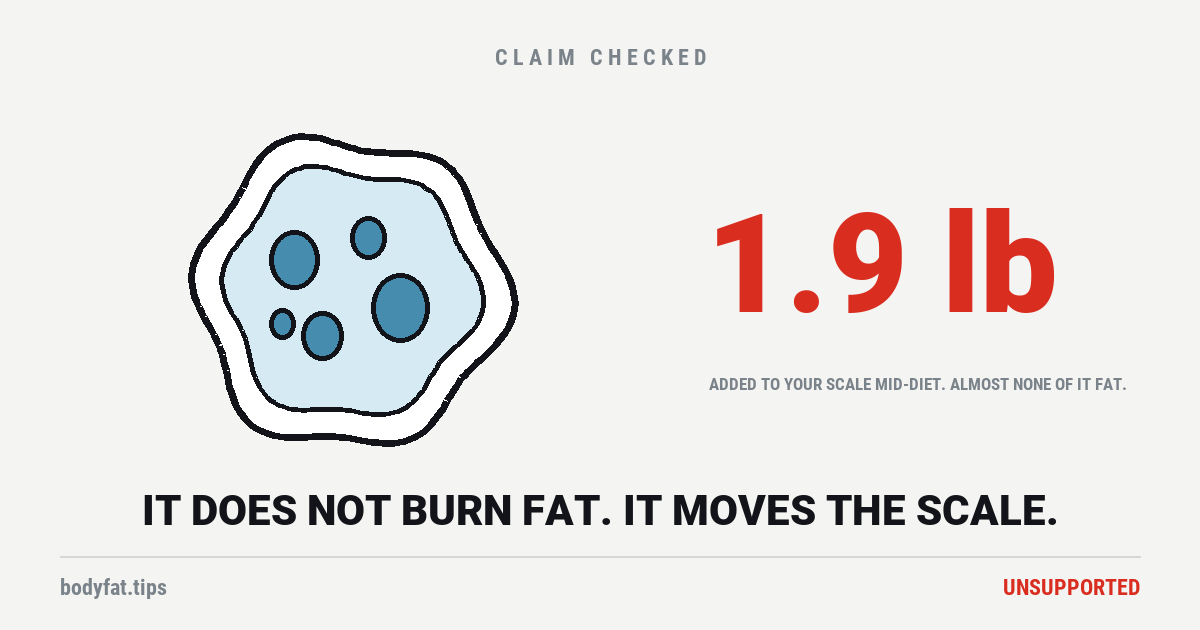
Pool 143 randomised trials and creatine adds about 1.9 lb of body mass. Almost all of it — 1.8 lb — is fat-free mass, a large part of that being water that arrives with the creatine. [1]
So if you start creatine in week one of a diet, the scale can sit still or rise for a fortnight while you are in a genuine calorie deficit. Nothing has gone wrong. You have added roughly two pounds of not-fat on top of whatever fat you are losing — trials from one week to two years have not found that creatine adds fat [4] — and the two are moving in opposite directions at the same time.
We covered what that weight is made of, in detail and with the water measurements, in its own verdict. This page is about the practical problem it creates.
Does it burn fat? Two analyses, two answers
This is where we have to be careful, because the two best recent pooled analyses do not agree — and the honest thing is to show you both.
| Analysis | What it pooled | Fat mass |
| 143 trials | protocols with or without training |
no change body fat % −0.3 pts |
| 12 trials | resistance training required, adults under 50 |
−1.6 lb body fat % −0.9 pts |
The larger one screened 4,831 studies and pooled 143 randomised trials. Fat mass was calculated from 62 separate comparisons and did not move: 0.05 kg, with a range of plausible answers that comfortably includes zero. Body fat percentage, from 89 comparisons, fell by 0.28 of a point — statistically real, and about a quarter of one percentage point in practice. And the heterogeneity statistic — which measures how much the individual trials disagreed with each other — came out at 0%, meaning they did not disagree at all. [1] On fat mass, that is about as clean a null as this field produces.
The smaller one restricted itself to trials that paired creatine with resistance training, in adults under 50, with the analysis plan registered before the work started. It found fat mass down by 0.73 kg — about 1.6 lb — and body fat percentage down 0.88 points. [2]
You can see the difference in what they included; it is stated in their own titles. One pooled creatine protocols with or without any training attached. The other required resistance training.
The obvious hypothesis is that requiring resistance training is what produced the fat loss. The larger paper lets you check that: it split its own trials by exercise type, and in the 40 comparisons that paired creatine with resistance training, fat mass did not move either (+0.09 kg, a range of −0.30 to +0.48), nor did body fat percentage in the 43 that measured it (−0.02 of a point). Its own quarter-point drop in body fat percentage came from the trials the paper classes as combined training, not from the resistance-training ones. [1] So the restriction alone does not explain the gap. Which trials each paper admitted, and how those trials measured fat, would be the next place to look. Two analyses of overlapping literature reached different answers, the bigger one found nothing on fat mass, and that is the current state of play.
Either way, notice the size of the thing being argued about. The optimistic reading is one and a half pounds of fat over a training block. Nobody is dieting on that.
So should you take it while dieting?
That is your call, and here is the information it turns on.
Creatine is not a fat-loss agent. Nothing in either analysis suggests it removes fat in any amount that would change how a diet feels or how long it takes. If you are taking it hoping to accelerate a cut, the evidence does not support that.
What it does reliably do is add lean mass and strength when paired with resistance training — around two and a half pounds of lean mass in adults under fifty. That effect is not suspended because you are eating less.
And it will cost you about two pounds on the scale that is not fat. If you weigh yourself daily and take that number personally, starting creatine in the same week as a diet is a recipe for concluding that the diet is not working when it is.
A simple fix, if you want one: start creatine either well before a diet or well into it, so the one-off water shift does not land in the middle of the period you are judging your progress by. And judge progress over weeks rather than days.
The thing that is not in dispute
A tape measure and a mirror do not care about water weight. The scale does. During a phase when your weight is deliberately moving, adding a compound that puts about two pounds on you, much of it water — spread through the body in the same proportions as before, not pooled in the muscle [3] — makes the scale a worse instrument than it already was.
That is not an argument against creatine. It is an argument for not letting one number referee a process it cannot see.
The verdict
Creatine does not help you lose weight, and the claim that it burns fat is not supported. The largest pooled analysis — 143 trials, with the individual studies in complete agreement — found no change in fat mass and a drop in body fat percentage of about a quarter of a point. A smaller analysis restricted to training studies found about 1.6 lb less fat mass, which is worth knowing and is not a fat-loss strategy.
What it will do is put roughly two pounds on your scale that are not fat, at the exact moment you are watching that scale most closely.
If you want creatine for what it is actually good at, that is a different question with a much better answer — muscle and strength, where it is one of only two supplements out of 250 screened that survived a proper evidence check.
Related: does creatine make you gain weight · creatine benefits · how much creatine should you take · is creatine safe · best supplements for muscle growth
Corrected on 15 September 2026 after an independent editorial review. The evidence panel’s funding field said the sources stated nothing; all four carry declarations, three of them naming creatine companies, and the field now reports them. The page said the 143-trial analysis found no change in fat mass or body fat percentage; it found no change in fat mass (0.05 kg) and a small, statistically real drop in body fat percentage of 0.28 of a point, and the body, the verdict, the table and the provenance chain now say so. And the page said neither analysis had tested whether requiring resistance training explains their disagreement; the larger one had, and in its resistance-training-only comparisons neither fat mass (+0.09 kg) nor body fat percentage (−0.02 of a point) moved, which the page now reports.
Also changed: the page said creatine puts two pounds of water “into your muscles”; its own fluid-distribution study found total body water rose with no shift toward the inside of the cell, and the wording and the provenance chain now match it. Two listed sources are now cited where the text relies on them, and a stray “2012” on the last provenance step, left over from an earlier version of this page, has been removed. For the record: this page was first published in June 2024 and was rebuilt around the two 2024 meta-analyses on 5 August 2026; the date shown at the top is the original one. The rating, Unsupported, is unchanged.
- Protein for Fat Loss: It Works — For Most Dieters, Your Target Is a Third Too High
supported - Caffeine Before a Workout: 21 Meta-Analyses Say It Works. And Your Daily Coffee Habit Does Not Blunt It.
established - Lion’s Mane: The Trial Everyone Cites Had Fifteen People Per Group. Four Weeks After They Stopped, It Was Gone.
preliminary