How Much Creatine Should You Take? 3 To 5 Grams — And You’re Already Most Of The Way There

Three to five grams a day. That is the answer, you can stop reading, and nothing below will change it.
But the number is the least interesting part of this question, and if you have ever wondered why creatine seems to do a lot for your training partner and not much for you, the reason is on this page.
Start with the fact almost nobody leads with
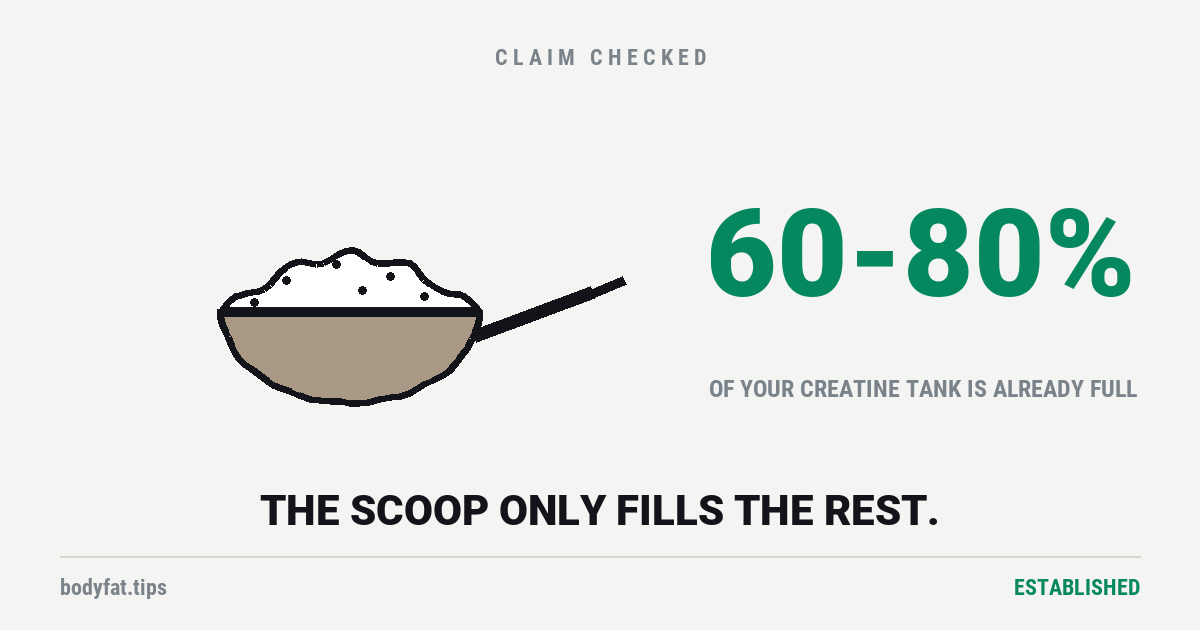
You are not empty. You are already most of the way full.
A normal diet contains one to two grams of creatine a day — it is in meat and fish — and on that intake, according to the muscle biopsy literature summarised in the sports nutrition position stand, your muscle creatine stores are already about 60 to 80% saturated [1].
ISSN position stand, 2017
Supplementing raises muscle creatine by 20 to 40% [1]. That gap — the top slice of the tank — is the entire product. Everything creatine has been shown to do for your muscles happens inside it.
Which immediately tells you something the dosing charts do not: the answer to “how much should I take” depends far less on your body than on how much room you had left.
The same dose, six times the result
In 2004 two researchers did something unusual. Rather than ask eleven men how they felt on creatine, they took muscle biopsies before and after an identical five-day load and looked [3].
Same dose for their size — 0.3 g per kilogram of body weight a day, which works out at about 21 g for a 154 lb (70 kg) man [3]. Same schedule. Same five days. Here is what came back.
Three men were responders, gaining 29.5 mmol/kg of muscle creatine. Five were quasi-responders at 14.9. Three were non-responders, gaining 5.1 [3]. Top group to bottom group: roughly a six-fold difference, on the same tub of powder.
So what separated them? Mostly the thing this page opened with. The responders started with the lowest muscle creatine — they had the most room. They also had more type II fibres, the fast ones that do the explosive work, larger fibres, and more fat-free mass. The non-responders came in with fuller tanks, and over those five days their one-rep-max did not improve at all [3].
The authors put it carefully: “a favorable preexisting biological profile may determine the final extent to which an individual responds” [3].
Now the caveat, because it is a big one: eleven men, split three ways. Three people in a group is not a group, it is an anecdote with a biopsy needle. What makes this worth reporting anyway is that it measured the thing directly instead of inferring it, and the direction matches the physiology — a tank that is fuller has less room. Treat it as a well-evidenced explanation, not a precise proportion.
So do you need a loading phase?
No. It changes how fast you arrive, not where you end up.
The position stand calls loading — 5 grams four times a day for five to seven days — “the most effective way to increase muscle creatine stores” [1]. That sentence gets quoted constantly. Three lines later the same document offers the alternative: “ingest 3 g/day of creatine monohydrate for 28 days” [1]. The sentence after that names the price of the slow road: it “would only result in a gradual increase in muscle creatine content compared to the more rapid loading method and may therefore have less effect on exercise performance and/or training adaptations until creatine stores are fully saturated” [1].
And once the tank is full, that alternative is not a compromise. It comes from a 1996 study that measured muscle creatine directly and found 3 grams a day for 28 days produced the same roughly 20% rise as 20 grams a day for six [2]. Same destination. Slower road.
“Most effective” is true about speed, and the document says as much in its next breath. We used to add that a misreading of the phrase is what put loading instructions on the tub. We could not trace that, and the dates run against it, because loading led from the start. A 1992 biopsy study raised muscle creatine by giving 5 g four or six times a day [6], and the 1996 paper’s own conclusion opens with “a rapid way to ‘creatine load’ human skeletal muscle” before it gets to 3 g a day [2].
Does loading cost you anything on the scale? Not in the end. In a 2024 pooling of 143 trials, how much weight creatine added did not depend on whether people loaded [7]. What loading changes is when the weight arrives, and that part is our reasoning rather than a measurement: loading fills the tank in about a week and 3 g a day takes about four [2], and the 1996 authors put the early weight down to water the body holds on to as the creatine goes in [2]. We take the scale apart on our creatine and weight gain verdict.
If you are vegetarian or vegan — the honest version
You will have read that vegetarians respond best to creatine. The logic is sound: creatine comes from meat and fish, so if you eat neither you start lower down the tank and have more room to fill.
It has been tested, more than once. The best trial so far ran in 2003, and the newest trial’s own authors call it “the best example of a rigorously controlled randomized trial” on the question to date [4]. It took 18 vegetarians and 24 meat-eaters, men and women aged 19 to 55, and randomised them, double-blind, to creatine or a placebo through eight weeks of weight training [8][9]. The vegetarians on creatine ended up with a bigger rise in muscle creatine and phosphocreatine, more lean tissue (muscle and everything else that is not fat or bone) and more total work in their exercise tests than the meat-eaters on creatine [8].
A 2020 review of nine studies found creatine raised strength, muscular endurance and sprint power in vegetarians. But it said the studies “were mixed” on whether creatine improves vegetarians’ performance more than meat-eaters’, and it rated only one of the nine at low risk of bias — its measure of how far a study’s design could have tilted the result [9].
The newest trial, from 2025, is smaller and shorter. Fifteen healthy vegans and vegetarians, randomised and double-blinded, took either creatine or a matched placebo for a week, with no training added [4].
The filling part worked, and worked hard. Muscle creatine rose 18.8 mmol/kg. Total muscle creatine rose 30.8. Body mass went up 3.4 lb (1.56 kg) and fat-free mass 2.5 lb (1.15 kg). The placebo group moved on none of it [4].
Then they measured whether any of it did anything. Phosphocreatine — the stored form your muscles actually spend during a hard effort — did not change, though the authors say that may be the biopsy’s doing: the procedure itself can break phosphocreatine down before it is measured. And peak and mean power across repeated sprints did not change either [4].
Seven people took the creatine. Seven. A trial that small can miss a real effect easily, and the authors are not claiming creatine does nothing for vegetarians. But over seven days, without training, it went looking for a sprint benefit and did not find one. It was sized to detect a change in muscle creatine, not in sprint power; its authors calculate the sprint result would have needed 23 people. And it had no meat-eaters to compare against, which they list as a limitation, while its creatine group’s starting level, they note, “resembles that previously reported for omnivores” [4].
The tank filled. Within a week and without training, the tap did not obviously run faster; over eight weeks of lifting, in the 2003 trial, it did, and by more for the vegetarians [8]. The 2025 authors read the two together: creatine “may provide a small benefit in isolation”, and resistance training is what amplifies it [4]. That is a more interesting result than the version you usually get, and we would rather hand it to you straight.
Who wrote the dosing advice, and why that is worth knowing
Nearly every number in this article’s first half traces to one document: the 2017 position stand from the International Society of Sports Nutrition. It is careful, comprehensive and heavily cited.
It also contains a competing-interests statement that essentially nobody who cites it repeats.
Its lead author co-founded the ISSN, holds industry-funded grants to research creatine, works as a scientific and legal consultant, and advises a supplement company. And in his own words, he “prepared this position stand update at the request of the Council for Responsible Nutrition and ISSN” [1]. The Council for Responsible Nutrition is the supplement industry’s trade association, and the paper’s funding line is plainer still: “Support to prepare this manuscript was provided by the Council for Responsible Nutrition” [1].
Seven of its ten authors declare industry ties. Co-authors disclose advisory roles with companies that sell creatine, royalties from sports nutrition products, expert-witness work, and patent applications in the field; one is chief science officer for Post Active Nutrition, and another is chief executive of Vitargo Global Sciences, which sells a carbohydrate product [1].
So does that mean the doses are wrong? No — and this is the part that matters. The 3 grams a day figure comes from Hultman’s 1996 muscle-biopsy work, published two decades earlier by a different group [2]. We used to add “with no such ties”. We had not checked, and it was not so. The paper itself carries no funding or interest statement, which was normal in 1996. The patent records say more. Its first author was one of two named inventors on a patent first filed in Britain in July 1992, covering a daily dose of at least 0.2 g of creatine per kilogram of body weight, at least 15 g for a 154 lb (70 kg) person, taken for two to seven days: the loading protocol [10]. And by the time the paper appeared, its first and senior authors were among four named inventors on an application, later granted as a patent held by the University of Nottingham, for taking creatine with carbohydrate [11].
The finding that body composition does not depend on whether you loaded comes from a 2024 meta-analysis of 143 trials, which found the gains held with a daily maintenance dose whether or not people loaded first [7]. That is secondary research, not the independent primary research we first called it. It was funded by an Iranian university research institute, it appeared in the ISSN’s own journal, and one of the four researchers who supervised it is a co-author of the position stand who sits on the scientific advisory board of a creatine manufacturer [7].
So nobody in this chain is free of interests. The number survives anyway, because two different kinds of evidence point the same way: biopsies that measured the muscle directly, and pooled trials that measured what people actually gained.
What the disclosures should change is how you read the framing rather than the arithmetic. Which protocol a document puts first is a choice. The amounts underneath are what the biopsies measured.
We report funding on every page. This is why.
How do you know if you are a non-responder?
You almost certainly cannot. And the reason is worth having, because it tells you what to do instead.
“Responder” and “non-responder” are not descriptions of how the stuff felt. They are thresholds. In the study above, a responder was defined as someone whose muscle creatine rose by more than 20 mmol per kilogram of dry muscle over the five days, and a non-responder as someone whose rose by less than 10 [3].
Those numbers come out of a needle in your thigh. There is no version of that measurement available at home, at a gym, or from a blood test.
About that “non-responder percentage”
People go looking for the figure. There is not one.
The number in circulation traces back to two tiny biopsy studies. One is the eleven men above: three responders, five in the middle, three non-responders [3]. Three out of eleven is 27%, and 27% is roughly what gets quoted. The other, from 1994, gave eight volunteers 20 g a day for five days, and in three of them muscle creatine rose only 5 to 7% [12]. A 2026 review still cites exactly those two for its “20–30%” [13].
It is not a rate. It is six people. Eleven young men at one Canadian university, average age 22.7, and eight volunteers in a 1994 study, all loaded for five days [3][12]. Nobody has since run the study at a size that would turn that fraction into a population figure.
So when a page tells you “around 20 to 30% of people are non-responders,” what it is doing is reporting six people as though they were a survey. The honest version is that non-response is real, it has been measured directly, and how common it is remains an open question.
The tests people use instead, and what they are worth
| What you check | What the 2004 study found | Worth to you |
| Strength going up | Responders improved their one-rep-max leg press over the five days. Non-responders showed no improvement in one-rep-max at all. | The best signal available — and still a group finding, over five days, in eleven men. |
| The scale | Body mass was measured before and after. The published summary does not break the change out by response group. | UNKNOWN. We will not invent a threshold. |
| How you feel | Not measured. | Nothing. |
The third row is the one to sit with. Nobody in that study was asked whether the creatine felt like it was working, so the most popular test in the world has never been checked against the only measurement that defines the categories.
Is it genetic?
Possibly, in part, and the evidence is thin enough that the interesting thing is what it does not license.
In 2024 a researcher genotyped 161 professional male footballers whose clubs’ medical staff had them take five days of loading and seven weeks of maintenance, and found that variant frequencies at two genes — ACE and AMPD1 — differed between the players who gained muscle mass and the ones who did not [5].
Now the caveats, and there are several, because this is precisely the kind of finding that becomes a consumer DNA test.
It is one of two small studies, and our PubMed search on 18 September 2026 found no third. The author sets out to analyse the question “for the first time”; a 2014 trial that randomised 21 footballers in Russia to creatine or a placebo had already reported their response varying with the same AMPD1 gene, though it measured fitness rather than muscle [14]. The 2024 study had no placebo group, and it estimated muscle mass from body measurements with a formula rather than measuring it directly [5]. The participants are professional male footballers, which is close to the least representative group you could pick. The headline result runs on a composite score the study built itself out of six gene variants, with a cut-off of 54.16 drawn from the same data it is then used to split. And the finding is reported as an odds ratio — a number that compares the chances between two groups without telling you what either chance was [5].
Here is what settles it regardless of how the science lands. Even if the genetics turns out to be real, there is no test you could take that would change what you should do. The dose is three to five grams either way. Finding out by trying costs you a few dollars of powder and a month of your life. Anything sold to tell you in advance is charging considerably more than that, on the strength of two small studies of footballers.
Before you decide it is not working
1. Give it the four weeks. At three to five grams a day you are filling the tank slowly on purpose. The 1996 study needed 28 days to reach the same place a loading dose reached in six [2]. Two weeks in, you are not a non-responder. You are early.
2. Check you are still taking it. Stop, and your muscle creatine drains back toward where it started. In the 1996 study, a month after the last dose it was close enough to the starting level that the study could no longer tell the two apart, and the position stand puts the usual return at four to six weeks [2][1]. It is a standing order, not a course of treatment.
3. Check what you were expecting. Creatine has not been shown to burn fat, and it puts about two pounds on the scale that are not fat. If the disappointment is that the scale moved the wrong way, that is the thing working exactly as documented.
4. Consider how much room you had. This one is our reasoning rather than a finding, so weigh it as such. The responders were the men who started with the lowest muscle creatine [3]. A normal diet already gets you to somewhere between 60 and 80% full, and the creatine in that diet comes from meat and fish [1]. Put those together and the person with least to gain is the one already eating plenty of both — while the person with most to gain is a vegetarian. That part has been put to the test: in the 2003 trial, vegetarians on creatine gained more muscle creatine and more lean tissue than meat-eaters on creatine [8]. The 2025 trial could not test it; it had no meat-eaters [4].
Which leaves the answer that nobody selling you anything is going to offer: if creatine is doing very little for you, the most likely reason is that it had very little to do. You were already most of the way full.
That is not a failure of the supplement, and it is certainly not a failure of yours. It is the tank at the top of this page, applied to one person. And it is the reason the honest dose is small and the honest expectation is modest — which is roughly the opposite of how the category is sold.
What to actually do
Three to five grams a day, of plain monohydrate, every day. That is the whole protocol. Larger people sit at the top of that range; the position stand notes some larger athletes may need 5 to 10 g/day to hold saturation [1].
Skip loading unless you have a reason to be in a hurry. Four weeks at 3 g gets you to the same place [2]. If you have a competition in ten days, load; otherwise the only thing you are buying is impatience.
Take it with food. Creatine taken with carbohydrate, or carbohydrate and protein, is retained more consistently [1]. In one of the trials behind that line, each 5 g dose came with either 96 g of carbohydrate or 50 g of protein plus 47 g of carbohydrate, and 50 g of carbohydrate on its own raised insulin, the hormone that helps muscle take creatine up, by less than either [15]. Think a proper meal, not a snack.
Every day, not just training days. You are topping up a reservoir, not fuelling a session. Stop entirely and it drains back to about where you started over four to six weeks [1][2].
And if it does nothing for you, that is a documented outcome, not a failure of discipline. Some people start close to full. The biopsy study found them [3]. Give it a couple of months and judge honestly; if nothing moves, you may simply have had less room than the person who recommended it to you.
One thing we are not doing on this page is telling you what is right for your body. We report what the research measured. Anyone with kidney disease, anyone pregnant, and anyone on medication should be asking a clinician rather than a website — though our safety verdict covers why the blood test that panics people is usually a false alarm.
The rest of the cluster: whether it helps you burn fat, what it does to the scale, and whether it costs you your hair.
An independent editorial review on 18 September 2026 found that this page misstated the evidence for vegetarians and credited its dosing sources with an independence they do not have. We called a one-week 2025 trial “the trial that exists” and said it found that vegetarians had the most to gain, though it had no meat-eaters to compare them with. Its own authors point to a 2003 eight-week trial in which vegetarians on creatine gained more muscle creatine, lean tissue and work than meat-eaters on creatine, and a 2020 review of nine studies found creatine helped vegetarians while the evidence on whether it helps them more was mixed; both are now on the page. We said the 1996 dosing study came from a group “with no such ties”, which we had never checked. Patent records show its first author was a named inventor on a patent, first filed in 1992, covering the loading dose, and that by the time the paper appeared its first and senior authors were inventors on an application for taking creatine with carbohydrate. And the 2024 meta-analysis we called “independent primary research” is a secondary analysis, published in the ISSN’s own journal and co-supervised by a position-stand author who sits on a creatine manufacturer’s advisory board.
The funding disclosures were incomplete, and several smaller claims went further than their sources. The Council for Responsible Nutrition paid for the position stand, not only asked for it; seven of its ten authors declare industry ties, and its co-authors hold patent applications, not patents. The genotyping study’s MAPFRE Foundation grant was missing, and its author’s second affiliation is a company whose website, as archived in 2024, named him co-founder and sold a genetic test for athletes. The “20–30%” non-responder figure traces to two tiny studies, not one, and the genetic link to two, not one. We said loading is what produces the sudden weight jump; the pooled trials found the weight gained did not depend on loading, and that loading changes only when it arrives is our reasoning, now labelled as such. We could not trace our claim that the position stand’s wording put loading instructions on tubs, and the dates run against it, so it is gone. We also corrected the washout time, the dose in the 2004 study, “any meal will do”, and a sentence that overlooked creatine in the brain. The rating is unchanged: Established. Three to five grams a day, with loading optional, is what both the biopsies and the pooled trials show.