Is Creatine Safe? Yes — And the Blood Test Explains the Panic

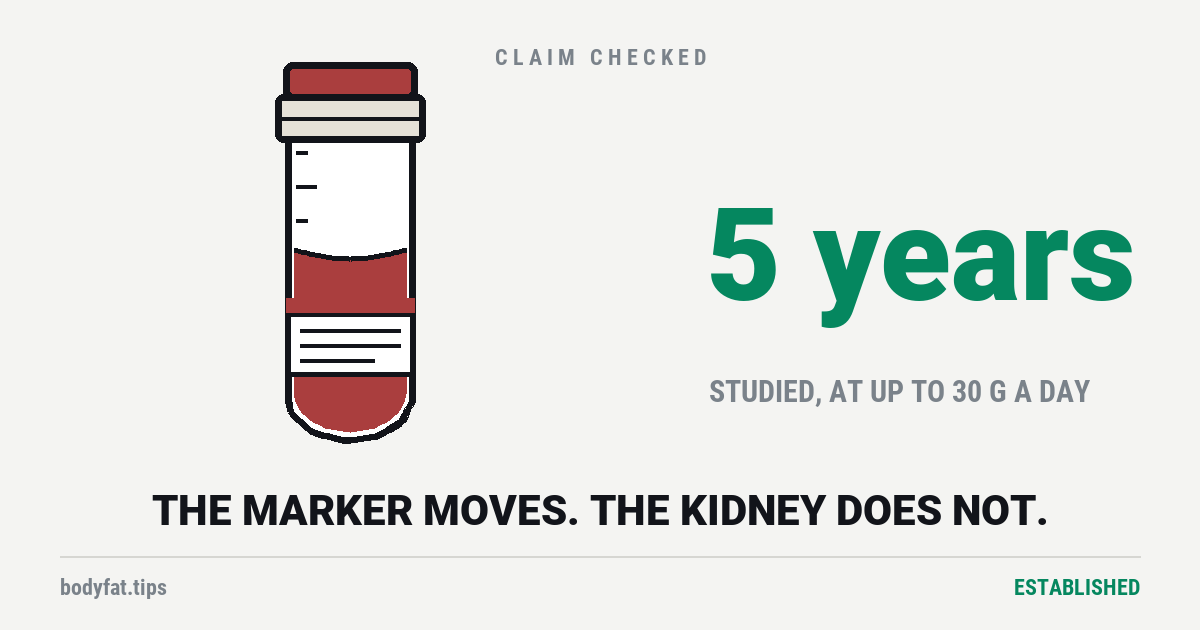
Yes, in healthy people. Up to 30 grams a day, for five years, studied in groups running from infants to the elderly [1].
That is a wildly higher dose and a wildly longer run than anything you are doing with a scoop and a shaker.
But the interesting part isn’t the safety data. It’s that we know exactly why everyone got scared, and it’s a genuinely good mistake.
Your blood test measures the wrong thing
When a doctor checks your kidneys with a standard blood panel, the number they look at is serum creatinine.
Creatinine is what creatine turns into when your body is finished with it. It is the ash. Your muscles burn through creatine, the leftovers wash into your blood, your kidneys filter them out, and the amount sitting in your blood at any moment is a decent proxy for how well that filtering is going.
Decent proxy. Not the thing itself.
So what happens when you deliberately put more creatine into your muscles? More ash. More creatinine in the blood. The number goes up.
Nothing has gone wrong with your kidneys. You have loaded more raw material into the front of a process and more of the by-product came out of the back. But the number on the page is the number labelled kidney function, and it went the wrong way, and that is a genuinely alarming thing to be told.
So somebody measured the organ instead of the gauge
A 2025 meta-analysis in BMC Nephrology pulled together 21 studies on exactly this question and pooled 12 of them — 177 people taking creatine, 263 controls [2].
Serum creatinine went up. Small, but real.
Learn More:

And glomerular filtration rate did not budge [2].
That second one is the whole ballgame. Glomerular filtration rate — GFR — is the actual measurement of how fast your kidneys are cleaning your blood. It is the organ doing its job, measured directly, rather than inferred from a by-product. The authors’ conclusion is that what you’re seeing is metabolic turnover, not kidney damage [2].
The gauge moved. The engine didn’t.
Worth noting who paid for that: nobody. The paper declares no funding [2].
Where the fear actually started
April 1998. The Lancet publishes a letter titled “Renal dysfunction accompanying oral creatine supplements” [3].
A letter. Describing one patient.
Here is the part that got lost on the way out of the building: it was argued with, in print, almost immediately. The Lancet published two replies on 18 July that same year [3]. Three months from case report to published disagreement, which is roughly the speed of light in academic publishing.
The disagreement did not travel. The letter did.
By 2000 the situation was clear enough that two Brussels researchers wrote an entire review with the subtitle “fact or fiction?”, saying outright that they were writing it to set the science against news coverage that “do[es] not hesitate to draw broad conclusions from individual case reports” [4].
They had been watching athletes’ kidney function directly — clearance testing and urine protein, over five days, nine weeks, and out to five years. Their finding: no adverse effects on renal function [4].
That was published twenty-six years ago. The gym is still telling you to cycle off.
Who this doesn’t cover
The safety finding is for healthy people, and that word is doing real work.
If you already have kidney disease, or you are on medication that affects kidney function, none of the above is about you, and the person to ask is a clinician who can see your actual numbers. This site reads research and reports what it found. It is journalism, not medical advice, and it does not know your history.
One practical thing worth carrying, though: if you take creatine and you are booked in for a blood test, say so. A slightly elevated creatinine reading in someone who supplements has a boring explanation, and your doctor can only rule it in if they know to.
The one-line version
Creatine raises the number people use to check your kidneys, without changing what your kidneys are doing.
A 1998 letter about one patient became a permanent piece of gym folklore, and the replies published three months later never made it out of the journal. If you want the other half of the creatine story — the weight that shows up on the scale in week one, and why it isn’t fat — that has its own verdict.